IKEA’s New Station Opens On The 20th May 2019
Meridian Water station is now in the National Rail on-line timetable.
It appears the first train to Meridian Water leaves Stratford at 06:03 on Monday, May 20th 2019. It will be going to Hertford East station.
I wonder how this will affect visitors at the nearby IKEA.
£100m Train Test Complex Plans For Neath Valley Backed
The title of this post is the same as that of this article on the BBC.
This much-needed project, which some wag has called Project Hornby, seems to be moving on..
This brief description is from the article.
The complex would allow trains to be tested on special tracks – laid out on 4.5 mile (7.3km) and two mile (3.1km) ovals – at speeds of up to 100mph (160kph).
It will certainly test their ability to go round corners.
Hopefully, the test track will shorten the time, it takes new and updated trains into service.
The Future Of Class 378 Trains
This post is a musing on the future of the Class 378 trains.
The Thames Tunnel
The Thames Tunnel is the tail that wags the East London Line, when it comes to trains.
- For evacuation and safety purposed, trains running through the tunnel, must have an emergency exit through the driver’s cab.
- It hasn’t happened yet, as far as I know, but a version of Sod’s Law states if you ran trains without this emergency exit, you’d need to use it.
- London Overground’s Class 378 trains have this feature, but their Class 710 trains do not.
So it would appear that until Bombardier build an Aventra with an emergency exit through the driver’s cab, that the existing Class 378 trains must work all services through the Thames Tunnel.
Incidentally, I can’t think of another long tunnel, that might be served by the London Overground, so it could be that Class 378 trains will be the only trains to go through the Thames Tunnel, until they wear out and need to go to the scrapyard.
Six Car Trains On The East London Line
I covered this in Will The East London Line Ever Get Six-Car Trains? and I came to this conclusion.
I will be very surprised if Network Rail’s original plan on six-car trains on the East London Line happens in the next few years.
It might happen in the future, but it would need expensive platform extensions at Shadwell, Wapping, Rotherhithe and Canada Water and Surrey Quays stations.
Increased Frequency On The East London Line
If five-car Class 378 trains are the limit, the only way to increase capacity of the East London Line would be to increase frequency.
The current frequency of the East London Line is sixteen trains per hour (tph)
There are four tph on each of these routes.
- Dalston Junction And Clapham Junction
- Dalston Junction And New Cross
- Highbury & Islington And Crystal Palace
- Highbury & Islington And West Croydon
Two increases are planned.
- 2018 – 6 tph – Highbury & Islington And Crystal Palace
- 2019 – 6 tph – Dalston Junction And Clapham Junction
This would increase the frequency of the East London Line to twenty tph.
It will probably mean an updated digital signalling system on the East London Line.
Eventually, I think it likely, that a full ERTMS system as is fitted to Thameslink and Crossrail will be fitted to at least the East London Line, but possibly the whole Overground network.
Digital signalling would certainly allow the twenty-four tph frequency of Thameslink and CXrossrail, which could mean that the four routes all received a frequency of four tph.
But Thameslink and Crossrail are theoretically capable of handling thirty tph or a train every two minutes, through their central tunnels.
If the two modern multi-billion pound tunnels can handle 30 tph, why can’t their little brother, that started life as a half-million pound pedestrian tunnel in 1843,
The Number Of Trains Needed For The Current Service
If I go through the routes of the original Overground, I find the following.
Dalston Junction And Clapham Junction
Trains take 46 minutes to go South and 44 minutes to come North and a round trip would take two hours.
This means that the current four tph service would need eight trains.
A six tph service in the future would need twelve trains.
Dalston Junction And New Cross
Trains take 22 minutes both ways and a round trip would take an hour.
This means that the current four tph service would need four trains.
A six tph service in the future would need six trains.
Highbury & Islington And Crystal Palace
Trains take 44 minutes to go South and 43 minutes to come North and a round trip would take two hours.
This means that the current four tph service would need eight trains.
A six tph service in the future would need twelve trains.
Highbury & Islington And West Croydon
Trains take 52 minutes both ways and a round trip would take two hours.
This means that the current four tph service would need eight trains.
A six tph service in the future would need twelve trains.
This means that the current four tph on all four routes needs twenty-eight trains.
The Proposed 2020 Service
This will have two extra tph to Crystal Palace and Clapham Junction and will need thirty-six trains.
Six Trains Per Hour On All Four Routes
as each route terminates at both ends in a single platform, which can handle six tph, with the right signalling, I feel that this could be the design objective of the East London Line, when it was built in the early-2010s.
This could be achieved with forty-two trains, leaving perhaps twelve to fifteen trains for other duties, depending on how many are needed on stand-by or are in maintenance.
What Could Be Done With Twelve Trains?
As I calculated earlier, three routes need twelve trains to provide a six tph service.
- Dalston Junction And Clapham Junction
- Highbury & Islington And Crystal Palace
- Highbury & Islington And West Croydon
All three services take between 44 and 52 minutes.
So could another six tph service that takes around this time be added to the current four services?
Willesden Junction As A Northern Terminal
Trains could take the North London Line to Willesden Junction and terminate in the Bay Platform 2.
I estimate the following timings from Willesden Junction.
- Highbury & Islington – 27 mins
- Dalston Junction – 31 mins
- Whitechapel – – 41 mins
- New Cross – 49 mins
- Crystal Palace – 64 mins
- Clapham Junction – 73 mins.
- West Croydon – 74 mins
It would appear that the only possible Southern terminal of the current four, would be New Cross, as that is the only terminal within the 44-52 minute range of journey time.
So could a service between Willesden Junction and New Cross replace the current one between Dalston Junction and New Cross?
- It would need to be run using dual-voltage trains
- Voltage changeover could be at Highbury & Islington station.
- Extending the New Cross service would free up a bay platform at Dalston Junction station.
- It should be possible to have a frequency of six tph.
- Serious modifications or additions to infrastructure would probably not be required.
As running to Willesden Junction was talked about before the Overground opened, I wonder if the numerous crossovers on the North London Line, already allow trains from the East London Line to terminate at Willesden Junction.
Southern Terminals Via New Cross Station
This map from carto.metro.free.fr shows the lines at New Cross station.
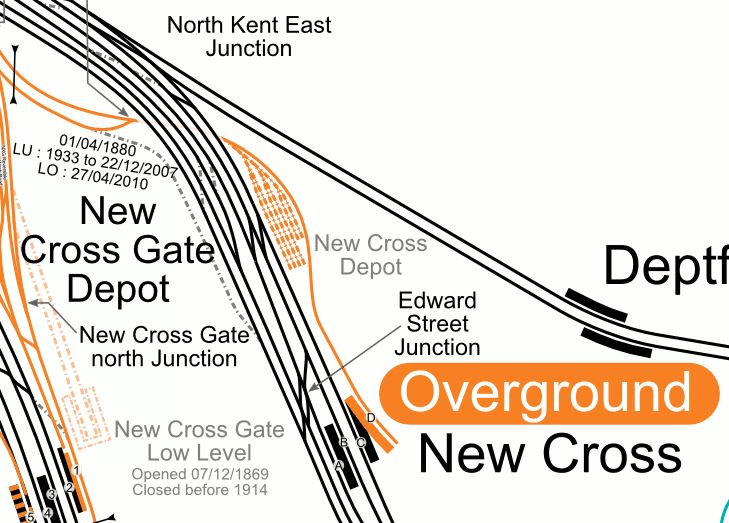
Note how the double-track East London Line, shown in orange, arrives from Surrey Quays station arrives in the North-Western corner of the map, becomes a single-track and then goes under the main lines before going into the bay platform D.
This Google Map shows the same area.
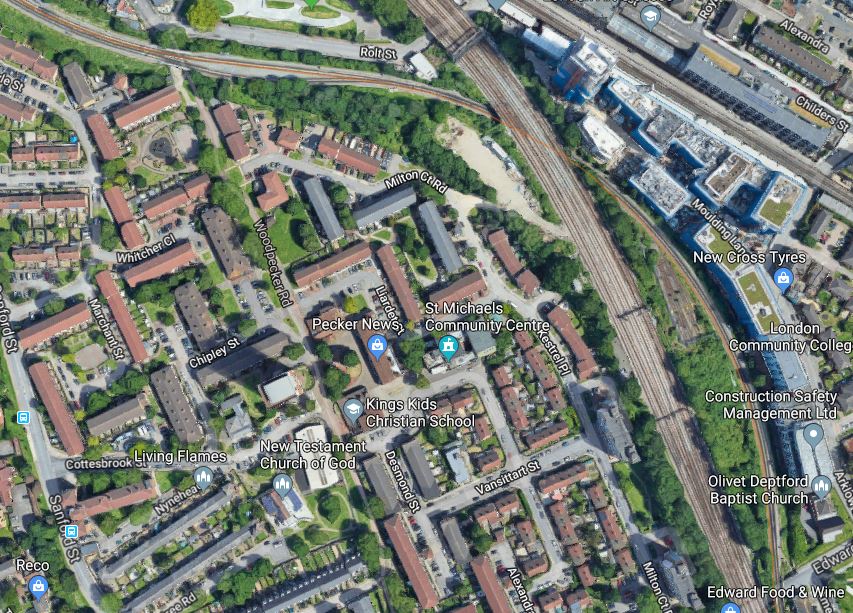
The London Overground track is clearly visible.
Could extra track be added, to enable the following?
- Southbound trains could join the main line and stop in Platform C
- Northbound could leave the main line after stopping in Platform A and go towards Surrey Quays station.
If this is possible, then trains could run between Dalston Junction and Lewisham stations.
Once at Lewisham they would have choice of Southern terminal,
Hayes As A Southern Terminal
Consider a service between Dalston Junction and Hayes stations.
- I estimate that a train could go between the two stations in 53 minutes.
- Hayes station has two terminal platforms
Six tph would probably be too many services, but 2-3 tph might be very welcome.
Orpington As A Southern Terminal
Consider a service between Dalston Junction and Orpington stations.
- I estimate that a train could go between the two stations in 47 minutes.
- Orpington station has three terminal platforms.
Six tph would probably be too many services, but 2-3 tph might be very welcome.
A Combined Hayes And Orpington Service
As a case can be made for services to both Hayes and Orpington via Lewisham, I think the ideal service could be two tph to both Hayes and Orpington.
- There would be four tph between Dalston Junction and Lewisham.
- Stations on the East London Line would have access to the important interchange station at Lewisham.
- Several stations on the routes to Hayes and Orpington would have a two tph service to Crossrail and the Jubilee Line.
Other Stations Via New Cross
Looking at rail maps, there would seem to be several possibilities including with their times from Dalston junction station.
- Beckenham Junction – 41 mins
- Bromley North – 40 mins
- Gove Park – 35 mins
There are probably others.
Southern Terminals Via Peckham Rye Station
As an example Streatham Common station is planned to be a major interchange and is 43 minutes from Dalston Junction.
Would a bay platform work here as an East london Line terminal?
Conclusion
If all fifty-seven Class 378 trains worked the East London Line, they could run six tph on the current routes.
- Dalston Junction And Clapham Junction
- Dalston Junction And New Cross
- Highbury & Islington And Crystal Palace
- Highbury & Islington And West Croydon
It would need forty-two trains.
Suppose the Dalston Junction and New Cross service was replaced with a Willesden Junction and New Cross service.
- This would provide a useful direct four tph service between East and North London.
- Changing at Highbury & Islington station would be avoided for a lot of journeys.
- The journey time wold be around 49 minutes.
- A two tph service would need four trains.
- A four tph service would need eight trains.
- A six tph service would need twelve trains.
- Many journeys between North and South London would now be possible with just a single same platform interchange.
To run the following frequencies on this route would mean these total frequencies on the East London Line and total numbers of trains.
- 2 tph – 20 tph – 40 trains
- 4 tph – 22 tph – 44 trains
- 6 tph – 24 tph – 48 trains
I think that if the figures are juggled a bit, there is enough trains to run extra services to one or more Southern destinations from Dalston Junction.
My preference would be a split service of 2 tph to both Hayes and Orpington via New Cross, where some new track would be needed.
This would do the following.
- Create a frequent connection between South-East and North-East London.
- Both areas would be connected to Crossrail and several Underground Lines, including the future Bakerloo Line Extension.
- The Hayes Line would be shared between Overground and Southeastern trains.
No more new trains or large amounts of new infrastructure would be needed.
I suspect that London Overground and the new Southeastern franchise can do better than my musings.
The Hackney Campaign To Bring The North London Line Back From The Brink In The 80s
The title of this post is the same as that of this article on the Hackney Gazette.
It is an interesting insight into life before the London Overground and how the section between Highbury & Islington and Stratford stations was created from a freight line, that hadn’t had passenger services for several decades.
It also talks about Broad Street station.
I used to use this station to travel from Ipswich to Metier’s offices at Stonebridge Park.
It was just a short walk from Liverpool Street station next door and then a train to Willesden along a very much forgotten North London Line, before taking the Bakerloo Line. It avoided the very crowded route via Baker Street station.
How Much Energy Can Extracted From A Kilogram Of Hydrogen?
This article on EnergyH, is entitled About Hydrogen Energy.
This is said.
Hydrogen has an energy density of 39 kWh/kg, which means that 1 kg of hydrogen contains 130 times more energy than 1kg of batteries. So lots of energy can be stored with hydrogen in only a small volume.
But as in most things in life, you can’t have it all as fuel cells are not 100 % efficient.
Wikipedia has a sub-section which gives the in-practice efficiency of a fuel cell, where this is said.
In a fuel-cell vehicle the tank-to-wheel efficiency is greater than 45% at low loads and shows average values of about 36% when a driving cycle like the NEDC (New European Driving Cycle) is used as test procedure. The comparable NEDC value for a Diesel vehicle is 22%. In 2008 Honda released a demonstration fuel cell electric vehicle (the Honda FCX Clarity) with fuel stack claiming a 60% tank-to-wheel efficiency.
For the purpose of this exercise, I’ll assume a conservative forty percent.
This means that a kilogram of hydrogen would generate 16 kWh
Raise that efficiency to fifty percent and 19 kWh would be generated.
Conclusion
Fuel cell efficiency will be key.
Network Rail Awards Final West London Station Upgrade Contracts For Crossrail Project
The title of this post is the same as that of this article on Rail Professional.
The stations are Acton Main Line, Ealing Broadway, West Ealing, Southall, Hayes & Harlington and West Drayton.
New buildings and step-free access is planned to be completed by December 2020.
Conclusion
About time!
Energy Efficient Bricks Made From Human Waste To Help Build London Homes
The title of this post is the same as that of this article in The Standard.
This is the first two paragraphs.
New homes and factories will be built from bricks made out of the human waste of four million Londoners.
Dried sewage from millions of homes will be transformed into two million heavy-duty breeze blocks a year.
It’s all happening at Beckton.
Vivarail And Arcola Announce Partnership To Bring Emission-Free Trains To The UK
The title of this post is the same as this press release from Vivarail.
These are the first two paragraphs
Vivarail, designers and manufacturers of the Class 230 trains, and hydrogen fuel cell specialists Arcola Energy today announced a long-term collaboration.
The companies share a determination to help de-carbonise the UK’s transport system. Vivarail has already designed and run an emission-free battery train whilst Arcola lead the market in supplying power systems for efficient fuel cell electric vehicles, primarily buses, to the UK. Working together the companies will develop a hydrogen/battery hybrid train.
It strikes me that this could be a good fit.
Powering A Bus
In New Facility To Power Liverpool’s Buses With Hydrogen, I described Arcola Energy’s involvement in a project to create and fuel hydrogen-powered buses in conjunction with Alexander Dennis.
- A typical hybrid double-decker bus like a New Routemaster has a battery capacity of 55 kWh.
- If these Liverpool hydrogen-powered double-decker buses have serial hybrid transmission like the New Routemaster, I could envisage them having a battery of up to 100 kWh, as let’s face it, the New Routemaster design is now eight years old and battery technology has moved on.
So the Arcola Energy-sourced fuel cell must be able to continuously top-up, the battery, in the same manner as the diesel engine on a hybrid bus.
Sit in the back of a New Routemaster and you can hear the engine cutting in and out. It doesn’t seem to work very hard, even on routes like the 73, which operate at high loadings.
Powering A Class 230 Train
Vivarail’s battery-powered Class 230 train, has a battery capacity of 106 kWh.
This size of battery could certainly be changed by a hydrogen fuel cell.
But could a hydrogen fuel cell provide enough power to keep the train running?
- Vivarail are clamming a range of fifty miles, which means that their two-car battery trains are consuming around 2 kWh for every mile.
- I will assume the train is travelling at its operating speed of sixty mph, which is a mile every minute.
- To keep the battery topped up would need 2 kWh to be produced every minute.
A hydrogen fuel cell with a rating of 120 kW would be needed to power the train continuously. But as the fuel cell would only be topping up the battery, I suspect that a smaller fuel cell would be sufficient.
The Ballard fuel cell is a HD variant of their FCveloCity family.
This page on the Ballard web site is the data sheet of an HD fuel cell of their FCveloCity family.
- The fuel cells come in three sizes 60, 85 and 100 kW
- The largest fuel cell would appear to be around 1.2 m x 1 m x 0.5 m and weigh around 400 Kg.
- The fuel cell has an associated cooling subsystem, that can provide heat for the train.
This Ballard fuel cell would appear to be capable of mounting under the floor of a train.
There are probably several other fuel cells that will fit the Class 230 train.
Arcola should know the best hydrogen fuel cell for the application, in terms of size, power and cost.
The Concept Train
Vivarail’s press release describes a concept train.
The concept train will be used to demonstrate the system capability and test performance. Vivarail’s production hydrogen trains will consist of 4-cars, with 2 battery driving motor cars and 2 intermediate cars housing the fuel cell and tanks.
Vivarail seem very certain of the formation of production trains.
I am not surprised at this certaincy.
- The mathematics of battery-powered and hydrogen-powered trains is well known.
- Vivarail have experience of running their battery-powered prototype.
- Arcola have experience of the capabilities of hydrogen-power.
I also wouldn’t be surprised to see some commonality between the Alexander Dennis and Vivarail installations.
Range Of A Hydrogen-Powered Class 230 Train
Nothing is said in Vivarail’s press release about the range on hydrogen.
In Hydrogen Trains Ready To Steam Ahead, I examined Alstom’s Class 321 Breeze hydrogen train, based on an article in The Times.
I said this about range.
The Times gives the range of the train as in excess of 625 miles
The Class 321 Breeze looks to be designed for longer routes than the Class 230 train.
I would suspect that a hydrogen-powered Class 230 train would have the range to do a typical day’s work without refuelling.
Refuelling A Hydrogen-Powered Class 230 Train
I don’t think this will be a problem as Arcola appear to have the expertise to provide a complete solution.
Conclusion
This is a co-operation, where both parties are bringing strengths to the venture.
Stoneleigh Station To Go Step-Free
This document on the Government web site is entitled Access for All: 73 Stations Set To Benefit From Additional Funding.
Stoneleigh station is on the list.
These pictures show the station and the current bridge,


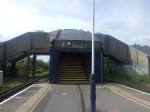
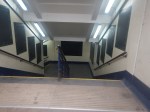

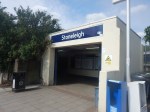

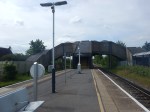
By coincidence, I met the son of an old friend at the station, who lived nearby. He was able to give me a few extra details. Thanks Billy!
Abysmal Step-Free Access
I only exited the station on the Stoneleigh Broadway side and from the platform it was a two staircases up of about fifteen steps and then three similar staircases down.
- In this day and age that is totally unacceptable.
- As the station was only built in 1932, it shows the attitude of Southern Railway to passengers of reduced mobility! They are certainly not welcome!
- Billy told me, that the railway divides Stoneleigh in two and using the bridge to get across is difficult for a lot of people.
There must be very few worse step-free stations than Stoneleigh.
The Station Is Bad For Health, Environment And The Community
How many people, who live on one side of the railway and need to go to the other to see the doctor, visit the library, go to church, have a coffee with a friend or just go to a shop, are now forced to get into a car to make the trip.
Demolition Is The Only Answer
It may be a wonderful example of 1930s creative concrete construction, but for the modern age, it is complete crap!
Te station needs to be demolished and either confined to the landfill of history or turned into building blocks or other useful product.
Replacement With A Modern Bridge
The objective would be to provide a bridge, that gave step-free access to
- Station Approach on the Western side.
- The island platform.
- Stoneleigh Broadway on the Eastern side.
This Google Map shows an aerial view of the station.
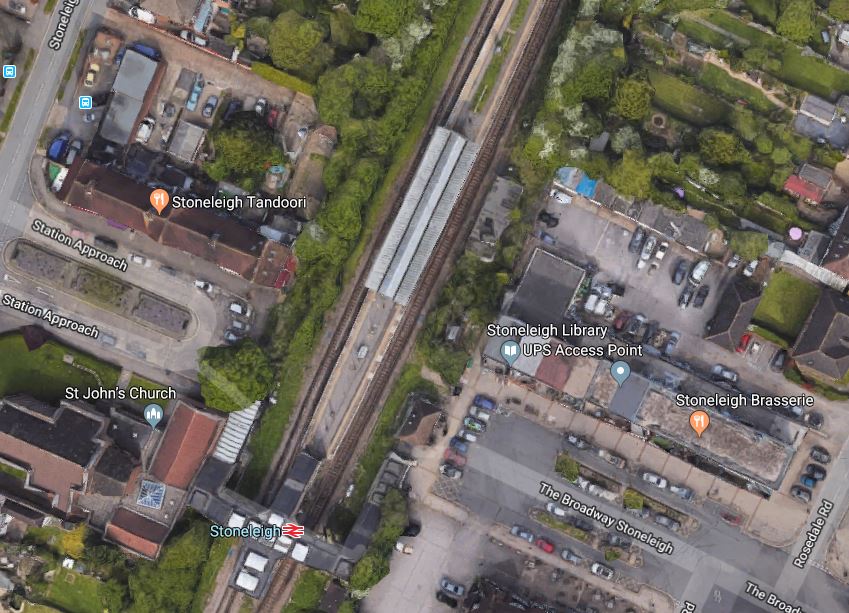
Note the number of useful places on either side of the railway.
There is also a lot of space on either side of the railway.
In Winner Announced In The Network Rail Footbridge Design Ideas Competition, I wrote how the competition was won by this bridge.
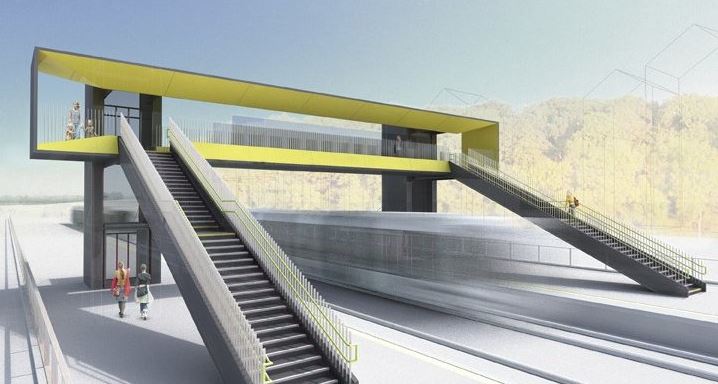
So could a factory-built bridge like this be installed be installed at Stoneleigh station?
Consider.
- The bridge has been designed so it can built as a double span, so ir could serve both sides of the railway and the platform.
- The steps at the end can even be turned through ninety degrees, so that they lead into the Broadway and Approach.
- To create space, the life expired wooden buildings on the platform, that seem to be only held up, by courtesy of the woodworm holding hands, would need to be demolished.
This would allow, the new bridge to be built before closing the current monstrosity.
The station would be completed by providing a modern building on the platform, with staff and passenger facilities, that were appropriate to the million-plus passengers, who use the station every year.
Once the station is fully working, the 1930s station would be demolished.
Conclusion
Using Network Rail’s new footbridge design, a modern station could be created without closing the station to passengers and/or trains.
Stoneleigh could get a step-free modernstation i a matter of months, after planning permission was obtained.
In Syon Lane Station To Go Step-Free, I describe how Syon Lane station is getting a step-free bridge in five months.
Leatherhead Station To Go Step-Free
This document on the Government web site is entitled Access for All: 73 Stations Set To Benefit From Additional Funding.
Leatherhead station is on the list.
These pictures show the station and the current subway,

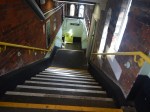
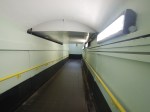
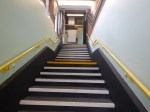
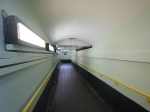
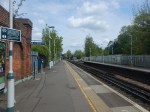
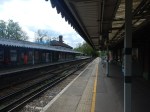
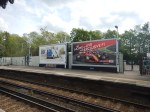
This is one of those stations, where lifts could probably be put into the subway.
But this would probably mean closing the subway, which is the main access between the platforms.
Look at this Google Map of the Northern end of the station.
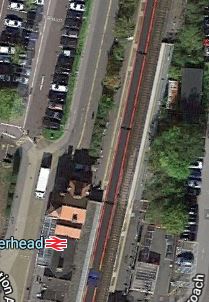
The map illustrates another problem. There is car parking by the London-bound platform and commuters will need to cross the tracks.
But the map does show there is a lot of space and a step-free bridge might be possible at this end of the station.
In Winner Announced In The Network Rail Footbridge Design Ideas Competition, I wrote how the competition was won by this bridge.
So could a factory-built bridge like this be installed be installed at Leatherhead station?
 The Anonymous Widower