Dr. Gerhard Cromme Joins Highview Power’s Board of Directors
The title of this post, is part of the title of this press release from Highview Power.
This is the introductory paragraph.
Highview Power, the global leader in long-duration energy storage solutions, is pleased to announce that Dr. Gerhard Cromme, former Chairman of the Supervisory Board at Siemens AG and ThyssenKrupp AG, will join its Board of Directors.
I think this could be a game-changing appointment.
Hydrostor Announces Australia’s First CompressedAir Energy Storage Project Secures Funding From Arena And South Australia Renewable Technology Fund
The title of this post, is the same as that of this article on the Australian Energy Storage Alliance.
This is the introductory paragraph.
Hydrostor Inc., a leader in Advanced Compressed Air Energy Storage (A-CAES), is pleased to announce that its subsidiary, Hydrostor Australia Pty Ltd, has been awarded a combined total of $9 million of grant funding from the Australian Renewable Energy Agency (ARENA) and the Government of South Australia Renewable Technology Fund for Australia’s first A-CAES project, to be sited at a mine outside of Adelaide—the Angas Zinc Mine near Strathalbyn, currently in care and maintenance.
I’ll answer a few questions.
Who Are Hydrostor?
They appear to be a Canadian company based in Toronto according to their web site, which has this prominent statement.
Hydrostor is the world’s leading developer of Advanced Compressed Air Energy Storage (A-CAES)
projects, enabling the transition to a cleaner, more affordable and more flexible electricity grid.
There is also a video on the home page.
What Technology Do They Use?
This description is from the AESA article.
The technology works by using electricity from the grid to run a compressor, producing heated compressed air. Heat is extracted from the air stream and stored inside a proprietary thermal store preserving the energy for use later in the cycle. Compressed air is then stored in a purpose-built underground cavern, which is kept at a constant pressure using hydrostatic head from a water column. During charging, compressed air displaces water out of the cavern up a water column to a surface reservoir, and during discharge water flows back into the cavern forcing air to the surface under pressure where it is re-heated using the stored heat and then expanded through a turbine to generate electricity on demand.
An animation describing Hydrostor’s A-CAES system is available on YouTube.
I found the video worth watching, as it answered most of my questions.
Where Could Systems Be Installed?
This paragraph from the AESA article talks about the location of the energy store in South Australia.
By selecting the Terramin Angas Zinc Mine, the project will repurpose existing underground mining infrastructure as the A-CAES system’s sub-surface air storage cavern, benefiting both the electricity grid in South Australia and the local community by converting an unused brownfield site into a clean energy project that drives economic development. Hydrostor acknowledges Terramin Australia Limited’s support in developing the project and the technology’s beneficial application to South Australia.
I can think of a couple of mines in the UK, where such a system can be installed.
Conclusion
Hydrostor’s technology is standard process engineering, with all components and construction techniques well-proven in many decades of use.
I shall be watching Hydrostor with interest.
Contenders: Long Duration Energy Storage Technologies, And Who’s Behind Them
The title of this post, is the same as that of this article on Energy Storage News.
It is a must-read for anybody interested in the technology of storing energy.
There are certainly some companies, I will add to my watch list.
Colne – Skipton Reopening Moves Closer
The title of this post, is the same as that of this article on the Railway Gazette.
This is the introductory paragraph.
Rail minister Chris Heaton-Harris has confirmed that investigations have been commissioned into the proposed reinstatement of the 19·3 km Colne – Skipton ‘missing link’ connecting east Lancashire and west Yorkshire.
Investigations will look into.
- Capital costs
- Passenger demand forecasts
- Service options.
- Gauge enhancement measures necessary to increase rail freight capacity on TransPennine routes including between Accrington and Todmorden stations.
- Proposals for a rail freight terminal on the site of the demolished Huncoat power station near Accrington.
This sounds more than a simple proposal to reopen the route between Skipton and Colne stations.
These are a few of my thoughts.
The Rail Route Between Preston And Skipton
The rail route between Preston on the West Coast Main Line and Skipton can be summarised as follows.
- Preston and Rose Grove via Huncoat – double-track – electrification at Preston
- Rose Grove and Colne – single-track
- Colne and Skipton – to be reinstated – electrification at Skipton
Colne and Skipton might not be the easiest route to reinstate, as a dual carriageway has been built across the route to the North of Colne station.
Could Colne And Skipton Be Double-Track All The Way?
Consider.
- The new section between Skipton and Colne could be built with single or double tracks.
- The section between Rose Grove and Colne stations was built as a double-track and singled in 1971. British Rail’s accountants strike again!
- The single-track section includes the Bank Top Viaduct, in the centre of Burnley.
- Trains currently take twenty-one minutes between Rose Grove and Colne stations.
This picture shows Bank Top Viaduct.
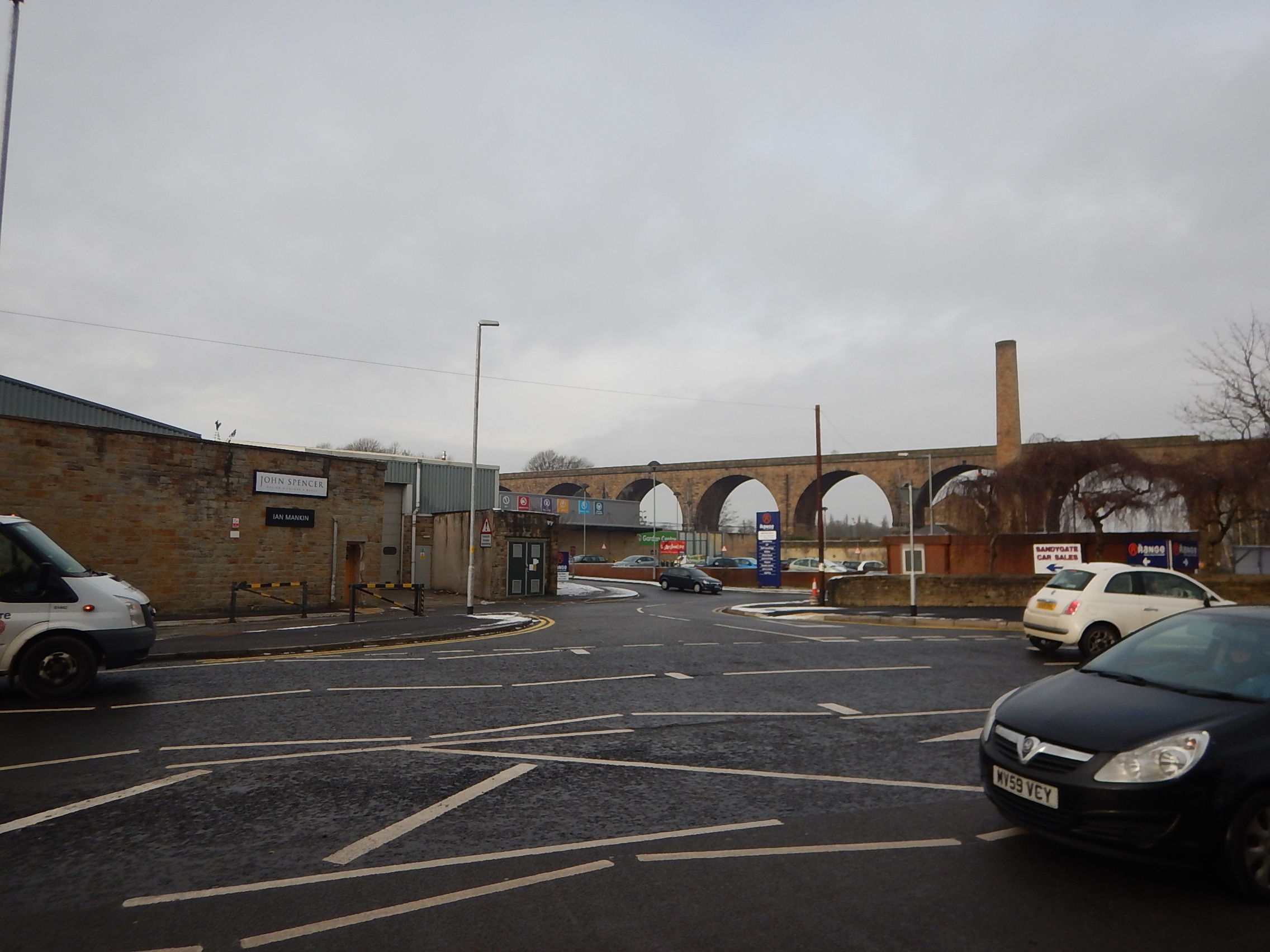
I think the viaduct could be key to whether the route is double-track all the way.
- If the redoubling can be performed at a reasonable cost, then that will be the way to go, as it might be possible to squeeze up to three trains per hour (tph) between Skipton and Rose Grove via Colne.
- If on the other hand, doubling is too difficult or expensive, I estimate that no more than two tph would be possible.
For both solutions, there will need to be double track or a long passing loop, between Skipton and Colne.
Could Colne And Skipton Be Electrified?
Consider.
- Preston is a fully-electrified station on the West Coast Main Line.
- Skipton is a fully-electrified station with electric trains to and from Leeds.
- Full electrification would create an electrified route between Leeds and Blackpool, Liverpool and Preston.
- It could be a useful diversion route for electric passenger trains across the Pennines, when their are engineering works on the Huddersfield Line or due to the building of Northern Powerhouse Rail.
- Electrification of the route, would allow electric haulage of freight trains to and from the proposed Huncoat Rail Freight Terminal.
- Electrification of the Calder Valley Line between Preston and Leeds is always being proposed.
- Electrication of Bank Top Viaduct could be tricky!
It should also be noted that this article on Rail Magazine was published on May 12th, 2020 and is entitled Electrification Key to Decarbonisation – Government. Views in Government about electrification have changed, so this might affect the decision to electrify the route.
The power is already there at both ends and electrification systems with low visual intrusion could be used.
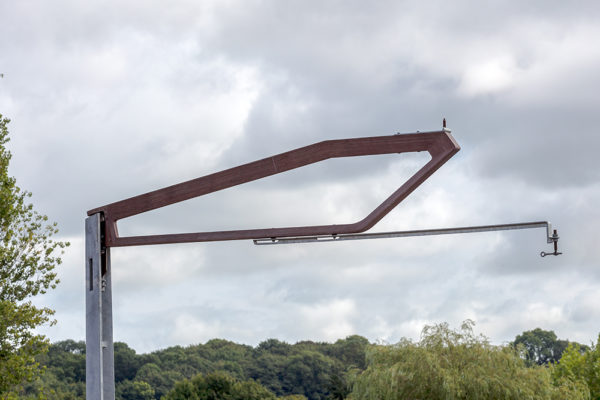
On the other hand, some might consider electrification of the route inappropriate.
Could Colne And Skipton Be Partially Electrified?
Consider.
- I estimate that the distance between Preston and Skipton will be 41 miles.
- If Blackpool North station were the final destination, there would be 34 miles (2 x 17) to charge the batteries.
- If Liverpool Lime Street station were the final destination, there would be 70 miles (2 x 35) to charge the batteries.
- If Leeds station were the final destination, there would be 52 miles (2 x 26) to charge the batteries.
- Manufacturers’ estimates of distances, indicate that battery electric trains could cover up to 65 miles on battery power.
As both ends of the route are electrified and trains would run extra miles under the wires, it would seem likely that a battery electric train could run between Preston and Skipton, without needing a charge en route.
Drax Group And Colne And Skipton Reinstatement
Drax power station uses Flue Gas Desulphurisation. Wikipedia says this about the process at Drax.
All six units are served by an independent wet limestone-gypsum flue gas desulphurisation (FGD) plant, which was installed between 1988 and 1996. This diverts gases from the boilers and passes them through a limestone slurry, which removes at least 90% of the sulphur dioxide (SO2). This is equivalent to removing over 250,000 tonnes of SO2 each year. The process requires 10,000 tonnes of limestone a week, sourced from Tunstead Quarry in Derbyshire. A byproduct of the process is gypsum, with 15,000 tonnes produced each week. This goes to be used in the manufacture of plasterboard. The gypsum is sold exclusively to British Gypsum, and it is transported by rail to their plant at Kirkby Thore (on the Settle-Carlisle Line).
The gypsum trains go through Skipton to access the Settle-Carlisle Line.
Drax power station is part-fuelled with biomass, which comes from all over the place including the United States via the Port of Liverpool.
It is no surprise that Drax Group are in favour of the Colne and Skipton reinstatement, as it would give them a new route between Drax and the Port of Liverpool.
This press release from Drax Group gives more details including this paragraph.
It will have a direct impact on improving our supply chain at Drax, allowing freight trains to travel much more quickly to the power station in North Yorkshire – reducing journey times from the Port of Liverpool to less than three hours, a journey which can take up to nine hours at the moment.
Trains will avoid the busy Huddersfield Line and Manchester Victoria station.
Drax’s statement would appear to be a powerful reason to reinstate Colne and Skipton.
These smart new or refurbished wagons, used by Drax to move woodchip should be much faster than the typical 20-30 mph freight speed of TransPennine routes.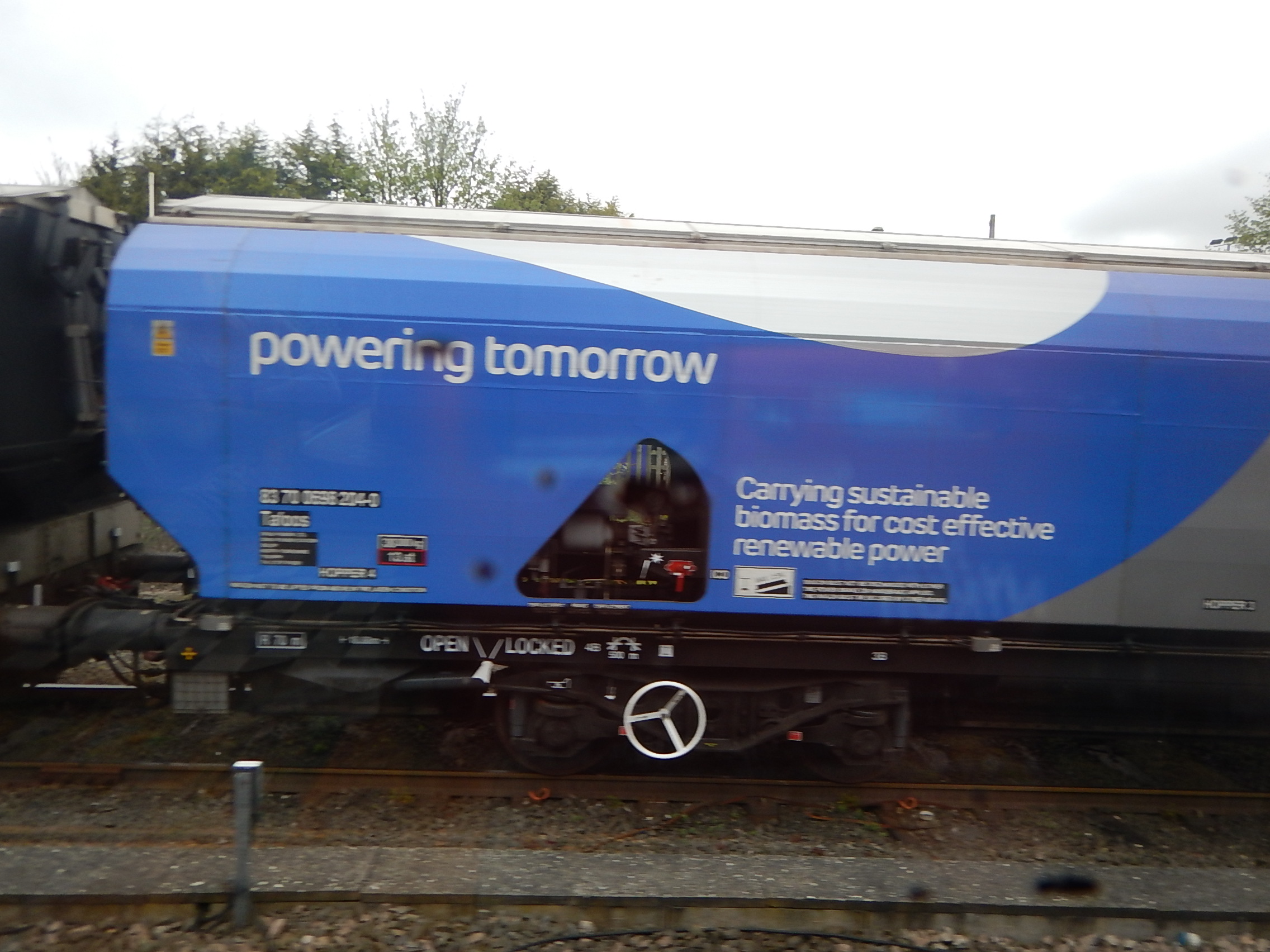
This page on the Drax web site, is entitled This train isn’t like any other in the UK, and it gives more details about the wagons.
- They were custom-designed and built in the last few years.
- The roofs open automatically for loading.
- A twenty-five wagon train can be loaded in 37 minutes.
- A full train can carry between 1,700 and 1,800 tonnes of biomass.
- Each train can unload in forty minutes.
- They are the largest wagons on UK railways by a margin of 30 %.
- Each wagon is nineteen metres long and can carry over seventy tonnes of biomass.
- Approximately 14 trains per day arrive at Drax, bringing 20,000 tonnes of biomass.
I suspect to minimise journey times, Drax would like to see a fully electrified route between Preston and Skipton and a new double-track route between Colne and Skipton.
The Huncoat Rail Freight Terminal
This Google Map shows the position of the former Huncoat power station.
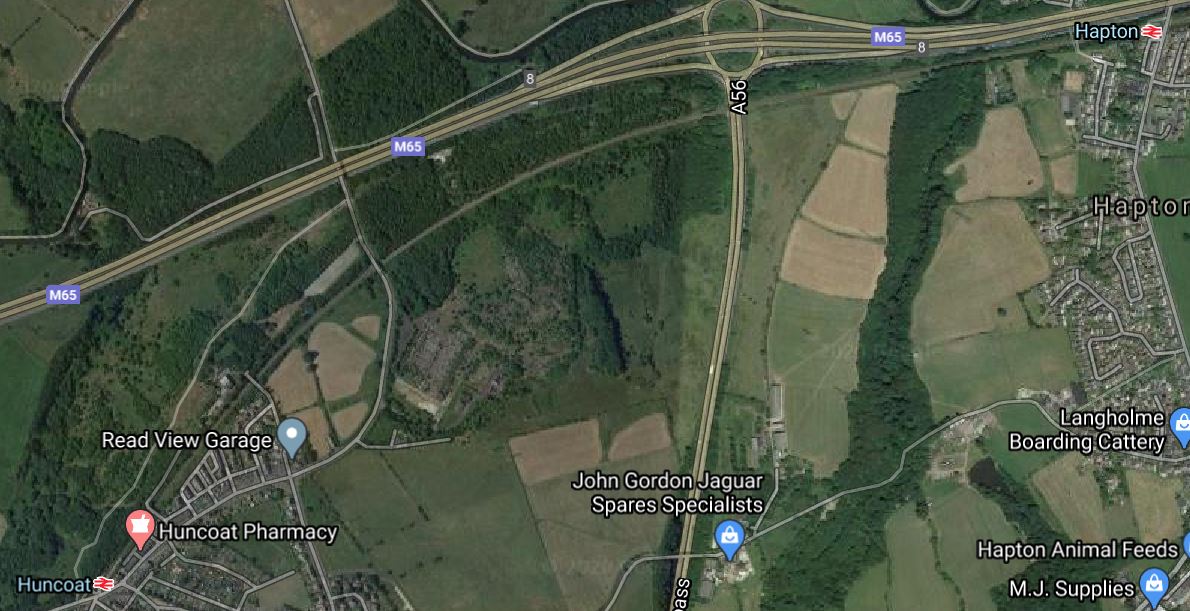
Note.
- Hapton station in the North-East corner of the map.
- Huncoat station in the South-West corner of the map.
- The East Lancashire Line running between the two stations.
- The M65 running across the top of the map.
- The A56 or Accrington bypass running North-South from the motorway junction at the top of the map.
Huncoat power station appears to have been in the South West corner of the rough-looking area, South of the M65 and the railway and West of the A56.
There is no Wikipedia entry for the demolished power station, but this page on The View From The North has some details and pictures.
It does appear to be a well connected site for a Rail Freight Terminal.
- There could be a direct connection to the motorway network.
- There is space for a connection with the East Lancashire Line, that would allow trains to access the interchange from both directions.
- Trains could go West to the Port of Liverpool and the West Coast Main Line via Preston.
- Trains could go East to Leeds and Yorkshire and on to the East Coast ports of Felixstowe, Hull, Immingham and Teesport.
- If the East Lancashire Line were to be electrified, electric haulage could be used.
The Rail Freight Terminal could be bigger than a hundred hectares.
Gauge Enhancement On TransPennine Routes Including Between Accrington And Todmorden
Consider
- Most freight trains passing through Hebden Bridge station use the route via Rochdale and Todmorden to get to and from Liverpool and the West.
- Few if any use the East Lancashire Line via Accrington.
- Some passenger trains do take the Accrington route.
- There are five tunnels between Accrington and the Todmorden Curve.
- The building of the Huncoat Rail Freight Terminal, must mean that trains between the Rail Freight Terminal and Leeds and the East would need to use the Calder Valley Line as far as the Todmorden Curve. or the East Lancashire Line to Colne for the new route.
As freight trains rarely seem to use the East Lancashire Line to the East of Accrington could it be that this section of track needs gauge enhancement?
But if this gauge enhancement were to be completed, that could give two routes between Huncoat Rail Freight Terminal and the East, for the largest freight trains.
Thoughts On The Project Management
It would appear that there are a series of sub-projects to be done.
- Perform gauge enhancement and route improvement on the East Lancashire Line between Rose Grove and Colne. This would include any doubling of the route, if that were to be done.
- Start building the link between Skipton and Colne.
- Start building the Huncoat Rail Freight Terminal.
- Finish building the link between Skipton and Colne.
- Start passenger and freight services between Skipton and Colne.
- Finish building the Huncoat Rail Freight Terminal.
- Perform gauge enhancement on the Calder Valley Line between Accrington and Todmorden.
My objectives would be.
- Open the Skipton and Colne route as a TransPennine diversion, as early as possible.
- Upgrade the East Lancashire Line between Rose Grove and Colne with minimum disruption.
- Open the Huncoat Rail Freight Terminal as early as possible.
- Create multiple freight routes to and from Huncoat Rail Freight Terminal.
Electrification would be a future aspiration.
Whither Drax?
Drax Gtroup and their flagship power station have a major environmental problem in that the power station is a large emitter of carbon dioxide.
They also run a lot of diesel locomotive hauled trains carrying biomass, fly ash, gypsum, limestone and other materials to and from Drax power station, which is on the Drax branch of the Pontefract Line.
- The Pontefract Line was built to serve the coalfields in the area.
- It runs between Leeds and Hull via Pontefract and Goole.
- It is not electrified, but it connects to the electrification at Leeds.
- In the East is has good connections to Cleethorpes, Goole, Grimsby, Hull and Immingham.
- The Port of Immingham is a major port, that is used by Drax to import biomass, which is hauled to the power station by diesel locomotives.
- The route between Drax and Immingham has been improved recently, by the addition of the North Doncaster chord.
- High Speed Two will run alongside the Pontefract Line on its approach to Leeds.
- Freight trains between Drax and Skipton use an electrified diversion South of Leeds via Armley, that avoids the need for freight trains to pass through Leeds station.
I can see that in a more favourable climate for electrification, that electrification of the Pontefract Line would be recommended.
Given, the environmental record of Drax, which is both good and bad, I would suspect they would like to see electrification of the Pontefract Line, as it would create a lower carbon route for biomass trains between Immingham and the power station.
A New Electrified TransPennine Route For Passengers And Freight
I sense that a grander plan might exist behind all my thoughts.
If the following routes were to be electrified.
- Preston and Skipton
- The Pontefract Line between Leeds and Hull.
- Knottingley and Immingham via Thorne
Hull and Liverpool would be connected for passenger electric trains and Liverpool and Immingham would be connected for freight.
Drax could also be on an electrified branch and they could say, they were hauling all their trains using renewable electricity. Marketing and environment are always important
Are Coeliacs More Risk-Averse?
I am coeliac, which means, that I am allergic to gluten!
So I have to be very careful about what I eat.
I have perhaps been glutened two or three times in the twenty years since I was diagnosed. With me it is nothing serious, but it does mean being close to a toilet for some hours.
If I look at my behaviour generally, I sometimes wonder, if I have become more risk-averse since my diagnosis.
I think too, that I’ve probably become more risk-averse since my stroke, after which, one of the world’s leading cardiologists told me, that if I got the Warfarin right, I’d never have another stroke.
I intend to prove him right! So I watch my INR like a Control Engineer would monitor reactor temperature in a nuclear power station.
I would assume that my risk-averse behaviour is fairly normal.
So if you have had a serious illness or near-death experience from which you have been able to almost fully recover, are you doing your best to make sure that you avoid COVID-19?
Cheesecake Energy Receives Investment From The University Of Nottingham
The title of this post, is the same as that of this article on NewsAnyway.
This is the introductory paragraph.
Cheesecake Energy Limited (CEL) today announced it has received investment from the University of Nottingham to support UK-wide pilot programmes for the company’s energy storage solution.
Thse two paragraphs are a brief description of the company, their technology and what they do.
Cheesecake Energy Limited is a fast-growing startup developing energy storage at 30-40% lower cost than the current market leader, lithium ion batteries. Its system uses compressed air and thermal energy storage to achieve high efficiency, long lifetime and dramatically lower environmental impact.
Founded in 2016, the company has already established itself within the Nottingham, and wider East Midlands energy ecosystem — having secured initial interest from local councils and bus services for pilot programmes. The company is currently designing a 150 kW / 750 kWh prototype system for completion in Q4 2020 which will be deployed with a local bus depot for charging of electric buses using renewable energy.
This is the home page of their web site, which proudly announces.
The Greenest Battery In The World
We’ll see and hear that slogan many times in the next few years.
A few of my thoughts on the company.
Cheesecake Energy’s Technology
Cheesecake Energy says it uses compressed air and thermal energy storage to achieve high efficiency, long lifetime and dramatically lower environment impact.
Three other companies also use or may use compressed air to store energy.
- Highview Power – See Highview Power To Build Europe’s Largest Battery Storage System
- Form Energy – See Will The Real Form Energy Please Stand Up!
- Hydrostor – See Hydrostor Announces Australia’s First CompressedAir Energy Storage Project Secures Funding From Arena And South Australia Renewable Technology Fund
As Cheesecake appear to be using a thermal energy storage, have they found a unique way to create another type of compressed air storage?
Battery Sizes
How do the sizes of the three companies batteries compare?
- Cheesecake Energy prototype – 150 kW – 750 kWh – five hours
- Form Energy for Great River Energy – 1MW – 150 MWh – 150 hours
- Highview Power for Vermont – 50MW – 400 MWh – 8 hours
- Hydrostor for South Australia – 50+MW – 4-24+ hours
The Cheesecake Energy prototype is the smallest battery, but Highview Power built a 750 KWh prototype before scaling up.
Note.
- The first figure is the maximum power output of the battery.
- The second figure is the capacity of the battery.
- The third figure is the maximum delivery time on full power.
- The capacity for Hydrostor wasn’t given.
The figures are nicely spread out, which leas me to think, that depending on your power needs, a compressed air battery can be built to satisfy them.
Charging Electric Buses
Buses like this Alexander Dennis Enviro200EV electric bus are increasingly seen in the UK.




And they all need to be charged!
Cheesecake Energy say that their prototype will be deployed with a local bus depot for charging of electric buses using renewable energy.
- An electric bus depot should be a good test and demonstration of the capabilities of their battery and its technology.
- Note that according to this data sheet of an Alexander Dennis Enviro200EV, which is a typical single-decker electric bus, the bus is charged by BYD dual plug 2×40kW AC charging, which gives the bus a range of up to 160 miles.
- With a 150 kW output could Cheesecake’s prototype charge two buses at the same time and several buses during a working day?
- Would DC charging as used by Vivarail’s charging system for trains be an alternative?
To me, it looks like Cheesecake are showing good marketing skills.
I do wonder if this size of charger could make the finances of electric buses more favourable.
Suppose, a bus company had a fleet of up to a dozen diesel single-decker buses running services around a city or large town.
- How much would they spend on electricity, if they replaced these buses with electric ones?
- Would being able to use cheaper overnight energy to charge buses in the day, be more affordable?
- Would electric buses run from renewable electricity attract passengers to the services?
These arguments for electric buses would also apply for a company running fleets of vans and small trucks.
To me, it looks like Cheesecake are showing good engineering/marketing skills, by designing a product that fits several markets.
The Government’s Terrible COVID-19 Statistics
In an article in The Times today, Sir David Speigelhalter lambasts the Government over their collection of COVID-19 statistics.
I have been involved in the analysis of several very large databases and four factors improve the quality of the answers you get.
- The more records or in this case tests you have, the better. So I back David Speigelhalter! We should stop people on the street and test them!
- The more fields or pieces of data in each test you have, the better. So perhaps each test should be linked to your NHS record.
- The quality of the data is important. In my experience NHS scores about two out of five for quality as a lot of medical staff, often fill it in badly. In one case, I was looking for reasons for low birth weight babies and in many cases, the field was filled with 9.99 Kg.
- And then there’s the output of the data. I was taught how to display data for idiots, by the former Chief Accountant of a FTSE 500 company, who was working as the Chief Management Accountant of a Clearing Bank. He had found showing scatter diagrams with each branch as a single point on a large sheet, really got Branch Managers to think about what they are doing, if they weren’t running with the herd. These diagrams made problem branches stand out like the sorest of thumbs!
So where are the scatter diagrams for all of the Health Authorities in the UK, so everybody can see how their area, is doing against everybody else?
By the way, I trust Sir David, as we have the same birthday and share it with James Cameron, Jeff Thomson, Katherine Hamnett, Lawrence of Arabia, Menachem Begin and Madonna.
Orders For Alstom Breeze Trains Still Expected
It is almost a year since I wrote Breeze Hydrogen Multiple-Unit Order Expected Soon, but no order has so far been placed.
But some things have happened or are happening.
- The two pre-production Alstom Coradia iLint trains seem to be running without trouble in Germany.
- The Northern Franchise is now run by the Government and called Northern Trains.
- Greater Anglia‘s Class 720 trains are finally being delivered.
- This should release Class 321 trains for conversion to hydrogen power.
At present, Greater Anglia appear to have 102 Class 321 trains in service, all of which could be converted to Alstom Breeze trains.
Although it should be noted that thirty trains have been upgraded to a Renatus specification, as cover, if there are any problems during Greater Anglia’s fleet changeover.
The Conversion Process
The 102 Class 321 trains will release the same number of each of the following coaches.
- DTCO – Driving Trailer Composite Open
- TSO – Trailer Standard Open
- PMSO – Pantograph Motor Standard Open
- DTSO – Driving Trailer Standard Open
Each three-car Breeze will need two Driver Trailer cars and a Pantograph Motor car to be converted.
Driver Trailer Cars
Consider.
- Most two- and three-car diesel multiple units in the UK, don’t have First Class seats.
- Many new trains like those of Greater Anglia and South West Trains don’t have First Class seats.
- Seating in these cars will be very much reduced by the fitting of a large hydrogen tank.
I wouldn’t be surprised to see both types of Driver Trailer cars converted into identical cars.
Pantograph Motor Car
The Pantograph Motor car will be seriously modified, with these systems and components installed.
- A new AC traction system.
- Batteries fed by the fuel cells,
- Regenerative braking
All will be controlled by a sophisticated energy management system.
- Will regenerative braking be able to charge the batteries?
- Will the pantograph be retained, so that on electrified lines, the trains can use the electrification?
- Will the fitting of third-rail shoes be considered?
- Will the train retain the 100 mph capability of the Class 321 train?
The train could be a real 100 mph efficient go-anywhere train.
New Interiors
New Class 321 Renatus-style interiors will be fitted.
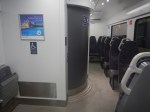



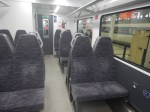

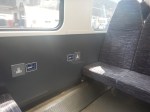
The Class 321 Renatus is a high-class interior for a suburban train.
- There are both fully-accessible and standard toilets.
- There are power sockets and wi-fi.
- Passenger information displays are fitted.
I suspect tables could be fitted, if the operator required them.
Northern Trains And The Alstom Breeze
The three-car Alstom Breeze is expected to have a similar capacity to a two-car diesel multiple unit.
Northern Trains Current And Future Trains
At present Northern have the following two-car diesel multiple units in service, according to Wikipedia.
- 7 x Class 155 trains
- 47 x Class 156 trains
- 45 x Class 158 trains
In addition, there are eight three-car Class 158 trains, which gives a total of 107 trains, that could be suitable for replacement by Alstom Breeze trains.
If these were the only trains available, Northern would have to keep some old diesel multiple units in service for longer.
But there are other trains expected to enter service, in the coming months.
- 7 x new two-car Class 195 trains
- 5 x new three-car Class 195 trains
- 3 x refurbished two-car Class 150 trains
- 8 x rebuilt four-car bi-mode Class 769 trains
Northern should just about scrape through, especially as COVID-19 has reduced services.
I would think, that Northern could absorb quite a lot of Alstom Breeze trains.
Deployment On Teesside
In Fuelling The Change On Teesside Rails, I talked about using the trains on Teesside.
- Services would be centred on Darlington and Middlesbrough.
- There is a supply of hydrogen nearby.
- Bishop Auckland, Newcastle, Nunthorpe, Redcar and Whitby could be served.
- The 1000 km range could be useful.
- The trains could even be a tourist attraction for the area.
In Northern’s Hydrogen Plans, I wrote about progress on these plans, which included applying for planning permission for the depot at Lackenby.
Deployment Around Widnes
In A Hydrogen Mobility Roadmap For North-West England, I wrote using the trains around Widnes.
- Services could be centred around Alstom’s Widnes factory.
- Hydrogen could be supplied by pipeline from Runcorn.
- Chester, Liverpool and Manchester could be served.
- Some routes might need more capacity.
Could Alstom introduce a couple of pre-production trains on a route past Widnes, in a similar way, that they have introduced the Coradia iLint train in Germany?
This approach seems to have helped a successful introduction into service of the trains.
Increasing Capacity
I do think that these trains will need extra capacity on some routes, like perhaps Liverpool and Manchester via Widnes and Warrington.
The solution would surely be to add one of the spare Trailer cars to bring the trains up to four cars and increase the passenger capacity by perhaps fifty percent.
Northern Routes Currently Run By Two-Car Diesels
Wikipedia lists these services as run by two-car-diesels in Classes 150, 155, 156 and 158.
- Barrow-in-Furness and Carlisle
- Barrow-in-Furness and Lancaster
- Blackburn and Rochdale
- Blackburn and Wigan Wallgate
- Blackpool North and York
- Clitheroe and Rochdale
- Hexham and Nunthorpe *
- Hull and Scarborough
- Hull and York
- Huddersfield and Castleford
- Huddersfield and Leeds
- Huddersfield and Sheffield
- Lancaster and Morecambe/Heysham Port
- Leeds and Carlisle
- Leeds and Chester
- Leeds and Goole
- Leeds and Knottingley
- Leeds and Lincoln
- Leeds and Manchester Victoria
- Leeds and Morecambe
- Leeds and Nottingham
- Leeds and Selby
- Leeds and Sheffield
- Leeds and Wigan Wallgate
- Leeds and York
- Liverpool Lime Street and Manchester Oxford Road *
- Manchester Piccadilly and Buxton
- Manchester Piccadilly and Chester
- Manchester Piccadilly and New Mills Central
- Manchester Piccadilly and Rose Hill Marple
- Manchester Piccadilly and Sheffield
- Manchester Victoria and Kirkby
- Manchester Victoria and Southport
- Manchester Victoria and Stalybridge
- Middlesbrough and Whitby *
- Newcastle and Carlisle
- Newcastle and Chathill
- Newcastle and Morpeth
- Oxenholme Lake District and Windermere
- Preston and Blackpool South
- Preston and Colne
- Preston and Ormskirk
- Saltburn and Bishop Auckland/Darlington *
- Sheffield and Adwick
- Sheffield and Bridlington
- Sheffield and Gainsborough Central
- Sheffield and Hull
- Southport and Alderley Edge
Those marked with an * could be served by hydrogen trains from Laverton and Widnes.
Positioning Hydrogen Trains
Trains often have to be positioned from and to the depot at the beginning and end of a day’s work.
On my list of services, there is an hourly shuttle service between Oxenholme Lake District and Windermere stations.
Suppose this service was to be run by an Alstom Breeze based at Widnes.
- The train could be fuelled with hydrogen at Widnes, early in the day.
- The train could position to Oxenholme Lake District along the West Coast Main Line, using the electrification, after joining it a few miles from the depot.
- Each round trip to Windermere is 20 miles or 32 kilometres.
- An Alstom Breeze train has a range of 1000 kilometres on hydrogen, so it could do thirty round trips without refuelling.
- At the end of the day, the train would return to the depot using the electrification.
I would expect, that the long range of hydrogen trains could make them easier to diagram or schedule, than battery ones.
They might also be able to work some distance away from the depot, if they could use an electrified route for positioning.
So if we look at Widnes, these are approximate distances to stations where hydrogen services might run.
- Liverpool Lime Street – 12 miles
- Manchester Airport – 33 miles
- Manchester Oxford Road – 22 miles
- Preston – 33 miles
- Warrington Central – 6 miles
- Wigan North Western – 18 miles
Some of the routes to these stations are partially electrified, so the trains could position using the electrification.
Consider these routes.
- Preston and Blackpool South – 20 miles
- Preston and Colne – 19 miles
- Preston and Ormskirk – 20 miles
A hydrogen train could position from Widnes and perhaps do fifteen trips before needing a refuel.
I will also look at distances from Lackenby, where the Teesside Depot will be built, as I wrote in Northern’s Hydrogen Plans.
- Darlington – 23 miles
- Newcastle via East Coast Main Line – 59 miles
- Newcastle via Durham Coast Line – 54 miles
- York via Northallerton and East Coast Main Line – 56 miles
I suspect quite a few services could be run from Lackenby depot, if the electrified East Coast Main Line was used to position the trains.
Possible Future Stages
If the trains are successful, I can see that Northern Trains will want to introduce more hydrogen trains.
As the Government controls this franchise, does this make more zero-carbon trains more or less likely?
More Trains
There are only so many Class 321 trains to convert, but after Alstom complete their takeover of Bombardier, I believe that a hydrogen-powered Aventra could become a reality.
I wrote about my ideas for this in I Design A Hydrogen Aventra.
So in the long term, if more hydrogen trains are needed, it shouldn’t be a problem.
More Depots
More depots will be needed and I would expect others like Lackenby will be added in strategic locations.
- Given the service pattern, Blackburn, Leeds and Sheffield must be possibilities.
- Hydrogen will probably be generated in the depots using electrolysers.
In the future could we see depots for hydrogen trains shared between bordering franchises?
- A depot at Carlisle could be shared between Northern and Scotrail
- A depot at Chester could be shared between Northern and Trains for Wales
- A depot at Exeter could be shared between Great Western and South West Railways
ITM Power in Rotherham have the technology to generate the hydrogen, which could also be used to fuel the local buses and other vehicles.
Conclusion
From pubished reports, it looks to me, that Northern have been thinking hard how they can deploy a substantial fleet of Alstom Breeze trains, by using depots at Widnes and Lackenby, where the trains can be refuelled overnight.
I am also fairly sure that Alstom will design the Breeze, so that trains can position themselves along the West and East Coast Main Lines, using the 25 KVAC electrification.
Success For Ovako In Green Steel Hydrogen Trial
The title of this post, is the same as that of this article in The Engineer.
Steel usually has to be heated to a high temperature before it can be rolled.
Normally, LPG is used, but Swedish steel company; Ovako, have conducted a full-scale trial using hydrogen, which seems to have proved it doesn’t result in lower quality.
150 Hours Of Storage? Company Says That’s True To Form
The title of this post, is the same as that of this article on Power Magazine.
It is very much a must-read about the emerging technology of high-capacity and long term energy storage, with particular reference to Highview Power and Form Energy.
The article fills out a lot of what I wrote in Will The Real Form Energy Please Stand Up!
I also feel that there’s also an old kid on the block, when it comes to long term energy storage and that is new methods of deploying pumped storage, that I wrote about in The New Generation Of Pumped Storage Systems.
 The Anonymous Widower