STEAG Advances Plans For 55MW Norfolk Solar Plant With Battery Storage
The title of this post, is the same as that of this article on Business Green.
It is very much a standard solar farm with a battery and provided everything is installed properly, there shouldn’t be to much adverse effects on wildlife and especially, East Anglia’s magnificent hares.
This article on the Solar Power Portal is entitled Solar Farms and Biodiversity.
This is a paragraph.
The point is that all sorts of wildlife move onto solar sites, from hares and hedgehogs, buzzards and butterflies, grasshoppers and beetles; other protected species such as Hazel Dormouse – all continue their ways along the hedgerows uninterrupted.
Hopefully, if the rules are followed at King’s Lynn, the hares will thrive.
New Electricity ‘Superhighways’ Needed To Cope With Surge In Wind Power
The title of this post, is the same as that of this article on the Telegraph.
This is the first two paragraphs.
Energy companies are pushing for the rapid approval of new electricity “superhighways” between Scotland and England amid fears that a lack of capacity will set back the country’s wind power revolution.
Businesses including SSE and Scottish Power are calling on the industry regulator Ofgem to approve a series of major new north-south power cables in a bid to ease congestion on the existing electricity network.
These points are mentioned in the article.
- Current capacity is 6 GW, which even now is not enough.
- Another 17 GW of capacity will be needed by 2033.
- Wind farms in Scotland have been switched off and replaced by gas-fired power stations because of a lack of grid capacity.
- Another 25 GW of wind farms could be built after leases were awarded last month.
Two North-South interconnectors are being planned.
Peterhead And Drax
This is being proposed by SSE and National Grid.
- It will be an undersea cable.
- It will be two cables, each with a capacity of 2 GW.
- Peterhead and Drax power station are four hundred miles apart by road and 279 miles as the seagull flies, as a lot of the route would be over the sea. So an undersea connection would appear to be sensible.
- Peterhead is on the coast, so connecting an undersea interconnector shouldn’t be too challenging or disruptive to the locals.
- Drax power station is a 4 GW power station and the largest in the UK, so it must have good grid connections.
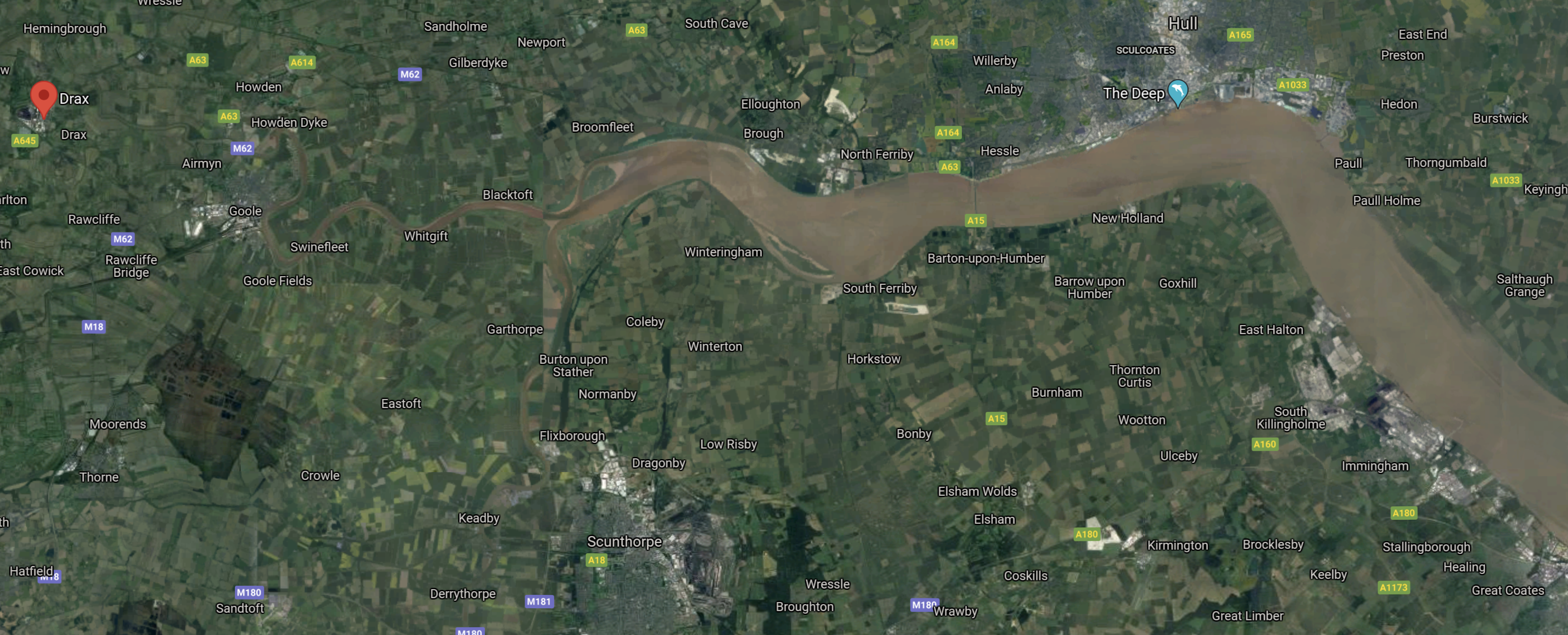
This Google Map shows the location of Drax power station in relation to Hull, Scunthorpe and the rivers in the area.
Note.
- Drax is marked by the red arrow in the West of the map.
- The large body of water in the East is the Humber Estuary.
- Hull is on the North Bank of the Humber.
- Scunthorpe, which is famous for its steel industry is South of the Humber in the middle of the map.
- To the West of Scunthorpe the Humber splits into the Trent and the Ouse.
- The Ouse leads all the way to Drax power station.
I suspect an undersea cable could go up the Humber and Ouse to Drax power station.
Is it a coincidence that both Drax power station and the proposed link to Peterhead are both around 4 GW?
Consider.
- Drax is a biomass power station, so it is not a zero carbon power station.
- Drax produces around six percent of the UK’s electricity.
- Most of the biomass comes by ship from North America.
- Protest groups regularly have protests at Drax because of its carbon emissions.
- Drax Group are experimenting with carbon capture.
- Drax is a big site and a large energy storage system could be built there.
- Wind is often criticised by opponents, saying wind is useless when the wind doesn’t blow.
- The Scots would be unlikely to send power to England, if they were short.
This is also said about Drax in Wikipedia.
Despite this intent for baseload operation, it was designed with a reasonable ability for load-following, being able to ramp up or down by 5% of full power per minute within the range of 50–100% of full power.
I take this it means it can be used to top up electricity generation to meet demand. Add in energy storage and it could be a superb load-follower.
So could the similar size of the interconnector and Drax power station be deliberate to guarantee England a 4 GW feed at all states of the wind?
I don’t think it is a coincidence.
Torness And Hawthorn Pit And Torness and South Humberside
These two cables are being proposed by Scottish Power.
- Each will be two GW.
- Torness is the site of the 1.36 GW Torness nuclear power station, which is likely to be decommissioned before 2030.
- Torness will have good grid connections and it is close to the sea.
- Hawthorn Pit is a large closed coal mine to the North of Newcastle, with a large substation close to the site. I suspect it will be an ideal place to feed power into the grid for Newcastle and it is close to the sea.
- Just South of Hawthorn Pit are the 1.32 GW Hartlepool nuclear power station, which will be decommissioned in 2024 and the landfall of the cables to the massive Dogger Bank wind farm.
- As I showed earlier with Drax, the Humber would be an ideal estuary to bring underwater power cables into the surrounding area. So perhaps the cable will go to Scunthorpe for the steelworks.
- As at Drax, there is backup in South Humberside, but here it is from the two Keadby gas-fired power stations.
The article in the Telegraph only gives the briefest of details of Scottish Power’s plans, but I suspect, that given the locations of the ends of the interconnectors, I suspect the cables will be underwater.
Conclusion
It strikes me that all three interconnectors have been well thought thought and they serve a variety of objectives.
- Bring Scottish wind power, South to England.
- Connect wind farms to the two nuclear power station sites at Hartlepool and Torness, that will close at the end of the decade.
- Allow the big 4 GW biomass-fired station at Drax to back up wind farms and step in when needed.
- Cut carbon emissions at Drax.
- Use underwater cables as much as possible to transfer the power, to avoid the disruption of digging in underground cables.
It looks to be a good plan.
Farringdon Station – 13th February 2022
The two main entrances to Farringdon station have now been finished and the road that runs between them has now been pedestrianised.












Is Farringdon station the only London station with separate entrances for National Rail and the Underground that are on opposite sides of a pedestrianised plaza?
Does it need to have some outdoor cafes in the Summer months?
Tideway – Blackfriars Bridge Foreshore – 13th February 2022
I took these pictures of the Tideway’s Blackfriars Bridge Foreshore site from the top of a 63 bus on Blackfriars Bridge.








Compare the pictures with those I took on the 4th September 2021.
Riding The Latest Alexander Dennis Electric Double-Decker Bus
This morning, I had a first ride in one of the latest Alexander Dennis electric double-decker buses.
















Note.
- The bus is definitely an improvement on previous electric models, that I have ridden on routes 43 and 212.
- Bus route 63 goes between Kings Cross and Honor Oak.
- If you want to go South from King’s Cross, the bus is caught at Stop D in front of the station.
- I’ve never seen a bus before with a wooden floor. Was it real or fake?
- The stop buttons were in the back of the seat in front. I’ve never seen this before.
- The are charging points for mobile phones.
Overall the standard of finish seemed high, but then it was in the new Wrightbus hydrogen buses I’ve ridden lately.
New Catalyst Extracts Hydrogen From Hydrogen Storage Materials More Efficiently
The title of this post, is the same as that of this article on Tech Explorist.
These are the first two paragraphs.
Hydrogen storage is a crucial enabling technology for advancing hydrogen and fuel cell technologies. One of the ways to store hydrogen is chemically. Chemical storage allows large amounts of hydrogen stored in small volumes at ambient temperatures.
However, for the hydrogen to be useful, catalysts are needed to activate LOHCs and release the hydrogen. This process is called dehydrogenation.
LOHCs are Liquid Organic Hydrogen Carriers.
The article describes how scientists at the Ames Laboratory have developed a new catalyst that doesn’t use metals or additives, that works at mild temperatures and under normal atmospheric conditions.
It does seem to me that LOHCs have a future, but given the sparseness of the Wikipedia entry, their widespread use may be some years away.
Tony Radakin And Ben Wallace In Russia
The Times today has published a picture with this caption.
Ben Wallace, the defence secretary, his counterpart, Sergei Shoigu, Admiral Sir Tony Radakin, chief of the defence staff, and Valery Gerasimov, chief of general staff
Ever since, Tony Radakin was made Chief of the Defence Staff, I’ve been curious about his name.
So tonight, I typed “radakin surname” into Google and got this answer.
Radakin (Russian: Радакин) is carried by more people in Russia than any other country or territory. It can also be rendered as a variant
Interesting! But surely, something that will enable the three military men and the former Scots guardsman to get on a bit better!
My Unusual Feet
My feet are often a red colour, as is shown in these pictures.




Note.
- It’s always the left that’s the reddest.
- They often itch, which I usually can cure with lots of Body Shop Hemp Foot Cream.
- I have no hard skin on my feet.
- I used to suffer badly from plantar fasciitis, but the foot cream seems to have stopped it.
Yesterday, I went to Liverpool on the train.
No problems, but this morning when I got out of bed and pulled my right calf muscle. Not badly as I was able to cure it with a bit of light massage and a hot bath.
I also found that in twenty-four hours, I’d lost nearly a kilo and my left foot was very red.
This is not the first time, I’ve had troubles after travelling on Class 390 trains. In another incident my left hand stopped working. That ended up with an overnight stay in hospital.
I’m no medic, but I do wonder, if I have a very leaky skin. I’ve mused on this before in My Unusual Body.
But does it let water molecules through, but the larger red corpuscles in my blood can’t get out, so my skin looks red?
Could it also explain, why I never need a plaster for an injection or when a blood sample is taken? Perhaps, the skin just parts for the needle and then closes after it’s taken out, so that the blood doesn’t leak.
To return to the Class 390 trains, I just wonder if their air-conditioning is set, so that the temperature and humidity is just right to suck the water out of my body. I certainly don’t get any problems on InterCity 225s, Hitachi AT-300 trains or Stadler Class 745 trains.
Norfolk Vanguard Offshore Wind Farm Re-approved By Government
The title of this post, is the same as that of this article on the BBC.
These are the two introductory paragraphs.
An offshore wind farm capable of generating electricity for nearly two million homes has been re-approved by government after consent was previously overturned by a High Court judge.
Vattenfall’s 1.8-gigawatt Norfolk Vanguard project had been granted consent by the Department for Business, Energy and Industrial Strategy (BEIS).
Note.
- Norfolk Boreas and Norfolk Vanguard are a pair of 1.8 GW offshore wind farms to be developed 72 and 47 kilometres off the Norfolk coast by Swedish company; Vattenfall.
- Hinckley Point C will have a capacity of 3.25 GW.
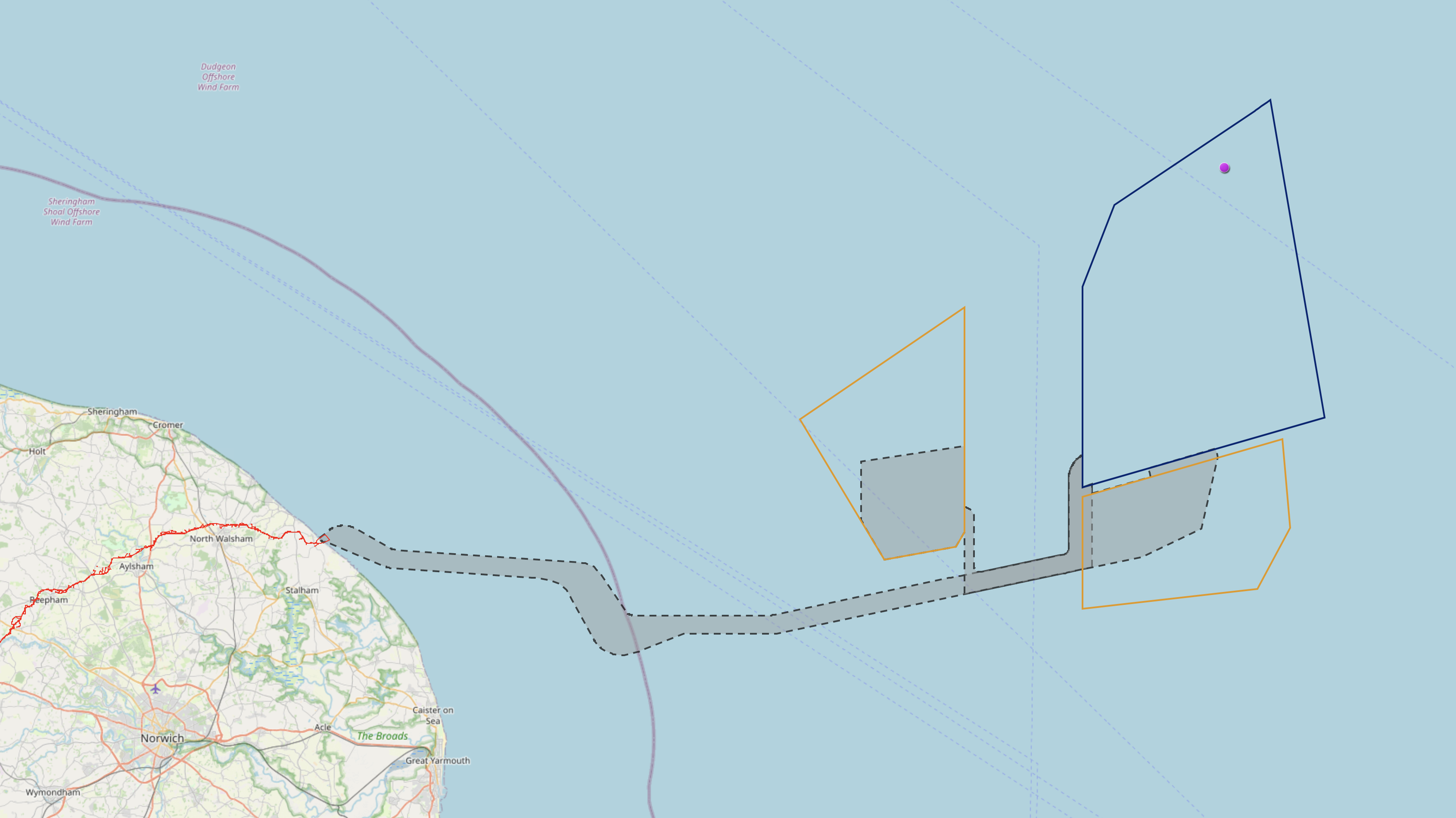
This map shows the two fields in relation to the coast.
Note.
- The purple line appears to be the UK’s ten mile limit.
- Norfolk Boreas is outlined in blue.
- Norfolk Vsnguard is outlined in orange.
- Cables will be run in the grey areas.
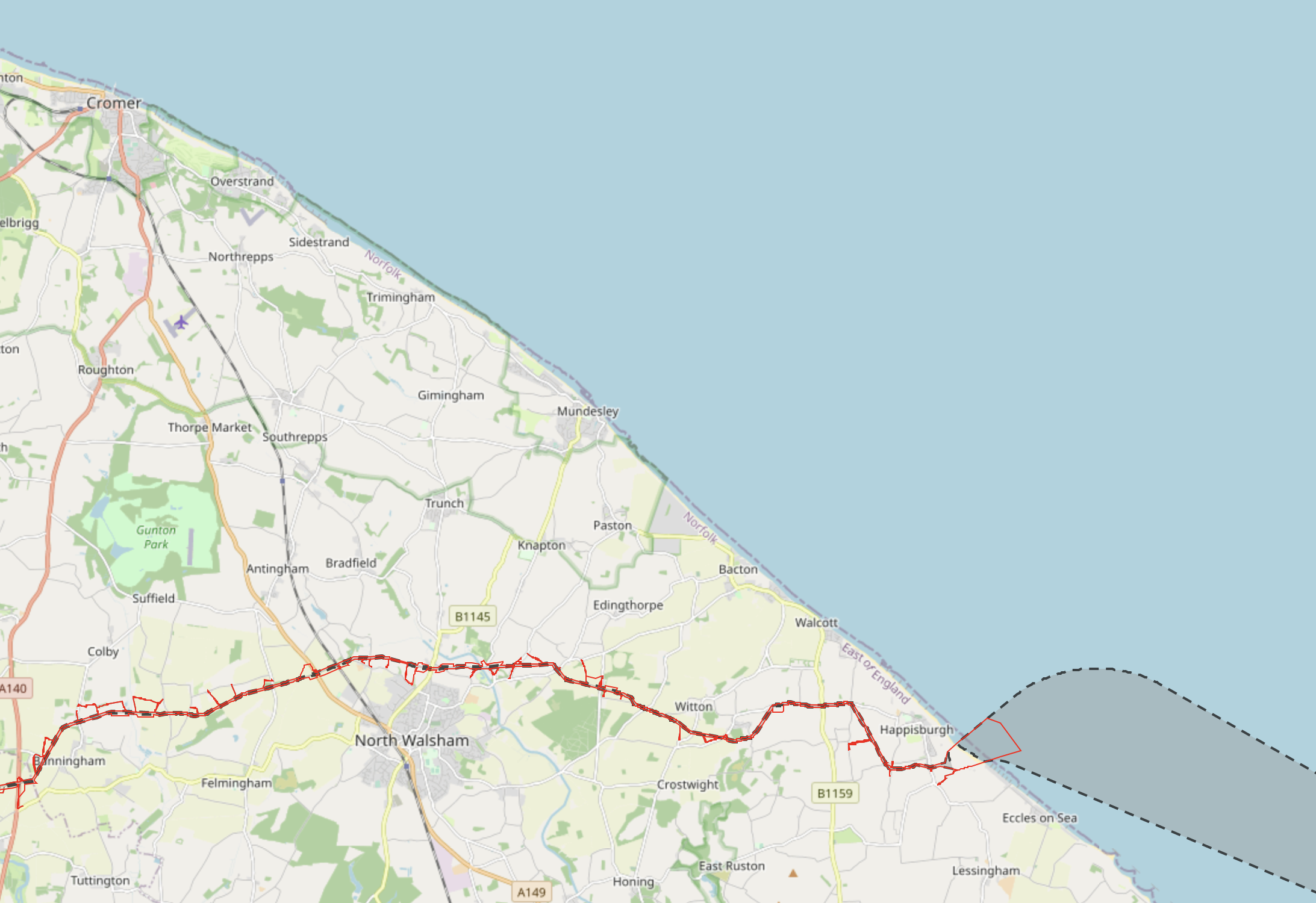
This second map shows the onshore cable.
Note.
- The cables are planned to come ashore between Happisburgh and Eccles-on-Sea.
- Bacton is only a short distance up the coast.
- The onshore cable is planned to go from here across Norfolk to the Necton substation.
But the planning permission was overturned by a legal ruling.
This article on the BBC is entitled Norfolk Vanguard: Ministers Wrong Over Wind Farm Go-Ahead, Says Judge.
These are the first four paragraphs.
A High Court judge has quashed permission for one of the world’s largest offshore wind farms to be built off the east coast of England.
The Norfolk Vanguard Offshore Wind Farm was granted development consent in July by the Secretary of State for Business, Energy and Industrial Strategy (BEIS).
But Mr Justice Holgate overturned the decision following legal action from a man living near a planned cable route.
A Department for BEIS spokeswoman said it was “disappointed by the outcome”.
This is a paragraph in today’s BBC article.
Kwasi Kwarteng, Secretary of State at the Department of Business, Energy and Industrial Strategy, granted development consent for the wind farm, having re-determined the application.
So will we be back to the Law Courts?
In Is There A Need For A Norfolk-Suffolk Interconnector?, I said this.
But seriously, is it a good idea to dig an underground cable all the way across Norfolk or in these times build a massive overhead cable either?
Perhaps the solution is to connect the Norfolk Boreas And Norfolk Vanguard wind farms to a giant electrolyser at Bacton, which creates hydrogen.
- The underground electricity cable across Norfolk would not be needed.
- Bacton gas terminal is only a few miles up the coast from the cable’s landfall.
- The UK gets another supply of gas.
- The hydrogen is blended with natural gas for consumption in the UK or Europe.
- A pure hydrogen feed can be used to supply hydrogen buses, trucks and other vehicles, either by tanker or pipeline.
- Excess hydrogen could be stored in depleted gas fields.
Thye main benefit though, would be that it would transform Bacton gas terminal from a declining asset into Norfolk’s Hydrogen Powerhouse.
For more information on blending hydrogen into our natural gas supply see HyDeploy.
Glendoe Hydro Power Station
When I think of hydro-electric power stations in the UK, I generally, think that most of the hydro-electric power stations were built years ago by organisations like the North of Scotland Hydroelectric Board. These power stations were one of the staples of the Meccano Magazine, of which I was a long-term subscriber in the 1950s.
But Glendoe hydro-electric power station is relatively new having been opened in 2009. At only 100 MW, the power-station may not be large in comparison to others around the world, but it does show what can be built in the Highlands of Scotland.
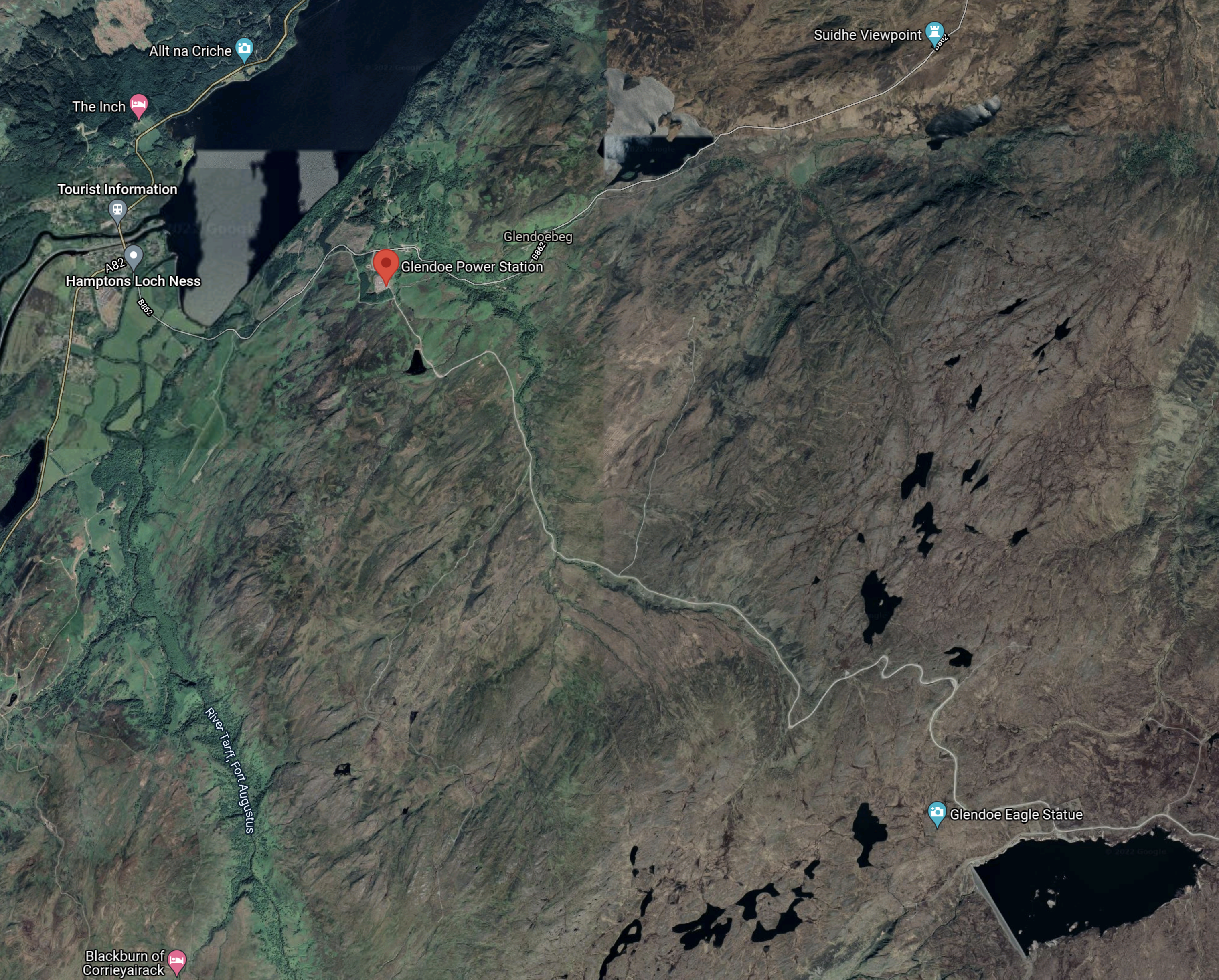
This Google Map shows the layout of the power station.
Note.
- The red arrow indicates the location of Glencoe power station, which is underground.
- To the North of the power station, is the Southern end of Loch Ness.
- In the South-Eastern corner of the map there is the lake from which the power station draws its water.
- The dam is at the Western end of the lake.
According to this article on Power Technology, the project cost £160 million.
This extract from a page on the SSE Renewables web site, describes the layout of the tunnels and the operation of the power station.
Engineers began planning the Glendoe project as far back as October 2001. Formal construction work at the site started over four years later, in January 2006. It involved constructing a 960 metre-wide dam on the River Tarff to create a new reservoir some 600 metres above the power station, giving it the greatest head of any hydro electric power station in the UK.
An 8.6 kilometre tunnel connects the reservoir to the power station that is built 250 metres below ground level, about two kilometres from the banks of Loch Ness. Although some of the tunnel was created using traditional drill and blast techniques that would have been familiar to the Tunnel Tigers of the last century, much of its length was bored out using a massive tunnelling machine named Eliza Jane by local schoolchildren.
The SSE page also describes the working and living conditions of those who built the scheme.
Most lived in specially constructed camps high in the hills above Loch Ness, braving brutal weather conditions in winter, and the fearsome Scottish midges in the summer.
The SSE page also gives the main use of the power station.
Today, the main operating feature of Glendoe is its ability to react quickly to changing demand for electricity, being able to reach full output in just 90 seconds.
So when there is an important football or rugby match on the television, it is ideal to supply the surge of electricity, when everybody puts on the kettle at half time.
Could This Power Station Have A Pumped Storage System Added?
Consider.
- There is a large lake six hundred metres above the power station.
- Loch Ness is a large source of water at the bottom of the mountain.
- Every tonne or cubic metre of water pumped into the upper lake would store 1.63 kWh of electricity.
- The world’s and the UK’s tunneling engineers are getting better and more ambitious.
- When this power station was built in the early years of this century, there wasn’t the large amount of wind turbines in Scotland, that there are now.
I suspect, it’s an idea that’s been looked at, but the costs or the distance to pump the water might kill it.
If a second project was the same size as the first, it would cost £210 million based on inflation.
But.
- It wouldn’t need another dam or a substation to connect to the National Grid.
- There would probably be a need for extra excavation at the power station to put in the pumps.
- I suspect it would need an extra tunnel to get the water uphill.
- One tunneling engineer told me, as with sex, digging a second tunnel is easier.
The main benefit, would be that it would be hidden infrastructure.
As to the energy storage capacity, I estimate from maps that the top reservoir at Glendoe is about half the size of Loch Mohr at Foyers power station, but the head is 600 metres as against 197 metres. As Foyers can store 10 GWh, it looks to me, that Glendoe could store around 15 GWh.
Also, as Glendoe power station was designed and built after the successful conversion of Foyers to a pumped storage station, I wouldn’t be surprised to find that Glendoe was designed, so that the station could be converted to pumped storage at a later date.
Conclusion
This scheme will be seriously looked at for extension with a pumped storage facility.
 The Anonymous Widower