N-Sea To Connect German Offshore Wind Farm To Dutch Gas Platform
The title of this post, is the same as that of this article on offshoreWIND.biz.
This is the sub-heading.
Dutch upstream oil and gas company, ONE-Dyas, has awarded N-Sea with a contract to install a subsea power cable between the Riffgat offshore wind farm in the German North Sea and the new, to-be-built N05-A gas production platform.
At a first look it appears that wind power is being used to power the gas production platform.
Other points from the article include.
- The distance of the connecting cable is ten kilometres.
- The Dutch government approved the scheme in June 2022.
- A final investment decision was made in September 2022.
I have some thoughts and further information.
Borkum, Rottumerplaat and Schiermonnikoog
The article says this about the position of the gas platform.
The N05-A platform will be installed some 20 kilometres north of the islands of Borkum, Rottumerplaat and Schiermonnikoog, and approximately one and a half kilometres from German waters.
This Google Map shows the three islands.
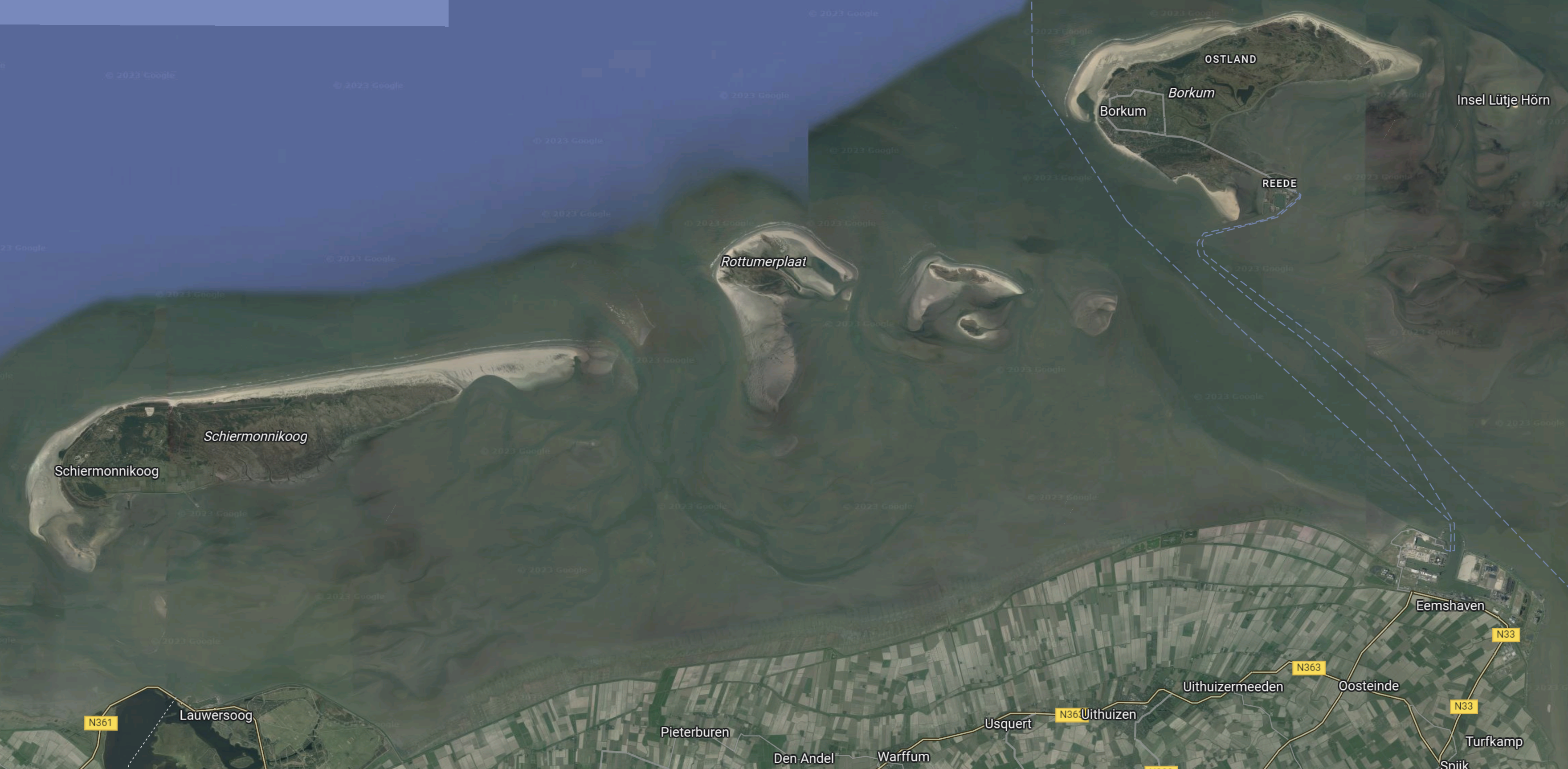
Note.
- Borkum is the horseshoe-shaped German island in the North-East corner of the map.
- Schiermonnikoog is the long and thin island in the West.
- Rottumerplaat is the larger of the two Dutch islands in middle map.
- Eemhaven, which I wrote about in The Train Station At The Northern End Of The Netherlands, is in the South-East corner of the map.
Shipping routes run up the River Ems and German-Dutch border in the East of the map
Riffgat Wind Farm
This web page on the EWE web site, gives this description of the wind farm.
EWE has built the first commercial wind farm in the German North Sea in summer 2013 with Riffgat. The modern wind farm has a total capacity of 108 megawatts of power and can supply around 120,000 households with environmentally friendly electricity. In just 14 months of construction, the 30 wind turbines of the 3.6 megawatt class have been installed 15 kilometers off the north seas of Borkum. The rotor diameter of the units is 120 meters, while the hub height is 90 meters, which corresponds to the height of the Bremen dome. Overall, the plants are 150 meters high from the water surface to the top rotor blade tip. They are founded on 70 meter long steel foundations (monopiles), 40 meters deep in the sea bottom. The water depth in the wind farm is between 18 and 23 meters. In addition to the wind power plants, Riffgat also consists of a substation which transports the generated electricity to a better transportable voltage level.
It looks a pretty standard 100 MW wind farm with fixed foundations.
The N05-A Platform
The article says this about the N05-A project.
The N05-A project is part of the so-called GEMS area, an area approximately 20 to 80 kilometres north of the Ems estuary. ONE-Dyas, together with partners Hansa Hydrocarbons and EBN, aims to extract natural gas from the N05-A field as well as surrounding fields in the German and Dutch North Sea.
The GEMS area has a web site with a URL with a .co.uk extension.
It has an informative video, which I don’t think would go down with Dutch chapter of Just Stop Oil.
The North Sea’s First Gas Platform To Run Entirely On Wind Power
The article says this about the N05-A project.
While the N05-A platform will not be the first in the North Sea to run on wind energy, it will be the first to do so entirely.
Hywind Tampen floating wind farm will be the first.
Conclusion
This looks like a good pragmatic solution to me.
I can see more connections between offshore wind farms and oil and gas facilities all over the world.
Farewell! Mary Quant!
This is a true story I heard, when I worked for ICI.
Do you remember those horrible drip-dry shirts, that men used to wear in the 1960s?
I suspect I took some to University, as my mother felt I could wash them.
Did you know that Mary Quant was partly responsible for their demise?
Mathematics tell us, that a pair of tights need a lot more nylon, than a pair of stockings.
As Mary Quant got a lot more ladies wearing tights to go with mini-skirts, there was a shortage of nylon.
ICI, who made much of the UK’s nylon, decided unilaterally to divert nylon from men’s shirts to ladies’ hosiery.
Bye bye! Nylon shirts!
RIP Dame Mary
BP And EnBW Hire Kent For 2.9 GW Scottish Offshore Wind Project
The title of this post, is the same as that of this article on offshoreWIND.biz.
This is the sub-heading.
Engineering and design service provider Kent has been awarded a contract by EnBW and BP to carry out pre-Front End Engineering Design (FEED) studies for the 2.9 GW Morven offshore wind project in Scotland.
Morven offshore wind farm would appear to be on its way.
According to Wikipedia’s list of UK offshore wind farms, the water depth in the Morven wind farm is between 65-75 metres.
- Total power is given as 2907 MW, which indicates that 14 MW turbines could be used.
- Siemens Gamesa 14 MW turbines have a blade length of 108 metres and their 10 MW have a blade length of 94 metres.
- This would seem to indicate that the wind turbine will be as much as 160 to 185 metres above the sea-bed.
A radical design of fixed foundation will be needed.
In Entrion Wind Wins ScotWind Feasibility Deal For Its 100-Metre Depth Foundation Tech, I look at technology that might work.
I also say this about work I did in Cambridge in the early 1970s.
The structures, I mathematically-modelled were for a company called Balaena Structures, that had been started by two Cambridge University engineering professors. The structures were about a hundred metres high and perhaps thirty metres in diameter.
They would have been built horizontally in the sort of dock, where you would build a supertanker and would have been floated into position horizontally. Water would then be let in to the cylinder and they would turn to the vertical. From that position, they would be lowered to the sea-bed by adjusting the water in the cylinder. They had a method of holding the Balaena to the seabed, which relied mainly on the weight of the structure and what they called the gum-boot principle.
Sadly, they never sold any platforms and the company folded.
Until recently, you could find the expired patents on the Internet.
I believe that a development of the Balaena design could be the solution to deep water fixed foundations.
Deepest Ever Fixed-Bottom Wind Turbine Foundation Stands Offshore Scotland
The title of this post, is the same as that of this article on offshoreWIND.biz.
This is the sub-heading.
The world’s deepest fixed-bottom wind turbine foundation has been installed at what will be Scotland’s largest offshore wind farm – Seagreen – off the coast of Angus.
This is the first paragraph.
On Friday, 7 April, the jacket foundation was transported to the project site on a barge operated by the main contractor, Seaway 7, where it was met by the Saipem 7000 – the semisubmersible crane vessel which is used to lift each of the 2,000-tonne turbine foundations into place.
It is obviously, a very worthwhile engineering achievement.
But two thousand tonnes of steel and a giant crane to lift it into place seems a bit of an overkill to me.
I believe that there must be a better method.
I feel that Entrion Wind’s idea of a FRP monopole, which I talked about in Entrion Wind Wins ScotWind Feasibility Deal For Its 100-Metre Depth Foundation Tech, could be a better bet.
ESB Invests In Floating Offshore Wind Mooring Tech
The title of this post, is the same as that of this article on offshoreWIND.biz.
This is the sub-heading.
Ireland’s Electricity Supply Board (ESB) has announced that it will invest in Dublin Offshore Technology (DOT), a company specialising in floating offshore wind mooring technology
These three paragraphs, outline the new relationship.
DOT has developed a technology solution for floating offshore wind mooring systems which provides significant design improvements for the wind farm, the company said.
The optimised mooring system delivers these benefits using locally-sourced materials tried and tested in the offshore environment with no degradation over the full lifetime of the wind farm, according to the Irish energy company.
By partnering with DOT, ESB will be able to leverage its expertise and resources to accelerate the development and delivery of its floating wind project portfolio.
In 13 Offshore Wind Projects Selected In World’s First Innovation And Targeted Oil & Gas Leasing Round, I wrote about how ESB and DOT were working together on Malin Sea Wind.
This update on the Dublin Offshore web site describes the Malin Sea Wind project.
In the early days of North Sea oil and gas, I saw relationships like these form and blossom. You could argue that the success of the project management system; Artemis, that I wrote, benefitted from close relationships with major oil companies and large international engineering companies.
History is just repeating itself.
The Construction Of The New Thanet Parkway Station Is Substantially Complete And It Will Open To Passengers On 31 July 2023
The title of this post, is the same as that of this page on the Network Rail web site.
The opening date is the most important information, but the rest of the page is worth a read, as it gives details of the work, that is still to do.
Much concerns sorting out the kevel crossings.
H&M Move Partners With Lanzatech To Launch Capsule Collection Using Captured Carbon Emissions
The title of this post, is the same as that of this press release from H & M.
This is the sub-heading.
This is the stuff of science fiction: LanzaTech diverts carbon emissions heading for the atmosphere, traps them, and turns them into thread. In a leap towards innovating sportswear, H&M Move partners with the breakthrough material science company for a drop arriving at hm.com/move on April 6.
And this is an H & M image of some of the clothes on a young lady.

Not bad considering that the polyester thread was made using carbon emissions from a steelworks.
Lanzatech’s Process
This paragraph from the H & M press release outlines the process.
Using three simple steps, LanzaTech captures carbon emissions from steel mills, traps them in bioreactors and converts them into the same building blocks that conventional polyester is made of. This revolutionary solution helps reduce pollution and limits the use of virgin fossil resources needed to make new products.
So does this mean that lots of products made from polyester can use the polyester made by Lanzatech?
As I worked for ICI Plastics Division, who had a polyester plant, that was used to make Melinex film, I suspect the answer is yes from the knowledge I picked up at the time.
Out of curiosity, I typed “polyester underwear men’s” into Google and there’s quite a lot of it about. Including some from Marks and Spencer that I own. Marks and Spencer also do a similar product for the ladies. Both products have a high proportion of polyester and could best be described as everyday.
I must find mine comfortable, as I have been buying them for some years now!
So it looks like it might be possible to replace a proportion of the fossil fuel-based polyester with one made from captured carbon dioxide.
And this can this be used in the same way as the fossil fuel-based polyester.
The Wikipedia entry for polyester is full of useful information and is very much a must-read.
This table gives world PET (polyethylene terephthalate) production for 2008 in millions tonnes/year
- Textile – 39
- Resin, bottle – 16
- Film – 1.5
- Special – 2.5
Note.
- Bottle includes, the bottles used for soft drinks, washing up liquid etc.
- Film is high quality and was used as recording tape, but now it’s mainly for packaging.
- Special includes engineering plastics.
Wikipedia has this section on recycling, where this is said.
Recycling of polymers has become very important as the production and use of plastic is continuously rising. Global plastic waste may almost triple by 2060 if this continues. Plastics can be recycled by various means like mechanical recycling, chemical recycling, etc. Among the recyclable polymers, polyester PET is one of the most recycled plastic. The ester bond present in polyesters is susceptible to hydrolysis (acidic or basic conditions), methanolysis and glycolysis which makes this class of polymers suitable for chemical recycling. Enzymatic/biological recycling of PET can be carried out using different enzymes like PETase, cutinase, esterase, lipase, etc. PETase has been also reported for enzymatic degradation of other synthetic polyesters (PBT, PHT, Akestra™, etc) which contains similar aromatic ester bond as that of PET.
Note that PET is one of the most recycled plastics.
So it looks like the LanzaTech process can not only use carbon dioxide, it can also create a product that can be recycled.
IberBlue Plans To Install 18 MW Floating Wind Turbines On Spanish-Portuguese Atlantic Ocean Border
The title of this post, is the same as that of this article on offshoreWIND.biz.
This is the sub-heading.
IberBlue Wind has announced plans to build two floating wind farms on the North Atlantic border between Spain and Portugal. The projects, planned to be installed off the coasts of Baixo Miño in Pontevedra and Viana do Castelo, would have a total of 109 turbines of 18 MW and a combined capacity of up to 1.96 GW.
These two later paragraphs also describe two other offshore wind farms being developed by IberBlue in Spain and Portugal.
Since then, IberBlue has already announced two floating offshore wind projects of 990 MW capacity each, one in Spain and one in Portugal.
In Spain, the joint venture is developing the Nao Victoria floating wind farm, planned to be built off the coasts of Cadiz and Malaga, in the Alboran Sea, the westernmost part of the Mediterranean Sea. The wind farm is planned to comprise 55 floating wind turbines, also with a nominal output of 18 MW per turbine.
It does look as if IberBlue have defined that for the seas around the Iberian peninsular, 18 MW floating wind turbines will be their standard.
As these giants could have a 20 % increase in capacity compared to 15 MW turbines for the same number of turbines, I think that developers will seriously look at the costs and performance pf the larger turbines and could install them more widely.
Are Boots Marching In The Wrong Direction?
My family has used Boots at the Angel since about 1900.
But have they ever been so disorganised?
Yesterday, I went to pick up some Warfarin, which I have taking for a dozen years.
It must be one of the most common and cheapest drugs they dispense.
I needed both 1 mg and 3 mg tablets.
But they didn’t have any 1 mg tablets.
The pharmacist explained that Boots didn’t have any.
Surely, this is a bit like Sainsbury’s running out of baked beans?
Cummins And Leclanché S.A. To Collaborate On Lower-Emissions Solutions For Use In Marine And Rail Applications
The title of this post, is the same as that of this press release from Cummins.
This is the introductory paragraph.
Today, global power and technology leader, Cummins Inc., and leading provider of energy storage solutions, Leclanché S.A, announced the signing of a Memorandum of Understanding (MOU). The collaboration represents a significant step forward in providing customers with a broader portfolio of integrated power solutions.
Effectively, this means that all customer requirements for integrated power solutions can be met by the two companies.
It appears to me, that if someone wanted Cummins to provide a system like the HybridFLEX train, I wrote about in Rolls-Royce And Porterbrook Launch First Hybrid Rail Project In The UK With MTU Hybrid PowerPacks, then Cummins and Leclanché have the technology between them to create a system.
In the UK, Cummins power these relatively-modern trains.
- Class 175 – 9 x two-car and 15 x three-car.
- Class 180 – 1 x four-car and 12 x five-car.
- Class 185 – 51 x three-car.
- Class 220 – 34 x four-car.
- Class 221 – 24 x four-car and 18 x five-car.
- Class 222 – 23 x five-car and 4 x seven-car.
Note.
- They are capable of 100 mph or 125 mph.
- Condition of the interiors is generally good.
- There are 9 x two-car, 66 x three-car, 59 x four-car, 53 five-car and 4 x seven-car.
- In Grand Central DMU To Be Used For Dual-Fuel Trial, I described innovative fuel trails in a Class 180 train.
- There could be other similar trains in Europe and around the world.
How many of these trains could be converted to hybrid operation, if Cummins and Leclanché were to create their version of the mtu Hybrid PowerPack?
Conclusion
Have Cummins and Leclanché decided that if a hybrid approach is good enough for Rolls-Royce mtu, then it’s good enough for them?
 The Anonymous Widower