The Future Is Blowing In The Wind
In Can We Move The Equilibrium Point Of The Energy Market?, I have been adding up all of the renewable energy to be commissioned in the next few years.
I am only looking at schemes that are being built or are consulting the public, have contracts and are by reputable and reliable developers, like BP, Equinor, Orsted, Scottish Power, Shell, SSE and Wattenfall
The numbers are not small.
This year 3.2 GW, should be commissioned, with another 2.3 GW in 2023. But the total between now and 2028 is at least 30 GW plus Hinckley Point C. In fact it could be higher, as I have ignored nearly all of the 25 plus GW of the Scotwind projects in the seas around Scotland.
As the UK needs about 23 GW to wash its face and we already have 25.5 GW of renewables installed, by the mid point of the decade, we should be able to reorganise our energy, by cutting gas usage for power generation and exporting surpluses to Europe.
The future is blowing the wind!
Can We Move The Equilibrium Point Of The Energy Market?
Equilibrium In Systems
As a Control Engineer, I believe that most systems eventually end up in a state of equilibrium.
How many football batches have you watched between two evenly-matched teams that have ended, where the statistics are even and the match has ended in a nil-nil draw or a win by one goal.
Now suppose one manager makes an inspired substitution, one important player gets injured or one player gets sent off.
One team will have an advantage, the statistics will no longer be even and one team will probably win.
The equilibrium point will have been shifted.
Zopa’s Stable Peer-to-Peer Lending System
I used Zopa’s peer-to-peer lending system for several years and found it a very stable system, that over the years paid a steady return of between four and five percent before tax.
I even developed a method to maximise my savings income, which I wrote about in The Concept Of Hybrid Banking.
It was a sad day for me, when Zopa closed its ground-breaking peer-to-peer lending system.
As a Control Engineer, I believe that Zopa’s strength was a well-written computerised algorithm, that matched lenders and borrowers and spread the risk.
- There was no bias in the system, introduced by personal prejudices.
- The algorithm was agnostic and judged all borrowers on their profiles and credit ratings alone.
- Money was allocated under fair rules for borrowers.
- I never borrowed from Zopa, but from my experience of owning half of a finance company, their terms were the most customer-friendly I’ve ever seen.
Someone will go back to the basics of peer-to-peer lending and it can’t be soon enough for both savers and borrowers.
Zopa In Troubled Times
Over the years that I invested in Zopa, my returns stayed very much the same, as the algorithm seemed to be able to maintain sufficient difference between lenders’ returns and borrowers’ rates. I also suspect the dynamics of savvy lenders and borrowers helped to stabilise both the system and the difference between rates.
It even worked through the Banking Crisis of 2008 and other mini-hiccups along the way.
My Conclusion About Zopa
As someone, who knows computing well, I would rate Zopa, one of the best computer systems, I’ve ever seen.
But it showed how a large transactional system can work well.
One of the keys to its success and smooth operation was that the computer was totally in control and it took all transaction decisions without direct human intervention.
The Energy Market
The energy market is a network of energy providers and users.
It is controlled by complicated rules and it has settled into an equilibrium, which involves.
- Importation of energy, which I suspect is not at a low price
- Some high priced energy generators, based on gas, which has a high-price, due to Putin’s war.
- Waste of wind energy due to lack of energy storage.
- The intermittency of renewable sources.
- A lack of gas storage, means that we probably get the wrong end of fluctuations in the gas price.
This results in a high price to consumers.
Can We Move The Equilibrium Point Of The Energy Market?
And we also need to move it quickly to a more favourable place, which benefits everybody!
As a Control Engineer, I believe that there are five ways to move the equilibrium point.
- Stop Putin’s war.
- Increase gas storage.
- Generate more low-cost electricity.
- Increase electricity storage.
- Improve the control algorithm.
I will now look at each in more detail.
Stopping Putin’s War
Giving in to Putin’s ambitions, would be an easy way to solve our energy crisis. But at what cost?
My parents generation, watched as Nazi Germany took over Austria and Czechoslovakia, whilst the world did nothing.
- We mustn’t repeat that mistake.
- We must not flinch in our support of the Ukraine.
- We must be ready to support Moldova, Finland and the Baltic States if Putin expands his ambitions.
I do wonder, if Boris will turn up with Churchillian-style anti-Putin rhetoric all over Eastern Europe.
Increasing Gas Storage
The major gas storage facility is Rough, which is handily close to the Easington gas terminal.
The facility needs maintenance and this paragraph from the Wikipedia entry gives the current status.
In May 2022, the Secretary of State for Business, Energy and Industrial Strategy, Kwasi Kwarteng, began talks with the site’s owners with a view to reopening the site to help ease the ongoing cost-of-living crisis in the United Kingdom. In June 2022, owners Centrica submitted an application to the North Sea Transition Authority (NSTA), the licencing authority for the UK Government, to reopen the facility. Approval was granted in July. Subsequently, Centrica indicated that they are working hard to restore storage operations at Rough which would depend on securing subsidies from the British government. Centrica was aiming to have some capacity available for the winter of 2022/23 against an overall plan to increase storage capacity gradually over time.
Note.
- Rough can store around 2832 million cubic metres of gas.
- This article on Energy Live News is entitled Reopening Of Rough Storage Gets The All-Clear.
Less well-known is SSE and Equinor’s Aldborough Gas Storage.
These three paragraphs from SSE web site, describe the gas storage.
The Aldbrough Gas Storage facility, in East Yorkshire, officially opened in June 2011. The last of the nine caverns entered commercial operation in November 2012.
The facility, which is a joint venture between SSE Thermal (66%) and Equinor, has the capacity to store around 330 million cubic metres (mcm) of gas.
SSE Thermal and Equinor have consent to increase the storage capacity at the Aldbrough site (Aldbrough Phase 2) and during the last couple of years have been working to involve the local community where appropriate to refine aspects of this project, which has not been progressed to date due to market conditions.
Future plans for the facility, may include converting it to one of the world’s largest hydrogen stores.
In the grand scheme of things, Rough and Aldborough, when you consider that the UK uses 211 million cubic metres of gas every day, will only keep us going for a few days.
But it should be noted, that the Easington gas terminal is connected to the Norwegian gas fields, by the Langeled pipeline.
So Yorkshire and Humberside will be alright.
Generating More Low-Cost Electricity
The only low-cost electricity of any size to come on stream will be wind-power.
This article on Renewables Now is entitled UK Hits 25.5 GW Of Wind Power Capacity.
These wind farms seem to be coming on stream soon or have been commissioned recently.
- Dogger Bank A – 1200 MW – Commissioning 2023 expected
- Dogger Bank B – 1200 MW – Commissioning 2024/25 expected
- Dogger Bank C – 1200 MW – Commissioning 2024/25 expected
- Hornsea Two – 1386 MW – Commissioned 2022
- Moray East – 950 MW – Commissioning 2022 expected
- Neart Na Gaoithe – 450 MW – Commissioning 2024 expected
- Seagreen – 1075 MW – Commissioning 2023 expected
- Triton Knoll – 857 MW – Commissioning 2022 expected
That is expected to be over 5 GW of offshore wind by the end of 2023.
In case there is some double counting, I’ll only say that wind power capacity could be near to 30 GW by December 2023, with perhaps another 3 GW by December 2024.
Other large wind farms in the future include.
- Berwick Bank – 4100 MW – Commissioning 2028 expected
- East Anglia Two – 900 MW – Commissioning 2026 expected
- East Anglia Three – 1400 MW – Commissioning 2027 expected
- Inch Cape Phase 1 – 1080 MW – Commissioning 2027 expected
- Hornsea Three – 2800 MW – Commissioning 2027 expected
- Moray West – 294 MW – Commissioning 2027 expected
- Morgan and Mona – 3000 MW – Commissioning for 2028 expected
- Morven – 2900 MW – Commissioning for 2028 expected
- Norfolk Boreas – 1400 MW – Commissioning 2027 expected
- Norfolk Vanguard – 1400 MW – Construction start planned for 2023
- Sofia – 1400 MW – Commissioning 2026 expected
That is over 14 GW of wind power.
I should also take note of solar and onshore wind power detailed in this document from the Department of Business, Industry and Industrial Strategy that lists all the Contracts for Difference Allocation Round 4 results for the supply of zero-carbon electricity.
It gives these figures and dates.
- Solar – 251 MW – Commissioning 2023/24 expected
- Solar – 1958 MW – Commissioning 2024/25 expected
- Onshore Wind – 888 MW – Commissioning 2024/25 expected
I can now build a yearly table of renewables likely to be commissioned in each year.
- 2022 – 3193 MW
- 2023 – 2275 MW
- 2024 – 701 MW
- 2025 – 5246 MW
- 2026 – 2300 MW
- 2027 – 6974 MW
- 2028 – 11400 MW
Note.
- Where a double date has been given, I’m taking the latter date.
- I have assumed that Norfolk Vanguard will be commissioned in 2028.
- I have ignored Hinckley Point C, which should add 3.26 GW in mid-2027.
- I have only taken into account one of the Scotwind wind farms in Scotland, some of which could be commissioned by 2028.
- I have assumed that BP’s Mona, Morgan and Morven will all be commissioned by 2028.
This is a total of 32 GW or an average of nearly 5 GW per year.
Increasing Electricity Storage
Big schemes like the 1.5 GW/ 30 GWh Coire Glas and 600 MW Cruachan 2 will help, but with 32 GW of renewable energy to be installed before 2028 and energy prices rocketing, we need substantial energy storage in the next couple of years.
One feasible plan that has been put forward is that of Highview Power’s CEO; Rupert Pearce,, that I wrote about in Highview Power’s Plan To Add Energy Storage To The UK Power Network.
The plan is to build twenty of Highview Power’s CRYOBatteries around the country.
- Each CRYOBattery will be able to store 30 GWh.
- Each CRYOBattery will be one of the largest batteries in the world.
- They will have three times the storage of the pumped storage hydroelectric power station at Dinorwig.
- They will be able to supply 2.5 GW for twelve hours, which is more output than Sizewell B nuclear power station.
Note.
- The first 30 GWh CRYOBattery is planned to be operational by late 2024.
- 600 GWh distributed around the country would probably be sufficient.
I believe that as these batteries are made from standard proven components, they could be built fairly quickly.
Paying For The Energy Storage
This press release from Highview Power is entitled New Analysis Reveals Extent Of UK Renewable Energy Waste, which makes these three bullet points.
- Enough renewable energy to power 500,000 homes a day wasted since the energy crisis began.
- 8 out of 10 Britons want more investment in boosting Britain’s energy resilience.
- UK spent £390 million turning off wind farms and using gas since September 2021.
Note.
- As the press release was published in July 2022, was the £390 million for ten months.
- Will this level of spend continue, as we’re not creating any electricity storage or building any factories that will start in a year or so, that will need large amounts of electricity?
- The Germans are at least building the NeuConnect interconnector between the Isle of Grain and Wilhelmshaven.
- As we’re adding up to 5 GW per year to our renewable energy systems, this problem will surely get worse and we’ll spend more money switching off wind turbines.
We have the money to build a very large amount of energy storage.
Improving The Control Algorithm
A better control algorithm would always help and politicians should only be allowed to set objectives.
Conclusion
There is a chance we’ll have an oversupply of electricity, but this will have effects in the UK.
- Gas-fired power-stations will be retired from front-line service to produce electricity.
- Some will question the need for nuclear power.
- Gas may even be used selectively to provide carbon dioxide for agricultural, scientific and industrial processes.
- Industries that need a lot of electricity may build factories in the UK.
- We will have a large supply of green hydrogen.
But it should bring the price of electricity down.
SSE Renewables Completes Acquisition Of European Renewable Energy Development Platform
The title of this post, is the same as that of this press release from SSE.
This paragraph introduces the deal.
SSE Renewables has completed the transaction with Siemens Gamesa Renewable Energy (SGRE) to acquire its existing European renewable energy development platform for a consideration of €580m.
I have a few thoughts.
Why Have Siemens Gamesa Sold Their European Renewable Energy Development Platform?
This article on Renewables Now is entitled Siemens Gamesa Wraps Up Sale Of 3.9-GW Wind Portfolio To SSE Renewables, gives a reason.
For the turbine maker, the sale represents one of the measures implemented to rein in profit losses quarter after quarter due to internal challenges, high costs and supply chain issues.
As with many things, it appears to be all about the money.
Can SSE Renewables Afford It?
Consider.
- SSE are developing the 1.5 GW/30 GWh Coire Glas pumped stored hydroelectric power station. I doubt the cost of that will be under a billion pounds.
- SSE developed the 0.5 GW Greater Gabbard wind farm and that development cost £1.5 billion
- SSE Renewables and Equinor are estimated on the web to be investing £9 billion in the Dogger Bank wind farm, which could deliver 3.6 GW.
- SSE Renewables have just announced the 4.1 GW Berwick Bank wind farm, which must need at least £9 billion.
SSE seem to have found a Scottish magic money tree.
€580m is just small change.
What Projects Are Included In The Deal?
This is a paragraph from the press release.
The SGRE portfolio includes c.3.8GW of onshore wind development projects – around half of which is located in Spain with the remainder across France, Italy and Greece – with scope for up to 1.4GW of additional co-located solar development opportunities. Development of the portfolio of projects has continued to progress since the acquisition was announced in April, with additional opportunities identified and permits and grid connections advancing. Over 2GW of the total pipeline is considered to be at a secured stage, where a grid connection or land agreement has been secured or relevant permits granted.
Note.
- As an engineer, I note that there is no offshore wind, which surely is the renewable energy development with most risk and installation costs.
- SSE Renewables have a lot of experience of onshore wind, so delivering and financing the extra 3.8 GW, shouldn’t be a problem.
- The 1.4 GW of solar comes with the word co-located. Wind and solar together, perhaps with a battery must surely be a good investment in the sunnier climes of Europe.
It doesn’t look to me that SSE Renewables have bought a load of assets that no-one wants.
I do wonder thought, if Siemens Gamesa were having trouble progressing this large diverse portfolio of projects, due to a shortage of resources like money and engineers.
So are SSE finishing off a few projects and they can transfer a few engineers to these projects?
Are SSE Spreading The Risk?
SSE operate mainly in the UK and Ireland, so is adding Spain, France, Italy and Greece a good idea?
Of the four new countries, it’s unlikely that all will perform well, but a mixed portfolio is usually a good idea.
Will SSE Renewables Buy Siemens Gamesa Turbines In The Future?
SSE Renewables seem to do an individual deal on each wind farm, as no one manufacturer dominates.
But now Siemens Gamesa may be more financially stable, perhaps they can get a better deal for the turbines they want.
Conclusion
I don’t think SSE Renewables have done a bad deal.
Extending The Elizabeth Line – Improving The Northern City Line
Some parts of North and North-East London, have less-than-good connections with the Elizabeth Line.
- The Piccadilly Line has no direct connection with the Elizabeth Line.
- The Victoria Line has no direct connection with the Elizabeth Line.
- The Bank branch of the Northern Line has only a poor connection with the Elizabeth Line at Moorgate station.
- The Northern City Line has only a poor connection with the Elizabeth Line at Moorgate station.
- The Charing Cross branch of the Northern Line has a good connection with the Elizabeth Line at Tottenham Court Road station.
- The Lea Valley Lines of the London Overground have good connections with the Elizabeth Line at Liverpool Street station.
- Thameslink has a good connection with the Elizabeth Line at Farringdon station.
It would appear that if you live near one of the Lea Valley Lines or Thameslink stations, you can access the Elizabeth Line fairly easily at Liverpool Street or Farringdon stations, but if you rely on a Northern, Northern City, Piccadilly or Victoria Line local station, you are not so lucky!
Could The Northern City Line Be Improved To Give Better Connections Between North London And The Elizabeth Line?
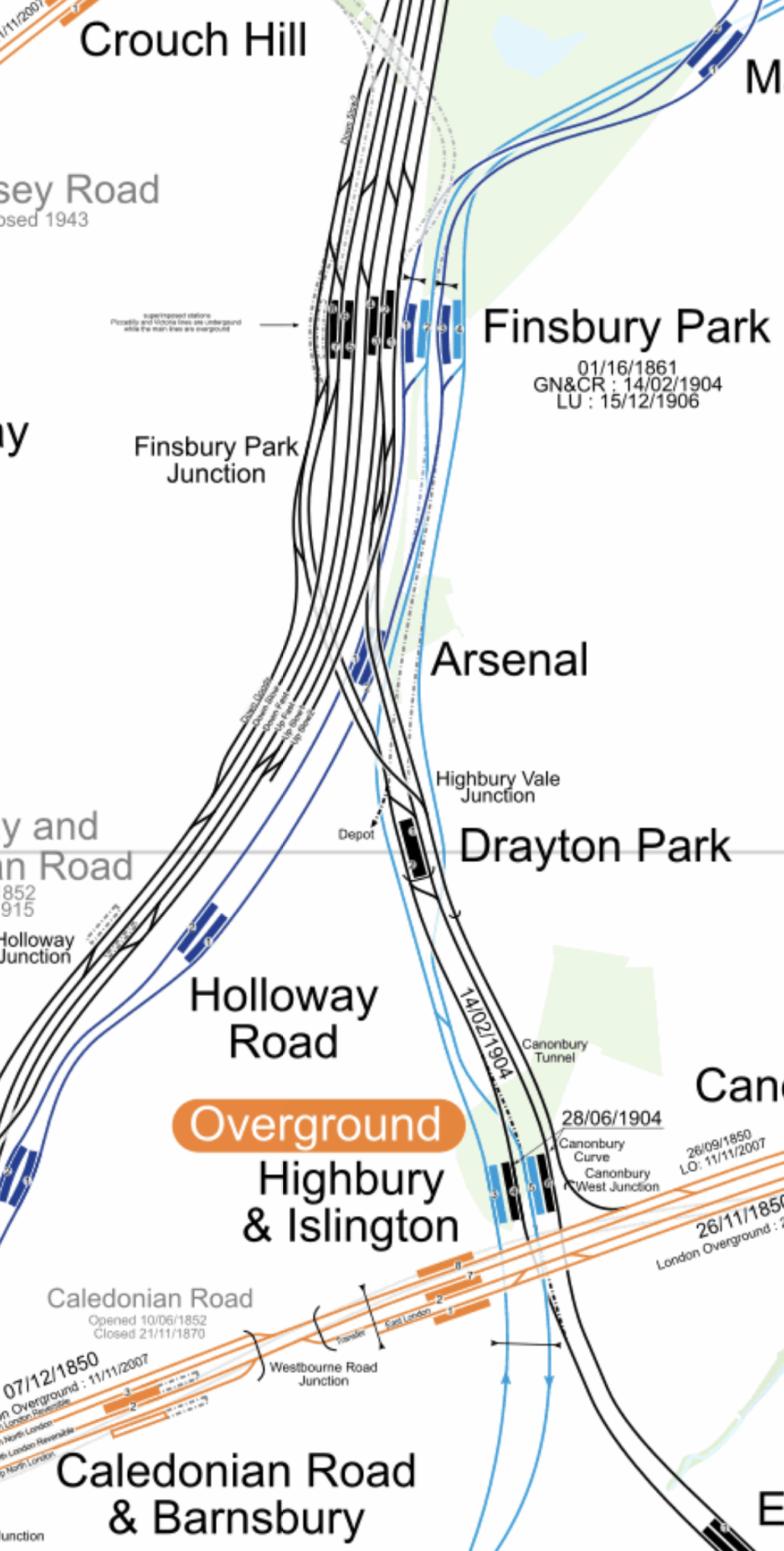
This map from cartometro.com shows the lines between Finsbury Park and Highbury & Islington stations.
Note.
- The dark blue tracks are the Piccadilly Line, which calls at M (Manor House), Finsbury Park, Arsenal, Holloway Road and Caledonian Road, before going South-West to King’s Cross St. Pancras.
- The lighter blue tracks are the Victoria Line, which calls at Finsbury Park and Highbury & Islington, before going South-West to King’s Cross St. Pancras.
- The black tracks on the Western side of the map are those of the East Coast Main Line into King’s Cross.
- The black tracks going South-East from Finsbury Park are the Northern City Line, which calls at Finsbury Park, Drayton Park, Highbury & Islington, E (Essex Road) and Old Street before terminating at Moorgate.
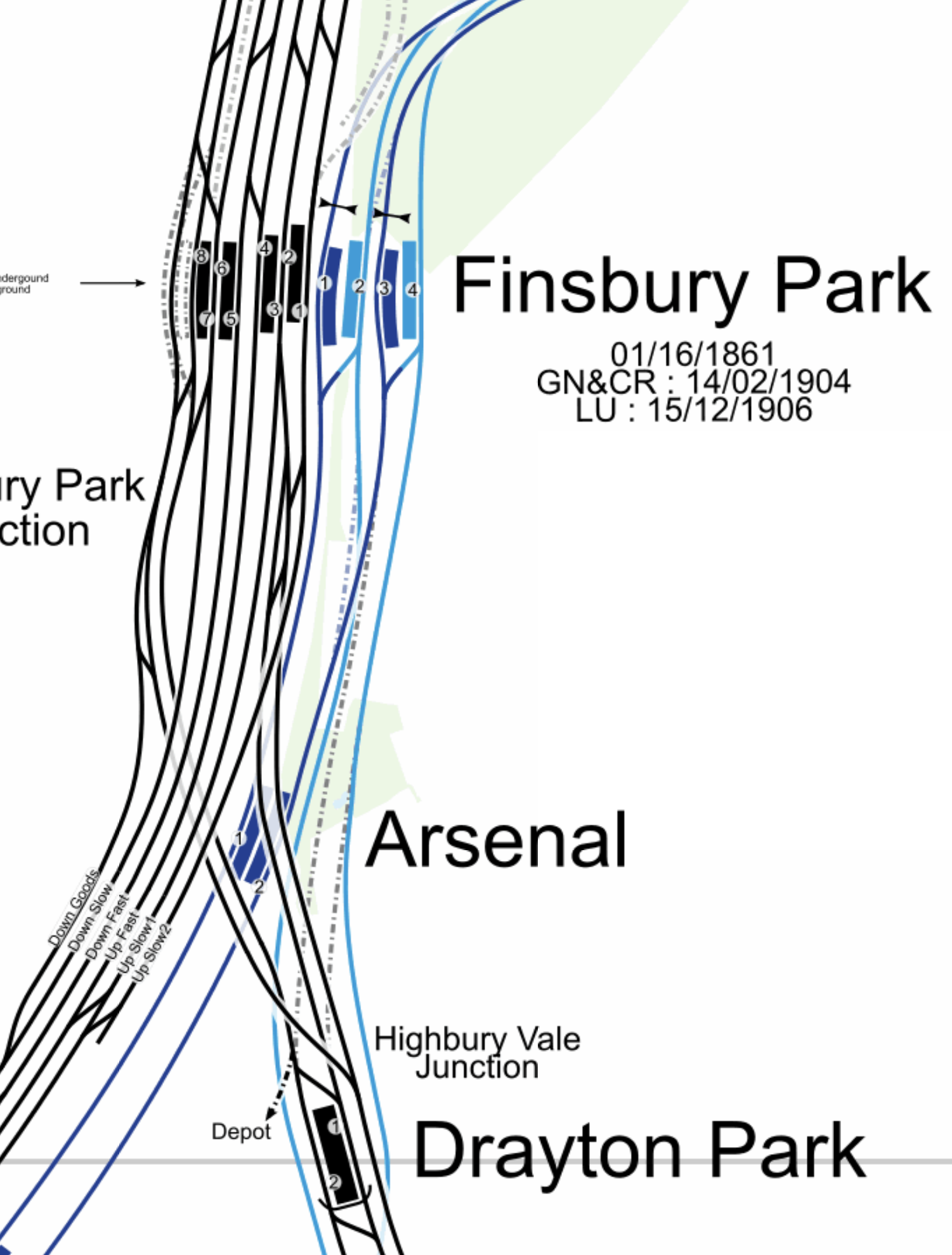
This second map shows the lines through Finsbury Park station.
Note.
- The dark blue tracks are the Piccadilly Line.
- The lighter blue tracks are the Victoria Line.
- The black tracks going through Drayton Park station are the Northern City Line.
- The platforms of the Piccadilly and Victoria Lines are paired at Finsbury Park station, so that passengers can change lines with a simple walk-across.
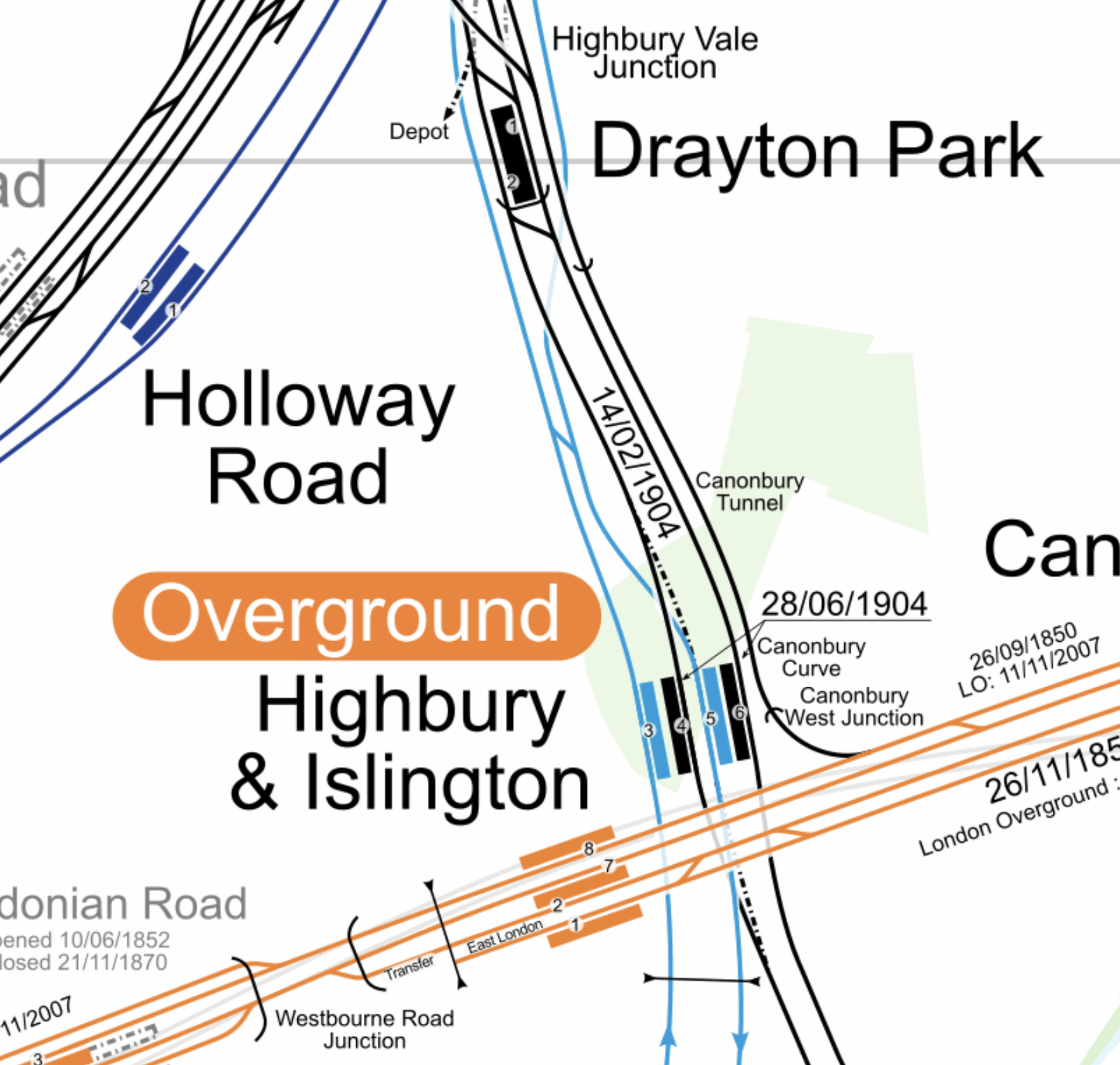
This third map shows the lines through Highbury & Islington station.
Note.
- The dark blue tracks are the Piccadilly Line.
- The lighter blue tracks are the Victoria Line.
- The orange tracks are the London Overground.
- The black tracks going through Drayton Park and Highbury & Islington stations are the Northern City Line, which terminates at Moorgate station.
- The platforms of the Northern City and Victoria Lines are paired at Highbury & Islington station, so that passengers can change lines with a simple walk-across.
The big problem with Highbury & Islington station is that is not step-free.
A Step-Free Route Between Wood Green And Moorgate Stations
Currently, it is possible to go between Wood Green and Moorgate stations by using three trains.
- Piccadilly Line – Wood Green to Finsbury Park – 6 mins
- Victoria Line – Finsbury Park to Highbury & Islington – 6 mins
- Northern City Line – Highbury & Islington to Moorgate – 10 mins
Note.
- These are actual times measured on my phone.
- The total time is twenty-two minutes.
- I had to wait a couple of minutes at both changes.
- Both changes are walk-across.
- The changes are not as perfect as they could be, although they would be easily managed with a buggy or a heavy case.
These pictures show the change at Highbury & Islington station.








These pictures show the change at Finsbury Park station.





This route works for all stations Between Manor House and Cockfosters.
- Cockfosters – Add 15 minutes
- Oakwood – Add 12 minutes
- Southgate – Add 9 minutes
- Arnos Grove – Add 6 minutes
- Bounds Green – Add 3 minutes
- Turnpike Lane – Subtract 2 minutes
- Manor House – Subtract 5 minutes
But look at the frequencies of the three sections in trains per hour (tph)
- Piccadilly Line – 21 tph
- Victoria Line – 33 tph
- Northern City Line – 4 tph
The Northern City Line frequency is not high enough, as you could have a fifteen minute wait for a train.
Improvements Needed To The Northern City Line
The Northern City Line now has new Class 717 trains, a terminal platform at Stevenage and full digital signalling is being installed.
- The major improvement needed would be to improve frequency to at least 12 tph.
- Six tph on both branches should be possible.
I would also install step-free access at more stations.
Moorgate Station’s Northern City Line Platforms
These pictures show the platforms of the Northern City Line at Moorgate station.








Note.
Improved Connections At Moorgate Station
I talked about the connections between the Northern and Elizabeth Lines at Moorgate station in Elizabeth Line To Northern Line At Moorgate Station.
This was my conclusion.
Routes between the Northern and Elizabeth Lines at Moorgate need to be improved.
I feel that some of the improvements could be fairly minor, but adding step-free access to the Northern City Line could be more difficult.
An Improved Connection Between Bank And Moorgate Stations
Currently, there are three ways between Bank and Moorgate stations.
- Use the Northern Line
- Use a 21, 43 or 141 bus routes
- Walk
I believe that it would also be possible to dig a pedestrian tunnel between the two stations and fit it out with a moving walkway.
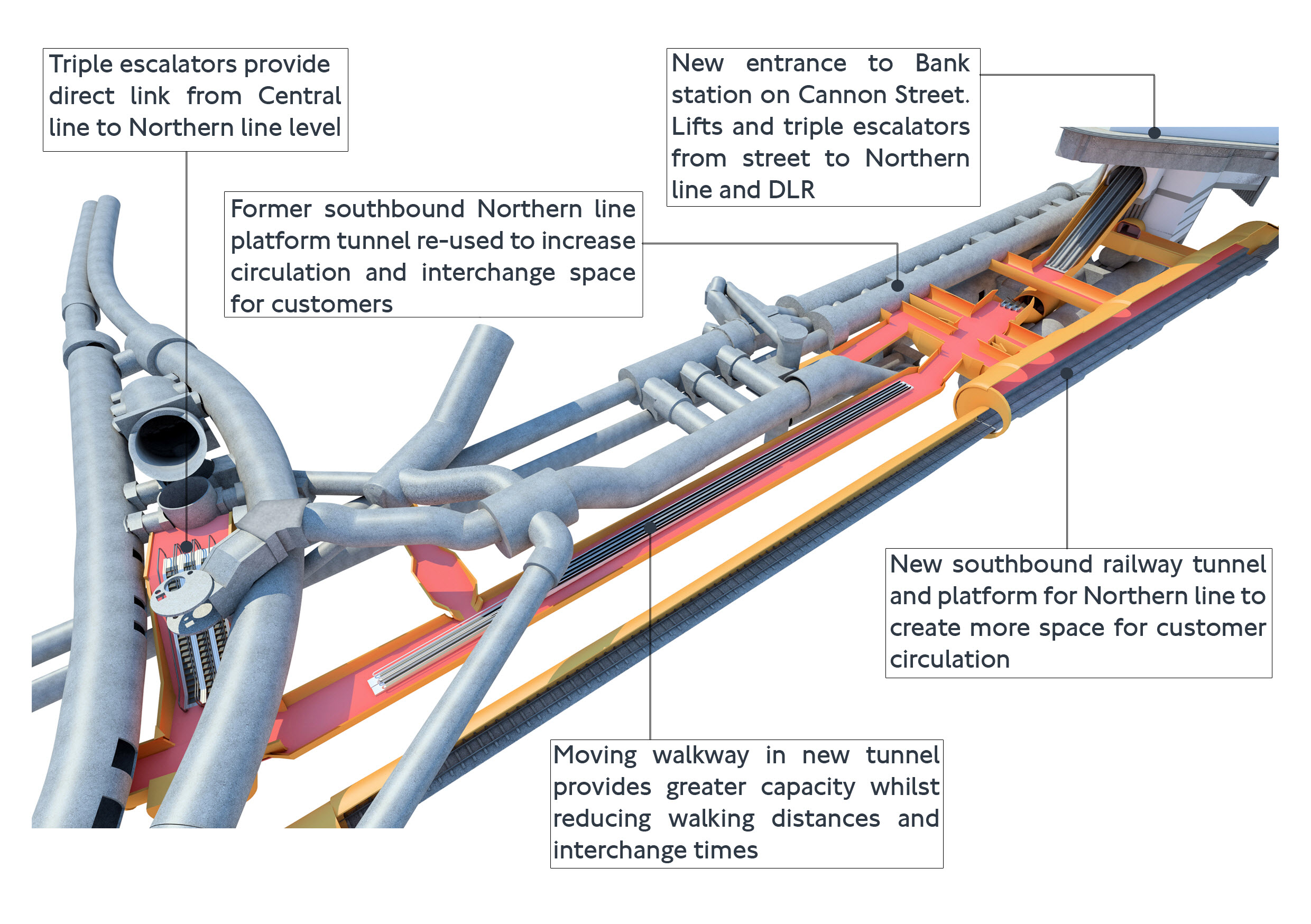
This visualisation shows the updated Bank station.
Note.
- Moorgate station is to the left.
- The only more-or-less completed bits are the two Northern Line tunnels and platforms and parallel pedestrian tunnel.
- The four cross tunnels can be picked out towards the far end of the station.
- Three of the cross tunnels can now be used by passengers.
- The moving walkway can be accessed from the two cross tunnels nearest to the Central Line.
- The escalators from the yet-to-open Cannon Street entrance appear to lead directly into a cross tunnel and a parallel tunnel to the moving walkway.
I believe that the moving walkway to Moorgate station could connect with the Bank station complex, at the Moorgate end of the new moving walkway in Bank station.
Extending The Elizabeth Line – London Crosslink
In the Wikipedia entry for the London Crosslink, this is the introduction.
London Crosslink was a passenger train service operated by Anglia Railways between Norwich and Basingstoke, using the North London Line to bypass central London. Class 170 Turbostar diesel multiple units were used, and the service operated between 22 May 2000 and 28 September 2002, supported by funding from the Strategic Rail Authority through its Rail Passenger Partnership fund.
As it was discontinued and it doesn’t seem to be sadly missed, I’m not advocating its reinstatement, but just looking how it might be run after the full opening of the Elizabeth Line.
But surely, there were good reasons, why the service was run in the first place and there might be a need in the future.
These are some characteristics of the service.
- There were about half-a-dozen services in both directions every day.
- At its full length it ran between Norwich and Basingstoke.
- Stops included Diss, Stowmarket, Ipswich, Colchester, Witham, Chelmsford, Ingatestone, Romford, Stratford, Highbury & Islington, Camden Road, West Hampstead, Brentford, Feltham, Staines, Woking and Farnborough (Main).
- Each service seemed to have a different stopping pattern.
- The timetable wasn’t very regular.
- The route wasn’t fully electrified.
It appears that it may have been a difficult service to timetable.
A London Crosslink Based On The Elizabeth Line
Consider.
- The route between Norwich and Stratford is possible and is fully-electrified.
- Trains could use the Central Tunnel of the Elizabeth Line between Stratford and Paddington.
- There is no connection between the Central Tunnel and Brentford, Feltham, Staines, Woking and Farnborough (Main).
I suspect that the service would go to Basingstoke via Reading.
An alternative route might be serve Heathrow Terminal 5 and then connect to the Windsor and Staines Line.
Note.
- In Extending The Elizabeth Line – Connecting Great Eastern Main Line Services To The Central Tunnel, I showed that I thought it was possible for Great Eastern Main Line service to use the Central Tunnel of the Elizabeth Line.
- Reading and Basingstoke is not electrified.
Would it be worthwhile?
Old Street Station – 24th August 2022
The new entrance to Old Street station is now open in the middle of the former roundabout.



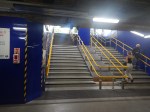
There will also be lifts.
Extending The Elizabeth Line – Thoughts On The Maximum Frequency In The Central Tunnel
The Wikipedia entry for the Elizabeth Line, says this about the indicative timetable after the 6th November 2022.
The indicative timetable consists of the following services on the Elizabeth line during peak hours: there will be 24 trains per hour (tph) in each direction in the central section (Paddington to Whitechapel): of these, 12 will run between Shenfield and Paddington, 6 will run between Abbey Wood and Heathrow, and 6 between Abbey Wood and either Reading or Maidenhead. Some trains on the Reading branch will not stop at all stations. Passengers travelling between stations west of Paddington and those on the north-eastern branch will need to change trains in the central section. Changing trains at Hayes & Harlington will be required for travel between Hanwell, West Ealing or Acton Main Line and other stations on the Reading branch.
The north-eastern section via Stratford is expected to see an additional four trains per hour during peak times between Gidea Park and the existing main line Liverpool Street station’s high level terminating platforms. Since these trains run over existing above-ground lines from Liverpool Street to Stratford, they will not call at Whitechapel.
When you consider, that Dear Old Vicky can handle 36 tph in the Peak, I feel that at some point in the future, the Elizabeth Line will handle more trains in the Central Tunnel.
This article on London Reconnections, which is entitled The Ninety Second Railway: Making the Victoria The Most Frequent Metro In The World, gives a history of increasing the frequency on the Victoria Line.
This is a paragraph from the article.
Of course, having the trains is only one part of the requirement. As our editor John Bull is prone to point out, there comes a point where frequency is not about how many trains you can squeeze through the tunnels, but about how quickly you can get passengers onto and clear of, the platforms.
As a regular passenger on the Victoria Line, there are times, when you notice that there are queues for the escalators and in the passageways at certain stations.
The Victoria Line probably can’t go to forty tph without substantial work on several stations.
But as these pictures show, the Elizabeth Line has space.












The Central Tunnel stations also have step-free walk-across access to the trains.








On my many journeys on the Lizzie Line, I’ve yet to see any delays in boarding in the Central Tunnel.
Extra Terminals
At present, the Elizabeth Line has been designed to have these terminal stations.
- Abbey Wood
- Heathrow Terminal 4
- Heathrow Terminal 5
- Maidenhead
- Paddington
- Reading
- Shenfield
The capacity in the East must match the capacity in the West.
Possible terminals in the East could be.
- Beaulieu Park
- Gravesend
- Hoo
- Northfleet
- Southend Victoria
And in the West they could be.
- Bedwyn
- Newbury
- Oxford
- Swindon
The numbers must still match.
Extra services would probably best be added gradually with time, when a need was proven.
Conclusion
I feel that only three things will limit the frequency of Elizabeth Line trains through the Central Tunnel.
- A frequency that fits the passenger numbers and route preferences.
- The capacity of the terminals
- The ability for engineers to meet that frequency safely and at an affordable cost.
Given that at certain times of the day, the Elizabeth Line is busier than you would expect, I wouldn’t be surprised to see that frequency higher than that planned.
Ilford Station – 4th September 2022
Ilford station is now substantially complete.















Note.
- Because of testing, the Elizabeth Line was running through Platforms 1 and 2 at Ilford station.
- Platforms 3 and 4 are running a test service between Shenfield and Paddington.
- Train displays on Platform 3 are showing trains going to Paddington.
It would appear, that there’s still a bit of work to finish.
Extending The Elizabeth Line – Connecting North Kent Line Services To The Central Tunnel At Abbey Wood
This map from cartometro.com shows the track layout at Abbey Wood.
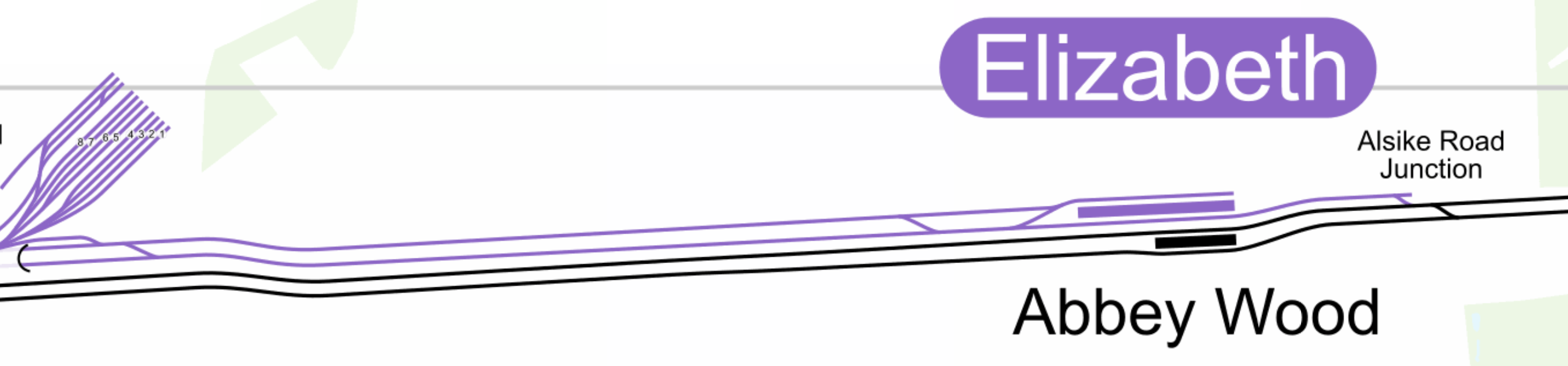
Note.
- The Elizabeth Line is shown in purple.
- The North Kent Line is shown in black.
- The North Kent Line platform to London is the Southernmost platform and is numbered 1.
- The North Kent Line platform from London is the other Southern platform and is numbered 2.
- The Elizabeth Line platforms are numbered 3 and 4.
- Platform 4 is the Northernmost platform.
At present the Elizabeth Line service to Abbey Wood station is twelve trains per hour (tph), with each platform handling six tph.
This picture shows trains in both Platform 3 and 4 looking towards the station buildings.

Note.
- Platform 3 is on the right.
- Platform 4 is on the left.
In Elizabeth Line To Ebbsfleet Extension Could Cost £3.2 Billion, I talk about this proposal as described in this article on Ian Visits.
One of the key features of Crossrail To Ebbsfleet (C2E) project is that instead of all trains terminating at Abbey Wood, trains will terminate as follows.
- Abbey Wood – 4 tph
- Northfleet – 4 tph
- Gravesend – 4 tph
This will mean that 8 tph would pass through Abbey Wood station.
- Platform 4 could certainly handle the four tph that terminated on the Elizabeth Line.
- Platform 3 would need to handle eight tph in both directions or sixteen tph to fulfil the proposed C2E service.
- This would be one train every 225 seconds.
I believe that digital signalling could handle this easily and safely.
I am fairly sure that the track layout at Abbey Wood allows eight tph to go both ways between the North Kent Line and the Elizabeth Line Central Tunnel.
The Maximum Capacity At Abbey Wood Station
Because of the current track layout at Abbey Wood, I believe that without track modifications, Abbey Wood station will not be able to handle more than 12 tph.
Energy Storage Will Deliver ‘Tens Of Billions Of Pounds A Year’
The title of this post, is the same as that of this article on Energy Live News.
This is the first paragraph.
This week’s Net Hero Podcast delves into how energy storage is being underappreciated as a key to cutting costs on our energy bills.
I have listened to the half-hour podcast and it is a fascinating interview with Rupert Pearce, who is the CEO of Highview Power.
He talks about.
- Green stability services
- Power stations in a box
- Vehicle-to-grid storage
- How Highview Power is location agnostic.
- And lots of other topics.
He also talks about the twenty Highview Power CRYOBatteries located around the country and financed traditionally, as there is money to be made.
Listen to what he has to say!
Conclusion
Rupert Pearce is a man with vision. And I like what he says!
 The Anonymous Widower