Extending The Elizabeth Line – Connecting Great Eastern Main Line Services To The Central Tunnel
If say it was ever needed to run a train between Ipswich or Southend Victoria stations and the Central Tunnel of the Elizabeth Line, three things must be possible.
Trains Would Have To Be Compatible With The Central Tunnel Of The Elizabeth Line
As any train would have to be compatible with the platform-edge doors in the central tunnel of the Elizabeth Line, the trains would have to be dimensionally identical to the current Class 345 trains.
- Nine cars
- Possibility of lengthening to ten cars.
- 204.73 metres long.
- 6 sets of doors per carriage
- Ability to run under full digital signalling.
I covered this in detail in Extending The Elizabeth Line – High Speed Trains On The Elizabeth Line.
Trains Would Need A 100 mph Capability To Travel On The Fast Lines Of The Great Eastern Main Line
They would be designed for a higher speed of at least 100 mph, to enable running on the fast lines.
The faster running would ease scheduling of the trains.
Effectively, the train would be a Class 345 train with more features and considerably more grunt.
Trains Must Be Able To Connect Between The Fast Lines And The Central Tunnel Of The Elizabeth Line At Stratford
This map from cartometro.com shows the track layout at Stratford.
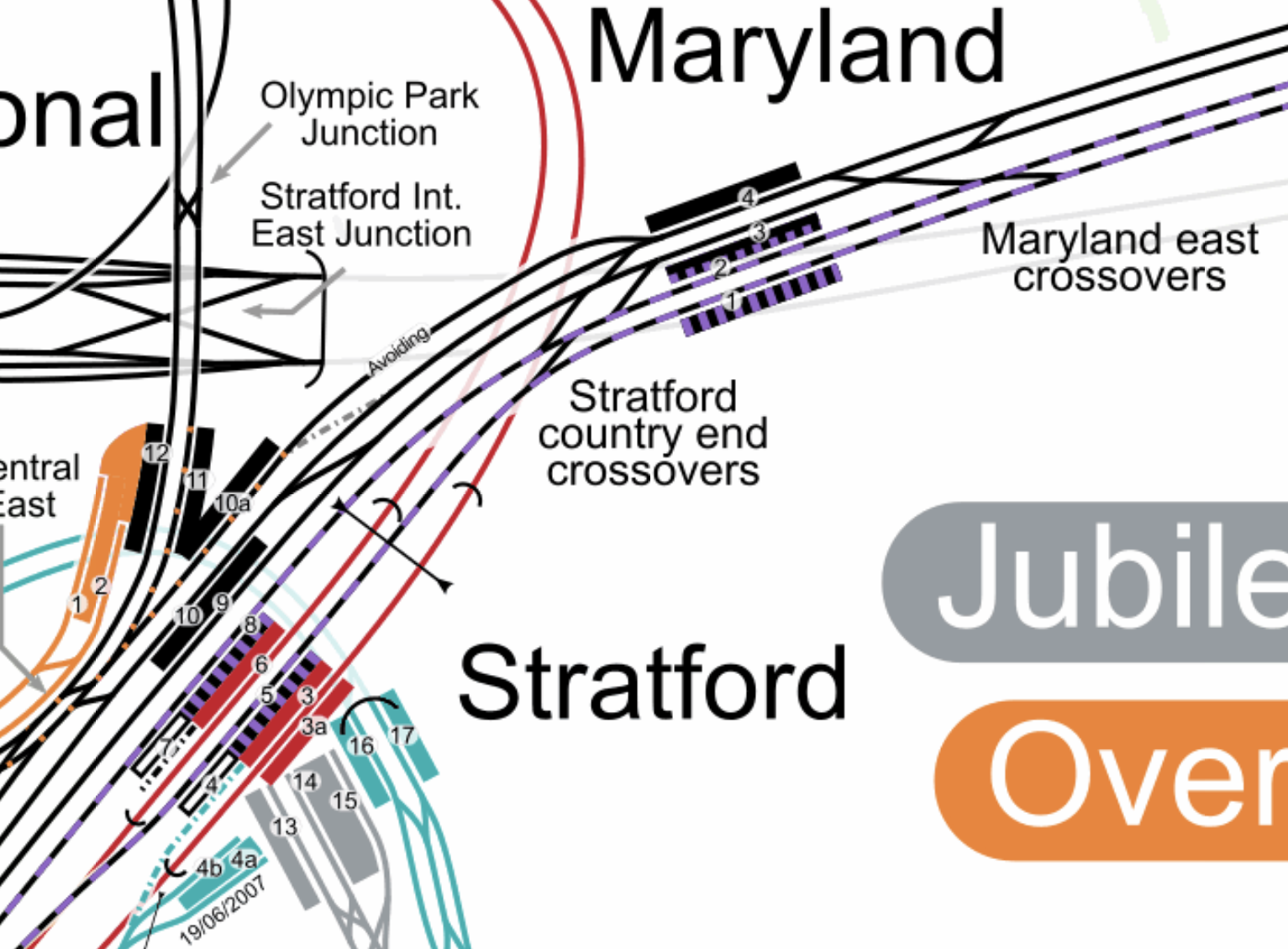
Note.
- The Elizabeth Line is shown in black and purple.
- The Elizabeth Line to Shenfield goes through Platform 8 at Stratford station and Platform 2 at Maryland station.
- The Great Eastern Main Line to Shenfield goes through Platform 10 at Stratford station and Platform 4 at Maryland station.
- The Stratford country end crossovers allow a train using the Elizabeth Line Central Tunnel to go through Platform 8 at Stratford station and Platform 4 at Maryland station before continuing on the Great Eastern Main Line.
- The Elizabeth Line to Central London goes through Platform 1 at Maryland station and Platform 5 at Stratford station.
- The Great Eastern Main Line to Central London goes through Platform 3 at Maryland station and Platform 9 at Stratford station.
- The Stratford country end crossovers allow a train using the Great Eastern Main Line to go through Platform 3 at Maryland station and Platform 3 at Stratford station before continuing through the Elizabeth Line Central Tunnel.
I am fairly sure that the track layout at Stratford allows trains to go both ways between Great Eastern Main Line and the Elizabeth Line Central Tunnel.
Extending The Elizabeth Line – Connecting Great Western Main Line Services To The Central Tunnel
If say it was ever needed to run a train between Oxford or Swindon stations and the Central Tunnel of the Elizabeth Line, three things must be possible.
Trains Would Have To Be Compatible With The Central Tunnel Of The Elizabeth Line
As any train would have to be compatible with the platform-edge doors in the central tunnel of the Elizabeth Line, the trains would have to be dimensionally identical to the current Class 345 trains.
- Nine cars
- Possibility of lengthening to ten cars.
- 204.73 metres long.
- 6 sets of doors per carriage
- Ability to run under full digital signalling.
I covered this in detail in Extending The Elizabeth Line – High Speed Trains On The Elizabeth Line.
Trains Would Need A 125 mph Capability To Travel On The Fast Lines Of The Great Western Main Line
They would be designed for a higher speed of at least 110 or 125 mph, to enable running on the fast lines.
The faster running would ease scheduling of the trains.
Effectively, the train would be a Class 345 train with more features and considerably more grunt.
Trains Must Be Able To Connect Between The Fast Lines And The Central Tunnel Of The Elizabeth Line At Royal Oak
This map from cartometro.com shows the track layout at Royal Oak.
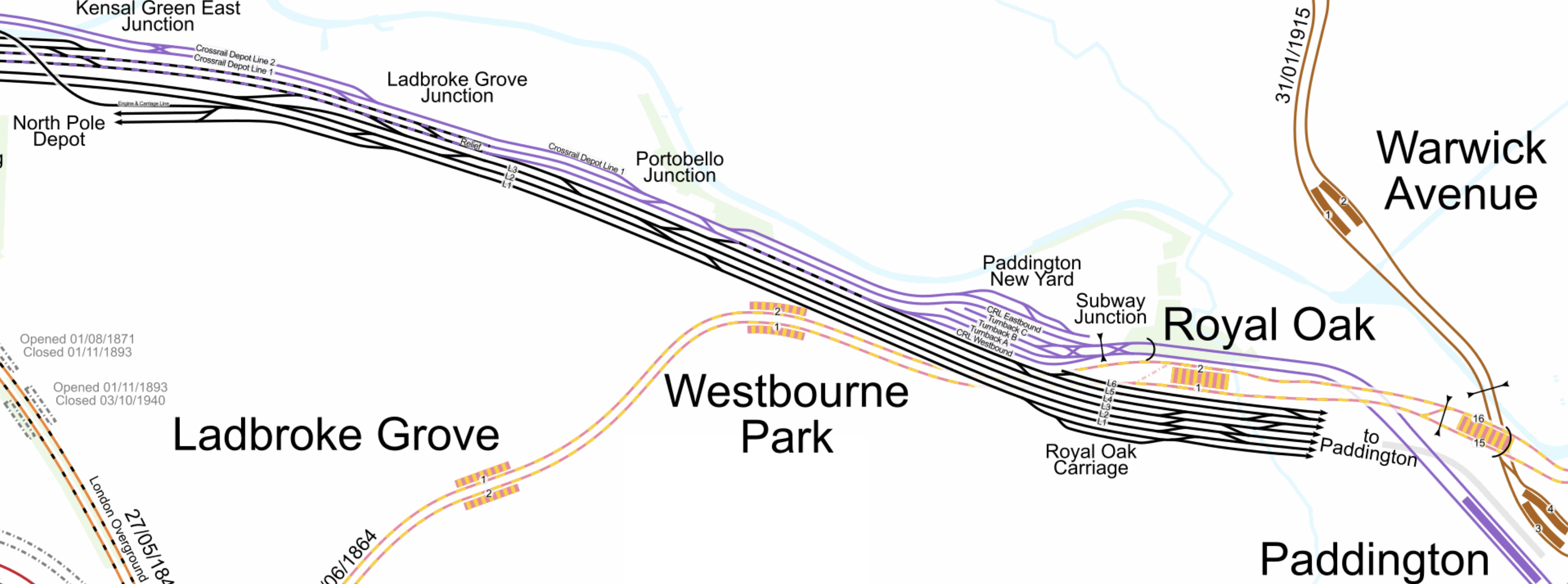
Note.
- The Elizabeth Line is shown in purple.
- Great Western Railway (GWR) tracks are shown in black.
- Where the Elizabeth Line shares the tracks with GWR services the tracks are shown in black and purple.
This map shows an enlargement of Kensal Green East Junction in the North-West corner of the previous map.
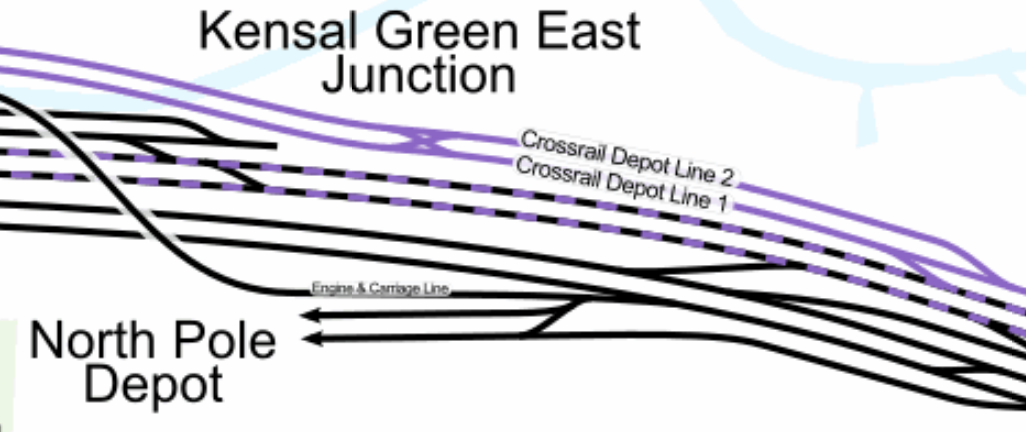
Note.
- The top pair of lines lead to the Elizabeth Line Depot at Old Oak Common.
- the pair of lines that are shown in black and purple handle Elizabeth Line and GWR local services.
- The pair of black lines are the Great Western Main Line.
- North Pole Depot is used by GWR for their Hitachi trains.
This map shows an enlargement between Ladbroke Grove Junction and Royal Oak.
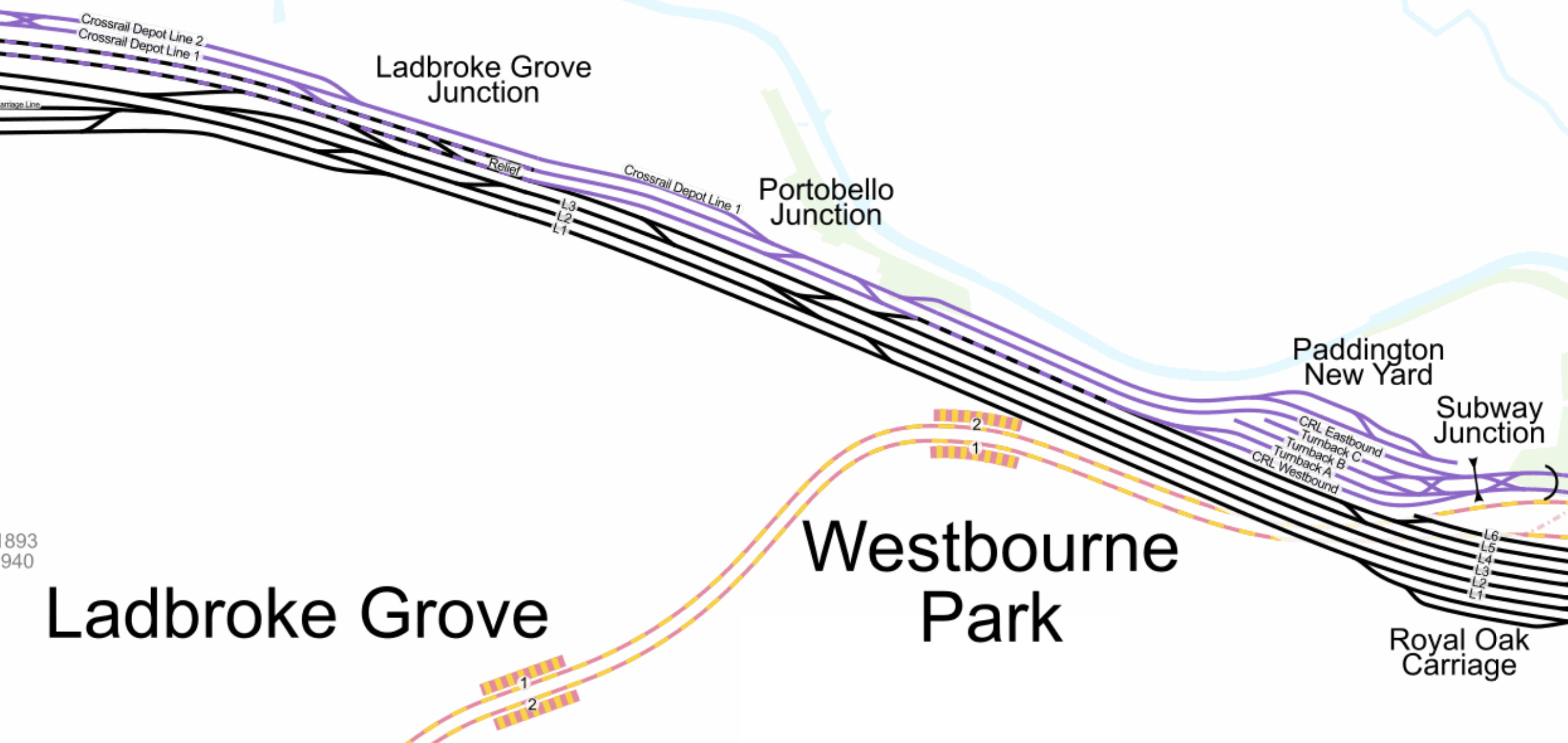
Note.
- In the South-East corner of the map is Subway junction, which appears to have two crossovers for maximum flexibility.
- To the East of Subway junction the curved line indicates the Royal Oak Portal of the Elizabeth Line Central Tunnel.
- To the West of Subway junction, there is Paddington New Yard, where there is five tracks labelled CRL Eastbound, Turnback C, Turnback B, Turnback A and CRL Westbound from North to South.
- Turnback C, Turnback B and Turnback A are the three turnback sidings, where trains are turned back East through the Elizabeth Line Central Tunnel.
- CRL Eastbound and CRL Westbound can be followed across the map to the black and purple lines of the Elizabeth Line to the West of Ladbroke Grove junction.
- At present the Western section of the Elizabeth Line terminates in Paddington station. Crossovers at Portobello junction appear to connect the Western section of the Elizabeth Line into Paddington station.
- More crossovers also appear to connect the Great Western Main Line to the CRL Eastbound and CRL Westbound through Paddington New Yard.
I am fairly sure that the track layout at Royal Oak allows trains to go both ways between Great Western Main Line and the Elizabeth Line Central Tunnel.
Pumped Storage Development In Scotland
The title of this post, is the same as that of this article on International Water Power & Dam Construction.
It describes and gives the current status of the two large pumped storage hydroelectric schemes under development in Scotland.
The 1.5 GW/30 GWh scheme at Coire Glass, that is promoted by SSE.
The Cruachan 2 scheme, that is promoted by Drax, that will upgrade Cruachan power station to 1.04 GW/7.2 GWh.
Note.
- Construction of both schemes could start in 2024, with completion in 2030.
- Both, SSE and Drax talk of a substantial uplift in employment during the construction.
- Both companies say that updated government legislation is needed for schemes like these.
The article is very much a must-read.
Conclusion
Welcome as these schemes are, given the dates talked about, it looks like we will need some other energy storage to bridge the gap until Coire Glas and Cruachan 2 are built.
Will Highview Power step forward with a fleet of their 2.5 GW/30 GWh CRYOBatteries, as was proposed by Rupert Pearce in Britain Will Soon Have A Glut Of Cheap Power, And World-Leading Batteries To Store It.
- The site needed for each CRYOBattery could be smaller than a football pitch.
- In Could A Highview Power CRYOBattery Use A LNG Tank For Liquid Air Storage?, I came to the conclusion that a single LNG tank could hold a lot of liquid air.
- The storing and recovery of the energy uses standard turbomachinery from MAN.
- Highview Power should unveil their first commercial system at Carrington near Manchester this year.
I am sure, that when they get their system working, they could build one in around a year.
Berwick Bank Wind Farm Could Provide Multi-Billion Pound Boost To Scottish Economy And Generate Thousands Of Jobs
The title of this post, is the same as that of this press release from SSE.
This press release is all about numbers.
- 307 turbines
- 4.1 GW nameplate capacity
- 5 million homes will be powered
- 8 million tonnes of carbon dioxide avoided
- Up to £8.3 billion to the UK economy
- 4650 potential jobs in Scotland
- 9300 potential jobs in the UK
These are all large figures.
This map from SSE shows the location of the wind farm.
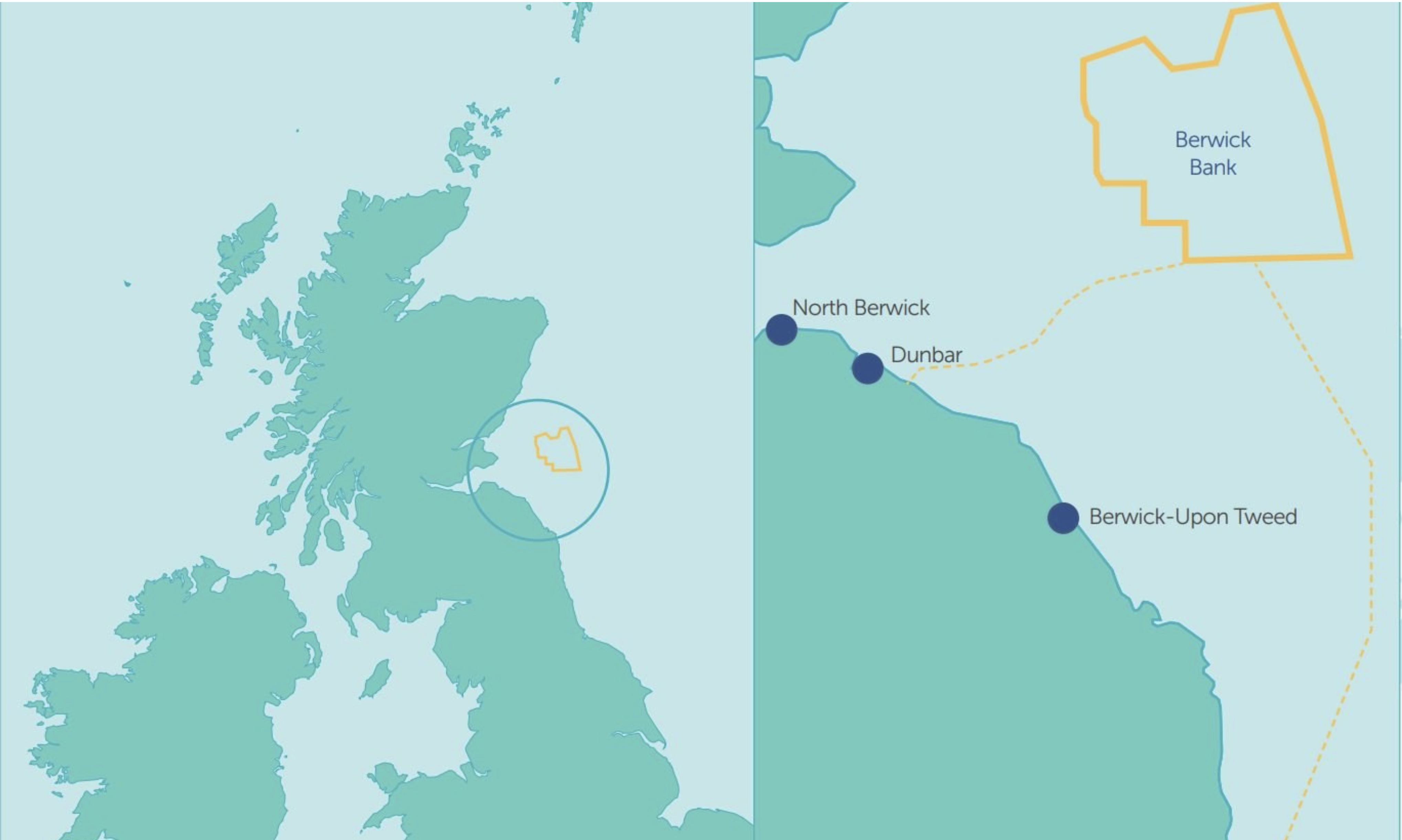
The press release says this about connections to the grid.
Berwick Bank has secured a grid connection at Branxton, near Torness, in East Lothian. A second grid connection will be required for the project, which has been determined as Blyth, Northumberland.
Note, that Torness is the site of Torness nuclear power station.
- It has a nameplate capacity of 1.29 GW.
- It is scheduled to be shutdown in 2028.
This Google Map shows the coast between Dunbar and Torness nuclear power station.
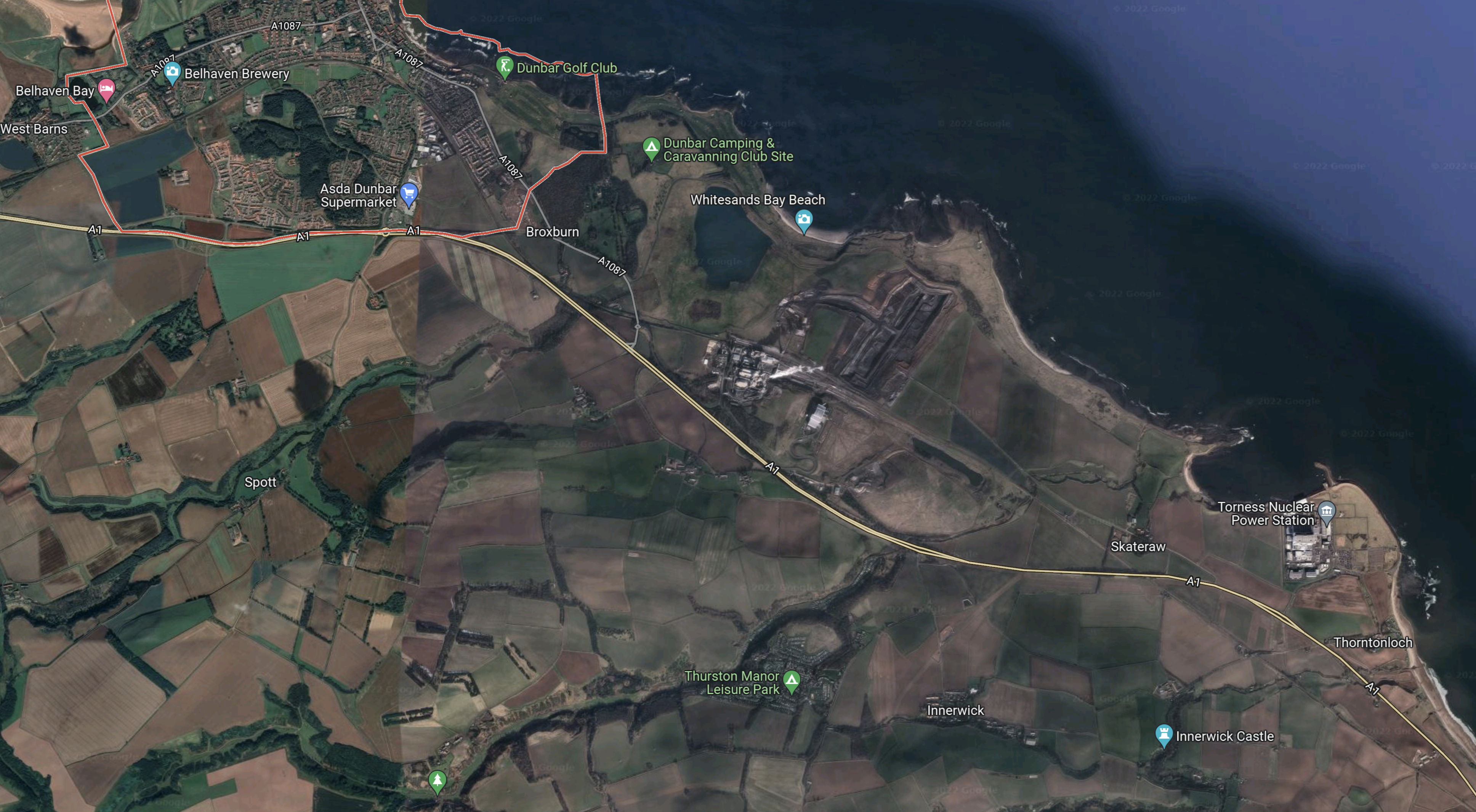
Note.
- The town of Dunbar is outlined in red.
- The yellow line running diagonally across the map is the A1 road.
- Torness nuclear power station is in the South-East corner of the map to the North of the A1.
This second Google Map shoes an enlargement of the South-East corner of the map.
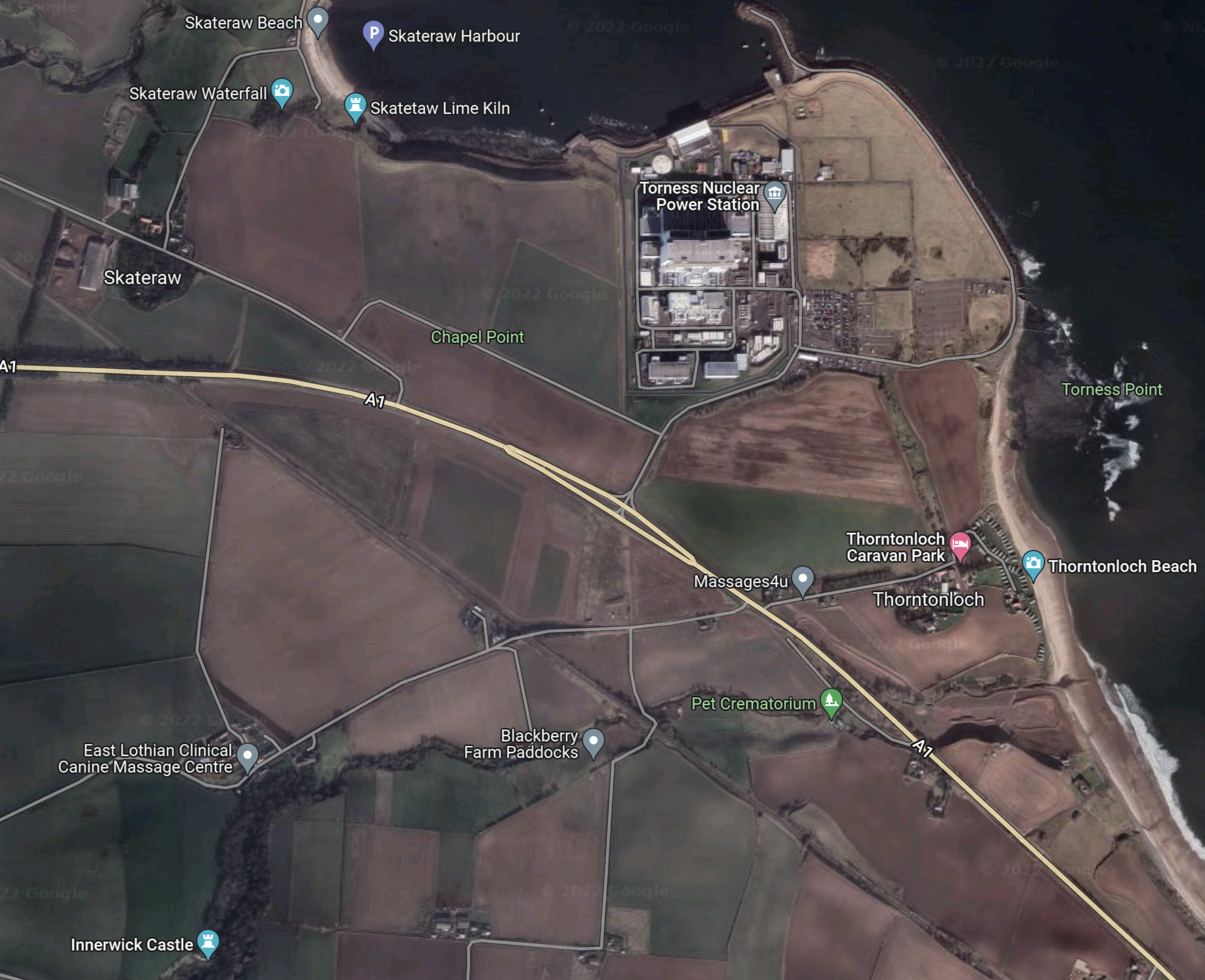
Note.
- Torness nuclear power station at the top of the map.
- The A1 road running across the map.
- The East Coast Main Line to the South of the A1.
- Innerwick Castle in the South-West corner of the map.
This Google Map shows the location of Branxton substation in relation to Innerwick Castle.
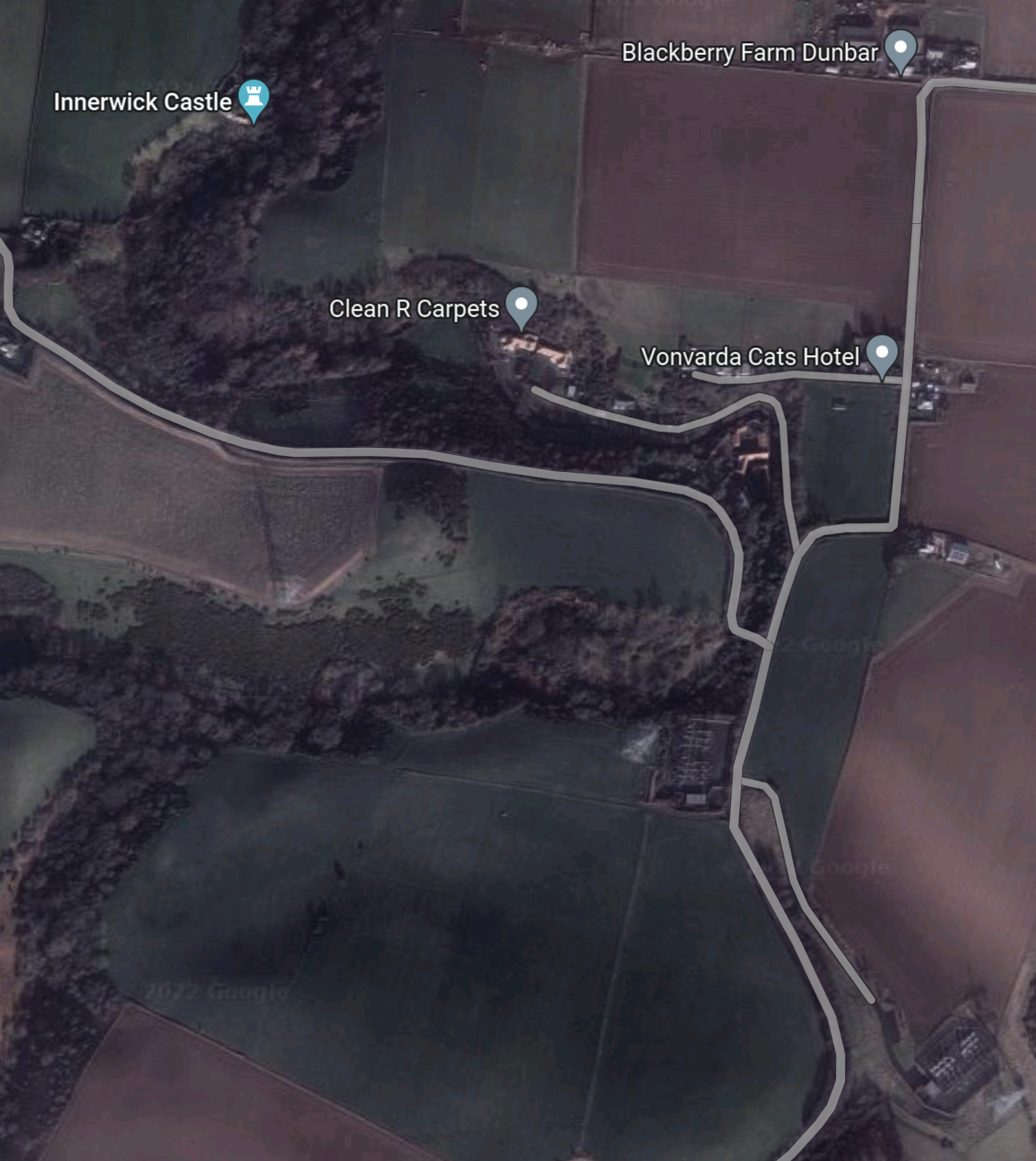
Note.
- Innerwick Castle is in the North-West corner of the map.
- Branxton substation is in the South-East corner of the map.
I estimate that the distance between Torness nuclear power station and Branxton substation is about five kilometres. The cable appears to be underground.
I have some thoughts.
Will The Connection Between Berwick Bank Wind Farm And Branxton Substation Be Underground?
If SSE follows the precedent of Torness nuclear power station, it will be underground.
Or will they use T-pylons?
This page on the National Grid web site is entitled What’s A T-Pylon And How Do We Build Them?.
From an engineering point of view, I suspect T-pylons could be used, but aesthetics and local preference may mean the cable is underground.
It should be noted that Torness nuclear power station will be shutdown in 2028. So will the current underground cable for the nuclear power station be repurposed after shutdown for the Berwick Bank wind farm?
This would mean, that the Southern connection cable to Blyth could be built first to support the first turbines erected in the wind farm.
When Will Berwick Bank Wind Farm Be Commissioned?
This page on the Berwick Bank wind farm web site is a briefing pack on the project.
The page gives construction and commission dates of 2026-2030.
Will There Be A Battery At Torness?
As we are talking about the latter half of the current decade for completion of the Berwick Bank wind farm, I believe that a substantial battery could be installed at Torness to smooth the output of the wind farm, when the wins isn’t blowing at full power.
One of Highview Power’s 2.5 GW/30 GWh CRYOBatteries could be about the right size if it has been successfully developed, but I am sure that other batteries will be of a suitable size.
If there is a case for a battery at Torness, there must surely be a case for a battery at Blyth.
Will Berwick Bank Wind Farm Be A Replacement For Torness Nuclear Power Station?
Consider.
- Torness nuclear power station is shutting down in 2028.
- Berwick Bank wind farm will be fully operational by 2030.
- Berwick Bank wind farm could use a repurposed connection to Branxton substation, if the nuclear power station no longer needs it.
- There is space on the Torness site for a large battery.
, it looks like Torness nuclear power station could be replaced by the larger wind farm.
When Did You Last See A Bluebottle?
I was on a train today and a big fly flew through.
But it wasn’t a bluebottle and I can’t remember seeing one for some time.
They were much more common, when I was growing up in the 1950s.
Hornsea 2, The World’s Largest Windfarm, Enters Full Operation
The title of this post, is the same as that of this press release from Ørsted.
These are the first three paragraphs, which outline the project.
The 1.3GW project comprises 165 wind turbines, located 89km off the Yorkshire Coast, which will help power over 1.4 million UK homes with low-cost, clean and secure renewable energy. It is situated alongside its sister project Hornsea 1, which together can power 2.5 million homes and make a significant contribution to the UK Government’s ambition of having 50 GW offshore wind in operation by 2030.
The Hornsea Zone, an area of the North Sea covering more than 2,000 sq km, is also set to include Hornsea 3. The 2.8GW project is planned to follow Hornsea 2 having been awarded a contract for difference from the UK government earlier this year.
Hornsea 2 has played a key role in the ongoing development of a larger and sustainably competitive UK supply chain to support the next phase of the UK’s offshore wind success story. In the past five years alone, Ørsted has placed major contracts with nearly 200 UK suppliers with £4.5 billion invested to date and a further £8.6 billion expected to be invested over the next decade.
Note.
- Hornsea1 was the previous largest offshore wind farm.
- The first three Hornsea wind farms, could have a total output of over 5 GW.
- There is a possible Hornsea 4, that may be in the pipeline!
Will Hornsea 3 take the crown from Hornsea 2, when it is commissioned in 2027?
I Can’t Wait Until The Sixth Of November
This morning, I wanted to go between Moorgate and Romford stations.
Because the Elizabeth Line is not fully joined up, I wanted to avoid a long walk.
So I had decided, that the best way to go would be.
- Hammersmith and City Line from Moorgate to Mile End.
- Central Line from Mile End to Stratford.
- Elizabeth Line from Stratford to Romford.
Note that both interchanges are cross-platform ones, so it is certainly a route with the minimum of walking.
When I got to Moorgate station, it appeared that there were problems with the Hammersmith and City Line, so assuming that things would be OK from Whitechapel, I took the Lizzie Line one stop to try my luck from there.
But my luck was out and after waiting for about twenty minutes in a stationary District Line train for a lift to Mile End station, I gave up and returned to the Lizzie Line, where I took a train to Canary Wharf station.
I’d changed between the Lizzie and Jubilee Lines before and wrote about it in Changing Trains At Canary Wharf Station – 13th June 2022.
I had not been impressed, as I’d found it a long walk.
But this time, I followed a route between the Eastern ends of both stations, which goes past Waitrose in the shopping centre. Opposite Waitrose was this stall.




That looks good for a pit stop. Badiani 1932 appear to have realised that London has a chronic shortage of ice cream and have opened a number of shops.
Once on the Jubilee Line, I finally got to Stratford and walked to the Lizzie Line for Romford Station.
What Had Caused All The Delays?
It appeared there had been a power supply problem on the Hammersmith and City Line.
Conclusion
Once Crossrail is fully open, it will be a bypass around problems like today.
Romford Station – 31st August 2022
Romford Station is now more-or-less complete for the Elizabeth Line.
I took these pictures today.

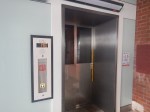





Note.
- The station now has lifts.
- Secure bicycle parking has been added.
- The ticket hall is a lot more spacious and it has three entrances to the street.
- Surprisingly, there were six positions for staff to sell tickets to customers.
- The new decor is a lot more plain with no marble.
This is a picture from 2016.
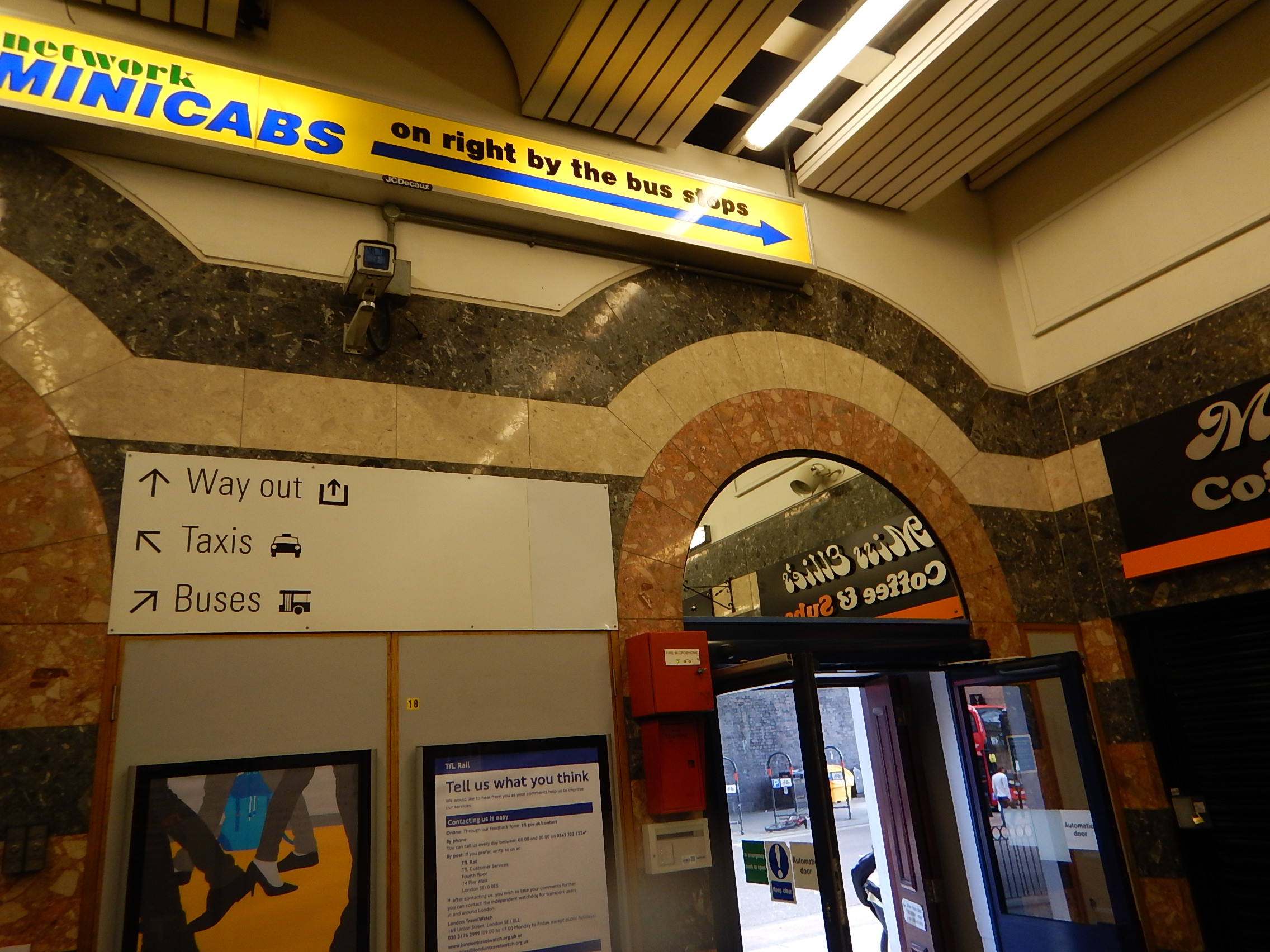
Will it be added later?
New £3.6bn London Transport Funding Deal Agreed
The title of this post, is the same as that of this article on the BBC.
These five paragraphs outline the deal.
A new £3.6bn government bailout to keep Tube trains, railways, buses and trams running in London has been agreed.
The package includes almost £1.2bn of upfront funding for Transport for London (TfL) to secure the long-term future of the capital’s transport network.
It is the sixth bailout for TfL after its revenues plummeted in the pandemic.
The funds will allow Piccadilly line trains to be built as well as upgrades to three Tube lines.
TfL Commissioner Andy Byford described the deal as “hard won” but Mayor of London Sadiq Khan, who is also chair of TfL, branded it “far from ideal”.
I have a few thoughts.
Will The North And Scotland Like It?
In my travels around the UK, when I ask someone on a bus,train or tram about their new transport funding, I often get a reply something like.
It’s good, but London gets more.
I don’t think other areas of the UK will like £3.6 billion, especially after Crossrail’s over budget and late construction.
Driverless Trains
The BBC article says this about driverless trains.
The 16-page settlement letter includes a commitment to “press forward a joint programme on the implementation of driverless trains on the London Underground”.
These seven paragraphs in the settlement letter say this about driverless trains.
29. TfL’s record of modernisation and innovation should not leave it behind other European
networks, which are achieving significant operational efficiencies through driverless trains.
Accordingly, DfT and TfL will press forward with the joint programme on the implementation of
driverless trains on the London Underground, recognising TfL’s safety, regulatory and statutory
responsibilities.
30. Taking the findings of the network review to the next stage, TfL will continue to work with DfT
to develop the evidence required to make a strong case for investment in driverless trains on the
London Underground. This will include but not be limited to the work set out below.
31. TfL will work with DfT to assess the case for introducing GoA4 on the London Underground
network, taking into account opportunities and risks.
32. TfL will undertake further studies and wider research to support progressing driverless trains
on the lines where the case(s) are strongest.
33. In addition, TfL should continue working with DfT to make progress developing and testing
innovative technology, where it can save money in the delivery of driverless trains.
34. Based on the findings of the above, TfL will work with DfT to develop a business case for
driverless trains as necessary.
35. TfL will ensure senior representation on the joint programme and will actively support this work
through the provision of staff resources, expertise and access to both the London Underground
network and any information sources. TfL’s participation should seek to explore all options in a
collaborative and open manner and work with the programme on an implementation plan. HMG
will provide resource funding to TfL to enable it to support the programme’s work
Around 1970, I worked at ICI in sections who were at the forefront in creating computer-controlled chemical plants.
I also remember that Simulation magazine gave a detailed description about how London Underground’s Victoria Line worked using automation, which colleagues thought was an excellent system.
The trouble with driverless trains, is that they have got too political.
- You have the Government wanting to introduce driverless trains for reasons of efficiency and to follow the best technological practice in Europe.
- You have the Unions totally against it for their obvious reasons.
- You have the Mayor of London grudgingly accepting it.
I take a practical attitude to automation based on the views of world-class automation engineers, I worked with in the 1960s and 1970s.
- In an airliner, most of the flying, landing and control of the aircraft is automatic, with the pilot monitoring everything on instruments.
- Much of the automation I was involved with all those years ago, was about ensuring optimal operation of plant and machinery and ensuring that the safety margins were not exceeded.
These two paragraphs from Wikipedia, explain the operation of the Victoria Line.
On opening, the line was equipped with a fixed-block Automatic Train Operation system (ATO). The train operator closed the train doors and pressed a pair of “start” buttons and, if the way ahead was clear, the ATO drives the train at a safe speed to the next station. At any point, the driver could switch to manual control if the ATO failed. The system, which operated until 2012, made the Victoria line the world’s first full-scale automatic railway.
The Victoria line runs faster trains than other Underground lines because it has fewer stops, ATO running and modern design. Train speeds can reach up to 50 miles per hour (80 km/h). A common method used by north London residents to visit the West End is to take the Northern line Bank branch, change platforms at Euston, and continue on faster Victoria line trains. The original signalling has been replaced with a more modern ATO system from Westinghouse Rail Systems incorporating ‘Distance to Go Radio’ and more than 400 track circuits. The track operator, London Underground Limited, claimed it is the world’s first ATO-on-ATO upgrade. The new system allowed a revised timetable to be introduced in February 2013, allowing up to 33 trains per hour instead of 27. In combination with new, faster trains, the line’s capacity increased by 21%, equivalent to an extra 10,000 passengers per hour.
Note.
- I very much approve of this type of automation, which fits well with the operation of metro services.
- The driver is very much in control, as he initiates and can stop all train movements.
- The original automation in the 1960s, used thermionic valves and relays.
- I believe that automation like this can be exceptionally safe.
As the extract says, Automatic Train Operation system (ATO) increases the frequency of trains, runs them faster and increases capacity.
The only problem is how do you sell it to the unions.
HS2 Completes First Tunnel Cross Passages
The title of this post, is the same as that of this press release from High Speed Two.
This is the first paragraph.
As the tunnelling machines under the Chilterns approach the four-mile mark, HS2 completes the first of thirty-eight underground connections between the northbound and southbound tunnels.
This video from High Speed Two, shows the construction of the cross tunnels.
There appears to have been a resurgence of traditional tunneling methods, albeit it with the assistance of modern mechanised tools.
In London recently, these tunnels have been dug without the use of expensive tunnel boring machines.
- The running and station tunnels for the Bank Station Upgrade.
- The tunnel for the Paddington Bakerloo Line Link.
I suspect there will a lot more dug traditionally in the future.
Bank And Moorgate
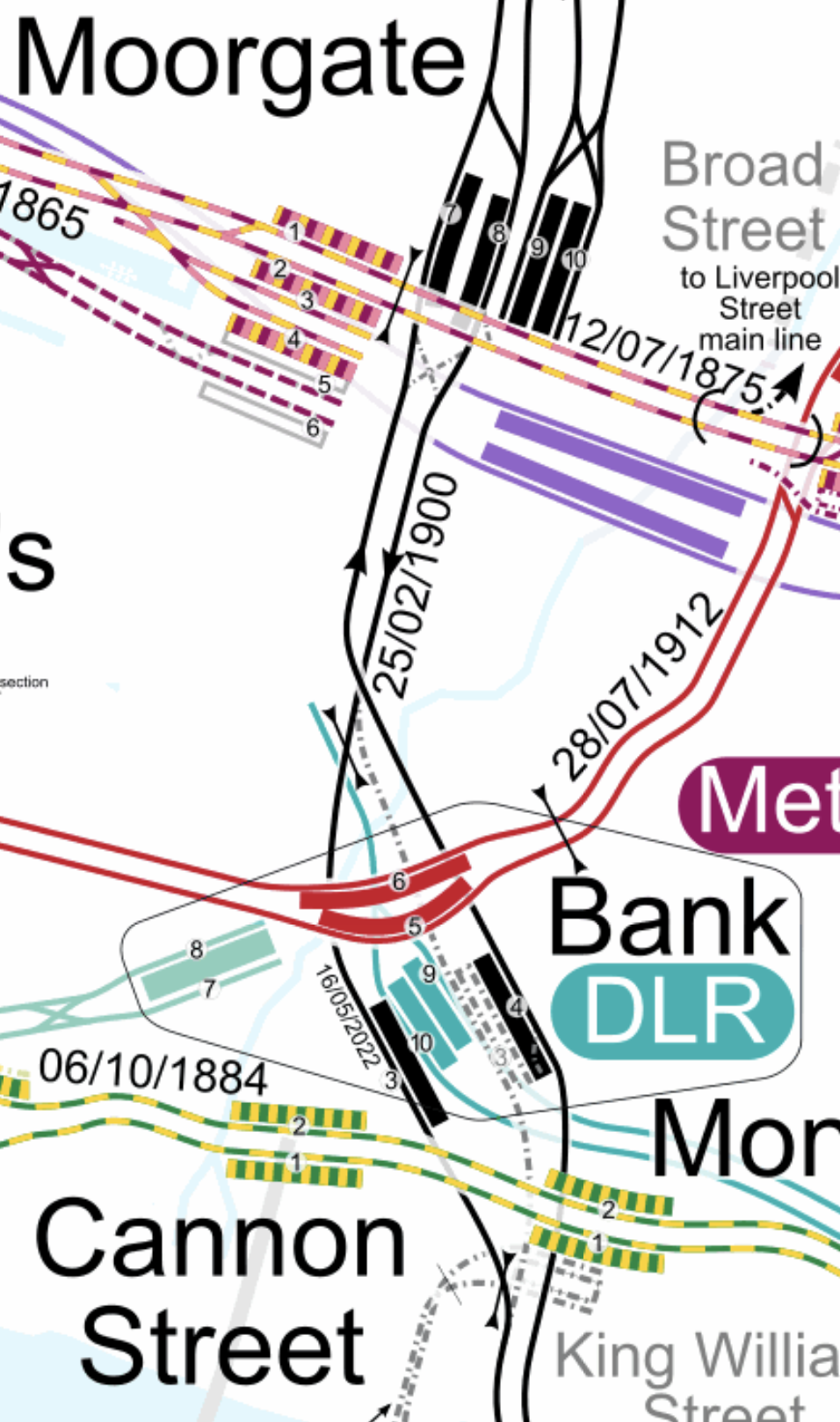
The map from cartometro.com shows the plethora of lines at Moorgate and Bank stations.
Note.
- Moorgate station is served by the Circle, Elizabeth, Hammersmith & City, Metropolitan, Northern and Northern City Lines.
- Bank station is served by the Central, Circle, District, Northern and Waterloo & City Lines.
- Bank station is also one terminus of the DLR.
I believe it would be possible to dig a long pedestrian tunnel with a travelator, between Moorgate and Bank stations under Moorgate, which connects the two stations.
City Thameslink Station And St. Paul’s
I discussed this in A Pedestrian Connection Between City Thameslink Station And St. Paul’s Tube Station.
 The Anonymous Widower