Government Orders 10,000 Ventilators From Dyson
The title of this post, is the same as that of this article on the BBC,
It may seem strange to some, that the government has turned to a vacuum cleaner manufacturer to build high-tech medical equipment for the NHS.
But.
- Look at the quality of the parts on your Dyson vacuum, where they all fit tightly together.
- I suspect that some of the principles about air-flow in a vacuum, apply to a ventilator.
- Advanced manufacturing has progressed a lot in recent years and it should be one of Dyson’s strengths.
The BBC are reporting that Dyson is working with The Technology Partnership, an innovation company based in Cambridge.
Get Set For Max Return, Says Boeing
The title of this post is the same as this article in The Times.
This is the introductory paragraph.
Boeing is to fire up its 737 Max production line by May as it seeks to return the aircraft to service by the middle of the year.
Two points from the article.
- Some suppliers have been asked to start shipping parts from April.
- Boeing’s share price has risen, by 34.3%
But given the shadow over air travel caused by COVID-19, is restarting production a wise move?
I certainly don’t trust the Boeing 737 MAX!
But then if you live in London, I don’t think, you will need to fly in one, as there are a good selection of short haul trains and airlines that fly the smaller Airbuses.
I probably won’t fly short-haul again, until an airline starts flying electric aircraft.
Network Rail Consults On Reigate Turnback Platform Plans
The title of this post, is the same as that of an article in Rail Magazine.
This is the introductory paragraph.
Network Rail is consulting with the public over plans to build a 12-car turnback platform at Reigate.
The third paragraph says this.
NR says “Reigate is hampered by platforms that are four-car in length. This means that Southern trains must split/join at Redhill, adding time to journeys and limiting capacity”
Other points are also made.
- Thameslink’s Class 700 trains which are fixed formations of eight or twelve cars can’t call at Reigate station.
- Power is poor at Reigate limiting the length of trains.
- Passengers from Reigate to London Bridge and beyond need to change at Redhill or East Croydon.
This Google Map shows the station.
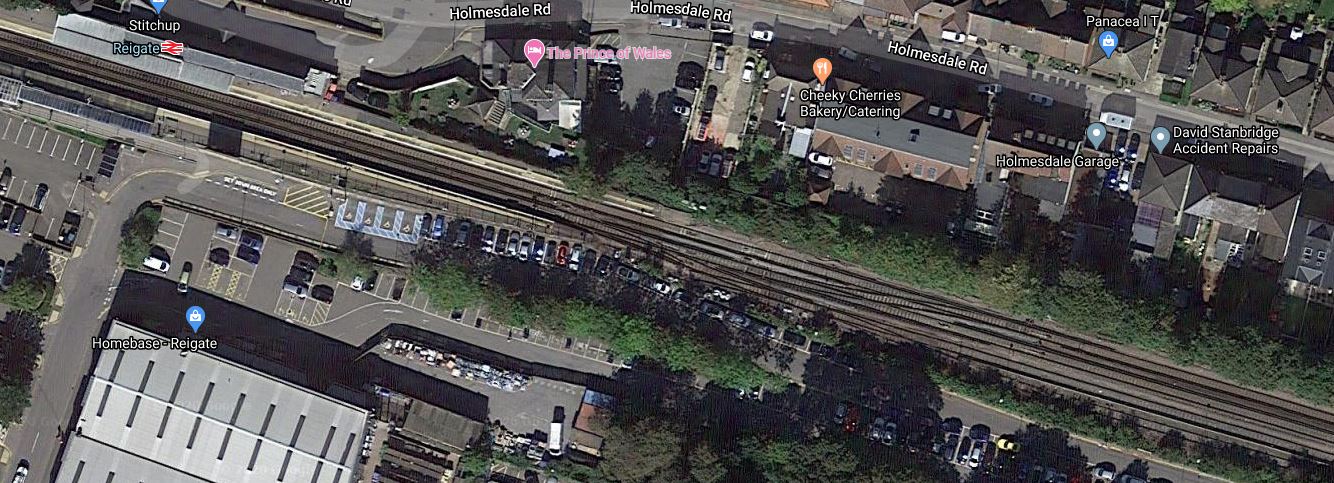
The new bay platform, which will be numbered 3, will go on the South side of the tracks at the East end of the station, where the car-park currently is situated.
Future Services At Reigate Station
In the Wikipedia entry for Reigate station, under Future, this is said.
In 2020, Network Rail announced that they are planning to upgrade Reigate station, which includes constructing a new 12-carriage bay platform (number 3) on the south side of the station, and extending the existing platform 2 to also accommodate 12-car trains. Currently the track layout just east of the station forces Southern to turn its trains around on platform 2, and since this platform is not long enough to accommodate 8-car sets, Southern services to and from Reigate are limited to 4 carriages in length. The upgrade would enable longer trains to serve the station, and the new bay platform would allow trains to/from London to terminate there instead of occupying the through westbound track, thus improving reliability on the whole line.
Once the upgrade is delivered, there are further proposals to introduce Thameslink services running to London Bridge, London St Pancras and beyond to destinations north of London, replacing the current Southern services to London Victoria.
In some ways, this work at Reigate is all part of a larger series of projects, that are aiming to improve reliability and create more capacity on the Brighton Main Line.
The Brighton Main Line Improvement Project
This £300 million project is described on this page on the Network Rail web site.
The improvement project focussed on the southern end of the Brighton Main Line between Three Bridges and Brighton / Lewes. Major engineering work was planned for the Victorian-era tunnels at Balcombe, Clayton, Haywards Heath and Patcham and the railway which runs through them.
We stemmed leaks into the tunnels and improved drainage, while the third rail power supply and signalling were replaced or upgraded.
Elsewhere on the closed section, we replaced the track and sets of points, which enable trains to switch between tracks.
The project is now complete and won an award at the Railway Innovation Awards 2019.
Upgrading Gatwick Airport StationThis £150 million project is described on this page on the Network Rail web site.The size of Gatwick Airport station will be doubled to improve the journey between train and plane.Benefits will include.
- Improved Accessibility
- A better journey experience
- Improved train performance
Works will include.
- Doubling the size of the station concourse.
- Eight new lifts, five new escalators and four new stairways.
- Widened platforms 5 and 6.
- Upgraded connections to the terminal.
The works will start in May 2020 and finish in 2023.
Access for All At Crawley Station
This £3.9 million project is described on this page of the Network Rail web site.
Crawley station is being upgraded to full step-free access, which should be complete in Autumn 2020.
It looks like a second bridge is being installed over the tracks.
I do wonder, if Crawley station is being upgraded, so that it can be used as a back-up access to Gatwick Airport, if some of the construction work at Gatwick Airport station means that the station will be closed.
The dates certainly fit and the station has two trains per hour (tph) to both London Bridge and Victoria stations.
Unblocking The Croydon Bottleneck
This £300 million project is described on this page of the Network Rail web site.
This is the introductory paragraph.
We are proposing an upgrade to the Brighton Main Line, to provide more reliable, more frequent and faster services for the 300,000 passengers who rely on it each weekday, and to provide the capacity needed for future growth.
There is also what looks to be a fairly frank video.
Platform 0 At Redhill Station
Redhill station gained a new Platform 0 a couple of years ago.
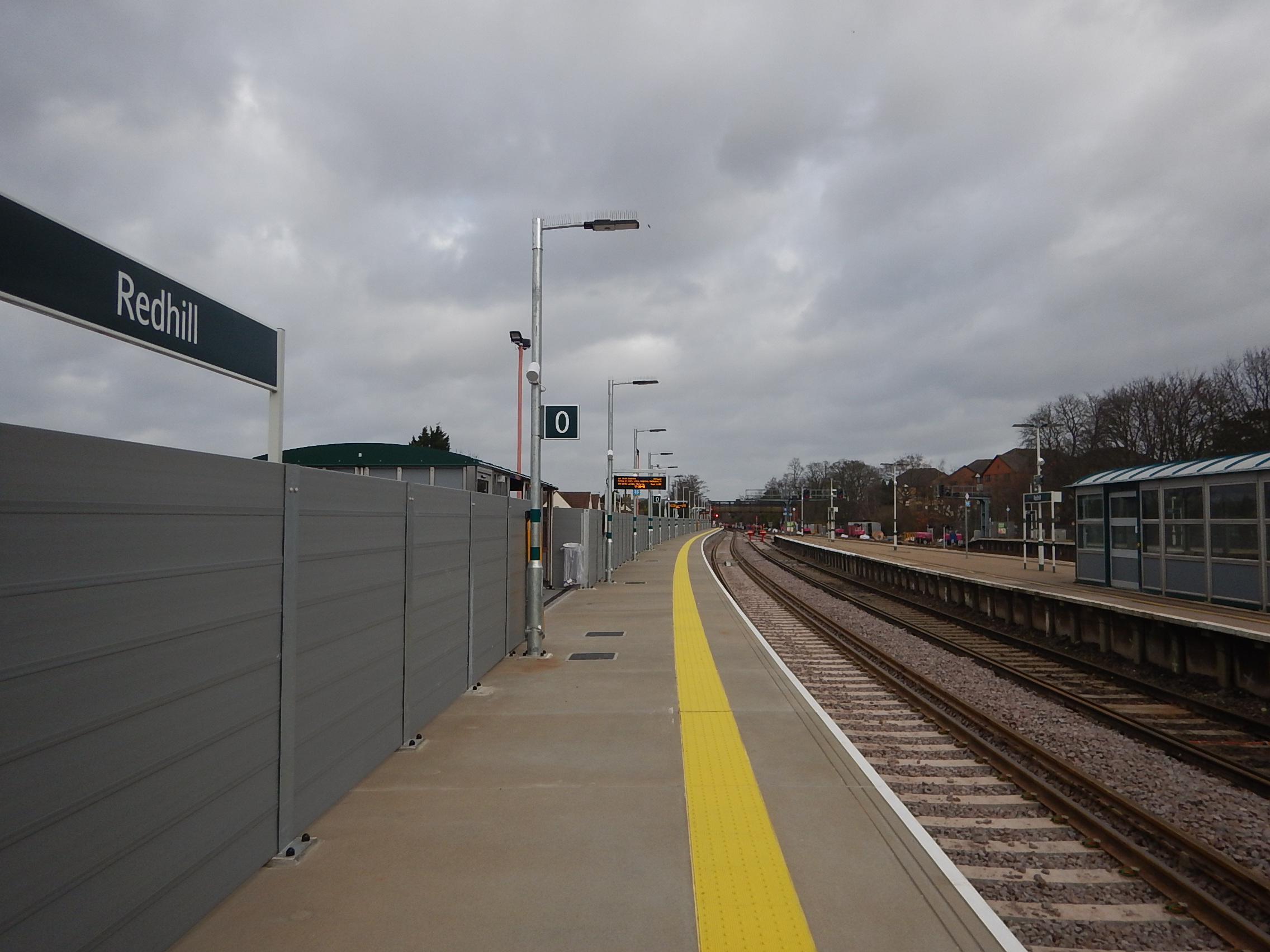
This long platform must help the operation of the station.
Thoughts On The Reigate Scheme
These are my thoughts on the building of two twelve-car platforms at Reigate station.
Thameslink To Reigate
This document on the Network Rail web site is entitled Connecting Reigate To Thameslink.
Currently, train services to the Reigate/Gatwick Airport/Crawley area are as follows.
- Southern – Two tph – London Victoria and Reigate via East Croydon, Purley, Coulsdon South, Merstham and Redhill.
- Southern – Two tph – London Victoria and Southampton/Portsmouth via East Croydon, Gatwick Airport, Three Bridges, Crawley and Horsham
- Thameslink – Two tph – Peterborough and Horsham via East Croydon, Purley, Coulsdon South, Merstham, Redhill, Horley, Gatwick Airport, Three Bridges and Crawley
- Thameslink – Two tph – Bedford and Gatwick Airport via East Croydon, Purley, Coulsdon South, Merstham, Redhill, Earlswood, Salfords and Horley.
- Thameslink – Two tph – Cambridge and Brighton via East Croydon and Gatwick Airport
- Thameslink – Two tph – Bedford and Brighton via East Croydon and Gatwick Airport
- Gatwick Express – Two tph – London Victoria and Brighton via Gatwick Airport
- Gatwick Express – Two tph – London Victoria and Gatwick Airport
- Great Western Railway – One tph – Reading and Gatwick Airport via Reigate and Redhill
Stations around Gatwick will get the following services from London
- Coulsdon South – Six tph
- Crawley – Four tph
- Earlswood – Two tph
- Gatwick Airport – Sixteen tph
- Horley – Four tph
- Merstham – Six tph
- Redhill – Six tph
- Reigate – Two tph
- Salfords – Two tph
I can see good reasons for terminating the Bedford and Gatwick Airport service at Reigate.
- Gatwick Airport has sixteen tph to Central London.
- During the rebuilding of Gatwick, it might be a good idea not to have trains terminating at Gatwick.
- Reigate is under seven miles from Gatwick Airport and a coach service would take under twelve minutes.
This would mean that, train services to the Reigate/Gatwick Airport/Crawley area are as follows.
- Southern – Two tph – London Victoria and Southampton/Portsmouth via East Croydon, Coulsdon South, Merstham, Redhill, Earlswood, Salfords, Horley, Gatwick Airport, Three Bridges, Crawley and Horsham
- Thameslink – Two tph – Peterborough and Horsham via East Croydon, Purley, Coulsdon South, Merstham, Redhill, Horley, Gatwick Airport, Three Bridges and Crawley
- Thameslink – Two tph – Bedford and Reigate via East Croydon and Redhill
- Thameslink – Two tph – Cambridge and Brighton via East Croydon and Gatwick Airport
- Thameslink – Two tph – Bedford and Brighton via East Croydon and Gatwick Airport
- Gatwick Express – Two tph – London Victoria and Brighton via Gatwick Airport
- Gatwick Express – Two tph – London Victoria and Gatwick Airport
- Great Western Railway – One tph – Reading and Gatwick Airport via Reigate and Redhill
Stations around Gatwick will get the following services from London
- Coulsdon South – Four tph
- Crawley – Four tph
- Earlswood – Two tph
- Gatwick Airport – Fourteen tph
- Horley – Four tph
- Merstham – Four tph
- Redhill – Six tph
- Reigate – Two tph
- Salfords – Two tph
Note.
- I have adjusted calling patterns to what is shown in the document called Connecting Reigate to Thameslink.
- Southern and Gatwick Express services will go to Victoria
- Thameslink services will go via London Bridge and St. Pancras.
- Passengers will be able to change at Redhill or East Croydon to swap their London terminal between Victoria and London Bridge/St. Pancras.
Obviously, Network Rail must have their own and better plans to run the services.
Will Platform 3 At Reigate Be Used As An Emergency Platform?
With the right track layout and signalling a bay platform can easily handle four tph, as platforms on the London Overground do at Clapham Junction, Crystal Palace, Dalston Junction, Highbury & Islington, New Cross and West Croydon stations. Some of these platforms will be going to six tph within a couple of years.
Over the next three years, Gatwick Airport station is being rebuilt.
Surely, Reigate would make an ideal station to turn trains, if the Brighton Main Line was blockaded.
- Passengers could be taken by bus to Gatwick.
- The two twelve-car platforms would be able to handle the longest trains on the Brighton Main Line.
- The car park could be used as a bus terminal.
It looks to me, like Network Rail are planning for the worst.
Electrification To Guildford?
Consider.
- One of the sub-projects of the rebuilding of the platforms at Reigate station will be boosting the power supply.
- Within two years, Great Western Railway will be running Class 769 trains with a third-rail capability between Reading and Redhill/Gatwick.
- All passenger trains running between Redhill and Reigate will have a third-rail capability.
- There is a 750 VDC electricity supply for electrification at Guildford.
So why, shouldn’t the line be electrified to Guildford station?
Thameslink To Guildford?
Consider.
- Trains between Reigate and Guildford take twenty-five minutes to do the twenty miles on the North Downs Line.
- I have read somewhere, that Guildford station is to be rebuilt.
- The North Downs Line passes through the sizeable town of Dorking.
- Two tph between Reading and Gatwick and two tph between Guildford and Redhill could surely share tracks between Guildford and Redhill.
If the line between Reigate and Guildford had been electrified, would it be worthwhile extending Thameslink from Reigate to Guildford?
Conclusion
I like this scheme at Reigate, but I do think there’s more behind it than has been disclosed.
LNER To Keep Class 91s Until 2023
The title of this post is the same as that of this article on Rail Magazine.
This is the two introductory paragraphs.
Class 91s hauling Mk 4s will remain with London North Eastern Railway until 2023.
Ten rakes of coaches and ten ‘91s’ will be used, with two additional spare ‘91s’ and a handful of spare Mk 4s also retained.
It looks like LNER are keeping enough Class 91 locomotives and Mark 4 coaches to guarantee having ten trains in service.
Why 2023?
The answer to this question is probably contained in an article in Issue 901 of Rail Magazine, which is entitled ORR Approves New Hitachi Inter-Car Connector Design, which has these two statements.
- All inter-car connectors will have been updated by Summer 2022.
- Hitachi has deals for a further 61 trains for three operators and all will be in traffic by the end of 2022.
It looks like Hitachi could have production capability from 2023.
The original Rail Magazine article also says this.
The extension is until the end of 2023 while LNER sources brand new trains, which would take a minimum of around two years to build and deliver. The operator has previously told RAIL it needs around six new trains.
It appears the difference between retaining ten InterCity 225 trains and adding six new trains to the fleet, is to cover for the retrofit of the inter-car connectors.
The Performance Of A Class 91 Locomotive And Five Mark 4 Coaches
I have seen in mentioned that Virgin East Coast were intending to run shortened rakes of Mark 4 coaches.
In the Wikipedia entry for the Class 91 locomotive, there is a section called Speed Record, where this is said.
A Class 91, 91010 (now 91110), holds the British locomotive speed record at 161.7 mph (260.2 km/h), set on 17 September 1989,[ just south of Little Bytham on a test run down Stoke Bank with the DVT leading. Although Class 370s, Class 373s and Class 374s have run faster, all are EMUs which means that the Electra is officially the fastest locomotive in Britain. Another loco (91031, now 91131), hauling five Mk4s and a DVT on a test run, ran between London King’s Cross and Edinburgh Waverley in 3 hours, 29 minutes and 30 seconds on 26 September 1991. This is still the current record. The set covered the route in an average speed of 112.5 mph (181.1 km/h) and reached the full 140 mph (225 km/h) several times during the run.
When you consider, this was nearly forty years ago, there can’t be much wrong with British Rail’s train engineering.
What Average Speed Do You Need To Achieve London And Edinburgh In Four Hours?
The rail distance between London and Edinburgh is 393 miles, so four hours needs an average speed of 98 mph.
Consider.
- I have travelled in InterCity 125 and InterCity 225 trains, where I have measured the speed at around 125 mph for perhaps thirty or forty miles.
- In Norwich-In-Ninety Is A Lot More Than Passengers Think!, I travelled to Norwich and back, at around 100 mph most of the way.
- Continuous 125 mph running is just as much about the track as the train.
- I have watched a driver in an InterCity 125 at work and these guys and girls know the route and their charges, like the backs of their hands.
I think it is possible to arrange train pathing, so that trains could run between London and Edinburgh in excess of 100 mph.
I believe, that this would enable London and Edinburgh in under four hours.
Will LNER Run Faster Services With Short Sets?
Virgin East Coast’s original plan, was to run short sets between London and Edinburgh.
Would these short sets have been faster, than full size sets?
- The power-to-weight ratio is higher, so acceleration would be better.
- A five-car train would probably need half the power of a ten-car train to cruise at a given speed.
- It might be possible to save weight to increase performance.
- There would be no intermediate stops.
- They know that the Kings Cross and Edinburgh record is three-and-a-half hours, which was set by a five-car train.
- In-cab digital signalling and other improvements could be fitted.
It should also be noted, that a short set would probably do significantly less damage to the track than a full-size set at 140 mph.
Possible Short InterCity 225 Routes
LNER have only six fully-electrified routes, where they could run short InterCity 225 sets.
- Kings Cross and Leeds
- Kings Cross and Doncaster
- Kings Cross and York
- Kings Cross and Newcastle
- Kings Cross and Edinburgh
- Kings Cross and Stirling
Note.
- All routes are fully-electrified, which is a pre-requisite, as InterCity 225 sets have no self-power capability.
- Kings Cross and Leeds will probably be run by pairs of Class 800 trains, as LNER looks like it will split trains at Leeds and serve two destinations.
- Do Doncaster, York and Newcastle generate enough traffic for a fast service?
- The Edinburgh route will have direct competition from East Coast Trains, who will be running five-car Class 803 trains.
- The Stirling route at over five hours is probably too long.
It looks to me, that the preferred route for InterCity 225 sets,; short or full-size will be Kings Cross and Edinburgh.
How Many Trains Would Be Needed To Run An Edinburgh Service?
A flagship service between London and Edinburgh might have the following timetable.
- One tph perhaps leaving at a fixed time in every hour.
- A timing of under four hours.
- Minimal numbers of intermediate stops.
- The service would not be extended past Edinburgh, as the trains need electrified lines.
Suppose, the trains could do a round trip in eight hours, this would mean that eight trains would be needed to provide a service.
Ten trains would allow one train in maintenance and one ready to be brought into service at a moment’s notice.
Does this explain, why ten InterCity 225 sets are being retained.
Would In-Cab Signalling Be Needed?
I suspect that under current rules, in-cab digital signalling might be needed! But as I observed in Partners On Board For In-Cab Signalling Project On East Coast Main Line, this is on its way!
But, as the average speed needed to do London and Edinburgh in four hours is only 98 mph, I wonder what time could be achieved by one of the top drivers, using the following.
- All their route knowledge and driving skill.
- A five-car train.
- Maximum acceleration.
- A well-thought out pathing structure.
- A clear track
- No hold-ups
- A non-stop run.
If the train were to run at 125 mph all the way without stopping, the journey time would be around three hours and ten minutes.
Wikipedia says this about in-cab digital signalling on the East Coast Main Line.
The line between London King’s Cross and Bawtry, on the approach to Doncaster, will be signalled with Level 2 ERTMS. The target date for operational ERTMS services is December 2018 with completion in 2020.
- I estimate that that this will mean that 145 miles of the route will have full in-cab digital signalling.
- Currently, the fastest London and Doncaster times are around 90 minutes, with many taking 97-98 minutes for the 155 miles.
This means the fast train takes 84 minutes between King’s Cross and Bawtry, at an average speed of 103 mph.
Suppose this fast train could go at 125 mph for all but twenty of the distance between King’s Cross and Bawtry, how much time would this save?
- 125 miles at 125 mph would take 60 minutes.
- 125 miles at 103 mph would take 72 minutes.
This means that just by running at 125 mph continuously for all but twenty miles could save up to twelve minutes.
If 140 mph running could be maintained on this section, another six minutes would be saved.
As they say, every little helps!
Lessons From Norwich-in-Ninety
In Norwich-In-Ninety Is A Lot More Than Passengers Think!, I travelled to Norwich and back, at around 100 mph most of the way.
Liverpool Street and Norwich is 114 miles and a ninety minute journey is an average of just 76 mph, which is 24 mph below the maximum cruise of a Class 90 locomotive and a rake of eight Mark 3 coaches. Compare this with an average speed of 98 mph needed for London and Edinburgh in four hours and the 125 mph maximum certified cruise of an InterCity 225 train, without in-cab digital signalling.
It should also be noted that Greater Anglia, run an additional stopping train after the Norwich-in-Ninety expresses, that call at several important stations and not just Ipswich.
Will LNER use a similar strategy? It was working well and successfully for Greater Anglia, until services were decimated by COVID-19!
Will LNER Increase Frequency Between London And Edinburgh To Three Trains Per Hour?
It would seem that the current two tph service running nine- or ten-car trains, runs with a high level of occupancy, so to replace some of these trains with faster and shorter trains might cause capacity problems.
But to add, a third faster train in the hour might be possible. Especially, if the Norwich-in-Ninety strategy were to be used. The timetable in both directions could be something like.
- XX:00 – Four hour express
- XX:06 – Four-hour plus train to current timing
- XX:30 – Four-hour plus train to current timing
LNER’s Marketing Department would like it.
Could Hitachi Trains Achieve London and Edinburgh In Four Hours?
The all-electric Class 801 trains most certainly have a performance to match an InterCity 225 in terms of acceleration and maximum operating speed without in-cab digital signalling. After all, the Japanese train was designed as a direct replacement for British Rail’s last high performance train!
So I believe that with a well-designed timetable, electric Hitachi trains will be able to run between London and Edinburgh in under four hours, with a small number of stops.
Note that LNER will have a fleet of thirty nine-car and twelve five-car all-electric Class 801 trains.
But East Coast Trains will have a fleet of five five-car all-electric Class 803 trains, which could get near to a four-hour timing, despite their four stops at Stevenage, Durham, Newcastle and Morpeth.
- I have timed a Class 800 train leaving Kings Cross and they get up to 125 mph fairly fast, by about Potters Bar, which is reached in eleven minutes.
- Stops at Stevenage, Durham and Morpeth will probably each add two minutes to the timing, with Newcastle adding five minutes.
- 125 mph all the way from Kings Cross to Edinburgh would be a timing of three hours and ten minutes.
Add up the stationary times at the stops (2+2+2+5) and that gives a journey time of three hours and twenty-one minutes, which leaves thirty-nine minutes for the five decelerations and accelerations between stationary and 125 mph.
This page on the Eversholt Rail web site, has a data sheet for a Class 802 train, which is a Class 800 train with larger engines.
The data sheet shows that a five-car train can accelerate to 125 mph and then decelerate to a stop in six minutes in electric mode. So five accelerations/deceleration cycles to 125 mph would take thirty minutes. This gives a journey time between London and Edinburgh of three hours and fifty-one minutes.
Note that Class 801 trains, which don’t lug diesel engines about will have better acceleration, due to the lower weight, so should have better acceleration and deceleration.
Does this time seem reasonable? First Group with their extensive experience of running Class 800 trains on the Great Western Main Line will know the capabilities of the trains, down to the last mph.
I doubt, they’d have bought the trains for East Coast Trains, if they couldn’t do London and Edinburgh in four hours.
I believe that both InterCity 225 and Class 801/803 trains can do London and Edinburgh in four hours and any train company that doesn’t offer this timing, will come second!
A Possible Hitachi-Based Timetable For LNER
I would be very surprised if a service pattern like this wouldn’t be possible.
- XX:00 – Four hour express – Class 801 train
- XX:06 – Four-hour plus train to current timing – Class 801 train or InterCity 225
- XX:30 – Four-hour plus train to current timing – Class 801 train or InterCity 225
Note.
- As there is only one extra train per hour, ten extra trains would be the addition to the fleet, needed to run this service pattern.
- Class 801 trains could be five-car or nine-car sets as passenger numbers require.
- InterCity 225 trains could be as long as are needed.
InterCity 225 trains would only be doing the job, they’ve done for many years.
Targeting The Airline Market
In Trains Ordered For 2021 Launch Of ‘High-Quality, Low Fare’ London – Edinburgh Service, which described the launch of First East Coast Trains, I said this about their target market.
First East Coast Trains is targeting the two-thirds of passengers, who fly between London and Edinburgh. The company are also targeting business passengers, as the first train arrives in Edinburgh at 10:00. Trains will take around four hours.
Note that currently, LNER’s first train arrives at 11:12. In the future, I would envisage that LNER intend to go for four hour journeys.
It would seem to me, that both train companies will be attempting to take passengers from the airlines.
Conclusion
It looks to me that ten InterCity 225 trains could add a third train in each hour between London and Edinburgh for LNER, that would do the journey in under four hours.
The third train could either be an InterCity 225 or a Class 801 train.
Enter The Polymath!
This article in today’s Times is entitled Pandemic Can Be Controlled, Says Scientist Michael Levitt.
Michael Levitt is no ordinary scientist.
- Born in South Africa
- Educated at Kings College and Cambridge
- Professor at Stanford
- A Nobel Laureate
He is also married to an expert in Chinese art, so visits China regularly.
This is the introductory paragraph to the Times article.
The world will beat coronavirus faster than most experts expect, provided that social distancing is observed, a Nobel laureate scientist who correctly forecast the pandemic’s trajectory in China has predicted.
This is the last section of the article, which has a headline of Levitt’s China Forecast.
- February 21 Professor forecasts 80,000 cases and 3,250 deaths
- March 23 Official figures from China say there have been 81,093 cases and 3,270 deaths. There have been 39 additional cases today and nine additional deaths
Whatever you do today, read the article.
It does look that his advice has been read by Boris! Or Boris’s advisors have come to the same conclusion.
UK To Raise Contactless Card Payment Limit To 45 pounds In April
The title of this post is the same as that of this report on Reuters.
This is the introductory paragraph.
Britain will raise the spending limit for contactless card payments to 45 pounds ($52) from 30 pounds on April 1 to support consumers during the coronavirus outbreak, the UK Finance industry association said on Tuesday.
I think this is a good thing.
When I go to Marks and Spencer to get my food, I have found that for the goods I buy, their average cost is two pounds. It is annoying the number of times I buy sixteen or seventeen items and I am just over the thirty pound limit.
So from April the first, I will be using chip-and-pin less often.
Surely, you’re more likely to pick up COVID-19 with chip-and-pin!
My Hand Is Mending Well
I took this picture in the GP’s surgery of my hand without a dressing.

The nurse felt, that it won’t be long before I can dispense with the plaster.
Aren’t bodies wonderful, how they can heal themselves! That wound is about twenty days old!
Walking Through De Beauvoir Town
I took these pictures as I walked through de Beauvoir Town, as I walked through today on my way to and from the doctor’s to get my hand dressed.








There wasn’t many people about and I perhaps only got within three metres to one person and her dog.
What would help would be a few seats, so that elderly people like me could take a break.
Flying Taxi Start-Up Raises $240m From Existing Investors Led By Tencent
The title of this post, is the same as that as this article on the Financial Times.
This is the introductory paragraph.
Lilium, a German flying taxi start-up, has raised $240m from existing investors led by Chinese technology group Tencent to fund the next stage of its growth.
The article has a picture of the Lilium Jet, which looks to be an interesting design.
- It is an electric VTOL aircraft.
- Power comes from no less than thirty-six electric motors driving ducted fans.
- The fans will tilt for take-off and landing.
- Maximum speed will be 190 mph, with a cruise of 170 mph.
- Range will be 300 kilometres or 186 miles
- Total installed power is 320 kW.
- Less than 150 kW will be needed for cruise.
- A MW (?) battery will be fitted according to Wikipedia. Do they mean MWh?
- It can carry two passengers with five from 2025.
- Empty weight is 440 Kg.
- Maximum take-off is 640 Kg.
- Initially, it will have a pilot, but the aim is for a completely autonomous aircraft.
Lilium aims to run a city-to-city taxi service starting in 2025.
I have a few thoughts.
Aerodynamics
There have been a lot of developments in aerodynamics in the last few years and the Lilium Jet and other electric aircraft like the Eviation Alice take full advantage of the developments.
So don’t expect electric aircraft to look convectional, unless perhaps they are an electric-engined conversion of an existing conventional aircraft!
Structure
The structure of aircraft is getting lighter and Airbus and Boeing with the 787 Dreamliner are showing what is possible.
Will an empty weight of 440 Kg be possible? Especially, if that includes the battery.
The Wikipedia figures allow a payload of 200 Kg. That must be only two passengers.
Power
Wikipedia talks about a one MW battery, but I suspect they mean one MWh, as this is the unit of battery capacity.
In Sparking A Revolution, I quoted Hitachi’s predictions and suggested that they could have a five-tonne battery, that held 15 MWh by 2035.
This would mean that a one MWh battery would weigh 333 Kg.
This must be near to the target weight of the battery needed to power a Lilium Jet.
But a one MWh battery that weighs just 333 Kg. would be a tough ask given the limitations of today’s battery chemistry.
Fire
Wikipedia says this about a fire.
The first prototype was destroyed by fire during maintenance on 27 February 2020.
As the Eviation Alice also suffered a fire, are these aircraft pushing batteries too hard.
Conclusion
I am sceptical about some of the figures quoted for the Lilium Jet in Wikipedia.
When I see the following.
- A Lilium Jet in the air, taking-off and landing.
- Two passengers flying in the aircraft.
- A Lilium Jet on a set of scales.
I’ll revise my opinion.
There is this video.
Obviously, I’m doing something wrong in my calculations.
Partners On Board For In-Cab Signalling Project On East Coast Main Line
The title of this post, is the same as that of this article on Rail Advent.
This is the introductory paragraph.
Network Rail has announced that it has brought Siemens and Atkins on as its partners in a project to introduce in-cab signalling on the southern section of the East Coast Main Line.
It is good, that a start is being made on this significant project, which should increase capacity between Kings Cross and Doncaster.
 The Anonymous Widower