Will I Get Coronavirus?
Everybody is saying that washing hands regularly in soap and water, is the best defence against the coronavirus.
How do I wash this hand?

Wish great difficulty, I assume.
All Boots could sell me was a packet of Milton Baby Wipes.

Let’s hope they work.
An Accident In My Bedroom
I awork on Saturday morning to find myself in a bedroom covered in blood and a living room next door with half as much.
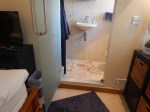


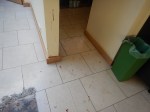




It appeared, that I’d fallen over the bathroom step in the middle of the night and banged my head on the toilet.
I ended up spending a night in the Royal London Hospital and they fixed me up well!
It is now Monday morning and the first picture says a lot. Note the the mat by the step is out of line. It slipped, I then tripped over the step and hit my head on the basin. There is olso an overturned stool in the bathroom, which I must have fallen on and this probably did more damage.
Next Stop, Hydrogen-Powered Trains
The title of this post is the same as that as this article on the BBC’s Future Platet web site.
This is the introductory paragraph.
As old diesel trains are phased out of rail networks around the world, the UK is about to test a new type of engine that could help to decarbonise railways – hydrogen-powered trains.
The article then goes on to summarise the current developments in hydrogen grains.
Northern’s Battery Plans
The title of this post, is half of the title of an article in the March 2020 Edition of Modern Railways.
It appears that CAF will convert some three-car Class 331 trains into four-car battery-electric trains.
- A three-car Class 331 train has a formation of DMSOL+PTS+DMSO.
- A fourth car with batteries will be inserted into the train.
- Batteries will also be added to the PTS car.
- The battery-electric trains would be used between Manchester and Windermere.
It looks like a round trip would take three hours including turnarounds, thus meaning three trains would be needed to run the service.
The article says this.
The branch was due to be electrified, but this was cancelled in 2017, and as a result 3×3-car Class 195 trains were ordered. As well as the environmental benefits, introduction of the battery ‘331s’ on Windermere services would free-up ‘195s’ for cascade elsewhere on the Northern network.
Note that the total length or the route is 98 miles of which only the ten miles of the Windermere Branch Line are not electrified.
What Battery Capacity Would Be Needed?
I reckon it will be fine to use a figure of 3 kWh per vehicle-mile to give a rough estimate of the power needed for a return trip from Oxenholme to indermere.
- Two x Ten Miles x Four Cars x 3 kWh would give 240 kWh.
- There would also be losses due to the seven stops, although the trains have regenerative braking, to limit losses.
Remember though that CAF have been running battery trams for several years, so I suspect that they have the experience to size the batteries appropriately.
In Thoughts On The Actual Battery Size In Class 756 Trains And Class 398 Tram-Trains, I say that four-car Class 756 trains will have 600 kWh of batteries and a range of 40 miles. I wouldn’t be surprised to find that a four-car Class 331 train had similar battery size and range on batteries, as the two trains are competing in the same market, with similar weights and passenger capacities.
Charging The Batteries
The Modern Railways article says this about charging the train’s batteries.
Northern believes battery power would be sufficient for one return trip along the branch without recharging, but as most diagrams currently involve two trips, provision of a recharge facility is likely, with the possibility that this could be located at Windermere or that recharging could take place while the units are in the platform at Oxenholme.
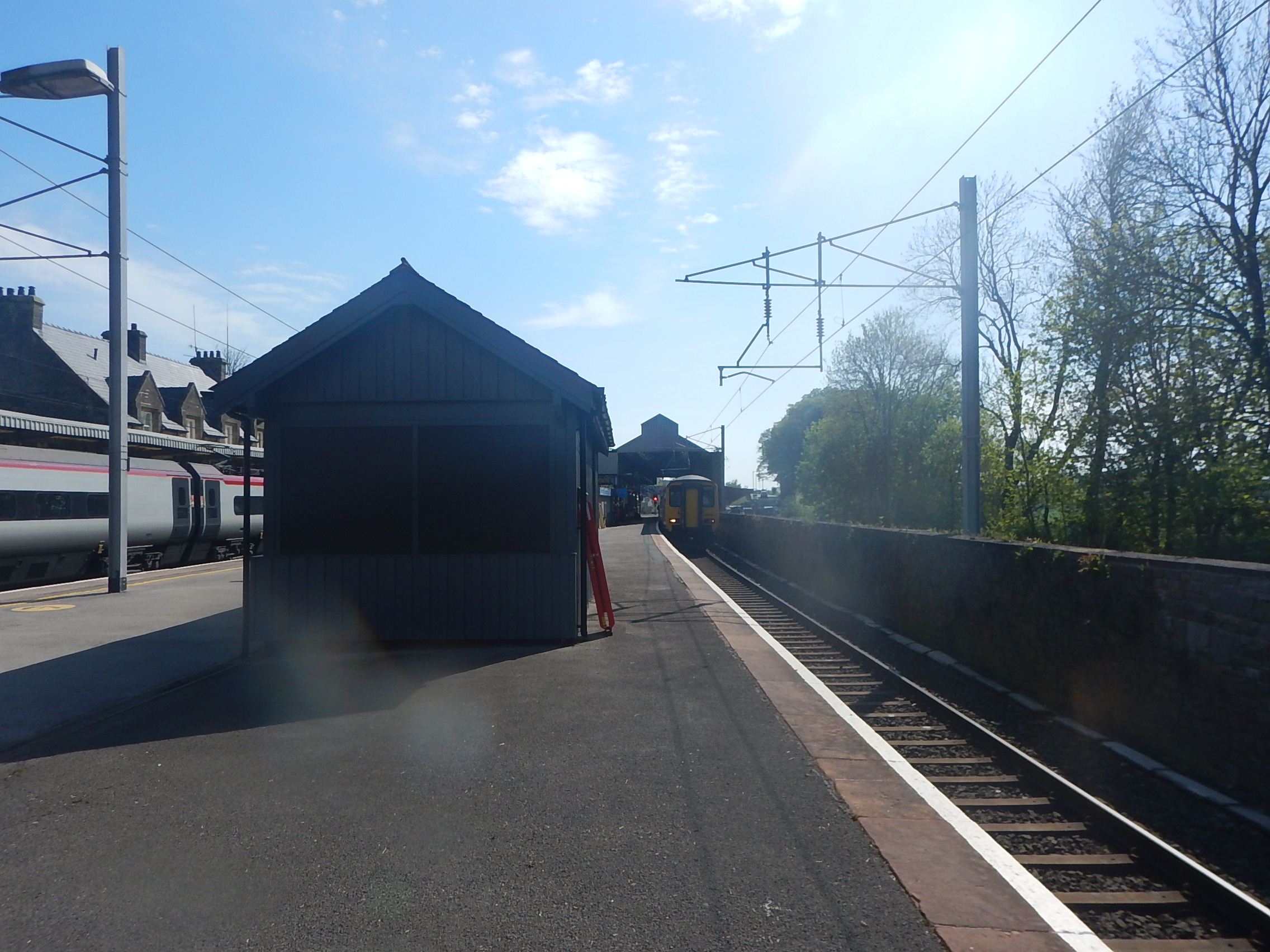
The bay platform 3 at Oxenholme station is already electrified, as this picture shows.
I particularly like Vivarail’s Fast Charge system based on third-rail technology.
A battery bank is connected to the third-rail and switched on, when the train is in contact, so that battery-to-battery transfer can take place.
It’s just like jump-starting a car, but with more power.
This form of charging would be ideal in a terminal station like Windermere.
- The driver would stop the train in Windermere station in the correct place, for passengers to exit and enter the train.
- In this position, the contact shoe on the train makes contact with the third-rail, which is not energised..
- The Fast Charge system detects a train is connected and connects the battery bank to the third-rail.
- Energy flows between the Fast Charge system’s battery bank and the train’s batteries.
- When the train’s batteries are full, the Fast Charge system switches itself off and disconnects the third-rail.
- The third-rail is made electrically dead, when the train has left, so that there is no electrical risk, if someone should fall from the platform.
Note that the only time, the third-rail used to transfer energy is live, there is a four-car train parked on top of it.
When I was eighteen, I was designing and building electronic systems using similar principles to control heavy rolling mills, used to process non-ferrous metals.
Changing Between Overhead Electrification And Battery Power
All trains running between Manchester Airport and Windermere, stop in Platform 3 at Oxenholme station to pick up and put down passengers.
- Trains going towards Windermere would lower the pantograph and switch to battery power.
- Trains going towards Mabchester Airport would raise the pantograph and switch to overhead electrification power.
Both changes would take place, whilst the train is stopped in Platform 3 at Oxenholme station.
Northern’s Hydrogen Plans
The title of this post, is half of the title of an article in the March 2020 Edition of Modern Railways.
I discussed Northern’s possible hydrogen trains in Fuelling The Change On Teesside Rails.
This new article gives a lot more detail in this paragraph.
Northern has submitted planning documents, with the preferred site for a maintenance and fuelling facility understood to be at Lackenby. As hydrogen units would have a more limited operating range than DMUs (around 600 miles), they would likely need to return to the depot every night. Northern believes the routes radiating from Middlesbrough to Nunthorpe, Bishop Auckland and Saltburn are ideal candidates for the operation, as they are unlikely to be electrified and can be operated as a self contained network using hydrogen trains. A fleet of around a dozen Breeze units is planned, with the possibility they could also operate services to Whitby and on the Durham Coast Line to Newcastle. Planning documentation suggested the first hydrogen train would be ready for testing in June 2021, but this was based on construction of the depot facility beginning in January this year.
It all sounds very comprehensive.
Capacity Comparison With The iLint
The Modern Railways article says this about the capacity of the Breeze.
A three-car Breeze is expected to have a similar passenger capacity to a two-car DMU.
A two-car Class 156 train, which currently work the lines around Middlesbrough, was built with 163 seats and the Lint 54, on which the iLint is based, has between 150 and 180 seats.
It will be interesting to see how actual seat numbers compare between the Breeze and iLint.
MAHYTEC Creates World’s First Hydrogen-Powered Riding Lawnmower
I searched for hydrogen-powered lawnmower and found this page.
Surely ideal for the Prince of Wales to buy for Camilla, when she does the mowing at Highgrove.
But seriously, if you can make a hydrogen-powered ride-on mower, you can make any number of smaller horticultural and agricultural vehicles, that run on hydrogen.
How long before John Deere or one of the big Japanese manufacturers releases a hydrogen-powered lawnmower, that takes the large grass-cutting market by storm?
It won’t be just the grass, that is green!
I suspect a company like ITM Power will provide the operator with their own hydrogen generator.
I can envisage the farm of the future, having the following.
- Hydrogen powered tractors, loaders and other powered machinery.
- Hydrogen-powered Range-Rover to speed through the lanes.
- Hydrogen-powered lawn mower to make the place look good.
- Hydrogen-powered vehicles for road use.
All would be powered by the farm’s own hydrgen generator, which might use their own wind turbine.
First Hydrogen Train Arrives In The Netherlands
The title of this post is the same as that on this article of Railway News.
This is the introductory paragraph.
On 26 February the first hydrogen train arrived in the Netherlands. The Dutch rail infrastructure manager ProRail led the train into the country from Germany via Oldenzaal and then ran it on track to its provisional parking facility in Leeuwarden.
The article also says this.
The public will also have the chance to view the hydrogen train on 7 March, when it will be at Groningen Station between noon and 4pm.
I won’t be going, as I’ve ridden the train in Germany as I reported in My First Ride In An Alstom Coradia iLint.

These trains are technology demonstrators at best and greenwash at worst.
Hydrogen power needs a radical new design of train and not a quick rehash of an existing design.
The problem is that the Coradia iLint is based on a diesel mechanical train and it has a lot of transmission noise.
You get less noise and vibration in the average British-Rail era diesel multiple unit like a Class 156 train. But then these are diesel hydraulic, have steel-bodies and built thirty years ago.
When I first saw the iLint, I looked for the pantograph, as these trains run on partially-electrified lines and hydrogen-powered trains are effectively electric trains with a different source of electricity.
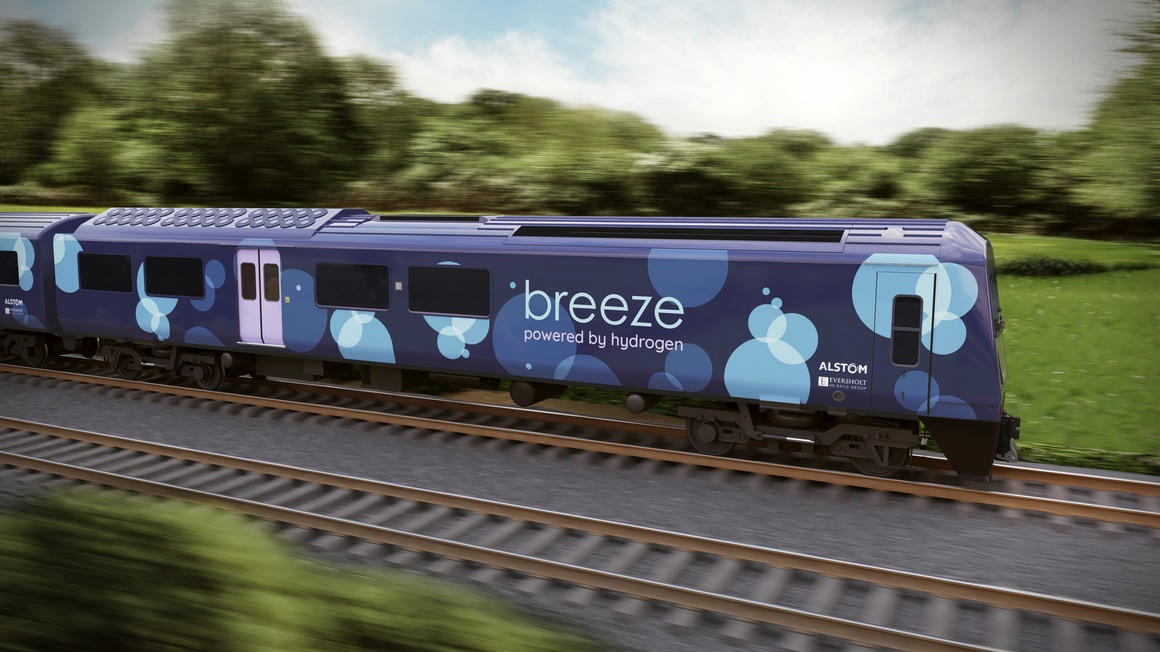
To be fair to Alstom, their development of the hydrogen-powered Class 321 Breeze, will also be able to use a pantograph, but as this visualisation shows, the hydrogen tanks take up a lot of space.
Hydrogen might find itself a place on the railways, but I suspect that battery-electric will always be better for passenger trains.
- Battery technology will improve faster than hydrogen technology.
- Innovators will find better ways of fast-charging trains.
- A battery-electric train will match the daily range of a hydrogen-powered train, using innovative dynamic charging.
- Many modern electric trains can be converted into battery-electric ones.
- As the Class 379 BEMU trial, this conversion can be relatively easy, quick and successful.
I suspect though, the mathematics will be different for freight locomotives.
Could Battery-Electric Hitachi Trains Work LNER’s Services?
Before I answer this question, I will lay out the battery-electric train’s specification.
Hitachi’s Proposed Battery Electric Train
Based on information in an article in Issue 898 of Rail Magazine, which is entitled Sparking A Revolution, the specification of Hitachi’s proposed battery-electric train is given as follows.
- Based on Class 800-802/804 trains or Class 385 trains.
- Range of 55-65 miles.
- Operating speed of 90-100 mph
- Recharge in ten minutes when static.
- A battery life of 8-10 years.
- Battery-only power for stations and urban areas.
- Trains are designed to be created by conversion of existing Class 80x trains
For this post, I will assume that the train is five or nine-cars long. This is the length of LNER‘s Class 800 and 801 trains.
LNER’s Services
These are LNER services that run from London to the North of England and Scotland.
I shall go through all the services and see how they would be affected by Hitachi’s proposed battery-electric Class AT-300 train.
London Kings Cross And Edinburgh
- The service runs at a frequency of two trains per hour (tph)
- Some services extend to Aberdeen, Stirling and Inverness and are discussed in the following sections.
This service can be run totally using the existing electrification.
London Kings Cross And Aberdeen
- The service runs at a frequency of four trains per day (tpd)
- Intermediate stations are York, Darlington, Newcastle, Berwick-upon-Tweed, Edinburgh, Haymarket, Inverkeithing, Kirkaldy, Leuchars, Dundee, Arbroath, Montrose and Stonehaven.
- Currently, the electrification goes 394 miles to Haymarket.
The service is 524 miles long and takes seven hours and four minutes.
To ascertain, if the Hitachi’s proposed battery-electric Class AT-300 train, could run this route, I’ll display the various sections of the route.
- London Kings Cross and Haymarket – 394 miles – Electrified
- Haymarket and Inverkeithing – 12 miles – Not Electrified
- Inverkeithing and Kirkcaldy – 13 miles – Not Electrified
- Kirkaldy and Leuchars – 25 miles – Not Electrified
- Leuchars and Dundee – 8 miles – Not Electrified
- Dundee and Arbroath – 17 miles – Not Electrified
- Arbroath and Montrose – 14 miles – Not Electrified
- Montrose and Stonehaven – 24 miles – Not Electrified
- Stonehaven and Aberdeen – 16 miles – Not Electrified
Note.
- Haymarket and Dundee is a distance of 58 miles
- Dundee and Stonehaven is a distance of 55 miles
So could the service be run with Fast Charge systems at Dundee, Stonehaven and Aberdeen?
I think it could, but the problem would be charging time at Dundee and Stonehaven, as it could add twenty minutes to the journey time and make timetabling difficult on the route.
Perhaps, an alternative would be to electrify a section in the middle of the route to create an electrification island, that could be reached from both Haymarket and Aberdeen.
The obvious section to electrify would be between Dundee and Montrose.
- It is a distance of 31 miles to electrify.
- I have flown my virtual helicopter along the route and it could be already gauge-cleared for electrification,
- Dundee station has been recently rebuilt.
- Haymarket and Dundee is a distance of 58 miles.
- Montrose and Aberdeen is a distance of 40 miles.
- Pantographs could be raised and lowered at Dundee and Montrose stations.
With this electrification and a Fast Charge system at Aberdeen, I believe that Hitachi’s proposed battery-electric Class AT-300 train could run between London Kings Cross and Aberdeen.
As an alternative to the Fast Charge system at Aberdeen, the route of Aberdeen Crossrail between Aberdeen and Inverurie could be electrified.
- This would enable battery-electric Class 385 trains to run between Inverurie and Montrose.
- The route through Aberdeen is newly-built, so should be gauge-cleared and reasonably easy to electrify.
It should also be noted that if battery-electric trains can run between Edinburgh and Aberdeen, then these services are also possible, using the same trains.
- Glasgow and Aberdeen
- Stirling and Aberdeen
All passenger services between Scotland’s Cenreal Belt and Aberdeen appear to be possible using battery-electric trains
London Kings Cross And Stirling
- The service runs at a frequency of one tpd
- Intermediate stations are York, Darlington, Newcastle, Berwick-upon-Tweed, Edinburgh, Haymarket, Falkirk Grahamstown
This service can be run totally using the existing electrification.
London Kings Cross And Inverness
- The service runs at a frequency of one tpd
- Intermediate stations are York, Darlington, Newcastle, Berwick-upon-Tweed, Edinburgh, Haymarket, Falkirk Grahamstown, Stirling, Gleneagles, Perth, Pitlochry, Kingussie and Aviemore.
- Currently, the electrification goes 429 miles to Stirling, but I have read that the Scottish government would like to see it extended to Perth, which is 462 miles from London.
The service is 581 miles long and takes eight hours and six minutes.
To ascertain, if the Hitachi’s proposed battery-electric Class AT-300 train, could run this route, I’ll display the various sections of the route.
- London Kings Cross and Haymarket – 394 miles – Electrified
- Haymarket and Falkirk Grahamsrown – 23 miles – Electrified
- Falkirk Grahamsrown and Stirling – 11 miles – Electrified.
- Stirling and Gleneagles – 17 miles – Not Electrified
- Gleneagles and Perth – 16 miles – Not Electrified
- Perth and Pitlochry – 28 miles – – Not Electrified
- Pitlochry and Kingussie – 44 miles – Not Rlectrified.
- Kingussie and Aviemore – 12 miles – Not Rlectrified.
- Aviemore and Inverness – 34 miles – Not Electrified
Note.
- The distance between Dunblane, where the electrification actually finishes and Perth is only 28 miles, which shouldn’t be too challenging.
- All the sections North of Perth are well within range of a fully charged train.
- Some sections of the route are challenging. Look at the video I published in Edinburgh to Inverness in the Cab of an HST.
- Hitachi run diesel Class 800 trains to Inverness, so they must know the power required and the battery size to run between Perth and Inverness.
I also believe that the Scottish Government, ScotRail, the Highland tourist industry and Hitachi, would all put their endeavours behind a project to get battery-electric trains between Perth and Inverness.
It would send a powerful message, that if battery-electric trains can run on one of the most scenic rail lines in the world without electrification, then nowhere is out of reach of battery trains.
Looking at the figures, I am convinced that a series of Fast Charge systems at stations like Pitlochry, Kingussie and Aviemore could supply enough power to allow a nine-car version of Hitachi’s proposed battery-electric Class AT-300 train to work the route.
This battery-electrification, would also enable battery-electric Class 385 trains to work the route.
If all this sounds a bit fanciful and over ambitious, read the history of the North of Scotland Hydro-Electric Board, which brought electricity to the area in the 1940s and 1950s.
This battery-electrification is a small project compared to what the Hydro-Electric Board achieved.
I can see a time, when similar techniques allow battery-electric trains to run these lines from Inverness.
- Far North Line – 174 miles
- Inverness and Kyle of Lochalsh – 82 miles
- Inverness and Aberdeen – 108 miles
The Far North Line would probably need two or three Fast Charge systems at intermediate stations, but the other lines would probably only need one system, somewhere in the middle.
I think that this analysis for London and Inverness shows that all parts of England, Scotland and Wales can be served by modern battery-electric trains.
It would also appear that the cost of the necessary Fast Charging systems, would be much more affordable than full electrification, North of Perth.
I estimate that less than a dozen Fast Charging systems would be needed, North of Perth.
- Some electrification might be needed in Inverness station.
- Electrification between Inverurie and Aberdeen could help.
- There’s no shortage of zero-carbon electricity from wind and hydro-electric power.
A couple of years ago, I speculated in a post called London To Thurso Direct.
Could it happen on a regular basis in the summer months?
London Kings Cross And Leeds
- The service runs at a frequency of two tph
- Intermediate stations are Stevenage, Peterborough, Grantham, Doncaster and Wakefield Westgate
This service can be run totally using the existing electrification.
London Kings Cross And Harrogate
- The service runs at a frequency of six tpd
- Intermediate stations are Stevenage, Grantham, Doncaster and Wakefield Westgate
- Leeds and Harrogate is a distance of nineteen miles and is not electrified.
- Hitachi’s proposed battery-electric Class AT-300 train should be able to go from Leeds to Harrogate and back, using battery power alone.
- Batteries will be charged using the electrification at and around Leeds.
This service can be run totally using the existing electrification.
London Kings Cross And Bradford Foster Square
- The service runs at a frequency of one tpd
- Intermediate stations are Stevenage, Peterborough, Grantham, Doncaster and Wakefield Westgate
- Leeds and Bradford Forster Square is a distance of fourteen miles and electrified.
This service can be run totally using the existing electrification.
London Kings Cross And Skipton
- The service runs at a frequency of one tpd
- Intermediate stations are Stevenage, Peterborough, Grantham, Doncaster and Wakefield Westgate
- Leeds and Skipton is a distance of twenty-six miles and electrified.
This service can be run totally using the existing electrification.
London Kings Cross And Lincoln
- The service runs at a frequency of one train per two hours (1tp2h)
- Intermediate stations are Stevenage, Peterborough, Grantham and Newark North Gate
- Newark North Gate and Lincoln is a distance of sixteen miles and not electrified.
- Hitachi’s proposed battery-electric Class AT-300 train should be able to go from Newark North Gate to Lincoln and back, using battery power alone.
- Batteries will be charged using the electrification between Newark North Gate and London Kings Cross.
This service can be run totally using the existing electrification.
London Kings Cross And York
- The service runs at a frequency of 1tp2h
- Intermediate stations are Stevenage, Peterborough, Grantham and Newark North Gate, Retford and Doncaster
This service can be run totally using the existing electrification.
London Kings Cross And Hull
- The service runs at a frequency of one tpd
- Intermediate stations are Stevenage, Peterborough, Grantham and Newark North Gate, Retford and Doncaster
- Temple Hirst Junction and Hull is a distance of thirty-six miles and not electrified.
- Hitachi’s proposed battery-electric Class AT-300 train should be able to go from Temple Hirst Junction and Hull and back, using battery power and a Fast Charge system at Hull.
- Batteries will also be charged using the electrification between Temple Hirst Junction and London Kings Cross.
This service can be run totally using the existing electrification.
Consider.
- The train runs seventy-two miles to get to Hull and back on lines without electrification..
- Hitachi state that the trains maximum range on battery power is sixty-five miles.
- Hull Trains and TransPennine Express also run similar trains on this route, that will need charging at Hull.
So rather than installing a Fast Charge system at Hull, would it be better to do one of the following.
- Create a battery-electric AT-300 train with a bigger battery and a longer range. A One-Size-Fits-All could be better.
- However, the larger battery would be an ideal solution for Hull Trains, who also have to reverse and go on to Beverley.
- Electrify the last few miles of track into Hull. I don’t like this as electrifying stations can be tricky and getting power might be difficult!
- Electrify between Temple Hirst Junction and Selby station and whilst this is done, build a solution to the problem of the swing bridge. Power for the electrification can be taken from the East Coast Main Line.
I’m sure a compromise between train battery size and electrification can be found, that creates a solution, that is acceptable to the accountants.
Conclusion
I think it could be possible, that LNER could use a fleet of all-electric and battery-electric AT-300 trains.
Japanese Giant Sumitomo Heavy Invests In Liquid-Air Energy Storage Pioneer
The title of this post is the same as that of this article on RechargeNews.
This is the introductory paragraph.
Japanese industrial giant Sumitomo Heavy Industries (SHI) has made a $46m investment in UK long-duration energy storage outfit Highview Power as part of a partnership deal to develop projects using its ‘cryobattery’ technology around the world.
I have extremely strong positive feelings about Highview Power.
I just wish, I was a shareholder!
Plan To Reopen Maid Marian Train Line Takes Step Forward
The title of this post is the same as that of this article on Nottinghamshire Live.
This is the introduction to the article.
A long-awaited plan to reopen the disused Maid Marian line for passenger trains has progressed.
It is hoped the train line could link with the proposed HS2 station at Toton, meaning travellers in Kirkby and Sutton could access the high-speed route.
I wrote about this route before in After The Robin Hood Line Will Nottingham See The Maid Marian Line?
This was one of my comments on the Maid Marian Line.
But the clincher is that it would provide connectivity for HS2 all the way from Worksop and Mansfield to Lincoln and Grimsby.
HS2 is needed, but we must make sure that the benefits of the line are spread to all parts of the country.
With High Speed Two under way, we should make sure that we provide maximum connectivity to the new high speed route.
In the case of the Maid Marian Line between the East Midland Hub station on High Speed Two and Grimsby, Lincoln, Mansfield and Worksop, I’m sure Hitachi or another manfacturer can design a 100 mph zero-carbon train to speed travellers through the Nottinghamshire countryside.
 The Anonymous Widower