The Formation Of A Class 710 Train
This morning, I was able to look at the plates on all four cars of a Class 710 train.
Here is the formation of the train.
DMS+PMS(W)+MS1+DMS
The plates on the individual cars are as follows.
DMS – Driving Motored Standard
- Weight – 43.5 tonnes
- Length – 21.45 metres
- Width 2.78 metres
- Seats – 43
The two DMS cars would appear to be identical.
PMS  -Pantograph Motored Standard
- Weight – 38.5 tonnes
- Length – 19.99 metres
- Width 2.78 metres
- Seats – 51
The signifies a wheelchair space.
MS1 – Motored Standard
- Weight – 32.3 tonnes
- Length – 19.99 metres
- Width 2.78 metres
- Seats – 52
It is similar in size to the PMS car, but has an extra seat.
These figures add up to the unit figures you would expect.
- Weight – 157.8 tonnes
- Length – 82.88 metres
- Seats – 189
But what else can be said?
All Cars Are Motored
All four cars are motored, which is not an arrangement seen very often in UK electrical multiple units.
- Most British Rail units like Class 317, 319 and 321 trains have only one motored car.
- Five-car Class 800 trains have two trailer cars and nine-car trains have four trailer cars.
- Eight-car Class 700 trains have four trailer cars and twelve-car trains have six trailer cars.
Class 345 trains which are also Aventras, have eight motored cars and only one trailer car.
I suspect that it is an arrangement that gives advantages, over the weight and cost of the extra motors.
Less Force Between Wheel And Rail
The tractive and braking force between the wheels and the rail will be less to get the same acceleration and deceleration, as the force will be divided between all traction motors and wheels.
Does applying the power at all wheels mean that the train accelerates and decelerates faster, thus cutting station dwell times?
Does this mean that wheel slip, which damages wheels and rails is less likely?
Are the lower power traction motors more reliable?
Can A Motored Car Be Changed Automatically To A Trailer Car?
Suppose a traction motor or its controlling system packs up, can the train’s central computer switch it out and effectively convert the errant motored car into a trailer car.
On a 710 train, that would mean a 25 % loss of power, but surely the train has sufficient power to be driven to the next station?
Equalisation Of Forces Between Cars
The forces between the four cars must be equal and possibly low at all times, as you have four identical individually-powered, computer-controlled vehicles moving in unison.
Does this give passengers a smoother ride?
Does it mean that walking between cars is an easier process?
I think so and I can only think of the problems of getting a four-person pantomine caterpillar working properly!
A Logical Way To Power A Train
Could it be that this is the logical way to power a train, but you need precise computer control of all cars to take full advantage?
It strikes me that getting it right could be a very difficult piece of computing, so has this been causing the delays for the Class 710 trains?
I don’t think we’ll know the answers to all my questions, until Bombardier publish a full authorised philosophy.
Twenty Metre Long Cars
British Rail designed a lot of trains to be eighty metres long give or take a metre. So there are a lot of platforms in the UK, that can accommodate an eighty-metre long train.
All of the London Overground routes, where these trains will run have platforms that can accommodate 80, 100 or 160 metre long trains.
So they could be run by a single train or two trains running together as appropriate without any expensive platform lengthening.
The Two Driving Cars Appear Identical
This must be logical.
Many older electrical multiple units have different driving cars.
Sod’s law states that one type will be less reliable than the other, so you’ll end up with a shortage of trains.
But if both driving cars are identical, you have much less of a problem.
What Will Be The Formation Of a Five-Car Class 710 Train?
If all cars are to be powered then it will be.
DMS+PMS(W)+MS1+MS2+DMS
MS2 and MS1 would be identical.
Would you really want to add a new trailer car into the fleet to complicate maintenance?
Why Are The Trains For The Lea Valley Lines Not Eight-Car Trains?
On the Lea Valley Lines, London Overground have said that they’ll generally run two four-car trains as an eight-car train.
In Latest On The New London Overground Class 710 Trains, I discussed the possibility of changing the order to a number of eight-car trains and felt there could be advantages.
- Higher passenger capacity in the same train length.
- An eight-car train would contain only two DMS cars instead of four.
- Trains could be built as two four-car half-trains, to improve reliability.
- Passengers would be able to walk the full length of the train.
Bombardier and London Overground must have analysed this and as they have more information than I do, they have come to a different conclusion.
Is there for instance, a safe procedure, that uses the operational train to transfer passengers to a safe place and then drag the failed train to appropriate parking?
- With an eight-car train, you’d have no operational train to take passengers to safety.
- With two four-car half-trains, as in Crossrail’s Class 345 trains, would you have other problems? But the Croosrail trains are designed for a long tunnel, with difficult evacuation problems.
There must be a very valid reason.
Conclusion
The Class 710 train has been well-designed and is not your normal suburban train.
Politics Just Got Even More Interesting!
I don’t know about politics, but I like to think I know about data and I have a long and deep memory.
We now have two immovable and possibly unstoppable forces on opposite sides, which have almost equal support.
- Those that want to leave the European Union without a deal.
- Those that want to remain in the European Union.
They are irreconcilable positions.
I remember an acrimonious takeover attempt by Imperial Chemical Industries for Courtaulds in the 1960s. Not so much, at the time but because I later worked for ICI and became friends with a guy, who had worked for British Nylon Spinners at Pontypool.
Later I became aware of Frank Kearton and his part in the stopping of the takeover.
At the time he was the Engineering Director of Courtaulds. In a Press Conference, the CEO of Courtaulds was floundering and giving a rather bad impression. A question was asked and Frank Kearton stepped in and answered it so well, he took over the Press Conference.
He became CEO and the takeover was defeated. Kearton went on to have a respected career.
I may have remember the story wrong and I suspect it’s Kearton’s version, that I’m repeating.
In the UK are in a similar position to Courtaulds in the sixties. Both major parties are almost leaderless and none of those at the top of the Tory, Labour and Liberal Democrat parties are better than the average run-of-the-mill MPs, who generally do a good job.
We need someone to step forward to unite this country and sort out the mess.
Will he or she be one of the following?
- Jeremy Corbyn – Anybody that far left and over seventy would be unacceptable to well over half of the population.
- Boris Johnson – You might employ him as a salesman, but you wouldn’t employ him in any management position.
- Vince Cable – Too old and he’s sensible enough to know it.
- The herd of Tory leadership candidates – Perhaps one might have the qualities, and they would need to show amazing style, intelligence and oratory to even get on the final ballot.
- Nigel Farage – The other side believe he’s the cause of the problem, so wouldn’t follow him.
- Caroline Lucas – Green policies are anathema to perhaps seventy percent of the country, who still fly too much and don’t buy zero-emission cars?
We need someone with amazing qualities to step out of the shadows, just as Frank Kearton did at Courtaulds.
Conclusion
I’ve put a small bet on my choice for the next Tory Leader and Prime Minister.
Are Attitudes To Cars Changing?
There were two articles on the same page of yesterday’s Times.
City Steps Up Safety Drive With 15mph Limit
This is the first paragraph.
A blanket speed limit of 15 mph will be introduced in the City of London as part of a safety drive.
They are intending to have the limit in place by 2021-22!
Hopefully, in that time, these rail projects will be finished and discouraging the use of vehicular traffic.
- Crossrail
- The capacity increase at Bank station.
- New trains and faster suburban services into Cannon Street, Liverpool Street, London Bridge and Moorgate stations.
- Frequency improvements on the Circle, District, Hammersmith & City and Metropolitan Lines.
- Better cycling and walking routes.
The City of London wants to attract more visitors and these projects and the speed limit will surely help.
Travellers Who Arrive Ar Heathrow By Car Face Pollution Charge
This is the first paragraph.
Motorists will be charged up to £15 to drive to Heathrow under plans to combat congestion and pollution around London’s busiest airport.
Heathrow’s Chief Executive, is quoted as saying.
Three or four years ago the general mood was of opposition. The mood has changed hugely.
I believe that Hathrow can cut its carbon and pollution footprints significantly, by the following.
- Making all air-side vehicles zero-carbon.
- Increasingly the rail lines and services to the Airport.
- Encouraging passengers and workers to go to and from the Airport by zero-carbon transport.
I also think, that an Airport, that marketed itself as No Addition Carbon, could attract more passengers.
What Is The Kinetic Energy Of A Class 710 Train?
I finally got a good look at a Class 710 train at Gospel Oak station this morning.
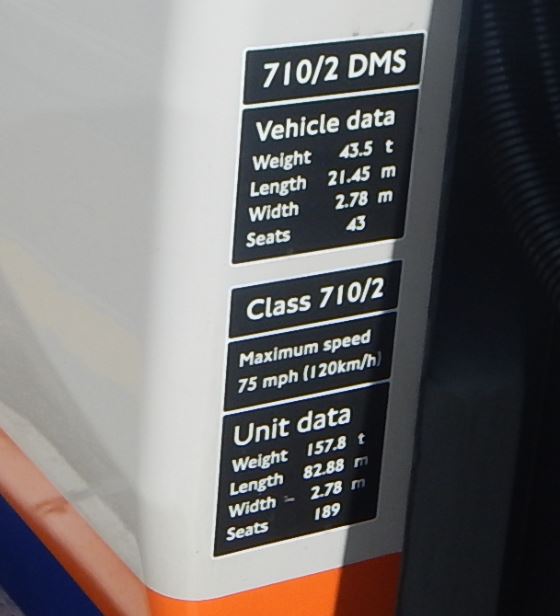
The picture shows the plate on the end of a DMS car.
- The weight of the train is 157.8 tonnes. Note that the four-car Class 378 trains weigh 172.1 tonnes.
- 700 passengers at 90 Kg each with baggage, bikes and buggies would be 63 tonnes.
- That would be a total weight of 220.8 tonnes.
- The operating speed is shown as 75 mph., which is the same as the Class 315 train, that many Class 710 trains will replace.
Using the Omni Kinetic Energy Calculator gives a kinetic energy of 34.5 kWh.
For completeness these are the figures for different speeds.
- 50 mph – 15.3 kWh
- 60 mph – 22.1 kWh
- 90 mph – 49.4 kWh – Operating speed of a Crossrail Class 345 train.
- 100 mph – 61.3 kWh – Operating speed of many electric multiple units.
Note that the amount of energy is proportional to the square of the speed.
What Do The Kinetic Energy Figures Show?
These are a few of my thoughts.
What Is Regenerative Braking?
A full Class 710 is travelling along at 75 mph, ihas 34.5 kWh of kinetic energy. Whenit needs to stop at a station, this energy has to be dissipated.
With normal friction brakes, the energy will be converted into heat and wasted.
But with regenerative braking, the traction motors are used in reverse to generate electricity.
This electricity is generally handled in one of three ways.
- It is passed through resistors on the roof of the train and turned into heat and wasted.
- It is fed back into the electrification and used by nearby trains. This needs special transformers feeding the electrification.
- It is stored in a battery or other energy storage device on the train.
The last method is the most efficient, as the stored energy can be used to help restart the train and regain line speed.
Can The Lea Valley Lines Electrification Handle Regenerative Braking?
This question must be asked, as if the lines can’t then running trains with batteries could be the best way to handle regenerative braking and improve efficiency and reduce the electricity bill.
It should be noted, that the Chingford and Enfield Town routes are not shared with any other trains, so running Class 710 trains on these routes may have advatages in the maintenance of the electrification, if the trains handle the regenerative braking.
On the Cheshunt route, there are also some Greater Anglia services, but these will generally be run by Class 720 trains, which are also Aventras.
On the other hand, the electrification on the Gospel Oak to Barking Line has probably been installed to handle the reverse currents.
Do Class 710 Trains Have Regenerative Braking?
Search the Internet for “Class 710 train regenerative braking” and you find little in addition to my ramblings.
But other Aventras, like Crossrail’s Class 345 trains have been stated to have regenerative braking.
I also repeated my views in an article in Rail Magazine, which I described in I’ve Been Published In Rail Magazine.
No-one has told me that they disagree with my views and I was talking rubbish!
So I will assume that Class 710 trains do have regenerative braking!
The Aventra’s Electrical Systems
In this article in Global Rail News from 2011, which is entitled Bombardier’s AVENTRA – A new era in train performance, gives some details of the Aventra’s electrical systems. This is said.
AVENTRA can run on both 25kV AC and 750V DC power – the high-efficiency transformers being another area where a heavier component was chosen because, in the long term, it’s cheaper to run. Pairs of cars will run off a common power bus with a converter on one car powering both. The other car can be fitted with power storage devices such as super-capacitors or Lithium-ion batteries if required.
This was published eight years ago, so I suspect Bombardier have refined the concept.
But even in 2011, Bombardier were thinking about energy storage on the train.
How Much Storage Would A Class 710 Train Need?
As I said earlier, I train would need sufficient energy storage to store the kinetic energy of a train.
As my calculations show that a full train travelling at the maximum speed of 75 mph, then the energy storage for this version of a Class 710 train must be able to store at least 34.5 kWh, at all times.
The size of the on board energy storage could be around 40-50 kWh, which is readily available in a lithium ion battery, that has been designed for transport use.
Where Would The Energy Storage Be Placed?
The extract above says that two cars hold the electrical systems.
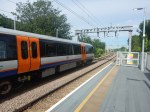
These pictures show the pantograph car and driver car next to it.
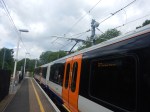
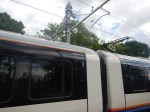

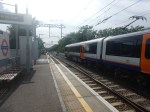
Note that underneath the pantograph car is a transformer.
So are these, the pair of cars, the extract describes? They certainly could be!
This is a selection of pictures of the underneath of the driver car.
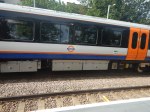
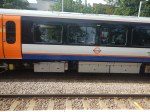

Note.
- There are two large boxes with latches under both driver cars.
- Next to these boxes is a smaller box. At the pantograph end of the train, it is open and looks like a cooling system for the two boxes
- At the other end of the train, the smaller box appears to have a blanking plate, so perhaps the boxes are empty.
The only sensible use I can think of for the boxesis to store the batteries or capacitors.
I
I would estimate that each of the four large boxes.
- Is about a metre wide.
- Is about 0.3 metres high.
- Is sized to fit within the 2.7 metre width of the train. Perhaps 2.5 metres.
These give a column of 0.75 cubic metres.
Bombardier used to manufacture a Primove 50 kWh battery, which was built to power trams and trains, that had the following characteristics.
- A weight of under a tonne.
- Dimensions of under two x one x half metres.
Were these boxes under the floor of the driver cabs of the Class 710 train designed to hold a Primove 50 kWh or similar battery?
Four batteries could give the train as much as 200 kWh of energy storage.
But surely for trundling along the Gospel Oak to Barking Line. a smaller battery capacity would be sufficient. I suspect that you fill the boxes with how many batteries you need and the computer does the rest.
Perhaps, just one 50 kWh battery would be enough! This could explain, why the cooling system appears to be blanked off at one end of the train.
Could The Batteries Be Used To Power The Class 710 Train?
In an article in the October 2017 Edition of Modern Railways, which is entitled Celling England By The Pound, Ian Walmsley says this in relation to trains running on the Uckfield Branch, which is not very challenging.
A modern EMU needs between 3 and 5 kWh per vehicle mile for this sort of service.
So a 50 kWh bsttery would give the following ranges with these consumption rates for a four-car Class 710 trains.
- 3 kWh – 4.2 miles
- 4 kWh – 3.1 miles
- 5 kWh – 2.5 miles
It looks to me, that battery power would be possible over the extension to Barking Riverside station, which is about a mile long.
Battery power would also other uses.
- Moving the train to a safe place for passenger evacuation, when the overhead electrification fails.
- Moving the train in a depot or sidings, without overhead power.
- Running innovative on-board services for maintenance and train preparation, when the train is parked overnight.
Reliable battery power has a lot of uses on a train.
West London Orbital Railway
The West London Orbital Railway would have less than ten miles of lines without electrification, with several electrified miles on either side.
I believe that Class 710 trains with the right amount of batteries could bridge the gap and make a massive difference to rail transport in North and West London.
I think that jumping a gap of a few miles on battery power, may well be easier than doing an Out-and-Back service..
A Flexible System
As it appears, each Class 710 train has got four battery boxes, I suspect that batteries can be installed as to the needs of the route.
- Standard operation on Gospel Oak to Barking, Watford DC Lines and Lea Valley Lines could be one or two batteries to handle regenerative braking.
- Out-and-Back to Barking Riverside station ,might need two batteries.
- West London Orbital services might need three or four batteries.
These battery boxes also could be designed to allow an easy and quick change of battery, as batteries on buses have given Transport for London trouble in the past.
Conclusion
Bombardier’s design of the Aventra has been designed with battery operation in mind, which opens up lots of possibilities!
And Then There Were Three!
This morning, I went to Gospel Oak station to look at what was running on the Gospel Oak to Barking Line.
I’d just watched two Class 710 and two Class 378 trains run the 10:10, 10:35, 10:50 and 11:05 trains to Barking, when another Class 710 train come through, by-passing Platform 3 and going straight on towards Barking.
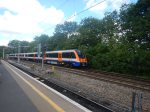
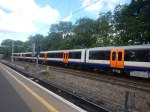
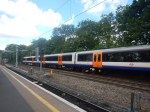
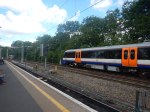
So that must mean there’s at least a third Class 710 train, either being tested, training drivers or accumulating mileage.
Checking on Real Time Trains, it appears that the train passed Gospel Oak station at 11:11 and then ran all the way to Barking station, where it arrived at 11:53, which would have been the time that the missing 11:20 train would have arrived in Barking.
I can’t find any trains disappearing, but it looks like a train joined the service in the missing 11:20 slot and another train disappears back to Willesden Depot, thus creating a slot for another train.
The outcome is the following.
- Passengers seem to be getting at least three trains in every hour in each direction.
- London Overground have at least two and possibly three Class 710 trains running between Gospel Oak and Barking.
Baldrick would be proud!
Is It Illegal To Discriminate Against Diesel Black Cabs?
I probably take one or two black cabs a week.
Usually, this is from a rank at a main line station or from outside Marks & Spencer on Finsbury Pavement, when I have a lot of shopping.
A couple of days ago, I was waiting outside Moorgate station for a 21 or 141 bus to travel home, as these conveniently stop within a hundred metres of my house.
Note that I prefer the 21 bus, as its’s a New Routemaster, which are more spacious.
But as no bus seemed due and I was in a hurry, I decided to take a black cab.
So I made a deal with myself. Whichever cam first of a 21 bus or a battery electric taxi would take me home. The bus came first and I got in.
I think now, that there are more battery electric taxis on the streets, in Central London, the chances of being picked up by one are increasing significantly.
But is it illegal to discriminate, as I now appear to be doing?
I would argue, that my choice of a battery electric taxi is not environmental but selfish! These new taxis are more comfortable, spacious and quieter, making the journey experience much more pleasurable.
After all, why would you travel in a Ford or Vauxhall, when you have the comfort of a Jaguar? Especially, as the cost of both vehicles is the same!
A Trip Around The West Midlands
Today, I did a trip around the West Midlands, using five different trains.
Tain 1 – 19:10 – Chiltern – London Marylebone To Leamington Spa
This was one of Chiltern’s rakes of Mark 3 coaches hauled by a Class 68 locomotive.
I like these trains.
- They are comfortable.
- Everybody gets a table and half sit by a big window.
- There is more space than Virgin Train’s Class 390 trains.
- They may be slower, but they are fast enough for most journeys I make.
The train arrived seven minutes late at Leamington Spa at 11:32.
Train 2 – 12:02 – West Midlands Trains – Leamington Spa To Nuneaton
This is a new West Midlands Trains service, via the new station at Kenilworth and Coventry.
The trains are Class 172 trains, that used to run on the Gospel Oak to Barking Line.
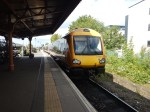


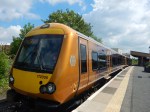


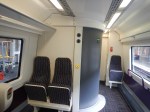


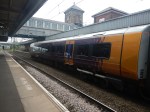

Note.
- The have been repainted and refreshed.
- The seat cover on the driver’s seat is a relic of the London Overground.
- The train now has a toilet.
The train was about half-full and I got the impression, that the new service had been well-received.
The train arrived on time at Nuneaton at 12:38.
Train 3 – 12:54 – West Midlands Trains – Nuneaton to Rugeley Trent Valley
The train was a Class 350 train and it arrived eight minutes late at 13:29.
These pictures show Rugeley Trent Valley station.

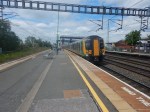
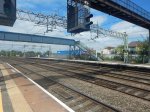
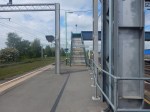
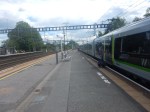
It is very minimal with just a shelter, a basic footbridge and no information on how or where to buy a ticket.
Passengers deserve better than this!
Train 4 – 13:43 – West Midlands Trains – Rugeley Trent Valley to Birmingham New Street
This is a new West Midlands Trains electric service.
Compared to the Leamington Spa to Nuneaton service, passengers were spread rather thinly in the train.
The train was a Class 350 train and it arrived five minutes late at 14:44.
Train 5 – 15:55 – Chiltern – Birmingham Moor Street to London Marylebone
Another comfortable Chiltern Railways train back to London, which arrived four minutes late at 17:47.
Customer Service
Customer service and especially that from West Midlands Trains was rather patchy.
- Leamington Spa station was rebuilding the entrance, but staff were around.
- Nuneaton station was very quiet.
- Rugeley Trent Valley station needs a lot of improvement.
- The two Birmingham City Centre stations were much better.
I actually had to travel ticketless from Rugeley Trent Valley to Birmingham New Street, as the Conductor on the train didn’t check the tickets.
But Virgin Trains were very professional at Birmingham New Street.
Service Pattern
I have some observations on the service patterns.
- For comfort reasons, I would prefer that Chiltern ran Mark 3 coaches and Class 68 locomotives on all Birmingham services.
- In the future, it looks like Leamington Spa and Nuneaton needs at least a half-hourly service.
- There definitely needs to be more services on the Chase Line.
There also is a serious need for staff and better facilities at Rugeley Trent Valley station.
No-one even a hardened member of the SAS would want to spend thirty minutes changing trains there on a blustery and cold winter’s day.
Conclusion
I tried two new services today, that started on the May 2019 timetable change.
- A diesel service between Leamington Spa and Nuneaton via Kenilworth and Coventry.
- An electrified service between Rugeley Trent Valley and Birmingham New Street.
The first would appear to be what passengers want, but the second needs a bit of promoting.
Egypt To Power Europe By Underwater Cable
The title of this post is the same as that of a short news item on page 32 of today’s Times.
Egypt appears to be using gas from four new offshoregas fields to generate the power.
But surely, they could also use solar, as I’ve heard Egypt gets a lot of sun!
I do think though, that countries like Egypt, Libya, Tunisia and Morocco, which are all reasonably close to Europe could generate substantial amounts of solar power, which could then be exported to the North, through undersea cables, which are not very long using today’s technology.
I also think, that solar power will grow Southwards from the countries bordering the Mediterranean.
Will these basket case countries like Sudan, Mauritania, Somalia and Chad, acquire both an income and the electricity they need to improve the lot of their people?
Whether, their people will benefit, is another question, but Europe’s need for green energy could be the need, that these countries will fill, using unproductive desert.
I also think, there’s scope to combine solar farms with agriculture in the shade to create the food they need.
Read Solar Farms And Biodiversity on Solar Power Portal.
Stop It! Phone App Cries Out To Deter Japan Subway Gropers
The title of this post, is the same as that of an article on page 31 of today’s Times.
An app has been developed and deployed in Japan, where if a lady being groped on the Subway if she presses a button on the app, it displays an appropriate message on her phone.
If the groper persists, then another button, shouts out a message.
As a regular traveller on crowded London Underground and Overground trains, I know groping goes on, but I have never seen it happen, except between obviously consenting couples, who arrived and left together.
Although, you do get the odd bumping at times, but usually smiles and a sorry, say it is a genuine accident.
 The Anonymous Widower