Hither Green Station To Go Step-Free
This document on the Government web site is entitled Access for All: 73 Stations Set To Benefit From Additional Funding.
Hither Green station is on the list.
These pictures show the station and the current bridges,

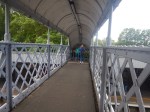
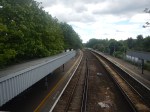

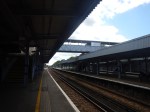

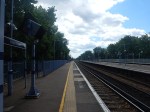

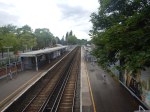
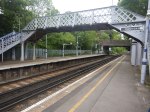
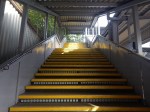
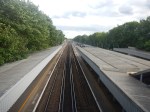
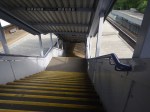
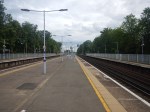


Like Petts Wood station, which I wrote about in Petts Wood Station To Go Step-Free, Hither Green station is a rather unlovely assemblage.
- It has all the qualities of the worst corrugated iron buildings.
- There are five flights of steep stairs.
- There are two separate bridges.
- Entry to and exit from the station are from a subway, that links to Platforms 4 and 5.
- To access Platforms 1,2, 3 and 6, a bridge must be used.
- I suspect that some interchanges may need crossing both bridges.
This Google Map shows the station.
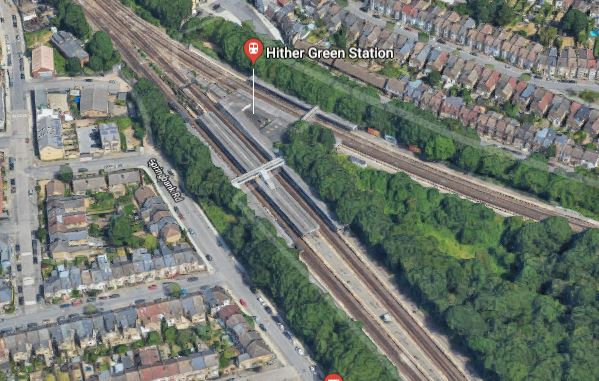
Note the three pairs of tracks, with six platforms and two bridges.
In Winner Announced In The Network Rail Footbridge Design Ideas Competition, I wrote how the competition was won by this bridge.
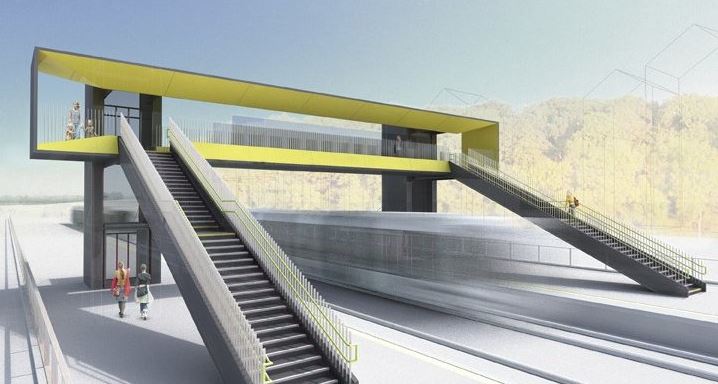
So could a factory-built bridge like this be installed be installed at Hither Green station?
This bridge has the great advantage, that it can be installed without closing the existing bridge.
This Google Map shows the South Eastern section of the station.
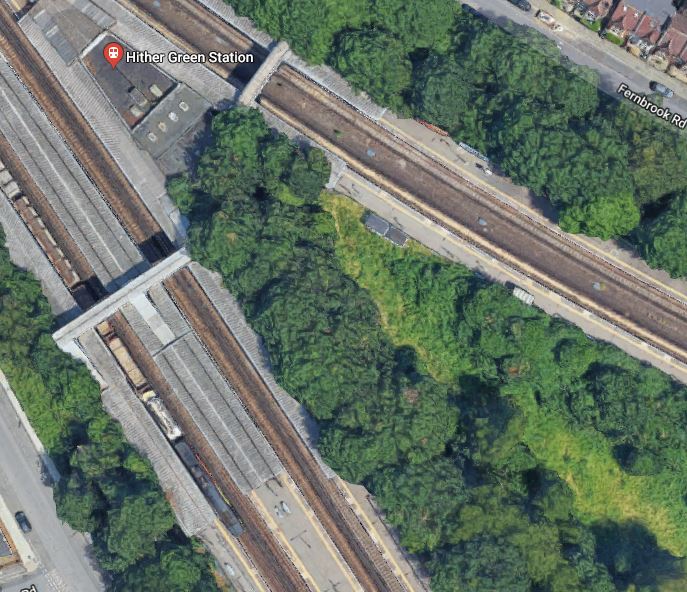
Could two bridges linked ny an aerial walkway across the woods be added beyond the covered parts of the station?
Some interchanges would be a walk of perhaps a hundred metres, but they would be fully step-free.
The rest of this terrible station would be left untouched and could be gradually improved in the future.
Silicon Roundabout Goes Two-Way
Old Street Roundabout, commonly known as Silicon Roundabout has now gone two-way!
But as these pictures, which were taken around nine in the morning, show, it is a traffic nightmare.


It’s not good for pedestrians either and I now use the trains from Angel or Essex Road to go safely underneath at busy times.
Surely the big problem, is what do you call Silicon Roundabout?
Will 5G Be Another Way To Rip Off The Poor?
My late wife was a barrister, who specialised in family matters, like divorce, custody of children, adoption and money.
She had this career for about thirty years before she died in 2007.
As the years progressed, she’d talk about the latest expensive must-haves of her clients.
- First it was video recorders and then it was mobile phones.
- Various game consoles arrived! Whatever they are? I’ve never played a computer game in my life!
- Then came Sky Television and large screen televisions.
- Every child had to have the latest phone.
And now we have 5G, which promises to be the next unaffordable addiction, to go along with alcohol, drugs, pay-day loans, junk food, on-lne subscriptions and gambling!
It will drive the poor and low-paid even further into poverty.
On the train recently, I was talking to a guy with nine children.
As he was going to Court to get custody of one of the nine, and from other things he had said, I felt that the nine weren’t of the same mother.
He was living on benefits and caring for one disabled child.
How will he be able to afford nine 5G phones?
It’ll all end in tears!
Better Storage Might Give Hydrogen The Edge As Renewable Car Fuel
The title of this post is the same as that of this article on an Australian blog called Create.
This paragraph summarises the article.
Professor David Antonelli from Lancaster University has recently discovered a material that he says could allow existing tank sizes to fuel four times their current range.
Take the time to read the article in full!
If this is developed successfully, then coupled to improved battery technology, that will surely increase the practical range of hybrid hydrogen-battery cars, trucks, buses and trains.
Whilst politicians vanish up their backsides discussing the irrelevant Brexit, engineers and scientists will get on developing ideas, that will make everybody’s lives better.
Could A Bombardier Innovia Monorail Be A Modern Replacement For The Liverpool Overhead Railway
Speak to many Liverpudlians born before about 1950 and they will talk about the Liverpool Overhead Railway with deep affection.
The railway ran North-South along Liverpool Docks.
- The original railway ran for five miles, which was later extended to seven.
- There were almost twenty stations, including one at Pier Head.
- It was the second oldest electric metro in the world.
Sadly, the Dockers’ Umbrella wore out, went bust and closed in 1956.
If it had survived, with Liverpool becoming an increasingly important destination for cruise ships and visitors, and with the development of the dockside with modern housing, commercial and leisure developments, including a new Bradley-Moore Dock Stadium for Everton, the Liverpool Overhead Railway would have remained a very important part of Liverpool’s transport infrastructure.
But it’s not there and some Liverpudlians still call for its rebuilding.
In writing Bombardier Transportation Consortium Preferred Bidder In $4.5B Cairo Monorail, I found this video promoting the Innovia monorail.
If Bombardier wanted a high-profile site to install a system to demonstrate its capabilities, there would probably not be a better place in the UK.
But could it be built at an affordable cost?
- The Cairo monorail is 100 km long and the project cost including trains and maintenance for several years is $4.5billion. So a very rough estimate for a ten kilometre system in Liverpool could be around £300 million.
- It should be noted that the 5.5 kilometre long Trafford Park Line of the Manchester Metrolink is costing £350million and that doesn’t include any rolling stock.
- Liverpool is also spending nearly £500million on updating Merseyrail with new Class 777 trains.
I would think it is unlikely, that it will be built, unless the decision is taken for political, property development or tourism reasons.
Conclusion
A monorail could be a welcome and spectacular addition to Liverpool’s waterfront.
But I doubt it would be an easy development to finance.
Aviva Investors Acquires 101 Moorgate Development Site
The title of this post is the same as that of the title of this article on Property Funds World.
This introductory paragraph says it all.
Aviva Investors, a global asset management unit of Aviva, has completed the acquisition of the long leasehold interest in 101 Moorgate, EC2, from Transport for London (TfL). Aviva Investors will develop a mixed-use retail and office site above Crossrail infrastructure and opposite the new Crossrail Liverpool Street Station western entrance.
This Google Map shows a 3D visualisation of the site.
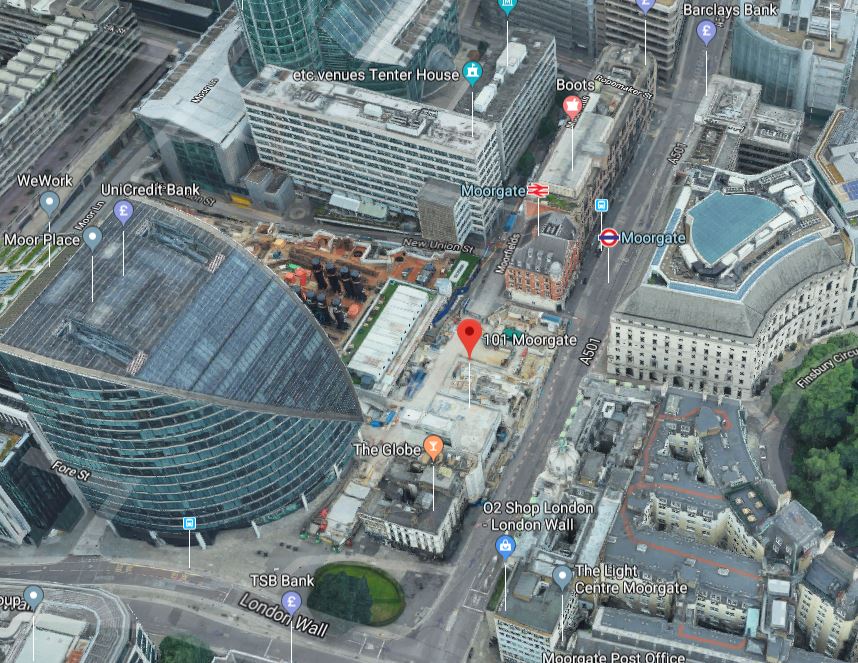
Note the site is indicated by the red arrow.
To its left is the distinctive Moor House, which as well as being a large office block, incorporates a Crossrail ventilation shaft.
Hopefully, Transport for London raised a few pennies for that deal.
Is Leon The Only Fast-Food Restaurant, Where You Get Personal Service?
When I ordered my full English pot in Leon a few minutes ago, they were temporarily out. So the assistant told me to sit down and he brought it to me a couple of minutes later.
This regularly happens in Leon and it’s one of the reasons I go!
My Unusual Body
I say unusual, but I suspect there are others out there with similar problems to me.
I was delivered in 1947, by the almost exotically-named; Dr. Egerton White, who was the family GP. He had all the expected characteristics of a three-piece suit, a corporation, a long watch chain and the obligatory Rover car. He also had a rather unusual blotchy skin, that leads me to think he was probably of mixed race.
I was small in stature, not the healthiest of children and was always going to see him and his partner, a Doctor Curley!
- At times, I would cough my guts out for hours on end.
- Later I remember my mother saying to my future wife, that I had difficulty eating as a baby, and I would fall asleep as she fed me.
- Often I would spend three or four months away from school and I can remember spending hours with my head over a large jug of hot Friar’s Balsam.
- At one point, someone said it could be the lead in the paint in our house, so my father burnt it all off and replaced it.
- My mother used to make gallons of home-made lemonade according to one of Mrs. Beeton’s recipes, which must have helped, when I drunk it.
- Doctors White and Curley were puzzled and at one point prescribed the new-fangled drug penicillin.
- It should be remembered that in the 1950s, even in leafy Southgate, where we lived, the air was thick with the pollution from coal fires for a lot of the year.
In the end, one thing that helped was a nasal spray cooked-up by a pharmacist called Halliday. I can still smell it and suspect it was little more than the base chemical still used in some nasal sprays available from pharmacies.
Although my poor health persisted at times, I still managed to pass the 11-Plus and get to Minchenden Grammar School.
But I remember in the first year, I had virtually a term away.
From about ten or eleven, my health gradually improved.
I can suggest these reasons.
- Getting older helped in some way.
- I was exercising a lot more by cycling around, although it was up a hill to get home.
- My parents had bought a house in Felixstowe and we would spend weekends there. Although, as I got older I hated being away from my friends with little to do, so I tended to stay in and read.
In the 1960s, my health seemed to improve dramatically, when I spent three years at Liverpool University and a year afterwards working for ICI at Runcorn.
Liverpool is a Maritime City and in those days, the air was much better than London.
But I also got married in 1968 and I can never remember serious boughts of coughing, sneezing and breathing difficulties in the time Celia was alive.
Although, she did often say that before I went to sleep, I would always sneeze three times and sometimes she would even count them.
She also regularly said, that my sneezes were rather violent at times. They still are!
In the late nineties, I was diagnosed as a coeliac. Regularly, I’d go to the GP around the turn of the year with a general run-down feeling.
Nothing specific, but then an elderly locum decided I ought to have a blood test, which would be the first of my life!
The result was that I was very low in vitamin B12. As a series of injections didn’t improve the situation, I was sent to Addenbrooke’s Hospital for tests.
I was diagnosed as a coeliac, initially on a blood test and then by two endoscopies. Note that Addenbrooke’s used to do them without anaesthetic, as it means the patient can easily get into a better position and doesn’t break teeth. It also means that the hospital doesn’t have to provide as many beds for recovery. Certainly, I’ve had worse experiences with highly-capable dentists!
I thought this was the end of my health problems.
It certainly seemed to be, except for occasional breathing difficulties early in the year. I can remember having difficulty climbing Table Mountain.
My stroke was brought on by atrial fibrillation three years after Celia died.
It happened in Hong Kong and before it happened in the restaurant of the Mandarin Oriental Hotel, I had had a walk and remember how well the air felt early in the morning in the City.
The doctors said I had had a serious stroke and I was kept in hospital for twelve weeks on the 29th floor of a hospital with the sun streaming through the windows.
I remember one incident, where I was accused of throwing my water away and not drinking enough, as I wasn’t urinating. But I was drinking, so they checked my waterworks thoroughly and put in a catheter. Nothing improved. Thankfully, eventually they gave up!
So where was all that water going?
Another curious thing in Hong Kong was that their automatic blood pressure machines sometimes didn’t work well on me in the morning. So they resorted to traditional devices and a stethoscope. Strangely, these blood pressure machines never fail these days.
After the stroke, I was put on long-term Warfarin and I have been told several times, that I if I get the dose right, I won’t have another stroke.
Now moved to London, I possibly made the mistake of moving to a house, which gets too hot.
One day I collapsed, panicked as I thought it was another stroke.
It wasn’t and UCLH thought that I needed to be put on Ramipril, Bisoprolol Fumarate and Spirolactone.
Since then another cardiologist has dropped the Spirolactone.
As I said my body is unusual in strange ways.
- If I have an injection or give a blood sample, I don’t bleed afterwards or need a plaster. With a new nurse, it often causes a bit of a laugh!
- My nose seems to be permanently blocked and I rarely am able to blow it properly.
- My feet don’t have any hard skin, which is probably unusual for my age.
- I used to suffer from plantar fasciitis, which seems to have been partly cured by the Body Shop’s hemp foot protector.
- I drink a large amount of fluids, with probably six mugs of tea and a litre of lemonade or beer every day.
- I always have a mug of decaffinated tea before I go to bed.
- I often have half-an-hour’s sleep in the middle of the day. As did my father!
- My eyes are very dry and I have a bath most mornings, where I put my head under the water and open my eyes.
Perhaps, the strangest incident was when I went to sleep on the floor after a lot of tea, with the window open.
I woke up to find I couldn’t see! There was nothing wrong with me, but my large living room was full of steam, like you’d get if you leave the kettle on.
I came to the conclusion after that incident, that the only place the water could have come, was through my skin.
This was also suggested by a nurse, who said he’d got leaky skin.
As someone, who understands physics, could this leaky skin be the cause of my problems?
And do the drugs make it worse?
My Grandfather
He died at forty, long before I was born.
He was an alcoholic, who eventually died of pneumonia.
Could his drinking like mine, have started because of a need for fluids?
I used to drink a lot of beer until I was about twenty-four, but my father had suffered so badly emotionally because of the death of his father, that he had instilled the right attitude to drink deep in my mind.
Conclusion
This has been a bit of a ramble!
Bombardier Transportation Consortium Preferred Bidder In $4.5B Cairo Monorail
The title of this post is the same as that of this article on the Toronto Star.
This the first three paragraphs of the article.
Bombardier Transportation says its consortium has been named preferred bidder in a C$4.5 billion contract to build and supply a new monorail system in Egypt’s capital.
The company’s potential share of the design and build contract for the system in Cairo is C$1.8 billion with an operations and maintenance deal valued at about C$1.67 billion over 30 years.
The 54-kilometre monorail will connect East Cairo with the New Administrative City and a second 42-km line will connect 6th October City with Giza.
The railway division of Bombardier Inc. will deliver the project in partnership with two Egyptian companies Orascom Construction and the Arab Contractors with the trains being developed and built in Derby, Britain.
The article then mentions the Bombardier Innovia monorail.
- The latest Innovia 300 monorail is automated and driverless.
- These trains can travel at 80 kph
- They can handle 48,000 passengers per hour in both directions.
- The latest versions are manufactured in Brazil, Canada and China
- The latest versions are installed or planned in Brazil, China, Saudi Arabia and Thailand.
I think there must be more to this project than the article in the Toronto Star.
What Are The Strengths Of The Innovia 300 Monorail?
This is Bombardier’s video of the monorail.
It looks to be a well-designed system, that has several strengths.
- It is automated and driverless.
- Cars are short and the trains can take quite curves, with as low as a 46 metre radius.
- Trains can have up to eight cars. The Cairo trains will be four cars.
- The latest cars look stylish, with cab design not unlike an Aventra.
- The cars appear to be walkthrough.
- The track is a slender concrete beam with walkways on either side for passenger evacuation and maintenance.
- The tracks wouldn’t necessarily have to be elevated.
- Construction could be quicker than a conventional railway.
- It could also be built to travel over roads, railways, water and building, by placing the beam at the right height.
I would like to see one in operation, but Brazil is a long way, so I’ll stick with the video for the moment.
Why Develop And Build In Derby?
Why would a big company like Bombardier, with already three production lines for the monorail, want to setup another production line in Derby?
Bombardier say that the trains will also be developed in Derby.
Perhaps, some or all of these reasons apply.
- The cross-section of an Innovia 300 monorail car looks to be about the size of a British train.
- Can Derby’s manufacturing technology that has been used successfully to build Electrostar and Aventra bodies be applied to the Innovia monorail.
- Derby has good relations with a large number of appropriate suppliers in the UK and Europe.
- The new version will use the Aventra parts bin to cut development and manufacturing costs.
- Supporting the Egyptian system from Derby will not be difficult.
- Canada has better relations with the UK, than Brazil or China.
But even so, development could surely have been continued in Canada.
So Bombardier must have very good reasons!
Are Bombardier Proposing A Closely-Related Design For The Tyne And Wear Metro?
The current Class 994 trains of the Tyne and Wear Metro have the following dimensions.
- Width – 2.65 metres
- Height – 3.45 metres
- Car Length – 27.8 metres
- Train Length – 55.6 metres
The Class 710 train, which is an Aventra has the following dimensions.
- Width – 2.77 metres
- Height – 3.76 metres
So it would appear that the standard Aventra might be too large to fit the Metro, where Bombardier are approved bidders.
It does appear that Bombardier have designed the Aventra’s body from three aluminium extrusions, so these could be resized to fit the smaller dimensions of the Metro.
But looking at the video of the Innovia 300 monorail, I get the impression, that above the floor, the body might be almost the same size as that needed for the trains for the Metro.
So Bombardier would need to design an appropriate chassis, to replace that used for the monorail.
This could mean that the bodies on both trains could be identical.
- Four fifteen metre cars, would give a length of sixty metres.
- If longer trains are needed, then extra cars could be inserted up to a length of eight cars.
- The trains would be walk-through with lots of doors for easy exit according to the video.
- The four-car design would enable tight curves could be negotiated.
- There would surely be advantages in support and maintenance.
- Cabs could be provide for the driver if required.
I also believe that any new trains must have step-free access between train and platform. This picture shows a current train at South Shields station.
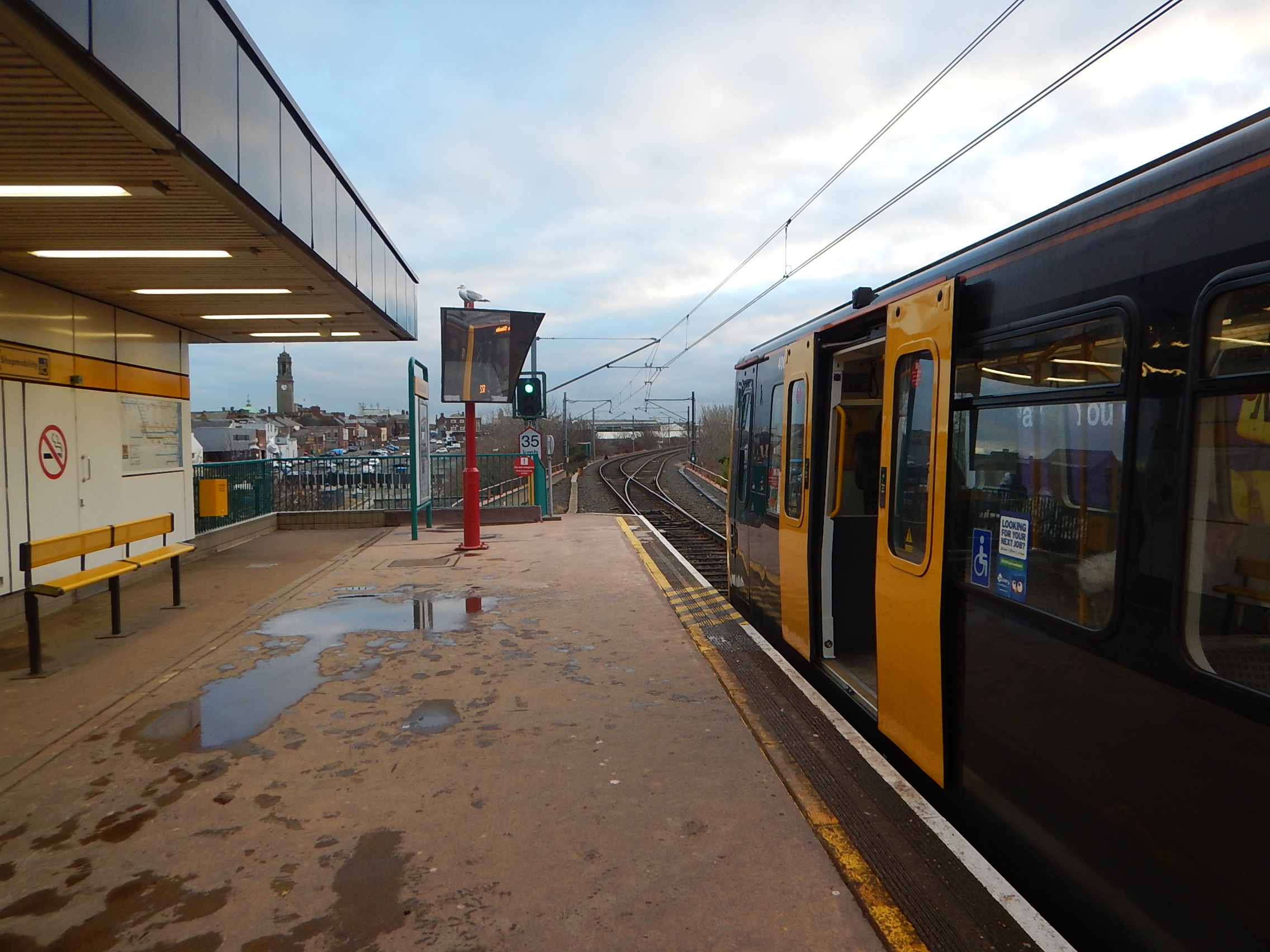
That is not bad for a system that opened forty years ago.
I would think that Bombardier will make the access better, when designing a new chassis from scratch.
But the big advantages of commonality between the Innovia monorail and the Metro cars, would be in the areas of support and expansion or lengthening of the fleet in the future.
What About The Docklands Light Railway?
The Docklands Light Railway like the Tyne and Wear Metro, is another one-off system, that is incompatible with most other rail systems in the UK.
The DLR is intending to replace the rolling stock and Bombardier has been shortlisted.
The current trains of the DLR have the following dimensions.
- Width – 2.65 metres
- Height – 3.47 metres
- Car Length – 28 metres
- Train Length – 56 metres
Give or take a few millimetres, they are almost the same size as the trains on the Tyne and Wear Metro.
Could we see similar trains on the Tyne and Wear Metro and the Docklands Light Railway?
Wikipedia says that the new DLR fleet will be 87 metres long, so could that mean six 14.5 metre cars?
A Possible Tram-Train?
Bombardier build trams and have supplied them to the UK.
The UK has just started to develop tram-train systems, with the South Wales Metro being developed in the next few years with Class 399 tram-trains.
If Bombardier use the concept, I’ve outlined here for the Tyne and Wear Metro and the Docklands Light Railway, I believe it is only a short development to get a tram-train, that could run in the UK
I’m sure that they could get it to work in Blackpool, where the company supplied their trams for the Blackpool tramway.
Are Bombardier Expecting Orders From Europe?
It was only in 2014, that the first Innovia 300 monorail route, Line 15 (São Paulo Metro), opened in Brazil.
But since then, have several Transport Authorities, City Councils and Governments visited Brazil to have a look?
Do Bombardier feel that they will be selling other systems in Europe?
If so, then Derby will be an excellent sales, development, production and support base.
Could We See Some Monorails In The UK?
If you look at the list of Bombardier Innovia systems on Wikipedia, there are several short systems at places like airports and theme parks and a few longer systems of which the Cairo system will be the longest.
I can see opportunities for the shorter distance systems.
- As a part of developments of Heathrow Airport’s third runway.
- As a part of the development of Gatwick Airport’s second runway.
- Linking Ebbsfleet International and Northfleet stations.
- Linking East Midlands Airport to East Midlands Parkway station.
- Linking the proposed Eden Centre at Morecambe with Lancaster station.
- Linking Bristol Airport to the City Centre
- Greenhithe station to the Bluewater shopping Centre.
- It could be a modern replacement for the Liverpool Overhead Railway.
There are probably other locations at stations, airports and theme parts, where Innovia monorail systems could be installed.
As to a longer system in the UK, the only one I can think off would be to link High Speed Two at East Midlands Hub station to Derby and Nottingham and perhaps East Midlands Airport.
But then that would then be a system on Derby’s doorstep.
Conclusion
There are possibilities and with a billion pound-plus order, the project could be on its way!
But surely, the big advantage to Bombardier is if they get the orders for the new trains for the Tyne and Wear Metro and the Docklands Light Railway, they can create trains with a lot of shared components for all three applications.
The two UK systems would get trains that weren’t totally unique, which must ease maintenance and future expansions of the respective systems.
CoolRail To Cut Carbon Footprint Of Fresh Food
The title of this post is the same as that of this article on Railway Gazette International.
These first two paragraphs outline the plan.
Food logistics company Euro Pool System has launched a thrice-weekly CoolRail dedicated temperature-controlled service to transport fresh produce between Valencia in Spain and Rotterdam in the Netherlands.
This is intended to be first route of planned network of CoolRail services which would link Spain with Germany, Scandinavia and the UK.
I can see this method of fresh food transportation growing, especially as CoolRail claim it is as fast as by road and cuts CO2 emissions by 70 to 90 %.
It also appears that the UK through the Channel Tunnel is in CoolRail’s plans.
Fish, Lamb And Beef To Europe
The obvious British export, that could use the service the other way to Europe is probably fish, as a large proportion of UK-landed fish goes to Europe at the present time.
This page on the Seafish web site, gives details about fish imports and exports.
Quality meat, like Welsh lamb and Scottish beef could also be sent to Europe, after being slaughtered in the UK.
What About Quality Food And Drink?
This page on the Scotch Whisky Association web site is entitled Scotch Whisky Exports On The Up in 2018.
This is two paragraphs from the page.
In 2018, the export value of Scotch Whisky grew +7.8% by value, to a record £4.70bn. The number of 70cl bottles exported also reached record levels growing to the equivalent of 1.28bn, up +3.6%.
The United States became the first billion pound export market for Scotch Whisky, growing to £1.04bn last year. The EU remains the largest region for exports, accounting for 30% of global value and 36% of global volume.
That means that Scotland exported to the EU, the equivalent of 461 million bottles of whisky, that is worth around £1.41billion.
A twenty-foot shipping container has a volume of 33.2 cubic metres., so with allowance for packaging, one could probably hold 33,200 bottles worth about £100,000.
To accommodate all Scotch Whisky exports to Europe on the 2018 figures, would need 14,000 containers per year or a very civilised thirty-eight containers a day.
Conclusion
There’s certainly a large market for food transport by rail across Europe and to the UK, some of which will be in containers with refrigeration and some without!
 The Anonymous Widower