Prototype Overhead Line Structure Revealed
The title of this post is the same as that of this article on Global Rail News.
This is the first paragraph.
A prototype overhead line structure (OLS) designed to be quick to install, easy to maintain and more attractive to look at has been unveiled by its creators, Mott MacDonald and Moxon Architects.
Searching the Internet, I found this press release about the structure, which is entitled Moxon and Mott MacDonald unveil prototype for innovative Integrated Overhead Line Structure.
This picture is from the press release.
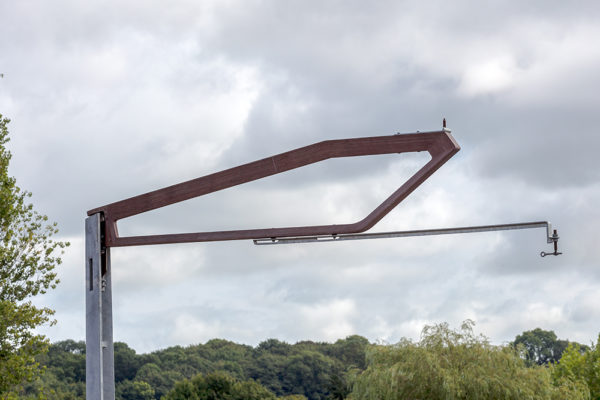
Various advantages are claimed.
- Reduced visual impact.
- Complete interoperability with existing overhead systems.
- Reduced number of components.
- Ease of installation.
- No additional engineer training.
- Reduced maintenance costs.
I like the concept, but is it too radical for Network Rail to give its blessing?
Perhaps the most radical feature is the use of laminated wood in the structure.
Conclusion
This is a very good design, but I doubt we’ll see it installed on UK railways.
£18.75m Halton Curve Project Delayed A Further Six Months
The title of this post is the same as that of this article on Rail Technology News.
I could just blame politicians for the latest project to be delayed, but it is not wholly their fault.
Train companies all over the UK, Europe and the Rest of the World have been ordering new trains at an unprecedented rate for the following reasons.
- The replacement of clapped-out trains like Pacers.
- Extra trains to provide extra services.
- Faster trains to provide faster services.
- Bigger or longer trains to provide more capacity.
- New electric trains for newly electrified routes.
- New trains often cost less to service and maintain.
- Affordable finance for quality new trains is available in billions of pounds, euros and dollars of all kinds.
In addition a lot of trains are being updated with new technology like signalling, automatic systems and high-technology interiors.
All of these factors mean that there is a high level of train testing that needs to be done.
These test tracks are in Europe and listed in Wikipedia.
- Czech Replublic – Velim railway test circuit – Two circuits of 4 and 13 km.
- France – Centre d’essais ferroviaires – Near Alstom Valenciennes factory site in Raismes, includes 2.75 km for testing at 100 km/h, a 1.85 km loop for endurance testing at 80 km/h, and a loop for testing driverless trains.
- Germany – Test and validation centre, Wegberg-Wildenrath – Near Wildenrath in North Rhine-Westphalia, Germany. Several loops of standard gauge and metre gauge track with various electrification systems.
- Poland – Test Track Centre near Żmigród – Operated by Warsaw Railway Institute. 7.7 km standard gauge loop, 160 km/h maximum allowed speed.
- Romania – Railway Testing Center Faurei – Total length of lines: 20,2 km, maximum speed 200 km/h.
- United Kingdom – Old Dalby Test Track
- United Kingdom – High Marnham Test Track
Note that Italy and Soain, who build substantial numbers of trains, don’t have a specialist testing centre.
I have read somewhere that each individual train has to be run for so many hours before it can be certified for service.
Consider
- Bombardier is building 412 Aventras with lengths between three and ten cars.
- CAF is building trains for Calodonian Sleeper, Keolis Amey Wales, Northern, TranPennine Express and West Midlands Trains.
- Hitachi is building 182 Class 800/801/802 trains with length of five or nine cars.
- Hitachi is building 80 Class 385 trains with lengths of 3/4 cars.
- Siemens are building trains for Govia Thameslink Railway.
- Stadler is building trains for Greater Anglia, Keolis Amay Wales and MerseyRail.
I haven’t done a detailed calculation must it must be at least 700 trains.
In addition there are various rebuilt and existing trains that will need to be tested.
- ScotRail’s shorterned InterCity 125s
- Porterbrook’s Class 769 trains.
- Vivarail’s Class 230 trains.
- Alstom’s Class 321 Hydrogen trains.
- Crossrail Class 345 trains need further testing.
And there will be new orders for the following franchises and lines.
- East Midlands.
- London Underground Piccadilly Line.
- South Eastern
- West Coast Alliance
I haven’t done a detailed calculation but we must be talking of nearly a thousand new trains of which probably six hundred will be delivered in the next five years.
I’m no expert, but I feel that two short test tracks and short lengths of improvised test tracks in factories, isn’t enough to test all these trains and certify them for service.
I should also blow my own trumpet and I know that when I wrote project management software, I was probably the best programmer in the World, at automatically scheduling resources.
So I tend to know, an impossible scheduling problem, when I see one!
Conclusion
We do send trains to Europe to specialist centres like the one at Velim in the Czech Republic. But these centres are also used by other European manufacturers.
I am led to the inevitable conclusion, that we need more train testing facilities, in both the UK and mainland Europe.
The Welsh Government has come to the same conclusion and are planning a test track at Neath, which I wrote about in £100m Rail Test Complex Plans For Neath Valley.
What would help, would be if Chris Grayling oiled a few wheels with some money. It might even result in some Continental trains coming to Wales for specialist testing like curing them of dracophobia.
I would also have felt that CAF would be happy with a test track fifty miles away from their new factory in Newport.
Come on, Wales! Fire up the dragons and get started!
Will Alstom Use The Buxtehude To Cuxhaven Route As A Test Route For The iLint Train?
I think there are various factors that could make the route between Buxtehude and Cuxhaven stations an ideal test route for hydrogen-powered iLint trains.
Bremervörde Depot
This Google Map shows the area of Bremervörde station.
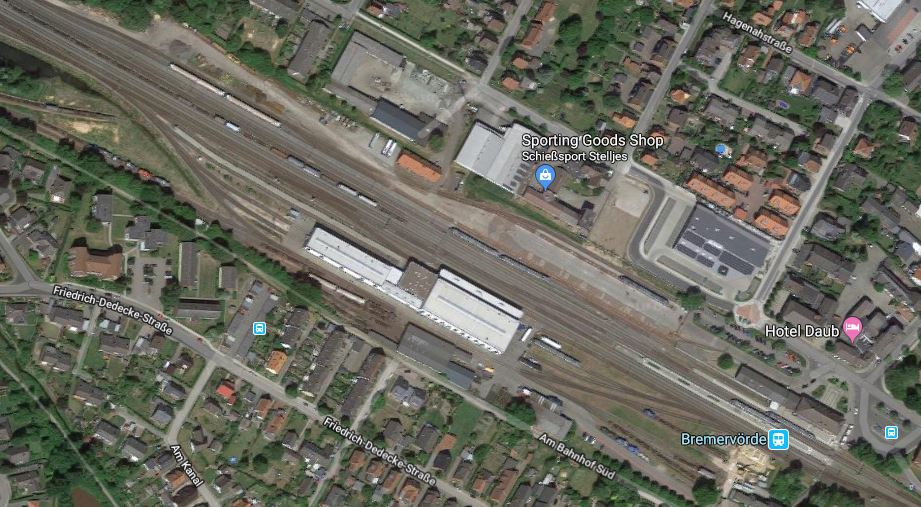
There appears to be a lot of space.
In this article on Railway Technology, which is entitled iLint: The World’s First Hydrogen-Powered Train, this is said.
As part of the deal, Alstom will provide maintenance for the trains over a 30-year period. Meanwhile, leading gas company Linde will supply hydrogen for the new trains and erect the first-ever hydrogen filling station for trains in Bremervörde. The plan is that hydrogen will be produced onsite via electrolysis and wind energy at a later stage of the project.
As I passed through Bremervörde station, on my trip to the line at the weekend, I took this picture.
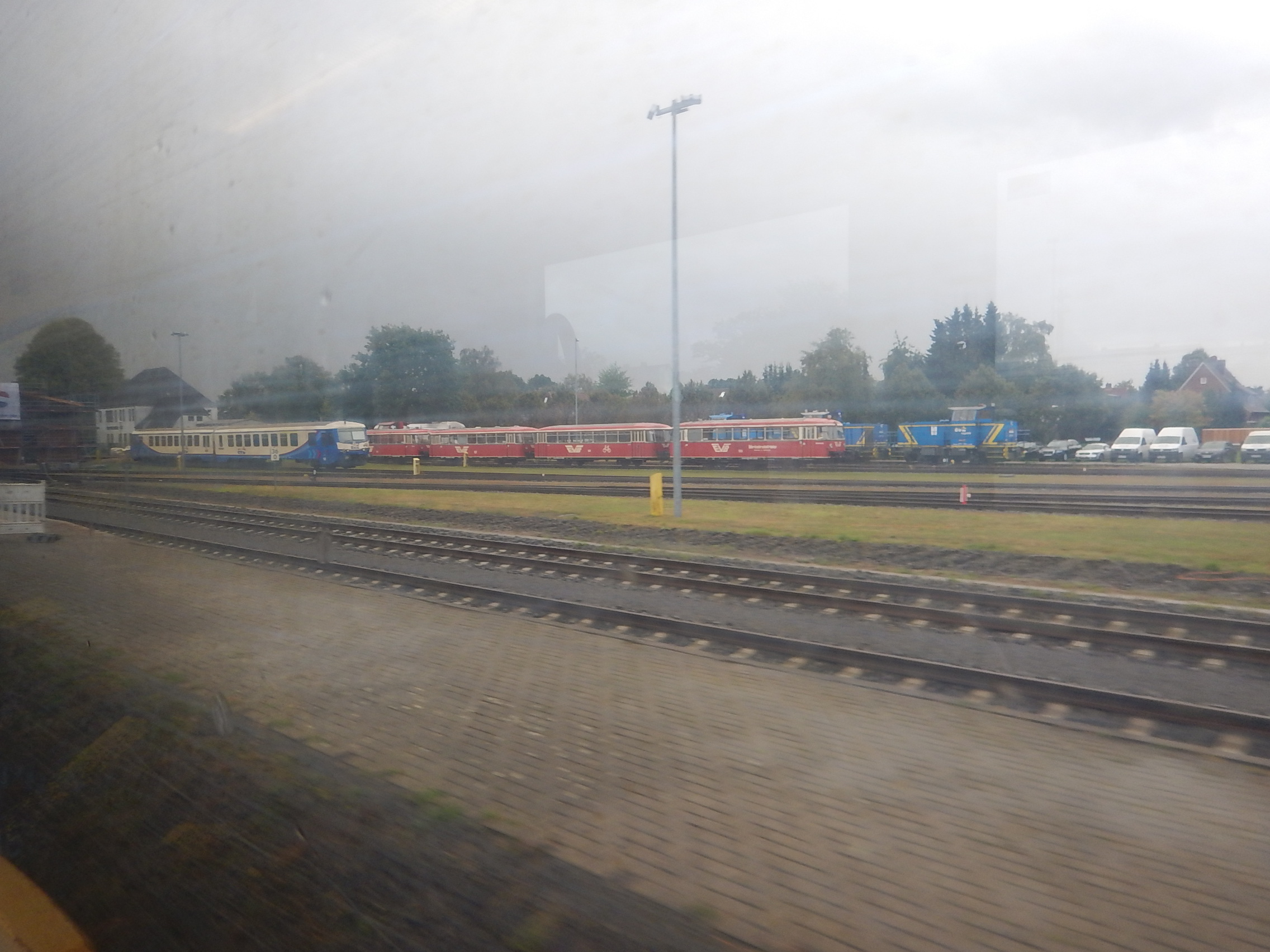
There would be plenty of space for the proposed hydrogen plant and to stable both the working fleet and any other trains, that were being tested for other places in Europe.
Linde would would only have to ensure that the hydrogen plant was sized for all future needs.
The Buxtehude To Cuxhaven Route
The route between Buxtehude and Cuxhaven has the following characteristics.
- It is about a hundred kilometres long.
- It is mainly single track except for the section through Bremerhaven, where it has at least two electrified tracks.
- There are passing places.
- The scheduled service is one train per hour (tph) in both directions.
- The line appears to have reasonably new signalling.
- There are numerous level crossings.
- I didn’t see any other traffic on the line, but I suspect there must be extra paths for freight, service trains, empty stock movements and a heritage service that uses part of the route.
I suspect that it could make an ideal test route, if extra trains could be squeezed in between the scheduled service.
Distance From the Salzgitter Factory
The Lint trains are built at in a factory at Salzgitter, which is between Hanover and Bruaunwieg, which is about four hours away.
The iLint trains could do this making their own small amounts of steam, but they would probably be dragged by a diesel locomotive.
Testing An Electric iLint
I think that we’ll eventually see a pantograph on the iLint, for one of three reasons.
- It would allow running on overhead electrification to charge the battery and reduce hydrogen consumption.
- It would allow creation of a diesel/electric hybrid version, that might be a lower capital cost alternative for shorter lines.
- It would create a battery.electric hybrid for short extension routes.
Alstom could possibly create a range of solutions for a wide range of applications.
The Buxtehade To Cuxhaven route includes a section of electrified line, which would surely be ideal for the testing of these trains.
Conclusion
I think that Alstom will use the route to test hydrogen-powered trains.
A Sighting Of The Two Coradia iLint Hydrogen Trains
I finally got to see the two Coradia iLint trains, parked at Bremervörde station.

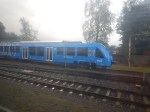
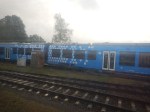
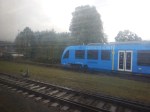
On bahn.de they were talking about weather warnings, so perhaps Alstom and the operator were just being prudent. After all they didn’t want another Hindenburg disaster!
Not that there’s much chance of that these days when modern materials are used to build safe methods of hydrogen storage.
A Full-Barrier Level Crossing For Pedestrians And Cyclists At Bremervörde Station
I photographed this full-barrier level crossing For pedestrians and cyclists At Bremervörde station.


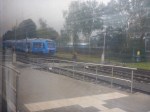


I watched the crossing for several minutes as my train waited for a green signal and pedestrians and cyclists crossed safely at times when the barriers were up. The barrier were also lowered, so that a train could proceed into the nearby depot.
Nobody seemed to disregard the barriers.
Perhaps, though the Germans are better than obeying orders than we are? Although, walking about Hamburg, I did feel that German pedestrians cross in more dangerous ways, than Londoners do.
Surely, if the Germans can put in this level crossing under the same European Health and Safety rules as we use, then we can do the same?
Think Again, If You Think We Have Too Many Level Crossings!
These are some pictures of the level crossing on the route between Buxtehude and Cuxhaven stations.





Some seemed to be very busy, but others were just on a concrete farm track.
I think with the exception of in the electrified Bremerhaven section, I didn’t see any bridges over the route.
The other feature visible from the line, was the large number of wind turbines.
A Brief Glimpse Of A Hydrogen-Powered Coradia iLint
On my early morning journey between Hamburg and Bremerhaven stations, with a change at Buxtehude station, I caught the first train of the day.
At Bremervörde station, my train stopped alongside a hydrogen-powered Coradia iLint and this was the best of the pictures I tried to take in the bad light and pouring rain.

I saw passengers sitting on the train, but by the time we left, they all seemed to have taken other means of transport.
Are Greater Anglia Buying So Many Class 755 Trains, So They Can Run A Better Service During Constant Works On The Great Eastern?
Yet again, they were rebuilding the Great Eastern Main Line, so I didn’t get to football at Ipswich yesterday.
It’s not that I mind the buses, but it means two things.
- I have to leave so early, that I can’t do my weekly shop before I go.
- I also get back so late that I will miss Strictly on the television.
There is also the problem, that Ipswich is one of the worst places to find a gluten-free meal, unless you go to Pizza Express.
I often have my lunch before I travel or take it on the train from Leon or M & S.
For some time now, I’ve suspected that Greater Anglia have ordered a lot more Class 755 trains, than they need, based on a train-for-train replacement basis
It now becomes obvious why!
At weekends, they will link four-car trains together and run four trains per hour on the following routes.
- Norwich to Cambridge
- Ipswich to Cambridge
One train in four will continue to and from London after Cambridge.
On the other hand, it could be a plot by Norwich fans in Greater Anglia’s headquarters in Norwich to annoy Ipswich fans!
How To Build A Station In Nine Months
This document on the Network Rail web site is entitled Highlights Of The Great North Rail Project.
There is this section which is entitled We Build A Railway Station In Just Nine Months.
It’s about the building of Maghull North station.
This is said.
Network Rail undertook the scheme on behalf of Merseytravel, appointing contractor Buckingham Group.
How did we deliver the station so quickly and carry out most of the works while keeping the railway line open? A head start, line access and a tight summer deadline.
Robert Grey, a project manager of infrastructure projects at Network Rail, said: “Nine months is quite short for a station… The restricting factor is the access. We had quite a bit of flexibility there. We had access for long weekends and a 12-day possession of the line after Christmas… Without those we’d still be there now.”
I also put it down to the Liverpudlian attitude, which in my experience seems to accept disruption to their lives without complaining too much and then joke about it, when it’s all over.
I was in Liverpool during the bus strike of 1968. where Liverpudlians just walked.
Some of this attitude would be of great help in sorting the problem of the Steventon Bridge in Oxfordshire. I wrote about this bridge at the end of The Stone Arch Railway Bridges Of Scotland.
Crossrail-Spoil Wetland Provides Haven For Wildlife
The title of this post is the same as that of this article on the BBC.
This is the first two paragraphs.
A £70m project to create a wetland twice the size of the City of London is nearly finished with wildlife thriving in new lagoons, marsh and fields.
New wetland on Wallasea Island, off the Essex coast, was created from tunnel spoil from London’s Crossrail project.
Wallasea Island shows that large construction projects don’t have to be all about steel and concrete.
 The Anonymous Widower