I’ve Just Come Across Avnos
I feel we should take into account any possibilities of second use of oil or gas structures, that once held hydrocarbons.
An article in a magazine called Carbon Herald pointed me to a company called Avnos, who are developing Direct Air Capture of carbon dioxide out of the atmosphere. If systems like that of Avnos do work, we may need somewhere to put the carbon dioxide.
Centrica are storing the hydrogen in the Rough gas field, which was previously used for storing natural gas and now some depleted gas fields are being used to store captured carbon dioxide.
On the subject of carbon capture, Avnos do it differently, in that for every tonne of CO2, they capture from the air, they capture five tonnes of distilled water. And they do it without using any heat.
This is their web site.
This is their mission statement on the front page of the web site. There is also a video.
Carbon Negative. Water Positive
Avnos is commercializing the most advanced technology in the Direct Air Capture of CO2
Our proprietary Hybrid Direct Air Capture (HDAC) solution inverts the water paradigm in DAC, producing water, eliminating heat consumption and reducing costs compared to other forms of DAC.
It sounds too good to be true!
But I have experience of the positive financial results of fluid dynamics in this area.
Thirty years ago, two guys approached me with an idea for an aerosol valve that used nitrogen as a propellant.
At the time, I lived in the house, where Osborne Reynolds, the great Victorian fluid dynamicist of Reynold’s number fame had been brought up.
The guys succeeded and the device was sold on to J & J.
They were then asked to develop a metered dose inhaler for asthma drugs, which is now sold as Respimat, which is sold by Boehringer Ingelheim.
Afterwards, I researched Reynolds at Manchester University, where he was the first Professor of Engineering and I found that he had done some marvelous things with fluids. He was a true genius and undergraduates are still taught on his Victorian apparatus.
I suspect that Avnos may have been exploring in the same area and are using another of Reynold’s useful properties.
Paddington And Minehead By Train
Two projects announced in the last six months may make this a possibility.
- FirstGroup’s Paddington and Paignton Service
- The West Somerset Tidal Lagoon
Neither project has the full permissions it needs, but if Lumo do stop at Taunnton and the West Somerset Tidal Lagoon is built, if could open up an interesting possibility.
In Thoughts On Lumo’s Proposed Paddington And Paignton Service, I stated that a train could take two hours between Paddington and Taunton, if it went for a fast non-stop run to Bath Spar station.
In MP Pushes For Tidal Lagoon In Bristol Channel, I said this.
I believe that for the lagoon project to be complete, the West Somerset Railway needs to be turned into a fully-operational branch line between Minehead and Taunton to improve access for residents, visitors and workers to Minehead and other places in West Somerset.
Surely, with a quick change of train, passengers could be in Minehead thirty minutes after arriving at Taunton.
In recent years several new branch lines have open in the UK and been given time to attract new passengers.
- The Borders Railway to Tweedbank
- Merseyrail to Headbolt Lane
- The Northumberland Line to Ashington
- ScotRail to Leven.
- The Dartmouth Line to Okehampton
None appear to be in any danger of being closed.
I very much feel, that if the West Somerset Railway, ran a full service between Minehead and Taunton, it would follow the same pattern.
British Buses For British Bottoms
Occasionally, I catch the 153 bus, as it goes between the Leon, where I often go for breakfast, and the William Harvey Heart Centre, where I volunteer as a lab-rat.
Lately, I’ve noticed that the route is being run by new Wrightbus GB Kite single-decker battery-electric buses.
This morning I had a ride.







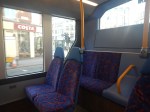




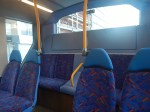












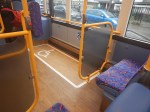
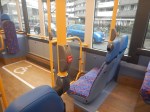

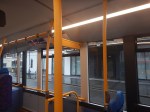
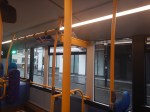

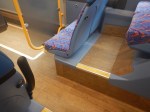
Note.
- The buses are battery-electric.
- This page is the bus’s home page.
- This bus is the short 10.2 metre long version.
- It was certainly a well-built, smooth-riding and comfortable bus, that was approved by my sensitive British bottom.
This Press Release from Wrightbus is entitled Wrightbus Sets Sights On Further European Expansion After Hydrogen Buses Land In Germany.
This is the sub-heading.
Leading zero-emission bus pioneer Wrightbus has announced plans for further expansion into Europe following the arrival of a landmark hydrogen bus order into Germany.
These are the first three paragraphs.
All of the 31 buses for operator Regionalverkehr Köln Gmbh (RVK) are now in situ – the first ever Wrightbus vehicles on European soil – with testing underway before the fleet goes into service across the Cologne region.
Named the fastest-growing bus manufacturer in Europe, Wrightbus has enjoyed a remarkable year. Alongside further hydrogen bus deals for Saarbahn, Vestische, Cottbus and West Verkehr, and the opening of a new European service centre in Bruhl, Wrightbus is also hiring staff to supply buses to France and Benelux.
In October, it also signed a landmark deal worth up to half-a-billion pounds to supply more than 1,000 buses to operator Go-Ahead over the next three years – 90 per cent of which will be zero-emission.
The press release says that deals are possible in France and Benelux.
MP Pushes For Tidal Lagoon In Bristol Channel
The title of this post, is the same as that of this article on the BBC.
This is the sub-heading.
Building a tidal lagoon in the Bristol Channel could provide clean energy for 120 years, an MP has said.
These three paragraphs give more details.
The proposed West Somerset Lagoon, which would cost £10bn to build, would run nine miles (14km) from Minehead to Watchet in Somerset.
Its lifespan would be twice that of a nuclear power plant, said Tiverton and Minehead MP Rachel Gilmour.
Mrs Gilmour said she will soon be discussing the proposal with ministers. If the project is pursued, it could be up and running by 2038 – bringing jobs and financial benefits to the area.
The project already has a web site, with this mission statement.
The West Somerset Tidal Lagoon is a proposed Tidal Range power scheme, that aims to harness the energy of the tides to provide zero carbon renewable energy. It is strategically located on the southern coast of the Bristol Channel Basin between Minehead and Watchet to take advantage of the world’s second highest tidal range and will become the UK’s largest sustainable energy project.
This map from OpenRailwayMap shows the coast between Minehead and Watchet.
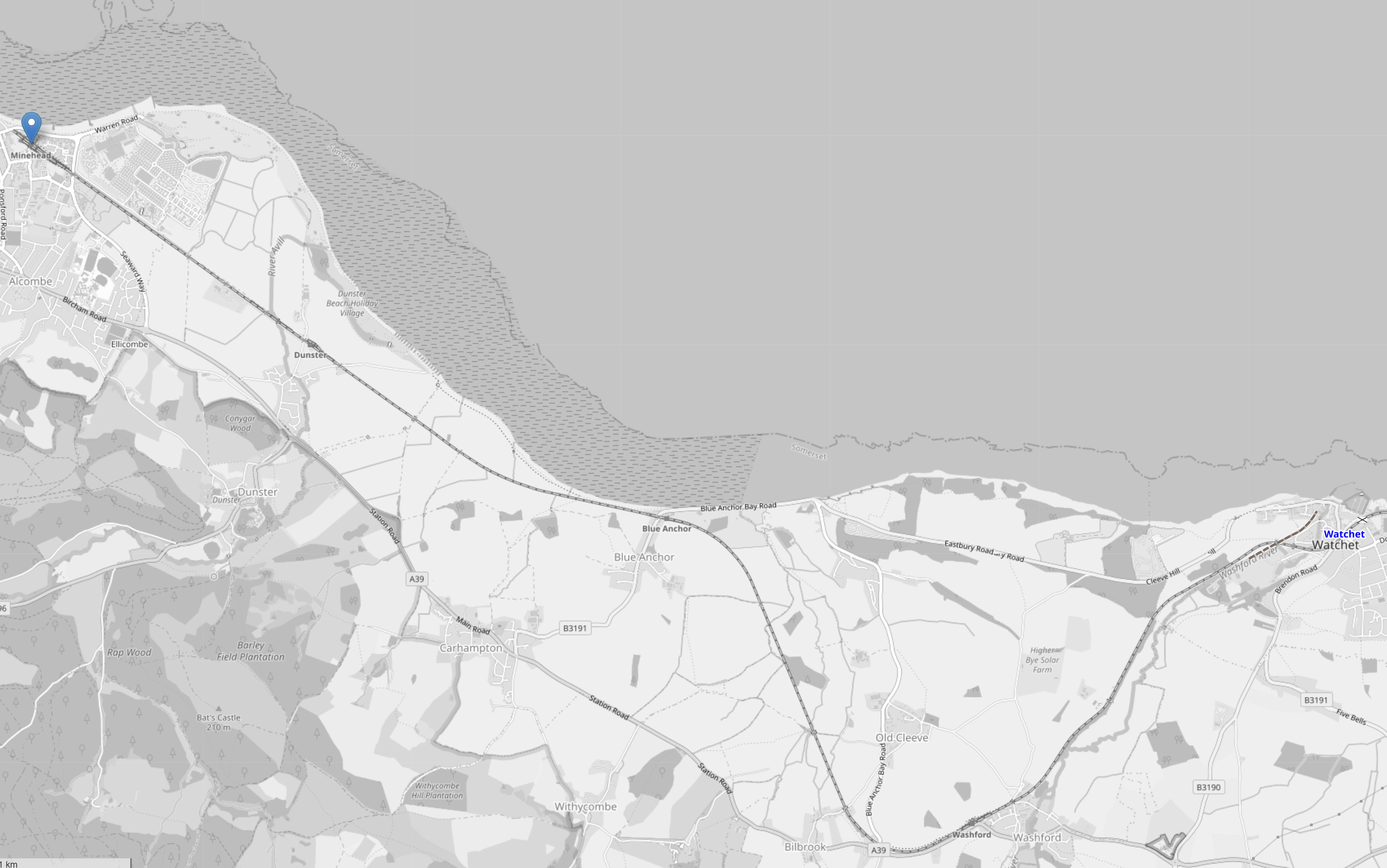
Note.
- Minehead station is indicated by the blue arrow in the North-West of the map.
- Watchet station is indicated by the blue lettering on the Eastern edge of the map.
- The West Somerset Railway links the two stations and connects them to the Bristol and Exeter Line at Norton Fitzwarren station.
It looks like the sea wall of the lagoon will curve between Minehead and Watchet.
The West Somerset Railway
This OpenRailwayMap shows the whole West Somerset Railway.
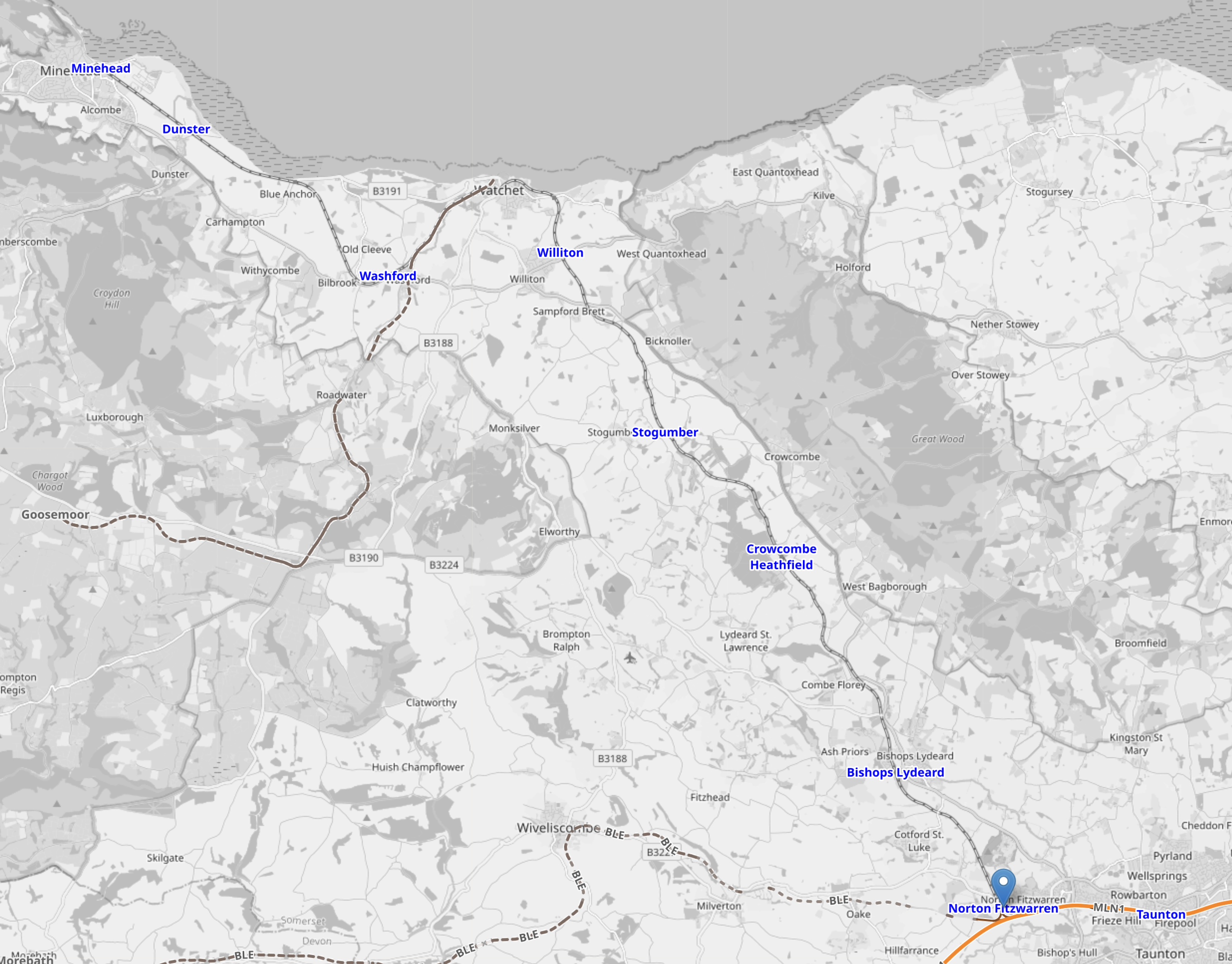
Note.
- Minehead station is in the North-West corner of the map.
- Norton Fitzwarren station is indicated by the blue arrow in the South-East corner of the map, where the West Somerset Railway joins the main line between Exeter and Bristol.
- Taunton station on the main line with trains all over the country is a few miles to the East of Norton Fitzwarren station.
I believe that for the lagoon project to be completed, the West Somerset Railway needs to be turned into a fully-operational branch line from Taunton to improve access for residents, visitors and workers to Minehead and other places in West Somerset.
Large projects like these need large numbers of workers to be completed.
Less disruption to local residents and businesses is caused if a park and ride site is set up. Sizewell C is setting up two from the nearby East Suffolk Line, using hydrogen-powered buses.
Sizewell C also intends to bring in heavy equipment and construction materials by rail from Ipswich and Lowestoft.
The West Somerset Tidal Lagoon could use the railway to bring in heavy loads.
If the West Somerset Railway is going to be used to ease the construction of the lagoon , then this should be properly to connected to Taunton first.
The Lady On The Train
One of the most amazing people, I’ve ever met was a New York State Supreme Court Judge. It is wrong to guess a lady’s edge, but she was about my age; late seventies, black, well-dressed and sat down next to me in Second Class with the biggest smile on her face on the train between Cambridge and London.
She was at a legal conference of senior judges from all over the world at Cambridge University and was going exploring in London.
The reason for the smile was extraordinary. When she went to the ticket counter, she was surprised that the Pakistani-as-she-described him ticket guy asked for her age. He then asked, if she would be doing any other travelling in the UK and when she said yes, he sold her a Senior Railcard as well. She had found it such a surreal experience, that would never have happened in the States that she was still laughing, when the sat down.
She could of course have been not just a New York State Supreme Court Judge, but a full United States Supreme Court Judge and I’d misheard, although I doubt she would have been one of Trump’s picks last time around.
I do hope that when Trump finds himself in the United States Supreme Court as he inevitably will, that she is there to give her verdict.
Thoughts On The Washington National Air Tragedy
I flew light aircraft for over twenty years as a hobby and to get about on business. I flew mainly in the UK, but flew for perhaps fifty to a hundred hours in Australia, France, Ireland, Italy and the United States. I flew planes on to islands like the Scillies in the UK, the Lido in Venice and the Barrier Reef in Australia. It was great fun and I enjoyed it immensely.
I had a friend, who had been an RAF Air Traffic Controller, who would be horrified at Trump’s remarks on diversity, as although he was white, he had been born in Tobago and had many ATC colleagues who were not white.
Flying around the world, most ATC personnel, try to smooth you on your way, even in France and Italy. But American ATC seems to work under unnecessary pressure because they allow planes to where British, French and Australian ATC wouldn’t.
I was told in the 1970s, that aviation experts, wanted to close National Airport, but the politicians wouldn’t allow it.
If I was Trump, I would bring in outside experts from somewhere like Australia, where in my opinion, they do ATC so much better than the Americans.
Rolls-Royce Powers World’s Fastest Offshore Crew Transfer Vessels
The title of this post, is the same as that of this news item from Rolls-Royce.
These three bullet points, act as sub-headings.
- Sea trials demonstrate maximum speed exceeding 53 knots under operational load.
- Each of the three ships is powered by four 16-cylinder mtu Series 2000 engines.
- 35-meter ships are designed as “Surface Effect Ships” (SES)
This is the introductory paragraph.
The Singapore shipbuilder Strategic Marine has commissioned three new offshore supply vessels that, with a maximum speed of over 53 knots, are the fastest of their kind in the world. Each vessel is powered by four 16-cylinder mtu Series 2000M72 engines from Rolls-Royce. The vessels will be used by a national oil company in Africa for passenger transfer to offshore platforms. To enable fast and safe transfer, the 35-meter-long vessels were designed as so-called “Surface Effect Ships”.
This Rolls-Royce image shows one of the Crew Transfer Vessels at 50 knots.
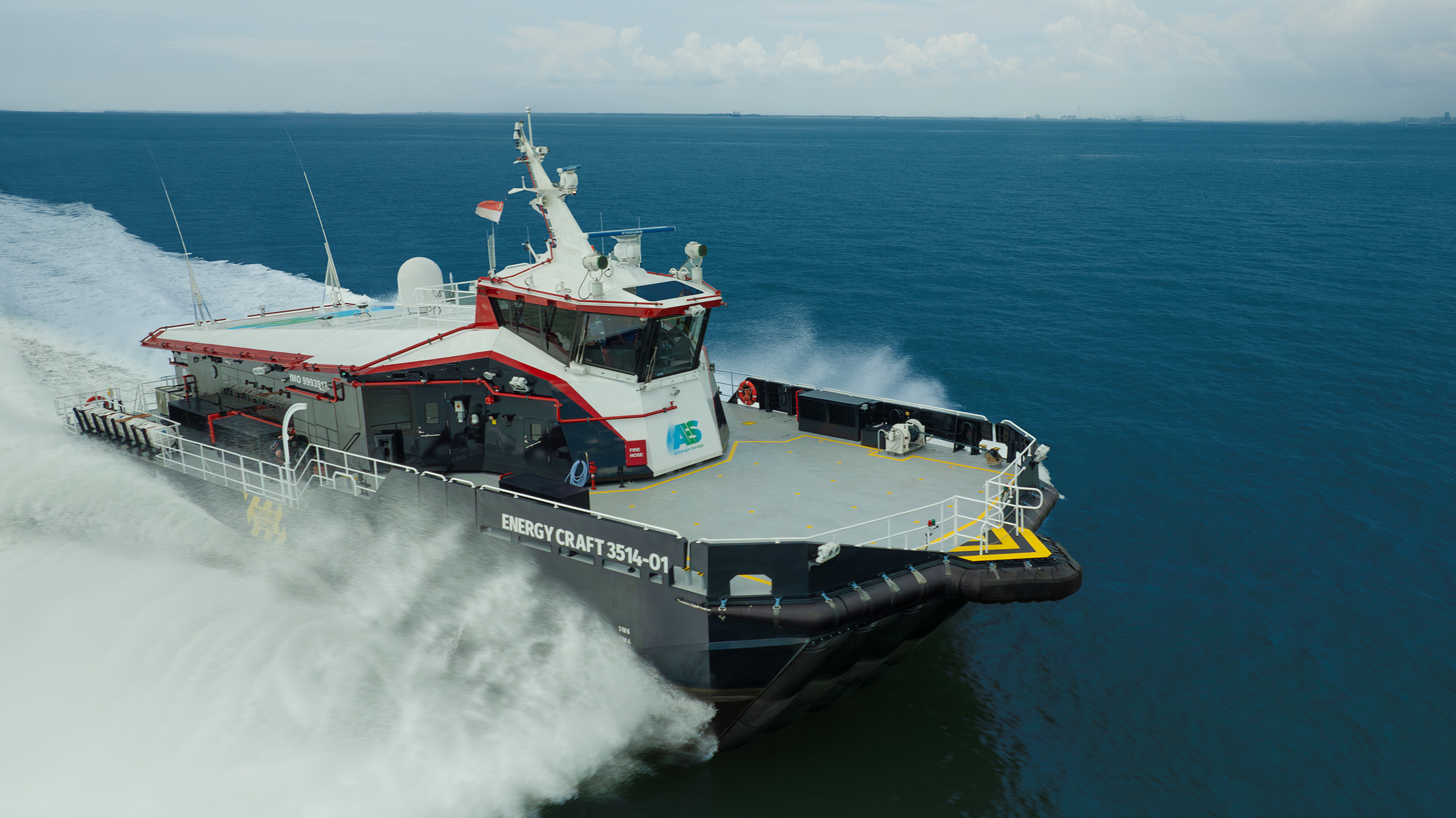
On a slightly different tack, this Rolls-Royce image shows The Spirit of Innovation.

Rolls-Royce described it in this press release which is entitled ‘Spirit of Innovation’ Stakes Claim To Be The World’s Fastest All-Electric Vehicle, using these words.
During its record-breaking runs, the aircraft clocked up a maximum speed of 623 km/h (387.4 mph) which we believe makes the ‘Spirit of Innovation’ the world’s fastest all-electric vehicle.
I’ve probably been over 1,300 mph in Concorde.
So are the three offshore supply vessels, the fastest of their kind in the world?
This video shows one of the Crew Transfer Vessels doing, what they are intended to do.
Rolls-Royce seem to be borrowing a philosophy from their past, where they showed in the Schneider Trophy, just what their engines could do.
These two paragraphs describe the design of the Crew Transfer Vessels.
To enable fast and safe passenger transfer to offshore platforms, the 35-meter-long vessels have been designed as so-called “Surface Effect Ships” (SES). SES uses air-cushion technology within a catamaran hull form. This design was used for the first time in the offshore oil and gas industry.
The boats have an optimized power-to-weight ratio and use powerful fans to generate an air cushion between the hulls that minimizes hull drag and resistance. Combined with the mtu propulsion package (each delivering 5,760 kW of power), the vessels can travel at much higher speeds than conventional monohulls and catamarans, with consumption remaining at the same per hour of operations. The high speed of well over 50 knots (more than 90 km/h) ensures shorter transit times, while the low hull resistance saves fuel and reduces emissions.
I believe, that the Rolls-Royce mtu diesel engines used in these vessels can also be fueled by hydrogen, so is that the next development?
Could we be seeing hydrogen-powered fast ferries on short sea routes around the world?
UK Unveils Measures To Fast-Track 16 GW Of Offshore Wind
The title of this post, is the same as that of this article on offshoreWIND.biz.
This is the sub-heading.
The UK government has unveiled measures to unlock up to 13 offshore wind projects, which could generate up to 16 GW of electricity and potentially bring GBP 20 billion (approximately EUR 23.9 billion) to GBP 30 billion (about EUR 35.8 billion) of investment in homegrown clean power.
These paragraphs illustrate how thw the government propose to do it.
According to the UK government, ministers are streamlining the consenting process to accelerate the construction of offshore wind projects. As set out in Chancellor Rachel Reeves’ growth speech, this will hasten the delivery of vital infrastructure projects and unlock growth as part of the government’s Plan for Change while protecting nature and the environment.
The government plans to eliminate obstacles that have delayed or blocked the development of offshore wind projects by designating new Marine Protected Areas (MPAs) or extending existing MPAs to compensate for impacts to the seabed.
This should prevent delays that have previously resulted from insufficient environmental compensation being agreed upon while protecting the marine environment and contributing to the government’s commitment to protect 30 per cent of its seas for nature by 2030.
- The Government will be streamlining the consanting process.
- But will this streamlining just give more ammunition to the Nimbies?
- Will more compensation be paid and has Rachel from Accounts go it to spend?
- Designating new or redefining existing Marine Protected Areas (MPA).
- The wind farm developers developers will pay for the MPAs.
- Any new designations of MPAs will follow the existing process required under legislation and will include consulting other affected industries and communities.
Surely, if the developers pay for the MPAs, then the price of the energy produced will rise. But then I’m only following Sir Isaac!
We’ve seen streamlining and acceleration before and I can’t remember all of these actions producing positive results.
My feelings are the following should be done.
Fully back the development of the Port of Ardersier, as a floating wind farm production facility.
I discussed this in Redevelopment Of Scottish Port Begins As Owner Secures GBP 400 Million For Offshore Wid Upgrade.
Cleethorpes-London Service Delayed At Least A Year
The title of this post, is the same as that of this article on the BBC.
This is the sub-heading.
The reintroduction of a direct rail service between North East Lincolnshire and London has been delayed for at least another year
These are the first three paragraphs.
Train operator LNER planned to introduce the route from Cleethorpes via Grimsby, Lincoln and Market Rasen to the capital last month.
It is now hoped the service will be available when the East Coast mainline timetable changes are brought at the end of this year.
However, it could be longer due to required improvements to Market Rasen station, which could cost up to £20m.
It looks to me, that to paraphrase a well known project management phrase, LNER got their ducks in the wrong order.
According to the BBC article, the local MPs are not amused.
Hull Trains Eyes Worksop And Sheffield Launch
The title of this post, is the same as that of this article on Railway Gazette.
These are the two introductory paragraphs of the article.
Hull Trains’ proposed London King’s Cross – Worksop – Sheffield open access service would ‘give people more choice’, offer more flexibility in train fares and make the area better known, according to Labour Member of Parliament for Bassetlaw Jo White.
Speaking at the launch of FirstGroup’s Moving forward together: Why open access is essential for a better railway report on January 21, White said the service would increase opportunities for the growing population of Worksop, where new housing being built. Looking back at the history of open access, she said East Hull MP John Prescott had been a supporter of the original launch of Hull Trains.
I suspect that the ebullient John Prescott would have given full backing to Hull Trains proposed Sheffield service.
I have some thoughts about Hull Trains proposed service.
London Overground Syndrome
I am fairly certain, that this service will suffer from from London Overground Syndrome, which is defined like this.
This benign disease, which is probably a modern version of the Victorian railway mania, was first identified in East London in 2011, when it was found that the newly-refurbished East London Line and North London Line were inadequate due to high passenger satisfaction and much increased usage. It has now spread across other parts of the capital, despite various eradication programs.
It may be for slightly different reasons, but as Workshop station has good car parking and could have fast trains to London, it could attract passengers.
But I don’t think two trains per day will be enough.
Tram-Trains Between Sheffield And Retford Via Worksop
Consider.
- It’s under twenty-five miles between Sheffield and Retford, so this route would be possible using battery-electric tram trains, similar to those in South Wales.
- These tram-trains would also be suitable for the Robin Hood Line between Nottingham and Worksop via Mansfield.
- The speed limits are not fast and the distances are not great and I suspect battery-electric versions of Sheffield’s tram trains could handle all routes.
- By using temporal separation, Hull Trains services could be sneaked in early and late in the day.
As both cities of Nottingham and Sheffield have used or thought about using tram-trains, I’m sure Stadler could provide a suitable tram-train, that could work in the two cities and all the branch lines that used to serve the numerous coal mines.
It would be levelling up on a big way.
It could grow into a very comprehensive East Midlands Metro, that also served Derby, Doncaster and possibly Lincoln.
Stadler’s products can certainly be configured in many unusual ways.
 The Anonymous Widower