Not Taking Notice Of My Unsubscribes
One national charity, which I think does a lot of good work, but which I’ve never supported keeps sending me e-mails, so I might buy something from them on-line.
I unsubscribe each time, but still they keep coming. I think I’ve had thirteen since the start of November.
I do wonder, if a lot of people now wouldn’t support this charity, as they’ve had a similar treatment. Which I wouldn’t!
If I get a tin rattler in front of me, they’ll get the reasons.
Are BT Winding Me Up?
BT have said, I can’t have fibre-optic broadband, as I’m too close to the exchange. But this poster has appeared opposite my house, on a BT box.
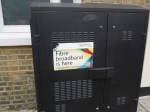

That is just not on. So should I complain to OFCOM?
A Quick Analysis Of Bank Phishing E-Mails
I have been collecting bank phishing e-mails since July.
I’ve received a hundred and six of them, with most banks being mentioned a couple of times. The scores were as follows.
Halifax – 2
Nationwide – 2
HSBC – 9
Santander – 2
Lloyds – 2
But this is dwarfed by twenty six aimed at customers of RBS and Natwest. Let’s face it, if you’re a phishing expert, you might target a bank with well-publices problems, as an e-mail about security issues might be expected. Incidentally, I’ve never had an e-mail of any sort from Nationwide, except for a monthly one, to say that my statement is ready. But that has no links in it.
So that is another reason to leave the bank, as because you are obviously not that savvy in staying with them, you might be the sort of person, who falls victim to the scam.
But I wouldn’t think of moving to Barclays, as they score a massive 53 in the period.
It would seem to me, that the time you are most vulnerable to scams is just after you’ve changed banks, so as there are still Barclays phishing e-mails flying around, I’d avoid them.
Passwords
The BBC has an article on their web site today about passwords for Internet sites.
I go in to lots of sites and there are some I never use as their security doesn’t suit me.
If a site insists, I use a shift to enter a password, then that company doesn’t get my business. I think that Verified by Visa insists on this, so I never use my Visa card on-line. So if I see an on-line transaction, when I check my Visa account, I know it’s fraud.
Incidentally, I think it’s a good idea to only use one card for on-line transactions and keep that secure in a close place by your computer.
My passwords are generally based on phone numbers, that I remember from my childhood, which were like the classic Whitehall 1212, which was Scotland Yard. You can check your password here. They say, that it would take a PC a thousand years to crack one of my passwords. But even my immediate family wouldn’t probably have known the number.
And all it was was an old London phone number.
Even the last phone number I had in Suffolk, which was Thurlow 789, would take a computer 10 days. The previous phone number at Debach, which was on a small exchange called Charsfield and was just three digits, would take a thousand years. Unless of course you had my details from the 1970s.
Incidentally, if I translate my current phone number, back to the exchange name that would take 27 years. If you want to translate your London number, there’s a list here.
So it would appear you can be both lazy and secure!
Microsoft Outlook Is Full Of Bugs
I would be annoyed with myself, if I’d written software with as many bugs as Microsoft Outlook.
What is driving me hairless at the moment is trying to send the e-mail address, telephone numbers and physical address of a sick friend, to those in my address book who know him. I’m using a vcf format Business Card.
Unfortunately, since I first sent his address by this method a couple of years ago, the entry has changed, as my friend has moved.
But Outlook persists in sending the old details. Do I have to delete the entry and reenter everything?
That to me is a triple-X rated bug.
More ARM Processors Than People
A friend has told me that he was in a meeting and one of the founders of ARM pointed out, that there were probably more ARM processors in the room than people.
As I type this, I’m wondering how many ARM processors are in this room with me.
For a start, there’s my Samsung Galaxy S3 Mini, which has an ARM CPU and GPU. As the CPU is dual core, is that a total of three or two?
There’s also a modern Samsung television, two set-top boxes, four Nokia phones, including three 6310i, two digital cameras and a Samsung Tab, all of which might contain one or more ARM processors.
I think that I’m outnumbered! But take note that in 2012, they sold 8.7 billion units!
London’s Name Advantage
It has just been announced that London has now acquired the .london domain name extension.
If you go through the major cities of the world, it generally would seem to work for many like Paris, Berlin, Rome and New York, but it doesn’t work for cities with longer names like Edinburgh, San Francisco and Copenhagen.
So do the short-named cities like London have an advantage? try typing in the domain name for the mayor of Vladivostok!
Four Direct Debits
This morning on my summary bank statement, the last four entries just say Direct Debit. If I go to the full statement only one is fully annotated and understandable.
I can identify two of the other entries, but the third is almost a complete mystery to me.
As they are Direct Debits, my bank can do a lot better than this, as they must have had the payee to actually pay the direct debit.
So why are these payees not shown in the summary? It wouldn’t cost them any money to say “DD nPower” rather than “Direct Debit”. It even has less characters.
The first bank, that offers a fully annotated money transfer service gets my business!
The Good And The Bad Of A & E
The saga of my hand is hopefully now finished.
But it does illustrate the good and the bad of A & E in the NHS.
The damage happened near to my surgery and the nurse patched it up. She also checked my tetanus and found it was up to date.
But possibly because of my Warfarin, the blood started to seep around the plaster and in the end, when I started dripping blood all over a Victoria line train, I got out at Warren Street station and I went to A & E at University College Hospital. They did a stronger patch but even that fell apart, probably because I type too much and the damage was on the point of the knuckle.
So it was back to the surgery and then on to Boots, where I bought a large traditional plaster to put over the lot, and some white cotton gloves to protect the whole package.
I still have a scab on the back of the hand and now because of the success of the hospital bandage, I wear a wrist support to take the pressure off my wrist and the knuckle.
The treatment, I got was generally good and quick, as who would complain at forty minutes in A & E for a minor injury.
But as I live alone and couldn’t patch it up myself with one good hand, it needed trips to get medical help.
So are we seeing more people going to A & E because so many of us now live alone? And is A & E geared up for it?
But the real problem that A & E has, is the lack of a joined up database with my GP. The nurse at the surgery checked my tetanus status, which I thought was good, but of course, I couldn’t remember the date. The nurse in the hospital asked and I told her it was good. but she had no means of checking.
Incidentally, one thing that saved time in A & E was that I’d been an in-patient at the hospital and I was already registered.
Those who object to a large joined up NHS patient database, are probably the people, who complain loudest at the wait in A & E.
But how much time and effort would it save?
A Message To All Customers Of Currys/Dixons plc
On the 30th of October, I noticed an entry on my credit card statement labelled PRODUCT SUPPORT AG, with a reference of 0844 800 6080. I thought at first, it was some sort of charge, I’d encountered on my trips into Europe for something like wi-fi access. But I was still curious, so on searching the Internet, I found this page on a web site called Odd Box. Here’s the first paragraph.
If you have previously purchased a product from PC World or Currys, you may have signed up toPC WORLD/Currys, WHATEVER HAPPENS. The transaction under your credit or debit card as PRODUCT SUPPORT AG. It’s also marketed as Knowhow from Dixons Retail plc, the parent company of PC World, Currys and Dixons. This is an extended warranty offered for TVs, Laptop, PCs, electronics in general or any other item they sale. The warranty usually goes beyond the standard manufacture warranty to fix or replace items that develop a fault.
Now I never purchase extended warranties on anything, as these days electronics goods are either very reliable or die in the first few days. If it’s the latter, I’m of course protected under my normal retail rights.
I always strongly say I don’t want the extended warranty, so I started to suspect there had been a mistake somewhere.
But on what product and how much had I been charged in error. So to find out these answers, I sent a message to my bank, which is Nationwide.
On my credit card statement, there is an entry that puzzles me. It says Product Support AG and has a reference of 0844 800 6080. On checking the Internet I find it is for something I bought in Dixon/Currys.
I have no idea what it was, as I don’t keep statements. I also always say that I don’t want the insurance or service, so I suspect someone at their end has filled in the computer incorrectly. I never need support for anything in this area, as I once sold a computer company for a nine figure sum, and I was the technical guy behind it. So not only is insurance something I stand myself on anything computing or electrical, but if I don’t know the problem, one of my friends does. So for this reason, I never take the extra insurance. It’s their version of PPI, which I managed to avoid, except in one small case.
So please could you send me details of the transaction, what it was for and how much their practices have cost me? I suspect, it was an error at their end, as I am usually very definite in refusing the support. I shall be posting all of this on my blog and writing to Watchdog and my MP, so your co-operation in this matter is appreciated.
I hoped that this would give an answer to my questions, so I could take the matter further with Dixons.
I didn’t get an answer, I got decisive action.Today, just a couple of working days after my original message to Nationwide, four payments had been refunded to my credit card and it is now obvious from the dates that the product was my Samsung Tab 2. Something, I no longer use, as everything I did on it, I now do on my Samsung Galaxy Mini phone, which you’ll admit is a little bit smaller to take on my travels.
It’s certainly pats on the back all round for Nationwide.
The money refunded incidentally, pays for a good meal for two. Do I have any takers? You can have the Samsung Tab 2, if you want it. It’s got a case too!
One point here, is that I would have spotted this mistake earlier, if the information on credit card statements was more detailed.
Does keeping the statement information deliberately vague, mean it is more likely, that customers, will not spot to what they’ve signed up? Next time, I buy something from Currys/PC World, I’ll use several of those credit cards with the Queen’s head on them.
I also notice that with my new television, which was bought from John Lewis, that they threw in an extra warranty for free!

