Highview Power Names Rupert Pearce Chief Executive Officer
The title of this post, is the same as that of this article on business wire.
This is the first paragraph.
Highview Power, a global leader in providing long duration energy storage and essential grid services, has named Rupert Pearce as its new CEO. In this role, Pearce will leverage his expertise in guiding technology companies through significant transformation and globalisation to position Highview Power as a leader in accelerating the energy transition.
He certainly seems to be type of CEO, that Highview needs to succeed.
Australian Start-Up Eyes Disused Mine Shafts For Giga-Scale Gravity Energy Storage
Thye title of this post, is the same as that of this article on Renew Economy.
This is the first paragraph.
A newly launched Australian start-up has unveiled its own take on gravitational energy storage technology that will use super-heavy weights in legacy mine shafts to capture and release energy, with around 3GWh of potential storage capacity already identified for development.
Note.
- The company is called Green Gravity.
- I can’t find a web site.
The idea seems very much like Gravitricity.
- The energy stored seems about the same order of magnitude.
- In Disused Coal Mine Could Host Gravity Energy Storage Project, I describe how Gravitricity will be using coal mines to store energy.
Gravitricity’s ideas may be patented.
ScotWind N3 Offshore Wind Farm
I introduced this wind farm in ScotWind Offshore Wind Leasing Delivers Major Boost To Scotland’s Net Zero Aspirations as Lease 15 – The Odd Bid Out.
I said this.
In any design competition, there is usually at least one design, that is not look like any of the others.
In the successful bids for the ScotWind leases, the bid from Magnora ASA stands out.
- The company has an unusual home page on its offshore wind web site.
- This page on their web site outlines their project.
- It will be technology agnostic, with 15MW turbines and a total capacity of 500MW
- It will use floating offshore wind with a concrete floater
- It is estimated, that it will have a capacity factor of 56 %.
- The water depth will be an astonishing 106-125m
- The construction and operation will use local facilities at Stornoway and Kishorn Ports.
- The floater will have local and Scottish content.
- The project will use UK operated vessels.
- Hydrogen is mentioned.
- Consent is planned for 2026, with construction starting in 2028 and completion in 2030.
This project could serve as a model for wind farms all round the world with a 500 MW power station, hydrogen production and local involvement and construction.
I have some thoughts.
The Location Of The Windfarm
This Google Map shows the area between Stornaway and Kishorn.
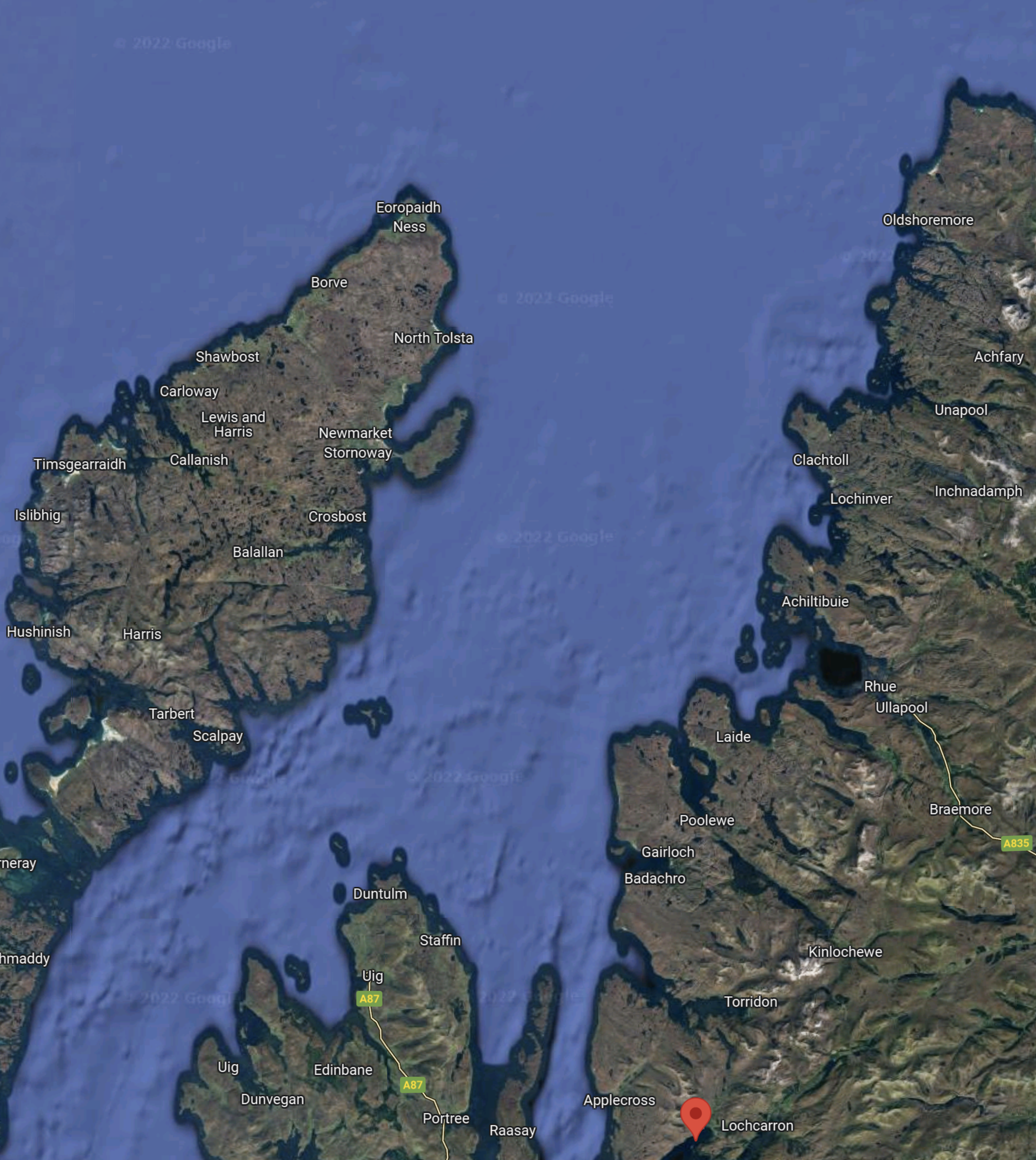
Note.
- The island in the North-West of the map is Lewis and Harris.
- The windfarm will be to the North-West of the island.
- Stornaway is on the isthmus, that connects the small peninsular on the East of the island.
- The port of Stornaway is on the South side of the isthmus.
- The port of Kishorn is shown by the red arrow.
This second Google Map shows the town of Stornaway.
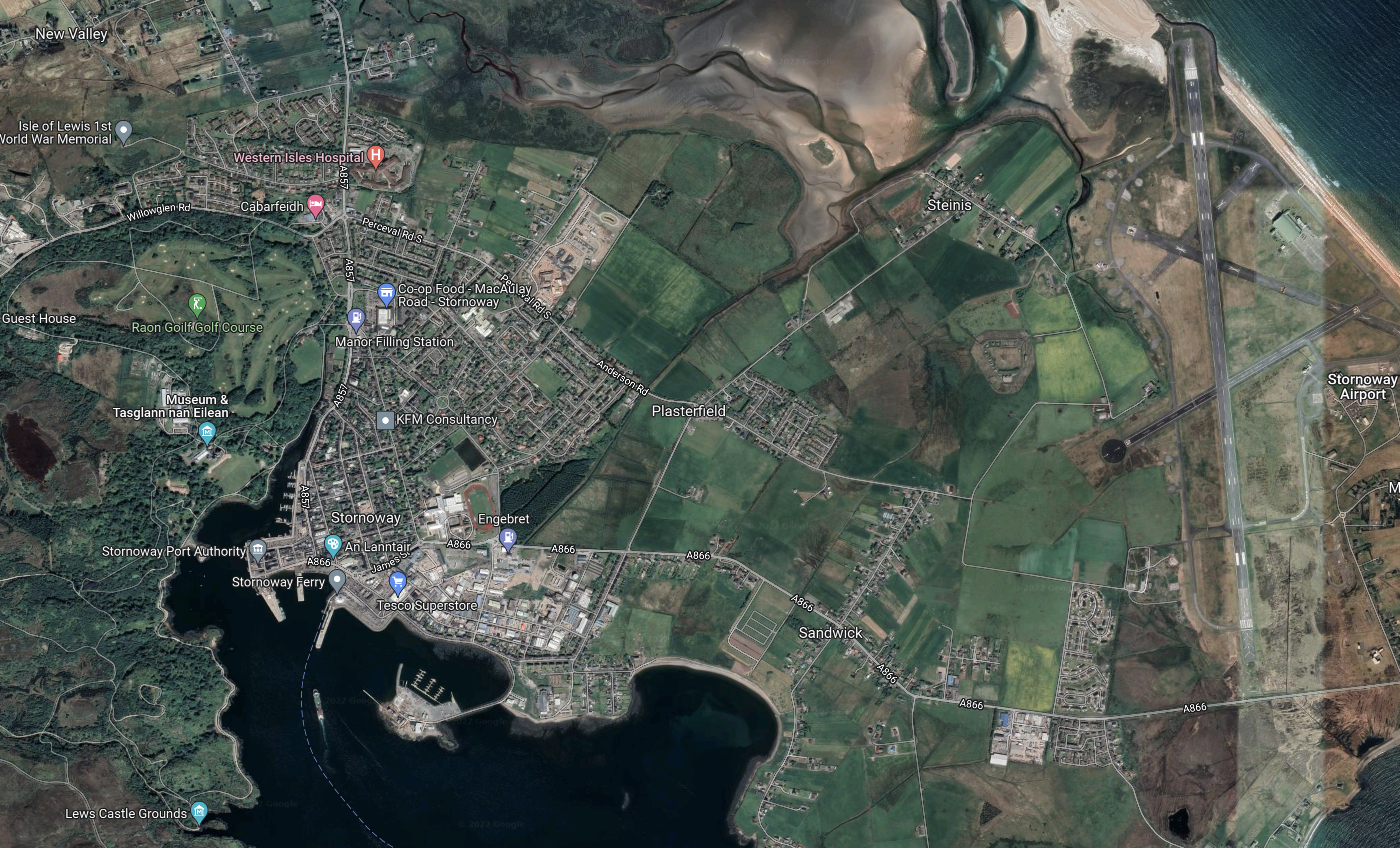
Note that Stornaway has a substantial airport in the East and a large port.
This third Google Map shows Loch Kishorn in more detail.
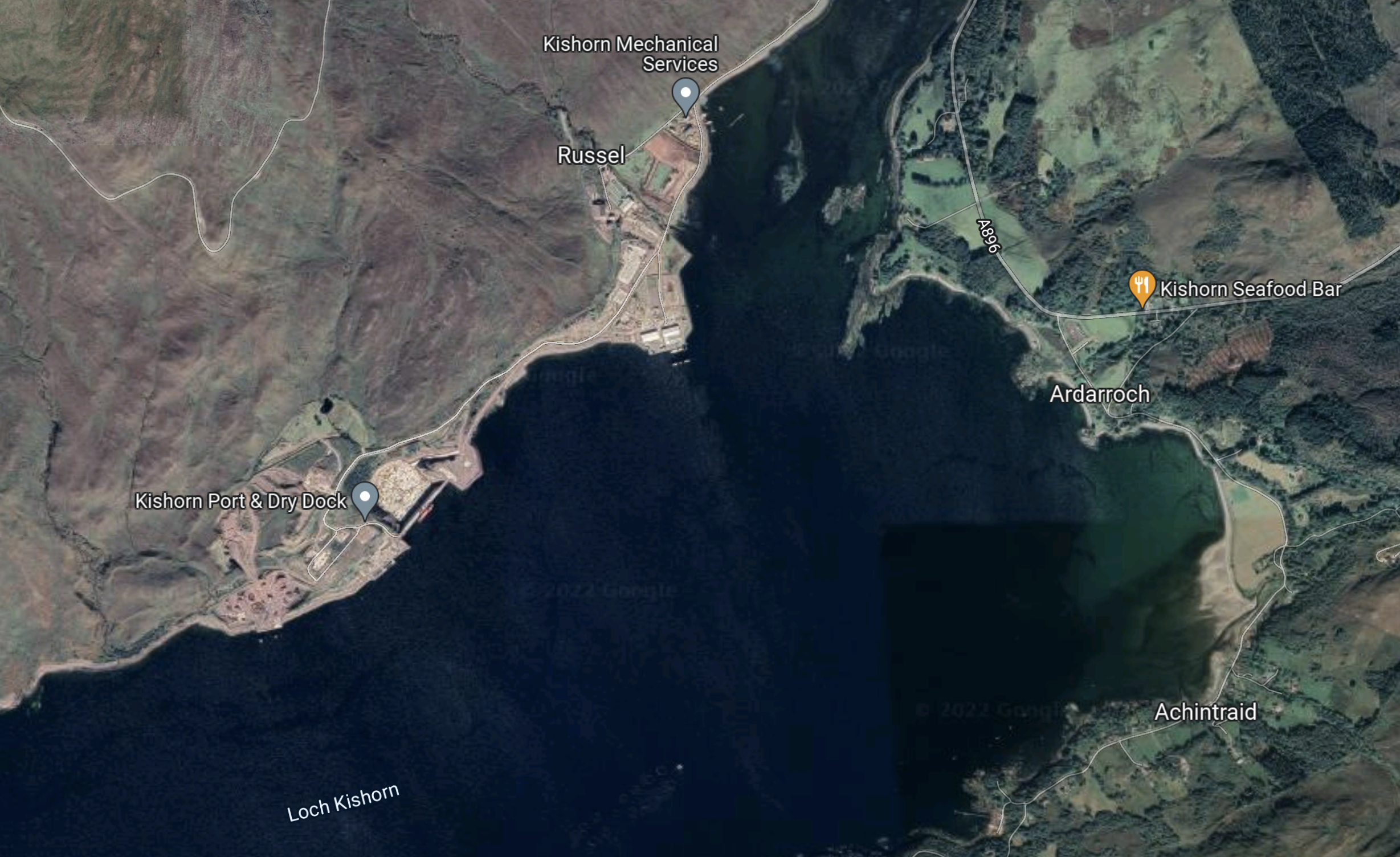
Kishorn Yard at the Kishorn Port was originally built to create the large structures in steel and concrete for the development of North Sea Oil. This is an extract from the Wikipedia entry.
The yard was therefore well suited to build the 600,000-tonne concrete Ninian Central Platform, which was built in 1978. Material was supplied by sea and when complete the platform needed seven tugs to tow it to its operating position in the North Sea. The Ninian Central Platform still holds the record as the largest movable object ever created by man.
If the yard could build the Ninian Central Platform, I’m sure that Magnora ASA intend to build the concrete floater in Loch Kishorn.
The Floating Wind Turbines
In visualisations on the site, the floating wind turbines are shown as sitting on floating three-pointed star structures.
As Technip UK are partners in the project and I suspect they are a subsidiary of TechnipFMC, who are a well-known company described like this in Wikipedia.
TechnipFMC plc is a French-American, UK-domiciled global oil and gas company that provides complete project life cycle services for the energy industry.
The company would certainly have the expertise to design a floating platform for a wind farm.
Like the WindFloat, it could be based on semi-submersible offshore platform technology.
The Magnora web site, say that 15 MW wind turbines will be used, so these will probably be some of the largest wind turbines in the world.
Currently, the largest floating wind turbines are the 9.5 MW units at the Kincardine Wind Farm in Scotland.
33 x 15 MW wind turbines would give a capacity of 495 MW.
I suspect the turbines would be towed to Stornaway or Kishorn for major servicing.
What Will The Concrete Floater Do?
There are a variety of tasks that the concrete floater could handle.
- It could collect the electricity from the wind turbines. I suspect this would give advantages in the connection and disconnection of individual turbines into the windfarm.
- Any electricity conversion necessary would be handled on the floater.
- The floater would handle the seaward end of the connection to the shore.
- There could be a battery or energy storage device on the floater.
- Could a Gravitricity battery or something similar be built into the floater?
- Magnora mention hydrogen on their web site. Could an electrolyser be built on the floater and the hydrogen distributed to Lewis and Harris by pipeline?
Some oil and gas platforms are very comprehensive and there is no reason why there can’t be substantial processing done on the floater.
The Concrete Floater
According to Wikipedia, offshore concrete structures have been in use successfully for about 50 years. Nearly fifty are in use in the oil and gas industry.
Wikipedia introduces its section on floating concrete structures like this.
Since concrete is quite resistant to corrosion from salt water and keeps maintenance costs low, floating concrete structures have become increasingly attractive to the oil and gas industry in the last two decades.
I also wonder if a floating concrete structure would make a good hydrogen storage tank, if there is electrolysis on the floater on the to turn electricity into hydrogen.
Conclusion
My original conclusion after reading about this wind farm was.
This project could serve as a model for wind farms all round the world with a 500 MW power station, hydrogen production and local involvement and construction.
I have no reason to change my mind and feel that the concept may have even more possibilities.
MacHairWind Wind Farm
MachairWind wind farm has its own page on the ScottishPower Renewables web site.
These are the two introductory paragraphs.
The MacHairWind project off the coast of Islay, which could deliver 2GW of cleaner renewable energy, will make a significant contribution to tackling climate change and achieving Net Zero, with the potential to generate enough clean electricity to power over 2 million homes in Scotland.
It will also build on ScottishPower’s long-standing presence and positive track record of investing in and working with local communities and businesses across Argyll & Bute to realise the benefits of renewable energy developments.
This Google Map shows the area of the wind farm, which is to the North West of the island of Islay.
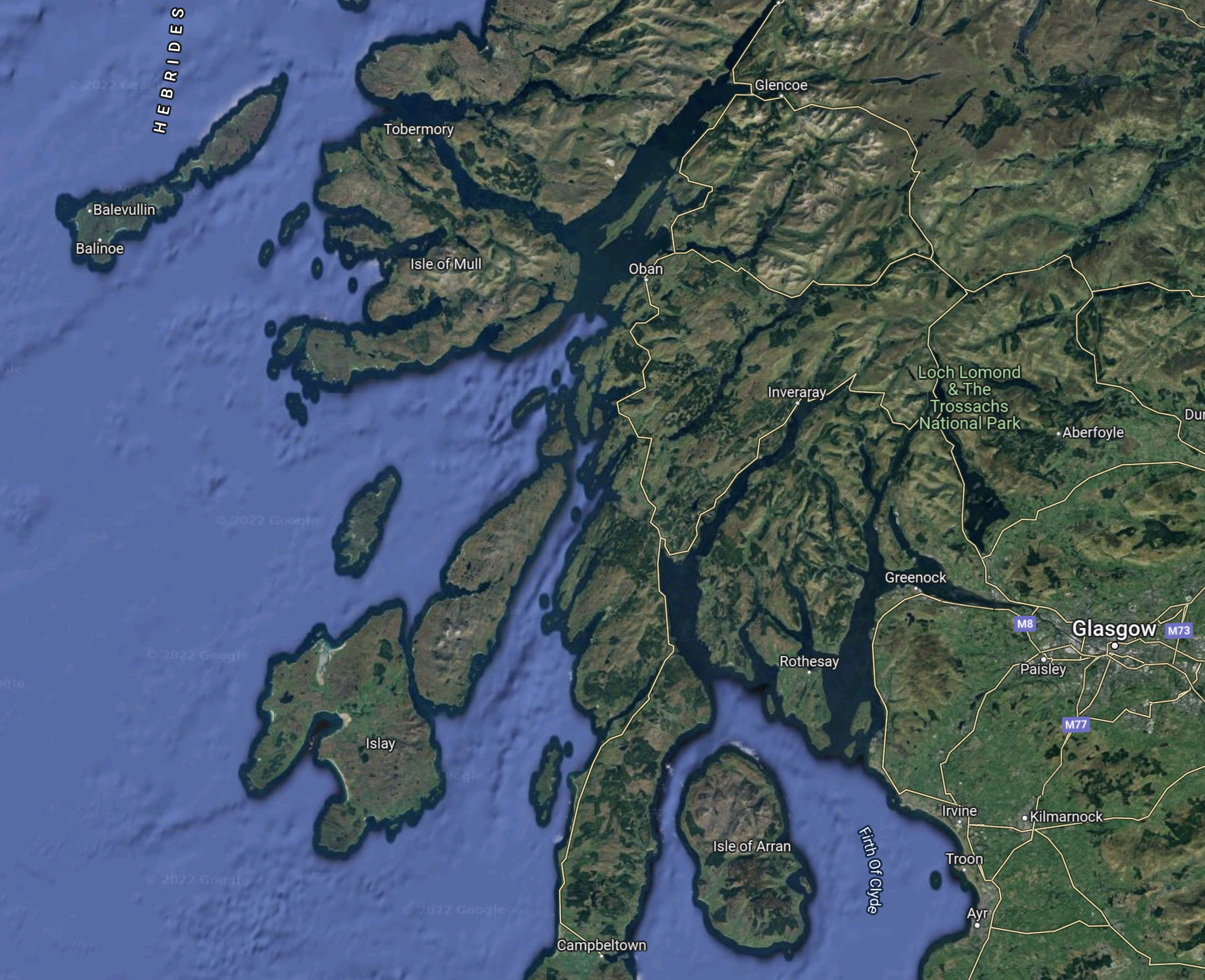
Note.
- There certainly is a large space of empty sea to the North-West of Islay.
- Glasgow is not far away.
This second Google Map shows the area to the North-East of Islay.
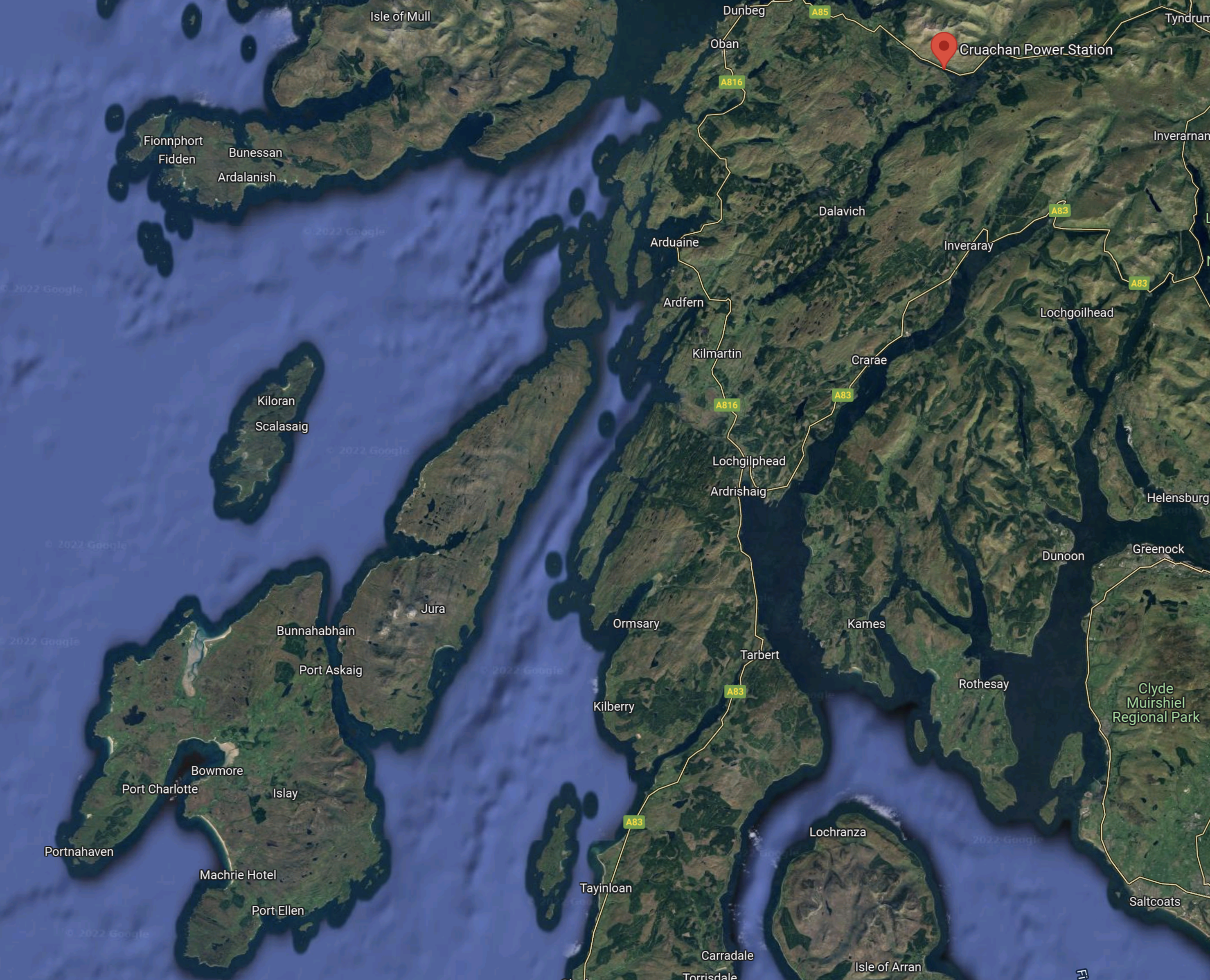
Note.
- Islay is in the South-West corner of the map.
- Colonsay is the smaller island to the North.
- In the North-East corner of the map the red arrow indicate Cruachan pumped hydro power station.
- In the South-East corner of the map is the Clyde Estuary, where the two nuclear power stations at Hunterston were located.
- Hunterston is also the Northern end of Western HVDC Link to North Wales.
Wikipedia says this about the relationship of the Cruachan power station and Hunterston’s nuclear stations.
Construction began in 1959 to coincide with the Hunterston A nuclear power station in Ayrshire. Cruachan uses cheap off-peak electricity generated at night to pump water to the higher reservoir, which can then be released during the day to provide power as necessary.
Now that the two nuclear stations are being decommissioned, will the MacHairWind wind farm be used to pump water to Cruachan’s higher reservoir?
Conclusion
The MacHairWind wind farm seems a well-positioned wind farm.
- It is close to Glasgow.
- It can be used in tandem with the Cruachan pumped hydro power station.
- It will have access to the Western HVDC Link to send power to the North-West of England.
Is Scotland replacing the 1.2 GW Hunterston B nuclear power station with a 2 GW wind farm, with help from Cruachan and other proposed pumped storage hydro schemes to the North of Glasgow?
It also looks like increasing the power at Cruachan from the current 440 MW to a GW, by the building of Cruachan 2 would give the area even more energy security.
Loch Kemp Pumped Hydro
Loch Kemp Is a smaller loch just to the East of Loch Ness.
This Google Map shows Loch Kemp in relation to Loch Ness.
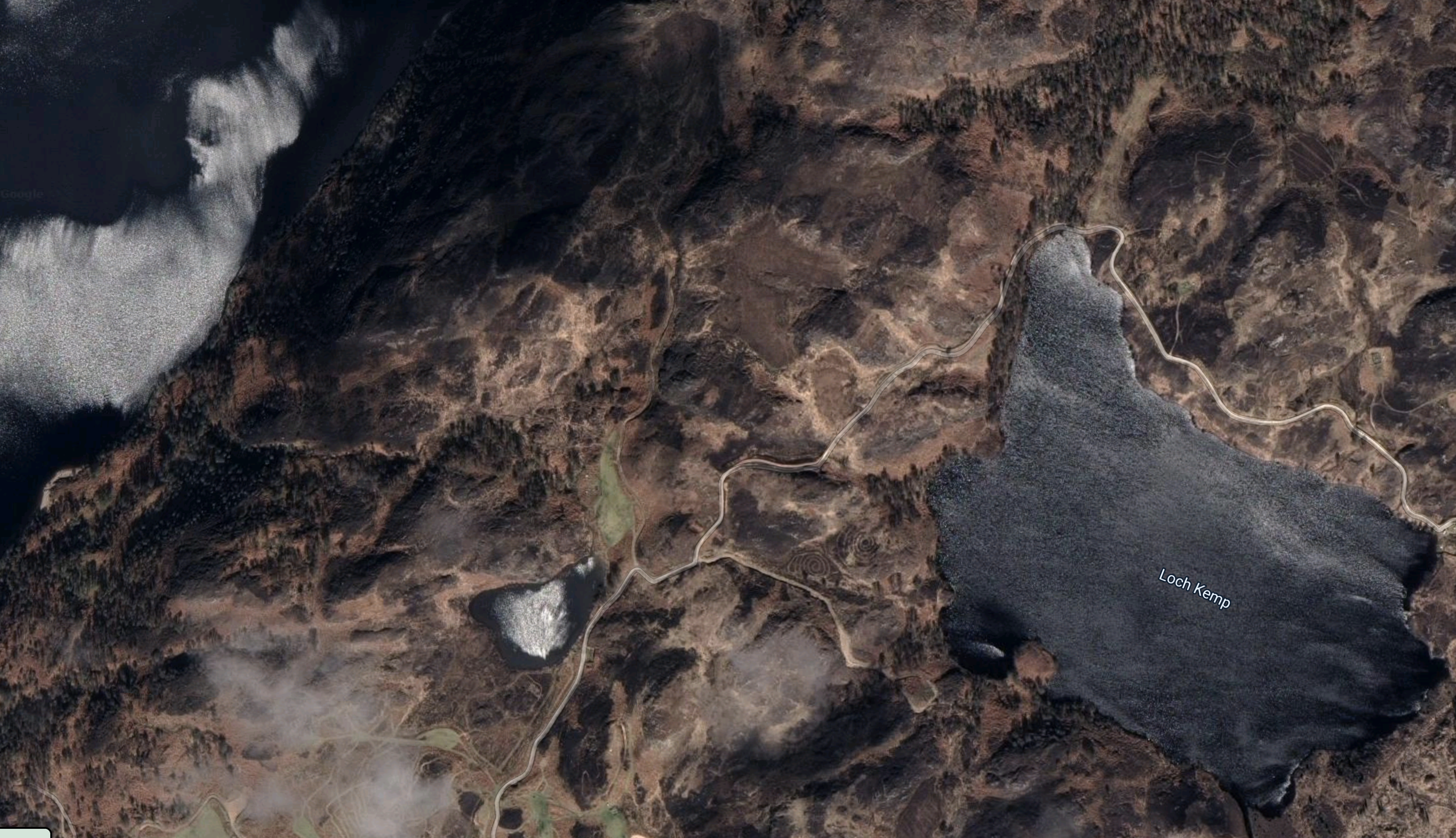
Note.
- Loch Ness is in the North West corner of the map, with partial cloud cover.
- Loch Kemp is in the South East corner of the map.
The proposed Loch Kemp pumped hydro scheme will have these characteristics.
- Loch Kemp will be the upper reservoir.
- Loch Ness will be the lower reservoir.
- The power station will be on the banks of Loch Ness.
- The power station will be designed to fit into the environment.
- Eight dams will be built to enlarge Loch Kemp.
- Trees will be planted.
- Output of the power station will be 300 MW
- Available storage could be 9 GWh.
The station will have almost as much storage capacity as Electric Mountain, but that power station has an output of 1.8 GW.
In Glendoe Hydro Power Station, I wrote about the Glendoe Hydro Scheme.
- It is a 100 MW hydroelectric power station
- It has the highest head at 600 metres of any power station in the UK.
- It opened in 2009, making it one of the newest hydroelectric power stations in the UK.
- The actual power station is in an underground cavern.
- The dam and power station have been designed to be hidden from view.
This Google Map shows the location of Glendoe power station to the South of Loch Kemp.
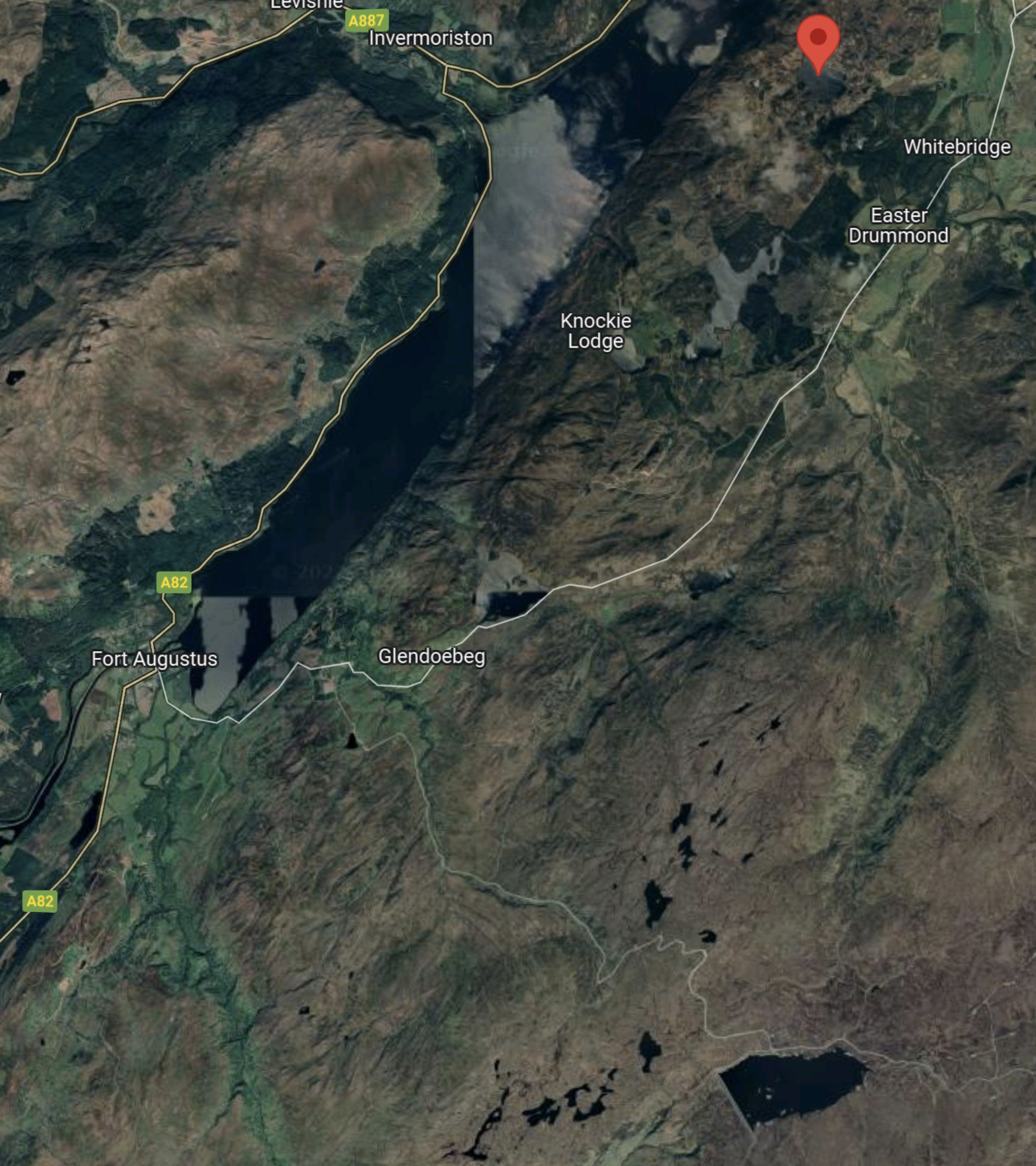
Note.
- The red arrow indicates Loch Kemp.
- The loch in the South East corner is the reservoir that feeds Glendoe power station.
- Fort Augustus is at the Southern end of Loch Ness.
This Google Map shows the Northern end of Loch Ness.
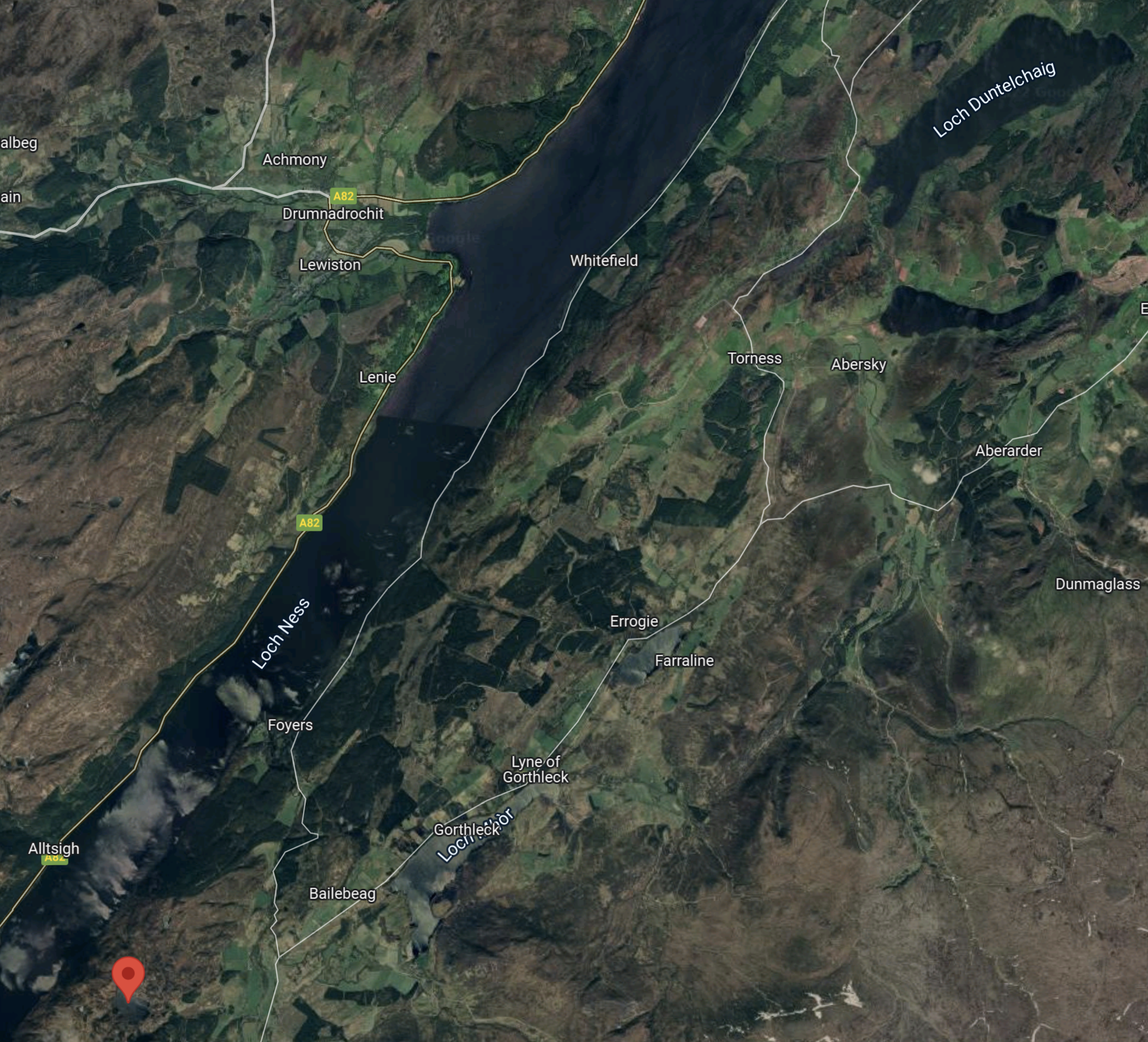
Note.
- The red arrow indicates Loch Kemp.
- Foyers, which is a short distance to the North West, is the site of the Foyers pumped hydro scheme. I wrote about this scheme in The Development Of The Foyers Pumped Storage Scheme.
- Loch Duntelchaig, in the North-East corner of the map, is being used as the upper reservoir of the Red John pumped hydro scheme. I wrote about this project in Red John Pumped Storage Hydro Project.
On the East side of Loch Ness there seems to be four substantial hydro-electric schemes.
In order from South to North these schemes are.
Glendoe
Glendoe is a modern 100 MW hydroelectric power station, that opened in 2009.
In Glendoe Hydro Power Station, I felt it might be possible to expand Glendoe into a pumped hydro scheme, with upwards of 10 GWh of storage.
Loch Kemp
Loch Kemp is a proposed 300 MW/9 GWh pumped hydro storage station.
Foyers
Foyers is an existing 300 MW/10 GWh pumped hydro storage station.
Red John
Red John is a proposed 450 MW/2.8 GWh pumped hydro storage station, which has received planning permission.
These four power stations could be summarised as follows.
- Glendoe – 100 MW/10 GWh
- Loch Kemp – 300 MW/9 GWh
- Foyers – 300 MW/10 GWh
- Red John – 450 MW/2.8 GWh
Note.
- Totals are 1150 MW and 31.8 GWh
- Foyers was converted from a conventional hydroelectric power station, that was opened in 1895 to a pumped hydro storage station.
- If Foyers can be converted, why can’t Glendoe.
A very large pumped storage station of four separate units, can be built on the East side of Loch Ness.
Conclusion
This is only on the East side of Loch Ness, so if the West side can be similarly developed, Loch Ness could be developed into a real Loch Ness monster with over 60 GWh of pumped hydro storage.
Ministerial Roundtable Seeks To Unlock Investment In UK Energy Storage
The title of this post, is the same as that of this press release from Drax.
These are the first two paragraphs.
Business leaders have met with UK Energy Minister the Rt Hon Greg Hands MP to discuss how the government could unlock significant investment in vital energy storage technologies needed to decarbonise the power sector and help ensure greater energy independence.
The meeting was organised by the Long-Duration Electricity Storage Alliance, a new association of companies, progressing plans across a range of technologies to be first of their kind to be developed in the UK for decades.
This press release, which I found on the Drax website, has obviously been produced by the four companies; Drax, Highview Power, Invinity Energy Systems and SSE Renewables.
Greg Hands MP, who is the Minister of State for Business, Energy and Clean Growth said this.
The Long-Duration Electricity Storage Alliance is a key part of our plan to get the full benefit from our world-class renewables sector. Government have already committed £68 million of funding toward the development of these technologies.
“This will support the UK as we shift towards domestically-produced renewable energy that will boost our energy security and create jobs and investment.
The three CEOs and a director from SSE, make statements about what they are doing and what they need from Government, which are all worth reading.
- Drax still needs planning permission for its flagship project at Cruachan, that is called Cruachan 2.
- SSE are saying that the massive 30 GWh Coire Glas pumped hydro scheme has full planning permission and is shovel-ready.
- Drax and SSE appear to be in favour of Cap and Floor regimes to support long term energy storage.
- Highview Power and Invinity Energy Systems appear very optimistic.
- Finance for capital cost is not mentioned. As billions will be needed for some of these schemes and the returns are very predictable, I assume that it has been promised.
After reading this press release fully, I too am optimistic.
Conclusion
I feel sure, that a sensible plan will evolve fairly soon, which will involve these four companies and possibly some others.
A Rusting Battery In Minnesota Could Unlock The Electric Grid Of The Future
The title of this post is the same as that of this article on the West Central Tribune.
This is the first paragraph.
A pilot project between Minnesota’s second largest supplier of electricity, Great River Energy, and a Massachusetts start-up claims to have a breakthrough in battery technology that would allow for vast expansions of renewable energy on the power grid.
The article goes on to describe Form Energy’s batteries and gives a couple of pictures.
I’m not sure, but it looks like the battery can supply 1 MW for a hundred hours.
Form Energy have impressive backers and have been secretive in the past, but the concept of using iron oxide (rust) as an energy storage medium sounds to me, to be a challenging idea.
A Resilient Net Zero Electricity System Achievable By 2035 But Increased Investment Required, Regen Report Finds
The title of this post, is the same as that of this article on Current News.
This is the first two paragraphs.
The technical solutions needed to operate a net zero electricity system by 2035 are available or attainable, Regen has found, though a step-change in the level of investment is still needed.
The trade body has produced a new report for National Grid ESO into a ‘day in the life’ of a fully decarbonized electricity system by 2035, which the ESO is aiming for.
The article gives a lot of figures about our electricity supply in 2035.
Consumption of electricity will be between 450 and 500TWh per year, with the following sources.
- 55-65GW of offshore wind
- 25-35GW onshore wind
- 40-50GW of solar
- 6-10GW of other renewables
- 10-15GW of low carbon dispatch
- 8-10GW of nuclear
- 8-12GW of carbon capture and storage (CCS)
- 15-25GW of fossil fuel backup.
Note.
- 450-500 TWh is 51-57 GW per hour averaged out over the year.
- They emphasise the importance of energy storage.
- No mention is made of the massive Coire Glas pumped hydro storage.
- No mention is made of hydrogen.
- As is normal, with reports like this the authors don’t keep their GW and GWh separate.
- They also don’t explain the hierarchy of MW, GW and TW, which is 1000 x steps up the scale.
The full report is at this page on the Internet.
Gelion Claims Zinc-Bromine Gel Batteries Will Replace Lithium-Ion
The title of this post, is the same as that as this article on RideApart.
These are the first two paragraphs.
Battery technologies are evolving at a rapid pace—and for good reasons. With the automotive world moving toward electrification, companies need to find solutions for producing electric vehicles on a massive scale. While lithium-ion battery technology rules the roost today, that isn’t stopping firms from developing the next big leap forward.
From solid-state power units to structural batteries to sci-fi-worthy quantum batteries, there’s no shortage of ideas and concepts. However, the Australian company Gelion Technologies believes it found a more affordable and durable approach with its zinc-bromine gel battery. Unlike lithium-ion units, the material found in Gelion’s design isn’t rare, expensive, or potentially flammable.
It’s yet another development coming out of Australia.
Gore Street Energy Storage Fund Seals ‘Landmark’ Acquisition In Germany
The title of this post, is the same as that of this article on Proactive Investors.
This is the first paragraph.
“This is a landmark acquisition with compelling fundamentals which not only demonstrates our entry into new markets but also increases our operational cash generating assets, and further diversifies Gore Street’s portfolio.”
I would assume that this is a quote from someone at Gore Street.
A more engineering approach is taken in this article on Renewsables Now, which is entitled Gore Street Buys 90% Stake In 22-MW/28-MWh Battery In Germany.
Gore Street Energy Storage Fund certainly have ambition.
 The Anonymous Widower