National Grid Installs LineVision Sensors To Expand The Capacity Of Existing Power Lines
The title of this post, is the same as that of this press release from National Grid.
These are four bullet points from the press release.
- LineVision’s Dynamic Line Rating (DLR) technology trialled for first time in Great Britain following successful deployment on National Grid’s electricity networks in the US.
- The sensors and data analytics platform will highlight spare capacity on overhead power lines allowing for the integration of more renewable power.
- Technology has the potential to unlock 0.6GW of additional capacity, enough to power more than 500,000 homes and save £1.4 million in network operating costs per year based on the results from the US networks.
- Combined with the construction of new infrastructure, the innovative technology forms part of National Grid’s work to upgrade and adapt the electricity network to meet increased demand and help deliver a net zero grid.
In some ways this seems like the sort of story, that could be filed under Too-Good-To-Be-True.
But as a Graduate Control Engineer, I’m willing to give National Grid and LineVision the benefit of the doubt.
- It appears to be technology proven in the United States.
- That experience should feed over, once the manuals are translated into the dual English-American form of English.
- I suspect that applying this technology to interconnectors could increase their capacity.
- I also think that as we add more storage, power sources or interconnectors to our electricity network, this will open up more savings.
- As the UK power network gets more complicated, the system should come into its own.
This is an excellent decision by National Grid.
Groundbreaking Green Energy Hub Planned For Former Thorpe Marsh Power Station Site
The title of this post, is the same as that of this press release from the Banks Group.
This is the introductory paragraph.
Outline plans are set to be revealed for the creation of a groundbreaking green energy hub at the former Thorpe Marsh power station site near Doncaster.
Other details include.
- The 1 GW Thorpe March coal-fired power station closed in 1994 and was demolished in 2012.
- The project would take advantage of the site’s existing 1,450MW connection to the National Grid.
- The storage capacity will be 2.8 GWh.
- The site is a a 65-hectare area of land to the west of the village of Barnby Dun.
It is thought to be the largest battery energy storage system currently being planned in the UK, and one of the largest anywhere in the world.
T have a few thoughts.
The Site At Barnby Dun
This Google Map shows the site to the West of Barnby Dun.

Note.
- The power station site is indicated by the six cooling towers.
- The Doncaster and Hull railway line runs across the map to the North of the cooling towers.
- The cooling towers were demolished in 2012, according to Wikipedia.
- More recent images on the web show a cleared site, with six concrete circles, where the towers once stood.
- There is a sub-station to the South of the former power station.
- The River Don runs North-South on the map.
- Barnby Dun is the village to the East of the River Don.
Because of the towers, I’m unsure of the date of the map. Are Google’s maps ten years old?
The site certainly has the three most important things; location, location and location.
I suspect too, that large pieces of equipment could be floated in by barge.
The Type Of Storage
The press release just talks of a 2.8 GWh battery, but what type is it?
Lithium-Ion
This section in Wikipedia gives details of the world’s largest lithium-ion grid batteries.
- At 2.8 GWh the Thorpe Marsh battery would be bigger than any lithium-ion batteries, that are currently in operation, anywhere in the world.
- It would also be the third largest lithium-ion battery in the world, under development.
- It’s up there with a smaller-scale pumped storage hydro-electric power station like Ffestiniog power station.
I suspect that this battery might not be lithium-ion but one of the newer technologies.
Gravitricity
I suspect that a Gravitricity battery would be too small.
Highview Power
On the Projects page of the Highview Power web site, there is a list of their UK projects.
One project is headlined Yorkshire, UK and it is described like this.
Highview Power’s second commercial renewable energy power station in the UK is a 200MW/2.5GWh facility in Yorkshire. This is the first of 18 sites for UK wide deployment strategically located to benefit from the existing transmission infrastructure.
Could this 2.5 GWh project be the 2.8 GWh battery planned for Thorpe Marsh?
300 MWh is not a big difference between friends.
A Meeting About The Power Station
This article on the Doncaster Free Press is entitled Plans For Former Thorpe Marsh Power Station To Be Turned Into Green Energy Hub.
The article gives a lot of useful information and says this about the meeting.
The launch of the plan will take place with a surgery in Barnby Dun Parish Hall, Wednesday 2 November, 2pm-7:30pm.
I shall be going to have a look on the 2nd. Would anybody care to join me?
The article does have an artists’s impression of the battery, but it is a stock image of a series of lithium-ion batteries, that came from the Banks Group press release.
New South Wales Plans Three Batteries
This article on Energy Storage News is entitled Shell Battery Project In New South Wales Would Add 1GWh Energy Storage To Growing Market.
The three batteries are.
- Shell – 500MW/1,000MWh BESS project in Wellington, in Central West NSW.
- Waratah Super Battery 700MW/1,400MWh transmission system “shock absorber”
- A proposed 500MW/2,000 MWh BESS from energy generator-retailer EnergyAustralia.
Note.
- All batteries appear to be lithium ion.
- This gives a total output of 1.7 GW and a total storage capacity of 4.4 GWh.
- The NSW government is targeting 12GW of renewable energy capacity by 2030.
- 3 GW of utility-scale wind and solar in development, construction, or already in operation, in the state.
The state seems to be making a good start.
Should Hospitals Be The Power Backup Locations?
I was reading an article in The Times about how protestors were blocking roads in Central London and they’re inadvertently stopped an ambulance.
So this question occurred to me. Why I don’t know, but my mind has always jumped about and put thoughts together?
Consider.
- The latest generation of energy storage that could be used to back up the grid are coming down in physical size.
- Hospitals have complex power systems, as they use a lot of electricity.
- Hospitals need emergency power backup.
- Because of their high electrical use, hospitals will have a high capacity connection to the National Grid.
- Some modern treatments need a lot of electricity.
- Will ambulances be battery-powered and will need to be charged up, whilst delivering patients?
- Many bus routes terminate at the local hospital, so if the buses are battery-powered, these could be charged as well.
As an Electrical and Control Engineer, I feel that to put a town, city or are’s back-up battery at the hospital would be a sensible idea.
Hospitals should be designed to be health, energy and transport hubs for their communities.
The Monster In The Mountains That Could Save Europe’s Winter
Ulla-Førre is a complex of five hydroelectric power stations and a massive lake in the Norwegian mountains to the East of Stavanger.
- The power stations have a total generating capacity of 2.1 GW.
- Lake Blåsjø is able to hold enough water to generate 7800 GWh of electricity.
- The complex is at the Norwegian end of the North Sea Link to Blyth in England.
This YouTube video from Statkraft, explains how Ulla-Førre was built.
I have some further explanation and thoughts.
What Is The Operating Philosophy Of The North Sea Link?
This press release from National Grid says this.
The Norwegian power generation is sourced from hydropower plants connected to large reservoirs, which can respond faster to fluctuations in demand compared to other major generation technologies. However, as the water level in reservoirs is subject to weather conditions, production varies throughout seasons and years.
When wind generation is high and electricity demand low in Britain, NSL will enable renewable power to be exported from the UK, conserving water in Norway’s reservoirs. When demand is high in Britain and there is low wind generation, hydro power can be imported from Norway, helping to ensure secure, affordable and sustainable electricity supplies for UK consumers.
It almost seems to me, that the North Sea Link is part of a massive pumped-storage system, where we can bank some of our wind-generated electricity in Norway and draw it out when we need it.
Suppose There Is No Wind In The UK And Norway’s Giant Reservoirs Need Filling?
We could always throw on a substitute, which is the 1,185 MW Hartlepool nuclear power station.
- Unfortunately, this will close in 2024.
- Wikipedia indicates that Hartlepool’s closure has been on and off several years, so I don’t think it will be delayed again.
- A new station probably couldn’t be commissioned until 2029, at the earliest.
But over the next few years these wind farms will be connected to the North-East.
- Sofia wind farm should commission the 1.4 GW Phase 1, which connects to Teesside in 2023.
- Dogger Bank wind farm should commission 3.6 GW, which connects to Teesside and Humberside in 2025.
- The 4.1 GW Berwick Bank wind farm will have a second connection to Blyth by 2030. Say 2 GW!
There’s more than enough wind there to fill up Norway’s reservoirs and replace Hartlepool nuclear station.
Will Ulla-Førre Be Expanded?
It does sound to me that the video does imply that Ulla-Førre could be expanded.
Will Norwegian Pumped Storage Hydro Help Us Through The Winter?
In UK To Norway Sub-Sea Green Power Cable Operational, I discussed the North Sea Link interconnector to Norway.
The North Sea Link is no ordinary interconnector, as it is a lot more than a 1.4 GW cable linking the electricity grids of the UK and Norway.
- At the UK end, there is an increasing amount of wind power. The UK has added 3.5 GW in 2022.
- At the Norway end, there is the 2.1 GW Ulla-Førre hydropower complex.
- The water to generate electricity at Ulla-Førre comes from the artificial Lake Blåsjø, which contains enough water to generate 7.8 TWh of electricity.
- The storage capacity at Ulla-Førre is 857 times greater than that at the UK’s largest pumped storage hydroelectric power station at Dinorwig in North Wales.
- The power complex consists of five power stations and some can also be used as a pump powered by UK electricity to fill Lake Blåsjø with water.
Effectively, the North Sea Link, the Ulla-Førre power complex and Lake Blåsjø are a giant pumped storage hydro battery, that can either be filled by Norwegian precipitation and water flows or by using surplus UK electricity, through the North Sea Link, which opened a year ago.
If the Norwegian precipitation goes on strike, the only way to fill Lake Blåsjø is to use surplus UK power, which I suspect will be British wind and nuclear in the middle of the night!
But then I thought we will be short of electricity this winter.
- I suspect we will be at times, but then at others there will be a surplus.
- So the surplus will be pumped to Norway to top up the reservoir at Lake Blåsjø.
- When we are short of electricity, the Norwegians will turn water back into electricity and send it back through the North Sea Link.
It will be more sophisticated than that, but basically, I believe it provides us with the electricity we need, at the times, when we need it.
I wouldn’t be surprised to be told, that we’ve been squirreling away overnight wind energy to Norway over the last few months.
I have written more about Ulla-Førre in The Monster In The Mountains That Could Save Europe’s Winter.
It includes a video about the building of the complex.
The Belgians Go Large
This press release from Elia Group is entitled Elia Presents Its Plans For An Energy Island, Which Will Be Called The Princess Elisabeth Island.
These two paragraphs outline the project.
In the presence of federal ministers Tinne Van der Straeten (Energy) and Vincent Van Quickenborne (North Sea), system operator Elia has presented its draft plans for what will be the world’s first artificial energy island.
The Princess Elisabeth Island will be located almost 45 km off the Belgian coast and will serve as the link between the offshore wind farms in the second offshore wind zone (which will have a maximum capacity of 3.5 GW) and its onshore high-voltage grid. The energy island will also be the first building block of a European offshore electricity grid that will serve as a central hub for new interconnectors with the UK and Denmark. The island is an innovative tour de force that once again puts Belgium on the map as a pioneer in offshore energy.
Note, that Princess Elisabeth is the heir apparent to the Belgian throne.
I have some thoughts.
Will The Wind Turbines Float Or Have Fixed Foundations?
Consider.
- 3.5 GW of wind farms will probably need around 220 wind turbines.
- Most of the large wind farms in the seas around the UK, that are below about 50 miles from the shore are on fixed foundations.
- The seas around East Anglia and Belgium are probably fairly similar.
I suspect that using today’s technology, the turbines will have fixed foundations.
But floats with two or more turbines , that generate more electricity per square kilometre may be developed.
Will Hydrogen Be Generated On The Island?
This could happen and I don’t see why not.
Tankers could even dock on the island to transport the hydrogen.
Could The Island Service Floating Wind Turbines?
All that is needed, is sufficient depth of water and a large crane.
It is a possibility!
Will There Be A UK Interconnector To Princess Elisabeth Island?
The press release says this.
The energy island will also be the first building block of a European offshore electricity grid that will serve as a central hub for new interconnectors with the UK and Denmark.
There could be interconnectors all over the North Sea linking wind farms and energy islands to the UK, France, Belgium, The Netherlands, Germany, Denmark and Norway.
We’d all be in it together.
Conclusion
This is a very ambitious project.
Rolls-Royce And SOWITEC Cooperate On Power-To-X Projects
The title of this post, is the same of that of this press release from Rolls-Royce.
The press release starts with these two bullet points.
- Target: up to 500 MW electrolysis capacity for power-to-X projects
- Production of green hydrogen and e-fuels for shipping, aviation, mining, agriculture, data centers
In Rolls-Royce Makes Duisburg Container Terminal Climate Neutral With MTU Hydrogen Technology, I wrote how Rolls-Royce were building a carbon-neutral energy supply for the port.
This Rolls-Royce graphic illustrates the project.

It looks like SOWITEC would be the sort of company to install the decentralised renewables for this project.
Rolls-Royce seem to be collecting the technology to build complex projects like the power supply for the Duisburg Container Terminal, either by acquisition or negotiating friendly links.
But I do think, that Rolls-Royce possibly need two items for a complete portfolio.
A factory with a large capacity to build electrolysers. The press release says they need 500 MW by 2028 or nearly 100 MW per year.
Some form of GWh-sized energy storage. I wouldn’t be surprised to see Rolls-Royce do a deal with an energy storage company.
Do All Wind Turbines Have To Be Similar?
I feel this is a reasonable question to ask.
But do all wind turbines have to look like those in this picture?

Wikipedia lists three main types.
- Horizontal Axis – Those in the picture are of this type, as are all the large wind turbines I’ve seen in operation.
- Vertical Axis – Wikipedia shows several examples.
- Unconventional Types
Recently, I have come across some which would be placed in the last group.
Hybrid Offshore Wind And Wave Energy Systems
This article on the Journal of Physics is entitled Review of Hybrid Offshore Wind and Wave Energy Systems, is a study from serious academics.
This is the abstract.
Hybrid wind wave systems combine offshore wind turbines with wave energy on a shared platform. These systems optimize power production at a single location by harnessing both the wind and the waves. Wave energy is currently at an earlier development stage than offshore wind. Research in this area is focused in wave energy converters being used for platform motion suppression of floating offshore wind turbines. Wave energy converters can passively shelter offshore wind turbines from waves and can also be actively controlled to reduce the system loads. Additionally, a small amount of supplemental power may be generated, which can be used for offshore wind turbine local power needs. There may be future benefits to these hybrid systems, but at this stage wave energy may increase the project cost and risk of offshore wind turbines. Hybrid wind wave system research and development is discussed, with a focus on floating offshore wind turbines. Additionally, two ocean demonstration scale hybrid wind and wave systems are discussed as case studies: the Poseidon Wave and Wind system and the W2Power system. Hybrid wind wave systems show potential to be part of the future of offshore wind energy.
Note.
- Wave energy development is at an earlier stage than offshore wind.
- Wave energy converters can passively shelter offshore wind turbines from waves and can also be actively controlled to reduce the system loads.
- There is more about Poseidon on this page on the Tethys web site.
- There is more about W2Power on the Pelagic Power web site.
The last sentence of the abstract is significant and I believe that hybrid offshore wind and wave energy will play a significant part in the future of offshore energy.
Wind Turbines With Added Storage
Critics and cynics of wind power always ask, what happens, when the wind doesn’t blow.
It is generally accepted, that the best thing to do is to pair a wind farm with some form of energy storage.
Technologies and solar and/or wind farms with energy storage are starting to be proposed and/or installed.
- In Cleve Hill Solar Park, I wrote about a solar farm, a wind farm and a battery sharing a grid connection.
- In First Ever Gravity Green Energy Storage System Set For North Yorkshire Town, I wrote about a battery being installed where two massive wind farms connect to the grid.
- In How To Store Excess Wind Power Underwater, I describe a Dutch system called an Ocean Battery.
- In UK Cleantech Consortium Awarded Funding For Energy Storage Technology Integrated With Floating Wind, I wrote about adding Marine Pumped Hydro to offshore wind farms.
More energy storage will be added in the future in or near to wind and solar farms.
Twin Turbines
This document from the Department of Business, Industry and Industrial Strategy lists all the Contracts for Difference Allocation Round 4 results for the supply of zero-carbon electricity.
One of the projects allocated a Contract for Difference, was the 32 MW TwinHub wind turbine, which I wrote about in Hexicon Wins UK’s First Ever CfD Auction For Floating Offshore Wind.
A full scale twin turbine hasn’t been built yet, but it does seem promising and the visualisations are impressive.
Scroll down on the TwinHub home page to see a video.
World Wide Wind
I’ll let the images on the World Wide Wind web site do the talking.
But who would have thought, that contrarotating wind turbines, set at an angle in the sea would work?
This is so unusual, it might just work very well.
Conclusion
There will be other unusual concepts in the future.
What Is INTOG?
This page on the Crown Estate Scotland web site outlines INTOG.
This is the introduction at the top of the page.
Innovation and Targeted Oil & Gas (INTOG) is a leasing round for offshore wind projects that will directly reduce emissions from oil & gas production and boost further innovation.
Developers can apply for seabed rights to build two types of offshore wind project:
IN – Small scale, innovative projects, of less than 100MW
TOG – Projects connected directly to oil and gas infrastructure, to provide electricity and reduce the carbon emissions associated with production
INTOG is designed, in response to demand from government and industry, to help achieve the targets of the North Sea Transition Sector Deal, which is a sector deal between government and the offshore oil and gas industry.
I have a few thoughts and have also found some news stories.
Isolated Communities
This document from the Department of Business, Industry and Industrial Strategy lists all the Contracts for Difference Allocation Round 4 results for the supply of zero-carbon electricity that were announced yesterday.
The document introduces the concept of Remote Island Wind, which I wrote about in The Concept Of Remote Island Wind.
I don’t know of one, but there might be isolated communities, with perhaps a dodgy power supply, who might like to improve this, by means of a small offshore wind farm, meeting perhaps these criteria.
- Less than 100 MW.
- Agreement of the locals.
- A community fund.
- An important use for the electricity.
Locations and applications could be.
- A small fishing port, where winds regularly bring the grid cable down in winter.
- A village with a rail station to perhaps charge battery-electric trains.
- A deep loch, where floating wind turbines are erected.
- To provide hydrogen for transport.
We shall see what ideas are put forward.
Floating Power Stations
Floating wind farms are generally made up of individual turbines on floats.
- Turbines can be up to the largest used onshore or on fixed foundations.
- The Kincardine floating offshore wind farm in Scotland uses 9.5 MW turbines.
- The floats are anchored to the sea bed.
- There is a power cable connecting the turbines appropriately to each other, the shore or an offshore substation.
But we are talking innovation here, so we might see some first-of-a-kind ideas.
Single Floating Turbines
A large floating wind farm, is effectively a large number of floating wind turbines anchored in the same area of sea, and connected to the same floating or fixed substation.
I can’t see any reason, why a single floating wind turbine couldn’t be anchored by itself to provide local power.
It might even be connected to an onshore or subsea energy store, so that it provided a more constant output.
Surely, a single turbine perhaps ten miles offshore wouldn’t be a very large blot on the seascape?
I grew up in Felixstowe and got used to seeing HM Fort Roughs on the horizon from the beach. That is seven miles offshore and some people, I know have windsurfed around it from the beach.
TwinHub
I talked about TwinHub in Hexicon Wins UK’s First Ever CfD Auction For Floating Offshore Wind.
TwinHub mounts two turbines on one float and this is a visualisation of a TwinHub being towed into place.
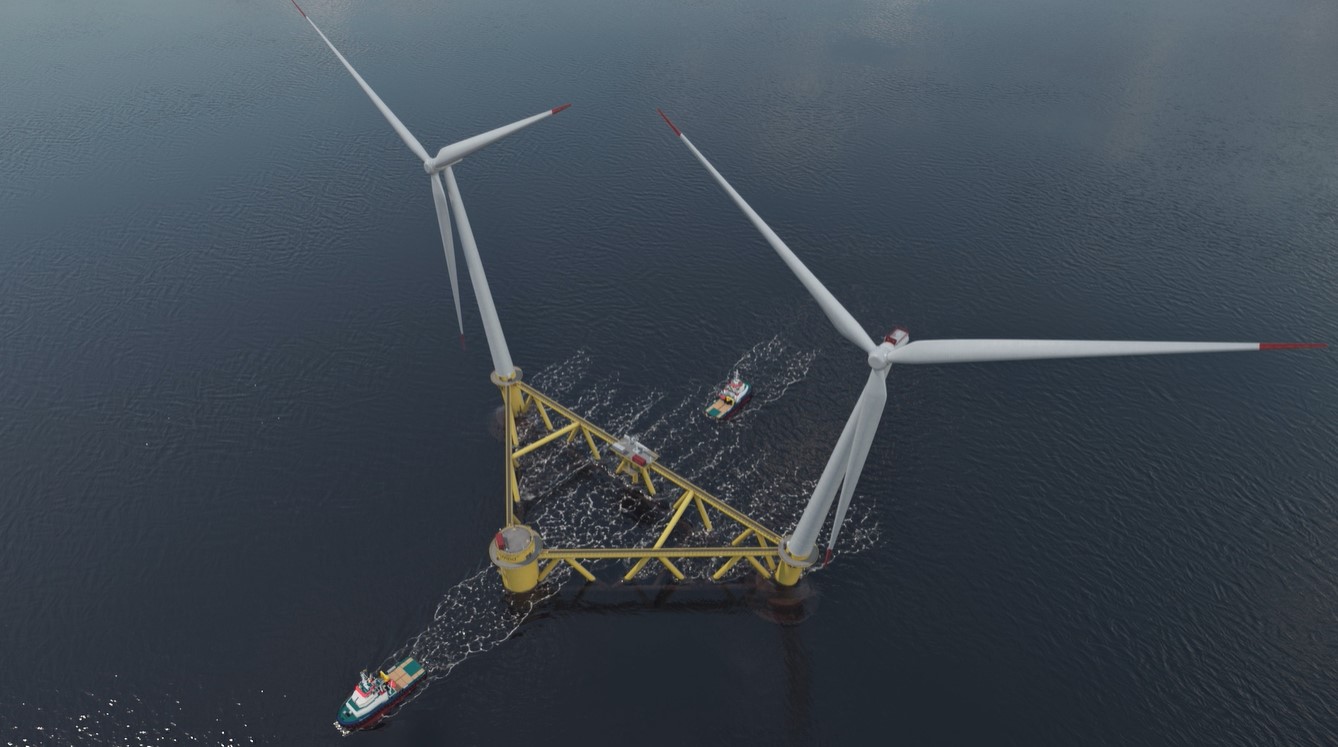
Note.
- The design turns into the wind automatically, so that the maximum amount of electricity is generated.
- A Contract for Difference for a 32 MW TwinHub has been awarded, at a strike price of £87.30/MWh, that will be installed near Hayle in Cornwall.
- With a capacity factor of 50 %, that will produce just over 140,160 MWh per year or over £12 million per year.
This article on the BBC, which is entitled Funding Secured For Floating Wind Farm Off Cornwall, gives more details of the Hayle TwinHub.
The possibility of a floating wind farm off the coast of Cornwall has moved a step closer after securing government funding, project bosses have said.
Swedish company Hexicon plans to install its TwinHub system, with the hope it could begin operating in 2025.
It would be deployed about 10 miles (16km) off Hayle.
Project supporters said it could be a boost to the local economy and help establish Cornwall in the growing renewable energy sector.
Figures have not been released, but it is understood the government funding has effectively secured a fixed price for the power TwinHub would produce for 15 years, making it economically viable.
The article says that this 32 MW system could develop enough electricity for 45,000 homes.
This could be a very suitable size for many applications.
- As at Hayle, one could be floated just off the coast to power a remote part of the country. As Cornwall has a few old mine shafts, it might even be backed up by a Gravitricity system on shore or another suitable non-lithium battery.
- Could one float alongside an oil or gas platform and be tethered to it, to provide the power?
Scotland’s hydroelectric power stations, prove that not all power stations have to be large to be successful.
Vårgrønn and Flotation Energy’s Joint Bid
This article on offshoreWIND.biz is entitled Vårgrønn And Flotation Energy To Jointly Bid in INTOG Leasing Round, gives a few details about their joint bid.
But there is nothing substantial about ideas and locations.
I can see several joint ventures with a suitable system, bidding for various projects around the Scottish coast.
Cerulean
Cerulean sounds like it could be a sea monster, but it is a shade of blue.
This article on offshoreWind.biz is entitled Cerulean Reveals 6 GW Floating Offshore Wind Bid Under INTOG Leasing Round.
These are the two introductory paragraphs.
Green energy infrastructure developer Cerulean Winds has revealed it will bid for four seabed lease sites with a combined capacity of 6 GW of floating wind to decarbonise the UK’s oil and gas sector under Crown Estate Scotland’s Innovation and Targeted Oil and Gas (INTOG) leasing round.
This scale will remove more emissions quickly, keep costs lower for platform operators and provide the anchor for large-scale North-South offshore transmission, Cerulean Winds said.
Note.
- It is privately-funded project, that needs no government subsidy and will cost £30 billion.
- It looks like each site will be a hundred turbines.
- If they’re the same, they could be 1.5 GW each.
- Each site will need £7.5 billion of investment. So it looks like Cerulean have access to a similar magic money tree as Kwasi Kwarteng.
Effectively, they’re building four 1.5 GW power stations in the seas around us to power a large proportion of the oil and gas rigs.
For more on Cerulean Winds’ massive project see Cerulean Winds Is A Different Type Of Wind Energy Company.
Will There Be An Offshore Wind Supermarket?
I can see the big turbine, float and electrical gubbins manufacturers establishing a one-stop shop for developers, who want to install small wind farms, that meet the INTOG criteria.
So suppose, the archetypal Scottish laird in his castle on his own island wanted a 6 MW turbine to go green, he would just go to the B & Q Offshore web site and order what he needed. It would then be towed into place and connected to his local grid.
I can see modular systems being developed, that fit both local infrastructure and oil and gas platforms.
Conclusion
I can see scores of projects being submitted.
I even know the son of a Scottish laird, whose father owns a castle on an island, who could be taking interest in INTOG. They might also apply under Remote Island Wind in another leasing round.
But we will have to wait until the end of March 2023, to find out who have been successful.

