Long Duration Energy Storage Would Reduce The UK’d Gas Usage By 10 Megatonnes By 2035
The title of this post, is the same as that of this press release on the Highview Power web site.
The press release gives these three bullet points.
- UK has wasted over 1,300 GWh of wind since the start of the energy crisis in September 2021 due to an inability to store excess generation – enough to power 500,000 homes a day.
- A new survey from YouGov, commissioned by Highview Power, reveals that 43% of UK adults think the UK imports too much gas, rising to 54% among Conservative voters at the 2019 General Election.
- Long-duration energy storage (LDES) would reduce UK’s gas usage by 10 megatonnes in 2035 and save the grid around £2 billion a year, passing on savings of up to £50 a year.
In Highview Power’s Plan To Add Energy Storage To The UK Power Network, I talked about Highview Power’s possible 30 GWh CRYOBattery.
This project has not been fully revealed and I expect something will be announced before the end of this year.
Rio Tinto’s Big Energy Project Attracts Multiple Bidders
The title of this post, is the same as that of this article on Mining Technology.
The article has this subtitle.
The company seeks to offset its power consumption with a massive renewable plant.
These two paragraphs introduce the project.
British and Australian mining giant Rio Tinto has attracted multiple bids for a massive renewable power infrastructure project.
The company currently seeks suppliers to build up to 4GW of renewable generation for its alumina and aluminium operations in Queensland, Australia. Speaking to the Melbourne Mining Club, the company’s CEO of Australia, Kellie Parker, said that it had received proposals for “a lot more than 4GW”. Parker also said that construction of the project “would not be easy” due to the cost of construction for Australian projects.
In the UK, we may talk of wind farms like Hornsea, which could produce 6 GW, but the Aussies can produce similar amounts of energy from the sun.
This will be the fourth major renewable power development in Australia to be announced in the last few months.
- The Asian Renewable Energy Hub could generate up to 26 GW in Western Australia.
- I wrote about Andrew Forrest’s ambitions in Andrew Forrest Snaps Up Pilbara And Gascoyne Cattle Stations For Green Energy Production.
- The Australia-Asia Power Link will export solar power from Australia to Singapore.
Australia is certainly looking to power the world.
Energy Storage
Rio Tinto are also talking about energy storage, as other systems of this type and size do. Could this be one of a number of Australian projects mentioned on the Highview Power web site?
Could A Highview Power CRYOBattery Use A LNG Tank For Liquid Air Storage?
This Google Map shows a 3D image of liquified natural gas (LNG) tanks at South Hook LNG Terminal near Milford Haven.
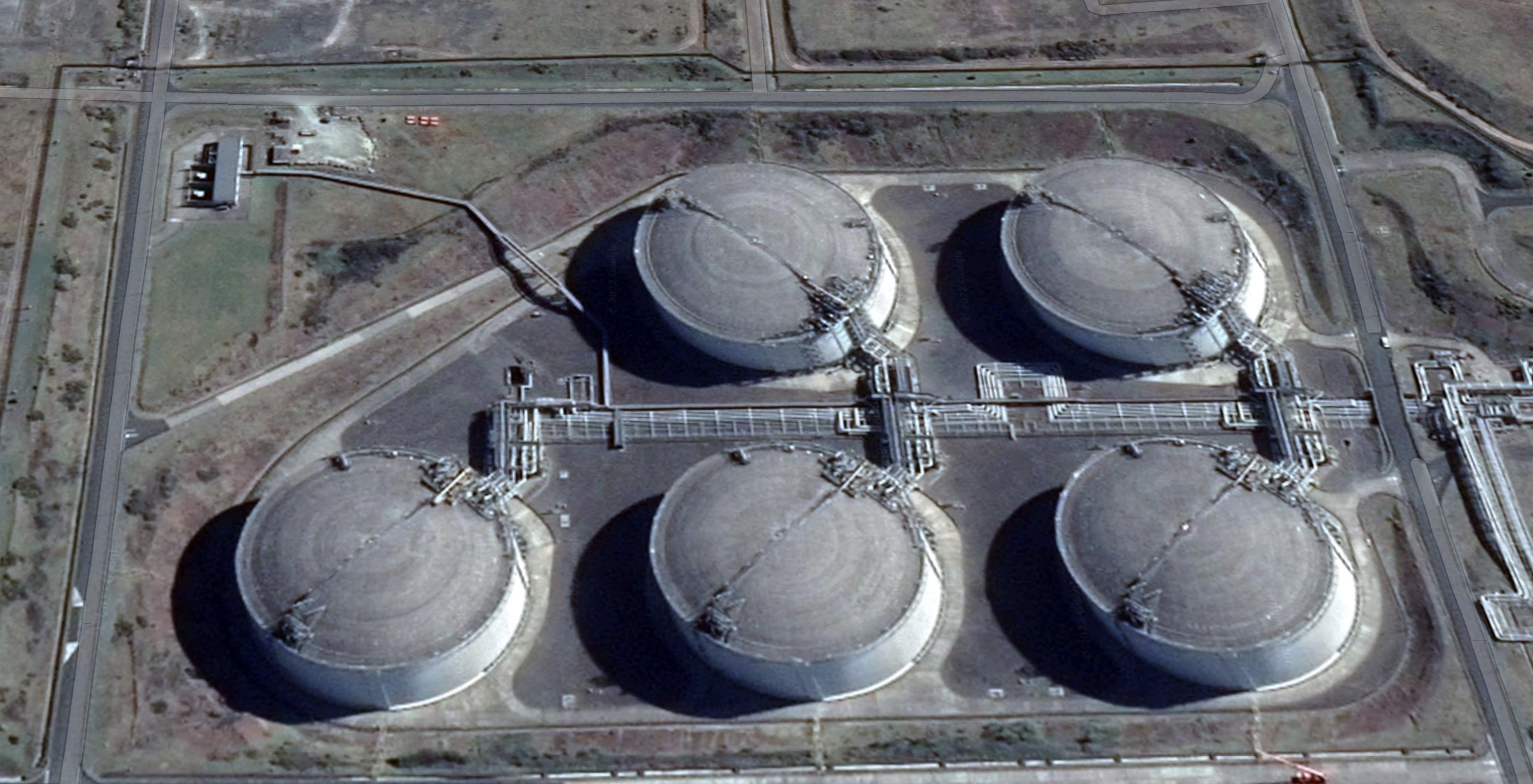
Note that images of these tanks under construction on the Internet, show that there is an underground portion of the tanks.
This page on the CIMC-ENRIC web site is entitled Successful Delivery Of 5,000M3 LNG Single Containment Tank Project. The page shows the design of the LNG tank.
As the density of liquid air is 870 kg/m3, a 5,000 cubic metre tank would contain 4,350 tonnes of liquid air at −194.35 °C and atmospheric pressure.
How much energy would be needed to create 4,350 tonnes of liquid air?
In this document, this is said about compressing natural gas with an electric drive.
It is the most-energy efficient technology with 230 kWh per ton of LNG.
As air and natural gas have molecules of similar weight, would 230 kWh per tonne be applicable to liquid air.
If it is, then around a GWh of electricity will be needed to create the liquid air.
This Wikipedia entry is entitled Cryogenic Energy Storage and describes Highview Power’s CRYOBattery.
This section describes the operation of the CRYOBattery.
When it is cheaper (usually at night), electricity is used to cool air from the atmosphere to -195 °C using the Claude Cycle to the point where it liquefies. The liquid air, which takes up one-thousandth of the volume of the gas, can be kept for a long time in a large vacuum flask at atmospheric pressure. At times of high demand for electricity, the liquid air is pumped at high pressure into a heat exchanger, which acts as a boiler. Air from the atmosphere at ambient temperature, or hot water from an industrial heat source, is used to heat the liquid and turn it back into a gas. The massive increase in volume and pressure from this is used to drive a turbine to generate electricity.
Note.
- The Claude cycle is described in this Wikipedia entry.
- The liquid air takes up one-thousandth of the volume of the gas.
- Wikipedia suggests that Highview claim the process has a round trip efficiency of 70 %.
Having done calculations in the past with chemical reactions in a series of large vessels, the dynamics can be strange and I wouldn’t be surprised that as Highview learn more about the process and add more and better ways of recycling heat and coolth, efficiencies will improve.
Certainly, in the process I mathematically-modelled in the 1970s, when I worked for ICI, I remember that one large reaction vessel performed better than four or five smaller ones with the same total volume.
Hence my thought that perhaps one large containment tank could be the most efficient design.
I also think, that the design of LNG tanks must have improved significantly over the last few years, as the transport of LNG has increased in importance.
Form Energy And The UK
This article on the Telegraph, which is entitled Britain Will Soon Have A Glut Of Cheap Power, And World-Leading Batteries To Store It, is proving to be a mine of information about the development of the UK Power Network.
Reliable information about US startup; Form Energy has been hard to find.
But the Telegraph article has these three paragraphs on Form Energy.
Form Energy in Boston – backed by Jeff Bezos and Bill Gates – is working on an iron-air “rust” battery based on the reversible oxidation of iron pellets. It does not require rare and polluting minerals such as vanadium, and will have a 100-hour range.
“The modules will produce electricity for one-tenth the cost of any technology available today for grid storage,” the company told Recharge.
Form Energy has been working with National Grid to map out the economics of UK renewables with storage, and how to cope with future curtailment. And it too praises the UK as a global trailblazer, though its pilot project next year will be in Minnesota.
Note.
- Iron certainly, isn’t an exotic material.
- A hundred hour range is claimed.
- If National Grid have been working with Form Energy, is it reasonable to assume, that they have been working with Highview Power?
- Good to see that Form Energy praises the UK as a global trailblazer. I have noted several times, that the Department for Business, Energy and Industrial Strategy seems to be well-advised.
Will National Grid put in one of Form Energy’s batteries? It would be a prudent thing to do, to make sure you get the best.
Highview Power’s Second Commercial System In Yorkshire
This is all that Highview Power say about their proposed system in Yorkshire, on their web site.
Highview Power’s second commercial renewable energy power station in the UK is a 200MW/2.5GWh facility in Yorkshire. This is the first of 18 sites for UK wide deployment strategically located to benefit from the existing transmission infrastructure.
I have a few thoughts.
How Does The Size Of This System Fit With Other Systems?
According to the Highview Power web site the Manchester system is a 50MW/300MWh facility, but Wikipedia has this system as a 50MW/250MWh.
In this article on the Telegraph, which is entitled Britain Will Soon Have A Glut Of Cheap Power, And World-Leading Batteries To Store It, it is stated that they are planning a battery with this specification, location and timeline.
- 2.5 GW output
- 30 GWh of storage
- Located on Humberside
- Delivery in late 2024.
This CRYOBattery is an absolute monster.
Will The Humberside CRYOBattery Be Built At Creyke Beck Substation?
In Highview Power’s Plan To Add Energy Storage To The UK Power Network, I came to the conclusion, that the Humberside CRYOBattery will most likely be built near Creyke Beck substation, which is close to Cottingham.
- Dogger Bank A, Dogger Bank B and Hornsea 4 offshore wind farms will all be connected to the Creyke Beck substation.
- These wind farms have a total capacity of 3.4 GW.
- The Humberside CRYOBattery, now looks to have a maximum output of 2.5 GW.
- It looks like the Humberside CRYOBattery would be a well-matched backup to the three planned wind farms and perhaps even a few more turbines.
Building the Humberside CRYOBattery at Creyke Beck substation would appear to be a sensible decision.
Is Cottingham In Humberside, Yorkshire Or Both?
The Wikipedia entry for the village is named Cottingham, East Riding of Yorkshire, says this.
A golf course and leisure club on Wood Hill Way, and a major (400/275 kV AC) electricity substation “Creyke Beck”, lie just outside the formal boundaries of the parish, within Skidby civil parish.
Skidby is definitely in Yorkshire.
Where Are The Other Seventeen Sites?
The Yorkshire facility is indicated to be one of 18 sites on the Highview Power web site. Where are the other seventeen?
All we know is that they will be strategically located to benefit from the existing transmission infrastructure.
This is said in the Wikipedia entry, which is entitled High-Voltage Substations In The United Kingdom.
In 2020 there were 179 400 kV substations and 137 275 kV substations.
He who pays the money, makes the choice!
Has The Company Changed Direction?
I wrote Highview Power Names Rupert Pearce Chief Executive Officer on April 12th, 2022.
- Since then, the Vermont and Chile projects have disappeared from the web site and projects in Yorkshire and Australia have been added.
- The web site has also been improved.
- As new CEOs often do, is Rupert Pearce refocussing the company?
Are they also looking in detail at current projects?
Has The Yorkshire Project Grown Substantially?
Consider.
- National Grid are a company that has improved its image and engineering in recent years.
- It has shown it can obtain finance for infrastructure from the City of London and respected financial institutions.
- National Grid probably have extensive computer models of their electricity network.
- National Grid knows it must add energy storage to their electricity network.
- National Grid pays almost a billion pounds a year to wind farm operators to shut them down.
Eventually saving up to a billion pounds would be a good reason to have a small bet on promising technology.
Did Rupert Pearce ask his engineers to design the largest CRYOBattery they can?
Did National Grid have a count up sand find that twenty CRYOBatteries would cover all the strategic points on their transmission infrastructure?
According to the figures on the Highview Power web site (200 MW/2.5 GWh), eighteen systems like the one proposed for Yorkshire would have.
- A total output of 3.6 GW
- A total storage capacity of 45 GWh
The figures given in the article in the Telegraph (2.5 GW/30 GWh) for the very large system, would mean that twenty systems would have.
- A total output of 50 GW
- A total storage capacity of 600 GWh
These figures are between thirteen and fourteen times larger than those originally proposed.
Building The System
The Highview Power web site, says this about the deployment of eighteen systems.
UK wide deployment strategically located to benefit from the existing transmission infrastructure.
This Google Map shows the Creyke Beck substation.
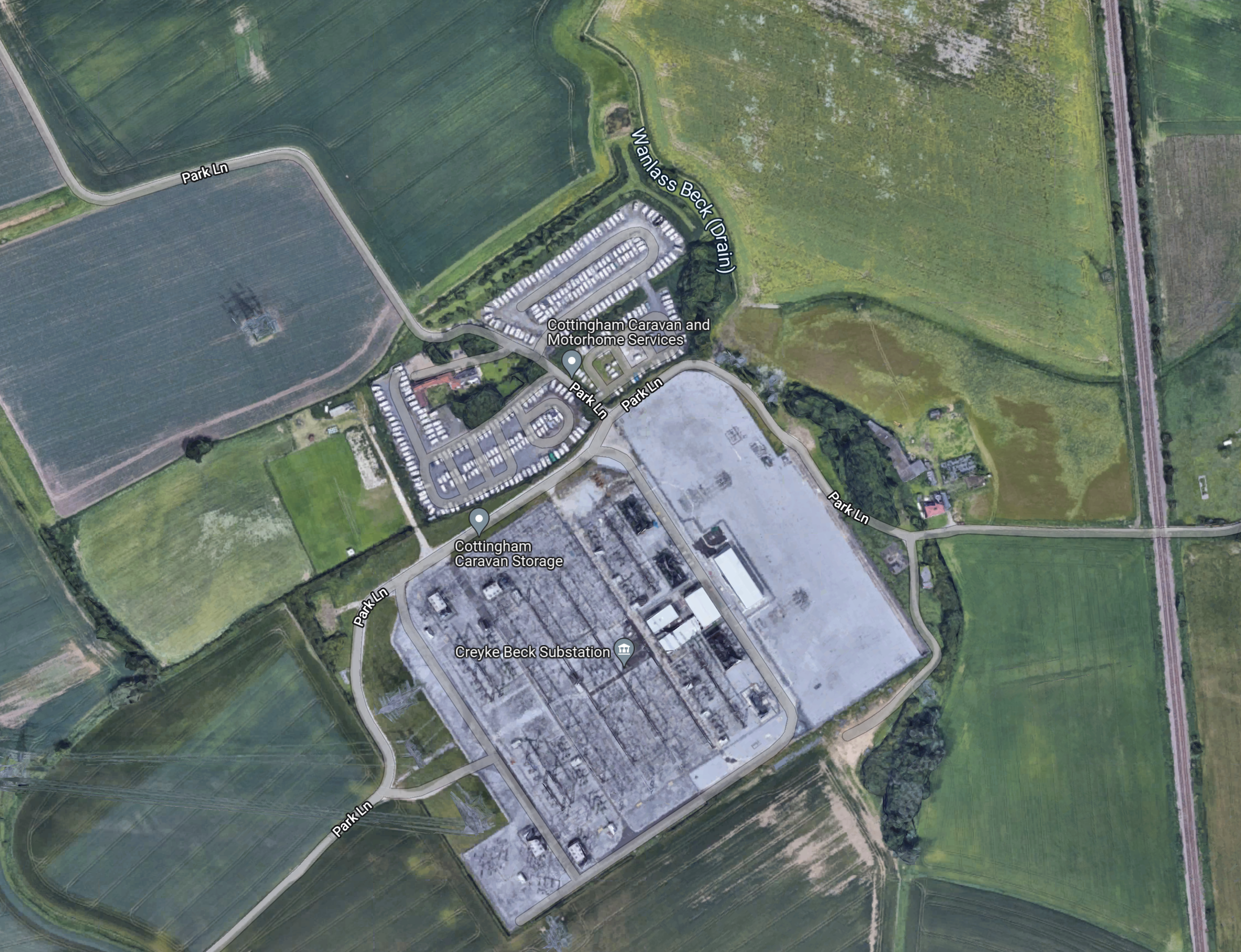
Could 30 GWh of liquid-air storage be accommodated on the site?
I can see a large insulated sphere, partly buried in the ground being used.
Designing, building and testing the first system will probably be the most difficult part of the project.
- But once the first system is successfully working reliably, the roll-out of other systems can be started.
- The biggest problem will probably be planning permissions, so the systems must be designed to be sympathetic to the local environment.
I can certainly see, twenty of these systems in the UK, but how many others will we see worldwide?
I
Highview Power’s Plan To Add Energy Storage To The UK Power Network
The plan was disclosed in this article on the Telegraph, which is entitled Britain Will Soon Have A Glut Of Cheap Power, And World-Leading Batteries To Store It, by Rupert Pearce, who is Highview’s chief executive.
His plan is to build twenty of Highview Power’s CRYOBatteries around the country.
- Each CRYOBattery will be able to store 30 GWh.
- Each CRYOBattery will be one of the largest batteries in the world.
- They will have three times the storage of the pumped storage hydroelectric power station at Dinorwig.
- They will be able to supply 2.5 GW for twelve hours, which is more output than Sizewell B nuclear power station.
The first 30 GWh CRYOBattery is planned to be operational by late 2024.
- It will be built on Humberside.
- Humberside is or will be closely connected to the Dogger Bank, Hornsea and Sofia wind farms.
- When fully developed, I believe these wind farms could be producing upwards of 8 GW.
The Telegraph quotes Rupert Pearce as saying this.
We can take power when the grid can’t handle it, and fill our tanks with wasted wind (curtailment). At the moment the grid has to pay companies £1bn a year not to produce, which is grotesque.
I certainly agree with what he says about it being a grotesque practice.
It sounds to me, that Rupert’s plan would see Highview Power in the waste electricity management business.
- The wasted wind would just be switched to the Humberside CRYOBattery, if there was too much power in the area.
- The CRYOBattery might be conveniently located, where the wind farm cables join the grid.
- Dogger Bank A and B wind farms are connected to Creyke Beck substation, which is North of the Humber.
- Hornsea 1 and Hornsea 2 wind farm are connected to Killingholme substation, which is South of the Humber.
- Hornsea 3 wind farm will be connected to Norfolk.
- Hornsea 4 wind farms will be connected to Creyke Beck substation
- It looks like the combined capacity of Dogger Bank A, Dogger Bank B and Hornsea 4 could be around 3.4 GW.
- Sofia wind farm will be connected to Lazenby substation near Redcar.
- As the CRYOBattery is buying, selling and storing electricity, I would assume that there’s money to be made.
This Google Map shows Creyke Beck substation.
Note.
- It is a large site.
- Creyke Beck Storage have built a 49.99 MW lithium-ion storage battery on the site.
- The Northern part of the site is used to store caravans.
- It looks like the combined capacity of Dogger Bank A, Dogger Bank B and Hornsea 4 could be around 3.4 GW.
It looks like a 30 GWh CRYOBattery with a maximum output of 2.5 GW would be an ideal companion for the three wind farms connected to Creyke Back substation.
The combination could probably supply upwards of 2.5 GW to the grid at all times to provide a strong baseload for Humberside.
Conclusion
Will the income from the Humberside CRYOBattery be used to fund the next CRYOBattery?
I very much think so as it’s very sensible financial management!
Renewable Power’s Effect On The Tory Leadership Election
I wouldn’t normally comment on the Tory Leadership Election, as I don’t have a vote and my preference has already been eliminated.
But after reading this article on the Telegraph, which is entitled Britain Will Soon Have A Glut Of Cheap Power, And World-Leading Batteries To Store It, I feel I have to comment both about this election and the General Election, that will follow in a few years.
These two paragraphs from the article illustrate the future growth of offshore wind power.
It is a point about the mathematical implications of the UK’s gargantuan push for renewables. Offshore wind capacity is going to increase from 11 to 50 gigawatts (GW) by 2030 under the Government’s latest fast-track plans.
RenewableUK says this country currently has a total of 86GW in the project pipeline. This the most ambitious rollout of offshore wind in the world, ahead of China at 78GW, and the US at 48GW.
If we assume that there is eight years left of this decade, that means that we should install about 4.9 GW of offshore wind every year until 2030. If we add in planned solar and onshore wind developments, we must be looking at at least 5 GW of renewable energy being added every year.
We have also got the 3.26 GW Hinckley Point C coming on stream.
I think we can say, that when it comes to electricity generation, we will not be worried, so Liz and Rishi can leave that one to the engineers.
If we have an electricity problem, it is about distribution and storage.
- We need more interconnectors between where the wind farms are being built and where the electricity will be used.
- National Grid and the Government have published plans for two interconnectors between Scotland and England, which I wrote about in New Electricity ‘Superhighways’ Needed To Cope With Surge In Wind Power.
- We need energy storage to back up the wind and solar power, when the wind isn’t blowing and the sun isn’t shining.
I think it is reasonable to assume, that we will get the interconnectors we need and the Telegraph article puts forward a very feasible and affordable solution to the energy storage problem, which is described in these two paragraphs from the article.
That is now in sight, and one of the world leaders is a British start-up. Highview Power has refined a beautifully simple technology using liquid air stored in insulated steel towers at low pressure.
This cryogenic process cools air to minus 196 degrees using the standard kit for LNG. It compresses the volume 700-fold. The liquid re-expands with a blast of force when heated and drives a turbine, providing dispatchable power with the help of a flywheel.
The article also talks of twenty energy storage systems, spread around the UK.
- They will have a total output of 6 GW.
- In total they will be able to store 600 GWh of electricity.
The first one for Humberside is currently being planned.
Surely, building these wind and solar farms, interconnectors and energy storage systems will cost billions of pounds.
Consider.
- Wind and solar farms get paid for the electricity they generate.
- , Interconnectors get paid for the electricity they transfer.
- Energy storage systems make a profit by buying energy when it’s cheap and selling it, when the price is better.
- In World’s Largest Wind Farm Attracts Huge Backing From Insurance Giant, I talked about how Aviva were funding the world’s largest wind farm at Hornsea.
- National Grid has a history of funding interconnectors like the North Sea Link from large financial institutions.
I believe that the islands of Great Britain and Ireland and the waters around our combined shores will become the largest zero-carbon power station in the world.
This will attract engineering companies and financial institutions from all over the world and we will see a repeat of the rush for energy that we saw for oil and gas in the last century.
If we get the financial regime right, I can see a lot of tax money flowing towards the Exchequer.
The big question will be what do we do with all this energy.
- Some will be converted into hydrogen for transport, the making of zero-carbon steel and cement and for use as a chemical feedstock.
- Industries that use a lot of electricity may move to the UK.
- A large supply of electricity and hydrogen will make it easy to decarbonise housing, offices and factories.
The Telegraph article also says this.
Much can be exported to the Continent through interconnectors for a fat revenue stream, helping to plug the UK’s trade deficit, and helping to rescue Germany from the double folly of nuclear closures and the Putin pact. But there are limits since weather patterns in Britain and Northwest Europe overlap – partially.
I suspect that more energy will be exported to Germany than most economists think, as it will be needed and it will be a nice little earner for the UK.
Given the substantial amount of German investment in our wind industry, I do wonder, if Boris and Olaf did a deal to encourage more German investment, when they met in April this year.
- BP have been backed with their wind farms by a German utility company.
- RWE are developing the Sofia wind farm.
- Only last week, the deal for the NeuConnect interconnector between the Isle of Grain and Wilhelmshaven was signed.
- Siemens have a lot of investments in the UK.
I wouldn’t be surprised to see more German investments in the next few months.
The Golden Hello
Has there ever been a Prime Minister, who will receive such a golden hello, as the one Liz or Rishi will receive in September?
The Tory Leadership Election
Some of the candidates said they would reduce taxes , if they won and Liz Truss is still saying that.
I wonder why Rishi isn’t saying that he would reduce taxes, as he must know the cash flow that is coming. It may be he’s just a more cautious soul.
Can Highview Power’s CRYOBattery Compete With Pumped Storage Hydroelectricity?
In this article on the Telegraph, Rupert Pearce, who is Highview’s chief executive and ex-head of the satellite company Inmarsat, discloses this.
Highview is well beyond the pilot phase and is developing its first large UK plant in Humberside, today Britain’s top hub for North Sea wind. It will offer 2.5GW for over 12 hours, or 0.5GW for over 60 hours, and so forth, and should be up and running by late 2024.
The Humberside plant is new to me, as it has not been previously announced by Highview Power.
- If it is built it will be megahuge with a storage capacity of 30 GWh and a maximum output of 2.5 GW.
- Humberside with its connections to North Sea Wind, will be an ideal location for a huge CRYOBattery.
- The world’s largest pumped storage hydroelectric power station is Fengning Pumped Storage Power Station in China and it is 40 GWh.
Pumped storage hydroelectric power stations are the gold standard of energy storage.
In the UK we have four pumped storage hydroelectric power stations.
- Cruachan Power Station – 7.1 GWh
- Dinorwig Power Station (Electric Mountain) – 9.1 GWh
- Falls of Foyers – 10 GWh
- Ffestiniog Power Station 1 GWh
With two more under construction.
- Coire Glas Power Station – 30 GWh
- Red John Power Station – 2.8 GWh
As energy is agnostic, 30 GWh of pumped storage hydroelectric power at Coire Glas is the equivalent of 30 GWh in Highview Power’s proposed Humberside CRYOBattery.
Advantages Of CRYOBatteries Over Pumped Storage Hydroelectric Power
I can think of these advantages.
- Cost
- Could be build on the flat lands of East Anglia or Lincolnshire
- Factory-built
- NIMBYs won’t have much to argue about
- No dams
- No flooding of valleys
- No massive construction sites.
- No mountains required
- No tunnels
- Small footprint
I suspect that a large CRYOBattery could be built well within a year of starting construction.
Rupert Pearce’s Dream
The Telegraph article says this and I suspect it’s a quote from Rupert Pearce.
Further projects will be built at a breakneck speed of two to three a year during the 2020s, with a target of 20 sites able to provide almost 6GW of back-up electricity for four days at a time, or whatever time/power mix is optimal.
6 GW for four days is 576 GWh, which if it were spread around twenty sites is 28.8 GWh per site, which is just under the 30 GWh of the proposed Humberside CRYOBattery.
Conclusion
You can just imagine the headlines in The Sun!
Man In Bishop’s Stortford Shed Saves The World!
This story on the BBC, which is entitled Meet The British Inventor Who Came Up With A Green Way Of Generating Electricity From Air – In His Shed, explains my suggested headline.
Now that’s what I call success!
How Will Highview Power Affect The Lithium-Ion Grid Battery Market?
In this article on the Telegraph, Rupert Pearce, who is Highview’s chief executive and ex-head of the satellite company Inmarsat, discloses this.
Highview is well beyond the pilot phase and is developing its first large UK plant in Humberside, today Britain’s top hub for North Sea wind. It will offer 2.5GW for over 12 hours, or 0.5GW for over 60 hours, and so forth, and should be up and running by late 2024.
The Humberside plant is new to me, as it has not been previously announced by Highview Power.
- If it is built it will be megahuge with a storage capacity of 30 GWh and a maximum output of 2.5 GW.
- Humberside with its connections to North Sea Wind, will be an ideal location for a huge CRYOBattery.
- The world’s largest battery is at Ouarzazate Solar Power Station in Morocco and it is 3 GWh.
- The world’s largest pumped storage power station is Fengning Pumped Storage Power Station in China and it is 40 GWh.
The proposed Humberside battery also has a smaller sibling under construction at Carrington in Manchester.
This will have a storage capacity of 250 MWh and a maximum output of 50 MW.
Factors Affecting The Choice
Several factors will affect the choice between lithium-ion batteries and Highview Power’s CRYOBattery.
Reliability
Reliability is paramount and whilst lithium-ion batteries batteries have a high level of reliability, there probably needs to be more development and quality assurance before CRYOBatteries have a similar level of reliability.
Size
The largest lithium-ion battery, that has been proposed in the UK, is the 320 MW/640 MWh battery that will be installed at the Gateway Energy Centre in Essex.
This size of CRYOBattery should be possible, but this size is probably in range of both lithium-ion and CRYOBatteries.
Safety
The Wikipedia entry for Battery Storage Power Station has this to say about Safety.
Some batteries operating at high temperatures (sodium–sulfur battery) or using corrosive components are subject to calendar ageing, or failure even if not used. Other technologies suffer from cycle ageing, or deterioration caused by charge-discharge cycles. This deterioration is generally higher at high charging rates. These two types of ageing cause a loss of performance (capacity or voltage decrease), overheating, and may eventually lead to critical failure (electrolyte leaks, fire, explosion).
An example of the latter was a Tesla Megapack in Geelong which caught fire, fire and subsequent explosion of battery farm in Arizona, fire of Moss Landing battery farm. Concerns about possible fire and explosion of a battery module were also raised during residential protests against Cleve Hill solar farm in United Kingdom. Battery fire in Illinois resulted in “thousands of residents” being evacuated, and there were 23 battery farm fires in South Korea over the period of two years. Battery fires may release a number of dangerous gases, including highly corrosive and toxic hydrogen fluoride.
The long term safety of a CRYOBattery is probably not yet known in detail, but I suspect in some applications, CRYOBatteries could be safer than chemical batteries.
Environmental Factors
I suspect that CRYOBatteries can be built without any hard-to-mine or environmentally-unfriendly materials like lithium.
Cost
The article in The Telegraph, says this about costs.
Mr Pearce said Highview’s levelised cost of energy (LCOE) would start at $140-$150, below lithium, and then slide on a “glide path” to $100 with over time.
It does look that the all important factor of cost could be the clincher in the choice between the two systems.
For larger batteries, the CRYOBattery will probably have a larger advantage.
Conclusion
I can see Highview Power and their CRYOBatteries putting up a good fight against lithium-ion batteries, especially with larger batteries, where they have a larger cost advantage.
In the UK, we will know they have won an advantage, if the two big battery-storage funds; Gore Street and Gresham House, start to install CRYOBatteries.
Britain Will Soon Have A Glut Of Cheap Power, And World-Leading Batteries To Store It
The title of this post, is the same as that of this article on the Telegraph.
This is the first four paragraphs.
Today’s electricity price shock is the last crisis of the old order. Britain will soon have far more power at times of peak production than it can absorb. The logistical headache will be abundance.
Wind and solar provided almost 60pc of the UK’s power for substantial stretches last weekend, briefly peaking at 66pc. This is not to make a propaganda point about green energy, although this home-made power is self-evidently displacing liquefied natural gas (LNG) imported right now at nosebleed prices.
It is a point about the mathematical implications of the UK’s gargantuan push for renewables. Offshore wind capacity is going to increase from 11 to 50 gigawatts (GW) by 2030 under the Government’s latest fast-track plans.
RenewableUK says this country currently has a total of 86GW in the project pipeline. This the most ambitious rollout of offshore wind in the world, ahead of China at 78GW, and the US at 48GW.
The article goes on to give a comprehensive account of where we are with renewables, where we are going and how we will handle things, when the wind doesn’t blow.
Dogger Bank
The article says this about the Dogger Bank wind farm, which is being developed by SSE.
The giant hi-tech turbines to be erected on the Dogger Bank, where wind conditions are superb, bear no resemblance to the low-tech, low-yield dwarves of yesteryear. The “capacity factor” is approaching 60pc, which entirely changes the energy equation.
A capacity factor of 60 % seems a bit high to me and is what can be expected with the latest floating turbines. But these are fixed to the sea floor.
The Wikipedia entry for the Dogger Bank wind farm, says this about the building of the the first two sections of the massive wind farm.
On 21 September 2020, it was announced that Dogger Bank A and B will use 190 GE Haliade-X 13 MW offshore wind turbines over both sites, meaning that 95 turbines will be used on each site.[19] The availability of upgraded Haliade-X turbines rated at 13 MW rather than 12 MW means that each site will be capable of generating up to 1.235 GW, for a total of 2.47 GW. Turbines will be pre-assembled at Able Seaton Port in Hartlepool, an activity that will lead to the creation of 120 skilled jobs at the port during construction. Turbine installation is expected to commence in 2023 at Dogger Bank A.[20] Power Purchase Agreements (PPA) for 15 years were signed in November 2020. Offshore cable laying started in April 2022. Installation of the turbine foundations was started in July 2022.
This GE data sheet about the Haliade-X offshore wind turbine, says this about capacity factor.
it also features a 60-64% capacity factor above industry standard. Capacity factor compares how much energy was generated against the maximum that could have been produced at continuous full power operation during a specific period of time.
A 60-64% capacity factor is exceptional.
Current plans for Dogger Bank indicate that 3.6 GW will be installed and operational by 2024/25.
Could that mean that Dogger Bank will be able to deliver 2.16 GW almost continuously, on GE’s figures? Sizewell B is only 1.25 GW.
Sofia Wind Farm
There was going to be a fourth section to Dogger Bank, but this is now the separate Sofia wind farm.
- It is being developed by RWE.
- The first phase of three has a capacity of 1.4 MW. Does that mean Sofia will eventually be a 4.2 GW wind farm?
- RWE seem to be putting in a very large offshore substation. Could this support a lot more turbines?
- The wind farm seems to be using high-specification SiemensGamesa 14MW SG 14-222 DD wind turbines, which have a Power Boost facility to deliver up to 15 MW.
- I can’t find anything about capacity factor.
Wikipedia gives a delivery date of 2023 for the first phase of Sofia.
Storing Electricity
The article says this about storing electricity.
Much of the power will have to be stored for days or weeks at a time. Lithium batteries cannot do the job: their sweet spot is two hours, and they are expensive. You need “long duration” storage at a cost that must ultimately fall below $100 (£82) per megawatt hour (MWh), the global benchmark of commercial viability.
That is now in sight, and one of the world leaders is a British start-up. Highview Power has refined a beautifully simple technology using liquid air stored in insulated steel towers at low pressure.
I have had Highview Power on my radar for some time.
Highview Power
What is there not to like about Highview Power?
- The original idea was developed in a shed in Bishop’s Stortford, by a lone inventor.
- Sumitomo are one of their backers.
- They are also backed by English Universities and the UK Government.
- They have run a successful pilot plant in Bury.
- They are now building their first full-size 50 MW/250 MWh commercial plant at Carrington near Manchester.
- Much of the equipment they use to build their batteries is standard equipment from world-class companies like MAN.
- There are no exotic and expensive materials used.
The writer of the article has obviously had a long chat with Rupert Pearce, who is Highview’s chief executive and ex-head of the satellite company Inmarsat.
Pearce happily discloses this monster.
Highview is well beyond the pilot phase and is developing its first large UK plant in Humberside, today Britain’s top hub for North Sea wind. It will offer 2.5GW for over 12 hours, or 0.5GW for over 60 hours, and so forth, and should be up and running by late 2024.
Note.
- The world’s largest battery is at Ouarzazate Solar Power Station in Morocco and it is 3 GWh.
- Highview’s Humberside battery is megahuge at 30 GWh.
- The world’s largest pumped storage power station is Fengning Pumped Storage Power Station in China and it is 40 GWh.
- My experience of doing the calculations for large reaction vessels and other structures, tells me, that Highview should be able to construct huge systems.
I suspect that it will be easier and more affordable to build the Humberside battery.
This is another pair of paragraphs.
Mr Pearce said Highview’s levelised cost of energy (LCOE) would start at $140-$150, below lithium, and then slide on a “glide path” to $100 with over time. The company has parallel projects in Spain and Australia but Britain is the showroom.
“The UK is a fantastic place to do this. It has one of the most innovative grids in the world and an open, fair, liquid, market mechanism with absolute visibility,” he said.
It looks to me, that Rupert Pearce has taken Highview Power to a different level, in his short tenure at the company.
The world will soon be very familiar with the name of Highview Power.
 The Anonymous Widower