This Is What I Call A MOAB
Jamestown is a small Australian town of a few over fourteen hundred souls, probably home to several million flies and some of the most venomous spiders and snakes known to man.
I have never visited the town, but I must have flown nearly over it, when I flew a Piper Arrow around Australia with C.
Just to the North of the town is the Hornsdale Wind Farm, which consists of 99 wind turbines with a generating capacity of 315 MW.
But this is not what brought the wind farm to my attention in an article in today’s Times under a headline of Biggest Ever Battery Plugs City’s Energy Gap.
This is said.
The battery array was built after a high-stakes bet by Elon Musk, 46, the US technology billionaire behind Tesla electric cars, that he could meet a 100-day building deadline or he would give the system away.
Wikipedia has a section on this battery.
This is said.
South Australia received 90 proposals and considered 5 projects. Tesla, Inc. is building the world’s most powerful lithium ion battery adjacent to the wind farm. It has two sections; a 70 MW running for 10 minutes, and a 30 MW with a 3 hour capacity. Samsung 21700-size cells are used.
It will be operated by Tesla and provide a total of 129 megawatt-hours (460 GJ) of storage capable of discharge at 100 megawatts (130,000 hp) into the power grid. This will help prevent load-shedding blackouts and provide stability to the grid (grid services) while other generators can be started in the event of sudden drops in wind or other network issues. It is intended to be built in 100 days counting from 29 September 2017, when a grid connection agreement was signed with Electranet, and some units were operational. The battery construction was completed and testing began on 25 November 2017. It is owned by Neoen and Tesla, with the government having the ability to call on the stored power under certain circumstances.
It certainly seems to be the Mother-Of-All-Batteries! Hence MOAB!
The Times is reporting that the battery system has cost £30 million.
This works out at about £233,000 to store each Megawatt-Hour stored.
When you consider that we have five offshore that are bigger than the Hornsdale Wind Farm, surely it is only a matter of time before we add a battery to one.
These MOABs are an intriguing concept!
OVO Offers Solar Panels And A Battery
There are a couple of reports on the Internet, that the smaller energy supplier; Ovo Energy, is now offering deals on solar panels and a battery.
I have been thinking of adding a battery for some time, but I don’t think the time is quite right yet, as the price of batteries is becoming more affordable.
However, I do think that Ovo’s move is the first of many we will see in the next few months and years.
This march towards solar and batteries could have various consequences for the UK.
- Many house builders will add solar panels and a battery to new houses.
- Domestic electricity needs will reduce.
- Solar panels and batteries may have some interesting effects on the property market.
Battery owners could also charge up overnight on low-price electricity, so the daily operation could be something like.
- Overnight the battery is charged on low-price electricity.
- Morning ablutions and breakfast, thus uses low-price electricity.
- Hopefully, the sun charges the battery during the day.
- Evening electricity would in part be what has been stored during the day.
One overall effect of the battery is to smooth the energy needs of a property.
So as the proportion of houses with batteries increases, the National Grid will see a reduction in the spikes of electricity demand, as evetybody makes a cup of tea in the advert breaks.
But the biggest effect will be on how the UK would generate its electricity.
I am not against nuclear power for any technical or environmental reasons, but I do think that the cost of new nuclear power stations like Hinckley Point C are not good value for money compared with other methods of generation. On the other hand, if we are going to have much smoother electricity needs, then we do need the nuclear power station’s ability to produce a steady baseload of power.
I am against inappropriate on-shore wind in many locations, but I am not against off-shore wind or perhaps a few large turbines in an industrial estate.
I feel that solar, batteries and off-shore wind could give the UK very affordable electricity, but they need to be backed by some form of baseload power stations, which at the moment can only be nuclear.
Conclusion
Following my logic, I believe, that as more batteries are installed in the UK, the following will happen.
- Those who install a battery will save money whether they have solar panels or not!
- Batteries will be allowed to be charged on low-cost overnight electricity.
- As more batteries are installed in the UK, the UK power needs will be smoother.
- Overnight off-shore wind could be used to charge all these batteries.
This leads me to the conclusion, that the Government should create incentives for homes to install batteries, which would be charged with low-cost overnight electricity or solar panels.
BBC Click On Batteries
This weekend’s Click on the BBC is a cracker and it’s all about batteries.
Electric Mountain
It starts with pictures of the UK’s largest battery at Dinorwig Power Station or Electric Mountain, as it is colloquially known.
The pumped storage power station was completed in 1984 and with a peak generating capacity of 1.6 GW, it was built to satisfy short term demand, such as when people make a cup of tea in advert breaks in television programs. Under Purpose of the Wikipedia entry for Dinorwig Power Station, there is a very good summary of what the station does.
To build Dinorwig was a wonderful piece of foresight by the CEGB, over forty years ago.
Would environmentalists allow Dinorwig Power Station to be built these days?
That is a difficult question to answer!
On the one hand it is a massive development in an outstanding area of natural beauty and on the other Dinorwig and intermittent power sources like solar and wind power, is a marriage made in heaven by quality engineering.
As solar and wind power increase we will need more electric mountains and other ways of storing considerable amounts of electricity.
Close to Electric Mountain, another much smaller pumped storage power station of 100 MW capacity is being proposed in disued slate quarries at Glyn Rhonwy. This article on UK Hillwalking, is entitled Opinion: Glyn Rhonwy Hydro is Causing a Stir.
The article was written in 2015 and it looks like Planning Permission for the new pumped storage power station at Glyn Rhonwy has now been given.
The UK’s particular problem with pumped storage power stations, is mainly one of geography, in that we lack mountains.
However Electric Mountain is in the top ten pumped storage power stations on this list in Wikipedia.
I doubt in today’s economy, Electric Mountain would be built, despite the fact that it is probably needed more than ever with all those intermittent forms of electricity generation.
The Future Of Pumped Storage Technology
But if you read Wikipedia on pumped-storage technology, there are some interesting and downright wacky technologies proposed.
I particular like the idea of underwater storage, which if paired with offshore wind farms could be the power of the future. That idea is a German project called StEnSea.
Better Batteries
Click also talks about work at the Warwick Manufacturing Group about increasing the capacity of existing lithium-ion batteries for transport use by improved design of the battery package. Seventy to eighty percent increases in capacity were mentioned, by a guy who looked serious.
I would reckon that within five years, that electric vehicle range will have doubled, just by increments in chemistry, design and manufacture.
Batteries will also be a lot more affordable.
Intelligent Charging
Warwick Manufacturing Group are also working on research to create an intelligent charging algorithm, as a bad charging regime can reduce battery life and performance.
I rate this as significant, as anything that can improve performance and reduce cost is certainly needed in battery-powered transport.
The program reclons it would improve battery performance by ten percent in cars.
Surely, this would be most applicable to buses or trains, running on a regular route, as predicting energy use would be much easier, especially if the number of passengers were known.
In Technology Doesn’t Have To Be Complex, I discussed how Bombardier were using the suspension to give a good estimate of the weight of passengers on a Class 378 train. I suspect that bus and train manufacturers can use similar techniques to give an estimate.
So a bus or train on a particular route could build a loading profile, which would be able to calculate, when was the optimum time for the battery to be charged.
As an example, the 21 bus, that can be used from Bank station to my house, is serviced by hybrid new Routemasters. It has a very variable passenger load and sometimes after Old Street, it can be surprisingly empty.
Intelligent charging must surely offer advantages on a bus route like this, in terms of battery life and the use of the onboard diesel engine.
But is on trains, where intelligent charging can be of most use.
I believe that modern trains like Aventras and Hitachi’s Class 800 trains are designed to use batteries to handle regenerative braking.
If you take a Class 345 train running on Crossrail, the battery philosophy might be something like this.
- Enough energy is stored in the battery at all times, so that the train can be moved to a safe place for passenger evacuation in case of a complete power failure.
- Enough spare capacity is left in the battery, so that at the next stop, the regnerative braking energy can be stored on the train.
- Battery power would be used where appropriate to reduce energy consumption.
- The control algorithm would take inputs from route profile and passenger loading.
It may sound complicated, but philosophies like this have been used on aircraft for around forty years.
Reusing Vehicle Batteries In Homes
Click also had detailed coverage about how vehicles batteries could be remanufactured and used in homes. Especially, when solar panels are fitted.
Other Batteries
On the on-line version, the program goes on to look at alternative new ideas for batteries.
Inside Electric Mountain
The on-line version, also gives a tour of Electric Mountain.
Conclusion
The future’s electric, with batteries.
Electricity Shake-Up Could Save Consumers ‘up to £40bn’
The title of this post is the same as that of this article in the BBC.
The electricity shake-up was forecast in yesterday’s Sunday Times and I wrote about it in Giant Batteries To Store Green Energy.
In We Need More Electricity, I talked about what RWE are doing to create an all-purpose Energy Centre at Tilbury.
The Tilbury Energy Centre will feature.
- Efficient energy generation from natural gas.
- Substantial energy storage.
- Peak energy production from natural gas.
- Load balancing of wind power with storage and generation from natural gas.
But I suspect, it will get involved in other advanced techniques, like using carbon dioxide to get greenhouse fruit and vegetables to grow quicker.
The electricity market is changing.
Giant Batteries To Store Green Energy
In today’s Sunday Times, there is a small article with this title.
This is the first two paragraphs.
Britain could soon be relying on battery power under plans to create a network of electrical storage facilities around the national grid.
Greg Clark, the Business Secretary, is expected to announce plans this week for giant rechargeable battery facilities to be installed near wind and solar farms to store the energy generated when demand is low. It can then be released when demand rises.
The article also says that householders will be encouraged to use batteries alongside solar panels.
I think this is only the start.
Imagine an estate of new houses, an office development, a factory estate or a business park.
- Solar panels would be everywhere.
- Wind turbines could be strategically placed.
- A central CHP system would provide heating and some electricity.
Everything would be backed up by a suitably-sized battery.
We Need More Electricity
Everything we do, seems to need more and more electricity.
- We are greening our transport and every electric train, car, bus and truck will need to be charged.
- Unless it is hydrogen-powered, in which case we’ll need electricity to split water into hydrogen and oxygen.
- Computing and the Internet needs more electricity and is leading to companies putting server farms in countries like Iceland, where there are Gigawatts of low-cost electricity.
- We’re also using more energy hungry equipment like air-conditioning and some household appliances.
- And then there’s industry, where some processes like metal smelting need lots of electricity.
At least developments like LED lighting and energy harvesting are helping to cut our use.
Filling The Gap
How are we going to fill our increasing energy gap?
Coal is going and rightly so!
A lot of nuclear power stations, which once built don’t create more carbon dioxide, are coming to the end of their lives. But the financial and technical problems of building new ones seem insoluble. Will the 3,200 MW Hinckley Point C ever be built?
That 3,200 MW size says a lot about the gap.
It is the sort of number that renewables, like wind and solar will scarcely make a dent in.
Unfortunately, geography hasn’t donated us the terrain for the massive hydroelectric schemes , that are the best way to generate loe-carbon electricity.
Almost fifty years ago, I worked briefly for Frederick Snow and Partners, who were promoting a barrage of the River |Severn. I wrote about my experiences in The Severn Barrage and I still believe , that this should be done, especially as if done properly, it would also do a lot to tame the periodic flooding of the River.
The Tilbury Energy Centre
An article in The Times caught my eye last week with the headline of Tilbury Planned As Site Of UK’s Biggest Gas-Fired Power Station.
It said that RWE were going to build a massive 2,500 MW gas-fired power station.
This page on the RWE web site is entitled Tilbury Energy Centre.
This is from that page.
RWE Generation is proposing to submit plans to develop Tilbury Energy Centre at the former Tilbury B Power Station site. The development would include the potential for a Combined Cycle Gas Turbine (CCGT) power station with capacity of up to 2,500 Megawatts, 100 MW of energy storage facility and 300MW of open Cycle Gas Turbines (OCGT). The exact size and range of these technologies will be defined as the project progresses, based on an assessment of environmental impacts, as well as market and commercial factors.
The development consent application will also include a 3km gas pipeline that will connect the proposed plant to the transmission network which runs to the east of the Tilbury power station. The proposed CCGT power station would be located on the coal stock yard at the site of the former power station, but would be physically much smaller than its predecessor (a coal/biomass plant).
I will now look at the various issues.
Carbon Dioxide
But what about all that carbon dioxide that will be produced?
This is the great dilemma of a gas-powered power-station of this size.
But the advantage of natural gas over coal is that it contains several hydrogen atoms, which produce pure water under combustion. The only carbon in natural gas is the one carbon atom in methane, where it is joined to four hydrogen atoms.
Compared to burning coal, burning natural gas creates only forty percent of the carbon dioxide in creating the same amount of energy.
If you look at Drax power station, which is a 3,960 MW station, it produces a lot of carbon dioxide, even though it is now fuelled with a lot of imported biomass.
On the other hand, we could always eat the carbon dioxide.
This document on the Horticultural Development Council web site, is entitled Tomatoes: Guidelines for CO2 enrichment – A Grower Guide.
This and other technologies will be developed for the use of waste carbon-dioxide in the next couple of decades.
The great advantage of a gas-fired power station, is that, unlike coal, there are little or no impurities in the feedstock.
The Site
This Google Map shows the site, to the East of Tilbury Docks.
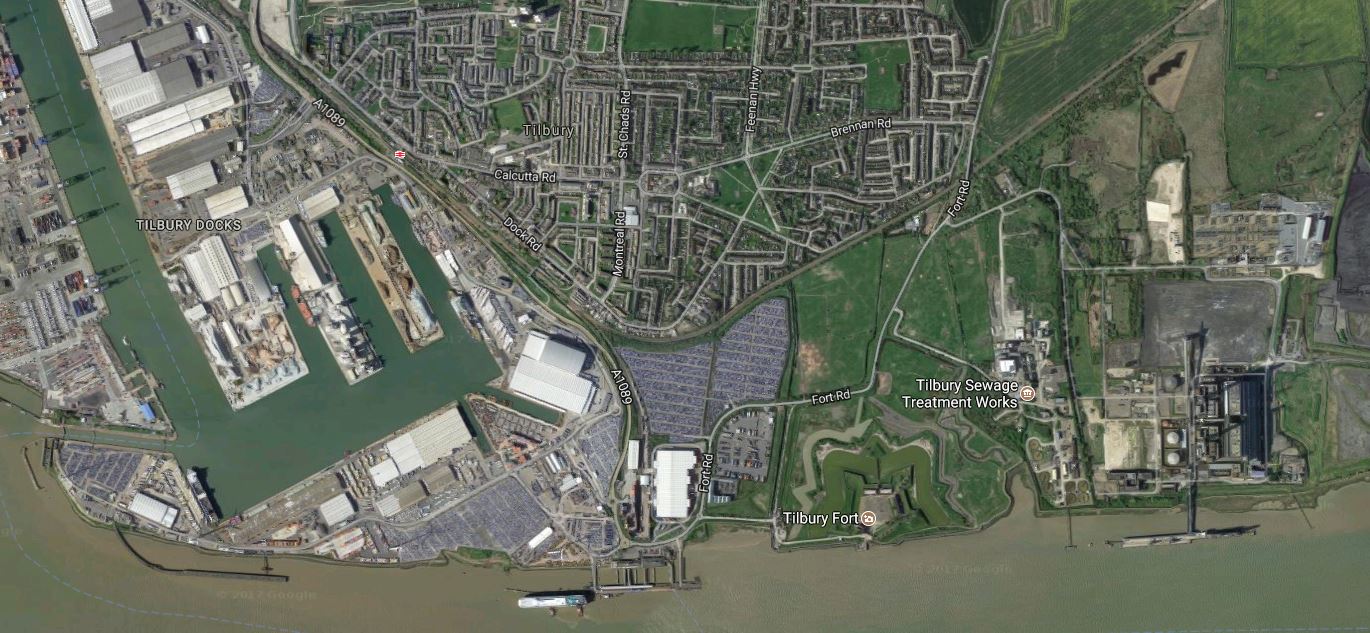
Note that the site is in the South East corner of the map, with its jetty for coal in the River.
These pictures show the area.
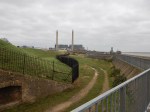


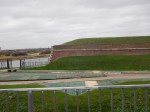

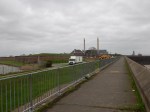


The CCGT power station would be built to the North of the derelict Tilbury B power station. I’ll repeat what RWE have said.
The proposed CCGT power station would be located on the coal stock yard at the site of the former power station, but would be physically much smaller than its predecessor (a coal/biomass plant).
Hopefully, when complete, it will improve the area behind partially Grade II* Listed Tilbury Fort.
Another development in the area is the Lower Thames Crossing, which will pass to the East of the site of the proposed power station. As this would be a tunnel could this offer advantages in the design of electricity and gas connections to the power station.
What Is A CCGT (Combined Cycle Gas Turbine) Power Station?
Combined cycle is described well but in a rather scientific manner in Wikipedia. This is the first paragraph.
In electric power generation a combined cycle is an assembly of heat engines that work in tandem from the same source of heat, converting it into mechanical energy, which in turn usually drives electrical generators. The principle is that after completing its cycle (in the first engine), the temperature of the working fluid engine is still high enough that a second subsequent heat engine may extract energy from the waste heat that the first engine produced. By combining these multiple streams of work upon a single mechanical shaft turning an electric generator, the overall net efficiency of the system may be increased by 50–60%. That is, from an overall efficiency of say 34% (in a single cycle) to possibly an overall efficiency of 51% (in a mechanical combination of two cycles) in net Carnot thermodynamic efficiency. This can be done because heat engines are only able to use a portion of the energy their fuel generates (usually less than 50%). In an ordinary (non combined cycle) heat engine the remaining heat (e.g., hot exhaust fumes) from combustion is generally wasted.
Thought of simply, it’s like putting a steam generator on the hot exhaust of your car and using the steam generated to create electricity.
The significant figures are that a single cycle has an efficiency of say 34%, whereas a combined cycle could be possibly as high as 51%.
In a section in the Wikipedia entry called Efficiency of CCGT Plants, this is said.
The most recent[when?] General Electric 9HA can attain 41.5% simple cycle efficiency and 61.4% in combined cycle mode, with a gas turbine output of 397 to 470MW and a combined output of 592MW to 701MW. Its firing temperature is between 2,600 and 2,900 °F (1,430 and 1,590 °C), its overall pressure ratio is 21.8 to 1 and is scheduled to be used by Électricité de France in Bouchain. On April 28, 2016 this plant was certified by Guinness World Records as the worlds most efficient combined cycle power plant at 62.22%. The Chubu Electric’s Nishi-ku, Nagoya power plant 405MW 7HA is expected to have 62% gross combined cycle efficiency.
There is also a section in the Wikipedia entry called Boosting Efficiency, where this is said.
The efficiency of CCGT and GT can be boosted by pre-cooling combustion air. This is practised in hot climates and also has the effect of increasing power output. This is achieved by evaporative cooling of water using a moist matrix placed in front of the turbine, or by using Ice storage air conditioning. The latter has the advantage of greater improvements due to the lower temperatures available. Furthermore, ice storage can be used as a means of load control or load shifting since ice can be made during periods of low power demand and, potentially in the future the anticipated high availability of other resources such as renewables during certain periods.
So is the location of the site by the Thames, important because of all that cold water.
But surely using surplus electricity to create ice, which is then used to improve the efficiency of the power produced from gas is one of those outwardly-bonkers, but elegant ideas, that has a sound scientific and economic case.
It’s not pure storage of electricity as in a battery or at Electric Mountain, but it allows spare renewable energy to be used profitably for electricity generators, consumers and the environment.
The location certainly isn’t short of space and it is close to some of the largest wind-farms in the UK in the Thames Estuary, of which the London Array alone has a capacity of 630 MW.
Wikipedia also has a section on an Integrated solar combined cycle (ISCC), where a CCGT power station is combined with a solar array.
I can’t see RWE building a new CCGT plant without using the latest technology and the highest efficiency.
Surely the higher the efficiency, the less carbon dioxide is released for a given amount of electricity.
Building A CCGT Power Station
The power station itself is just a big building, where large pieces of machinery can be arranged and connected together to produce electricity.
To get an idea of scale of power stations, think of the original part of Tate Modern in London, which was the turbine hall of the Bankside power station, which generated 300 MW.
Turbines are getting smaller and more powerful, so I won’t speculate on the size of RWE’s proposed 2,500 MW station.
It will also only need a gas pipe in and a cable to connect the station to the grid. There is no need to use trains or trucks to deliver fuel.
Wikipedia has a section entitled Typical Size Of CCGT Plants, which says this.
For large-scale power generation, a typical set would be a 270 MW primary gas turbine coupled to a 130 MW secondary steam turbine, giving a total output of 400 MW. A typical power station might consist of between 1 and 6 such sets.
I feel that this raises interesting questions about the placement of single unit CCGT power stations.
It also means that at somewhere like Tilbury, you can build the units as required in sequence, provided the services are built with the first unit.
So on a large site like Tilbury, the building process can be organised in the best way posible and we might find that the station is expanded later.
RWE say this on their web site.
The exact size and range of these technologies will be defined as the project progresses, based on an assessment of environmental impacts, as well as market and commercial factors.
That sounds like a good plan to me!
100 MW Of Energy Storage At Tilbury
RWE’s plan also includes 100 MW of energy storage, although they say market and commercial factors could change this.
Energy storage is the classic way to bridge shortages in energy, when demand rises suddenly, as cin the classic half-time drinks in the Cup inal.
In Wikipedia’s list of energy storage projects, there are some interesting developments.
The Hornsdale Wind Farm in Australia has the following.
- 99 wind turbines.
- A total generating capacity of 315 MW.
Elon Musk is building the world’s largest lithium-ion battery next door with a capacity of 129 MwH
But those energy storage projects aren’t all about lithium-ion batteries.
Several like Electric Mountain in Wales use pumped storage and others use molten salt.
Essex doesn’t have the mountains for the former and probably the geology for the latter.
But the technology gets better all the time, so who knows what technology will be used?
The intriguing idea is the one I mentioned earlier to make ice to cool the air to improve the efficiency of the CCGT power station.
What Is The Difference Between A CCGT (Combined Cycle Gas Turbine) And An OCGT (Open Cycle Gas Turbine) Power Station?
RWE have said that they will provide 300 MW of 300MW of Open Cycle Gas Turbines, so what is the difference.
This page from the MottMacdonald web site gives a useful summary.
OCGT plants are often used for the following applications:
- Providing a peak lopping capability
- As a back- up to wind and solar power
- As phase 1 to generate revenue where phase 2 may be conversion to a CCGT
CCGT plants offer greater efficiency.
I’ve also read elsewhere, that OCGT plants can use a much wider range of fuel. Used cooking oil?
Conclusion
There is a lot more to this than building a 2,500 MW gas-fired power station.
RWE will be flexible and I think we could see a very different mix to the one they have proposed.
Thoughts On Batteries
As a Control Engineer, I have a lot of thoughts about making the World a more efficient and safer place.
As a simple example of what Control Engineering is all about, do two hundred mile drives in your car.
- One is a route you don’t know.
- The other is one you know very well.
In both journeys drive as carefully as you can to try to do both journeys using the minimum amount of fuel.
Inevitably, in most cases, you will do the second route on less fuel, because you will adjust speed and anticipate possible problems from previous knowledge.
A well-designed control system for a self-driving car should be able to outperform a manually-driver car because it has better knowledge.
Control Engineering is all about taking all the knowledge you can, processing it in a control system or computer and doing the job to the ultimate best.
Batteries Will Get A Higher Charge Density Per Cubic Metre And Per Dollar
There are a lot of clever engineers and scientists out there in countries like China, Germany, Japan, Korea and the USA, working on battery technology and increasing the charge density will be one of their key objectives.
The smaller and more affordable a battery becomes, the more will be sold.
With several large companies out there investing heavily in the production of batteries, there can only be one ultimate wuner – the individual, company, government or organisation, who eventually pays for the product in which the battery is installed.
So How Will Control Engineering Be Involved?
In some ways, it already is!
Control Engineering In Personal Devices
In your smart-phone, laptop or personal device, you can set parameters to get the maximum minutes for one charge of the battery.
You are effectively, tweaking the device and the battery control system is doing the best it can with the lkimited energy resources of the battery of the device.
Control Engineering In Transport Systems
One of the problems with personal devices, is they need to be plugged in to be charged.
But as transport systems are larger and often have access to other forms of energy, recharging is not such a problem.
- Batteries in hybrid vehicles can be charged by an onboard engine.
- Some battery and hybrid cars can be plugged into the mains.
- Braking energy can be recovered and used to charge the battery.
- Trains, trams and trolley-buses can use overhead wires or third-rail systems to charge the battery.
It is the major task of the vehicle’s control system to balance the needs of traction and the onboard systems, by pulling in energy from various sources.
A Typical Hybrid Bus
A hybrid bus like a Routemaster, has a very different transmission system to your bog-standard diesel bus.
- It is actually driven by a Siemens ELFA2[4]electric traction motor.
- Braking is regenerative.
- The Cummins diesel engine is mounted under the rear stairs.
- The 75 KwH battery is mounted under the front stairs.
Effectively, the diesel engine tops up the battery to a high enough level and the wheels are driven from the battery.
The control system manages the energy starting and stopping the engine as required.
The Ultimate Hybrid Bus
In the ultimate hybrid bus, the control system would know lots of other factors, including.
- The route.
- The actual and expected number of passengers.
- The actual and expected weather.
- Whether Arsenal were plying at home, or there was a demonstration by taxi-drivers.
So it would manage the power in the battery according to the predicted future energy requirements.
What would that do for fuel economy and the reduction of pollution?
But how could the efficiency of the bus be improved further?
- A lighter battery with the same capacity.
- A lighter diesel-engine, traction motor and other components.
- A much improved control system.
As with most things, reducing weight is probably the most important. But don’t underestimate, what can be achieved with the ultimate control system.
It all points to my belief, that we should probably leave the development of batteries to the big boys and concentrate on the applications.
Hybrid Electric Trucks
Hybrid electric trucks are on the way.
Hybrid Trains And Trams
I think the mathematics point to hybrid trains and trams being one of the better applications of batteries in transport.
A typical four-car electric multiple unit like a new Class 710 train, weighs about 130 tonnes or 138 tonnes with passengers. Going at a line speed of 100 kph, it has a kinetic energy of 15 KwH. So this amount of kinetic energy would be well within the scope of a 75 KwH battery from a Routemaster bus.
I think that the typical four-car electric multiple unit can easily be fitted with a battery to handle the braking for the train.
The physics of steel-wheel-on-steel-rail are also very efficient, as Robert Stephenson, if not his father, would have known.
But with trains, there are several ways the batteries can be charged.
- From 25 KVAC overhead power.
- From 750 VDC third-rail power.
- By recovering braking energy.
- From a small diesel generator.
A good control system manages the energy and also raises and lowers the pantograph as needed.
Conclusions
Design and manufacturing competition from the big players in batteries, will bring the price down and increase the amount of energy that can be stored in a battery of a particular size.
But the key to making the most out of a battery is to have a well-designed control system to manage the energy.
Theresa Mentions The B-Word
On today’s Andrew Marr Show, Theresa May has just said that she has setup a review into battery technology.
I can’t find anything else.
However, I did find this snippet in The Sunday Times, when I bought the paper.
Ministers will pledge to invest in digital, energy, construction and transport infrastructure in each region. Funding is already earmarked for an institute to develop new battery technology.
That is probably something we need.
Small Modular Nuclear Reactors
My objections to nuclear power plants like Hinckley Point C, is very much like my objections to giant aircraft carriers like HMS Queen Elizabeth,enormous 4×4 Chelsea tractors and massive houses, where one billionaire lives with just his trophy wife.
It’s just that they satisfy the ego of a class of men (and it’s usually men!), who like to show off, that they have more money or power than others.
There are generally much more efficient and affordable ways of achieving the same aims.
As a small example, I remember having a chat with a General in the British Army, who had very low opinions of heavy tanks and felt that there were better ways of spending the money to achieve the same objectives.
I also remember some of the arguments about the aluminium frigates after the Falklands War. A lot of these were amplified, by a friend, who’d gone to the islands as an officer on a British Rail ferry.
This is said about Hinckley Point C in Wikipedia.
Hinkley Point C nuclear power station is a much-delayed proposal to construct a 3,200 MWe nuclear power station with two EPR reactors in Somerset, England. The proposed site is one of eight announced by the British government in 2010,[5] and on 26 November 2012 a nuclear site licence was granted. In October 2014, the European Commission adjusted the “gain-share mechanism” so that the project does not break state-aid rules.[7] Financing for the project will be provided “by the mainly [French] state-owned EDF [and Chinese] state-owned CGN will pay £6bn for one third of it”.[8] EDF may sell up to 15% of their stake. Financing of the project is still to be finalised.
I have a feeling that any sane woman, who’s lived with a man with bad shopping habits, would cancel it tomorrow.
After all, it’s supposed to cost £18billion and there is still no date yet for when it will produce a watt of electricity.
As a reaction to these enormous costs, the Small Modular Nuclear Reactor is being proposed. Wikipedia says this.
Small modular reactors (SMRs) are a type of nuclear fission reactor which are smaller than conventional reactors, and manufactured at a plant and brought to a site to be fully constructed.
Small reactors are defined by the International Atomic Energy Agency as those with an electricity output of less than 300 MWe, although general opinion is that anything with an output of less than 500 MWe counts as a small reactor.
Modular reactors allow for less on-site construction, increased containment efficiency, and heightened nuclear materials security.
I recommend reading the full Wikipedia article.
I feel that SMRs have a lot of advantages.
- Much more of the building can be in a factory, not on a bleak remote site.
- They are particularly suited to remote locations, where there is a shortage of construction workers.
- An SMR may be a much less risky project cost-wise than a conventional large plant.
- Containment is more efficient.
- Proliferation concerns are lessened.
- Say you are building a plant that needs a lot of electricity, like say an aluminium smelter. The SMR could be built alongside, so there would be no need for massive transmission lines, between the smelter and its power source.
- They could be built underground, lessening the visual impact.
- High energy use industries like steel-making could be paired with an SMR.
- Large office complexes like Canary Wharf could be linked to an SMR deep underneath for their massive energy use.
- Build time is much less.
I like the concept and think that this type of reactor, perhaps arranged in groups around a country or region, will kill off the traditional large nuclear reactor.
This section on safety features illustrates the innovative thinking behind the reactors.
Since there are several different ideas for SMRs, there are many different safety features that can be involved. Coolant systems can use natural circulation – convection – so there are no pumps, no moving parts that could break down, and they keep removing decay heat after the reactor shuts down, so that the core doesn’t overheat and melt. Negative temperature coefficients in the moderators and the fuels keep the fission reactions under control, causing the fission reactions to slow down as temperature increases.
I suspect we can now design a reliable reactor, that say it received a direct hit from a tsunami or three simultaneous crashes from Jumbo jets, would fail-safe.
There are certainly a lot of groups and companies trying to design the ultimate SMR.
There is even a concept being developed at the Universities of Manchester and Delft in the Netherlands called a u-Battery. That concept may not work, but something like it will produce electricity for a lot of people and industry around the world.
The dinosaurs like Hinckley Point C are hopefully a mistake of the past.
Atlantic Superconnection Features In The Sunday Times
I am an electrical engineer by training and although possibly the only work I’ve done in the power field directly is to wire a plug, I know the technology of power generation fairly well.
Ever since I went to Iceland last year and first heard about IceLink, I’ve followed the project with interest.
Today there is an article in The Sunday Times entitled Cameron wants sea cable to bring lava power from Iceland.
It talks about the involvement of a company called Atlantic Superconnection
Read the article and follow the company!
 The Anonymous Widower