Cummins Inc. Selected By The UK Department Of Transport For Its High-Horsepower Methanol Vessel Retrofit Project
The title of this post, is the same as that of this press release from Cummins.
This is sub-heading.
One of Only 10 Flagship Projects Chosen in the Multi-Million-Pound ZEVI Competition Enabling Decarbonization of the UK’s Maritime Sector
These three paragraphs outline the project.
Today, Cummins Inc. (NYSE: CMI) announced the selection of its proposal to jointly develop a Methanol Kit for its QSK60 engine as part of the Zero Emission Vessels and Infrastructure (ZEVI) competition, funded by the UK Government and delivered in partnership with Innovate UK. To be chosen as one of the top 10 projects, Cummins delivered a proposal to collaborate with a major UK port and operators to develop, deploy and operate clean maritime technology solutions on the path to decarbonization and reduction to the overall greenhouse gas footprint.
The £4.4M in total funding will be leveraged by Cummins and its fellow project stakeholders — Ocean Infinity, the Aberdeen Harbour Board, and Proman AG — in the deployment of a UK-designed and built methanol conversion kit for a high-horsepower marine internal combustion engine, offering the UK an important foothold in enabling the transition to cleaner maritime fuels.
Upon completion in the second quarter of 2025, the project targets a reduction in CO2 emissions of 50 percent for offshore operations of the vessel with NOx, SOx and PM at levels considerably below those emitted by conventional fuel. Furthermore, all retrofitted dual-fuel engines will achieve compliance with IMO Tier III emission standards.
They certainly aim to get a move on to complete by mid-2025.
I have some thoughts.
Methanol Fuel
The Wikipedia entry for methanol fuel, starts with this sentence.
Methanol fuel is an alternative biofuel for internal combustion and other engines, either in combination with gasoline or independently. Methanol (CH3OH) is less expensive to produce sustainably than ethanol fuel, although it produces more toxic effects than ethanol and has lower energy density than gasoline. Methanol is safer for the environment than gasoline, is an anti-freeze agent, prevents dirt and grime buildup within the engine, has a higher flashpoint in case of fire, and produces horsepower equivalent to that of super high-octane gasoline.
Methanol certainly seems to be an environmentally-friendly fuel, when compared to alternatives.
Production Of Green Methanol
This paragraph from the Wikipedia entry for methanol fuel, explains some of the routes to make green methanol.
Bio-methanol, also known as green-methanol, may be produced by gasification of organic materials to synthesis gas followed by conventional methanol synthesis. This route can offer renewable methanol production from biomass at efficiencies up to 75%. Widespread production by this route has a proposed potential to offer methanol fuel at a low cost and with benefits to the environment. Increasingly, methanol fuel has been produced using renewable energy and carbon dioxide as a feedstock. Carbon Recycling International, an Icelandic-American company, completed the first commercial scale renewable methanol plant in 2011. As of 2018, Enerkem has been producing biomethanol through the conversion and gasification of municipal solid waste at its Edmonton facility. As of July 2023, construction for the $1 billion Varennes Carbon Recycling Plant, which will produce biofuel such as methanol through non-recyclable and timber waste, is 30 percent complete.
Surely, if the C in CH3OH, which is the chemical formula for methanol, comes from captured carbon dioxide from the atmosphere or say a gas-fired power station, methanol can be a truly green fuel.
UK’s Green Power Industry Receives Surprise £10bn Pledge
The title of this post, is the same as that of this article in the Guardian.
This is the sub-heading.
Potential investment by NatPower would create largest portfolio of battery storage projects in Britain
These five paragraphs outline the proposed investment.
Britain’s under-pressure green power industry has received a surprise fillip after a renewables developer pledged to plough £10bn into what would become the largest portfolio of battery storage projects in the country.
NatPower, a UK startup that is part of a larger European energy group, is poised to submit planning applications for three “gigaparks”, with a further 10 to follow next year.
Battery storage projects are seen as a key part of the jigsaw to decarbonise Britain’s power grid, allowing electricity generated by wind turbines and solar panels to be stored for use when weather conditions are still or not sunny.
The NatPower investment would lead to the construction of 60 gigawatt hours of battery storage, with solar and wind projects also in the pipeline.
The two gigaparks would be located in the north of England, with a further site in the west of the country planned later this year. The projects would be built on industrial land, and also through leasing deals with farmers.
Note.
- To gauge the scale of this development; the largest energy storage development in the UK at present is SSE Renewable’s massive Coire Glas pumped storage hydro in the Highlands of Scotland, which is a 1.5 GW/30 GWh monster, that is budgeted to cost £1.5 billion.
- NatPower has a web site, which has an opening video, which is all landscape, sun, water and wind, that would be worthy of an epic from Hollywood or by Eisenstein.
- NatPower’s investment of £10 billion, buys them 60 GWh of storage and if it’s a proportionate amount of capacity to Coire Glas, perhaps around 3GW or around the capacity of Hinckley Point C.
I have a few thoughts.
Is It All A Hoax?
Those who were alive and sober in 1977, may well remember the April Fools’ Day Hoax of the Guardian of that year, which concerned a fake supplement in the paper promoting the island of San Serriffe.
The story has its own Wikipedia entry.
The web site; http://www.sanserriffe.com, doesn’t seem to be accessible.
Today’s story seems genuine, although some will smell a rat.
UK Set To Provide Record GBP 800 Million Support For Offshore Wind Projects
The title of this post, is the same as that of this article on offshoreWIND.biz.
This is the sub-heading.
The UK government has revealed the budget of over GBP 1 billion (approximately EUR 1.2 billion) for this year’s Contracts for Difference (CfD) Allocation Round 6 (AR6) with the majority of it, GBP 800 million (around EUR 936 million), earmarked for offshore wind.
These three paragraphs explain the three pots.
The Department for Energy Security and Net Zero (DESNZ) confirmed that over GBP 1 billion will be set aside for the budget, divided into three pots.
Within the overall budget, GBP 120 million is designated for established technologies like solar and onshore wind in Pot 1, while GBP 105 million is set aside for emerging technologies such as floating offshore wind and geothermal in Pot 2.
According to DESNZ, following an extensive review of the latest evidence, including the impact of global events on supply chains, the government has allocated a record GBP 800 million for offshore wind, making this the largest round yet, with four times more budget available to offshore wind than in the previous round.
I am glad to see the support for geothermal energy.
Whilst, these three paragraphs explain the pricing.
This follows the increase in the maximum price for offshore wind and floating offshore wind in November and will help to deliver the UK’s ambition of up to 50 GW of offshore wind by 2030, including up to 5 GW of floating offshore wind, according to the government.
Last year, CfD Round 5 attracted no investors with the former maximum strike prices set at GBP 44/MWh for offshore wind with fixed-bottom foundations, which was too low for the developers who were facing the consequences of inflation and supply chain challenges. The maximum bid price for floating wind was GBP 114/MWh.
Now, the maximum price available for offshore wind projects with fixed-bottom foundations has risen by 66 per cent, from GBP 44/MWh to GBP 73/MWh. The maximum strike price for floating offshore wind projects increased by 52 per cent, from GBP 116/MWh to GBP 176/MWh ahead of AR6 which will open on 27 March.
Prices have certainly risen, but this paragraph explains a limiting mechanism, which is straight out of the Control Engineer’s Toolbox.
The funding for the support will be sourced from energy bills rather than taxation. However, if the price of electricity surpasses the predetermined rate, additional charges will be applied to wind power, with the excess funds returned to consumers.
I would hope that extensive mathematical modelling has been applied to test the new pricing structure.
Centrica Completes Work On 20MW Hydrogen-Ready Peaker In Redditch
The title of this post, is the same as that of this press release from Centrica.
This is the sub-heading.
Construction is complete on Centrica’s new 20MW hydrogen-blend-ready gas-fired peaking plant in Worcestershire, transforming the previously decommissioned Redditch power plant.
These paragraphs give more details of the project.
The plant is designed to support times of high or peak demand for electricity. Peaking plants only operate when production from renewables can’t meet demand, supporting the energy transition by maintaining a stable electricity supply. The Redditch site can power the equivalent of 2,000 homes for a full day, helping to maintain stability and reliability on the grid.
The plant is capable of using a blend of natural gas and hydrogen, futureproofing the site and supporting the UK’s transition towards a decarbonised energy system.
The Redditch peaking plant forms part of Centrica’s plans to invest between £600m – £800m a year until 2028 in renewable generation, security of supply, and its customers, including building out a portfolio of flexible energy assets. That includes the redevelopment of several legacy power stations, including the Brigg Energy Park in to a power generation and battery storage asset, and the first power station in the UK to be part-fuelled by hydrogen.
I also wrote Centrica Business Solutions Begins Work On 20MW Hydrogen-Ready Peaker In Redditch, about this project.
HiiROC
I wonder if this power station will be fitted with a HiiROC system, which will split the natural gas into two useful products; hydrogen and carbon black.
I wrote about HiiROC in Centrica Partners With Hull-Based HiiRoc For Hydrogen Fuel Switch Trial At Humber Power Plant.
I can see lots of HiiROC systems creating a hydrogen feed, to decarbonise various processes.
Whose Engines Are Used At Redditch?
Centrica still haven’t disclosed, whose engines they are using.
Work Starts On World’s Largest Floating Solar Project, Part of RWE’s OranjeWind
The title of this post, is the same as that of this article on offshoreWIND.biz.
This is the sub-heading.
The Nautical SUNRISE consortium partners have commenced the project whose goal is to facilitate research and development of offshore floating solar systems and its components. The project aims to integrate a 5 MW offshore floating solar system within RWE’s OranjeWind, a wind farm to be built 53 kilometres off the Dutch coast.
These three paragraphs outline the project.
Research and development on the offshore floating solar (OFS) systems and its components of the EUR 8.4 million project, supported by EUR 6.8 million of the Horizon Europe programme, kicked off in December 2023.
The project will enable the large-scale deployment and commercialisation of offshore floating solar systems in the future, both as standalone systems and integrated into offshore wind farms.
The project aims to design, build, and showcase a 5 MW OFS system using the modular solution of the Dutch floating company SolarDuck.
Note.
- It’s only the fourth of March and this is the second floating solar project of the month.
- The first was SolarDuck, Green Arrow Capital And New Developments S.R.L. Sign Collaboration Agreement For A Grid-Scale Offshore Hybrid Wind-Solar Project In Italy.
- I can understand Italy, but surely a solar farm in the Dutch waters of the North Sea, is being at least slightly optimistic.
But the home page of the Oranjewind web site, does have a mission statement of Blueprint For The New Generation Of Offshore Wind Farms.
Under a heading of The Perfect Match, this is said.
RWE’s OranjeWind offshore wind farm will be located 53 kilometers from the Dutch coast. To tackle the challenges of fluctuating power generation from wind and flexible energy demand, RWE has developed a blueprint for the integration of offshore wind farms in the Dutch energy system.
A combination of smart innovations and investments will be used to realise this perfect match between supply and demand.
Under Innovations At OranjeWind, this is said.
In order to realise system integration and accelerate the energy transition, RWE is working together with a number of innovators on new developments in offshore wind farms. The company is realising and testing these innovations in the OranjeWind wind farm.These innovations include offshore floating solar, a subsea lithium-ion battery, LiDAR power forecasting system and a subsea hydro storage power plant off-site.
These technologies have their own sections, which give more information.
- Subsea Pumped Hydro Storage Power Plant (Ocean Grazer)
- Floating Solar (SolarDuck)
- Intelligent Subsea Energy Storage (Verlume)
- LiDAR-based Power Forecasting (ForWind, University of Oldenburg)
The web site also says this about knowledge from OranjeWind.
There is a lot to learn in an innovative project such as OranjeWind. While developing the wind farm, RWE started the OranjeWind Knowledge programme. This programme aims to generate and share knowledge to accelerate the energy transition.
In strong partnerships with TNO and Dutch universities, research is carried out in parallel to the development and operation of OranjeWind. By sharing research results, lessons learned, and relevant in-house expertise, RWE aims to close knowledge gaps and provide valuable insights in key focus areas for system integration. The generated knowledge will become openly available to educational and research institutes, governments and the market.
To ensure the dissemination of knowledge, RWE will actively partner with educational institutions of all levels across the Netherlands. These partnerships allow RWE to share its expertise and provide the future workforce with the knowledge and skills needed to enable the energy transition.
It certainly appears that RWE intends to get as much out of this project as they can.
I don’t think that they can be criticised for that objective.
SolarDuck, Green Arrow Capital And New Developments S.R.L. Sign Collaboration Agreement For A Grid-Scale Offshore Hybrid Wind-Solar Project In Italy
The title of this post, is the same as that of this press release from SolarDuck.
These three bullet points, act as sub-headings.
- 540 MW hybrid offshore wind-solar farm offshore Corigliano, Calabria
- Milestone project to accelerate scaling of Offshore Floating Solar Photovoltaic (OFPV)
- Strategic collaboration proves the potential of the technology in Italy and the wider
Mediterranean region
These three paragraphs outline the project.
SolarDuck, leader in OFPV technology, Green Arrow Capital, leading Italian Independent Asset
Manager in the alternative investment world, and New Developments s.r.l., one of Italy’s
most experienced developers, have agreed to collaborate on the development of a landmark
120MWp OFPV farm integrated with 420MW Floating Offshore Wind (FOW).The project will install SolarDuck’s unique elevated platform technology that allows PV panels
to be deployed in significant wave heights whilst maintaining a safe working environment for
access and maintenance and minimizing environmental impact. In addition, the collaboration
will also allow the harnessing of the complementarity of wind and solar energy resources.“With the current momentum, we believe this is a unique opportunity for the offshore
renewable energy industry to help shape a favorable regulatory framework and facilitate the
scaling of OFPV. This is not just important for Italy, but also for other countries in the
Mediterranean. Our collaboration with New Developments and Green Arrow Capital can also
serve as a catalyst for OFPV in Italy”, says SolarDuck CEO, Koen Burgers.
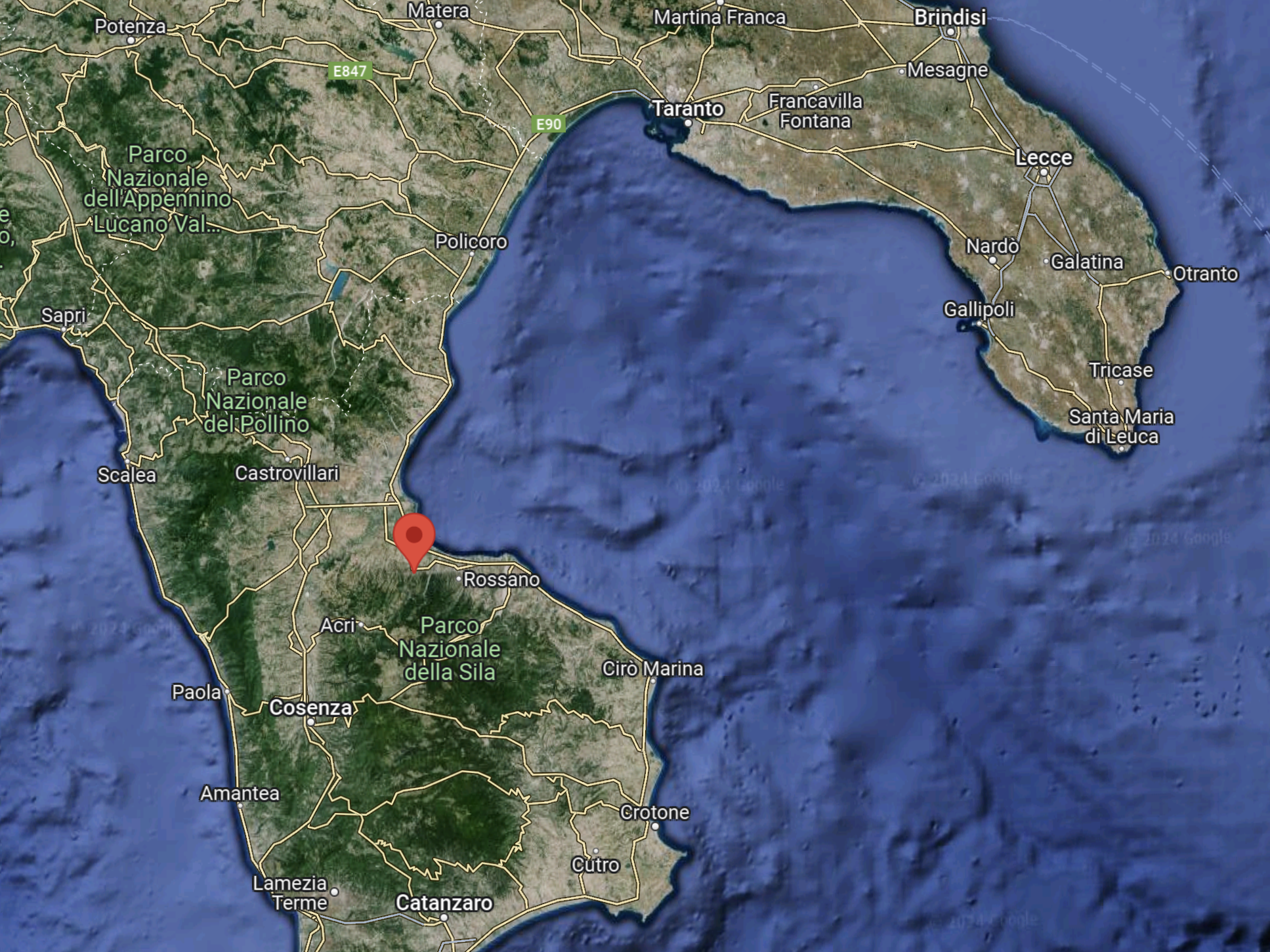
This Google Map shows the location of Corigliano at the foot of Italy.
Note.
- Corigliano is indicated by the red arrow.
- There is an explanatory video of their technology on SolarDuck’s web site.
Opposite Corigliano on the other side of the can be seen the Italian Naval Base of Taranto, which was the scene of the Battle of Taranto, which was one of the most significant naval battles of Second World War, if not the most significant.
- This web page has the Fleet Air Arm’s account of the battle.
- I have a book, that shows the Japanese visiting Taranto after the battle.
- Did the Japanese use what they learned to plan their successful raid on Pearl Harbor?
- Without Pearl Harbor, would the Americans have stayed out of the Second World War?
I visited Taranto in the 1980s and stood on the Dockside. Perhaps, it is time to go again?
Conclusion
I have a feeling that a hybrid offshore wind-solar farm can generate more electricity in a given area, by making better use of the space available.
It will be interesting to see how this hybrid wind farm performs.
In an area with plenty of sun and wind, it could be a better solution.
Only the mathematics will tell.
Why Firms Are Racing To Produce Green Ammonia
The title of this post, is the same as that of this article on the BBC.
This is the sub-heading.
In the 19th Century, Europeans realised what the Inca had known long before. Bird droppings, or guano, made a fantastic fertiliser.
These are the first three paragraphs.
And so sprang up a gigantic industry dedicated to the harvesting of guano from Latin American bird colonies, where there were huge piles of the stuff.
It was so rich in ammonia, the key ingredient, that a mere whiff could induce coughing and sneezing. Not exactly a pleasant cargo to ferry across the world.
As demand for fertiliser rose in the early 1900s, someone began to think, “Perhaps there’s another way?” That someone was Fritz Haber, a German chemist who, along with Carl Bosch, developed the Haber-Bosch process for synthesising ammonia.
This Wikipedia entry describes the Haber-Bosch process.
This is the first paragraph.
The Haber process, also called the Haber–Bosch process, is the main industrial procedure for the production of ammonia. The German chemists Fritz Haber and Carl Bosch developed it in the first decade of the 20th century. The process converts atmospheric nitrogen (N2) to ammonia (NH3) by a reaction with hydrogen (H2) using an iron metal catalyst under high temperatures and pressures. This reaction is slightly exothermic (i.e. it releases energy), meaning that the reaction is favoured at lower temperatures and higher pressures. It decreases entropy, complicating the process. Hydrogen is produced via steam reforming, followed by an iterative closed cycle to react hydrogen with nitrogen to produce ammonia.
These companies are mentioned in the BBC article.
Starfire Energy
This is their web site.
Their home page has a title of Modular, Variable-Rate Ammonia (NH3) Production and this description of their technology.
We are scaling up technologies to make and use carbon-free ammonia fuel. Rapid Ramp is a variable-rate ammonia production process engineered into a modular plant design. Prometheus Fire is a lower temperature, high flow ammonia cracking process that allows ammonia to be used like natural gas, but with no CO2 emissions.
According to the co-founder of the company, Starfire’s process can use intermittent power, like wind and solar.
Could a farmer make their own fertiliser with a containerised system and say a 5MW wind turbine or a small solar farm?
Atmonia
This is their web site.
This description of their process is on their home page.
Atmonia is developing a nitrogen electrolyser with our patented catalyst. The technology uses only air, water and electricity for direct ammonia production. This enables zero carbon ammonia production, when applying renewable electricity.
Could a farmer make their own fertiliser with a containerised system and say a 5MW wind turbine or a small solar farm?
Jupiter Ionics
This is their web site.
Their home page has an endless video and this statement.
We’re commercialising carbon-neutral, electrochemical technology for sustainable agriculture, ammonia-fuelled transport and renewable energy exports.
These three paragraphs in the BBC article, say more about the process used by Jupiter Ionics.
Jupiter Ionics is currently planning to build an ammonia production module on the megawatt scale, which could produce a tonne per day.
Jupiter Ionics’ technology differs from Starfire Energy and Atmonia’s in that it uses lithium as a mediator to break apart nitrogen molecules, which naturally exist as strongly bonded pairs of nitrogen atoms, to form lithium nitride. This then reacts with hydrogen to make the ammonia.
Within the next 12-18 months, Jupiter Ionics aims to scale up its equipment so that it can produce a kilogram of ammonia per day. A grape farmer in the state of Victoria who has solar panels on his land is hoping to trial the system, says Prof MacFarlane.
It appears that Starfire Energy, Atmonia and Jupiter have containerised systems, that can take air, water and electricity and can create sizeable quantities of ammonia for fertiliser or a fuel.
This page on the Ammonia Energy Association web site is entitled Amogy: Ammonia-Powered Tractor, where this is said, alongside a picture of a standard John Deere tractor.
Earlier this month, Amogy demonstrated a new ammonia-powered tractor in Stony Brook, New York. A 100 kW ammonia-to-power system was successfully integrated into a John Deere mid-size standard tractor, which can operate on liquid ammonia fuel for a period of several hours. The tractor conversion demonstration was made possible by significant seed funding secured in late 2021.
The unique system is comprised of a standard liquid-storage tank and highly efficient ammonia-cracking modules integrated into a hybrid fuel cell system, which can provide consistent primary power for several hours per refueling. Therefore, the pioneering vehicle maintains the functionality and duration requirements operators rely on to support farming tasks, which has never been offered with other alternative energy solutions. The ammonia-powered tractor was driven for separate periods, with a refueling session in between. Refueling a tractor with liquid ammonia is fast and simple, similar to gas or diesel refueling.
This is Amogy’s web site.
I can also see a problem, if every farmer of a certain size wants to make their own ammonia for both fertiliser and fuel.
The NIMBYs will have a field day, but at least the countryside’s low-life won’t be nicking your diesel.
Nitricity
The BBC article also talks about Nitricity.
As Josh McEnaney, president and chief executive of Nitricity in the US, explains, spreading ammonia on fields results in greenhouse gas emissions that could be avoided if we took a more direct approach to applying nitrogen, the crucial element that promotes plant growth, to the soil.
His company is developing a system that uses solar-powered plasma cells to fix nitrogen from the air. This is then used to make nitric acid, which can be applied to the soil. Early experiments with tomato plants yielded success and the company is now trialling its technology with suppliers for the US fast food chain Chipotle.
“We don’t require any hydrogen production,” says Dr McEnaney. “We go straight for the fertiliser.”
This is the Nitricity web site.
Two Experts Give Their Views
The BBC article finishes with the views of two experts.
Bill David at the University of Oxford points out that, around the world, there is already lots of infrastructure designed to store and transport ammonia.
He praises large projects for manufacturing ammonia using renewable energy, such as the one in Uzbekistan that will reportedly spew out 454,000 tonnes of ammonia per year with the help of 2.4 gigawatts of wind energy.
While ammonia can be used as a fuel, it can also be cracked to release hydrogen, which may itself be burned as a fuel, points out Lindsey Motlow, senior research associate at Darcy Partners, a technology firm that works with the oil and gas industry.
“We’re seeing real progress in [the] development of ammonia cracking technology,” she says.
Conclusion
According to the BBC article, two percent of the carbon dioxide emitted on the planet comes from the creation of fertiliser.
So it looks like we can either fry or starve, if we don’t address the problem of zero-carbon fertiliser.
But the downside could be every farm having its own wind turbine.
The BBC article and the related web sites are a must-read.
UK Can Secure Record Number Of Offshore Wind Farms In This Year’s Auction For New Projects
The title of this post, is the same as that of this press release from RenewableUK.
The first five paragraphs, should be read as a whole and are a good summary of, where the UK is with offshore wind.
A new report published today by RenewableUK shows that the Government has an opportunity to secure a record number of new offshore wind farms, and record amount of new capacity, in this year’s summer’s auction for contracts to generate clean power (Contracts for Difference). In a huge boost to the UK’s energy security, the Government has the potential to double the country’s offshore wind capacity in this year’s auction alone.
RenewableUK’s latest EnergyPulse Insights Offshore Wind report reveals that 14 wind farms are already eligible to bid into this year’s CfD auction (Allocation Round 6), providing nearly 10.3 gigawatts (GW) of new capacity. The previous records were set in 2022 when 8.5GW was eligible across 7 projects.
In addition to this, a further 4.7GW of new offshore wind capacity (out of 8.7GW in the planning system) could become eligible before applications open for AR6 at the end of March. If these projects were to receive consent from the Government, 14.9GW of offshore wind capacity would be eligible for this year’s auction. The report notes that being eligible does not mean that projects will choose to bid in – but they have the potential to do so.
To put this 14.9GW of potential new capacity into context, we currently have 14.7GW of fully operational offshore wind which generates 14% of the UK’s entire electricity needs. Just one gigawatt of offshore wind generates enough electricity to power over a million British homes for a year.
The report also shows that a further 5.2GW are already under construction in UK waters, and it forecasts that nearly 45GW could be fully operational by the end of 2030.
It is certainly worth reading through to the last paragraph.
The press release also lists the projects eligible to bid into AR6.
- Norfolk Vanguard West and Norfolk Vanguard East (2,760MW) – RWE
- Hornsea Four (2,600MW) – Ørsted
- Awel y Môr (1,100MW) – RWE
- East Anglia Two (900MW) – Iberdrola
- East Anglia One North (800MW) – Iberdrola
- Hornsea Three (753.1MW) – Ørsted
- Seagreen 1A (500MW) – SSE Renewables, TotalEnergies
- East Anglia Three (318MW) – Iberdrola
- Inch Cape (270MW) – Inch Cape Offshore
- Pentland (floating project) (100MW) – Highland Wind Limited
- Erebus (floating project) (100MW)
- Blyth 2 (floating project) (58MW)
- Forthwind (test and demonstration site) (8MW) – Forthwind Limited
These make a total of 10,267MW
Currently, as I write this the UK is generating 29 GW, so 45 GW with a lot of energy storage, should be enough to power the country.
Iberdrola Preparing Two East Anglia Offshore Wind Projects For UK’s Sixth CfD Round
The title of this post, is the same as that of this article on offshoreWIND.biz.
This is the sub-heading.
ScottishPower Renewables, Iberdrola’s company in the UK, is getting the East Anglia One North and East Anglia Two offshore wind projects ready for the upcoming auction round for Contracts for Difference (CfD).
These three paragraphs give more details.
This is according to project updates Iberdrola published as part of its financial results for 2023.
Iberdrola says “good progress is being made in the key engineering and design work” for the two projects and, while they were not presented in the UK’s fifth CfD Allocation Round (AR5), preparations are being made to take part in Allocation Round 6 (AR6).
The two offshore wind farms are part of the GBP 6.5 billion (around EUR 7.6 billion) East Anglia Hub project, which also includes East Anglia Three, currently in construction and expected to start delivering electricity in 2026. The 1.4 GW East Anglia Three was awarded Contract for Difference in July 2022.
It is now possible to build a table of Iberdrola’s East Anglian Hub.
- East Anglia One – 714 MW – Commissioned in 2020.
- East Anglia One North – 800 MW – To be commissioned in 2026.
- East Anglia Two – 900 MW – To be commissioned in 2026.
- East Anglia Three – 1372 MW – To be commissioned in 2026.
Note.
- East Anglia One is the largest windfarm in Iberdrola’s history
- These four wind farms are connected to the shore at Bawdsey on the River Deben.
These wind farms are a total of 3786 MW.
In addition there are RWE’s three Norfolk wind farms.
- Norfolk Boreas – 1386 MW – To be commissioned in 2027.
- Norfolk Vanguard East – 1380 MW – To be commissioned before 2030.
- Norfolk Vanguard West – 1380 MW – To be commissioned before 2030.
These wind farms are a total of 4146 MW, with a grand total of 7932 MW.
What Will Happen To The Electricity?
Consider.
- It is a lot of electricity.
- The good people of Norfolk are already protesting about the cables and pylons, that will connect the electricity to the National Grid.
- The good people of Suffolk will probably follow, their Northern neighbours.
- The wind farms are owned by Spanish company; Iberdrola and German company; RWE.
I wonder, if someone will build a giant electrolyser at a convenient place on the coast and export the hydrogen to Europe by pipeline or tanker.
- The ports of Felixstowe, Great Yarmouth and Lowestoft could probably handle a gas tanker.
- The Bacton gas terminal has gas pipelines to Belgium and The Netherlands.
In addition, there are various electricity interconnectors in use or under construction, that could send electricity to Europe.
- National Grid’s Lion Link to the Netherlands.
- NeuConnect to Germany from the Isle of Grain.
Whoever is the UK’s Prime Minister in 2030 will reap the benefits of these East Anglian and Norfolk wind farms.
In addition.
- The Hornsea wind farm will have tripled in size from 2604 MW to 8000 MW.
- The Dogger Bank wind farm will have grown from 1235 MW to 8000 MW.
- There is 4200 MW of wind farms in Morecambe Bay and around England.
They would be so lucky.
Hinkley Point C Fish Protection Plans Attacked By Environmental Organisations
The title of this post, is the same as that of this article on New Civil Engineer.
This is the sub-heading.
Revised plans to protect fish from water intake tubes for the Hinkley Point C nuclear power plant on the Severn Estuary have come under fresh criticism from environmental organisations.
These three paragraphs outline the story.
EDF recenrly proposed plans to create a saltmarsh at the Somerset nuclear plant site as an alternative to an acoustic fish deterrent. This followed the Environment Secretary having ruled in 2021, in line with Environment Agency recommendations, that the plant should install an acoustic fish deterrent.
The plant is scheduled to circulate 120,000l of water per second from the Bristol Channel to the nuclear power station through 8km underground tunnels to provide cooling for the power station’s systems.
A group of environmental non-governmental organisations (eNGOs) issued a statement coordinated by Somerset Wildlife Trust saying Hinkley Point C “will have a significant impact on marine and migratory fish including already vulnerable Atlantic salmon, twaite shad and European eel over its lifetime”.
This Google Map shows Lake Michigan, which was where I came across another tale of fish and nuclear power.
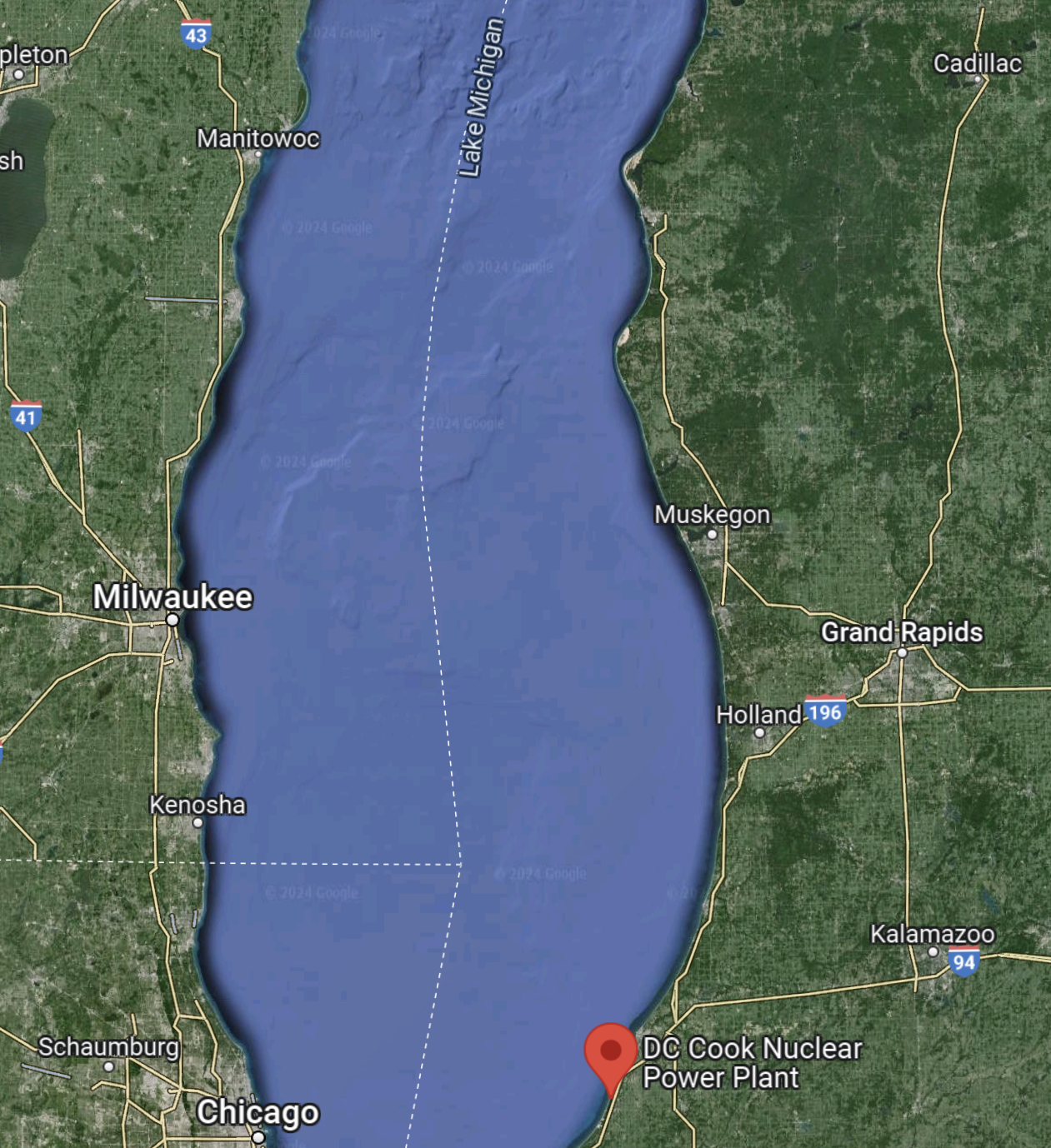
Note the red arrow, which marks the DC Cook Nuclear Power Plant.
This second Google Map shows a close-up of the plant.
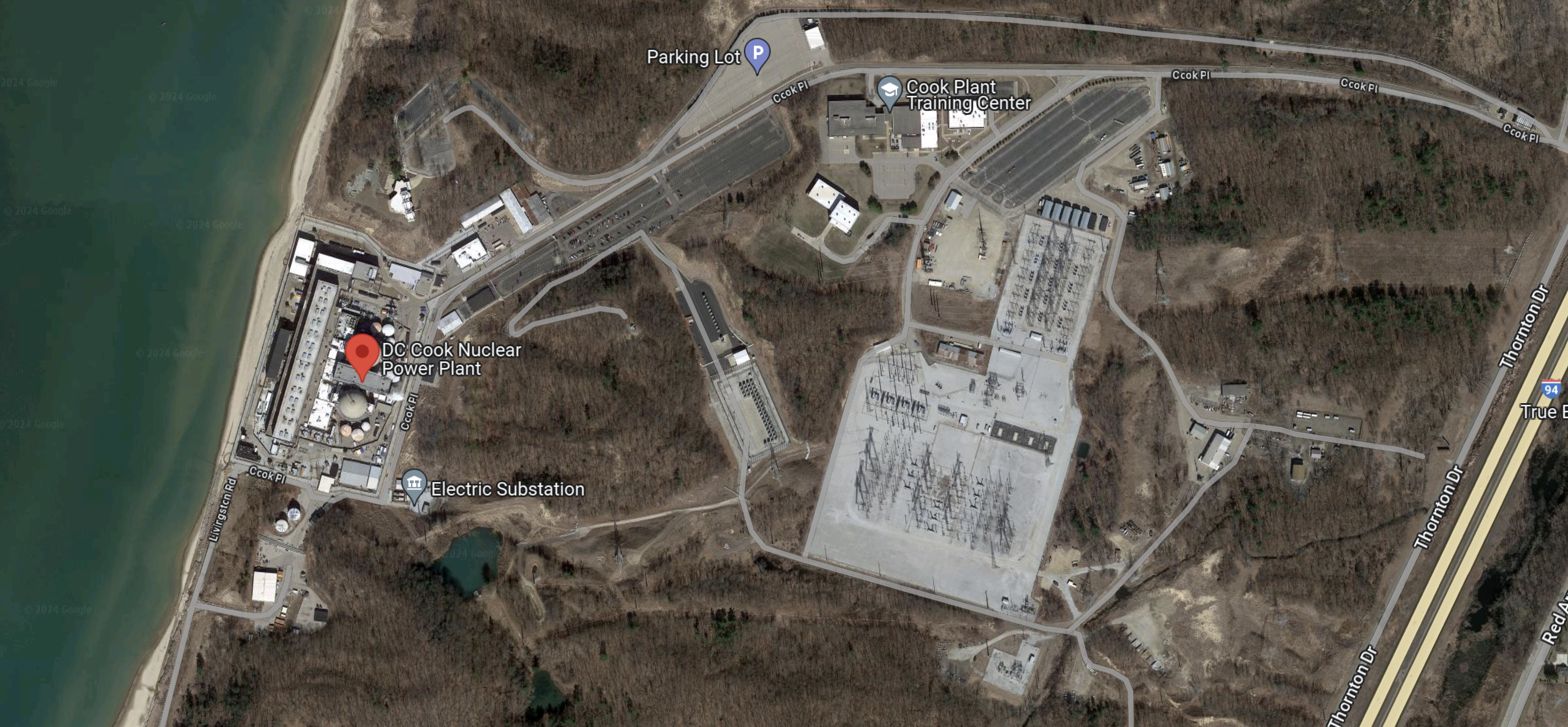
The power plant sits on the shores of Lake Michigan, from which it gets its cooling water.
In the early 1980s, after the Three Mile Island accident in 1979, I was given a tour of two nuclear power stations of which this plant was one and Shippingport or Beaver Valley was the other. Both were Artemis customers and one of the projects they were using the software on, was to plan and document all the Three Mile Island modifications or TMIs.
But it’s the Cook power plant that I remember.
- I’d turned up at Benton Harbor Airport on a very cold, snowy evening and I remember that the Hertz representation had got all the cars running so customers could drive away in the warm.
- DC Cook was impressive and very well run, and it was a very good customer visit.
- The fishy tale, I heard there was that the warm water from the power station attracted the fish and that some locals in the winter took to fishing through the ice of Lake Michigan. Occasionally, they fell through the ice.
- I was told, that some locals felt that the plant should be shut because of this, but it’s still running forty years after my visit.
- Lunch was interesting, as we went to a Michigan version of the famous Rook restaurant in the Two Ronnies. Except that every dish on the menu had something to do with beans, as that is the area of the US, where navy (baked) beans are grown. They even had a bean savoury for afters!
This article from the Huron Daily Tribune is entitled Fish Force Michigan Nuke Plant Shut Down, where these are the first two paragraphs.
Officials shut down a nuclear power plant on the eastern shore of Lake Michigan on Thursday after a large number of fish swam into the plant’s cooling-water system.
The two reactors at Donald C. Cook Nuclear Plant were idled as workers removed the fish and monitored the cooling system. It wasn’t clear when the reactor would be restarted, owner and operator American Electric Power Co. Inc. said in a statement.
It does appear that Cook was suffering from fish in the system.
I hope this doesn’t predict more delays for Hinckley Point C.
 The Anonymous Widower