Why Firms Are Racing To Produce Green Ammonia
The title of this post, is the same as that of this article on the BBC.
This is the sub-heading.
In the 19th Century, Europeans realised what the Inca had known long before. Bird droppings, or guano, made a fantastic fertiliser.
These are the first three paragraphs.
And so sprang up a gigantic industry dedicated to the harvesting of guano from Latin American bird colonies, where there were huge piles of the stuff.
It was so rich in ammonia, the key ingredient, that a mere whiff could induce coughing and sneezing. Not exactly a pleasant cargo to ferry across the world.
As demand for fertiliser rose in the early 1900s, someone began to think, “Perhaps there’s another way?” That someone was Fritz Haber, a German chemist who, along with Carl Bosch, developed the Haber-Bosch process for synthesising ammonia.
This Wikipedia entry describes the Haber-Bosch process.
This is the first paragraph.
The Haber process, also called the Haber–Bosch process, is the main industrial procedure for the production of ammonia. The German chemists Fritz Haber and Carl Bosch developed it in the first decade of the 20th century. The process converts atmospheric nitrogen (N2) to ammonia (NH3) by a reaction with hydrogen (H2) using an iron metal catalyst under high temperatures and pressures. This reaction is slightly exothermic (i.e. it releases energy), meaning that the reaction is favoured at lower temperatures and higher pressures. It decreases entropy, complicating the process. Hydrogen is produced via steam reforming, followed by an iterative closed cycle to react hydrogen with nitrogen to produce ammonia.
These companies are mentioned in the BBC article.
Starfire Energy
This is their web site.
Their home page has a title of Modular, Variable-Rate Ammonia (NH3) Production and this description of their technology.
We are scaling up technologies to make and use carbon-free ammonia fuel. Rapid Ramp is a variable-rate ammonia production process engineered into a modular plant design. Prometheus Fire is a lower temperature, high flow ammonia cracking process that allows ammonia to be used like natural gas, but with no CO2 emissions.
According to the co-founder of the company, Starfire’s process can use intermittent power, like wind and solar.
Could a farmer make their own fertiliser with a containerised system and say a 5MW wind turbine or a small solar farm?
Atmonia
This is their web site.
This description of their process is on their home page.
Atmonia is developing a nitrogen electrolyser with our patented catalyst. The technology uses only air, water and electricity for direct ammonia production. This enables zero carbon ammonia production, when applying renewable electricity.
Could a farmer make their own fertiliser with a containerised system and say a 5MW wind turbine or a small solar farm?
Jupiter Ionics
This is their web site.
Their home page has an endless video and this statement.
We’re commercialising carbon-neutral, electrochemical technology for sustainable agriculture, ammonia-fuelled transport and renewable energy exports.
These three paragraphs in the BBC article, say more about the process used by Jupiter Ionics.
Jupiter Ionics is currently planning to build an ammonia production module on the megawatt scale, which could produce a tonne per day.
Jupiter Ionics’ technology differs from Starfire Energy and Atmonia’s in that it uses lithium as a mediator to break apart nitrogen molecules, which naturally exist as strongly bonded pairs of nitrogen atoms, to form lithium nitride. This then reacts with hydrogen to make the ammonia.
Within the next 12-18 months, Jupiter Ionics aims to scale up its equipment so that it can produce a kilogram of ammonia per day. A grape farmer in the state of Victoria who has solar panels on his land is hoping to trial the system, says Prof MacFarlane.
It appears that Starfire Energy, Atmonia and Jupiter have containerised systems, that can take air, water and electricity and can create sizeable quantities of ammonia for fertiliser or a fuel.
This page on the Ammonia Energy Association web site is entitled Amogy: Ammonia-Powered Tractor, where this is said, alongside a picture of a standard John Deere tractor.
Earlier this month, Amogy demonstrated a new ammonia-powered tractor in Stony Brook, New York. A 100 kW ammonia-to-power system was successfully integrated into a John Deere mid-size standard tractor, which can operate on liquid ammonia fuel for a period of several hours. The tractor conversion demonstration was made possible by significant seed funding secured in late 2021.
The unique system is comprised of a standard liquid-storage tank and highly efficient ammonia-cracking modules integrated into a hybrid fuel cell system, which can provide consistent primary power for several hours per refueling. Therefore, the pioneering vehicle maintains the functionality and duration requirements operators rely on to support farming tasks, which has never been offered with other alternative energy solutions. The ammonia-powered tractor was driven for separate periods, with a refueling session in between. Refueling a tractor with liquid ammonia is fast and simple, similar to gas or diesel refueling.
This is Amogy’s web site.
I can also see a problem, if every farmer of a certain size wants to make their own ammonia for both fertiliser and fuel.
The NIMBYs will have a field day, but at least the countryside’s low-life won’t be nicking your diesel.
Nitricity
The BBC article also talks about Nitricity.
As Josh McEnaney, president and chief executive of Nitricity in the US, explains, spreading ammonia on fields results in greenhouse gas emissions that could be avoided if we took a more direct approach to applying nitrogen, the crucial element that promotes plant growth, to the soil.
His company is developing a system that uses solar-powered plasma cells to fix nitrogen from the air. This is then used to make nitric acid, which can be applied to the soil. Early experiments with tomato plants yielded success and the company is now trialling its technology with suppliers for the US fast food chain Chipotle.
“We don’t require any hydrogen production,” says Dr McEnaney. “We go straight for the fertiliser.”
This is the Nitricity web site.
Two Experts Give Their Views
The BBC article finishes with the views of two experts.
Bill David at the University of Oxford points out that, around the world, there is already lots of infrastructure designed to store and transport ammonia.
He praises large projects for manufacturing ammonia using renewable energy, such as the one in Uzbekistan that will reportedly spew out 454,000 tonnes of ammonia per year with the help of 2.4 gigawatts of wind energy.
While ammonia can be used as a fuel, it can also be cracked to release hydrogen, which may itself be burned as a fuel, points out Lindsey Motlow, senior research associate at Darcy Partners, a technology firm that works with the oil and gas industry.
“We’re seeing real progress in [the] development of ammonia cracking technology,” she says.
Conclusion
According to the BBC article, two percent of the carbon dioxide emitted on the planet comes from the creation of fertiliser.
So it looks like we can either fry or starve, if we don’t address the problem of zero-carbon fertiliser.
But the downside could be every farm having its own wind turbine.
The BBC article and the related web sites are a must-read.
UK Can Secure Record Number Of Offshore Wind Farms In This Year’s Auction For New Projects
The title of this post, is the same as that of this press release from RenewableUK.
The first five paragraphs, should be read as a whole and are a good summary of, where the UK is with offshore wind.
A new report published today by RenewableUK shows that the Government has an opportunity to secure a record number of new offshore wind farms, and record amount of new capacity, in this year’s summer’s auction for contracts to generate clean power (Contracts for Difference). In a huge boost to the UK’s energy security, the Government has the potential to double the country’s offshore wind capacity in this year’s auction alone.
RenewableUK’s latest EnergyPulse Insights Offshore Wind report reveals that 14 wind farms are already eligible to bid into this year’s CfD auction (Allocation Round 6), providing nearly 10.3 gigawatts (GW) of new capacity. The previous records were set in 2022 when 8.5GW was eligible across 7 projects.
In addition to this, a further 4.7GW of new offshore wind capacity (out of 8.7GW in the planning system) could become eligible before applications open for AR6 at the end of March. If these projects were to receive consent from the Government, 14.9GW of offshore wind capacity would be eligible for this year’s auction. The report notes that being eligible does not mean that projects will choose to bid in – but they have the potential to do so.
To put this 14.9GW of potential new capacity into context, we currently have 14.7GW of fully operational offshore wind which generates 14% of the UK’s entire electricity needs. Just one gigawatt of offshore wind generates enough electricity to power over a million British homes for a year.
The report also shows that a further 5.2GW are already under construction in UK waters, and it forecasts that nearly 45GW could be fully operational by the end of 2030.
It is certainly worth reading through to the last paragraph.
The press release also lists the projects eligible to bid into AR6.
- Norfolk Vanguard West and Norfolk Vanguard East (2,760MW) – RWE
- Hornsea Four (2,600MW) – Ørsted
- Awel y Môr (1,100MW) – RWE
- East Anglia Two (900MW) – Iberdrola
- East Anglia One North (800MW) – Iberdrola
- Hornsea Three (753.1MW) – Ørsted
- Seagreen 1A (500MW) – SSE Renewables, TotalEnergies
- East Anglia Three (318MW) – Iberdrola
- Inch Cape (270MW) – Inch Cape Offshore
- Pentland (floating project) (100MW) – Highland Wind Limited
- Erebus (floating project) (100MW)
- Blyth 2 (floating project) (58MW)
- Forthwind (test and demonstration site) (8MW) – Forthwind Limited
These make a total of 10,267MW
Currently, as I write this the UK is generating 29 GW, so 45 GW with a lot of energy storage, should be enough to power the country.
Iberdrola Preparing Two East Anglia Offshore Wind Projects For UK’s Sixth CfD Round
The title of this post, is the same as that of this article on offshoreWIND.biz.
This is the sub-heading.
ScottishPower Renewables, Iberdrola’s company in the UK, is getting the East Anglia One North and East Anglia Two offshore wind projects ready for the upcoming auction round for Contracts for Difference (CfD).
These three paragraphs give more details.
This is according to project updates Iberdrola published as part of its financial results for 2023.
Iberdrola says “good progress is being made in the key engineering and design work” for the two projects and, while they were not presented in the UK’s fifth CfD Allocation Round (AR5), preparations are being made to take part in Allocation Round 6 (AR6).
The two offshore wind farms are part of the GBP 6.5 billion (around EUR 7.6 billion) East Anglia Hub project, which also includes East Anglia Three, currently in construction and expected to start delivering electricity in 2026. The 1.4 GW East Anglia Three was awarded Contract for Difference in July 2022.
It is now possible to build a table of Iberdrola’s East Anglian Hub.
- East Anglia One – 714 MW – Commissioned in 2020.
- East Anglia One North – 800 MW – To be commissioned in 2026.
- East Anglia Two – 900 MW – To be commissioned in 2026.
- East Anglia Three – 1372 MW – To be commissioned in 2026.
Note.
- East Anglia One is the largest windfarm in Iberdrola’s history
- These four wind farms are connected to the shore at Bawdsey on the River Deben.
These wind farms are a total of 3786 MW.
In addition there are RWE’s three Norfolk wind farms.
- Norfolk Boreas – 1386 MW – To be commissioned in 2027.
- Norfolk Vanguard East – 1380 MW – To be commissioned before 2030.
- Norfolk Vanguard West – 1380 MW – To be commissioned before 2030.
These wind farms are a total of 4146 MW, with a grand total of 7932 MW.
What Will Happen To The Electricity?
Consider.
- It is a lot of electricity.
- The good people of Norfolk are already protesting about the cables and pylons, that will connect the electricity to the National Grid.
- The good people of Suffolk will probably follow, their Northern neighbours.
- The wind farms are owned by Spanish company; Iberdrola and German company; RWE.
I wonder, if someone will build a giant electrolyser at a convenient place on the coast and export the hydrogen to Europe by pipeline or tanker.
- The ports of Felixstowe, Great Yarmouth and Lowestoft could probably handle a gas tanker.
- The Bacton gas terminal has gas pipelines to Belgium and The Netherlands.
In addition, there are various electricity interconnectors in use or under construction, that could send electricity to Europe.
- National Grid’s Lion Link to the Netherlands.
- NeuConnect to Germany from the Isle of Grain.
Whoever is the UK’s Prime Minister in 2030 will reap the benefits of these East Anglian and Norfolk wind farms.
In addition.
- The Hornsea wind farm will have tripled in size from 2604 MW to 8000 MW.
- The Dogger Bank wind farm will have grown from 1235 MW to 8000 MW.
- There is 4200 MW of wind farms in Morecambe Bay and around England.
They would be so lucky.
Hinkley Point C Fish Protection Plans Attacked By Environmental Organisations
The title of this post, is the same as that of this article on New Civil Engineer.
This is the sub-heading.
Revised plans to protect fish from water intake tubes for the Hinkley Point C nuclear power plant on the Severn Estuary have come under fresh criticism from environmental organisations.
These three paragraphs outline the story.
EDF recenrly proposed plans to create a saltmarsh at the Somerset nuclear plant site as an alternative to an acoustic fish deterrent. This followed the Environment Secretary having ruled in 2021, in line with Environment Agency recommendations, that the plant should install an acoustic fish deterrent.
The plant is scheduled to circulate 120,000l of water per second from the Bristol Channel to the nuclear power station through 8km underground tunnels to provide cooling for the power station’s systems.
A group of environmental non-governmental organisations (eNGOs) issued a statement coordinated by Somerset Wildlife Trust saying Hinkley Point C “will have a significant impact on marine and migratory fish including already vulnerable Atlantic salmon, twaite shad and European eel over its lifetime”.
This Google Map shows Lake Michigan, which was where I came across another tale of fish and nuclear power.
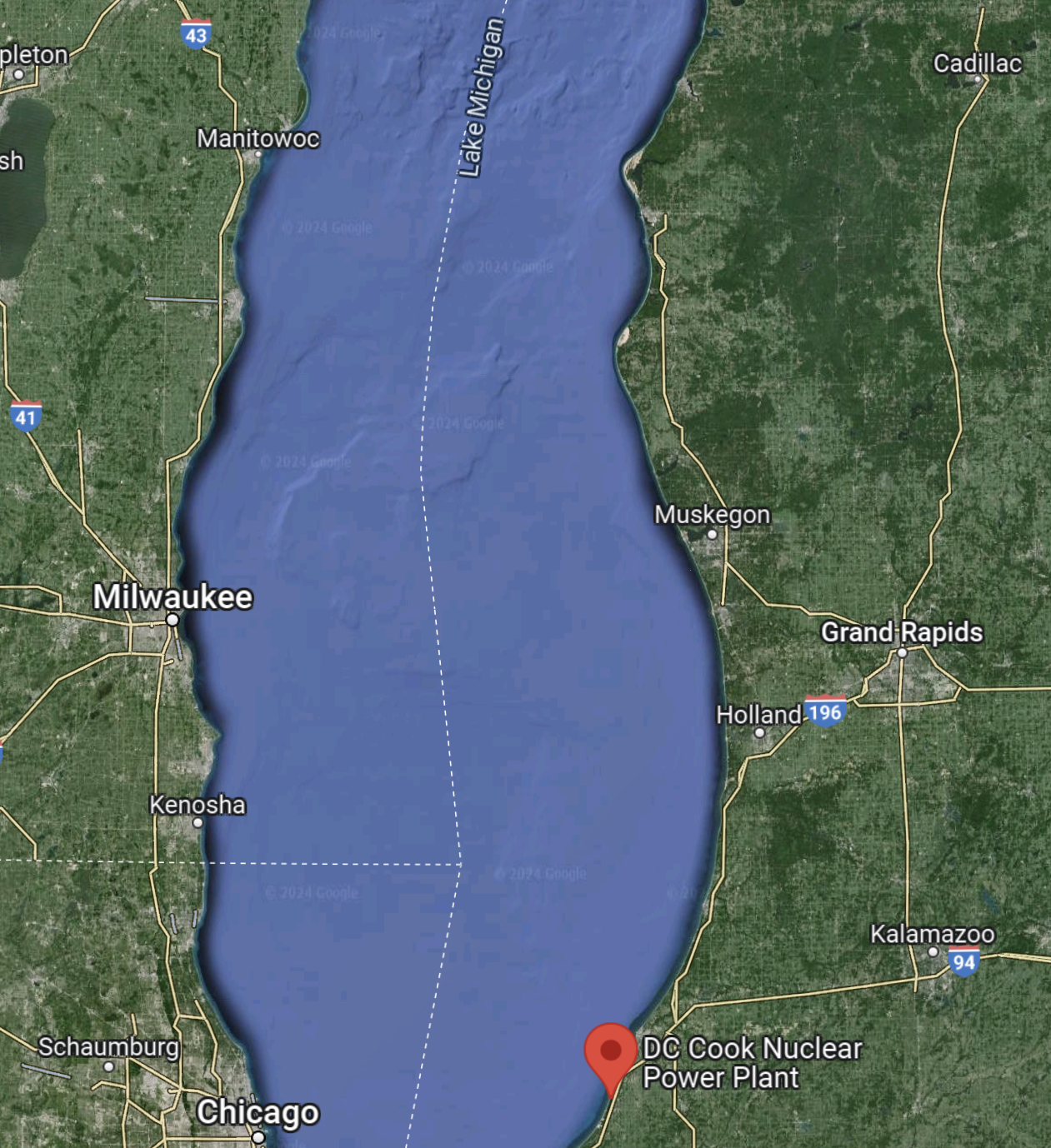
Note the red arrow, which marks the DC Cook Nuclear Power Plant.
This second Google Map shows a close-up of the plant.
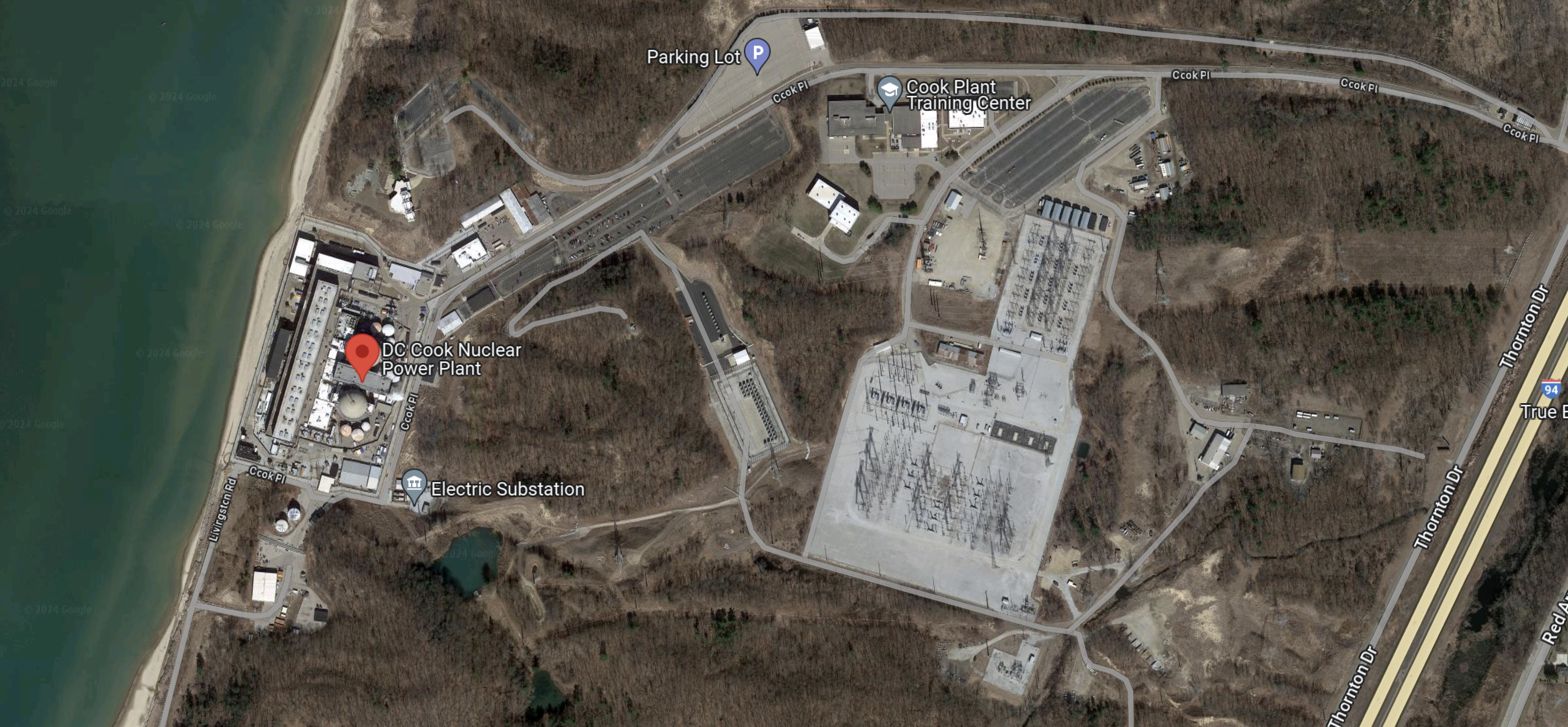
The power plant sits on the shores of Lake Michigan, from which it gets its cooling water.
In the early 1980s, after the Three Mile Island accident in 1979, I was given a tour of two nuclear power stations of which this plant was one and Shippingport or Beaver Valley was the other. Both were Artemis customers and one of the projects they were using the software on, was to plan and document all the Three Mile Island modifications or TMIs.
But it’s the Cook power plant that I remember.
- I’d turned up at Benton Harbor Airport on a very cold, snowy evening and I remember that the Hertz representation had got all the cars running so customers could drive away in the warm.
- DC Cook was impressive and very well run, and it was a very good customer visit.
- The fishy tale, I heard there was that the warm water from the power station attracted the fish and that some locals in the winter took to fishing through the ice of Lake Michigan. Occasionally, they fell through the ice.
- I was told, that some locals felt that the plant should be shut because of this, but it’s still running forty years after my visit.
- Lunch was interesting, as we went to a Michigan version of the famous Rook restaurant in the Two Ronnies. Except that every dish on the menu had something to do with beans, as that is the area of the US, where navy (baked) beans are grown. They even had a bean savoury for afters!
This article from the Huron Daily Tribune is entitled Fish Force Michigan Nuke Plant Shut Down, where these are the first two paragraphs.
Officials shut down a nuclear power plant on the eastern shore of Lake Michigan on Thursday after a large number of fish swam into the plant’s cooling-water system.
The two reactors at Donald C. Cook Nuclear Plant were idled as workers removed the fish and monitored the cooling system. It wasn’t clear when the reactor would be restarted, owner and operator American Electric Power Co. Inc. said in a statement.
It does appear that Cook was suffering from fish in the system.
I hope this doesn’t predict more delays for Hinckley Point C.
Rio Tinto Signs Australia’s Biggest Renewable Power Deal As It Works To Repower Its Gladstone Operations
The title of this post, is the same as that of this press release from Rio Tinto.
These three paragraphs outline the deal.
Rio Tinto has signed Australia’s largest renewable power purchase agreement (PPA) to date to supply its Gladstone operations in Queensland, agreeing to buy the majority of electricity from Windlab’s planned 1.4GW Bungaban wind energy project.
The agreement, which follows the announcement last month of a PPA for the Upper Calliope solar farm in Queensland, will make Rio Tinto the biggest industrial buyer of renewable power in Australia and is another major step in the work to repower the company’s Gladstone production assets – Boyne aluminium smelter, Yarwun alumina refinery and Queensland Alumina refinery.
Under the new PPA with Windlab, Rio Tinto will buy 80% of all power generated from the Bungaban wind energy project over 25 years. The project, which is currently in early development, will be built and operated by Windlab at a site in Queensland about 40 kilometres from the town of Wandoan, and 290 kilometres south-west of Gladstone, subject to development and grid connection approvals.
This Google Map indicates the position of Gladstone on the coast of Queensland.
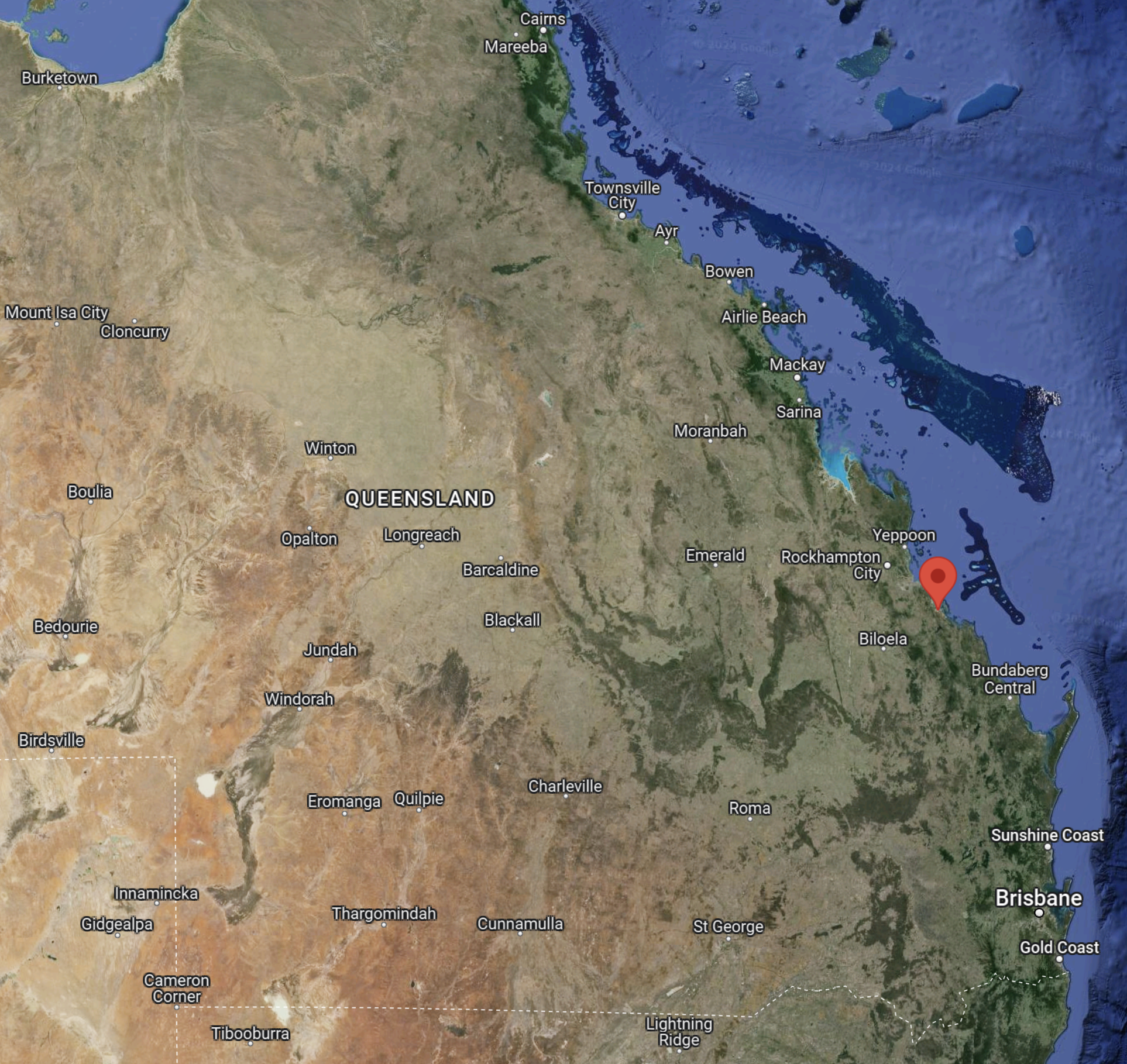
This map brings back memories.
I had hired a Piper Arrow from Sydney and I flew my late wife via Mildura, Adelaide, Coober Pedy, Yulara to Alice Springs taking about a week for it.
From Alice, I flew via Mount Isa to Cairns, which is at the top of the map on the coast.
I remember on leaving Aloce, I asked Air Traffic Control, what time it was in Queensland. The reply was “They’re half-an-hour ahead and twenty-five years behind!”
Mount Isa was infamous on the trip, as it was there we met the only disagreeable Aussie on the whole adventure. Unfortunately, he was in charge of the fuel and didn’t want to serve us. Probably, because he was drunk.
Finally, we got away and spent a couple of nights at Cairns, where we drove up the coast and explored the Daintree.
It was then a short hop for the plane onto the Battier Reef, where we stayed at a resort called Bedarra, which was probably the most exclusive place we ever stayed.
After a few days it was back in the plane and down the coast to Brisbane. That was a strange flight, as all Australian airline pilots were on strike, so we had the airspace to ourselves. At Mackay, the refuellers were so lacking in business, they were all too happy to fuel the plane.
After a couple of days in Brisbane, we flew the plane to Goondawindi, where we picked up our eldest son, before flying back to Sydney, where we took a flight home.
It was a memorable trip and I now wish, that we’d extended it by a couple of weeks.
Conclusion
Australia is a land of boundless solar energy, which is why we went there on holiday and Rio Tinto will be doing all there aluminium smelting by the use of renewables.
I can see in the future that the UK’s boundless wind energy will attract high energy businesses to the UK.
A World First For Liverpool
This article on The Engineer is entitled ABB Grid Balancing Facility Comes Online.
This is the sub-heading.
A significant new project to provide vital inertia across the UK’s electricity grid has gone live at the Lister Drive Greener Grid Park in Liverpool.
This Google Map, shows the Lister Drive Greener Grid Park.
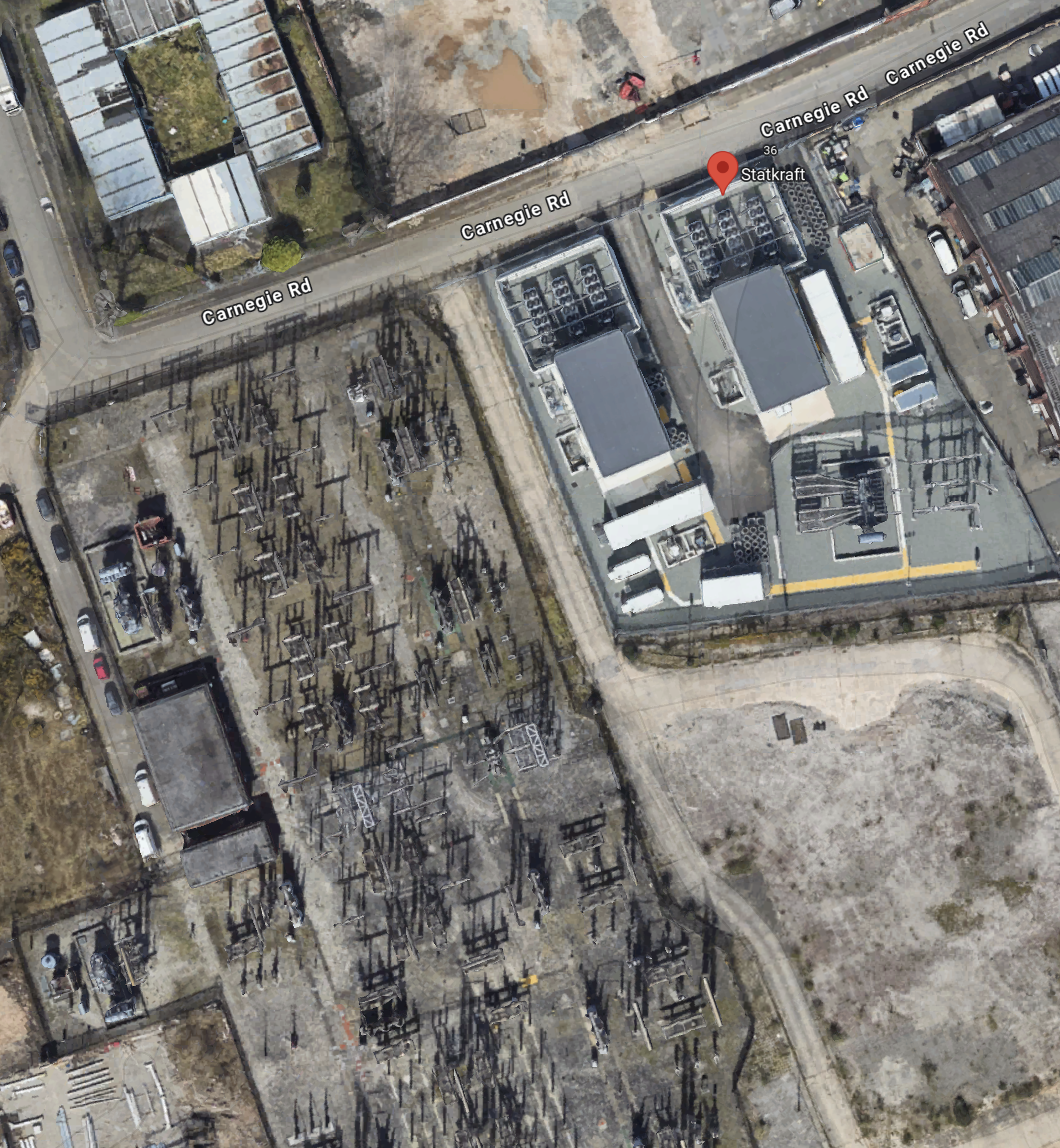
Note.
- The red arrow indicates the location of the pair of synchronous condensers.
- The metal forest to the West of the Statkraft site, looks like a large substation.
These are the first two paragraphs.
Featuring two ABB synchronous condensers, the facility is designed to replicate the inertia currently provided by spinning turbines at coal and gas-fired plants. This inertia is essential for maintaining the correct frequency and voltage across electricity grids, so an alternative source must be installed as thermal generation is replaced by wind and solar, which provide no inertia.
Developed for Norwegian renewable energy firm Statkraft, Lister Drive is the first project anywhere in the world to feature a high-inertia configuration that couples a synchronous condenser with a 40-tonne flywheel. According to ABB, this approach increases the instantaneously available inertia by 3.5 times, ensuring the network frequency and voltage are held stable within the tight limits essential to maintain grid reliability.
In my Electrical Engineering degree course at Liverpool University, I opted out of power engineering, as I preferred Electronics and Control Engineering. So I am indebted to this Wikipedia entry for what a synchronous condenser is and does.
Statkraft seem to be developing several of their Greener Grid Parks, in various places in the UK.
Form Energy To Begin Manufacturing Iron Air Batteries In Weirton To Stabilize Electrical Grid
The title of this post, is the same as that of this article on wesa.fm.
These three paragraphs detail the story.
A company pioneering electrical grid batteries that will provide days of backup power for power plants reliant on renewable energy is building out its manufacturing arm throughout the greater Pittsburgh region.
Form Energy is on track to begin manufacturing the new kind of grid asset this spring, one the company says is sorely needed in a destabilized climate. As bonuses, it’s cheap — made of earth-abundant and predominantly domestically sourced materials — and Form needs a large, maker workforce to pull it off.
This is a welcomed development in the community of Weirton, West Virginia, which has seen population and industry decline steadily since the 1970s. Most recently, Cleveland-Cliffs — a neighbor company in the small town — announced it would idle its tinplate production plant and lay off up to 900 employees.
I like Form Energy’s iron-air batteries.
They would appear to be a direct replacement for lithium-ion batteries in stationary applications likeBattery-Energy Storage Systems (BESS).
I suspect they will work eoth the grid-balancing software developed for lithium-ion batteries.
- They use rust and air to store energy.
- The science came out of MIT.
- The venture is well-backed by the likes of Bill Gates.
There’s more about this factory on this page of their web site.
- The web site talks of innovative software, like grid modelling software.
- They aim to start production in the second half of this year.
- At full production the factory will employ 750 people.
- The annual production will be 500 MW of batteries.
This is a company to watch.
Fire Safety Of Battery-Electric Vehicles
I notice that there has been talk of fires in battery-electric vehicles on this blog.
So I thought I’d put up a post with an appropriate topic.
There are some things that already could worry me.
- Vivarail had a fire early on.
- The Merseyrail Class 777 trains go in the tunnels under Liverpool.
- The new Piccadilly Line trains will have batteries.
- Did electric vehicle batteries contribute to the ferocity of the fire in the Luton Airport car park?
- Fire brigades are getting very worried about e-scooter and e-bike fires.
- This page on the Internet gives details of recent BESS fires.
- Do we investigate fires and publish the results properly?
I have some questions.
- Would it be sensible to have nationwide database of all batteries?
- Should we use more non-lithium methods in large stationary batteries?
- Should we use more capacitors?
- Should we make it a criminal offence to build or use a non-compliant e-bike or e-scooter?
- Should installing a battery in your house, need a safety certificate?
One half of me says yes and the other says no, to some of these questions.
The UK’s Pumped Storage Hydroelectricity
This post is a simple list of the UK’s pumped storage hydroelectricity.
- Balliemeanoch – 1500 MW/45 GWh – In Development
- Coire Glas – 1500 MW/30 GWh – Under Construction
- Corrievarkie – 600 MW/14.5 GWh – In Development
- Cruachan – 1000 MW/7.1 GWh – In Operation
- Fearn – 1800 MW/37 GWh – In Development
- Dinorwig – 1800 MW/9.1 GWh – In Operation
- Earba – 900 MW/33 GWh – In Development
- Foyers – 305 MW/10 GWh – In Operation
- Ffestiniog – 360 MW/1.44 GWh – In Operation
- Loch Kemp – 600 MW/9 GWh – In Development
- Loch Sloy – 152.5 MW/25 GWh – In Operation
- Red John – 450 MW/2.8 GWh – Under Construction
Note.
- Cruachan is only 440 MW and is being upgraded.
- The storage capacity at Foyers may be wrong, as I can’t find my original source.
When fully developed the total will be 10969.3 MW/223.94 GWh.
Wylfa: UK Government In Talks To Buy Nuclear Site – Report
The title of this post, is the same as that as this article on the BBC.
This is the sub-heading.
The UK government is reportedly in talks to take control of a site in north Wales where a planned nuclear project was scrapped in 2019.
These paragraphs outline the story.
State-owned Great British Nuclear is “in early discussions” with Hitachi, which owns the land at Wylfa, on Anglesey, the Financial Times reported.
A government spokesman said Wylfa was one of many “potential sites” that could host nuclear projects.
Hitachi abandoned its plans there in January 2019.
An unnamed minister told the FT that “tentative negotiations” with Hitachi had already begun, but said a deal might not be reached until after a general election expected later this year.
Tom Greatrex, chief executive of the Nuclear Industry Association and Virginia Crosbie, MP for Ynys Môn both welcomed the talks.
These are my thoughts.
Where Is Wylfa?
This Google Map shows Anglesey.
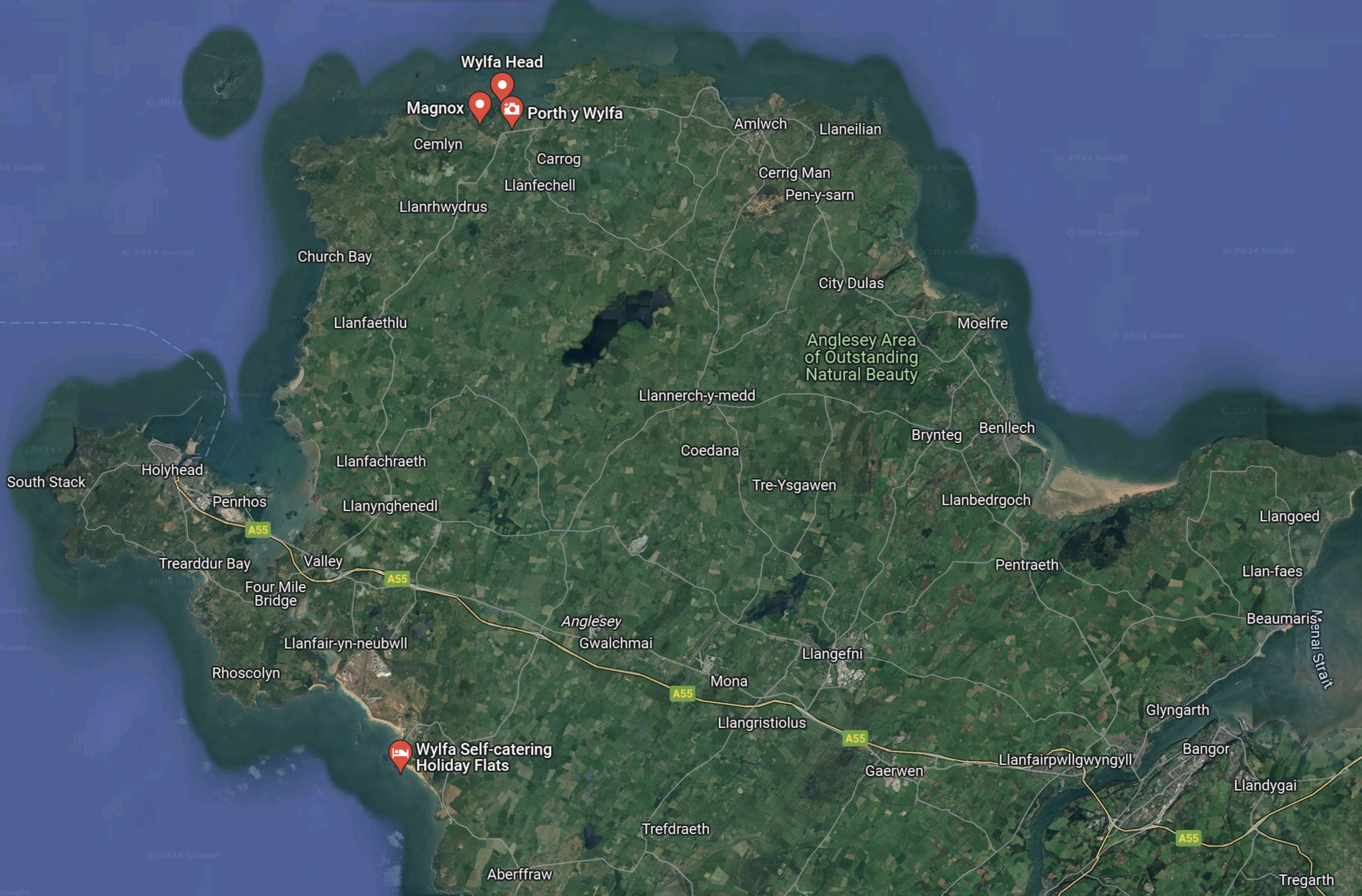
Wylfa power station is near Wylfa Head at the top of the map, where they are indicated by the cluster of red arrows.
This Google Map shows the power station to a larger scale.
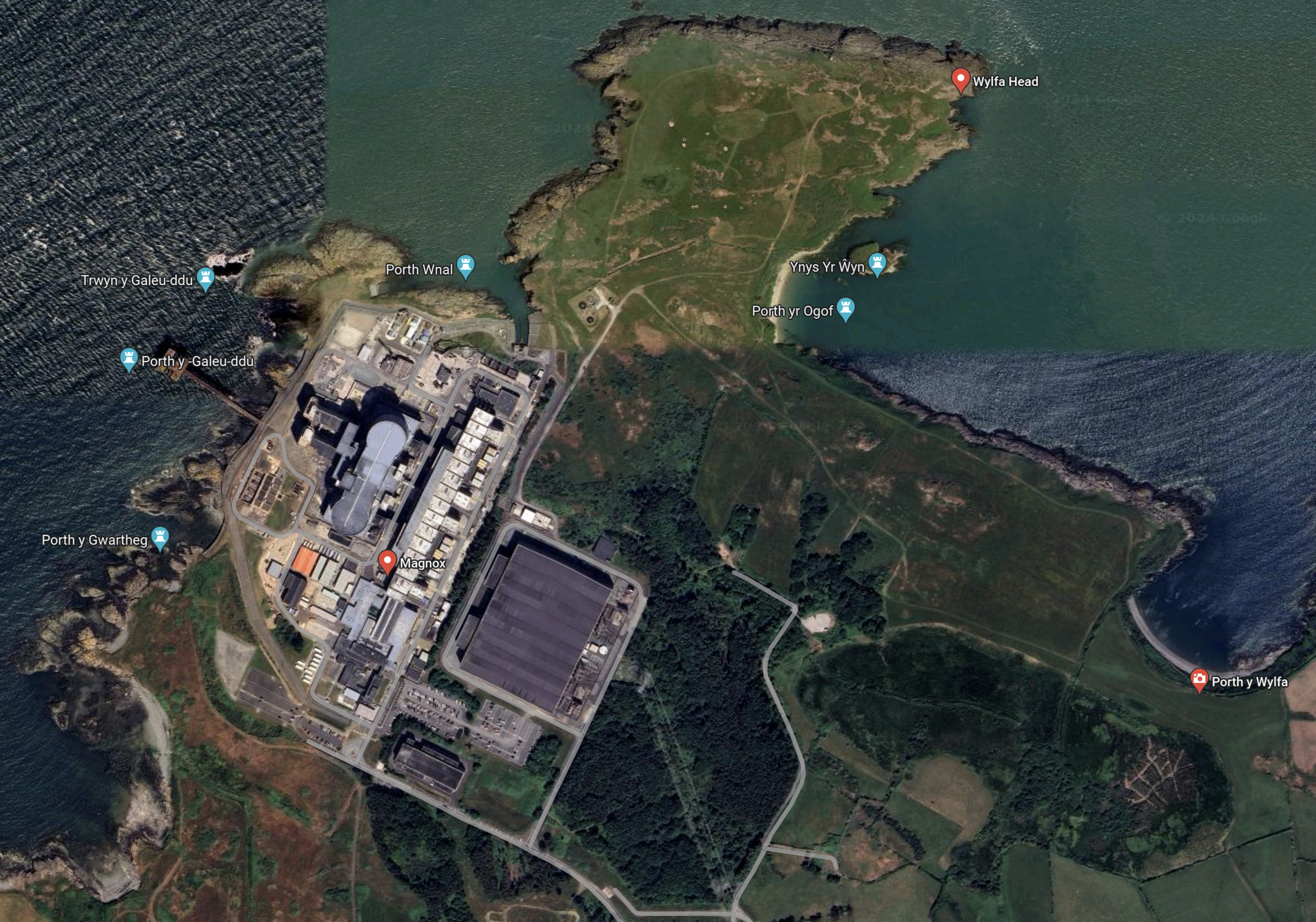
Note.
- The red arrow named Magnox marks the decommissioned Magnox power station.
- The topmost red arrow marks Wylfa Head.
- The rightmost red arrow marks Porth y Wylfa, which looks like a small harbour.
- On some maps the square building to the East of the power station is marked as Wylfa sub-station.
- There certainly appears to be an overhead transmission line leading South from the power station complex.
Virginia Crosbie, MP for Ynys Môn, also said this according to the BBC article.
The nuclear industry is unanimous that Wylfa is the best site in Europe for large-scale nuclear,” she said, adding that it would be “the largest inward investment” in Welsh history and “transformational” for the people of north-west Wales.
But I do wonder, if when you have cleared the Wylfa site leaving the sub-station, that it could be a site where renewables could come ashore and be fed into the grid.
Why Is Wylfa The Best Site In Europe For Large-Scale Nuclear?
Given the protests about putting new power transmission lines across Norfolk and Suffolk, I feel that Wylfa’s largest asset could be its high capacity connection to the UK’s grid.
According to the Wikipedia entry for Wylfa power station, this is said about Wylfa B.
Horizon Nuclear Power, originally an E.ON and RWE joint venture, bought by Hitachi in 2012, announced in 2009 intentions to install about 3,000 MWe of new nuclear plant at Wylfa. Horizon planned to build two advanced boiling water reactors (ABWRs) at a site to the south of the existing Wylfa station.
It would seem that the high capacity connection to the UK’s grid, is capable of handling a 3 GW power station at Wylfa, which could be very useful in the grand scheme of things.
This is also said in the Wikipedia entry for Wylfa power station.
On 4 April 2017, Horizon submitted a Site Licence Application to the Office for Nuclear Regulation. The scheme was extended to include a tunnel under the Menai Strait to carry the power cables to protect the conservation worth of the Strait and the Area of Outstanding Natural Beauty.
Horizon certainly seemed to try hard to get Wylfa B under construction.
As I said earlier, the Wylfa site could be an ideal site to connect offshore renewables to the grid.
 The Anonymous Widower