Vestas Unveils Plans For V236-15.0 MW Nacelle Factory In Scotland
The title of this post, is the same as that of this article on offshoreWIND.biz.
This is the sub-heading.
Vestas plans to build a nacelle and hub assembly facility in Scotland to support offshore wind projects in the UK and across Europe.
These four paragraphs give what looks to be a full outline of a more or less comprehensive plan.
The proposed factory would require a capital investment of more than EUR 250 million and is planned to manufacture nacelles and hubs for the company’s V236-15.0 MW offshore wind turbine. The new facility is expected to create up to 500 direct jobs, with additional employment across the supply chain.
According to Vestas, the plan to set up the factory follows the results of the Contracts for Difference Allocation Round 7 (AR7) in January 2026, the company’s growing offshore wind order book in the UK, and strategic discussions with the UK and Scottish governments on the next steps to develop and co-invest in the facility.
The plan also includes the potential co-location of suppliers producing other major turbine components, as part of a broader manufacturing setup.
The final investment decision (FID) on the new factory will depend on Vestas securing sufficient UK-based orders for the AR7 projects and those from the upcoming AR8. Subject to the timing of those results and the planning process, the facility could begin production by 2029 or 2030, Vestas said on 25 March.
- V236-15.0 turbines are 15 MW turbines, for which Vestas have 256 orders in the UK for Inchcape, Norfolk Vanguard East and Norfolk Vanguard West.
- In addition to new wind farms, will these large turbines be used for refitting to older wind farms?
- If other manufacturers or components could be involved, this would surely be sensible.
The picture in the original article shows the large size of these nacelles, which would suggest a site with good access to water might be good to ease transport.
Did The Help For Steel, Six Days Ago Help?
On the 19th March, I wrote UK Steel Industry Backed By Major New Trade Measure And Strategy. Did this help for steel to formulate Vestas’s plans? I wouldn’t be surprised, if the steel can be taken to the site Vesta chooses by rail or water.
Shares Available In ‘UK-First’ Community-Owned Battery Energy Storage System
The title of this post is the same as that on this article on Solar Power Portal.
This is the sub-heading.
Low Carbon Hub, an Oxfordshire-based developer of community-owned renewable energy projects, is inviting investment in the 3MW/12MWh BESS.
These four paragraphs add more details.
Consumers have the opportunity to invest in the UK’s ‘first’ community-owned battery energy storage system (BESS).
Low Carbon Hub, an Oxfordshire-based developer of community-owned renewable energy projects, is inviting investment in the 3MW/12MWh BESS, which is co-located with the Ray Valley solar power plant.
At one time the largest community-owned solar development in the UK, the 19MW Ray Valley solar project came online in 2022.
Low Carbon Hub now plans to install battery energy storage at the site to “ensure more clean energy is used, and more money is generated for communities,” it said. As such, members of the public and organisations can buy shares in the Community Energy Fund through direct impact investing platform Ethex.
I think we could see more of this in the future.
NextEnergy Solar Fund To Shift To Energy Storage And Divest Solar in Strategic Overhaul
The title of this post is the same as that of this article on the Solar Power Portal.
This is the sub-heading.
As part of the reset, NextEnergy said it will increase its energy storage exposure up to 30% of its gross asset value, a significant increase on its current rate of 10%.
These two paragraphs give more of their reasoning.
NextEnergy Solar Fund has completed a “strategic reset” of its investment strategy which will see it focus on energy storage assets and increase project sales.
As part of the reset, NextEnergy said it will increase its energy storage exposure up to 30% of its gross asset value, a significant increase on its current rate of 10%. The company said the shift would “enhance the Company’s existing stable revenues generated by its operational solar assets and support future revenues”.
In Is Sumitomo Heavy Industries Highview Power Energy Storage System On Line At Hiroshima?, I describe a power supply system developed by Sumitomo Heavy Industries to supply a stable 5 MW to a LNG Terminal, using these components.
- A Cold Source
- Solar Panels
- A 5 MW/20 MWh Highview Power liquid-air CRYObattery.
Do Sumitomo Heavy Industries believe that a combination of energy and/or battery sources working together gives the quality of stable power, that is needed by today’s modern factories, facilities and buildings?
As a Graduate Control Engineer, I very much believe stable power supplies are a good thing and Sumitomo Heavy Industries obviously feel that Highview Power’s liquid air CRYObatteries are a good way to provide them.
The adding of a battery into a solar-powered renewable power supply, would surely, increase the amount of batteries that NextEnergy were financing.
‘Mobilising EUR 1 Trillion in Investments’ | North Sea Countries, Industry, TSOs to Ink Offshore Wind Pact
The title of this post, is the same as that of this article on offshoreWIND.biz.
This is the sub-heading.
Government officials from Belgium, Denmark, France, Germany, Ireland, Luxembourg, the Netherlands, Norway and the UK are set to sign a declaration confirming the ambition to build 300 GW of offshore wind in the North Seas by 2050, and an investment pact with the offshore wind industry and transmission system operators (TSOs) that is said to mobilise EUR 1 trillion in economic activity.
These three paragraphs add a lot of powerful detail.
Under the Offshore Wind Investment Pact for the North Seas, to be signed today (26 January) at the North Sea Summit in Hamburg, governments of the nine North Sea countries will commit to building 15 GW of offshore wind per year from 2031 to 2040.
The heads of state and energy ministers will also vow to de-risk offshore wind investments through a commitment to provide two-sided Contracts for Difference (CfDs) as the standard for offshore wind auction design. The pact also commits governments to remove any regulatory obstacles to power purchase agreements (PPAs), according to WindEurope, which will sign the pact on behalf of the industry.
On the industry’s side, the commitment is to drive down the costs of offshore wind by 30 per cent towards 2040, mobilise EUR 1 trillion of economic activity for Europe, create 91,000 additional jobs and invest EUR 9.5 billion in manufacturing, port infrastructure and vessels.
These two paragraphs say something about cost reductions.
The cost reduction of offshore wind is planned to be achieved through scale effects, lower costs of capital and further industrialisation supported by clarity and visibility on the project pipeline.
The transmission system operators (TSOs) will identify cost-effective cooperation projects in the North Sea, including 20 GW of promising cross-border projects by 2027 for deployment in the 2030s.
I hope there is a project management system, that can step into this frenzy, just as Artemis did in the 1970s with North Sea Oil and Gas.
The BBC has reported the story under a title of UK To Join Major Wind Farm Project With Nine European Countries.
this is the sub-title.
The UK is set to back a vast new fleet of offshore wind projects in the North Sea alongside nine other European countries including Norway, Germany and the Netherlands.
These six paragraphs add more detail.
The government says the deal will strengthen energy security by offering an escape from what it calls the “fossil fuel rollercoaster”.
For the first time, some of the new wind farms will be linked to multiple countries through undersea cables known as interconnectors, which supporters say should lower prices across the region.
But it could prove controversial as wind farm operators would be able to shop around between countries to sell power to the highest bidder – potentially driving up electricity prices when supply is tight.
Energy Secretary Ed Miliband will sign a declaration on Monday at a meeting on the future of the North Sea in the German city of Hamburg, committing to complete the scheme by 2050.
Jane Cooper, deputy CEO of industry body RenewableUK, said the deal would “drive down costs for billpayers” as well as increasing “the energy security of the UK and the whole of the North Sea region significantly”.
But Claire Countinho, shadow energy secretary, warned “we cannot escape the fact that the rush to build wind farms at breakneck speed is pushing up everybody’s energy bills.”
Claire Coutinho, as an outsider at present and a member of a party out of Government had to say something negative, but her negotiations when she was UK Energy Minister with her German opposite number, which I wrote about in UK And Germany Boost Offshore Renewables Ties, seem very much a precursor to today’s agreement.
The 73 Group
The 73 Group was a finance company, that I owed jointly with a guy named David Mann, who was an experienced provider of finance for cars, trucks and other vehicles and equipment.
- The company had been the idea of an accountant, I shared with David, named Graham Manning.
- David put in his expertise and I put in some of the money, I received from the sale of my share of the Artemis software.
- It operated mainly in the area around Ipswich in Suffolk.
- Many of the customers were owner/drivers, who ferried containers to and from the docks at Felixstowe, who had known David for some years.
- The company certainly gave a better return, than putting money on deposit.
- One of the things, I did was extensively model a book of loans for vehicles and this gave me an insight into the dynamics of money.
Sadly in the end, David became ill and we wound the company up.
It gave me an interesting insight into local finance and I believe, that local finance companies with good connections and the right systems and people can be profitable.
It also gave me a few good tales.
Coaches Are Good Business
A good top-of-the range coach is good business for operators, coach dealers and finance companies.
I remember spending one evening with David and a coach operator in a pub, when the operator had had a fabulous day stitching together coaches as Rail Replacement Buses for British Rail after a train derailment, between Ipswich and Colchester.
I learned a lot about operating coaches that night and it’s why I’m so keen on hydrogen-powered coaches, with their expected long range, quietness and smoothness.
Fairground Rides Are Good Business
Surprisingly, if you don’t mind being paid in fifty pence pieces on the Ipswich bypass at ten o’clock at night.
You Need A Good Collections Guy
Our’s was excellent.
A Smorgasbord Of Misery
This phrase of Kemi Badenoch’s in her reply to Rachel Reeve’s budget speech will do her no harm.
Cornwall Insight Forecasts Lower Household Energy Bills In January
The title of this post, is the same as that of this article on Solar Power Portal.
This is a paragraph from the article.
The Default Tariff Cap is set by the UK’s energy regulator Ofgem as the maximum rate per unit and standing charge that can be billed to customers for their energy use. Cornwall Insight’s latest forecast predicts the cap will fall to £1,733 a year for a typical dual fuel household in the first quarter of 2026.
Consider.
- I am on a dual-fuel tariff for gas and electricity.
- At present, I pay £159 per month or £1,908 per year.
If I was on the new price cap, I’d pay £144.42 per month or about 10 % less.
The Thoughts Of Chris O’Shea
This article on This Is Money is entitled Centrica boss has bold plans to back British energy projects – but will strategy pay off?.
The article is basically an interview with a reporter and gives O’Shea’s opinions on various topics.
Chris O’Shea is CEO of Centrica and his Wikipedia entry gives more details.
These are his thoughts.
On Investing In Sizewell C
This is a paragraph from the article.
‘Sizewell C will probably run for 100 years,’ O’Shea says. ‘The person who will take the last electron it produces has probably not been born. We are very happy to be the UK’s largest strategic investor.’
Note.
- The paragraph shows a bold attitude.
- I also lived near Sizewell, when Sizewell B was built and the general feeling locally was that the new nuclear station was good for the area.
- It has now been running for thirty years and should be good for another ten.
Both nuclear power stations at Sizewell have had a good safety record. Could this be in part, because of the heavy engineering tradition of the Leiston area?
On Investing In UK Energy Infrastructure
This is a paragraph from the article
‘I just thought: sustainable carbon-free electricity in a country that needs electricity – and we import 20 per cent of ours – why would we look to sell nuclear?’ Backing nuclear power is part of O’Shea’s wider strategy to invest in UK energy infrastructure.
The UK certainly needs investors in UK energy infrastructure.
On Government Support For Sizewell C
This is a paragraph from the article.
Centrica’s 500,000 shareholders include an army of private investors, many of whom came on board during the ‘Tell Sid’ privatisations of the 1980s and all of whom will be hoping he is right. What about the risks that deterred his predecessors? O’Shea argues he will achieve reliable returns thanks to a Government-backed financial model that enables the company to recover capital ploughed into Sizewell C and make a set return.
I have worked with some very innovative accountants and bankers in the past fifty years, including an ex-Chief Accountant of Vickers and usually if there’s a will, there’s a solution to the trickiest of financial problems.
On LNG
These are two paragraphs from the article.
Major moves include a £200 million stake in the LNG terminal at Isle of Grain in Kent.
The belief is that LNG, which produces significantly fewer greenhouse gas emissions than other fossil fuels and is easier and cheaper to transport and store, will be a major source of energy for the UK in the coming years.
Note.
- Centrica are major suppliers of gas-powered Combined Heat and Power units were the carbon dioxide is captured and either used or sold profitably.
- In at least one case, a CHP unit is used to heat a large greenhouse and the carbon dioxide is fed to the plants.
- In another, a the gas-fired Redditch power station, the food-grade carbon dioxide is sold to the food and construction industries.
- Grain LNG Terminal can also export gas and is only a short sea crossing from gas-hungry Germany.
- According to this Centrica press release, Centrica will run low-carbon bunkering services from the Grain LNG Terminal.
I analyse the investment in Grain LNG Terminal in Investment in Grain LNG.
On Rough Gas Storage
These are three paragraphs from the article.
O’Shea remains hopeful for plans to develop the Rough gas storage facility in the North Sea, which he re-opened in 2022.
The idea is that Centrica will invest £2 billion to ‘create the biggest gas storage facility in the world’, along with up to 5,000 jobs.
It could be used to store hydrogen, touted as a major energy source of the future, provided the Government comes up with a supportive regulatory framework as it has for Sizewell.
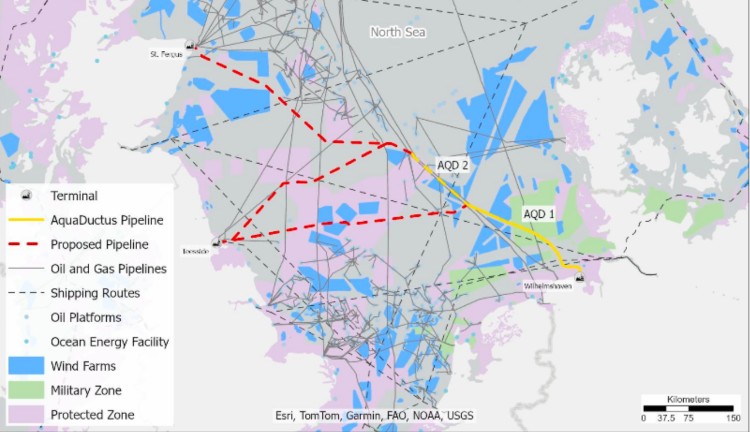
The German AquaVentus project aims to bring at least 100 GW of green hydrogen to mainland Germany from the North Sea.
This map of the North Sea, which I downloaded from the Hydrogen Scotland web site, shows the co-operation between Hydrogen Scotland and AquaVentus
Note.
- The yellow AquaDuctus pipeline connected to the German coast near Wilhelmshaven.
- There appear to be two AquaDuctus sections ; AQD 1 and AQD 2.
- There are appear to be three proposed pipelines, which are shown in a dotted red, that connect the UK to AquaDuctus.
- The Northern proposed pipeline appears to connect to the St. Fergus gas terminal on the North-East tip of Scotland.
- The two Southern proposed pipelines appear to connect to the Easington gas terminal in East Yorkshire.
- Easington gas terminal is within easy reach of the massive gas stores, which are being converted to store hydrogen at Aldbrough and Rough.
- The blue areas are offshore wind farms.
- The blue area straddling the Southernmost proposed pipe line is the Dogger Bank wind farm, is the world’s largest offshore wind farm and could eventually total over 6 GW.
- RWE are developing 7.2 GW of wind farms between Dogger Bank and Norfolk in UK waters, which could generate hydrogen for AquaDuctus.
This cooperation seems to be getting the hydrogen Germany needs to its industry.
It should be noted, that Germany has no sizeable hydrogen stores, but the AquaVentus system gives them access to SSE’s Aldbrough and Centrica’s Rough hydrogen stores.
So will the two hydrogen stores be storing hydrogen for both the UK and Germany?
Storing hydrogen and selling it to the country with the highest need could be a nice little earner.
On X-energy
These are three paragraphs from the article.
He is also backing a £10 billion plan to build the UK’s first advanced modular reactors in a partnership with X-energy of the US.
The project is taking place in Hartlepool, in County Durham, where the existing nuclear power station is due to reach the end of its life in 2028.
As is the nature of these projects, it involves risks around technology, regulation and finance, though the potential rewards are significant. Among them is the prospect of 2,500 jobs in the town, where unemployment is high.
Note.
- This is another bold deal.
- I wrote in detail about this deal in Centrica And X-energy Agree To Deploy UK’s First Advanced Modular Reactors.
- Jobs are mentioned in the This is Money article for the second time.
I also think, if it works to replace the Hartlepool nuclear power station, then it can be used to replace other decommissioned nuclear power stations.
On Getting Your First Job
These are three paragraphs from the article.
His career got off to a slow start when he struggled to secure a training contract with an accountancy firm after leaving Glasgow University.
‘I had about 30, 40 rejection letters. I remember the stress of not having a job when everyone else did – you just feel different,’ he says.
He feels it is ‘a duty’ for bosses to try to give young people a start.
I very much agree with that. I would very much be a hypocrite, if I didn’t, as I was given good starts by two companies.
On Apprenticeships
This is a paragraph from the article.
‘We are committed to creating one new apprenticeship for every day of this decade,’ he points out, sounding genuinely proud.
I very much agree with that. My father only had a small printing business, but he was proud of the apprentices he’d trained.
On Innovation
Centrica have backed three innovative ideas.
- heata, which is a distributed data centre in your hot water tank, which uses the waste heat to give you hot water.
- HiiROC, which is an innovative way to generate affordable hydrogen efficiently.
- Highview Power, which stores energy as liquid air.
I’m surprised that backing innovations like these was not mentioned.
Conclusion
This article is very much a must read.
Sheffield Wednesday Placed In Administration
The title of this post, is the same as that of this article on the BBC.
Does this mean that the City of Sheffield will now work a six-day week?
Iberdrola Looking To Sell 49 Pct Stake In UK Offshore Wind Farm – Report
The title of this post, is the same as that of this article on offshoreWIND.biz.
This is the sub-heading.
Iberdrola has begun exploring the sale of 49 per cent of its East Anglia Two offshore wind farm project in the UK, according to a report by the Spanish media outlet Cinco Días citing unnamed sources.
These four paragraphs give more details.
The renewable energy developer has already engaged Bank of America and BBVA as financial advisors to assist with the potential transaction, Cinco Días writes.
Iberdrola’s interest in selling a nearly half stake in East Anglia Two mirrors previous deals in the East Anglia portfolio, where the company has brought in financial partners in two other phases, East Anglia One and East Anglia Three.
The 714 MW East Anglia One offshore wind farm is owned by Iberdrola’s UK arm ScottishPower Renewables and Macquarie’s Green Investment Group (GIG), with Octopus Energy having acquired a 10 per cent stake from GIG this April. East Agnlia One has been in operation since 2021.
In July this year, Iberdrola and UAE clean energy company Masdar announced what the companies said was the largest offshore wind transaction of the decade as they signed an agreement to co-invest in the 1.4 GW East Anglia Three project, currently under construction.
But then being bought and sold is the way of life for an offshore wind farm.
In 2018, I wrote World’s Largest Wind Farm Attracts Huge Backing From Insurance Giant, which contains this extract from the Times says this about the funding of wind farms.
Wind farms throw off “long-term boring, stable cashflows”, Mr. Murphy said, which was perfect to match Aviva policyholders and annuitants, the ultimate backers of the project. Aviva has bought fixed-rate and inflation-linked bonds, issued by the project. While the coupon paid on the 15-year bonds, has not been disclosed, similar risk projects typically pay an interest rate of about 3 per cent pm their bonds. Projects typically are structured at about 30 per cent equity and 70 per cent debt.
Darryl Murphy is Aviva’s head of infrastructure debt. The article also says, that Aviva will have a billion pounds invested in wind farms by the end of the year.
I wonder how long it will be before individual investors can fund their pensions, with a direct investment in a wind farm?
- The wind farm would surely be a better investment if it had an integrated battery to supply power, when the wind didn’t blow.
- It would probably also be a safer investment, if it had been generating electricity for some years.
After all, at the present time, you can invest in batteries through companies like Gresham House and Gore Street.
 The Anonymous Widower