JERA Nex BP, EnBW Submit Morven Offshore Wind Farm Application
The title of this post, is the same as that of this article on offshoreWIND.biz.
This is the sub-heading.
A joint venture between JERA Nex BP and EnBW has submitted Section 36 consent applications for the Morven offshore wind farm to the Scottish government
These two paragraphs add a few details.
The developer secured the seabed rights for the Morven offshore wind farm as a single project in the ScotWind Leasing Round in 2022 and split it into two separate projects during the early development phase.
Located around 60 kilometres off the coast of Aberdeenshire at its closest point, the site is planned to house Morven North and Morven South, which would have a combined installed capacity of up to 3 GW and around 190 wind turbines in total.
Morven Offshore Wind Farm now has a comprehensive web site.
The web site says that the electricity will be brought ashore at Hawthorn Pit.
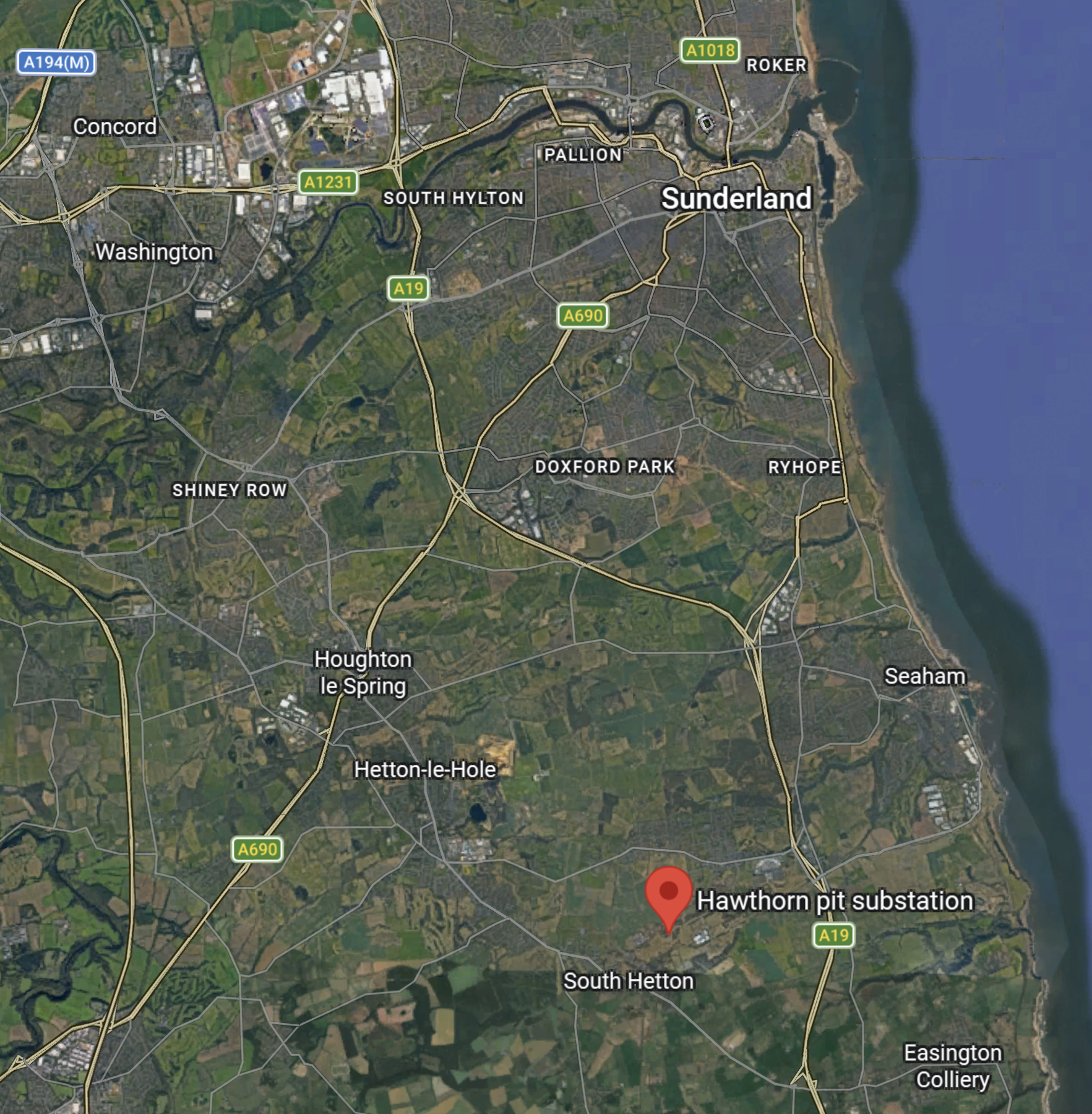
This Google Map shows the location of Hawthorn Pit.
Note.
- Hawthorn Pit is indicated by the red arrow.
- Sunderland is at the top of the map on the coast.
- Aura Power has already obtained planning permission for Hawthorn Pit solar farm, which will be up to 49.9 MW.
- Zenobe are developing a battery-energy-storage-system(BESS) 1.5 km to the South-East of the new Hawthorn Pit substation, which will have an output of 300 MW. Sloppily, there is no detail on capacity, but Google AI indicates, it is a 300 MW/600 MWh battery.
- Hawthorn Pit substation is also the expected to be the Southern end of Eastern Green Link 1, which will help to bring Scottish wind power to England, which will be a 2 GW undersea interconnector to Torness.
In Murphy Starts Work On £2.5bn Eastern Green Link 1, I detail the start of building of Eastern Green Link 1 and say it should be operational by 2029.
When Is The Morven Offshore Wind Farm Expected To Be Commissioned?
I asked Google AI the question above and received this answer.
The 2.9 GW Morven offshore wind farm is expected to be fully commissioned and operational between 2031 and 2035, with initial grid connections and power export potentially starting as early as 2030.
The timeline for full deployment of the Morven Offshore Wind Farm remains somewhat flexible as it depends on final planning approvals and connection offers from the National Energy System Operator (NESO).
The Cables For The Morven Offshore Wind Farm And Eastern Green Link 1
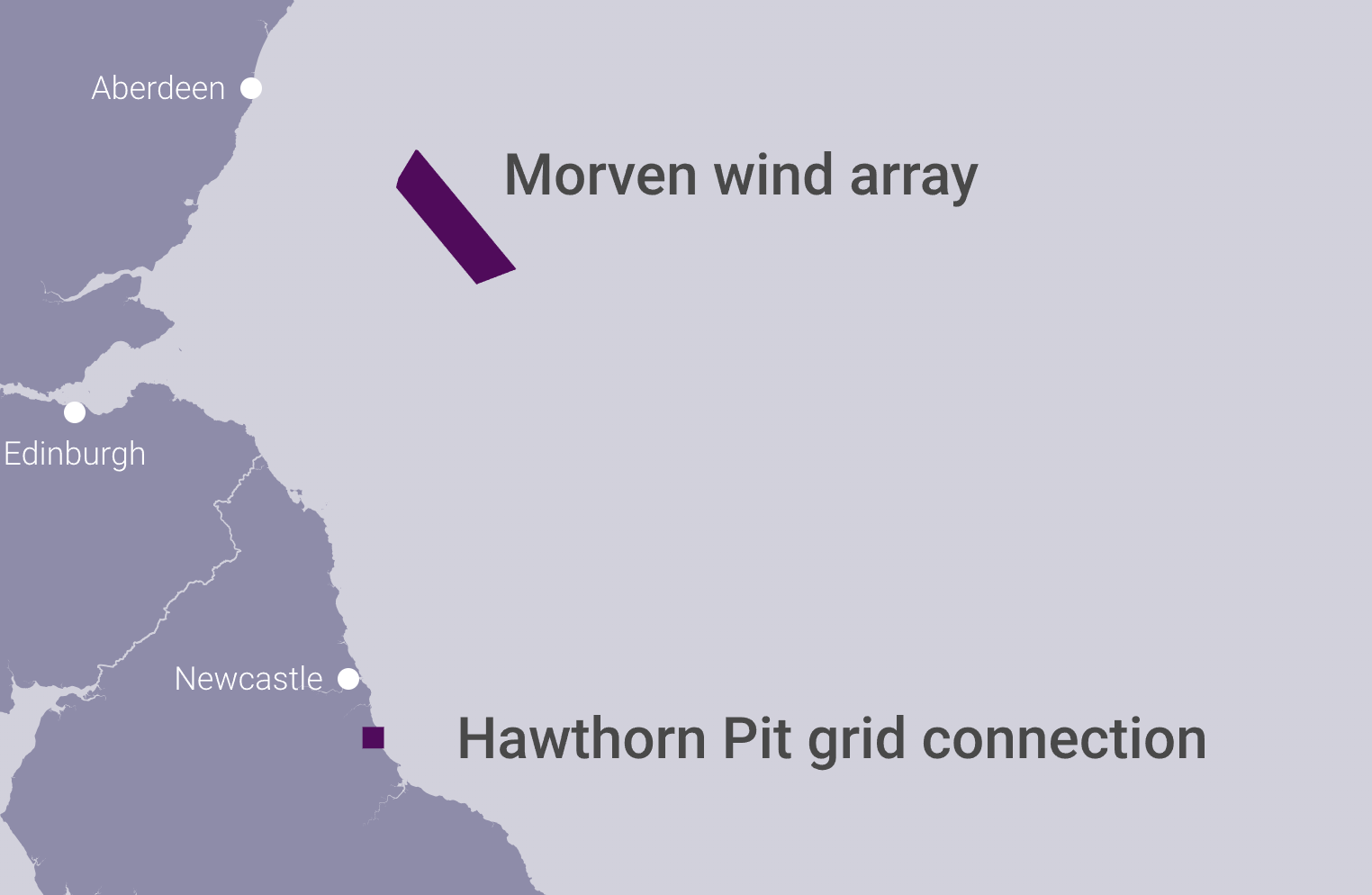
This map clipped from the Morven Offshore Wind Farm web site, shows the locations of Aberdeen, Hawthorn Pit and the Morven Offshore Wind Farm.
Note.
- The location of the Morven wind array was first mentioned in June 2020, as part of ScotWind by Crown Estate Scotland.
- The development of Eastern Green Link 1 was first mentioned in May 2021, by National Grid.
- Torness is to the East of Edinburgh.
- Eastern Green Link 1 connects Torness and Hawthorn Pit.
- the Morven wind array connects to England at Hawthorn Pit.
Over the last few years National Grid and other companies have been developing a technique called offshore hybrid assets, which I describe in What Are Offshore Hybrid Assets?.
An offshore hybrid asset typically connects two countries via a large offshore wind farm, which can then send electricity to both countries.
In a traditional design, there would need to be.
- A 2 GW cable between Torness and Hawthorn Pit.
- A 2.9 GW cable between Morven and Hawthorn Pit.
In the Offshore Hybrid Asset design, there would need to be.
- A 2 GW cable between Torness and Morven
- A 2.9 GW cable between Morven and Hawthorn Pit.
I suspect cable would be saved.
This map shows the position of each ScotWind Leasing wind farm.

Note.
- The numbers are Scotwind’s lease number in their documents.
- Morven is ScotWind lease number 1.
- Eastern Green Link 1 is one of four interconnectors down the East Coast of the UK.
- I have added up the ScotWind lease numbers 1-6 and they total 10.5 GW.
That would be a lot of power to capture just by converting the four Eastern Green Link interconnectors into offshore hybrid assets.
How Will Aquaventus Connect To Aberdeen?
This is RWE’s description of AquaVentus, which is sub-titled Hydrogen Production In The North Sea.
Hydrogen is considered the great hope of decarbonisation in all sectors that cannot be electrified, e.g. industrial manufacturing, aviation and shipping. Massive investments in the expansion of renewable energy are needed to enable carbon-neutral hydrogen production. After all, wind, solar and hydroelectric power form the basis of climate-friendly hydrogen.
In its quest for climate-friendly hydrogen production, the AquaVentus initiative has set its sights on one renewable energy generation technology: offshore wind. The initiative aims to use electricity from offshore wind farms to operate electrolysers also installed at sea on an industrial scale. Plans envisage setting up electrolysis units in the North Sea with a total capacity of 10 gigawatts, enough to produce 1 million metric tons of green hydrogen.
RWE have also put this AquaVentus video on their web site.
Note, that in the video AquaVentus connects Germany to Denmark, Norway, The Netherlands and Aberdeen and Humberside in the UK.
I asked Google AI, the question in the title of this section, and received this answer.
AquaVentus connects to Aberdeen through a strategic infrastructure partnership with Hydrogen Scotland. The two organizations are integrating offshore wind power, offshore electrolysis, and a shared cross-border pipeline to link Scottish renewable generation with European industrial markets.
The connection strategy relies on a multi-stage approach across the North Sea:
Offshore Production & Transmission: AquaVentus aims to produce green hydrogen directly offshore. It will be transported via a pan-European pipeline network—such as the planned 400 km AquaDuctus to link offshore hubs with both the UK and mainland Europe.
Scottish-German Export Corridor: Building on previous research like the Scot2Ger study, this pipeline corridor directly connects Scotland’s abundant offshore wind resources to European demand, establishing Aberdeen as a critical origin node.
Integrated Energy Backbone: The initiative champions hybrid connection concepts (combining both power cables and hydrogen pipelines). This allows for maximum flexibility when integrating Aberdeen’s local onshore hydrogen infrastructure with broader transnational energy grids.
I will now ask Google AI some supplementary questions about AquaVentus in UK waters.
“Will AquaVentus Produce Hydrogen In UK Waters?”
Google AI gave this reply.
Yes, AquaVentus plans to produce green hydrogen in UK waters. The German-led consortium has partnered with Hydrogen Scotland to harness Scotland’s offshore wind potential for large-scale, cross-border hydrogen production and export.
Key Details of the UK-German Initiative
Production Scale: The initiative aims to install 10 gigawatts (GW) of offshore electrolysis capacity in the North Sea by 2035, producing up to 1 million metric tonnes of green hydrogen annually.
The “Pipes and Wires” Model: Offshore wind parks will be equipped with hybrid connection concepts, providing the flexibility to either send electricity directly to the grid or convert it into hydrogen via offshore electrolysers.
Transportation: The produced hydrogen will be transported to land via a shared transnational subsea pipeline corridor, linking Scottish resources to Germany and mainland Europe.The partnership is specifically aimed at creating a North Sea hydrogen corridor to boost energy security and build the foundational European Hydrogen Backbone.
“Will AquaVentus Land Hydrogen In Scotland?”
Google AI gave this reply.
Yes, the German-led AquaVentus initiative plans to land green hydrogen in Scotland as part of a coordinated North Sea energy corridor.
The cross-border initiative involves the following components:
The Pipeline Connection: A key part of the plan is the AquaDuctus offshore subsea pipeline, designed to collect green hydrogen produced from central North Sea wind farms and land it on the coast.
Scottish Partnership: Hydrogen Scotland and AquaVentus have formalized a Memorandum of Understanding to combine Scotland’s massive offshore wind potential with German infrastructure and electrolysis expertise.
Export Ambitions: Scotland aims to produce up to 3.3 Mt of green hydrogen per year by 2045, heavily relying on pipelines and networks to export this to mainland European hubs like Germany.
Offshore Facilities: The broader initiative plans to install 10 GW of offshore electrolysis capacity in the North Sea to produce up to 1 million tonnes of hydrogen annually.
Note that Google AI has told me that a Megatonne of hydrogen is currently worth around £2.5-5 billion.
“Will AquaVentus Connect To Any Of The ScotWind Leasing Wind Farms?”
Google AI gave this reply.
Yes, AquaVentus plans to link Scottish offshore wind resources (including ScotWind farms) to mainland Europe. Through an agreement with Hydrogen Scotland, AquaVentus intends to utilize hybrid “pipes and wires” infrastructure to transmit power or convert it into green hydrogen for direct pipeline transport.
The partnership serves several strategic goals:
The “Pipes & Wires” Concept: Wind farms built under the ScotWind leasing round will have the flexibility to either route electricity to the UK grid or convert it into green hydrogen via offshore electrolysers.
Cross-Border Pipelines: The hydrogen generated by Scottish offshore wind is targeted to be fed into the planned AquaDuctus pipeline, which forms a transnational energy corridor connecting the UK to Germany and the rest of Europe.
Policy Integration: AquaVentus is actively advocating for legal reforms to accommodate these cross-border hybrid connections, allowing direct pipeline integration for future offshore parks.
I believe these ScotWind Leasing wind farms could be connected to AquaVentus.
- 1 – Morven – 2.9 GW – JERA Nex BP, EnBW
- 2 – Ossian – 2.6 GW – SSE Renewables
- 3 – Bellrock – 1.2 GW – Falck Renewables
- 4 – CampionWind – 2 GW – Scottish Power, Shell
- 5 – Muir Mhòr – 0.8 GW – Vattenfall
- 6 – Bowdun – – 1 GW – Thistle Wind Partners
Note.
- All companies are major energy companies.
- The wind farms are in a cluster to the South-East of Scotland.
- Wind farms 2-5 are floating, and 1 and 6 are fixed.
- There is a maximum power of 10.5 GW.
- These wind farms would not need to be shut down, when there was too much wind, if the excess electricity could be converted into hydrogen.
- The “Pipes & Wires” Concept would allow all energy generated to be transferred to shore, either as electricity or hydrogen.
Cables would need to be laid to perform the functions of the Eastern Green Links 1-4.
- Eastern Green Link 1 – Torness and Hawthorn Pit
- Eastern Green Link 2 – Peterhead and Drax
- Eastern Green Link 3 – Westfield and Lincolnshire
- Eastern Green Link 4 – Peterhead and Lincolnshire
Eastern Green Link 5 is under development between Aberdeenshire and Lincolnshire.
“Is Anderby Creek An Important Node In The Electricity Grid?”
Google AI gave this reply.
Yes, Anderby Creek has become a highly important landfall location for the UK’s electricity grid, acting as a crucial connection point for high-capacity subsea cables bringing renewable energy from Scotland and offshore wind farms into England.
Its role in the national grid’s infrastructure centers on several major “superhighway” projects:
Eastern Green Link 5 (EGL 5): This £3bn National Grid project involves a 585km subsea High Voltage Direct Current (HVDC) cable carrying up to 2 GW of clean power (enough for two million homes) from Aberdeenshire, Scotland, to Anderby Creek.
Eastern Green Links 3 & 4 (EGL 3 / EGL 4): These are additional massive subsea cable projects that also plan to make landfall at Anderby Creek to transport Scottish wind energy down the UK coastline.
Offshore Wind Export Cables: Beyond long-distance transmission, the village already hosts export cables from local offshore wind developments like the Triton Knoll Wind Farm.
Because of the massive volume of power coming ashore, Anderby Creek serves as the starting point for significant onshore infrastructure. The cables transition underground at the beach and run roughly 8km inland to a proposed new converter station near Bilsby/Alford, where the power is converted and integrated into the broader Great Grid Upgrade.
“Will AquaVentus Have Access To The UK’s hydrogen Storage On Humberside?”
Google AI gave this reply.
Yes. Through a strategic partnership with Hydrogen Scotland, the AquaVentus initiative aims to establish cross-border offshore infrastructure that connects the central North Sea with existing and planned hydrogen networks across the UK, including those on Humberside.
The pipeline infrastructure associated with AquaVentus is envisioned to reach the UK just south of the massive hydrogen storage facilities located in East Yorkshire. While the German offshore pipeline (like AquaDuctus) is focused on landing green hydrogen into Germany, the broader AquaVentus framework is designed to integrate with British transmission networks and link to underground cavern storage in the UK.
On Humberside, major energy giants (including Centrica, Equinor, and SSE Thermal) are developing the integrated Humber Hydrogen transport and storage network. This system encompasses large-scale hydrogen storage at the Aldbrough Hydrogen Storage site and Rough Gas Storage. Because the AquaVentus UK branch connects to the Humber area’s onshore network, it positions the initiative to take advantage of these regional storage assets as a cornerstone for international trade and domestic energy resilience.
I think this is key as it gives AquaVentus access to very large hydrogen storage.
Conclusion
It almost looks to me, that National Grid and AquaVentus are combining their pipes and wires between the Southern North Sea and Aberdeen.
- Hydrogen offtake for Germany will be at Wilhelmshaven.
- Hydrogen offtake for England will be at Humberside.
- Hydrogen offtake for Scotland will be at Aberdeen.
- Electricity offtake for Germany will be at Wilhelmshaven.
- Electricity offtake for England will be at Anderby Creek.
- Electricity offtake for England will be at Hawthorn Pit.
- Electricity offtake for Scotland will be at Torness.
- Electricity offtake for Scotland will be at Aberdeen.
Note.
- There will probably be other connections to onshore locations and offshore wind farms.
- Hydrogen imports will be possible from Denmark, Norway and The Netherlands direct into AquaVentus.
The Thoughts Of Chris O’Shea
This article on This Is Money is entitled Centrica boss has bold plans to back British energy projects – but will strategy pay off?.
The article is basically an interview with a reporter and gives O’Shea’s opinions on various topics.
Chris O’Shea is CEO of Centrica and his Wikipedia entry gives more details.
These are his thoughts.
On Investing In Sizewell C
This is a paragraph from the article.
‘Sizewell C will probably run for 100 years,’ O’Shea says. ‘The person who will take the last electron it produces has probably not been born. We are very happy to be the UK’s largest strategic investor.’
Note.
- The paragraph shows a bold attitude.
- I also lived near Sizewell, when Sizewell B was built and the general feeling locally was that the new nuclear station was good for the area.
- It has now been running for thirty years and should be good for another ten.
Both nuclear power stations at Sizewell have had a good safety record. Could this be in part, because of the heavy engineering tradition of the Leiston area?
On Investing In UK Energy Infrastructure
This is a paragraph from the article
‘I just thought: sustainable carbon-free electricity in a country that needs electricity – and we import 20 per cent of ours – why would we look to sell nuclear?’ Backing nuclear power is part of O’Shea’s wider strategy to invest in UK energy infrastructure.
The UK certainly needs investors in UK energy infrastructure.
On Government Support For Sizewell C
This is a paragraph from the article.
Centrica’s 500,000 shareholders include an army of private investors, many of whom came on board during the ‘Tell Sid’ privatisations of the 1980s and all of whom will be hoping he is right. What about the risks that deterred his predecessors? O’Shea argues he will achieve reliable returns thanks to a Government-backed financial model that enables the company to recover capital ploughed into Sizewell C and make a set return.
I have worked with some very innovative accountants and bankers in the past fifty years, including an ex-Chief Accountant of Vickers and usually if there’s a will, there’s a solution to the trickiest of financial problems.
On LNG
These are two paragraphs from the article.
Major moves include a £200 million stake in the LNG terminal at Isle of Grain in Kent.
The belief is that LNG, which produces significantly fewer greenhouse gas emissions than other fossil fuels and is easier and cheaper to transport and store, will be a major source of energy for the UK in the coming years.
Note.
- Centrica are major suppliers of gas-powered Combined Heat and Power units were the carbon dioxide is captured and either used or sold profitably.
- In at least one case, a CHP unit is used to heat a large greenhouse and the carbon dioxide is fed to the plants.
- In another, a the gas-fired Redditch power station, the food-grade carbon dioxide is sold to the food and construction industries.
- Grain LNG Terminal can also export gas and is only a short sea crossing from gas-hungry Germany.
- According to this Centrica press release, Centrica will run low-carbon bunkering services from the Grain LNG Terminal.
I analyse the investment in Grain LNG Terminal in Investment in Grain LNG.
On Rough Gas Storage
These are three paragraphs from the article.
O’Shea remains hopeful for plans to develop the Rough gas storage facility in the North Sea, which he re-opened in 2022.
The idea is that Centrica will invest £2 billion to ‘create the biggest gas storage facility in the world’, along with up to 5,000 jobs.
It could be used to store hydrogen, touted as a major energy source of the future, provided the Government comes up with a supportive regulatory framework as it has for Sizewell.
The German AquaVentus project aims to bring at least 100 GW of green hydrogen to mainland Germany from the North Sea.
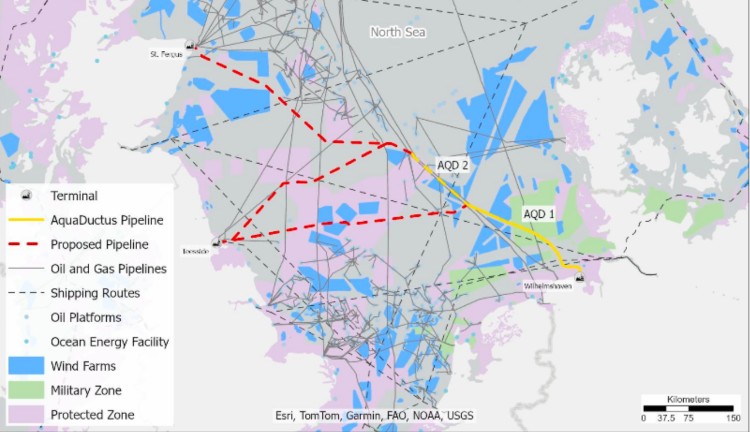
This map of the North Sea, which I downloaded from the Hydrogen Scotland web site, shows the co-operation between Hydrogen Scotland and AquaVentus
Note.
- The yellow AquaDuctus pipeline connected to the German coast near Wilhelmshaven.
- There appear to be two AquaDuctus sections ; AQD 1 and AQD 2.
- There are appear to be three proposed pipelines, which are shown in a dotted red, that connect the UK to AquaDuctus.
- The Northern proposed pipeline appears to connect to the St. Fergus gas terminal on the North-East tip of Scotland.
- The two Southern proposed pipelines appear to connect to the Easington gas terminal in East Yorkshire.
- Easington gas terminal is within easy reach of the massive gas stores, which are being converted to store hydrogen at Aldbrough and Rough.
- The blue areas are offshore wind farms.
- The blue area straddling the Southernmost proposed pipe line is the Dogger Bank wind farm, is the world’s largest offshore wind farm and could eventually total over 6 GW.
- RWE are developing 7.2 GW of wind farms between Dogger Bank and Norfolk in UK waters, which could generate hydrogen for AquaDuctus.
This cooperation seems to be getting the hydrogen Germany needs to its industry.
It should be noted, that Germany has no sizeable hydrogen stores, but the AquaVentus system gives them access to SSE’s Aldbrough and Centrica’s Rough hydrogen stores.
So will the two hydrogen stores be storing hydrogen for both the UK and Germany?
Storing hydrogen and selling it to the country with the highest need could be a nice little earner.
On X-energy
These are three paragraphs from the article.
He is also backing a £10 billion plan to build the UK’s first advanced modular reactors in a partnership with X-energy of the US.
The project is taking place in Hartlepool, in County Durham, where the existing nuclear power station is due to reach the end of its life in 2028.
As is the nature of these projects, it involves risks around technology, regulation and finance, though the potential rewards are significant. Among them is the prospect of 2,500 jobs in the town, where unemployment is high.
Note.
- This is another bold deal.
- I wrote in detail about this deal in Centrica And X-energy Agree To Deploy UK’s First Advanced Modular Reactors.
- Jobs are mentioned in the This is Money article for the second time.
I also think, if it works to replace the Hartlepool nuclear power station, then it can be used to replace other decommissioned nuclear power stations.
On Getting Your First Job
These are three paragraphs from the article.
His career got off to a slow start when he struggled to secure a training contract with an accountancy firm after leaving Glasgow University.
‘I had about 30, 40 rejection letters. I remember the stress of not having a job when everyone else did – you just feel different,’ he says.
He feels it is ‘a duty’ for bosses to try to give young people a start.
I very much agree with that. I would very much be a hypocrite, if I didn’t, as I was given good starts by two companies.
On Apprenticeships
This is a paragraph from the article.
‘We are committed to creating one new apprenticeship for every day of this decade,’ he points out, sounding genuinely proud.
I very much agree with that. My father only had a small printing business, but he was proud of the apprentices he’d trained.
On Innovation
Centrica have backed three innovative ideas.
- heata, which is a distributed data centre in your hot water tank, which uses the waste heat to give you hot water.
- HiiROC, which is an innovative way to generate affordable hydrogen efficiently.
- Highview Power, which stores energy as liquid air.
I’m surprised that backing innovations like these was not mentioned.
Conclusion
This article is very much a must read.
The Monster That Is AquaVentus Is Waking Up
I have written about AquaVentus for some time, but inh the last couple of days, ten references have been found to the project by my Google Alert.
What Is AquaVentus?
AquaVentus has a web page on the RWE web site, from where I clipped this image.
Note.
- The spine of AquaVentus is a pipeline called AquaDuctus to bring hydrogen to Germany.
- This image shows 10.3 GW of hydrogen will be generated and brought to near Wilhelmshaven in North-West Germany.
These two paragraphs introduce AquaVentus.
Hydrogen is considered the great hope of decarbonisation in all sectors that cannot be electrified, e.g. industrial manufacturing, aviation and shipping. Massive investments in the expansion of renewable energy are needed to enable carbon-neutral hydrogen production. After all, wind, solar and hydroelectric power form the basis of climate-friendly hydrogen.
In its quest for climate-friendly hydrogen production, the AquaVentus initiative has set its sights on one renewable energy generation technology: offshore wind. The initiative aims to use electricity from offshore wind farms to operate electrolysers also installed at sea on an industrial scale. Plans envisage setting up electrolysis units in the North Sea with a total capacity of 10 gigawatts, enough to produce 1 million metric tons of green hydrogen.
It is not an unambitious project.
North Sea Hydrogen Co-operation: AquaVentus And Hydrogen Scotland
The title of this section is the same as that of this page on the Hydrogen Scotland web site.
This is the introduction.
Hydrogen Scotland signed a comprehensive Memorandum of Understanding (MoU) with AquaVentus at Offshore Europe in Aberdeen. The partnership aims to unlock the North Sea’s vast potential for hydrogen production and establish Scotland as a key supplier to European markets through the development of shared infrastructure.
Both partners are committed to intensifying research activities and advocating for the rapid scale-up of a European hydrogen economy.
By joining forces, members of AquaVentus and Hydrogen Scotland can help advance the development and deployment of technologies along the entire value chain – from production through transport and storage to the use of hydrogen for decarbonising the energy system. In addition, both organisations intend to intensify their supporting activities and jointly advocate for the accelerated ramp-up of a European hydrogen economy.
This map of the North Sea, which I downloaded from the Hydrogen Scotland web site, shows the co-operation.
Note.
- The yellow AquaDuctus pipeline connected to the German coast near Wilhelmshaven.
- There appear to be two AquaDuctus sections ; AQD 1 and AQD 2.
- There are appear to be three proposed pipelines, which are shown in a dotted red, that connect the UK to AquaDuctus.
- The Northern proposed pipeline appears to connect to the St. Fergus gas terminal on the North-East tip of Scotland.
- The two Southern proposed pipelines appear to connect to the Easington gas terminal in East Yorkshire.
- Easington gas terminal is within easy reach of the massive gas stores, which are being converted to hold hydrogen at Aldbrough and Rough.
- The blue areas are offshore wind farms.
- The blue area straddling the Southernmost proposed pipe line is the Dogger Bank wind farm, is the world’s largest offshore wind farm and could evebtually total over 6 GW.
- RWE are developing 7.2 GW of wind farms between Dogger Bank and Norfolk in UK waters, which could generate hydrogen for AquaDuctus.
This cooperation seems to be getting the hydrogen Germany needs to its industry.
These five paragraphs outline a position paper by AquaVentus.
This opportunity for German-British cooperation on hydrogen is highlighted in a position paper presented by AquaVentus alongside the signing of the MoU. This paper addresses how the requirements of German-British cooperation – as outlined, for example, in the July 2025 Kensington Treaty between the UK and Germany and the European Commission’s Common Understanding published in May 2025 – can be met.
The position paper highlights the significant potential of hydrogen production in Scotland, the necessity of imports for Germany, and references transport infrastructure already under planning. It thus lays the foundation for cross-border hydrogen trade between Germany and the United Kingdom, and for deeper European cooperation in the hydrogen sector, with three essential prerequisites:
Firstly, the networking of producers and consumers across national borders is critical for a successful market ramp-up
Secondly, beyond this synchronised production and transport infrastructure, regulatory frameworks must also be harmonised. Hybrid connection concepts (pipes & wires) that integrate both electricity and hydrogen networks provide the necessary flexibility for future energy needs, enable efficient use of renewable energy and ensure cost-effective grid expansion
Thirdly, the development from a national core network to a European Hydrogen Backbone is emphasised. Projects such as AquaDuctus can serve as a nucleus for building a pan-European hydrogen network that will shape Europe’s energy infrastructure in the long term. For the authors, strengthened cooperation with the United Kingdom is not only a sound energy policy and economic decision, but also a key contribution to European energy resilience.
Note.
Scotland And AquaVentus Partner On North Sea Hydrogen Pipeline Plans
The title of this post, is the same as that of this article on H2-View.
These four paragraphs introduce the deal and add some detail.
Hydrogen Scotland has committed to working with the AquaDuctus consortium on cross-border infrastructure concepts to connect Scotland’s offshore wind power to hydrogen production in the North Sea.
Under a Memorandum of Understanding (MOU), the two organisations plan to combine Scotland’s offshore wind with AquaVentus’ offshore electrolysis expertise, linking export and import goals across the North Sea.
The AquaDuctus pipeline is a planned offshore hydrogen link designed to carry green hydrogen through the North Sea, using a pipes and wires hybrid approach. The German consortium plans 10GW of offshore electrolysers in the North Sea, producing around one million tonnes of green hydrogen.
The pipeline design allows offshore wind farms to deliver electricity when the grid needs it, or convert power into hydrogen via electrolysis and transport it through pipelines.
Germany is embracing hydrogen in a big way.
- I introduce AquaVentus in AquaVentus, which I suggest you read.
- AquaVentus is being developed by RWE.
- AquaVentus connects to a German hydrogen network called H2ercules to actually distribute the hydrogen.
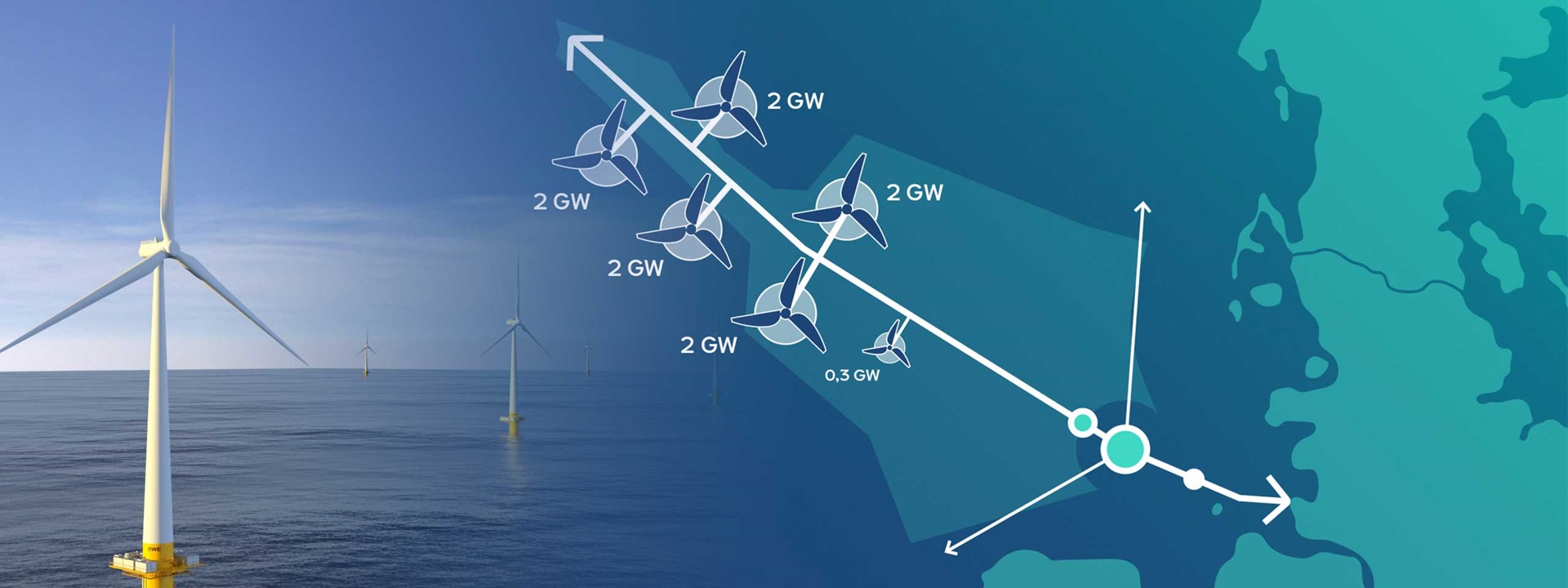
This video shows the structure of AquaVentus.
I clipped this map from the video.

Note.
- The thick white line running North-West/South-East is the spine of AquaVentus, that will deliver hydrogen to Germany.
- There is a link to Esbjerg in Denmark, that is marked DK.
- There appears to be an undeveloped link to Norway, which goes North,
- There appears to be an undeveloped link to Peterhead in Scotland, that is marked UK.
- There appears to be a link to just North of the Humber in England, that is marked UK.
- Just North of the Humber are the two massive gas storage sites of Aldbrough owned by SSE and Rough owned by Centrica.
- Aldbrough and Rough gas storage sites are being converted into two of the largest hydrogen storage sites in the world!
- There appear to be small ships sailing up and down the East Coast of the UK. Are these small coastal tankers, that are distributing the hydrogen to where it is needed?
When it is completed, AquaVentus will be a very comprehensive hydrogen network.
I believe that offshore electrolysers could be built in the area of the Hornsea 4, Dogger Bank South and other wind farms and the hydrogen generated would be taken by AquaVentus to either Germany or the UK.
- Both countries get the hydrogen they need.
- Excess hydrogen would be stored in Aldbrough and Rough.
- British Steel at Scunthorpe gets decarbonised.
- A 1.8 GW hydrogen-fired powerstation at Keadby gets the hydrogen it needs to backup the wind farms.
Germany and the UK get security in the supply of hydrogen.
Conclusion
This should be a massive deal for Germany and the UK.

