Port Talbot To Become Offshore Wind Hub For Celtic Sea
The title of this post, is the same as that of this article on the BBC.
This is the sub-heading.
Port Talbot will become the first dedicated hub for floating offshore wind in the Celtic Sea.
These four introductory paragraphs add some detail.
Associated British Ports (ABP) will begin detailed design and engineering work on new port infrastructure after securing grant funding of up to £64m from the UK government.
The project will support the assembly and deployment of floating turbines that will operate in deeper waters off the Welsh coast. ABP said the development could support thousands of jobs and attract hundreds of millions of pounds in further investment.
The UK government said the new port would help deliver clean, homegrown electricity, protect households from volatile fossil fuel markets and create up to 5,000 new jobs.
Redeveloping the port to handle the assembly of wind turbines could position Port Talbot at the centre of a fast-growing clean energy sector.
I have some thoughts.
How Much Wind Power Is Planned For The Western Approaches?
In Ocean Winds Enters Lease Agreement With Crown Estate For 1.5 GW Celtic Sea Floating Wind Project, I published this Google AI estimate of the wind power, that could be developed in the Western Approaches.
How Much Wind Power Is Planned For The Western Approaches?
I asked Google AI, the title of this section and received this answer.
The UK has a target of 50 GW of offshore wind by 2030, with significant projects planned for the Celtic Sea (part of the Western Approaches), which is a key area for 5 GW of floating wind. Total UK offshore wind pipeline capacity exceeds 93 GW, with major developments in this region focusing on floating technology.
Key details regarding wind power in the Western Approaches (specifically the Celtic Sea) include:
Celtic Sea Developments: The area is a primary focus for floating wind projects, designed to capitalize on deep-water potential, with 5 GW of floating wind expected to be deployed across the UK by 2030.
Pipeline and Capacity: The total UK pipeline for offshore wind, which includes the Western Approaches, is 93 GW, and the government is aiming for 43-50 GW of installed offshore capacity by 2030.
Project Status: The region is expected to benefit from the Crown Estate’s leasing rounds aimed at accelerating floating wind, with 15.4 GW of new projects submitted across the UK in 2024.
Wales/South West England Context: Wales has 1.4 GW of projects in the pre-application stage, with some potential for developments off the South West coast.
For more detailed information on specific projects and their development status, you can visit the RenewableUK website and RenewableUK website.
It looks like about 20 GW of offshore wind could be installed in the Western Approaches.
I would expect, a lot of work will be generated in the Port Talbot area.
A Lot Of Steel Will Be Needed
Earlier in the weeek, the UK Government backed the steel industry in Port Talbot, with a press release entitled UK Steel Industry Backed By Major New Trade Measure And Strategy.
Port Talbot Is A Comprehensive, Well-Connected Site
This Google Map shows the site.
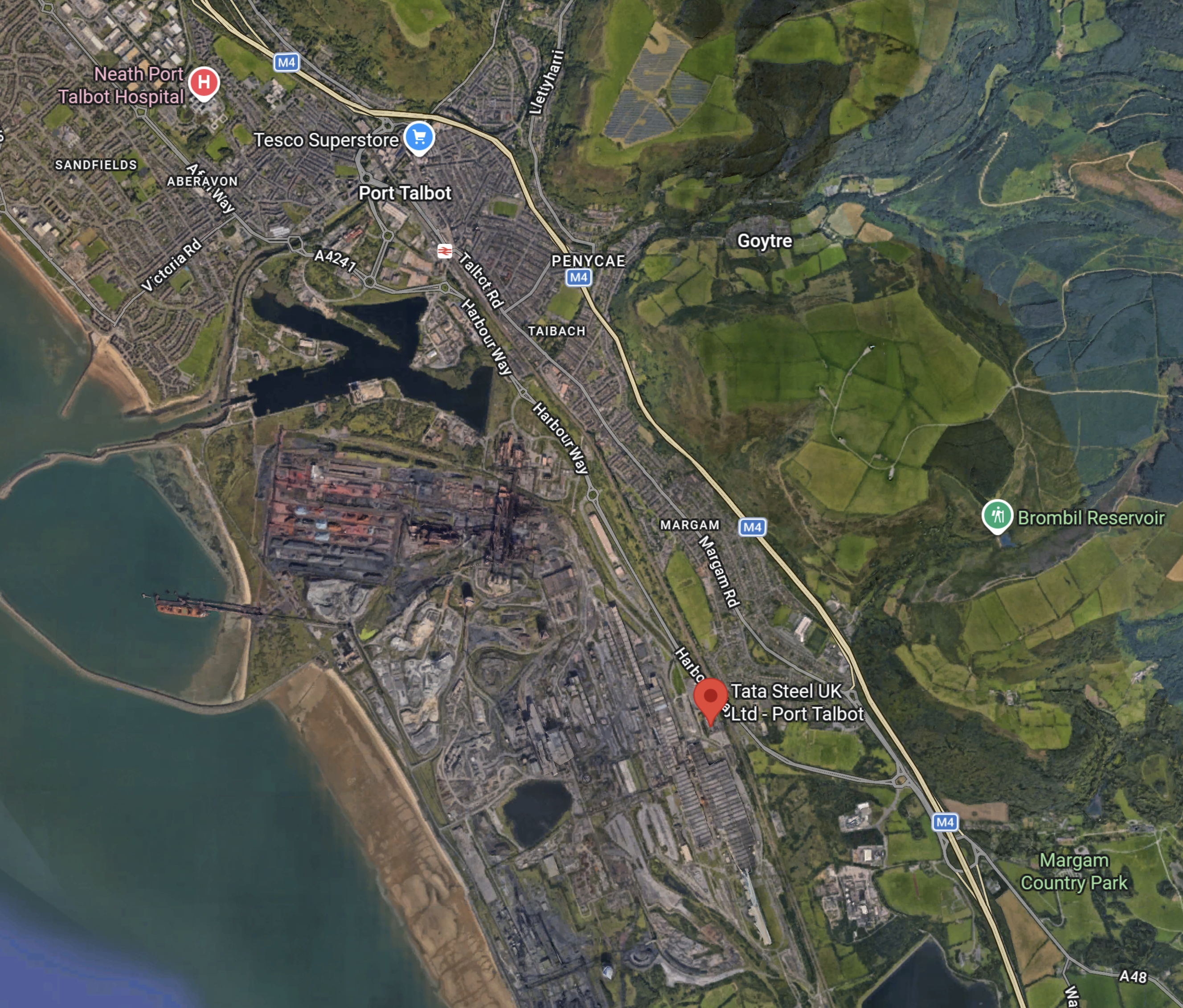
Note.
- The M4 running along the site.
- The South Wales Main Line running along the site, with Port Talbot Parkway serving the site.
- The harbour by the station.
- The Tata steelworks marked by the red arrow.
I hope the up to £64 million grant from the government is sufficient for Associated British Ports (ABP) to turn the harbour into a world-class floating wind facility and that the Treasury haven’t been too mean.
BW Ideol, ABP To Explore Serial Production Of Floating Wind Foundations At Port Talbot
I wrote a post with this name in December 2023, before the leases for the Celtic Sea windfarms had been awarded. As one has been awarded to EDf Renewables, BW Ideol seem to have made a good move.
BW Ideol have a web page, which describes their concrete floating wind foundations manufacturing line.
I hope South Wales has got enough concrete?
Shares Available In ‘UK-First’ Community-Owned Battery Energy Storage System
The title of this post is the same as that on this article on Solar Power Portal.
This is the sub-heading.
Low Carbon Hub, an Oxfordshire-based developer of community-owned renewable energy projects, is inviting investment in the 3MW/12MWh BESS.
These four paragraphs add more details.
Consumers have the opportunity to invest in the UK’s ‘first’ community-owned battery energy storage system (BESS).
Low Carbon Hub, an Oxfordshire-based developer of community-owned renewable energy projects, is inviting investment in the 3MW/12MWh BESS, which is co-located with the Ray Valley solar power plant.
At one time the largest community-owned solar development in the UK, the 19MW Ray Valley solar project came online in 2022.
Low Carbon Hub now plans to install battery energy storage at the site to “ensure more clean energy is used, and more money is generated for communities,” it said. As such, members of the public and organisations can buy shares in the Community Energy Fund through direct impact investing platform Ethex.
I think we could see more of this in the future.
UK Steel Industry Backed By Major New Trade Measure And Strategy
The title of this post, is the same as that of this press release from UK Government.
These three bullet points act as sub-headings.
-
Landmark new Steel Strategy sets ambition for up to 50% of steel used in the UK to be made in the UK, boosting production from 30%.
-
UK will introduce new trade measure to support national security by preserving vital steel production for critical national infrastructure and defence.
-
Steel import quotas will be reduced with higher tariffs of 50% outside of quotas, ensuring the UK steel sector’s future in the face of global overcapacity.
These three paragraphs add details.
On a visit to Tata Steel Port Talbot to meet steelworkers and launch the Strategy, the Business and Trade Secretary Peter Kyle announced the Government’s ambition to boost domestic production so that it can meet up to 50% of our domestic demand for steel, and secure the industry’s role in supporting vital UK sectors like infrastructure, defence and clean energy.
Building on the direct financial support the government has made so far, the National Wealth Fund will be the government’s main mechanism for providing up to £2.5 billion of financing for investment in the steel sector this Parliament. The Steel Strategy forms a vital part of the Government’s activist and strategic approach to British industry, taking decisive action to give businesses the certainty and support they need in uncertain times and bolstering the UK’s resilience.
Today, the UK also announces that from 1 July 2026, overall quota levels for steel imports will be significantly reduced by 60% compared to current arrangements, and steel coming into the UK above these levels will be subject to a 50% tariff.
Welsh Government Backs Marine Power Systems’ Floating Wind Tech With GBP 8 Million
The title of this post, is the same as that of this article on offshoreWIND.biz.
This is the sub-heading.
The Welsh government has invested GBP 8 million (approximately EUR 9.4 million) in Marine Power Systems (MPS) to support the commercialisation of its floating offshore wind technology.
These three paragraphs add more detail to the story.
According to the company, the funding will accelerate the deployment of its PelaFlex platform, a floating wind solution designed for deep-water sites where conventional fixed-bottom foundations are not viable.
Marine Power Systems said the investment will help move the technology from advanced development towards commercial-scale deployment and manufacturing. The company also plans to expand its industrial and assembly capabilities in the UK.
The PelaFlex platform has been designed to simplify fabrication, installation and long-term operations while enabling wind farms to be located further offshore where wind speeds are typically stronger and more consistent, MPS says.
The offshore wind industry in Wales seems to be gearing up for a big expansion.
Gwynt Glas is the collective name for the three 1.5 GW floating wind farms in the Western Approaches and in Gwynt Glas And South Wales Ports Combine Strength In Preparation For Multi-Billion Floating Wind Industry, I describe the initial agreement that started the Gwynt Glas project.
To my mind, Associated British Ports and the wind farm developers are making sure they can carpet the Western Approaches, with offshore wind farms.
In Ocean Winds Enters Lease Agreement With Crown Estate For 1.5 GW Celtic Sea Floating Wind Project, I talk in general about the progress of the first three 1.5 GW floating wind farms in Gwynt Glas and in particular about leasing of the third wind farm.
These two posts, indicate that the Port of Port Talbot is preparing itself to produce the floaters for floating wind turbines.
- BW Ideol, ABP To Explore Serial Production Of Floating Wind Foundations At Port Talbot
- Two Ports Advance To Next Stage Of UK Gov Funding For Floating Wind
It certainly appears, that South Wales will be able to build the heavyweight gubbins for floating offshore wind.
According to Was South Wales Once The World’s Largest Coal Exporter? it was, and in 1913, the region produced 57 million tons of coal, with more than half exported.
It does look like South Wales is going to repeat the economic success with offshore energy.
I’ve heard tales from elderly Welshmen talking of the coal ships in the docks of South Wales and will we be seeing gas tankers in the docks of South Wales?
NextEnergy Solar Fund To Shift To Energy Storage And Divest Solar in Strategic Overhaul
The title of this post is the same as that of this article on the Solar Power Portal.
This is the sub-heading.
As part of the reset, NextEnergy said it will increase its energy storage exposure up to 30% of its gross asset value, a significant increase on its current rate of 10%.
These two paragraphs give more of their reasoning.
NextEnergy Solar Fund has completed a “strategic reset” of its investment strategy which will see it focus on energy storage assets and increase project sales.
As part of the reset, NextEnergy said it will increase its energy storage exposure up to 30% of its gross asset value, a significant increase on its current rate of 10%. The company said the shift would “enhance the Company’s existing stable revenues generated by its operational solar assets and support future revenues”.
In Is Sumitomo Heavy Industries Highview Power Energy Storage System On Line At Hiroshima?, I describe a power supply system developed by Sumitomo Heavy Industries to supply a stable 5 MW to a LNG Terminal, using these components.
- A Cold Source
- Solar Panels
- A 5 MW/20 MWh Highview Power liquid-air CRYObattery.
Do Sumitomo Heavy Industries believe that a combination of energy and/or battery sources working together gives the quality of stable power, that is needed by today’s modern factories, facilities and buildings?
As a Graduate Control Engineer, I very much believe stable power supplies are a good thing and Sumitomo Heavy Industries obviously feel that Highview Power’s liquid air CRYObatteries are a good way to provide them.
The adding of a battery into a solar-powered renewable power supply, would surely, increase the amount of batteries that NextEnergy were financing.
‘Mobilising EUR 1 Trillion in Investments’ | North Sea Countries, Industry, TSOs to Ink Offshore Wind Pact
The title of this post, is the same as that of this article on offshoreWIND.biz.
This is the sub-heading.
Government officials from Belgium, Denmark, France, Germany, Ireland, Luxembourg, the Netherlands, Norway and the UK are set to sign a declaration confirming the ambition to build 300 GW of offshore wind in the North Seas by 2050, and an investment pact with the offshore wind industry and transmission system operators (TSOs) that is said to mobilise EUR 1 trillion in economic activity.
These three paragraphs add a lot of powerful detail.
Under the Offshore Wind Investment Pact for the North Seas, to be signed today (26 January) at the North Sea Summit in Hamburg, governments of the nine North Sea countries will commit to building 15 GW of offshore wind per year from 2031 to 2040.
The heads of state and energy ministers will also vow to de-risk offshore wind investments through a commitment to provide two-sided Contracts for Difference (CfDs) as the standard for offshore wind auction design. The pact also commits governments to remove any regulatory obstacles to power purchase agreements (PPAs), according to WindEurope, which will sign the pact on behalf of the industry.
On the industry’s side, the commitment is to drive down the costs of offshore wind by 30 per cent towards 2040, mobilise EUR 1 trillion of economic activity for Europe, create 91,000 additional jobs and invest EUR 9.5 billion in manufacturing, port infrastructure and vessels.
These two paragraphs say something about cost reductions.
The cost reduction of offshore wind is planned to be achieved through scale effects, lower costs of capital and further industrialisation supported by clarity and visibility on the project pipeline.
The transmission system operators (TSOs) will identify cost-effective cooperation projects in the North Sea, including 20 GW of promising cross-border projects by 2027 for deployment in the 2030s.
I hope there is a project management system, that can step into this frenzy, just as Artemis did in the 1970s with North Sea Oil and Gas.
The BBC has reported the story under a title of UK To Join Major Wind Farm Project With Nine European Countries.
this is the sub-title.
The UK is set to back a vast new fleet of offshore wind projects in the North Sea alongside nine other European countries including Norway, Germany and the Netherlands.
These six paragraphs add more detail.
The government says the deal will strengthen energy security by offering an escape from what it calls the “fossil fuel rollercoaster”.
For the first time, some of the new wind farms will be linked to multiple countries through undersea cables known as interconnectors, which supporters say should lower prices across the region.
But it could prove controversial as wind farm operators would be able to shop around between countries to sell power to the highest bidder – potentially driving up electricity prices when supply is tight.
Energy Secretary Ed Miliband will sign a declaration on Monday at a meeting on the future of the North Sea in the German city of Hamburg, committing to complete the scheme by 2050.
Jane Cooper, deputy CEO of industry body RenewableUK, said the deal would “drive down costs for billpayers” as well as increasing “the energy security of the UK and the whole of the North Sea region significantly”.
But Claire Countinho, shadow energy secretary, warned “we cannot escape the fact that the rush to build wind farms at breakneck speed is pushing up everybody’s energy bills.”
Claire Coutinho, as an outsider at present and a member of a party out of Government had to say something negative, but her negotiations when she was UK Energy Minister with her German opposite number, which I wrote about in UK And Germany Boost Offshore Renewables Ties, seem very much a precursor to today’s agreement.
The 73 Group
The 73 Group was a finance company, that I owed jointly with a guy named David Mann, who was an experienced provider of finance for cars, trucks and other vehicles and equipment.
- The company had been the idea of an accountant, I shared with David, named Graham Manning.
- David put in his expertise and I put in some of the money, I received from the sale of my share of the Artemis software.
- It operated mainly in the area around Ipswich in Suffolk.
- Many of the customers were owner/drivers, who ferried containers to and from the docks at Felixstowe, who had known David for some years.
- The company certainly gave a better return, than putting money on deposit.
- One of the things, I did was extensively model a book of loans for vehicles and this gave me an insight into the dynamics of money.
Sadly in the end, David became ill and we wound the company up.
It gave me an interesting insight into local finance and I believe, that local finance companies with good connections and the right systems and people can be profitable.
It also gave me a few good tales.
Coaches Are Good Business
A good top-of-the range coach is good business for operators, coach dealers and finance companies.
I remember spending one evening with David and a coach operator in a pub, when the operator had had a fabulous day stitching together coaches as Rail Replacement Buses for British Rail after a train derailment, between Ipswich and Colchester.
I learned a lot about operating coaches that night and it’s why I’m so keen on hydrogen-powered coaches, with their expected long range, quietness and smoothness.
Fairground Rides Are Good Business
Surprisingly, if you don’t mind being paid in fifty pence pieces on the Ipswich bypass at ten o’clock at night.
You Need A Good Collections Guy
Our’s was excellent.
ABP’s New Lowestoft Facility To Support East Anglia Two & Three O&M Ops
The title of this post, is the same as that of this article on offshoreWIND.biz.
This is the sub-heading.
UK port operator Associated British Ports (ABP) and ScottishPower Renewables have entered into a long-term agreement for supporting operations and maintenance (O&M) activities at the East Anglia Two and East Anglia Three offshore wind farms from ABP’s Lowestoft Eastern Energy Facility (LEEF).
These two initial paragraphs add a few more details.
Under the agreement, ScottishPower Renewables will utilise berths at LEEF for service operations vessels (SOVs) and crew transfer vessels (CTVs) that will serve the East Anglian offshore wind farms. The company already operates its East Anglia One O&M base in Lowestoft.
LEEF was officially opened by the UK Secretary of State for Energy Security and Net Zero in January 2025, after ABP invested GBP 35 million (almost EUR 40 million) in the port infrastructure. The facility features deep-water berths, modern utilities and future-proofed infrastructure to support shore power and alternative fuels, according to the port operator.
These are some of my thoughts
How Large Are The East Anglian Wind Farms?
There are four East Anglian Wind Farms.
- East Anglian 1 – 714 MW, which was commissioned in 2020.
- East Anglian 1 North – 800 MW, which is planned to be commissioned in 2026.
- East Anglian 2 – 963 MW, which is planned to be commission in 2029.
- East Anglian 3 -1372 MW, which is planned to be commission in 2026.
That makes a total of 3849 MW.
Where Do The Cables Come Ashore?
Google AI gives this answer to the question.
The subsea export cables for the East Anglia wind farms, including East Anglia ONE, come ashore at Bawdsey in Suffolk, where they connect to onshore cables that run underground for about 23-37 km to the Bramford converter station, near Ipswich, to join the National Grid.
I know Bawdsey well from about the late 1950s until we moved my wife and I moved our family from East Suffolk to West Suffolk in the 1990s.
These posts are two memories of Bawdsey Manor and Felixstowe Ferry on the other side of Deben, that I wrote after one of my last visits to the Deben Estuary in 2009.
It hasn’t changed much over the years.
A Smorgasbord Of Misery
This phrase of Kemi Badenoch’s in her reply to Rachel Reeve’s budget speech will do her no harm.
Cornwall Insight Forecasts Lower Household Energy Bills In January
The title of this post, is the same as that of this article on Solar Power Portal.
This is a paragraph from the article.
The Default Tariff Cap is set by the UK’s energy regulator Ofgem as the maximum rate per unit and standing charge that can be billed to customers for their energy use. Cornwall Insight’s latest forecast predicts the cap will fall to £1,733 a year for a typical dual fuel household in the first quarter of 2026.
Consider.
- I am on a dual-fuel tariff for gas and electricity.
- At present, I pay £159 per month or £1,908 per year.
If I was on the new price cap, I’d pay £144.42 per month or about 10 % less.

