Gwynt Glas Offshore Wind Project Strengthens Development And Welcomes New Partner, Sumitomo
The title of this post, is the same as that of this news item from Gwynt Glas.
These three initial paragraphs add some detail.
The Gwynt Glas offshore wind project has today announced a significant strengthening of its joint venture with Sumitomo Corporation joining as an equal partner alongside EDF power solutions UK and Ireland and ESB. Each partner now holds a 33.33% stake, while DP Energy continues to provide critical development support, leveraging its expertise in early stage project delivery and local engagement.
This strategic collaboration brings together three global leaders in renewable energy combining deep expertise in large scale development and delivery. The partnership positions Gwynt Glas to advance confidently through its next phases, reinforcing its role in delivering clean, homegrown energy for Wales and the UK while supporting energy security and economic growth.
Gwynt Glas is a proposed innovative floating offshore wind farm in the Celtic Sea. The up to 1.5 GW project continues to make strong progress and successfully submitted its Scoping Report to the Planning Inspectorate this summer.
Are Sumitomo Involved In Offshore Wind?
I asked Google AI, the question in the title of this section and received this answer.
Since making its first investment in a European offshore wind project in 2014, Sumitomo Corporation
has accumulated extensive expertise throughout the development, construction and operation phases of offshore wind projects.This marks Sumitomo Corporation’s first participation in a floating offshore wind project.
Are Sumitomo learning about floating offshore wind, by participating in a major project or are they up to something very innovative technically?
In Is Sumitomo Heavy Industries Highview Power Energy Storage System On Line At Hiroshima?, I talked about how Sumitomo’s engineers had taken Highview Power’s ideas for energy storage using liquid-air and downsized it to improve the efficiency of an LNG Terminal at Hiroshima, by adding a 4MW/20 MWh battery.
I just wonder, if some of the steel floats that will support the wind turbines, will also be used for liquid-air tanks as part of one of Highview Power’s batteries. As initially, there will be 66 turbines at Gwynt Glas, the battery could be a monster, but a very environmentally-friendly one!
Comet Ridge Lands Gladstone Gas Deal
It is obviously Highview Power’s day, as this project in Queensland, Australia gets five mentions in my Google Alert for Highview Power.
The title of this post, is the same as that of this article on Industry Queensland.
This is the sub-heading.
Mahalo gas hub developer Comet Ridge has reached a deal with Highview Power to supply the large-scale electricity project it is planning to build at the Aldoga State Development area near Gladstone.
These four paragraphs give a summary of the project.
The volume of gas targeted is 3.6 PJ/a (10 TJ/d) for a minimum of five years.
Highview’s Central Queensland Energy Storage Project is to be constructed in two phases.
Phase 1 consists of a 400MW four-hour battery energy storage system, two 200MW open-cycle gas turbines, a 370MVA synchronous condenser, and associated substations and transmission lines.
Phase 2 will be the build-out of a 200MW 12-hour liquid air energy storage system.
It looks like Highview Power’s battery is one of their larger systems and is a 200 MW/2.4 GWh version.
On Highview Power’s Projects page, this is said under a header of Australia.
Highview is developing a series of base‑load renewable energy power stations in Australia, with planning now underway for three major programmes. In Gladstone, Central Queensland, and Townsville, North Queensland, we are progressing large scale projects combining LDES and short-term battery storage. On the Darwin–Katherine network in the Northern Territory, plans are advancing for an integrated scheme incorporating solar generation, LDES and battery. Together, these initial developments will help Australia meet its target of halving carbon emissions by 2030 and achieving net zero by 2050.
Gladstone is named in this story and on Highview Power’s web site.
Could Highview Power be making a breakthrough in process engineering after Sumitomo’s success at the LNG Terminal at Hiroshima.
Mooir Vannin Offshore Wind Farm
This is a wind farm off the Isle of Man, that I missed as it is not on Wikipedia’s List of Offshore Wind Farms In The United Kingdom.
But it does have a web site, which has this handy map.
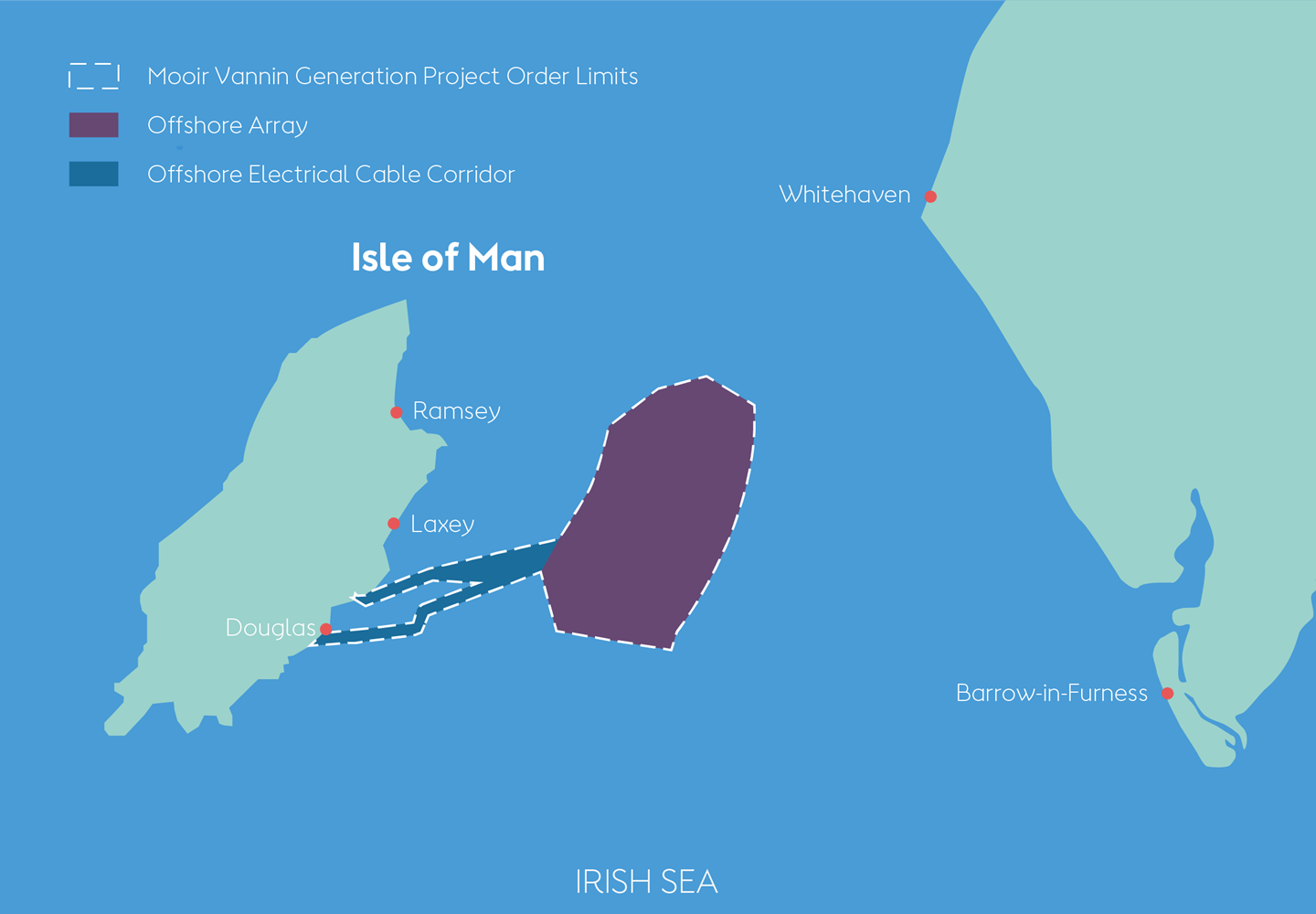
Note.
- The wind farm will have a capacity of 1.4 GW.
- Ørsted is building the web farm.
- It has planning permission.
- The operations base for the proposed Mooir Vannin Offshore Wind Farm will be located at Douglas Harbour on the Isle of Man.
- The Port is Owned By The Isle Of Man Government.
- Anticipated operational start date is the mid 2030s. I’ll assume 2035.
- According to the web site, connection will be to Douglas on the Isle of Man and Penwortham, Lancashire in the UK.
- Penwortham is part of Preston.
- Penwortham substation already has a 50 MW/50 MWh BESS and may get a bigger one.
- Current fossil-fuel power stations on the Isle of Man, include a number of diesel power stations and a 64 MW CCGT. They also have a 23 MW steam generator.
It looks like Mooir Vannin is large enough to give the island a carbon-free energy supply, backed up, by the UK National Grid at Penwortham.
I asked Google AI, “If The Isle of Man Was Going Into The Data Centre Business”, and received this reply.
The Isle of Man is actively positioning itself as a premier hub for data centres, tech firms, and AI companies. The government is utilizing its robust infrastructure, strong regulatory environment, and competitive tax policies to attract high-value data businesses to the island.
It also looks like they have a water system, that has a hydro-electric power-station.
Ørsted Is Danish
Ørsted is Danish and all of those countries to the North East of the UK have lots of islands.
So I asked Google AI, this question.”Does Denmark Have Any Islands With Power Stations?”, and received this comprehensive answer.
Yes, Denmark has several islands with power stations, ranging from natural islands utilizing large wind and biomass facilities to massive, pioneering “Energy Islands” built specifically as offshore power hubs.
Key Examples Include:
Bornholm (Baltic Sea): Designated as a major green “Energy Island” hub. It functions as a massive collection and distribution point for surrounding offshore wind farms, routing renewable energy to both the Danish grid and neighboring countries like Germany.
SamsØ (Kattegat strait): Known globally as a renewable energy island.
It is entirely powered by local onshore and offshore wind turbines and uses a mix of solar and battery storage systems to manage its energy needs, including marina charging.
North Sea Energy Island (VindØ): This is a colossal artificial island project (located roughly 80–100 km off the coast of Jutland) designed to act as an offshore power plant.
It acts as a hub to harvest and convert wind energy from hundreds of surrounding turbines.
Are Ørsted and Highview Power Still Talking?
In Highview Power, Ørsted Find Value In Integrating Offshore Wind With Liquid Air Energy Storage, it appeared that they still were.
As it appears that Highview Power’s Liquid Air Energy Storage can be sized to the application, I wouldn’t be surprised to see one of their batteries on an island powered by Danish wind turbines.
In Is Sumitomo Heavy Industries Highview Power Energy Storage System On Line At Hiroshima?, I describe how a Highview Power application, that uses cold, solar panels and a small Highview Power battery to increase the efficiency of a CNG Terminal.
How Many Of The UK’s Power Stations Are On Islands?
I asked Google AI this question and I received this answer.
There are three major, conventional thermal power stations on the UK’s offshore islands (two in Scotland and one in the Channel Islands), alongside several small-scale community-owned renewable plants that operate entirely off-grid.
The main island-based power stations include:
Lerwick Power Station (Shetland): A 66-73 MW diesel-fired plant commissioned in 1953. It provides a baseline of electricity for the Shetland mainland.
Sullom Voe Terminal Power Station (Shetland): An independent gas-fired station (roughly 92 MW capacity).
Its primary purpose is to serve the Sullom Voe gas terminal, but it also supplies the Shetland grid.
Queen’s Road Power Station (Jersey): A multi-engine facility in the Channel Islands that uses a mix of gas turbines and diesel generators to maintain island capacity.
(Note: Major UK islands, like the Isle of Wight, Anglesey, and the Isle of Skye, are physically connected to the mainland electricity grid via subsea cables, so they do not house their own large-scale, standalone power stations).
Beyond these conventional thermal stations, several smaller Scottish islands run on micro-grid, renewable-only power stations.
For instance:The Isle of Eigg: Powered entirely by a micro-grid of hydro, wind, and solar, completely disconnected from the UK grid.
It looks to me, that the Isle of Man, Shetland and Jersey, are the three most likely islands to get upgraded power systems and it also looks like Ørsted have the experience to make a good fist of it.
Conclusion
I have asked the question, I asked for the UK for a range of countries and I have received some interesting answers from Google AI. But the general trend seems to be to use appropriately-size medium-size and upwards, zero-carbon power stations with microgrids as on the Island of Eigg in the UK.
But I do believe that applying the technology that Ørsted, Highview Power and others are rolling out, that we can give the remote islands and places of Buckminster Fuller’s Spaceship Earth, the zero carbon power they need.
Oman Set For Next Frontier In Energy Storage
The title of this post is the same as that of this article on the Times of Oman.
This first paragraph introduces the story.
Oman’s solar story is already being written. Manah, Ibri II, and the next wave of solar IPPs moving through procurement have placed the Sultanate firmly among the region’s renewable leaders. The next chapter, the one every solar-rich nation is racing to author, is about the long-duration energy storage technology that powers the grid after sunset. Lithium-ion batteries handle the first few hours effectively. What comes after is the harder problem, and it is increasingly being solved by a technology called Liquid Air Energy Storage, or LAES: a technology that aligns naturally with Oman’s industrial base.
The article then describes how the technology to handle LAES technology aligns with all their expertise in handling liquified natural gas.
This paragraph outlines Oman’s expertise in cryogenic engineering.
Oman’s natural advantage in this race deserves far more attention than it has received. Cryogenic engineering, the discipline of holding substances at extraordinarily low temperatures without losing them, is the most demanding part of any LAES plant. It is also the foundation of the LNG export business that has run out of Qalhat for a quarter of a century. The workforce that liquefies natural gas at minus 162 degrees Celsius is the same workforce that can liquefy air. The insulation expertise, the compressor specifications, and the maintenance discipline are all already here, refined over decades and built locally. Few nations possess this depth of capability as a domestic resource. Oman does.
If Oman have called this one right, then any nation with plentiful renewable resources, of solar, hydro, offshore wind or geothermal, should be looking at Liquid Air Energy Storage.
This is not the first time, that Liquid Air Energy Storage has been paired with LNG.
Highview Power are the UK pioneers of Liquid Air Energy Storage and on the Projects page of their web site, there is this section on Japan.
Our investment partner Sumitomo Heavy Industries (SHI), together with Hiroshima Gas, is developing a grid‑scale LAES demonstration plant in Hatsukaichi, Hiroshima. The 5 MW, four‑hour facility will use waste cold from an adjacent LNG terminal to enhance efficiency and sustainability, showcasing the flexibility of Highview’s modular LAES technology. The plant is scheduled to be operational in 2025.
In Is Sumitomo Heavy Industries Highview Power Energy Storage System On Line At Hiroshima?, I describe how the Hiroshima plant held a completion ceremony on the 9th December, 2025.
Liquid Air Energy Storage and LNG may seem unlikely bedfellows, but when engineers share a few beers, joint projects seem to emerge.
NextEnergy Solar Fund To Shift To Energy Storage And Divest Solar in Strategic Overhaul
The title of this post is the same as that of this article on the Solar Power Portal.
This is the sub-heading.
As part of the reset, NextEnergy said it will increase its energy storage exposure up to 30% of its gross asset value, a significant increase on its current rate of 10%.
These two paragraphs give more of their reasoning.
NextEnergy Solar Fund has completed a “strategic reset” of its investment strategy which will see it focus on energy storage assets and increase project sales.
As part of the reset, NextEnergy said it will increase its energy storage exposure up to 30% of its gross asset value, a significant increase on its current rate of 10%. The company said the shift would “enhance the Company’s existing stable revenues generated by its operational solar assets and support future revenues”.
In Is Sumitomo Heavy Industries Highview Power Energy Storage System On Line At Hiroshima?, I describe a power supply system developed by Sumitomo Heavy Industries to supply a stable 5 MW to a LNG Terminal, using these components.
- A Cold Source
- Solar Panels
- A 5 MW/20 MWh Highview Power liquid-air CRYObattery.
Do Sumitomo Heavy Industries believe that a combination of energy and/or battery sources working together gives the quality of stable power, that is needed by today’s modern factories, facilities and buildings?
As a Graduate Control Engineer, I very much believe stable power supplies are a good thing and Sumitomo Heavy Industries obviously feel that Highview Power’s liquid air CRYObatteries are a good way to provide them.
The adding of a battery into a solar-powered renewable power supply, would surely, increase the amount of batteries that NextEnergy were financing.
How Much Electricity Do You Need To Charge A Garage Full Of Electric Buses?
Consider.
- A couple of years ago, I had a long discussion and a few beers with three managers of bus garages.
- In First Bus To Launch 1MW BESS Unit In Hampshire, Aberdeen To Follow, I talk about a specialist battery to charge buses.
- In Is Sumitomo Heavy Industries Highview Power Energy Storage System On line At Hiroshima?, I talk about an efficient, renewable power supply for an LNG Terminal.
I asked Google AI the question in the title of this post and received this comprehensive answer.
Charging a full garage of electric buses requires massive amounts of electricity, with typical, non-optimized charging for a 100-bus depot capable of drawing nearly 10 megawatts (MW) of power. To put this into perspective, a 100-bus depot might require roughly 150 Megawatt-hours (MWh) of energy to recharge over an eight-hour night.
Key Factors and Energy Requirements
Energy Consumption per Bus: A typical electric bus has a battery capacity between 300-500 kWh. Energy consumption averages around 1.11 to 1.35 kWh/km, with higher consumption in winter or with heavy A/C use.
Total Depot Power: For a 100-bus depot, power requirements can reach 10 MW, equivalent to the power output of a small hydroelectric dam.
Optimal Charging: Using smart charging, a 100-bus depot can reduce its peak demand to around 4 MW.
Daily Usage: A single, large electric bus can consume up to 500 kWh per day, with daily demand ranging from 189 to 231 kWh for typical operations.
Infrastructure and Grid Considerations
Charging Infrastructure: Depots often use 40 kW to 250 kW chargers, with 100 kW common for overnight charging.
Grid Capacity: A 34-bus depot might require a new 1000kVA transformer to handle the load.
Voltage: 11,000 volts may be required to power new substations, which are then stepped down to 400 volts for charging.
Operational Factors Affecting Energy Need
Heating and Cooling: Cold weather can increase energy consumption by up to 45% (due to electric heating).
Driving Style: Inefficient driving can increase energy consumption by 0.24 kWh/km above average.
Regenerative Braking: This can recover 37–40% of energy for 40-60 ft buses.
Cost Implications
Energy Bills: A 100-bus depot can incur monthly energy bills between $112,000 and $515,000 without optimization.
Cost Savings: Electric buses are generally cheaper to fuel, costing ~£0.21/mile compared to £0.49/mile for diesel.
Could A System Based On The Sumitomo/Highview Power System At Hiroshima Charge Electric Buses?
The optimal charging figure for a 100-bus garage would appear to be in the region of 4-5 MW.
In Is Sumitomo Heavy Industries Highview Power Energy Storage System On line At Hiroshima?, I state, that it looks like Highview Power’s CRYOBattery™ at the heart of the system has a capacity of 5 MW/20 MWh.
I also state in the post, that the Hiroshima facility is designed to support grid stability and enhance renewable energy integration.
Does this all mean that if you can install enough solar panels on the roof of the garage or perhaps a wind turbine nearby, that you can have buses substantially powered by the sun and wind.
Chicago would just love wind-powered buses!
Is Sumitomo Heavy Industries Highview Power Energy Storage System On Line At Hiroshima?
From some work I did at ICI in the 1970s on a PACE231R analog computer, I believe that Highview Power may have an extremely promising way of storing energy.
The Highview Power web site talks of Sumitomo Heavy Industries, who are building one of Highview’s batteries at Hiroshima in Japan.
So I asked Google AI the question in the title of this post and received this comprehensive answer.
Yes, the Sumitomo Heavy Industries (SHI) Highview Power liquid air energy storage (LAES) commercial demonstration plant in Hatsukaichi, Hiroshima, is operational, having commenced operations on December 1, 2025.
Key details about the plant:Location: Within the Hiroshima Gas Hatsukaichi LNG Terminal.Capacity: 5 MW output with 4-hour storage (4 MW charging).Technology: Uses Highview Power’s CRYOBattery™ technology, specifically utilizing waste cold from the adjacent LNG terminal to improve efficiency.Role: The facility is designed to support grid stability and enhance renewable energy integration.A completion ceremony for the project was held on December 9, 2025. This news item from Sumitomo Heavy Industries gives more details.This paragraph describes Liquid Air Energy Storage or (LAES).
- It looks like the battery has a capacity of 5 MW/20 MWh.
- As it talks about using waste cold, this looks to be a very professionally-designed specialist application.
- But surely, that would be expected from a company like Sumitomo Heavy Industries.
There are hundreds of LNG terminals globally, with significant growth driven by over 300 projects (roughly 177 import/regasification and 124 export/liquefaction) expected between 2025 and 2030. In 2023, there were 22 countries with active liquefaction (export) capacity, while Europe alone operates roughly 28 large-scale terminals, supplemented by a rapidly expanding fleet of FSRUs.Export Capacity: In 2023, global liquefaction capacity was 472 million tonnes per annum (mtpa), with top exporters being Australia, the U.S., and Qatar.Expansion: By 2027, 52 new liquefaction terminals are expected to commence operations.Import Growth: European regasification capacity is expanding, with major terminals in Spain, France, Italy, and new additions in Germany and other nations.U.S. Infrastructure: The U.S. alone has more than 170 LNG facilities performing various services.
- They are listed in this Wikipedia entry.
- There are around thirty in Japan alone.
- Will Centrica add a 5 MW /20 MWh Highview Power battery to their Grain LNG Terminal?
- Each facility installed is claimed to be designed to support grid stability and enhance renewable energy integration, so the last part must cut carbon emissions.
Yes, several major chemical engineering and industrial processes generate significant amounts of “waste cold” (low-grade thermal energy or cryogenic energy) that is often discarded. While the chemical industry conventionally focuses on recovering waste heat, recovering waste cold is becoming increasingly popular for improving energy efficiency, particularly in cryogenic processes.
- Liquefied Natural Gas (LNG) Regasification
- Cryogenic Air Separation Units (ASUs)
- Dry Ice and CO2 Liquefaction
-
Liquid Nitrogen Vaporization
-
Emerging: Cryogenic Carbon Capture
- Creation of this page was not difficult, but you have to get the tricks right.
- I used Google Chrome and Google AI.
- My blog is hosted in WordPress.
- All pages on this blog, where I have had help in their creation from Google AI are tagged as such.
I would be happy to help anybody, who wanted to use Artificial Intelligence to create blog pages.
MoU Signed To Develop Scottish Highlands As Offshore Wind And Renewables Hub
The title of this post, is the same as that of this article on offshoreWIND.biz.
This is the sub-heading.
The Inverness and Cromarty Firth Green Freeport (ICFGF) has signed a Memorandum of Understanding (MoU) with the UK and Scottish governments and The Highland Council, creating a formal framework for cooperation in developing the Highlands as a major international hub for the offshore wind and renewable energy sector
This is the first paragraph.
The agreement is said to unlock GBP 25 million (approximately EUR 29 million) in funding from the UK government, which ICFGF plans to use to support the delivery of significant infrastructure projects and its partner ports.
These are some points from the rest of the article.
- Inverness and Cromarty Firth Green Freeport aims to bring up to 11,300 jobs to the Highlands.
- Significant investments we’ve already include the Sumitomo subsea cable plant at Nigg and the Haventus energy transition facility at Ardersier.
- Over the next 25 years, ICFGF is expected to attract over GBP 6.5 billion of investment.
- The Green Freeport includes three tax sites: Cromarty Firth, which includes Port of Nigg, Port of Cromarty Firth, and Highland Deephaven.
- Ardersier Energy Transition Facility has secured a GBP 100 million joint credit facility to create nationally significant infrastructure for industrial-scale deployment of fixed and floating offshore wind.
- It has placed contracts with more than 110 local firms as part of the development.
These investments will setup the long-term future of Inverness and the Highlands of Scotland.
The Inverness and Cromarty Firth Green Freeport (ICFGF) has this web site, with these messages on the home page.
Europe’s strategic hub for renewable energy
Transforming the Highland economy and delivering national energy security
Conclusion
This area will become one of the most vibrant places in Europe.
Sumitomo Mitsui Trust Bank Makes Substantial Investment In Australia’s MCi Carbon
The title of this post, is the same as that of this article on the Carbon Herald.
This is the introductory paragraph.
MCi Carbon, an Australian clean technology platform revolutionising the carbon recycling industry, proudly announces the addition of esteemed Japanese investor, Sumitomo Mitsui Trust Bank, to its investor roster. This significant investment from the Japanese giant, with assets under management totalling $617 billion marks a pivotal moment in MCi Carbon’s journey towards global leadership in carbon capture and utilisation and underscores the growing international recognition of Australia’s role in the transition to a zero-carbon world economy.
I believe that MCi Carbon, will be a very successful company.
I first wrote about this company in March 2021 in Energy Minister Angus Taylor Launches $50 million Fund For Carbon Capture Projects.

