NHS To Buy Up Care Beds To Clear Wards
The title of this post, is the same as that of this article on the Sunday Times.
I can remember, when my late wife had her appendix out in 1967 in Barnet General Hospital, that there were two bed-blockers on the ward, where she was being treated. One had serious dementia.Has it really taken nearly sixty years to sort out this problem?
High Risk Of Coeliac Disease In Punjabis. Epidemiological Study In The South Asian And European Populations Of Leicestershire
The title of this post, is the same as that of this peer-reviewed paper on PubMed.gov.
This is the abstract of the paper.
The purpose of this study was to measure the incidence of coeliac disease in different ethnic communities and investigate the hypothesis that the incidence is decreasing in most European countries and the role incomplete retrieval of data may play. In a retrospective study of histologically confirmed cases of coeliac disease between 1975 and 1989 in the City of Leicester, 106 patients with coeliac disease were identified. Of these 86 were European and 20 Asian. The overall incidence of coeliac disease in Europeans was 2.5/10(5)/year (95% CI 2-3.2), in Gujaratis 0.9/10(5)/year (95% CI 0.4-1.8), and in Punjabis 6.9 (95% CI 3.2-12.3). These differences were independent of religious belief. The relative risk to Punjabis compared with Europeans is 2.9 (95% CI 1.5-5.3; chi 2 = 12.5, p < 0.01) and to Gujaratis 8.1 (95% CI 3-22.4; chi 2 = 25; p < 0.001). Gujaratis were at 0.4 risk of Europeans (90% CI 0.2-0.8; chi 2 = 6.7; p < 0.01). The incidence in the urban populations of Leicester was 6/10(5)/year (95% CI 1.3-1.9) which was significantly lower than the 3.2/10(5)/year (95% CI 2.7-3.8; chi 2 = 5.6; p < 0.001) in surrounding rural areas. This study shows that the incidence of coeliac disease in Punjabis (Sikhs, Hindus and Muslims) is 8 times higher than in Gujaratis (Hindus and Muslims) and 4 times higher than in Europeans in Leicester.
I find the last sentence in particular very significant.
I’m no medic, but I think it is reasonable to assume, that in a particular community for every diagnosed coeliac, there will be several undiagnosed coeliacs out there.
In this overview of coeliac disease on the NHS web site, this is said about the incidence of coeliac disease.
Coeliac disease is a condition that affects at least 1 in every 100 people in the UK.
But some experts think this may be underestimated because milder cases may go undiagnosed or be misdiagnosed as other digestive conditions, such as irritable bowel syndrome (IBS).
Reported cases of coeliac disease are around 3 times higher in women than men.
The one-in-100 figure is often used in web pages in European countries or Australia, Canada and the United States, so I’ll go along with that.
So does that mean that Punjabis living in Leicester, have a one-in-twenty-five likelihood of being coeliac?
Whether you have been diagnosed though, is a matter of pure luck.
I had been having gut problems for years and then one Autumn, I didn’t see my GP, but a very elderly locum, who as I had recently had my fiftieth birthday, gave me a present of my first blood test.
It turned out my B12 levels were very low and after several months of B12 injections, which made little difference to my B12, my GP decided to send me to a consultant at Addenbrooke’s Hospital in Cambridge.
My appointment was on a Monday morning and consultant took about ten minutes to ask a few questions, after which he said they would take a few bloods.
On the Wednesday morning, I received a letter that said, that I was probably suffering from coeliac disease and this would be confirmed by endoscopy.
Was I diagnosed solely by analysis of my blood? This was in 1997, which is after the date of the Leicester study.
Two endoscopies without sedative or anaesthetic were performed and I was confirmed as coeliac.
The first was performed by Dr. Richard Hardwick and the second by Dr. Rebecca Fitzgerald.
Both doctors feature in this story on the Cambridge University Hospitals web site, which is entitled Familial Gastric Cancer – Case Study.
My problems have been minor compared to the two sisters in the story.
My luck had been good and I recommend that everyone who feels they could be coeliac should get themselves tested.
Cases Of Covid-19 In Leicestershire
This article on the Leicester Mercury is entitled 11 Areas Of Leicestershire Have Among Worst Infection Rates in the UK.
In Coeliac Disease: Can We Avert The Impending Epidemic In India?, I started like this.
The title of this post, is the same as that of this article on the Indian Journal Of Research Medicine.
With the high levels of COVID-19 in Leicester and an Indian population who make up 28.3 % of the population of the city, I was searching the internet to see if there was any connection between those of Indian heritage and coeliac disease.
I know you should not try to prove a theory. But as a coeliac, I’m very interested to see how the millions of diagnosed coeliacs on a gluten-free diet like me, are faring in this pandemic.
I then talk about some extracts from the Indian research.
In a section entitled, which is entitled All Wheats Are Not Equal, I say this.
The other dimension to this problem is that not all wheat is alike when it comes to inducing celiac disease. The ancient or diploid wheats (e.g. Triticum monococcum) are poorly antigenic, while the modern hexaploid wheats e.g. Triticum aestivum) have highly antigenic glutens, more capable of inducing celiac disease in India, for centuries, grew diploid and later tetraploid wheat which is less antigenic, while hexaploid wheat used in making bread is recently introduced. Thus a change back to older varieties of wheat may have public health consequences.
So did all these factors come together to create the high levels of Covid-19 in Leicestershire?
Conclusion
I am getting bored with saying this. More research needs to be done!
Why A Lucky Few May Help The Rest Of Us Beat Disease
The title of this post, is the same as that of this article in The Times.
This is the sub-title.
A British biotech firm believes patients who defy odds could hold the key in their blood.
These three paragraphs introduce the article.
Patient 82 should be dead. At the age of 63 he was diagnosed with pancreatic cancer. In most cases, he would not have lasted a year. But seven years on, patient 82 is alive. Not merely alive — thriving.
He enjoys gardening. He likes seeing his grandchildren. He enjoys life.
How? The answer, a British biotech company believes, could lie in his blood. Now, with the help of dozens of other anonymous patients, all of whom have defied their cancer prognoses, they hope to find it.
Note, that the company is Alchemab Therapeutics.
The article got me thinking about myself.
I belong to a group of people, who are twenty-five percent less likely to suffer from cancer according to peer-reviewed research at Nottingham University.
I am coeliac and adhere to a strict gluten-free diet.
There may be other benefits too!
I have not had a serious dose of the covids, although I may have had a very mild case at the beginning of 2020 after I shared a train with a large number of exuberant Chinese students, who had recently arrived at Manchester Airport and were going to their new University across the Pennines.
I have also since found at least another seventy coeliacs, who have avoided serious doses of the covids.
Research From The University Of Padua
This paper on the US National Library of Medicine, which is from the University of Padua in Italy.
The University followed a group of 138 patients with coeliac disease, who had been on a gluten-free diet for at least six years, through the first wave of the Covid-19 pandemic in Padua.
This sentence, sums up the study.
In this analysis we report a real life “snapshot” of a cohort of CeD patients during the SARS-CoV-2 outbreak in Italy, all followed in one tertiary centre in a red area of Northern Italy. Our data show, in accordance with Emmi et al., the absolute absence of COVID-19 diagnosis in our population, although 18 subjects experienced flu-like symptoms with only one having undergone naso-pharyngeal swab.
It says that no test subject caught Covid-19, in an admittedly smallish number of patients.
But it reinforces my call for more research into whether if you are a diagnosed coeliac on a long-term gluten-free diet, you have an immune system, that gives you a degree of protection from the Covids.
The Times article mentions the immune system.
I believe my immune system to be strong after the reaction I had to the Astra Zeneca vaccine. I didn’t feel well to say the least after my Astra Zeneca vaccine and my GP and other doctors felt that it could be due to my immune system, thinking that the chimpanzee virus-based vaccine was a danger and attacking it.
Significantly, I had no reaction to the second dose. So had my immune system recognised the vaccine as a friend not a foe?
My son, who my late wife was sure was an undiagnosed coeliac, died of pancreatic cancer at just 37.
How did my late wife know? Don’t question her intuition and also she felt that my son and myself felt the same to her touch.
It should be noted that my son’s daughter was born with a Congenital hernia of the Diaphragm. Congenital defects can happen to people, who have a coeliac father.
At the age of 20, my granddaughter is fine now, after heroic surgery at the Royal London Hospital, at just a few days old.
Why Don’t I Feel The Cold?
It’s been cold today in London, but I didn’t really feel it.
100,000 Newborn Babies Set To Have Their DNA Fully Decoded
The title of this post, is the same as that of this article on the FT.
This sub-heading gives a few more details.
Genomics England programme aims to extend the number of treatable conditions detected to about 200.
I am coeliac and I do wish, I had been diagnosed at birth.
But more importantly, my youngest son, who would have been fifty this year, might still be here.
He was probably coeliac and worked as a sound engineer in the music business.
He lived the rock-and-roll lifestyle on a diet of ciggies, Subways and high strength cannabis.
He probably had an immune system, with all the strength of a plastic colander.
Consequently, he died at 37 of pancreatic cancer.
Never On Sunday
I am 75 and I can’t ever remember being called in for a hospital appointment on a Sunday.
But all will change next Sunday, as I have been called in to the Royal London Hospital for a US Doppler Liver/Portal System scan.
The doctors will see what they will see.
UK Space Agency And NNL Work On World’s First Space Battery Powered By British Fuel
The title of this post, is the same as that of this press release from the UK Government.
This is the sub-title.
The UK Space Agency and the National Nuclear Laboratory (NNL) are to collaborate on the world’s first space battery powered by Americium-241.
And these three paragraphs outline the project.
This work, commissioned and funded by the UK Space Agency from NNL, will be delivered in a new £19 million laboratory in Cumbria equipped with next-generation equipment and technology. It will deliver a sovereign supply of fuel for space batteries in the context of a global shortage, enabling the UK and its partners to pursue new space science and exploration missions.
Creating new highly-skilled jobs in the North West of England, it will drive innovation in radiochemistry and separations science and open a new market for the UK space sector.
Atomic space batteries, also known as Radioisotope Power Systems (RPSs), release heat as the radioactivity within them decays. The heat can be used directly to prevent spacecraft from freezing and it can be converted into electricity to power onboard systems. The batteries go on working for decades, without need for maintenance over the many years in which a spacecraft could be travelling.
These two paragraphs explain, why there is a need for a new type of atomic space batteries.
Considered ‘mission critical technologies’ by space agencies in the UK and around the world, all the Apollo missions had an atomic battery in tow, as has every rover that has gone to Mars. Until now, these have been powered by Plutonium-238, a radioisotope produced only in the US, where supply is limited, and Russia, so an alternative is urgently needed.
NNL, the UK’s national laboratory for nuclear fission, has been working on this endeavor since 2009, when its researchers first discovered that Americium-241, an alternative to Plutonium-238, is produced during the radioactive decay of used fuel from nuclear reactors and that it emits power for over 400 years.
With the supply plentiful – the new laboratory is being opened at NNL’s flagship Central Laboratory on the Sellafield site, home to the largest resource of Americium-241 available for extraction in the world – the new collaboration will turn a proven scientific concept into a fully-realised technology. It will be operational within the next four years and is expected to be first used on the European Space Agency’s Argonaut mission to the Moon and for future missions into deep space.
It would appear that Americium-241 has several advantages over Plutonium-238.
- Plutonium-238 has supply problems
- Who in their right mind, would buy a product like this from Russia or China?
- The batteries have a life of 400 years.
- There is plenty of suitable nuclear waste at Sellafield, from which Americium-241 can be extracted.
It looks like the first batteries could also be available in four years.
Aunt Margery
My late wife; C’s Aunt Margery was a lady, who needed a pacemaker. I seem to remember that after several of her pacemakers had run out of power and were replaced, and eventually she was fitted with a nuclear-powered pacemaker in the 1970s or 1980s.
This page on the Stanford University web site is entitled The History Of Nuclear Powered Pacemakers. It was written by Matthew DeGraw.
Many of these pacemakers in the 1960s and 1970s, were powered by Plutonium-238.
The last paragraph is entitled The Rise Of Lithium Battery Pacemakers And Fall Of Nuclear Pacemakers, where this is said.
Despite the often longer life-expectancies, nuclear pacemakers quickly became a part of the past when lithium batteries were developed. Not only did the technology improve, allowing for lighter, smaller, and programmable pacemakers, but doctors began to realize that this excessive longevity of nuclear pacemakers was excessive. Lithium pacemakers often last 10-15 years allowing for doctors to check in on their patients and replace either the batteries or the pacemakers themselves with new and improved technology as it is develops in those 10-15 year spans. While there are still several remaining patients with nuclear-powered pacemakers functioning in their bodies, it is likely that in the next few decades as these patients pass away, so will the once promising nuclear pacemakers.
Would the use of Americium-241 to power a nuclear pacemaker transform the economics of these devices?
I wonder, if there’s a cardiologist out there, who by chance reads this blog, who could answer my question!
Funding Available For Rail Construction Innovation Projects
The title of this post, is the same as that of this article on Railway Gazette.
These are the two introductory paragraphs.
Innovators from across the UK are being invited to submit proposals for the Innovation in Railway Construction Competition, which is making £7·44m available for ideas which could be tested at the Global Centre of Rail Excellence in South Wales.
The competition is being run by Innovate UK with GCRE and the Department for Business, Energy & Industrial Strategy.
£7.44m doesn’t seem much, but it is only for feasibility studies, as the article explains.
Entries for the first phase close at 12.00 on December 14, with funding available for feasibility studies of up to £25 000. This would be followed by an invite-only phase two, with successful first phase projects able to develop and demonstrate their innovations.
As Innovate UK keeps coming up with these competitions, they must be judged to be worthwhile.
Do they use the same technique in areas like Health and the NHS? If not, why not!
I Can Now See Why A Big Pharma Company Liked My Software Daisy
Yesterday, I went to a seminar about medical research.
There was a presentation, where data in several dimensions was shown and the data was crying out for a Daisy Chart.
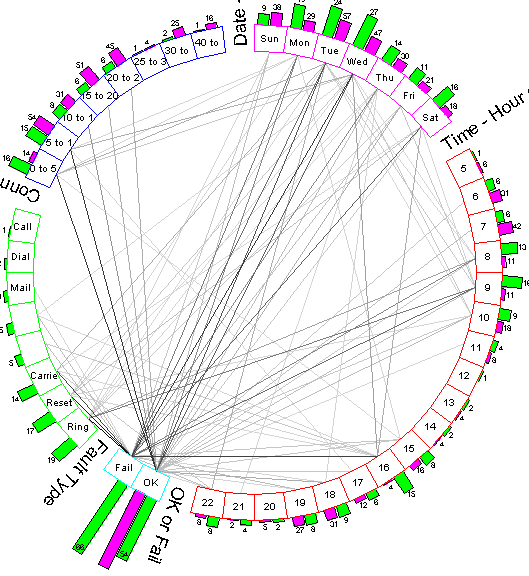
A Daisy Chart
This chart is a very simple presentation of telephone data, but I can imagine arcs showing factors like Dose, Blood Pressure, Sex, Patient Satisfaction etc.
Note.
- This chart is what I call a Day of the Week/Hour of the Day chart, which is a powerful way of looking at any time-based data, like faults or A & E arrivals.
- You can click on the nodes and links of the chart to access the data underneath. So if you wanted all female patients with high blood pressure in a separate Excel spreadsheet, this is possible with a couple of clicks.
- The charts can also be clipped from the screen and inserted into reports.
Daisy was used by one Big Pharma company twenty years ago and after yesterday’s presentation, I can understand, why they used it.
The seminar changed my mind about my attitude to Daisy and I got rather fired up about its possibilities.
China Covid: Chinese TV Censors Shots Of Maskless World Cup Fans
The title of this post, is the same as that of this article on the BBC.
These two paragraphs outline China’s censorship of the World Cup.
The phrase “football is nothing without fans” has become so accepted as to be cliché among some commentators. But Chinese state TV has been testing that assumption to its limit throughout the World Cup.
On Monday, as Ghana beat South Korea in a classic World Cup clash, subtle changes to China’s coverage of the match ensured viewers were not exposed to images of maskless supporters – and to a world moving on from Covid restrictions.
Autocratic regimes who act like China and Russia are doing now, have always come to a sticky and violent end.
When will these idiots ever learn?

