A Land Rover Defender Ambulance
This ambulance was parked outside the Red Cross in Moorfields, whilst I ate my breakfast in the LEON opposite.




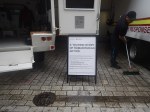
Note.
- It was from the Lincolnshire Red Cross.
- It was a very professional conversion.
- Judging by the sign it appeared to be promoting the link between Jaguar Land Rover and the Red Cross.
As an occasional user of an ambulance, I have some views on the design of these vehicles.
Should Ambulances Be Hydrogen Powered?
I asked Google AI this question and received this answer.
Hydrogen power offers significant advantages for ambulances by combining long driving ranges with rapid refuelling times, making it a strong contender for emergency fleets.
The Case For Hydrogen Ambulances
Fast Refuelling: Hydrogen tanks can be refuelled in about five minutes, keeping vehicles ready for back-to-back emergency shifts without long charging downtimes.
Longer Range: Fuel cell and battery hybrid setups (like the ZERRO project) can travel up to 300 miles, which is vital for rural areas or long-distance hospital transfers.
Onboard Power: Hydrogen fuel cells can power heavy medical equipment without draining the main drive battery or requiring extra diesel generators.
The Challenges
Infrastructure Costs: Public hydrogen refuelling stations remain scarce, limiting where vehicles can operate and refuel.
Vehicle Costs: Building and buying hydrogen fuel cell systems is currently more expensive than standard battery-electric or diesel setups.
Electric Competitiveness: Standard battery-electric ambulances are already performing well in urban areas where depots allow for overnight recharging and shorter daily shifts.
Note.
- I have been a passenger in about four or five hydrogen fuel cell-powered buses. All were mouse-quiet with no vibration. This is surely important in an ambulance!
- I used to live next to a London paramedic sixty years ago and he said it was a stressful job. Would a calm environment help to relieve that stress?
- The onboard power capability is surely important and will get more important in the future.
- As more hydrogen-powered vehicles appear on the roads, hydrogen fuelling stations will be less scarce.
The long-range of a hydrogen-powered ambulance might mean that patients were taken to an appropriate hospital immediately.
How Does The Performance Of Electric-Powered And Hydrogen-Powered Ambulances Compare?
I asked Google AI this question and received this answer.
Electric-powered and hydrogen-powered ambulances compare across range, refueling time, energy efficiency, and onboard power capabilities:
Range and Operational Capacity
Electric Ambulances (BEV): Typically offer a range of around 70 to 120 miles on a single charge, which suits local response cars, patient transport, or shorter urban shifts.
Hydrogen-Electric Fuel Cell Ambulances (FCEV): Use hydrogen fuel cells as a range extender to charge onboard batteries, providing a significantly higher extended range of up to 300 miles, which is closer to traditional diesel vehicles for demanding shifts.
Refueling and Downtime
Electric Ambulances: Require time plugged into charging infrastructure to replenish batteries, which can take anywhere from tens of minutes on rapid chargers to hours depending on power limits, creating potential downtime during fleet rotations.
Hydrogen Ambulances: Can be refueled with compressed hydrogen in roughly 5 minutes, allowing for immediate back-to-back operational shifts without prolonged downtime.
Energy Efficiency and Onboard Power
Electric Ambulances: Feature high overall powertrain efficiency (converting over 85% of battery energy into motion) and lower moving-part maintenance costs, but heavy medical equipment loads draw heavily on the primary battery and can restrict operational range.
Hydrogen Ambulances: Offer onboard power off-take capabilities directly from the fuel cell system, enabling high-draw medical equipment to run continuously without draining the main drive energy or requiring a separate noisy generator. However, hydrogen systems have lower overall well-to-wheel thermodynamic efficiency and higher complexity.
Infrastructure and Deployment
Electric Ambulances: Benefit from a rapidly expanding public and depot charging grid, with several NHS trusts already successfully deploying electric response and transport vehicles.
Hydrogen Ambulances: Remain in early trial and prototype phases (such as projects via ULEMCo and HVS) because specialized hydrogen refueling stations are scarce and expensive to build.
I suspect that the nature of the terrain in an area, will also affect the type of power selected.
My Sister’s Burst Aorta
This is a personal observation.
- My sister lives near Colchester General Hospital.
- After her aorta burst, she dialled 999 and an ambulance was dispatched.
- The paramedics corrected assessed her problem and didn’t muck around.
- They decided to take her immediately to Papworth Hospital on the other side of East Anglia.
- The road between the two hospitals is dual-carriageway all the way and possibly with a Police escort, they made the trip in time.
- After several months in hospital, she returned home.
- My sister has now fully recovered.
I believe journeys like this, would be faster and more comfortable in a custom-designed high-performance hydrogen fuel-cell ambulance.
It should be noted that the East Anglian Ambulance Service has been known to station ambulances on the bridges over the dual-carriageways to shorten response times to road accidents.
Are Toyota HiLux Pickups Used As Ambulances?
I asked Google AI this question and received this answer.
Yes, Toyota Hilux pickups are used as ambulances, especially in remote, rural, or off-road environments where standard van-based ambulances cannot travel.
Common Configurations
Canopy / Rapid Response Style: The pickup bed is fitted with a secure, weatherproof canopy or Truckman top to carry a single stretcher and essential emergency gear.
Box-Type Modular Body: A fully enclosed, purpose-built medical compartment is mounted directly onto the Hilux chassis, offering a climate-controlled environment and space for advanced life support (ALS) equipment.
Where They Are Used
Off-Road & Disaster Zones: Mountain rescue teams, humanitarian groups, and military field operations rely on the Hilux’s 4×4 capability and high ground clearance.
Specialized Services: Organizations like wildlife hospitals use adapted Hilux trucks as animal ambulances to reach stranded or injured wildlife in rough terrain. International agencies like the UN and WHO also deploy them in regions lacking paved infrastructure.
I would expect that in designing the next generation Toyota HiLux, Toyota have improved on the design for ambulances.
Will A Hydrogen-Powered toyota HiLux Pickup Make A Useful Ambulance?
I asked Google AI this question and received this answer.
A hydrogen-powered Toyota HiLux pickup can make a useful off-road or specialized utility ambulance, but its practical application as a standard emergency vehicle faces major limits.
Advantages for Ambulance Use
Off-road access: The rugged ladder-frame chassis of the HiLux allows access to remote, rugged, or off-road terrain where standard vans or traditional ambulances cannot go.
Quick refueling: Hydrogen fuel cells refuel in about 3 to 5 minutes, offering much faster turnaround times than battery-electric vehicles.
Clean operation: The fuel cell produces zero tailpipe emissions, creating a quiet, exhaust-free environment suitable for patient transport.
Good payload and towing: It targets a towing capacity of around 5,500 pounds (2,500 kg), handling heavy medical gear better than lighter electric alternatives.
Limitations for Ambulance Use
Cabin space: A pickup truck bed and cab offer less enclosed, climate-controlled volume for patients and attending medical staff compared to standard box ambulances or large vans (like the Toyota Hiace).
Infrastructure gaps: Hydrogen fueling stations remain very rare outside select urban or regional pockets, restricting emergency range and operational zones.
Availability: Toyota is targeting production for the hydrogen HiLux by 2028, meaning the vehicle is not yet available for immediate fleet purchase.
I do think though, that it would be very suitable for some specialist operations.
How I Was Imprisoned In A Pizza Restaurant And Driven Home By The Metropolitan Police
At lunchtime today, I received a phone call, saying that my GP’s surgery could see me at 16:30 this afternoon, to discuss my lack of sleep, arthritis and various strains and pains.
My middle son; Henry had expressed a desire to be at such an appointment, so I said, that if he could chauffeur me to the GP, he could come along.
His diary co-operated and he duly arrived outside my house at 16:00.By the time of the GP’s appointment, we had parked conveniently outside the surgery and we had been ushered into the GP’s consulting room.
We had a good meeting and by just after five, we had broken up and agreed a comprehensive plan for the diagnosis of my problems.
Henry had three problems of his own.
- He had legal work to do for the morning.
- He needed to do some bits of shopping.
- He also said, that he was feeling rather hungry.
- I too was hungry and needed to do some shopping.
So I suggested we drive to Southgate Road and see if we could get a pizza in Sweet Thursday.
- They do gluten-free pizzas, so I would have no dietary worries.
- In previous meals, I have found the quality excellent.
- There are shops nearby, where we could shop, if we needed.
As I approached the restaurant, I decided we had made the right decision, as there was a parking space about twenty metres from the restaurant.
We both had similar meals.
- Ham and mushroom pizzas, although mine was gluten-free.
- I drunk a zero-alcohol Lucky Saint, whilst Henry had a Diet-Coke.
- We both finished off, with two scoops of appropriate ice cream.
It was only, when we had paid and tried to leave that we got a very big surprise.
Parked in front of the restaurant with its disabled ramp extended, like some beached airliner was a 141 bus, that was empty of passengers.
- There was broken glass at the front of the bus.
- Was this evidence, that the bus had hit something or somebody?
- The police had strung white tape everywhere.
- There were half-a-dozen police cars and ambulances blocking Southgate Road.
Henry’s car wouldn’t be going anywhere for some time, as it was blocked in by two ambulances and a police car with flashing blue lights.
- So, Henry and I each had a coffee, to pass the time.
- We also made friends with others trapped in the restaurant.
- Henry also obtained information from the police, that no-one would be moving, until it was known that no-one would be moving until the full state of the injuries of the person hit by the bus was known.
So Henry and I just sat there with several others on the hard chairs in front of the restaurant.
In the end, for me, it was over very quickly.
- I live about a kilometre North of the incident.
- Some were walking from the incident to the Balls Pond Road to get a bus.
- I am fairly sure, Henry had told the police, that it was far too far for me to walk with my arthritic hip.
I was put in the back of a police car and ferried home, at about 21:45.
Thanks to the Metropolitan Police.
I have some further thoughts.
Do I Drink Enough?
Since lunchtime, I have drunk the following.
- 4 x 330 ml – Adnams Ghost Ship 0.5 % Beer
- 1 x 330 ml – Lucky Saint 0.5 % Beer
- 300 ml – Assorted water and juices.
- 1 cup – coffee.
Is that enough?
I certainly slept better last night!
Articles From The Engineer
I generally read articles from The Engineer once a week.
Here’s a few that are worth reading.
12th Feburuary 2023 – Hydrogen Ambulance Set For London
A project led by hydrogen fuel specialists ULEMCo is aiming to deliver the UK’s first zero emission hydrogen ambulance later this year
There is an interesting discussion, as to whether hydrogen or battery ambulances are better. Range and hotel power issues seem to favour hydrogen.
11th May 2023 – Bramble Energy Secures £12m For Hydrogen Bus
Bramble Energy has joined forces with Equipmake, Aeristech and Bath University to develop a new hydrogen double-deck bus integrating its printed circuit board fuel cell (PCBFC) technology
Bramble Energy can create bespoke fuel cell stacks in a ‘matter of days at scale and low-cost’.
12th May 2023 – Cornish Geothermal Project Leads Government Heat Scheme
The UK’s first deep geothermal heat network is one of seven new projects to receive funding as part of a new government programme to decarbonise buildings across England.
The full list of projects to receive support today via the Green Heat Networks Fund is detailed.
17th May 2023 – Ricardo Joins Pan-European Hydrogen Shipping Consortium
UK engineering firm Ricardo is set to play a key role in the sustainable HYdrogen powered Shipping (sHYpS) project being funded by the EU’s Horizon Europe programme.
One thing that is disclosed in the article, is that Ricardo have a new 400kW hydrogen fuel cell test chamber at the company’s UK headquarters.
Should Hospitals Be The Power Backup Locations?
I was reading an article in The Times about how protestors were blocking roads in Central London and they’re inadvertently stopped an ambulance.
So this question occurred to me. Why I don’t know, but my mind has always jumped about and put thoughts together?
Consider.
- The latest generation of energy storage that could be used to back up the grid are coming down in physical size.
- Hospitals have complex power systems, as they use a lot of electricity.
- Hospitals need emergency power backup.
- Because of their high electrical use, hospitals will have a high capacity connection to the National Grid.
- Some modern treatments need a lot of electricity.
- Will ambulances be battery-powered and will need to be charged up, whilst delivering patients?
- Many bus routes terminate at the local hospital, so if the buses are battery-powered, these could be charged as well.
As an Electrical and Control Engineer, I feel that to put a town, city or are’s back-up battery at the hospital would be a sensible idea.
Hospitals should be designed to be health, energy and transport hubs for their communities.
Hydrogen-Powered Ambulance Drives Into Glasgow Ahead Of London Trial
The title of this post, is the same as that of this article on New Atlas.
This is the first paragraph.
Back in February, ULEMCo and industry partners announced plans to design an electric rapid response ambulance for the UK’s NHS Trust that would run on batteries and hydrogen fuel cells. Now, the working prototype has driven into Glasgow to give global leaders attending the UN’s COP26 climate summit a closer look at the technology.
Surely, this is a good application of hydrogen power.
Could they be used in the scenario I proposed in Big London Hospital Was Close To Running Out Of Oxygen?
Hospitals would have an electrolyser, which would produce the following.
- High grade oxygen for the hospital.
- Hydrogen to power the vehicles and especially the ambulances.
Note.
- There would be no oxygen delivery problems.
- The excess hydrogen could be stored to use as an emergency power supply.
- Would it improve the air quality by the hospital?
I have checked with the world’s premier electrolyser company; ITM Power of Sheffield and my idea is feasible.

