Likelihood Of Dying From A Positive Test For The Covids
Bob, one of my mentors on making sense of data always suggested looking at ratios, when you wanted to investigate a database.
These ratios are the chance of dying after a positive test for Covid-19 in various places in the UK, based on Government statistics.
At the moment, the ratios are mainly from England, but I may expand them with time.
Countries
- England – 2.8 %
- Northern Ireland – 1.7 %
- Scotland – 3.3 %
- Wales – 2.3 %
Regions
- London – 2.0 %
London Boroughs
- Barking and Dagenham – 1.9 %
- Barnet 2.4 %
- Bexley – 2,0 %
- Brent – 3.0 %
- Bromley – 2.0 %
- Camden – 1.7 %
- Croydon – 2.8 %
- Ealing – 2.1 %
- Enfield – 10.1 %
- Greenwich – 1.8 %
- Hackney – 1.7 %
- Hammersmith and Fulham – 1.8 %
- Haringey – 1.8 %
- Harrow – 2.9 %
- Havering – 2.8 %
- Hillingdon – 2.1 %
- Hounslow – 2.1 %
- Islington – 1.5 %
- Kensington and Chelsea – 2.1 %
- Kingston upon Thames – 2.2 %
- Lewisham – 2.3 %
- Merton – 2.5 %
- Newham – 1.7 %
- Redbridge – 2.1 %
- Richmond upon Thames – 2.3 %
- Southwark – 1.4 %
- Sutton – 2.2 %
- Tower Hamlets – 1.1 %
- Waltham Forest – 1.9 %
- Wandsworth – 1.9 %
- Westminster – 2.0 %
Big Cities
- Belfast – 1.9 %
- Birmingham 2.8 %
- Bradford – 2.3 %
- Bristol – 1.3 %
- Cardiff – 2.5 %
- Coventry – 2.3 %
- Derby – 3.3 %
- Edinburgh – 3.4 %
- Glasgow – 3.0 %
- Hull – 3.1 %
- Leeds – 2.1 %
- Leicester – 1.9 %
- Liverpool – 2.6 %
- Manchester – 1.9 %
- Newcastle – 1.8 %
- Nottingham – 1.9 %
- Sheffield 2.6 %
Medium-Sized Towns and Cities
- Blackpool – 4.6 %
- Bolton – 3.0 %
- Bournemouth, Christchurch and Poole – 2.4 %
- Brighton and Hove – 1.9 %
- Luton – 2.6 %
- Middlesbrough – 2.8 %
- Milton Keynes – 2.0 %
- Peterborough – 2.2 %
- Plymouth – 2.2 %
- Portsmouth – 1.8 %
- Reading – 3.0 %
- Rotherham – 4.0 %
- Salford – 2.9 %
- Southampton 2.1 %
- Southend-on-Sea – 3.0 %
- Stoke-on-Trent 3.5 %
- Stockport – 3.2 %
- Sunderland – 3.8 %
- Wakefield – 3.1 %
- Warrington – 2.8 %
- Wigan – 3.8 %
- Wolverhampton – 2.9 %
- York 2.0 %
English Countryside
- Bath and North East Somerset – 1.6 %
- Bedford – 3.7 %
- Buckinghamshire – 2.3 %
- Cambridgeshire – 2.6 %
- Central Bedfordshire – 3.7 %
- Cheshire – 4.0 %
- County Durham – 3.5 %
- Cumbria – 4.1 %
- Derbyshire – 3.6 %
- Devon – 3.0 %
- Dorset – 3.4 %
- East Riding of Yorkshire – 4.0 %
- Essex – 2.7 %
- Gloucestershire – 4.6 %
- Hampshire – 3.3 %
- Herefordshire – 7.8 %
- Hertfordshire – 8.3 %
- Isle of Wight – 3.4 %
- Kent – 2.9 %
- Lancashire – 3.1 %
- Leicestershire – 2.9 %
- Lincolnshire – 3.9 %
- Medway – 2.6 %
- Norfolk – 3.2 %
- North Yorkshire – 3.1 %
- Northamptonshire – 3.7 %
- Northumberland – 3.6 %
- Nottinghamshire – 3.0 %
- Oxfordshire – 2.0 %
- Redcar and Cleveland – 3.2 %
- Rutland – 3.3 %
- Shropshire – 4.0 %
- Staffordshire – 4.0 %
- Sussex – 3.0 %
- Suffolk – 4.9 %
- Surrey – 2.8 %
- Torbay – 4.0 %
- Warwickshire – 3.6 %
- Windsor and Maidenhead – 2.6 %
- Worcestershire – 4.0 %
Miscellaneous
- Cornwall and Isles of Scilly – 2.8 %
- Highland – 2.7 %
- Isle of Wight – 3.4 %
- Orkney Islands – 5.1 %
- Scottish Borders – 3.8 %
- Shetland Islands – 4.7 %
Note that all values are rounded to one decimal place.
Conclusions
Can I draw any conclusions from the data.
The Four Countries
The mean for the whole of the UK, is 2.8 %, which is the same as England.
- Given that England is the largest country, this is not surprising.
- But why is Scotland at 3.3 % higher than England and Northern Ireland and Wales substantially better than England?
Is this a result of devolution? Or a result of national character?
Town Or Country
Looking at English cities and larger towns, their values seem to be lower than the countryside.
I wonder why this is?
To be continued…
A Thought On Covid-19
I am a Control Engineer, Mathematical Modeller and Statistician and have been following the data since the pandemic started.
Consider.
- Systems like the pandemic want to get to an equilibrium. And preferably one where they are in control. The virus tries to infect more people, so they can pass it on.
- But anybody, who is immune to the virus acts as a moderator does in a nuclear reactor, to slow the reaction down. So the more, who are immune in the population the better.
- As of today, 2,713,563 have tested positive for the virus and sadly 75,431 have died. That means at least 2.6 million have had the virus and survived. Are these people now immune to the virus? If they are, can they be added to those who are vaccinated?
- Also, how many people have had the virus and were not tested, but treated it like they might a cold? Are these safe from the virus, a second time around?
- What about children, who seem to have lower susceptibility to the virus?
- We can add in by the end of this week over a million, who have received the vaccine.
- We are at the present time having about 350,000 positive tests in a week. If these people with positive tests isolate as they should, that will be breaking the transmission of a lot of carriers.
- And then if the vaccine makers deliver two million a week and they are all used, that takes a lot of people out of the mix.
- How many people are shielding or working from home and never giving the virus a chance to infect them? It must be a couple of million.
These are all big numbers, but most of them are on our side and not that of the virus.
I watched BBC News at six and Emma Vardy said that in Northern Ireland, the vaccine might be having a positive effect. I wouldn’t have expected that this early!
I am more optimistic, than I was before I started to write this post.
Could the combination of lockdown and increasing numbers of vaccinations cut the rate of transmission of the virus?
An Encore From The Team That Developed The Covid-19 Vaccine
This article on the Guardian is entitled Team Behind Oxford Covid Jab Start Final Stage Of Malaria Vaccine Trials.
This is the first two paragraphs.
The Oxford team that has produced a successful coronavirus vaccine is about to enter the final stage of human trials in its quest for an inoculation against malaria.
The Jenner Institute director, Prof Adrian Hill, said the malaria vaccine would be tested on 4,800 children in Africa next year after early trials yielded promising results.
This is obviously good news for those, who live in areas affected by malaria, where in Africa a child under five dies every two minutes.
But surely, if the Jenner Institute can crack malaria, they should have the expertise to modify the current Cobid-19 vaccine to handle any new variants.
Conclusion
In my view, this is doubly good news!
Activists Cheer As ‘Sexist’ Tampon Tax Is Scrapped
The title of this post, is the same as that of this article on the BBC.
This is the first two paragraphs.
The 5% rate of VAT on sanitary products – referred to as the “tampon tax” – will be abolished in the UK from 1 January.
EU law required members to tax tampons and sanitary towels at 5%, treating period products as non-essential.
My late wife; C had very strong views about this and I suspect that my late mother and my granddaughter would share C’s views.
Is this a glimpse of the future, where when we feel European Union policy is wrong, we can diverge?
It would certainly be a good test of unfair policy by the UK government, if the EU objected and tried to stop us removing the tax.
At least smugglers, who decided to switch from smuggling drugs and other nasties to sanitary products would be doing something that caused less harm!
Students Design ‘Mitt’ Prosthetic Limb For Children
The title of this post, is the same as this article on the BBC.
This was the good news story of the day, which started with these two paragraphs.
Even the most up-to-date prosthetic limbs can often be too heavy, or hard for young children to use with ease.
But now, a group of Imperial College engineering students has created a new, lighter one.
There is a video in the BBC article, which shows how it works.
- It looks like it doesn’t have any power, so there are no heavy batteries.
- Tools are attached by a powerful magnet.
- As the name suggests, it is worn like a glove.
- Judging by the look on the little girl’s face, as she used it to do simple tasks, it has found a satisfied customer!
What puzzles me, is that it is such a simple idea, that it hasn’t been thought off before.
Could The Mitt Have Other Applications?
I have a feeling it could.
I recently cut the back of my hand badly.
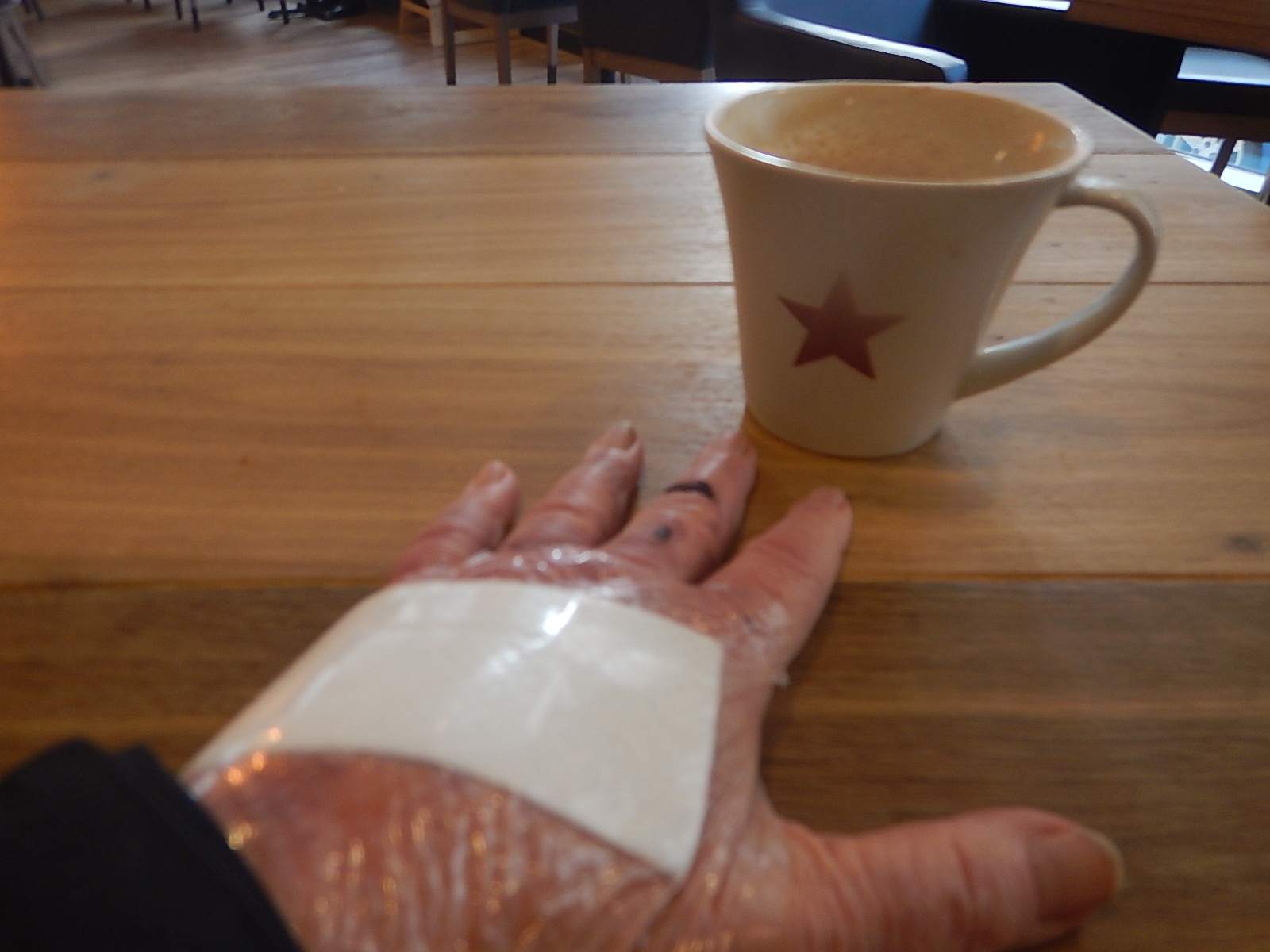
The picture shows it soon afterwards.
I don’t work or do many dirty tasks around the house, but could the students use their design principles for someone, who has perhaps damaged their hand and needs some protection.
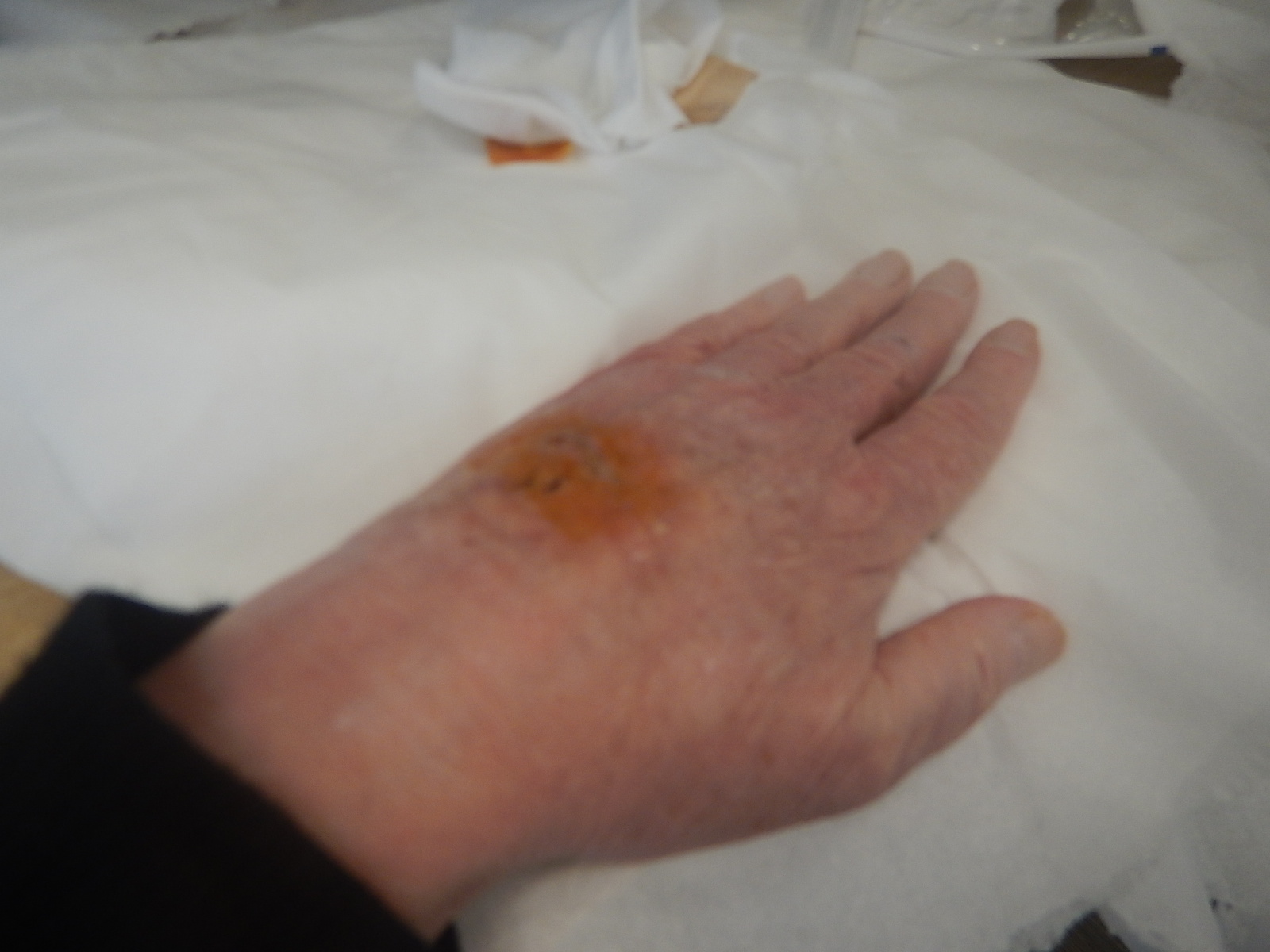
This second picture shows how well it healed in the end.
I think the principle behind the Mitt has legs.
Nearly 1,000 Covid-19 Vaccine Doses Meant For Town’s Most Clinically Vulnerable Had To Be Thrown Away
The title of this post, is the same as that of this article on the Manchester Evening News.
It appears it was because of a refrigeration problem.
With the need to distribute this vaccine at -70°C, it was only a matter of time before something like this happened.
How Cambridge University Test Students For The Covids
In Tom Whipple’s excellent article in The Times today, which is entitled In Search Of A Less Painful Route Through The Long Covid Winter, there is this paragraph.
They also point to a different, smaller-scale, test. In the summer, Cambridge University decided to go its own way on testing. Each “bubble” of students put their swabs to be tested together. If they contained a positive — validated through a far more effective laboratory test — they were each retested. At the start of the autumn term, the university experienced the usual run of cases. In the final week, when other universities were seeing mass outbreaks, all 10,000 students were tested. There were zero positives.
Could this simple method, speed up mass testing of residential areas, care homes and other universities?
Is The Pfizer Vaccine The New Betamax?
To me, the Pfizer vaccine may work well, but the precautions needed to deliver it safely are so onerous, I can’t see it being the most successful of vaccines.
If healthcare professionals and GP surgeries in the UK, are saying that the minus seventy delivery route is going to be difficult, then how difficult is it going to be to deliver it, in parts of India, Africa and South America.
I can’t see the current Pfizer vaccine lasting very long, before it is either overtaken by one of the many others vaccines under development or Pfizer reformulate it, so it has an easier method of delivery.
It truly is the new Betamax.
My Advice To Coeliacs On A Gluten-Free Diet Concerning The Covids
As a coeliac, I have been worried about the Covids and researching the statistics for some months.
Who Are Likely To Be Coeliac?
In the next sub-sections, I look at various groups.
Ashkenazi Jews
I am coeliac because there is an unbroken genetic line to my great-great-great-grandfather; Robert, who was a Jewish tailor from Königsberg in East Prussia. Census records in the UK, say that he arrived around 1800 and setup business in Bexley. Like many Jews from East Prussia, he had to leave, when he became eighteen, because he was male, Jewish and not one of the privileged families.
I know little of him, except from a brief chat from my father, whose own grandfather had met him as a child and remembered him, as a small elderly man, who didn’t speak any English.
I did get some more details of the Jewish community in East Prussia from a curator at the German Historical Museum in Berlin, and I don’t think she was proud at her countrymen’s treatment of the Jews before the Second World War. By the 1930s many had fled to the UK or the United States.
Wikipedia has a detailed History of the Jews in Königsberg.
In May this year at the height of the first wave of the pandemic, I wrote Jews In The UK And COVID-19, which is based on three articles in the Times of Israel.
This is an extract from my post.
I am also fairly sure, that my coeliac disease came from my Ashkenazi Jewish genes.
This second article on The Times of Israel is entitled Jewish Charity Warns Of Coeliac ‘Stigma’ As Half-A-Million Said Undiagnosed.
This is the introductory paragraph.
A Jewish charity says there is a “stigma” surrounding coeliac disease in the Jewish community, after a national charity warned that there were still half a million people in the UK who are undiagnosed.
I would assume that the half-a-million figure refers to all the population of the UK, as there are only about half that number of Jews in the UK.
Could coeliac stigma mean that there many older Jews, who are coeliac, have not been diagnosed and their poorer immune systems make them more vulnerable to COVID-19?
In the post, I also came to this conclusion.
I should say, that I’m no medic, but just a humble engineer, mathematician and statistician, who has nearly sixty years experience of analysing data.
That experience applied to coeliac disease and COVID-19, says that undiagnosed coeliac disease, is not helping our fight against COVID-19!
I stand by that statement today.
The Elderly
I suppose at seventy-three, I’m in this group too!
In April this year I wrote A Thought On Deaths Of The Elderly From Covid-19, where this was the conclusion.
Many of those 120,000 coeliacs will have been born before 1960 and have a high probably of not having been diagnosed. for the simple reason, that a childhood test for coeliac disease didn’t exist.
Will these undiagnosed coeliacs have a compromised immune system, that makes them more susceptible to Covid-19?
It has been said, that a good immune system helps you fight Covid-19!
I heard today of an 85-year-old coeliac, who was diagnosed at forty and is bright as a button on a gluten-free diet. They have already had their jab. Excellent!
The Irish
As with the Ashkenazi Jews, the Irish have suffered bad living conditions and famine and they seem to have more than their fair share of coeliac disease.
Black People With Slaves As Ancestors
In the last thirty years or so, I have come across three or four West Africans with coeliac disease, including one, who was an excellent chef in a pub, near where I lived at the time. I also met an American vet online called DogtorJ, who wrote this paper on his web site, which is entitled Why Is The Plane Of Our Nation’s Health In A Death Spiral? He was referring to the United States, but a lot of the points he makes can equally apply to the UK and other nations.
In one section he talks about the historical atrocity of the slave trade from a medical perspective, where he says this.
I read in one source that approximately 6% of the slaves never made it to their destinations, many of whom died of dysentery. It suddenly dawned on me that they could have easily been the newest batch of gluten intolerants. These transplanted people had never eaten wheat-based foods in the past and yet here they were, under the worst possible conditions, having this new dietary challenge suddenly thrust upon them in the form of the white man’s bread.
DogtorJ’s reasoning applies to Afro-Americans, but it could surely apply to all slaves and their descendants, just as one coeliac ancestor passed me the disease.
People From The Indian Sub-Continent
I always thought that the Indian Sub-Continent was fairly free of coeliac disease, as Indian cuisine is rice-based and I’ve had many excellent gluten-free meals in Indian restaurants all over the UK.
But then I found this article on the Indian Journal Of Research Medicine.
I wrote about the article in Coeliac Disease: Can We Avert The Impending Epidemic In India?
I finished with these sentences.
What do I know? I’m just an engineer and a coeliac who has a good nose for problems!
But please someone! Research the connection between undiagnosed coeliac disease and COVID-19!
My son; George was an undiagnosed coeliac with a gluten-rich and smoky lifestyle. He died at just 37 from pancreatic cancer.
Did he have a poor immune system, which meant he couldn’t fight the cancer? One expert on cancer said, “Yes!”
Are people from the sub-continent suffering from the same problems, that slaves did several centuries ago?
Research From The University Of Padua
This paper on the US National Library of Medicine, which is from the University of Padua in Italy.
The University followed a group of 138 patients with coeliac disease, who had been on a gluten-free diet for at least six years, through the first wave of the Covid-19 pandemic in Padua.
This sentence, sums up the study.
In this analysis we report a real life “snapshot” of a cohort of CeD patients during the SARS-CoV-2 outbreak in Italy, all followed in one tertiary centre in a red area of Northern Italy. Our data show, in accordance with Emmi et al., the absolute absence of COVID-19 diagnosis in our population, although 18 subjects experienced flu-like symptoms with only one having undergone naso-pharyngeal swab.
It says that no test subject caught Covid-19, in an admittedly smallish number of patients.
But it reinforces my call for more research into whether if you are a diagnosed coeliac on a long-term gluten-free diet, you have an immune system, that gives you a degree of protection from the Covids.
It should be remembered, that Joe West of Nottingham University has shown, that diagnosed coeliacs on a gluten-free diet have a 25% lower risk of cancer compared to the general population.
My Advice To Coeliacs On A Gluten-Free Diet Concerning The Covids
I shall be carrying on with my gluten-free diet, as the respected University of Padua found no problems in doing so!
A Small Piece Of Research
If you are on a gluten-free diet or you are a coeliac, you might like to fill in my poll, if you haven’t suffered from the Covids.
Did I Have A Close Brush With Covid-19?
In January, this year, I wrote a post called Mule Trains Between Liverpool And Norwich, where I went between Liverpool and Sheffield on a train formed of of several Class 153 trains.
I didn’t think of it, at the time, I wrote the post, but at Manchester Piccadilly station, the train filled up with a large number of Chinese students returning to University.
The students were happy and laughing, but you wouldn’t have complained about them, but there must have been twenty taking most of the available seats in my carriage. I shared a table with three!
At the time, Covid-19 had hardly started to invade the UK, with most cases starting in March.
But, after hearing someone’s story on the radio yesterday, I wonder about the health of those students.
I certainly, didn’t catch the covids seriously after that train journey and haven’t had the virus since, to my knowledge. But thinking back I may have felt unwell the next day.
But after reading the scientific paper from the University of Padua, that I wrote about in Risk of COVID-19 In Celiac Disease Patients, perhaps I was protected by a natural immunity provided by being a coeliac on a long-term gluten-free diet.
As my father said, I was born lucky!

