Anglo American And Aurizon Look To Hydrogen-Powered Trains
The title of this post, is the same as that of this article on World Coal.
This is the first paragraph.
Australia’s largest rail freight operator, Aurizon, and leading global mining company, Anglo American, have agreed to work together on a feasibility study to assess the introduction of hydrogen-powered trains for bulk freight in Queensland.
I find it interesting and very ironic, that this partnership has been formed, partly to transport the product, with the most polluting of end uses; coal.
The article also says this about Anglo American’s policy on decarbonisation of their mines.
As part of its commitment to carbon neutral mines by 2040, Anglo American has taken a global lead in the development of green hydrogen solutions for its ultra-class 290 t payload mine haul trucking fleet. Anglo American’s unique combination of powertrain technologies, designed to operate safely and effectively in real-world mine conditions, will displace the use of the majority of diesel at its mining operations, with an advanced trial of the prototype truck at its Mogalakwena platinum group metals mine in South Africa.
It does appear that the partnership are starting from a proven base of hydrogen technology.
Conclusion
This looks like a sound real-world project to produce a hydrogen-powered zero-carbon locomotive.
10GW Green Hydrogen Project Aims To Electrolyze Water Drawn From Desert Air
The title of this post, is the same as that of this article on Hydrogen Fuel News.
This is the first paragraph.
Desert Bloom, an AUD$10.75 billion (USD $7.63 billion) 10GW green hydrogen project will begin construction in Australia’s Northern Territory in 2022.
Desert Bloom is not a small project and uses new technology from Aqua Aerem.
ZeroAvia Raises $35 Million From United And Alaska Air Group to Provide Hydrogen-Electric Engines For Large Aircraft
The title of this post, is the same as that of this article on Aviation Today.
This is the first paragraph.
United Airlines announced an investment this week in ZeroAvia’s hydrogen-electric engines. ZeroAvia has secured $35 million in this latest round of investments from both United and Alaska Air Group. The total amount of investments in ZeroAvia is now $115 million and includes previous investors AP Ventures, Horizons Ventures, Shell Ventures, Breakthrough Energy Ventures, Summa Equity, and Amazon’s Climate Pledge Fund.
ZeroAvia certainly seem to be bringing in the investment.
After, yesterday’s trip in a dual-fuel train, lower- and zero-carbon fuels seem to be on the way.
Hydrogen Freight Locomotive Demonstration Planned
The title of this post, is the same as that, of this article on Railway Gazette.
The first two paragraphs explain the project.
Progress Rail, BNSF and Chevron have signed a memorandum of understanding to develop a fuel cell demonstrator locomotive to assess the viability of using hydrogen as an alternative to diesel for main line freight operations.
Progress Rail plans to design and build a prototype fuel cell locomotive, with Chevron developing the hydrogen fuelling infrastructure. BNSF would then operate the locomotive for a period of time.
It can’t be long before we start to see large-scale hydrogen locomotive projects in the UK and Europe.
Hydrogen Hub Plan Will Cut Transport Sector Emissions In The Highlands
The total of this post, is the same as that of this article on the Ross-Shire Journal.
This is the introduction to the article.
The site of one of the Highland capital’s most distinctive industrial landmarks is set to take on new life and a new role, helping decarbonise transport in the region.
The former SGN gas holder site on Harbour Road, Inverness, has been identified by H2 Green as an ideal location for its new green hydrogen production, storage, and distribution facility.
H2 Green, which is part of the Getech Group, signed a deal with gas network operator SGN for use of the site, which lies between Inverness’s rail depot and industrial area.
This Google Map shows the centre of Inverness.
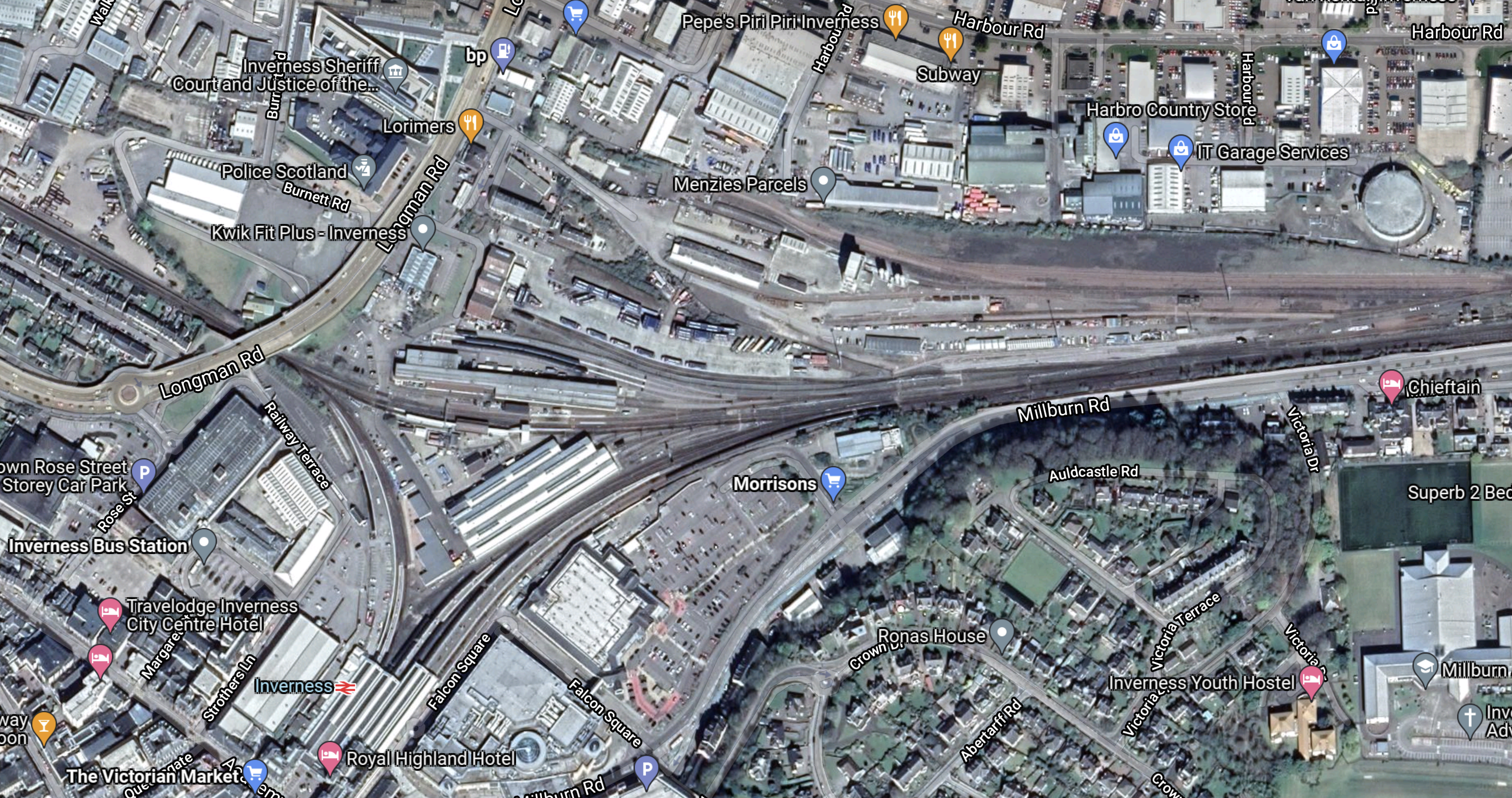
Note.
- Inverness station in the South West corner of the map.
- Inverness bus station is nearby.
- Harbour Road runs across the top of the map.
It looks to me that the round structure in the North East corner is the former SGN gas holder.
These are my thoughts.
The Size Of The Electrolyser
At eight tonnes of hydrogen per day, the proposed electrolyser would be almost as big as the Herne Bay Electrolyser, which creates ten tonnes of hydrogen per day.
Could The Gas Holder Be Used To Store Hydrogen?
As the gas holder was probably built for town gas, which contains a lot of hydrogen, I suspect it could be refurbished to hold hydrogen.
Oxygen Production
The article also says this about oxygen production.
The hub could also provide zero-carbon heat and medical-grade oxygen for hospitals, aquaculture and water treatment works in the area.
Could it be that oxygen is at a premium in the Highlands, so H2 Green are filling a need?
At the height of the pandemic, when hospitals had an oxygen shortage, I asked ITM Power, if they could produce medical grade oxygen, as a by-product of creating hydrogen. They replied in the affirmative.
Conclusion
It looks to me, that H2 Green have a well-thought out plan for hydrogen in The Highlands.
Opel Begins Production And Deliveries Of Hydrogen Vivaro Van
The title of this post, is the same as that of this article on Green Car Congress.
This is the first paragraph.
Opel has begun production of the hydrogen fuel cell variant of the Vivaro van, and has delivered the first one to the German manufacturer of premium domestic appliances, Miele. The hydrogen fuel cell vehicle will perform daily field service in the Rhine-Main region.
We need more hydrogen filling stations in the UK, so we can use vans like these.
Hydrogen Fuel Cell Locomotive From Canadian Pacific To Roll Out Before 2022
The title of this post, is the same as that of this article on Hydrogen Fuel News.
This is said.
The hydrogen fuel cell locomotive consists of an SD40-2F, which was converted to run on H2 power and is therefore nicknamed the H2 0EL. The company is calling it a “hydrogen zero-emissions locomotive”, and it will be operating under its own power before the end of this month, according to Canadian Pacific CEO Keith Creel.
Note that the SD40 locomotive is a diesel-electric locomotive of which 1286 were built around 1970.
Canadian Pacific have made this video, which was kindly pointed out by Alan.
The video seems to indicate that the converted locomotive will be able to continue to do the same duties as the original diesels, which have a power output of 2,240 kW.
Interestingly, power output seems to be of the same order as that of a Class 66 locomotive, so could a similar conversion by used with these locomotives?
When It Comes To Buses, Will Hydrogen Or Electric Win?
The title of this post, is the same as that of this evcellent article on WIRED.
The WIRED article is a serious comparison between the merits of battery and hydrogen-powered buses.
The writer of the article talked to two people, who should know.
- James Dixon, who is a Research Fellow in the Transport Studies Unit and Environmental Change Institute at Oxford University
- Neil Collins, who is Managing Director of Wrightbus.
I think the philosophy of Wrightbus with four basic zero-carbon buses could be right.
- Streetdeck Hydroliner FCEV – A hydrogen-powered double-deck bus.
- Streetdeck Electroliner BEV – A battery-powered double-deck bus.
- GB Kite Hydroliner FCEV – A hydrogen-powered single-deck bus.
- GB Kite Electroliner BEV – A battery-powered single-deck bus.
This surely is a basis for satisfying customers, who like to buy what they feel is best for their networks and passengers.
This paragraph from the Wired article, illustrates how terrain and climate might favour one bus or the other.
Still, hydrogen may be a better option in a city with lots of hills, like Hong Kong, where it’s also very warm and humid, says Collins. “That’s going to be a problem for electric buses, because the cooling and the hills are just going to drain the batteries,” he says. “But if the city is relatively flat, and the journey times are relatively short, and it’s not either significantly warm or significantly cold, battery electric can do a very good job.”
In addition, you wouldn’t choose hydrogen buses, if supply of hydrogen was difficult.
Could this be why Jo Bamford, who is the owner of Wightbus, has established a company to help bus operators with the transition to hydrogen. I wrote about it in New Company Established To Help Transition Bus Fleets To Hydrogen.
I have also heard stories of garages in city centres, where it is not possible to get enough power to charge a garage full of battery buses. Some of these garages are in residential areas, which perhaps may not welcome tankers of hydrogen going through to supply the buses with hydrogen.
Perhaps, the solution for garages like this is to relocate the garage to a site, which fulfils one of these conditions.
- Good connections to the motorway and trunk road network, so that hydrogen can be brought in by truck.
- A high-capacity electricity supply to either charge battery electric buses or generate hydrogen using an electrolyser.
Buses would operate according to this daily cycle.
- Buses would either be charged or refuelled with hydrogen overnight.
- They would position to a convenient place to start their daily diagrams.
- At the end of the day, they would return to the garage.
Note.
- Battery-electric buses may need to be topped-up during the day.
- Hydrogen buses with their longer range should be able to service routes further away.
- Routes would be arranged, so that hydrogen buses would not need to be topped up.
The big advantage of a remote bus garage is that the city centre site could be redeveloped to pay for the new buses and garage.
Siemens Gamesa Partners On Offshore Wind-to-Hydrogen
The title of this post, is the same as that of this article on renews.biz.
This is the first three paragraphs.
Siemens Gamesa has signed a memorandum of understanding with Strohm to collaborate on the development of offshore wind-to-hydrogen infrastructure.
The partnership will focus on the advancement of hydrogen transfer solutions that will look to improve the decentralized green hydrogen concept, whereby green hydrogen is generated in each turbine generator and transported to shore by a subsea pipe.
In this concept power cables are replaced by a pipe infrastructure used for storing and transferring hydrogen.
Thermoplastic composite pipe (TCP) will be used.
Andrew Forrest, AGL Partner To Explore Hydrogen Option For Hunter Valley Coal Plants
The title of this post, is the same as that of this article on abc.
This is the first paragraph.
Mining billionaire Andrew Forrest said hydrogen would eventually “dwarf” the coal industry as he announced plans to develop a green hydrogen hub in the New South Wales Hunter Valley.
I wish Forrest well with this venture, because if he makes a success of it, it could form a model for lots of other places in the world.
He’s certainly a man on a mission.
 The Anonymous Widower