Could An A320 neo Be Rebuilt As A ZEROe Turbofan?
This post is a follow-up to ZEROe – Towards The World’s First Zero-Emission Commercial Aircraft.
I spent a lot of time yesterday, looking at YouTube videos of the following.
- Airbus A320 aircraft
- Airbus A 320 neo aircraft
- Airbus’s proposed ZEROe Turbofan aircraft
I also captured these profiles from the Airbus web site, of three members of the new Airbus A 320 neo family and the current Airbus A 320 ceo.
A 319 neo – Length – 33.84 metres – Max Passengers – 160

A 320 neo – Length 37.57 metres – Max Passengers – 194

A 321 neo – Length 44.51 metres – Max Passengers – 244

A 320 ceo – Length 37.57 – Max Passengers – 180

Note.
- The links on each variant lead to Airbus’s on-line specification.
- All three variants have a wing-span of 35.8 metres and a height of 11.76 metres.
- All variants have sharklets or blended winglets to improve awrodynamic efficiency.
- There are different door, cargo door and window layouts on all three variants.
- The cockpits, tail and wings look similar.
This capture from an Airbus video, shows the profile of the proposed ZEROe Turbofan.

Note, that the ZEROe Turbofan looks more streamlined than the A 320 neo family, with a redesigned nose and more swept-back tailfin and sharklets.
These are my thoughts on the current A 320 neo family and their relationship with the ZEROe Turbofan.
Focus On Commonality
For each variant on the Airbus web site, there is a section with this title. This is the first sentence for the A 320 neo.
Due to its 95 per cent airframe commonality with the A320ceo (current engine option) version, Airbus’ A320neo jetliner fits seamlessly into existing A320 Family fleets worldwide – which is a key factor for the company’s customers and operators.
Will Airbus follow this philosophy with the ZEROe Turbofan?
If it worked between the changeover between the existing A 320 fleets and the A 320 neo fleets, why change the policy?
The Cockpits
The cockpits of the A 320 neo and the A 320 ceo seem to have a similar profile, but the cockpit of the ZEROe Turbofan seems to have been reprofiled.
In ZEROe – Towards The World’s First Zero-Emission Commercial Aircraft, I showed these front on views of the cockpits of the ZEROe Turboprop and ZEROe Turbofan.


I questioned if the two cockpits were related.
- A single cockpit for both aircraft would surely ease manufacture, maintenance and pilot training.
- I’m no aerodynamicist, but it certainly looks that the new cockpit will reduce drag and fuel consumption.
Although the cockpit, appears to be being used in the ZEROe for the first time, I would expect it is already under development and might feature in any later version of the A 320 neo.
The Fuselages
The fuselage width for both the A 320 neo family and the A 320 ceo are all 3.95 metres, with a maximum cabin width of 3.70 metres.
I would expect that the ZEROe Turboprop and the ZEROe Turbofan will also use this width.
Airbus use a design called Cabin-Flex to get the most out of the interior space in the A 320 neo. This paragraph is from the Wikipedia section, that is entitled Cabin-Flex.
By permanently replacing the second door pair in front of the wing (R2/L2) with a new second pair of overwing exits, the capacity of the A321neo is increased from 220 seats to 240 seats and fuel efficiency per seat is increased by 6%, exceeding 20% together with the new engines and the sharklets. The modifications should weigh 100 kg more.[82] Initial A321neos have the A321ceo exit door configuration with four exit door pairs until the Airbus Cabin-Flex (ACF) layout can be selected.
After reading the whole section, it looks to me, that the A 320 neo fuselage is designed, to be all things to all airlines and doors and seats can be arranged to fit any requirements.
In the ZEROe Turbofan, there is a large liquid hydrogen tank behind the rear pressure bulkhead, which could be brought forward a bit to give more space and hydrogen capacity.
I suspect there will be a lot of commonality between the fuselage of the A 320 neo family and that of a ZEROe Turbofan.
I spent a lot of time, as a child building Airfix models of aircraft and it may be too much of a simplification to think of these carbon-composite airliners, as giant Airfix models.
But I wouldn’t be surprised that just like the previous generation of aluminium airliners, they can be remanufactured into something different, just like British Airways Tristars, ended up as tanker-aircraft for the RAF.
I wouldn’t be surprised to find, that later A 320 neo fuselages will be able to be remanufactured into fuselages for ZEROe Turbofans.
Comparing The Fuselages Of The A 320 ceo, A 320 neo And ZEROe Turbofan
These are the three fuselage profiles.
A 320 ceo
A 320 neo
ZEROe Turbofan
Aircraft balance on the wings, which if I remember what little I know about aircraft aerodynamics and design, apply their lift forces to the centre of gravity of the aircraft.
I know that the profile of the ZEROe is to a different scale, but three things are apparent.
- The windows at the rear don’t go as far back, as they do in the two existing designs. But then there is no need for windows around the hydrogen tank.
- The hydrogen tank could be as long as a quarter of the length of the fuselage.
- The front section of the aircraft appears longer.
The longer front section would balance the weight of the hydrogen tank.
The passengers would also help to balance the weight of the tank, by being placed further forward.
There must be the possibility of creating a larger capacity and longer range variant of the ZEROe design, by adding a larger hydrogen tank and further stretching the nose.
Airbus have been stretching these designs for years, so I suspect that they have plans for a large number of possible variants of the ZEROe Turbofan.
According to the Wikipedia entry for the A 320 neo family, there are already five civil versions of the A 320 neo; A 319 neo, A 320 neo, A 321 neo, A 321LR and A 321XLR, plus corporate and military versions.
Add in the Cabin-Flex interior and the various A320s and the ZEROe to come, must be one of the most flexible transport systems in history.
The Tailplanes
As they are of the same height and look similar, the tail sections of the A 320 neo and A 320 ceo families could be almost identical, but the tail section of the ZEROe Turbofan appears to be slightly more swept-back and perhaps more aerodynamic.
As the ZEROe Turbofan, also appears to have had a nose-job, I would suspect that Airbus have a redesigned fuselage in the works to squeeze more fuel-efficiency out of this family of already very frugal aircraft. Could this feature the more aerodynamic tailplane?
Could this advanced fuselage feature in a later version of the A 320 neo?
I also feel, that the functionality of the tailplane on the ZEROe Turbofan will need to be little different to that on the earlier planes.
- The plane is still powered by two turbofan engines on the wings.
- Rudder forces, with an engine failure on one side, will still be the same.
The big difference will be that the fuel is at the back of the fuselage rather than in the wings, which will affect the balance.
Will this effect the design of the tailplane? I don’t think it will in a large way, as Airbus seem to have lengthened the nose to compensate.
The Wings
All the wings with sharklets for the A 320 neo family and the A 320 ceo have the same wingspan of 35.8 metres, so I would expect they are all substantially similar.
But there is one big difference in that the wings of the conventionally-powered aircraft are full of fuel.
This would probably mean that much of the wing stresses in the ZEROe Turbofan would be like an A 320 neo flying with little fuel in the wing tanks. As some aircraft in the A320 neo family have fuselage tanks, Airbus can even test the wing forces and handling in a real aircraft.
But it does look that Airbus will have little trouble designing, building and certifying the wing of a ZEROe Turbofan.
There is a minor difference in that the sharklets for the ZEROe Turbofan are more extreme.
But then as I said earlier, is there a new more aerodynamic airframe for the A 320 neo in the works?
Conclusion
I very much feel that there will be a route to convert some or all of the A 320 neo aircraft to hydrogen power.
New Four Stroke Engine: Turning Hydrogen Sceptics Into Believers
The title of this post, is the same as that of this article on Riviera Maritime Media.
This is the introductory paragraph.
A new medium-speed, dual-fuel engine will underpin the use of hydrogen as fuel for coastal shipping and cold ironing applications.
Coastal shipping I understand, but what is cold ironing?
Thank heaven for this Wikipedia entry, which has this introduction.
Cold ironing, or shore connection, shore-to-ship power (SSP) or alternative maritime power (AMP), is the process of providing shoreside electrical power to a ship at berth while its main and auxiliary engines are turned off.
The article says this under a heading of Cleaner Cold Ironing.
Mr Saverys believes ports can also benefit from using Behydro engines for cold ironing applications: “We actually think that a mobile electricity solution along the quay is much, much cheaper and more flexible than pulling electricity cables at every single terminal.”
He envisages the mobile solution as either land-based or barge-based: “More and more, we have to go to zero emissions in port. In Rotterdam, Hamburg and Antwerp, we realised we should look at a more flexible and cheaper solution.”
The article also says that the dual fuel (hydrogen and diesel) engines have marine, rail and power generation applications and they can build engines up to 10 MW.
ZEROe – Towards The World’s First Zero-Emission Commercial Aircraft
The title of this post, is the same as that of this Press Release from Airbus.
This is the introductory paragraph.
At Airbus, we have the ambition to develop the world’s first zero-emission commercial aircraft by 2035. Hydrogen propulsion will help us to deliver on this ambition. Our ZEROe concept aircraft enable us to explore a variety of configurations and hydrogen technologies that will shape the development of our future zero-emission aircraft.
Overall, the Press Release discloses a lot and gives details of three different aircraft, which are shown in this Airbus infographic.
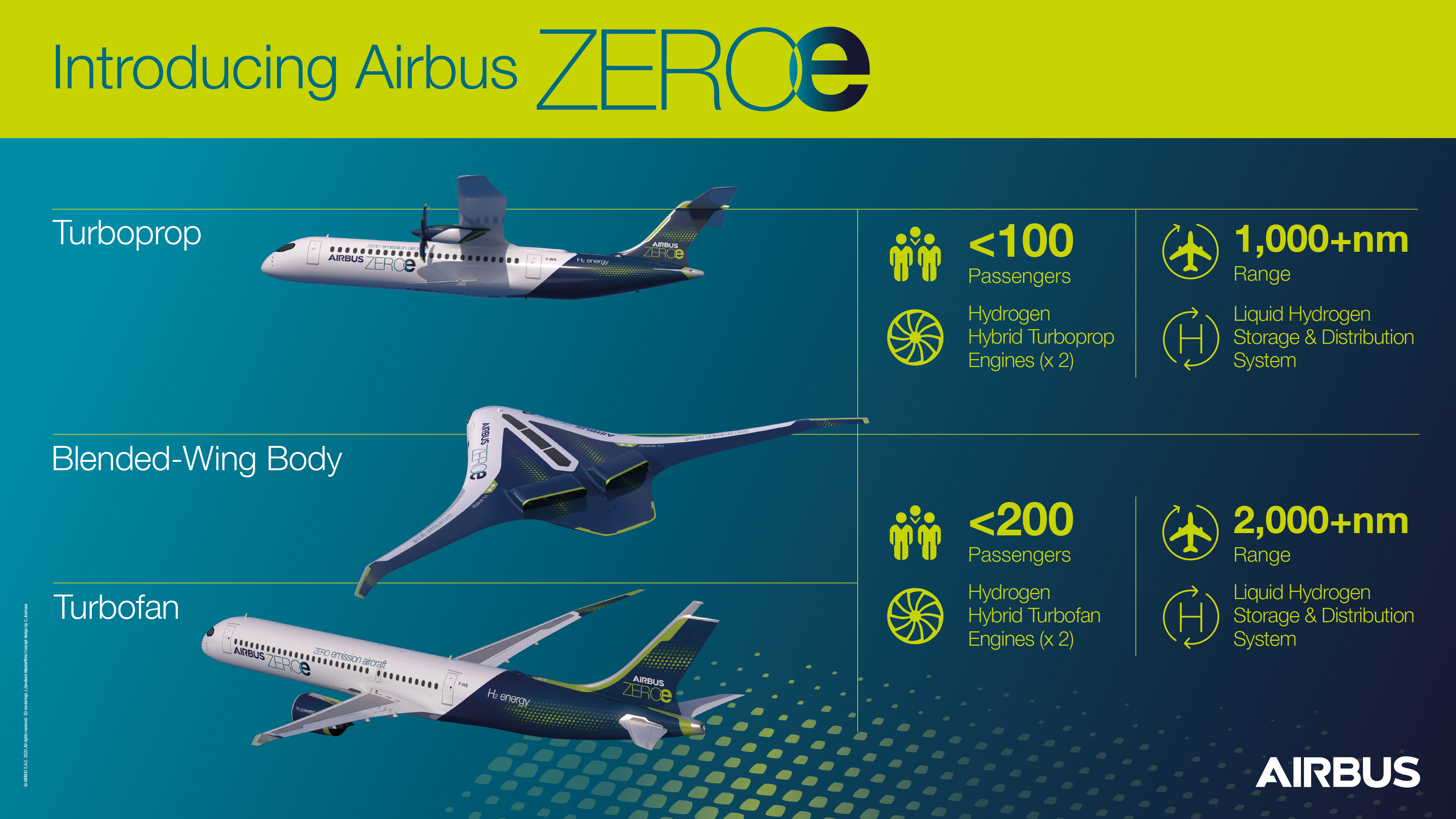
Discover the three zero-emission concept aircraft known as ZEROe in this infographic. These turbofan, turboprop, and blended-wing-body configurations are all hydrogen hybrid aircraft.
I have some thoughts that apply to all three concepts.
Hydrogen Hybrid Power
The Press Release says this about the propulsion systems for the three aircraft.
All three ZEROe concepts are hydrogen hybrid aircraft. They are powered by hydrogen combustion through modified gas-turbine engines. Liquid hydrogen is used as fuel for combustion with oxygen.
In addition, hydrogen fuel cells create electrical power that complements the gas turbine, resulting in a highly efficient hybrid-electric propulsion system. All of these technologies are complementary, and the benefits are additive.
There is a Wikipedia entry which is entitled Hydrogen Fuel, where this is said.
Once produced, hydrogen can be used in much the same way as natural gas – it can be delivered to fuel cells to generate electricity and heat, used in a combined cycle gas turbine to produce larger quantities of centrally produced electricity or burned to run a combustion engine; all methods producing no carbon or methane emissions.
It looks like the aircraft will be powered by engines that are not too different to the current engines in today’s aircraft.
This must be a big advantage, in that much of the research done to improve the current gas-turbine powered by aviation fuel will apply.
Liquid Hydrogen
It appears all three aircraft will use liquid hydrogen.
Liquid Hydrogen Storage
I believe the major uses for hydrogen will be aircraft, buses, cars, rail locomotives and multiple units and heavy trucks.
All will need efficient storage of the hydrogen.
Some applications, will use it in liquid form, as it is a more dense form, but it will need to be kept cold.
As aviation will probably be the most demanding application, will it drive the storage technology?
Oxygen
This will be atmospheric oxygen, which is used by any combustion engine.
Fuel Cells
Will the fuel cells be used to provide power for the plane’s systems, rather than to power the aircraft?
Most airlines do this with an auxiliary power unit or APU, which is just a small gas-turbine engine with a generator. The A 320 family use one made by Pratt & Whitney, which is described on this page of their web site. It is the third one on the page and is called a APS3200. This is said about its function.
Pratt & Whitney APS3200 is the Airbus baseline APU of choice for the Airbus A320 family of aircraft. It is designed to meet performance and environmental requirements for modern day, single-aisle aircraft. The APU comprises a single-shaft, fixedspeed, high-pressure ratio core driving a load compressor that provides bleed air for cabin conditioning and main engine starting, concurrent with 90kVA of electrical power.
The APU is usually located in the tail.
In the ZEROe family will there be a fuel-cell powered compressor to provide bleed air for cabin airconditioning and main engine starting?
Slippery Aerodynamics
Airbus seem to be the masters of slippery aerodynamics, which will help make the planes very fuel efficient.
Lightweight Composite Structures
Like the latest Airbus airliners, these planes will be made from lightweight composite structures and I wouldn’t be surprised to see weight saving in other parts of the aircraft.
Carbon Emissions And Pollution
There will be no carbon dioxide produced, as where’s the carbon in the fuel?
But there could be small amounts of the oxides of nitrogen produced, by the combustion, as nitrogen will be present from the air.
Noise
As the aircraft are powered by gas-turbine engines, there will be some noise.
The Mathematics Of Hydrogen-Powered Aviation
The mathematics for these three aircraft must say, that the designs are feasible.
Otherwise Airbus wouldn’t have published a detailed Press Release, only for it to be torn to pieces.
Pressures Driving Aviation In The Next Ten Years
Aviation will change in the text ten years and it will be driven by various competing forces.
Environmental Issues
Pollution, Carbon Emissions and Noise will be the big environmental issues.
Hydrogen will go a long way to reducing the first two issues, but progress with noise will generally be made by better engineering.
COVID-19 And Future Pandemics
These could have a bigger effect, as to make flying safe in these troubled times, passengers will need to be given more space.
But I do wonder, if there is an administrative solution, backed up, by innovative engineering.
Could a very quick test for COVID-19, that would stop infected passengers boarding, coupled with high quality automatic cleaning and air purification, ensure that passengers didn’t get infected?
Entry Into Service
Airbus are quoting 2035 in the Press Release and this YouTube video.
Is that ambitious?
Thoughts On The Three Designs
My thoughts on the three designs, follow in the next three sections.
The ZEROe Turboprop
This is Airbus’s summary of the design for the ZEROe Turboprop.
Two hybrid hydrogen turboprop engines, which drive the six bladed propellers, provide thrust. The liquid hydrogen storage and distribution system is located behind the rear pressure bulkhead.
This screen capture taken from the video, shows the plane.
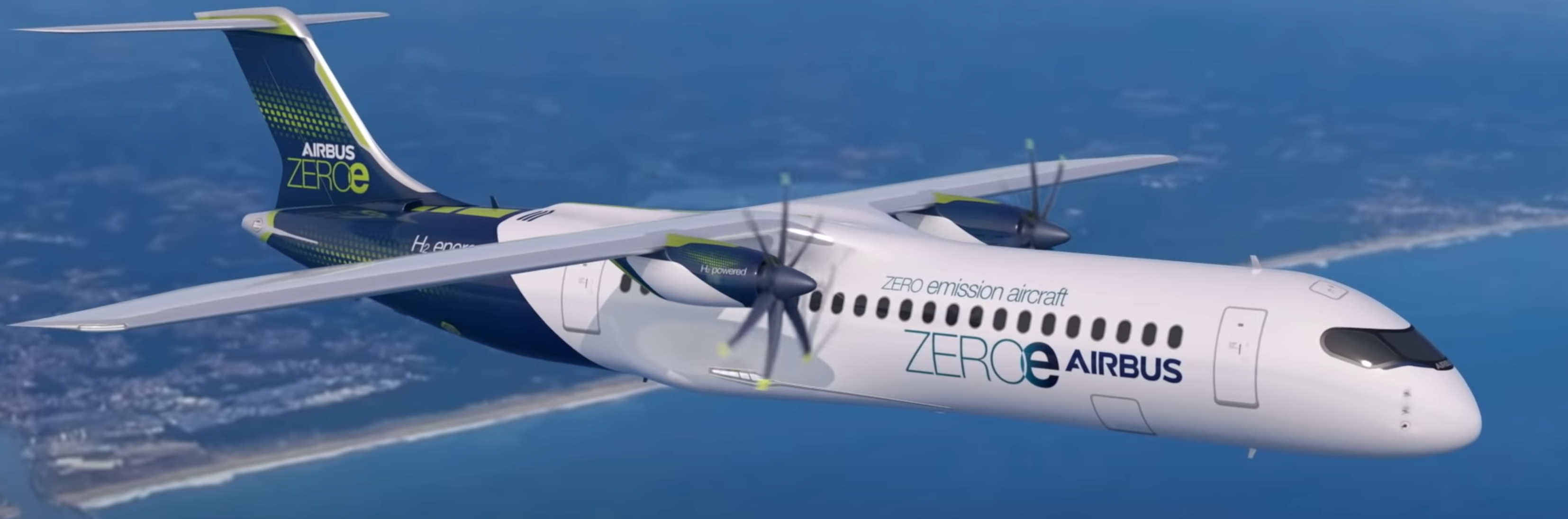
It certainly is a layout that has been used successfully, by many conventionally-powered aircraft in the past. The De Havilland Canada Dash 8 and ATR 72 are still in production.
The Turboprop Engines
If you look at the Lockheed-Martin C 130J Super Hercules, you will see it is powered by four Rolls-Royce AE 2100D3 turboprop engines, that drive 6-bladed Dowty R391 composite constant-speed fully-feathering reversible-pitch propellers.
These Rolls-Royce engines are a development of an Allison design, but they also form the heart of Rolls-Royce’s 2.5 MW Generator, that I wrote about in Our Sustainability Journey. The generator was developed for use in Airbus’s electric flight research program.
I wouldn’t be surprised to find the following.
- , The propulsion system for this aircraft is under test with hydrogen at Derby and Toulouse.
- Dowty are testing propellers suitable for the aircraft.
- Serious research is ongoing to store enough liquid hydrogen in a small tank that fits the design.
Why develop something new, when Rolls-Royce, Dowty and Lockheed have done all the basic design and testing?
The Fuselage
This screen capture taken from the video, shows the front view of the plane.
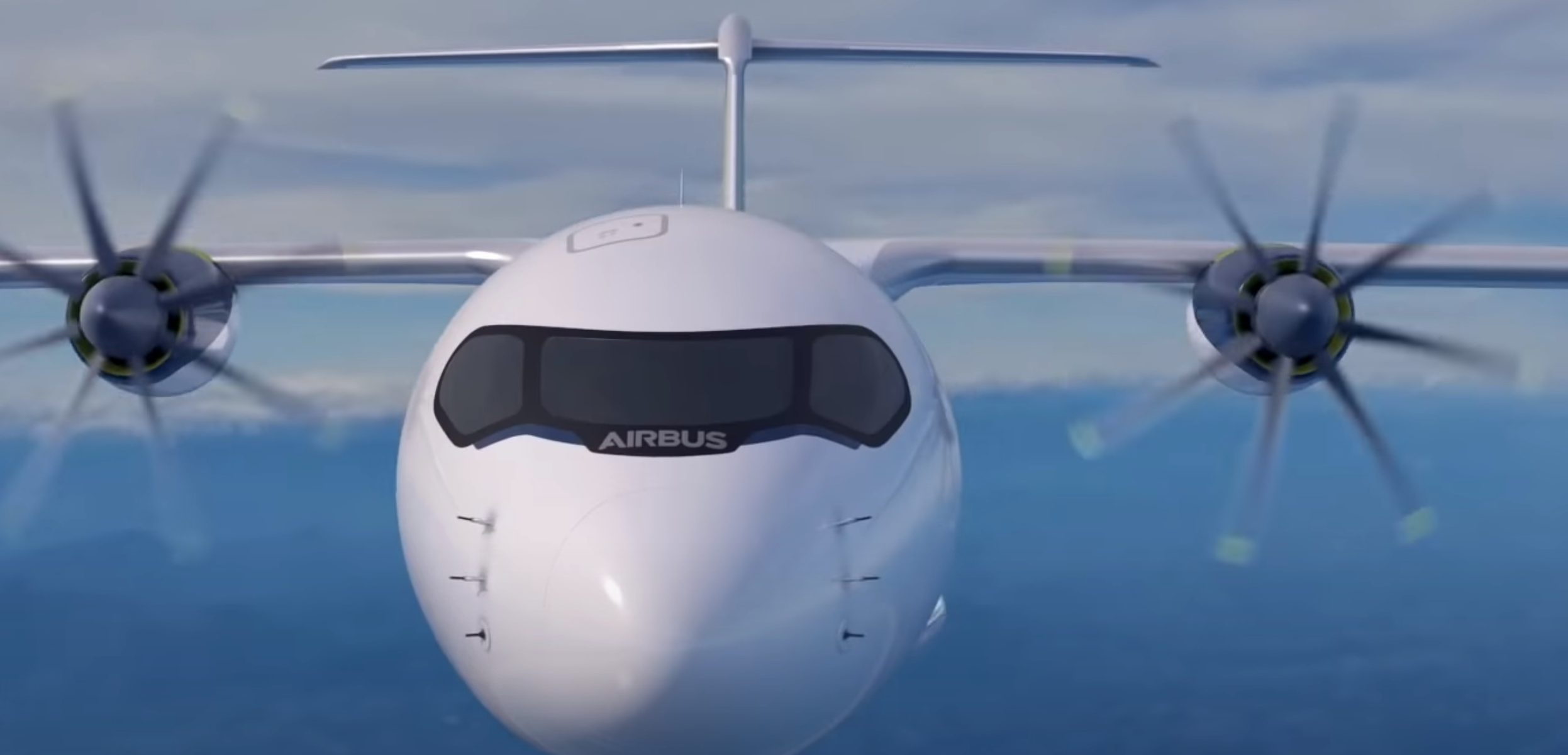
From clues in the picture, I estimate that the fuselage diameter is around four metres. Which is not surprising, as the Airbus A320 has a height of 4.14 metres and a with of 3.95 metres.
So is the ZEROe Turboprop based on a shortened Airbus A 320 fuselage?
As the aircraft has a capacity of less than a hundred passengers and an Airbus A320 has six-abreast seating, could the aircraft have sixteen rows of seats.
With the seat pitch of an Airbus A 320, which is 81 centimetres, this means just under thirteen metres for the passengers.
The Technical Challenge
I don’t feel there are any great technical challenges in building this aircraft.
- The engines appear to be conventional and could even have been more-or-less fully developed.
- The fuselage could be a development of an existing design.
- The wings and tail-plane are not large and given the company’s experience with large composite structures, they shouldn’t be too challenging.
- The hydrogen storage and distributing system will have to be designed, but as hydrogen is being used in increasing numbers of applications, I doubt the expertise will be difficult to find.
- The avionics and other important systems could probably be borrowed from other Airbus products.
Given that the much larger and more complicated Airbus A380 was launched in 2000 and first flew in 2005, I think that a prototype of this aircraft could fly around the middle of this decade.
The Market Segment
It may seem small at less than a hundred seats, but it does have a range of greater than a 1000 nautical miles or 1150 miles.
Consider.
- It compares closely in passenger capacity, speed and range, with the De Havilland Canada Dash 8/400 and the ATR 72/600.
- The ATR 72 is part produced by Airbus.
- The aircraft is forty percent slower than an Airbus A 320.
- It is a genuine zero-carbon aircraft.
- It looks like it could be designed to have a Short-Takeoff-And Landing (STOL) capability.
On the other hand, a lot of busy routes, like London and Edinburgh and Berlin and Munich are less than or around 400 miles.
These short routes are being challenged aggressively by the rail industry, as over this sort of distance, which typically takes four hours by train, rail has enough advantages, that passengers may choose not to fly.
Examples of cities with a range of between 400 and 1000 miles from London include.
- Berlin – 571 miles
- Cork – 354 miles
- Inverness – 445 miles
- Lisbon – 991 miles
- Madrid – 781 miles
- Palma – 835 miles
- Rome – 893 miles
- Stockholm – 892 miles
- Warsaw – 900 miles
This aircraft would appear to be sized as an aircraft, that can fly further than passengers are happy to travel by train. But because of its cruising speed, the routes, where it will be viable would probably be limited in duration.
But important routes to, from and between secondary locations, like those that used to be flown by FlyBe, would surely be naturals for this aircraft.
It looks to be an aircraft that could have a big future.
The ZEROe Turbofan
This is Airbus’s summary of the design.
Two hybrid hydrogen turbofan engines provide thrust. The liquid hydrogen storage and distribution system is located behind the rear pressure bulkhead.
This screen capture taken from the video, shows the plane.
This screen capture taken from the video, shows the front view of the plane.
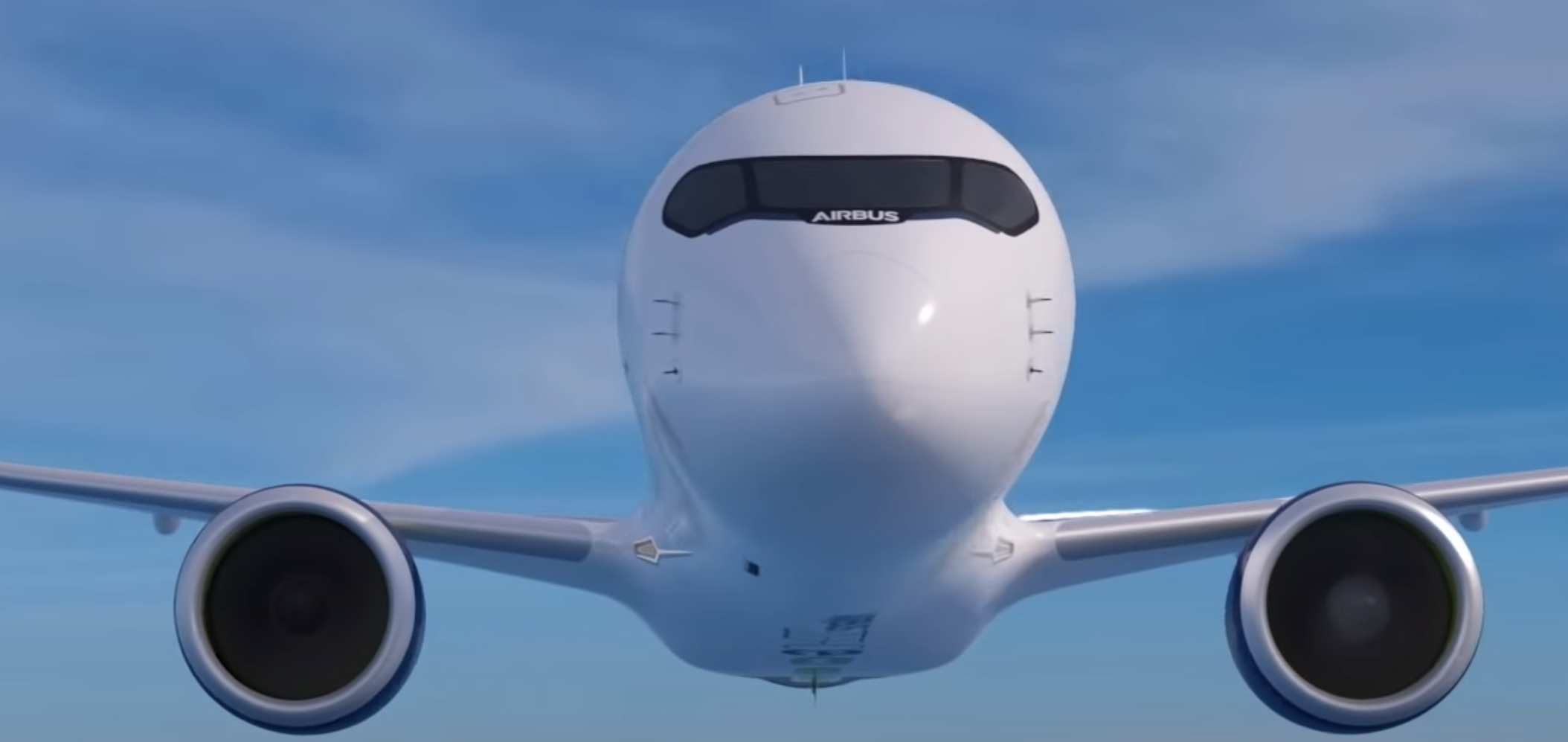
The aircraft doesn’t look very different different to an Airbus A320 and appears to be fairly conventional. It does appear to have the characteristic tall winglets of the A 320 neo.
The Turbofan Engines
These would be standard turbofan engines modified to run on hydrogen, fuelled from a liquid hydrogen tank behind the rear pressure bulkhead of the fuselage.
If you want to learn more about gas turbine engines and hydrogen, read this article on the General Electric web site, which is entitled The Hydrogen Generation: These Gas Turbines Can Run On The Most Abundant Element In the Universe,
Range And Performance
I will compare range, performance and capacity with the latest Airbus A 320.
ZEROe Turbofan
- Range – 2300 miles
- Cruising Speed – Mach 0.78
- Capacity – < 200 passengers
Airbus A 320
- Range – 3800 miles
- Cruising Speed – Mach 0.82
- Capacity – 190 passengers
There is not too much difference, except that the A 320 has a longer range.
The Cockpits Of The ZEROe Turboprop And The ZEROe Turbofan
This gallery puts the two cockpit images together.
Are they by any chance related?
Could the controls and avionics in both aircraft be the same?
A quick look says that like the Boeing 757 and 767, the two planes have a lot in common, which may enable a pilot trained on one aircraft to fly the other, with only minimal extra instruction.
And would it be a simple process to upgrade a pilot from an A 320 to a ZEROe Turbofan?
The Fuselages Of The ZEROe Turboprop And The ZEROe Turbofan
I estimated earlier that the fuselage of the Turboprop was based on the cross-section of the A320.
Looking at the pair of front views, I wouldn’t be surprised to find, that both aircraft are based on an updated A 320 fuselage design.
Passengers and flightcrew would certainly feel at home in the ZEROe Turbofan, if internally, it was the same size, layout and equipment as a standard A 320 or more likely an A 320 neo.
The Market Segment
These are my thoughts of the marketing objectives of the ZEROe Turbofan.
- The cruising speed and the number of passengers are surprisingly close, so has this aircraft been designed as an A 320 or Boeing 737 replacement?
- I suspect too, that it has been designed to be used at any airport, that could handle an Airbus A 320 or Boeing 737.
- It would be able to fly point-to-point flights between most pairs of European or North American cities.
It would certainly fit the zero-carbon shorter range airliner market!
In fact it would more than fit the market, it would define it!
The ZEROe Blended-Wing Body
This is Airbus’s summary of the design.
The exceptionally wide interior opens up multiple options for hydrogen storage and distribution. Here, the liquid hydrogen storage tanks are stored underneath the wings. Two hybrid hydrogen turbofan engines provide thrust.
This screen capture taken from the video, shows the plane.

This aircraft is proposed to have the same performance and capacity as the ZEROe Turbofan, which includes a 2000 nautical mile plus range.
The only other aircraft with a similar shape is the Northrop Grumman B-2 Spirit or Stealth Bomber. This is not a fast aircraft, but it is able to fly at an altitude of 50,000 ft, which compares to the 60,000 ft of Concorde and the 43,000 ft of an Airbus A 380.
I wonder, if the blended-wing body is designed to fly very high at around the 60,000 ft, which was Concorde territory.
It would only be doing 515 mph and would be well below the speed of sound.
So what is the point on going so high?
The air is very thin and there is a lot less drag.
It is also worth reading Wikipedia on the design of flying wings.
It might be possible to fly much further than 2000 nautical miles. After all Airbus did put in a plus sign!
Is this aircraft the long-distance aircraft of the three?
Extending The Range
I do wonder, if the engines in these aircraft could be capable of running on both hydrogen and aviation biofuel.
As the ZEROe Turboprop and the ZEROe Turbofan planes have empty wings, which in a conventional aircraft would hold fuel, could the space be used to hold aviation biofuel to extend the range?
Certification Of The Planes
The ZEROe Turboprop and ZEROe Turbofan are aircraft, where a lot of the design will already have been proven in previous aircraft, so will probably be much less onerous to approve, than the blended-wing body design.
Conclusion
It looks to me, that Airbus have designed three aircraft to cover the airline market.
I also feel that as the ZEROe Turboprop and ZEROe Turbofan, appear to have conventional airframes, that they could be delivered before 2035.
If I’m right, that the blended-wing body is a high flyer, it will be a ride to experience, travelling at that height all the way to New York.
Next Stop Hydrogen For New Rail Project
The title of this post, is the same as that of this article on Business Green.
This is the introductory paragraph.
Three British companies unite to develop new hydrogen fuelling infrastructure that could soon allow for the roll out of zero emission trains on the UK rail network.
Some points from the article.
- The three companies involved are Fuel Cell Systems Ltd, tpgroup, and Vanguard Sustainable Transport Solutions.
- Their initial focus will be on the rail industry.
It looks to be a good start to provide much-needed infrastructure.
Scunthorpe Steelworks
On my way back from Cleethorpes, I passed Scunthorpe Steelworks.


It did seem rather quiet, although I did pass a train-load of new rails on their way to somewhere.
The Future Of Steel-Making
Steel-Making is on its uppers in the UK and it has a bad carbon footprint.
However, various processes are in development that could make the industry fit for the Twenty-First Century.
HIsarna Steelmaking
In Whitehaven Deep Coal Mine Plan Moves Step Closer, I said this.
In Wikipedia, there is an entry for the HIsarna ironmaking process.
This process is being developed by the Ultra-Low Carbon Dioxide Steelmaking (ULCOS) consortium, which includes Tata Steel and the Rio Tinto Group. Reduction in carbon-dioxide produced by the process compared to traditional steel-making are claimed to be as high as fifty percent.
This figure does not include carbon-capture to reduce the carbon-dioxide still further.
However, looking at descriptions of the process, I feel that applying carbon-capture to the HIsarna steelmaking process might be a lot easier, than with traditional steelmaking.
As Scunthorpe is close to Theddlethorpe Gas Terminal, the captured carbon-dioxide could probably be stored in wells connected to the terminal.
Hydrogen Steelmaking
North-East Lincolnshire is becoming the new Aberdeen, but instead of being based solely on oil and gas, there is a large proportion of wind energy being reaped.
In the future, I believe that a lot of this wind energy will be turned into hydrogen gas both onshore and increasing off-shore scores of miles out in the North Sea. There is talk of upwards of 70 GW of wind turbines being installed and much of it will be turned into hydrogen in North-East Lincolnshire.
In Funding Award to Supply An 8MW Electrolyser, I wrote about hydrogen steelmaking and the HYBRIT process in particular.
Will some of this massive amount of hydrogen be piped to Scunthorpe to make steel?
Conclusion
The future of steelmaking in Scunthorpe, doesn’t have to be all doom and gloom.
Green Tugboats? ‘Revolutionary’ Hydrogen Ship Engine Unveiled In Belgium
The title of this post, is the same as that of this article on Business Green.
This is the first paragraph.
A “revolutionary” hybrid ship engine powered by green hydrogen and diesel has been unveiled today in Belgium, with developers claiming the innovation could cut CO2 emissions from ships, trains and electricity generators by up to 85 per cent.
The engine has been given the name BeHydro.
The first order has been received by the developers; ABC, for two 2MW dual fuel engines that will be installed on a hydrogen-powered tug for the Port of Antwerp.
Motors up to the size of 10 MW are under development.
This is the last sentence of the article.
In theory, any large diesel engine can be replaced by a BeHydro engine. The hydrogen future starts today.
It is a quote from the CEO of one of the companies involved.
Conclusion
This is a development to follow.
The BeHydro engine, with its dual-fuel approach, is claimed to cut carbon emissions by 85 %.
In the Wikipedia entry for ABC or Anglo Belgian Corporation, there is a section called Products. This is a paragraph.
The engines are found in use on large river barges such as those found on the Rhine, coastal freighters, fishing boats, ferries, tugboats (which typically use 2 engines), and other ships. Other applications include electricity generation, and pumping engines, engines for cranes, and locomotives (including the Belgian Railways Class 77 and Voith Maxima), as well as dual fuel (gas/oil) DZD engines.
I feel that that the BeHydro engine will keep the company busy.
Four Must-Read Articles From H2-View
I have just read these articles on H2-View.
- New partnership aims to convert Dash 8 airliner to hydrogen fuel
- 1,000 new hydrogen-powered buses planned for European roads
- Investing in hydrogen trains will put UK green recovery on the fast track
- Mercedes-Benz GenH2 Truck revealed
They are all worth a read.
The last one includes an informative video about German policy on hydrogen.
Green Hydrogen For Scotland
The title of this post, has been taken from this press release from ITM Power, which is entitled ‘Green Hydrogen For Scotland’ To Help Reach Net Zero Targets: First Project To Deliver A 10MW Electrolyser To Glasgow Facility.
This is the introductory paragraph.
A pioneering Strategic partnership has been established to create new green hydrogen production facilities with clusters of refuelling stations across Scotland, supporting the country’s efforts to achieve net zero by 2045. ‘Green Hydrogen for Scotland’ – a partnership of ScottishPower Renewables, BOC (a Linde company) and ITM Power – brings together industry-leading names in the renewables and clean fuel industries to offer an end-to-end market solution for reducing vehicle emissions through the provision of green hydrogen.
Other details include.
- The green hydrogen production facility located on the outskirts of Glasgow will be operated by BOC.
- ITM Power will deliver a 10 MW electrolyser.
- Electricity will come from , wind and solar produced by ScottishPower Renewables.
- The project aims to supply hydrogen to the commercial market within the next two years.
This ITM Power infographic outlines Green Hydrogen for Scotland.
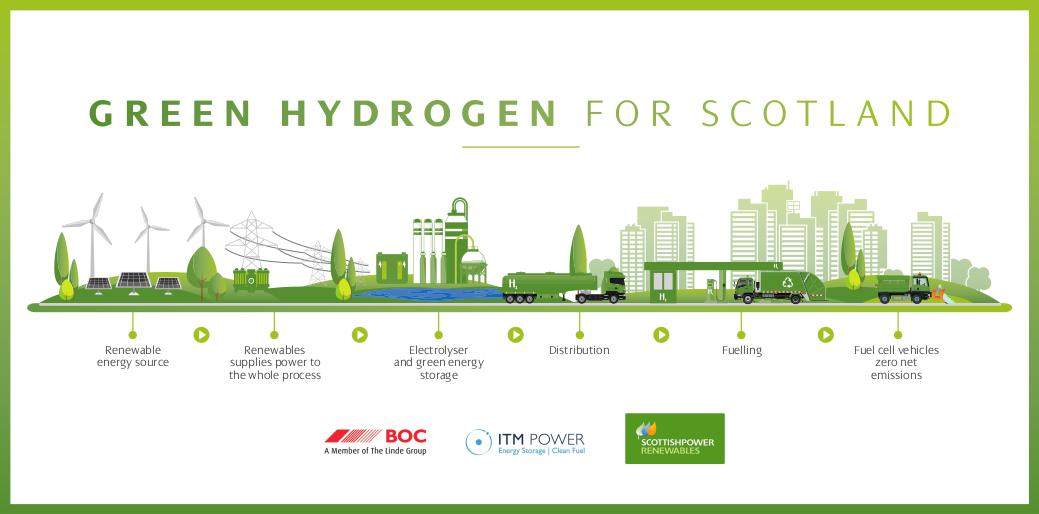
Surely it should be called tartan hydrogen. Does anybody know a tartan containing the blue of Scotland, the white of Yorkshire and the black, red and gold of Germany?
Transition Your Ships To Zero-Emissions With Ballard’s New FCwave
The title of this post, is the same as that of this post on the Ballard blog.
This is the introductory paragraph.
Today, the maritime sector accounts for approximately 2.5% of global carbon emissions, equivalent to 940 megatonnes each year . But the industry is now moving into a new era of mobility, where sustainability and climate change issues are top of mind.
And this paragraph introduces Ballard’s solution.
At Ballard, we’re here to support ship operators and marine propulsion integrators in this transition. Today, we’ll introduce you to our new FCwave™ fuel cell module—the world’s first commercial fuel cell solution for marine vessels.
There is a link to a brochure.
The blog also has two videos and a picture of a Caledonian MacBrayne ferry, which is labelled Ballard Fuel Cell Powered HySeas Consortium Ferry, so is a hydrogen-powered ferry coming to an island near you or where you like to go?
This article on the Liverpool Echo is entitled Plans For A New Ferry To Cross The Mersey.
As the current two ferries, were in service when I was a student at Liverpool University in the 1960s, replacement of one of the most iconic, if not the most iconic ferries in the world with hydrogen power would be a smart move, by both Liverpool and Ballard.
Especially, as the Liverpool area is not short of hydrogen.
 The Anonymous Widower