Permali To Develop Composite For Fuel Cell Retrofits
The title of this post, is the same as that of this article on Power Train Technology International.
This is the two opening paragraphs.
Composites engineering specialist Permali has won UK government funding to develop a lightweight composite solution, which is aimed at allowing existing diesel-powered buses to be retrofitted with zero-emission hydrogen powertrains.
According to the company, its R&D team, located at its main site in Gloucester, will be working on this development project in collaboration with hydrogen and fuel cell specialist company Arcola Energy and the UK National Composites Centre (NCC). The partnership is initially aimed at buses, but the new technology concept should be transferable to a wider range of vehicles, such as heavy-duty goods vehicles, trains and even aircraft.
That is an impressive introduction.
I shall be watching Permali.
Frankfurt Starts Building Fuel Station For World’s Biggest Zero-Emissions Train Fleet
The title of this post, is the same as that of this article on Reuters.
These are the two opening paragraphs.
German regional transport group RMV began construction on Monday of a filling station near Frankfurt that will use hydrogen generated as a by-product of chemicals manufacturing to fuel the world’s largest fleet of zero-emissions passenger trains.
France’s Alstom will deliver 27 hydrogen-powered fuel cell trains to the Infraserv Hoechst industrial park in the Rhine-Main region in mid-2022. Starting regular local services by that winter, the fleet will replace diesel engines.
All the investment will be partly funded by fares.
Chlorine Manufacture
I find it interesting, that the article also states that the hydrogen comes as a by-product of chlorine manufacture. When I worked in a ICI’s electrolysis plant around 1970, their plant used the Castner-Kellner process to produce both gases.
The process uses a lot of mercury and Wikipedia says this about the future of the process.
The mercury cell process continues in use to this day. Current-day mercury cell plant operations are criticized for environmental release of mercury leading in some cases to severe mercury poisoning as occurred in Japan Minamata_disease. Due to these concerns, mercury cell plants are being phased out, and a sustained effort is being made to reduce mercury emissions from existing plants.
Are INEOS, who now own the Runcorn plant, and the Germans still using the Castner-Kellner process?
I remember two stories about the theft of mercury from the Runcorn plant.
Mercury was and probably still is very valuable, and it was always being stolen. So ICI put a radioactive trace in the mercury, which didn’t affect the process. The result was that all legitimate metal dealers on Merseyside bough Geiger counters to check any mercury before they bought it.
One guy thought he had found the ideal way to steal mercury, so he filled his bike frame with the metal and wheeled it to the gate. Whilst he clocked out, he propped the bike against the gate-house. Unfortunately, it fell over and because of the weight of the mercury, he was unable to pick it up.
My work in the plant, involved devising a portable instrument that would detect mercury in air and a colleague’s project was to develop a way of detecting mercury in urine samples from the plant operatives.
Those projects say a lot, about why we should be careful around any process involving mercury.
£100m Station Revamp Could Double Local Train Services
The title of this post, is the same as that of this article on the Northern Echo.
This is the opening paragraph.
Officials behind plans for a £100m-plus transformation of Darlington’s Bank Top Station have confirmed it will remain the only one on the East Coast Mainline without a platform specifically for the London to Scotland service.
Darlington station has made various appearances in my life, all of which have been pleasurable ones.
I went several times to ICI’s Wilton site on Teesside in the 1970s, when the route to London was worked by the iconic Class 55 locomotives or Deltics.

I wrote about one memorable trip home from Darlington in The Thunder of Three-Thousand Three-Hundred Horses.
Over the years, I also seem to have had several clients for my computing skills in the area, including the use of my data analysis software; Daisy at Cummins Engines in the town.
And lately, it’s been for football at Middlesbrough to see Ipswich play, where I’ve changed trains. Sometimes, Town even won.
The improvements planned for the station are two-fold.
Improvement Of Local Services
This paragraph from Wikipedia, sums up the local train services on the Tees Valley Line between Saltburn and Bishop Auckland via Darlington, Middlesbrough and Redcar.
Northern run their Tees Valley line trains twice hourly to Middlesbrough, Redcar and Saltburn (hourly on Sundays), whilst the Bishop Auckland branch has a service every hour (including Sundays). The company also operates two Sundays-only direct trains to/from Stockton and Hartlepool.
If ever a route needed improvement it is this one.
This paragraph from the Northern Echo article, outlines the plans for Darlington station.
The meeting was also told the overhaul, which will see new platforms, a new station building, parking and an interchange for passengers, alongside other improvements, would also double capacity on Tees Valley and Bishop Auckland lines, meaning four trains an hour on the former and two trains an hour on the latter.
I also believe that the route is a shoe-in for zero-carbon services; hydrogen or battery electric.
Hydrogen Trains On Teesside
In Fuelling The Change On Teesside Rails, I discuss using hydrogen powered trains for the lines in the area and they could certainly provide services on more than just the Tees Valley Line.
- Teesside certainly has big plans for hydrogen to fuel its chemical industry.
- Hydrogen powered transport in the area has been backed by the Government, as I wrote about in Tees Valley Wins £1.3million Project To Bring Hydrogen Vehicles To The Region.
- Plans are advancing for a depot for hydrogen-powered trains at Lackenby.
The hydrogen powered trains would probably be this Alstom Breeze.
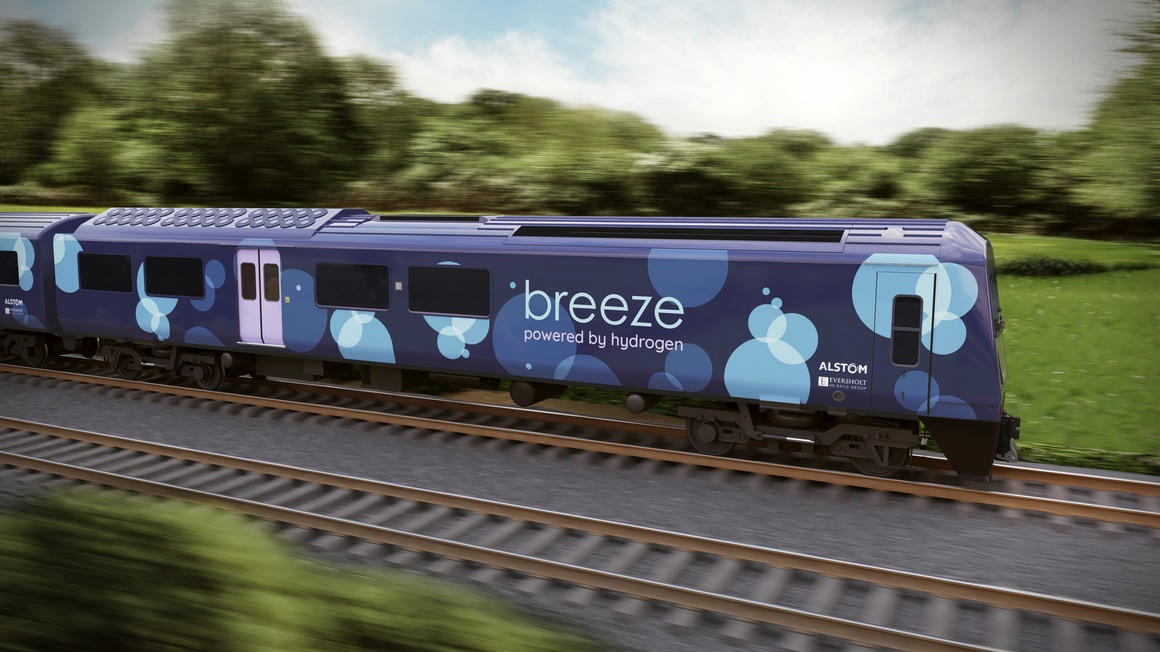
They would appear to be in pole position to change the image of Teesside’s trains.
Battery Electric Trains On Teesside
But I suspect. that an Anglo-Japanese partnership, based in the North-East could have other ideas.
- Hitachi have a train factory at Newton Aycliffe on the Tees Valley Line.
- Hyperdrive Innovation design and produce battery packs for transport and mobile applications in Sunderland.
The two companies have launched the Regional Battery Train, which is described in this Hitachi infographic.

Note than 90 kilometres is 56 miles, so the train has a very useful range.
Hitachi have talked about fitting batteries to their express trains to serve places like Middlesbrough, Redcar and Sunderland with zero-carbon electric services.
But their technology can also be fitted to their Class 385 trains and I’m sure that Scotland will order some battery-equipped Class 385 trains to expand their vigorous electric train network.
Both Scotland and Teesside will need to charge their battery trains.
Example distances on Teesside include.
- Darlington and Saltburn – 28 miles
- Darlington and Whitby – 47 miles
- Darlington and Bishop Auckland – 12 miles
The last route would be possible on a full battery, but the first two would need a quick battery top-up before return.
So there will need to be strategically-placed battery chargers around the North-East of England. These could include.
- Hexham
- Nunthorpe
- Redcar or Saltburn – This would also be used by TransPennine Express’s Class 802 trains, if they were to be fitted with batteries.
- Whitby
If Grand Central did the right thing and ran battery electric between London and Sunderland, there would probably be a need for a battery charger at Sunderland.
It appears that Adrian Shooter of Vivarail has just announced a One-Size-Fits-All Fast Charge system, that has been given interim approval by Network Rail.
I discuss this charger in Vivarail’s Plans For Zero-Emission Trains, which is based on a video on the Modern Railways web site.
There is more about Vivarail’s plans in the November 2020 Print Edition of the magazine, where this is said on page 69.
‘Network Rail has granted interim approval for the fast charge system and wants it to be the UK’s standard battery charging system’ says Mr. Shooter. ‘We believe it could have worldwide implications.’
I believe that Hitachi and Hyperdrive Innovation, with a little bit of help from friends in Seaham, can build a battery-electric train network in the North-East.
The Choice Between Hydrogen And Battery Electric
Consider.
- The hydrogen trains would need a refuelling system.
- The battery electric trains would need a charging structure, which could also be used by other battery electric services to and from the North-East.
- No new electrification or other infrastructure would be needed.
- If a depot is needed for the battery electric trains, they could probably use the site at Lackenby, that has been identified as a base for the hydrogen trains.
Which train would I choose?
I think the decision will come down to politics, money and to a certain extent design, capacity and fuel.
- The Japanese have just signed a post-Brexit trade deal and France or rather the EU hasn’t.
- The best leasing deal might count for a lot.
- Vivarail have stated that batteries for a battery electric train, could be leased on a per mile basis.
- The Hitachi train will be a new one and the Alstom train will be a conversion of a thirty year old British Rail train.
- The Hitachi train may well have a higher passenger capacity, as there is no need for the large hydrogen tank.
- Some people will worry about sharing the train with a large hydrogen tank.
- The green credentials of both trains is not a deal-breaker, but will provoke discussion.
I feel that as this is a passenger train, that I’m leaning towards a battery electric train built on the route.
An Avoiding Line Through Darlington
The Northern Echo also says this about track changes at the station.
A meeting of Darlington Borough Council’s communities and local services scrutiny committee was told a bus lane-style route off the mainline at the station would enable operators to run more high-speed services.
Councillors heard that the proposed track changes would enable very fast approaches to Darlington and allow other trains to pass as East Coast Mainline passengers boarded.
Some councillors seem to be unhappy about some trains passing through the station without stopping.
Are their fears justified?
This Google Map shows Darlington station.
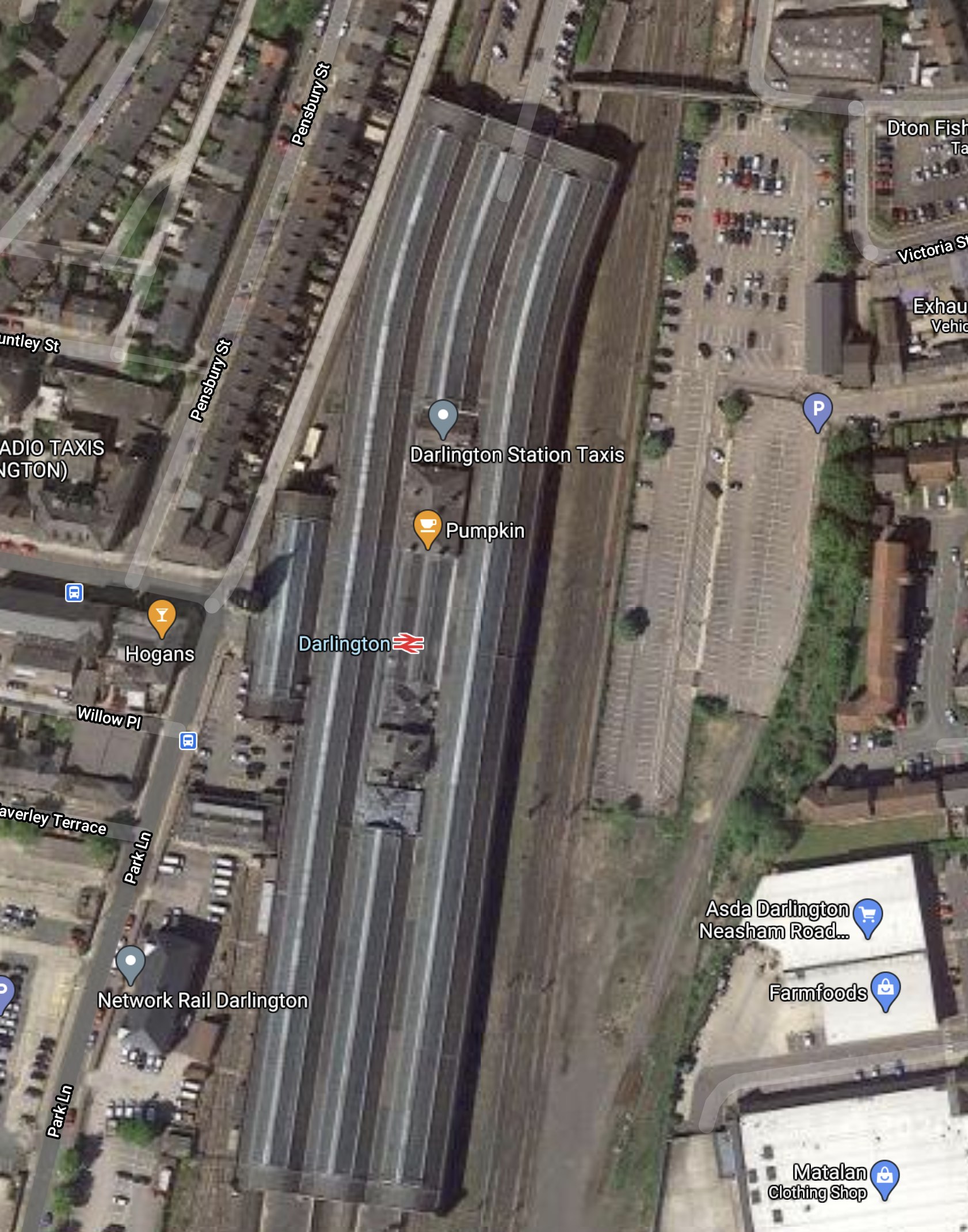
Note.
- The station has two long platforms and two South-facing bay platforms.
- There is plenty of space.
- There already appear to be a pair of electrified avoiding lines on the Eastern side of the station.
Wikipedia also says this about how Darlington station will be changed by High Speed Two.
The new high speed rail project in the UK, High Speed 2, is planned to run through Darlington once Phase 2b is complete and will run on the existing East Coast Main Line from York and Newcastle. Darlington Station will have two new platforms built for the HS2 trains on the Main Line, as the station is built just off the ECML to allow for freight services to pass through.
This would appear to suggest that the two current avoiding lines will be turned into high speed platforms.
Current High Speed Services At Darlington
The current high speed services at Darlington are as follows.
- LNER – two trains per hour (tph) – London Kings Cross and Edinburgh
- Cross Country – one tph – Plymouth and Edinburgh or Glasgow
- Cross Country – one tph – Southampton and Newcastle
- TransPennine Express – one tph – Liverpool and Edinburgh
- TransPennine Express – one tph – Manchester Airport and Newcastle
Northbound, this gives eight tph to Newcastle and four tph to Edinburgh
East Coast Trains
East Coast Trains‘s services are not planned to stop at Darlington.
High Speed Two Trains
Darlington is planned to be served by these High Speed Two trains.
- 1 tph – Birmingham Curzon Street and Newcastle via East Midlands Hub, York and Durham
- 1 tph – London Euston and Newcastle via Old Oak Common and York.
Both will be 200 metre High Speed Two Classic-Compatible trains
Northbound, this gives ten tph to Newcastle and four tph to Edinburgh.
As the Eastern Leg of High Speed Two has some spare capacity, I suspect there could be other services through Darlington.
Improvements To The East Coast Main Line
If you look at the East Coast Main Line between Doncaster and Newcastle, the route is a mixture of two and four-track railway.
- Between Doncaster and York, there are two tracks
- Between York and Northallerton, there are four tracks
- Between Northallerton and Darlington, there are two tracks
- North of Darlington, the route is mainly two tracks.
I have flown my virtual helicopter along much of the route and I can say this about it.
- Much of the route is through agricultural land, and where absolutely necessary extra tracks could possibly be added.
- The track is more-or-less straight for large sections of the route.
- Routes through some towns and cities, are tightly hemmed in by houses.
I also believe that the following developments will happen to the whole of the East Coast Main Line before High Speed Two opens.
- Full ERTMS in-cab digital signalling will be used on all trains on the route.
- The trains will be driven automatically, with the driver watching everything. Just like a pilot in an airliner!
- All the Hitachi Class 80x trains used by operators on the route, will be able to operate at up to 140 mph, once this signalling and some other improvements have been completed.
- All level crossings will have been removed.
- High Speed Two is being built using slab track, as I stated in HS2 Slab Track Contract Awarded. I suspect some sections of the East Coast Main Line, that are used by High Speed Two services, will be upgraded with slab track to increase performance and reduce lifetime costs.
Much of the East Coast Main Line could become a 140 mph high speed line, as against High Speed Two, which will be a 225 mph high speed line.
This will mean that all high speed trains will approach Darlington and most other stations on the route, at 140 mph.
Trains will take around a minute to decelerate from or accelerate to 140 mph and if the station stop took a minute, the trains will be up to speed again in just three minutes. In this time, the train would have travelled two-and-a-half miles.
Conclusion
I think that this will happen.
- The Tees Valley Line trains will be greatly improved by this project.
- Trains will generally run at up to 140 mph on the East Coast Main Line, under full digital control, like a slower High Speed Two.
- There will be two high speed platforms to the East of the current station, where most if not all of the High Speed Two, LNER and other fast services will stop.
- There could be up to 15 tph on the high speed lines.
With full step-free access between the high speed and the local platforms in the current station, this will be a great improvement.
Energy In North-East Lincolnshire
A few weeks ago, I took a train from Doncaster to Cleethorpes and back.



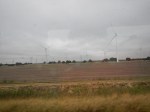

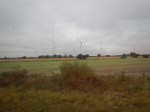
These pictures show the area is all about energy.
Keadby Power Station
Keadby power station is a 734 MW gas-fired power-station, that opened in 1996.
Keadby 2 Power Station
Keadby 2 is described on this page of the sseThermal web site.
These are the three opening paragraphs.
Keadby 2 is a new 840MW gas-fired power station in North Lincolnshire currently being constructed by our EPC contractor Siemens Energy. The project is adjacent to our operational Keadby 1 Power Station.
SSE Thermal has partnered with Siemens Energy to introduce first-of-a-kind, high-efficiency gas-fired generation technology to the UK. When completed, Keadby 2 is expected to become the cleanest and most-efficient gas-fired power station in Europe.
The station will also be capable of being upgraded to further decarbonise its generation through carbon capture or hydrogen technology, as routes to market develop.
Note.
- It will be possible to add Carbon Capture and Storage technology to Keadby 2 to make the plant net-zero carbon.
- Keadby 2 will be able to run on hydrogen.
- Keadby 2 is the under-construction power station in my pictures.
Could this be the prototype gas-fired power station of the future?
Keadby 3 Power Station
Keadby 3 is described on this page of the sseThermal web site.
These are the two opening paragraphs.
SSE Thermal is developing the option for a low-carbon combined cycle gas turbine (CCGT) at our Keadby site in North Lincolnshire, which will be known as Keadby 3.
As part of our commitment to a net zero emissions future, Keadby 3 will only be built with a clear route to decarbonisation, either using hydrogen as a low-carbon fuel, or equipping it with post-combustion carbon capture technology. The project is at the early stages of development and no final investment decision has been made.
Keadby 3 is still in the consultation and planning stage.
This newsletter on the sseThermal web site, gives some useful information about Keadby 3.
These are the first three paragraphs.
We are proposing to build a new gas fired power station at Keadby, North Lincolnshire. The project, known as Keadby 3, will have a generating capacity of up to 910 megawatts (MW) and will provide the essential back up to renewable generation and reliable and flexible energy during the country’s transition to Net Zero.
Keadby 3 will be a highly efficient gas fired power station. It will either use natural gas as the fuel and be fitted with a Carbon Capture Plant (CCP) to remove carbon dioxide (CO2) from the emissions to air from the plant, or it will be fired on primarily hydrogen, with no carbon dioxide emissions to air from its operation. Both options are currently being considered, and government is also currently considering the roles of carbon capture and hydrogen in the power sector nationally.
Keadby 3 will require connections for natural gas and possibly hydrogen fuel, water for use in the process
and for cooling and possibly for a pipeline to export the captured CO2 into a gathering network being provided by others and from there to a permanent geological storage site. An electricity connection to export the generated electricity to the UK transmission system will also be required. The plant would be capable of operating as a dispatchable low-carbon generating station to complement the increasing role of renewables in supplying the UK with electricity
Note.
- The three Keadby gas-fired power stations can generate 2484 MW of electricity in total.
- By comparison, the under-construction Hinckley Point C nuclear power station will be able to generate 3200 MW.
- The addition of a Keadby 4 power station, if it were the same size as Keadby 3, would mean the Keadby cluster of gas-fired power stations had a capacity of 3394 MW and they would be larger than the big nuclear station.
In terms of power output, it is an interesting alternative to a larger nuclear power station.
What About The Carbon?
If you’re burning natural gas, you will produce some carbon dioxide.
Power generation from natural gas creates 0.2 Kg of CO2 per kWh according to this web page.
So a 3000 MW station that produces 3000 MW, will produce 3000 MWh or 3000000 kWh in an hour.
This will create 600,000 Kg or 600 tonnes of carbon dioxide in an hour.
As there are roughly 9000 hours in a year, that is roughly 5.4 million tonnes of carbon dioxide.
This newsletter on the sseThermal web site, gives some information about sseThermal are going to do with the carbon dioxide.
As a low-carbon CCGT, Keadby 3 comprises one high efficiency gas turbine and associated steam turbine and either the infrastructure required to allow the CCGT to fire primarily on hydrogen gas, r inclusion of a post combustion Carbon Capture Plant (CCP) in a scenario where natural gas is used as the fuel. In the latter scenario, this is required in order that CO2 emissions are captured and directed to an offshore geological store through the Humber Low Carbon cluster pipeline network being developed by National Grid Ventures and partners.
A diagram of these components, and optional components, is shown below.
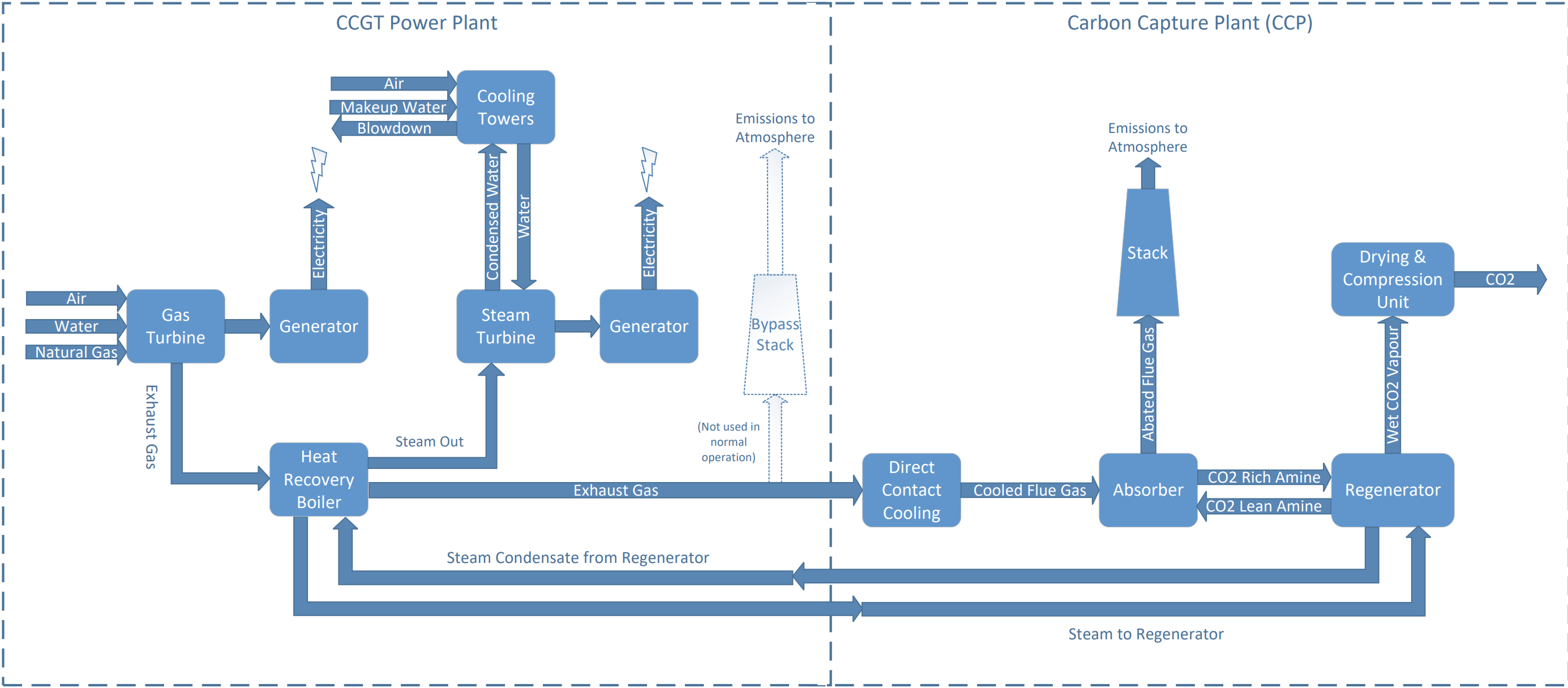
Note.
- Click on the image to get a larger view.
- The CCGT Power Plant is on the left.
- Most of the power is generated by the gas-turbine.
- Heat is recovered to create steam, which drives a turbine to create more electricity
- The Carbon Capture Plant is on the right.
- Carbon dioxide is extracted from the exhaust.
There are two outputs from the plant; electricity and carbon dioxide.
As the carbon dioxide is in a pipe from the drying and compression unit, it is easy to handle.
The newsletter says this about what will happen to the carbon dioxide.
CO2 emissions are captured and directed to an offshore geological store through the Humber Low Carbon cluster pipeline network being developed by National Grid Ventures and partners.
As there are several worked out gas fields in the area, there are places to store the carbon dioxide.
Storing The Carbon Dioxide
This map shows the Zero Carbon Humber pipeline layout.

Note.
- The orange line is a proposed carbon dioxide pipeline
- The black line alongside it, is a proposed hydrogen pipeline.
- Drax, Keadby and Saltend are power stations.
- Easington gas terminal is connected to around twenty gas fields in the North Sea.
- The terminal imports natural gas from Norway using the Langeled pipeline.
- The Rough field has been converted to gas storage and can hold four days supply of natural gas for the UK.
I can see this network being extended, with some of the depleted gas fields being converted into storage for natural gas, hydrogen or carbon dioxide.
Using The Carbon Dioxide
But I would prefer , that the carbon dioxide were to be put to use. Under Carbon Capture and Utilisation on Wikipedia, a variety of uses are shown.
Surprisingly, they don’t talk about using the carbon dioxide to promote the growing of crops in green houses.
I do think, though, that some clever chemists will find ways to convert the carbon into some form of advanced engineering plastics to replace steel.
Hydrogen-Fuelled Power Stations
Note how on the map the hydrogen pipeline goes through the Keadby cluster of power stations.
- Hydrogen is a zero-carbon fuel.
- It will be produced offshore by wind turbines connected to electrolysers.
- The hydrogen will be brought ashore using the existing gas pipeline network.
- Excess hydrogen could be stored in the worked out gas fields.
I suspect there will be a massive increase in the number of wind turbines in the North Sea to the East of Hull.
Hydrogen Steelmaking
In ten years time, this will surely be the way steel will be made. British Steel at Scunthorpe would surely be an ideal site.
It would also be an ideal site for the HIsarna steelmaking process, which generates much less carbon dioxide and because it is a continuous process, what carbon dioxide is generated is easily captured.
Conclusion
Installations like this will mean that large nuclear power stations built with Chinese money are not needed.
Microwaves Could Turn Plastic Waste Into Hydrogen Fuel
This headline from this article in The Times could be the headline of the day!
Although thinking about it, it wouldn’t be a good idea to put all your plastic waste in the microwave and switch it on. It might catch fire or even worse create lots of hydrogen in your kitchen, which could be followed by a mini-Hindenburg disaster in the kitchen.
These are the introductory paragraphs.
From the yellowed bottles in landfill to the jellyfish-like bags clogging the oceans, plastics pollution is an apparently intractable problem.
Yet, chemists lament, it shouldn’t be. Within this waste there is something extremely useful, if only we could access it: hydrogen. Now a British team of scientists believes it has found a way to get at it, and do so cheaply, thanks to tiny particles of iron and microwaves.
If their system works at scale they hope it could be a way of cheaply converting useless plastic into hydrogen fuel and carbon.
Don’t we all want to believe that this impossible dream could come true?
Some Background Information
Some of the things I talk about will be technical, so I will have a bit of a preamble.
Hydrogen; Handling And Uses
Because of pre-World War Two airships, which tended to catch fire and/or crash, hydrogen has a bad reputation.
I used to work as an instrument engineer in a hydrogen plant around 1970. To the best of my knowledge the plant I worked in is still producing hydrogen in the same large building at Runcorn.
Hydrogen is one of those substances, that if you handle with care, it can be one of the most useful elements in the world.
It is a fuel that burns creating a lot of energy.
The only by-product of hydrogen combustion is steam.
It is one of the feedstocks for making all types of chemicals like ethylene, fertilisers, ammonia, pharmaceuticals and a wide range of hydrocarbons.
Hydrogen is a constituent of natural gas and in my youth, it was a constituent of town gas.
Hydrogen and hydrocarbons are involved in the manufacture of a lot of plastics.
In the future, hydrogen will have even more uses like making steel and cement, and powering railway trains and locomotives, and shipping of all sizes.
Hydrocarbons
According to Wikipedia, hydrocarbons are compounds consisting entirely of atoms of hydrogen and carbon.
In a kitchen, there are several hydrocarbons.
- If you cook by gas, you will probably be burning natural gas, which is mainly methane, which is a hydrocarbon
- Some might use propane on a barbecue, which is another hydrocarbon.
- I suspect you have some polythene or polyethylene, to use the correct name, in your kitchen. This common plastic is chains of ethylene molecules. Ethylene is another hydrocarbon.
- There will also be some polypropylene, which as the name suggests is made from another hydrocarbon; propylene.
Hydrocarbons are everywhere
Plastics
I used to work in two ICI divisions; Mond at Runcorn and Plastics at Welwyn Garden City
- The forerunners of ICI Mond Division invented polyethylene and when I worked at Runcorn, I shared an office, with one of the guys, who had been involved before the Second World War. in the development of polyethylene.
- Plastics Division used to make several plastics and I was involved in various aspects of research plant design and production.
One day, I’ll post in this blog, some of the more interesting and funnier stories.
Many plastics are made by joining together long chains of their constituent molecules or monomer.
- Ethylene is the monomer for polyethylene.
- Propylene is the monomer for polypropylene.
- Vinyl chloride is the monomer for polyvinylchloride or PVC.
So how are the chains of molecules built?
- Polyethylene was made by ICI. by applying large amounts of pressure to ethylene gas in the presence of a catalyst.
- They used to make polypropylene in large reaction vessels filled with oil, using another catalyst.
I suspect both processes use large quantities of energy.
Catalysts
A catalyst is a substance which increases the rate of a chemical reaction.
Judging by the number of times, I find new catalysts being involved in chemical reactions, the following could be true.
- There are processes, where better catalysts can improve yields in the production of useful chemicals.
- There is a lot of catalyst research going on.
Much of this research in the UK, appears to be going on at Oxford University. And successfully to boot!
Velocys
It should be noted that Velocys was spun out of Oxford University, a few years ago.
- The company appears to have improved the Fischer-Tropsch process.
- They are building a waste-to-aviation biofuel plant in Lincolnshire.
- They are backed by British Airways, Shell and UK plc.
This infographic shows their process.
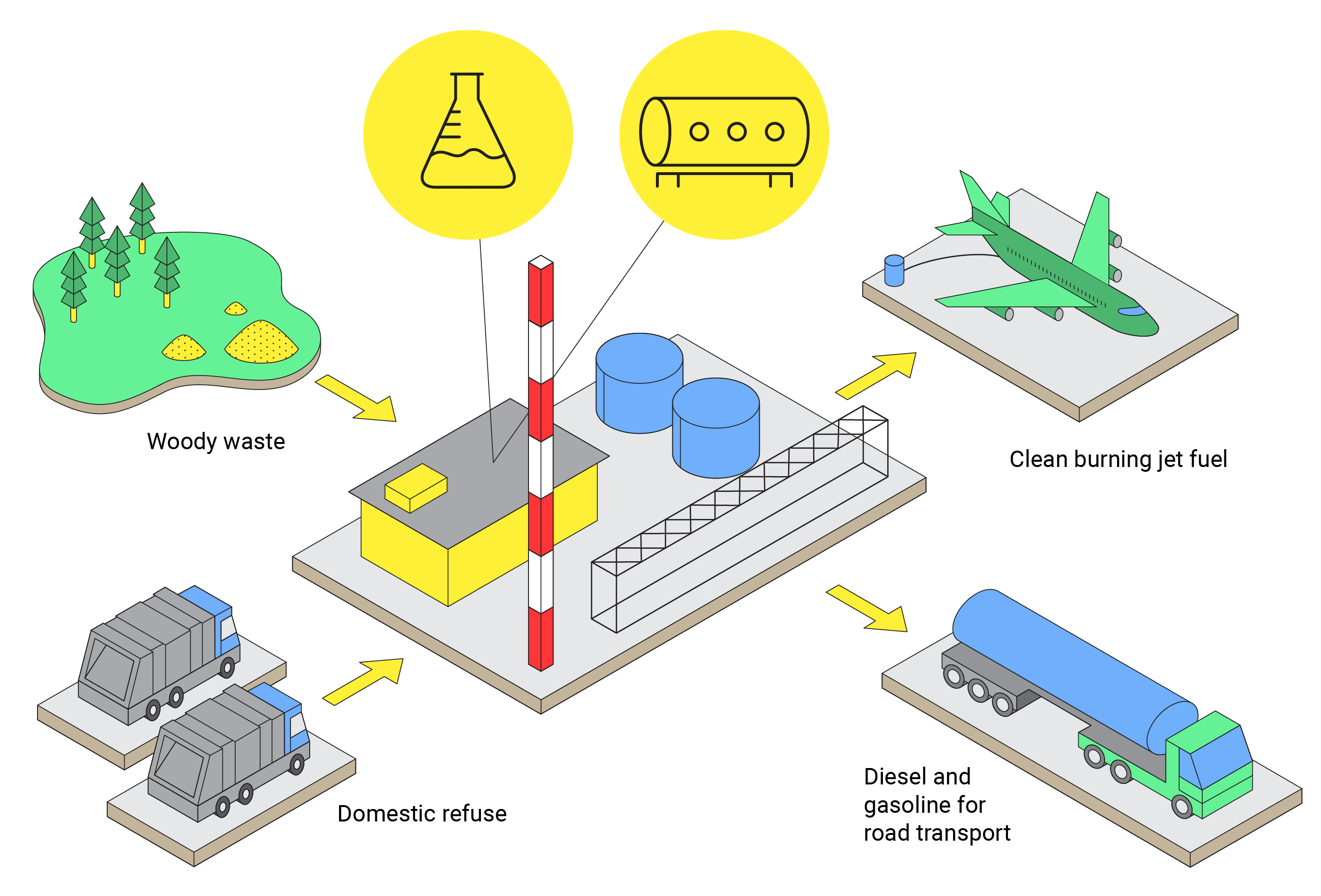
This could be a route to net-zero carbon aviation and heavy haulage.
The beauty is that there would need to be little modification to existing aircraft and trucks.
Oxford University’s Magic Process
These paragraphs from The Times article explain their process.
The clue came in research on particles of iron, and what happens when they get really small. “There’s a fascinating problem,” Professor Edwards said. “You take a bit of metal, and you break it into smaller and smaller bits. At what stage does it stop behaving like a copy of the bigger bit?”
When the particle gets below a critical size, it turns out it’s no longer a metal in the standard sense. The electrical conductivity plummets, and its ability to absorb microwaves does the reverse, increasing by ten orders of magnitude.
Professor Edwards realised that this could be useful. “When you turn on the microwaves, these things become little hotspots of heat,” he said. When he put them in a mix of milled-up plastic, he found that they broke the bonds between the hydrogen and carbon, without the expense and mess of also heating up the plastic itself.
What is left is hydrogen gas, which can be used for fuel, and lumps of carbon nanotubes, which Professor Edwards hopes might be of a high enough grade to have a use as well. The next stage is to work with industry to find ways to scale it up.
It sounds rather amazing.
Going Large!
This article from The Times on Friday, is entitled Plastic To Be Saved From Landfill By Revolutionary Recycling Plants.
These are the two introductory paragraphs.
Thousands of tonnes of plastic waste will be turned into new plastic in Britain rather than dumped in landfill sites, incinerated or sent overseas under plans for four new plants that will use cutting-edge recycling technology.
Up to 130,000 tonnes of plastic a year will be chemically transformed in the facilities, which are to be built in Teesside, the West Midlands and Perth.
It all sounds like technology, that can transform our use of plastics.
Conclusion
In the years since I left Liverpool University in 1968 with a degree in Electrical and control Engineering, it has sometimes seemed to me, that chemistry has been a partly neglected science.
It now seems to be coming to the fore strongly.
Hydrogen On The Line
This article on The Engineer is entitled On Track: Advances In UK Hydrogen Rail.
This sub-heading introduces the article.
An expert panel from Vivarail, Birmingham University and Alstom discuss UK developments in hydrogen powered rail transport.
The article is a very readable article, that explains, the whys, wherefores and hows of hydrogen powered rail transport in the UK.
Scotland To Trial World’s First Hydrogen-Powered Ferry In Orkney
The title of this post, is the same as that of this article on The Herald.
This is the introductory paragraph.
The world’s first hydrogen-fuelled ferry is set to undergo testing as Scotland powers forward in the green energy race.
I wonder how many of these there are in the world?
This paragraph lists those behind the project.
The HyDIME project is made up of a consortium of partners being led by Ferguson Marine. Partners include ULEMCo, Lloyd’s Register, HSSMI and Orkney Islands Council.
I suspect ULEMCo will provide the motive power, as their speciality is converting vehicles to run on hydrogen or dual-fuel of hydrogen and diesel.
There is also a HyDIME web site.
This is the project description from the web site.
- HyDIME (Hydrogen Diesel Injection in a Marine Environment) is a 12 month, Innovate UK funded project that will use an environmentally friendly form of hydrogen as a fuel for a commercial ferry operating between Shapinsay and Kirkwall in Orkney.
- HyDIME aims to make waves in the marine industry by proving the safe integration and use of hydrogen on vessels. One of HyDIME’s goals is the design and physical integration of a hydrogen injection system on a commercial passenger and vehicle ferry which will be the first of its kind worldwide.
- The hydrogen used in the HyDIME project will be cleanly produced from renewable energy. Excess energy generated from Orkney’s abundance of wind and tidal power will be used to produce hydrogen via electrolysis, resulting in carbon free, ’green’ hydrogen.
- Looking to the future beyond the project, HyDIME will conduct a scale-up analysis, addressing key questions such as, “How much hydrogen and renewable energy would be required to fuel the Shapinsay ferry PLUS a fleet of hydrogen vehicles in Orkney?” and “Can this project be replicated in other areas of Scotland and the rest of the UK?”.
- The HyDIME project will provide a stepping stone to accelerate and de-risk future hydrogen marine projects and will contribute towards growing the hydrogen economy in the UK.
This looks to be a very professional project, as they seem to be trying to answer all the questions, anyone will ask.
SEA Electric And Toyota Team Up For Electric Trucks
The title of this post, is the same as that of this article on AuManufacturing.
These are the introductory paragraphs.
Toyota’s Hino truck division has announced a major foray into electric and hydrogen powered trucks, with Melbourne’s SEA Electric set to partner in the development of a new medium sized truck.
SEA Electric manufactures electric vehicle drive trains in Melbourne and has been converting Hino truck models to electric here and in the United States.
Now the company will partner with Hino in its global Project Z which will expand its range of largely diesel trucks.
It appears that electric and hydrogen powered vehicles are being developed.
This paragraph describes the powertrain.
Running the SEA Drive 120 a powertrain, it is mounted on on a cab/chassis platform. The 1470Nm electric motor and 136kWh battery pack delivers range of up to 350km (220 miles), and a typical breakeven period of less than 4 years.
They also claim to have eliminated the need for a battery cooling system.
Conclusion
I am drawn to these conclusions.
It seems that there are scores of small companies all over the world developing battery and hydrogen power systems for trucks, buses and trains.
As with SEA Electric and Hino, big manufacturers are often happy to tie up with smaller technology companies to create new products.
Carnot – Is This The Next Generation Of Hydrogen Technology?
I first heard about Carnot on the crowdfunding site I use.
On this page on their web site, they talk about disruptive technology and say this.
The off-grid energy and long-haul transport sectors, unregulated until the last decade, must be net zero by 2050. Battery technology is unsuitable due to cost and weight. Hydrogen technology is considered to be the only viable solution to decarbonising these sectors. Carnot power units will have greater efficiency, lower total cost of ownership and greater range, reliability and durability than fuel cells. They are the key to unlocking a hydrogen future while minimising the impact to supply chains.
I have put a bet of a grand on this company, just in case it does turn out to be the next generation of hydrogen technology.
Birmingham Announces Hydrogen Bus Pilot
The title of this post, is the same as that of this article on SmartCitiesWorld.
This is the introductory paragraph.
The city council has bought 20 new hydrogen double-decker buses as part of its Clean Air Hydrogen Bus Pilot to kick-start the hydrogen market as a viable zero-emission fuel.
The buses will be built by Wrightbus.
 The Anonymous Widower