Cambridgeshire Company’s Self-Charging Trains Project Wins Government Funds
The title of this post, is the same as that of this article on the BBC.
These four paragraphs outline what the company is developing and how they received government funding.
Echion Technologies, based in Sawston near Cambridge, is creating train batteries that can charge from overheard wires, the Department for Transport said.
The trains would be able to use the batteries on unelectrified track.
The project was among the winners of the government’s First of a Kind competition.
The competition aims to award funding to projects that could transform the future of transport.
I have a few thoughts.
The Description In The First Of A Kind 2022 Winners Document
In this document, this is said.
Project No: 10039100
Project title: UBER – Ultra-high power Battery for low Emission Rail
Lead organisation: ECHION TECHNOLOGIES LTD
Project grant: £59,917
Public description: Project UBER (Ultra-high power Battery for low Emission Rail), aims to demonstrate for the first time, Echion’s XNO(tm) battery chemistry as the preferred battery technology for certain classes of battery electric trains. It targets Theme 1 of this competition.
Specifically, UBER aims to demonstrate the suitability of XNO(tm) for passenger trains that can be powered by the AC overhead electrification and charge a battery from the overhead wire (or another form of ‘standard’ trackside power — e.g. 3rd rail), to then run in battery-only mode on unelectrified section of a route. An example of such a train is the Revolution Very Light Rail (Revolution VLR) developed by Transport Design International (TDI), who is a partner in UBER.
Applying The Echion Technologies Batteries To Electric Trains
Consider.
- The BBC article is accompanied by a picture of a Class 717 train, which like the Class 700 train is dual voltage.
- Southeastern have thirty similar Class 707 trains, which are third-rail, although according to Wikipedia, were tested as dual-voltage trains.
- Most modern trains, like these Desiro City units made by Siemens, have a mix of motored and trailer cars, with one or more pantograph cars between the two driver cars.
- Because power is needed in all cars, there will be an electrical bus from one end of the train to distribute power.
- All trains in the family appear to have at least one trailer car, which will also be connected to the electrical bus.
With a family of trains like the Desiro City, Alstom’s Aventra, CAF’s Civity, Hitachi’s AT-200 or AT-300 or Stadler’s FLIRTs, train manufacturers assemble various cars, interiors and electrical gubbins together, to get the train performance and capability.
I would expect that the battery would be placed, where there is space and the most likely place is under the trailer car.
In some ways, it would work like the battery in a laptop computer, where operation is as follows.
- If there is external power, the computer runs on that power and the battery is also charged, if it is not fully-charged.
- If there is no external power, the computer runs on battery power, until the battery goes flat.
With a battery-electric train, operation is similar, with an important addition.
- If there is external power, the train runs on that power and the battery is also charged, if it is not fully-charged.
- If there is no external power, the train runs on battery power, until the battery goes flat.
- Desiro City and many other electric trains have regenerative braking and under braking, the electricity generated is is stored in the battery, if it is not fully-charged.
It could be considered by some, that regenerative braking is self-charging. But unfortunately, regenerative braking doesn’t recover all energy during braking. But it can be up to 70-80 % efficient.
Connecting The Echion Technologies Battery To The Train
The battery will have to be connected to the electrical bus, that runs the full length of the train.
As a Control Engineer, I suspect there will be a sophisticated control system, that will switch the battery between various modes and control the pantograph and third-rail shoes.
Perhaps, Echion Technologies have developed an all-purpose controller that could fit all trains?
Battery EMUs Envisaged In Southeastern Fleet Procurement
The title of this post, is the same as that of this article on Railway Gazette.
This is the first paragraph.
Southeastern has invited expressions of interest for the supply of new electric multiple-units with an optional battery capability for operation away from the 750 V DC third-rail network.
This article on bidstats is entitled Supply Of And Maintenance Support For New Rolling Stock For Southeastern, and gives more details.
These are my thoughts.
Southeastern HighSpeed Services
There would appear to be no changes in this contract to the Class 395 trains, that work on High Speed One, as this is said in the bidstats article.
Full compatibility with Southeastern infrastructure (excluding High Speed 1 infrastructure)
which appears to rule out running on High Speed One.
In addition, this article on Rail Magazine is entitled Southeastern’s Class 395 Javelin Train Sets Are To Receive A £27 million Facelift.
Southeastern Have Both 75 and 100 mph Trains
In addition to their Class 395 trains, Southeastern have the following trains in their fleet.
- Class 375 trains – 100 mph – 10 x 3 cars
- Class 375 trains – 100 mph – 102 x 4 cars
- Class 376 trains – 75 mph – 36 x 5 cars
- Class 465 trains – 75 mph – 129 x 4 cars
- Class 466 trains – 75 mph – 36 x 2 cars
- Class 707 trains – 100 mph – 18 x 5 cars
Note.
- Running a mixed fleet of 75 and 100 mph trains can’t be very efficient.
- The Class 465 and 466 trains are the oldest trains and date from 1991-1994.
- They are often to be seen in ten-car formations of 2 x 465 trains and a Class 466 train.
- Another twelve Class 707 trains are planned to join Southeastern.
I would expect the Class 465 and Class 466 trains to be replaced first.
What Length Will The New Trains Be?
If you look at the new suburban electric trains, they have the following lengths.
- c2c – Class 720 trains – 5 cars
- Greater Anglia – Class 720 trains – 5 cars
- Northern – Class 331 trains – 3 and 4 cars
- Southeastern – Class 707 trains – 5 cars
- South Western Railway – Class 701 trains – 5 and 10 cars
- West Midlands Trains – Class 730 trains – 3 and 5 cars
Note.
- Southeastern already run five-car trains as pairs.
- A significant proportion of existing suburban trains are five-car trains.
- Great Western, Hull Trains, LNER, Lumo and TransPennine Express run five-car Hitachi trains, with more companies to follow.
- A pair of five-car trains make a pair of a convenient length for most platforms.
I would be fairly confident, that the new trains will be five-car trains, with the ability to run as pairs.
What Will Be The Operating Speed Of The New Trains?
To match the speed of the Class 375 and Class 707 trains, I would expect them to be 100 mph trains.
The Quietness Of Battery-Electric Trains
All of the battery-electric trains I have ridden, have been mouse-quiet, with none of the clunking you get for a lot of electric trains.
This is said in the bidstats article says this about the interiors
Interiors suitable for metro & mainline operation.
I wouldn’t be surprised to see a lot of these trains on commuter routes to attract passengers.
Battery Power
This is said in the bidstats article about battery power.
Inclusion of options for traction batteries with capability for operation in depots and sidings without the need for external power supply, and with the capability to operate on the main line where power supply is not available due to isolations or incidents, or for non-electrified line sections of up to 20 miles.
Although Merseyrail’s new Class 777 trains are not in service yet, I find it interesting that the proposed Southeastern trains will be similarly-fitted with a small battery for depot and siding operation.
The twenty mile battery range is specific and I wonder if it will be used innovatively. I suspect it could be a bit longer in the future, as battery technology improves.
Possible Electrified Routes Using Battery Power
These are a few possibilities.
The Hoo Branch
In Effort To Contain Costs For Hoo Reopening, I discussed running electric trains to a proposed Hoo station.
I made these two points.
- Hoo junction to Hoo station is no more than five or six miles.
- There are also half-a-dozen level crossings on the route, which I doubt the anti-third rail brigade would not want to be electrified.
It would appear that a battery-electric train with a range of twenty miles would handle this route easily.
- Charging would be on the nearly thirty miles between Hoo junction and Charing Cross station.
- No charging would be needed at Hoo station.
There may be other possibilities for new routes locally to open up new housing developments.
The Sheerness Line
The Sheerness Line has the following characteristics.
- It is double-track
- It is electrified
- It is less than eight miles long.
- For most of the day, the service is one train per hour (tph)
- There are two tph in the Peak.
- Would two tph attract more passengers to the line?
- Does the power supply on the Sheerness Line limit the size and power of trains that can be run on the line?
- Is there a need for one train per day to London in the morning and a return in the evening?
- Could the Sheerness Line be run more economically with battery trains. providing a two tph service all day?
The Isle of Sheppey needs levelling up, perhaps 100 mph trains to London using battery power on the Sheerness Line, might just make a difference.
The Medway Valley Line
The Medway Valley Line has the following characteristics.
- It is double-track
- It is electrified
- It is less than twenty-six and a half miles long.
- For most of the day, the service is two tph.
- In the Peak there are HighSpeed services between Maidstone West and St.Pancras International stations.
If electrification was removed between Paddock Wood and Maidstone West stations, the HighSpeed services could still be run and battery-electric trains with a twenty mile range could still run the Tonbridge and Strood service.
The Marshlink Line
The Marshlink Line has the following characteristics.
- It is mainly single-track with a passing loop at Rye station.
- It is not electrified
- It is 25.4 miles between the electrified Ashford International and Ore stations.
- Services are irregular and less than one tph.
If the proposed battery-electric train had a range of thirty miles, it should be able to handle the Marshlink Line.
The service between Eastbourne and Ashford International stations would need to be moved between the Southern and Southeastern operations.
The Uckfield Branch
The Uckfield Branch has the following characteristics.
- It is a mixture of single- and double-track.
- It is not electrified South of Hurst Green Junction.
- It is 24.7 miles between the electrified Hurst Green Junction and Uckfield station
- Services are one tph.
If the proposed battery-electric train had a range of thirty-miles, it should be able to handle the Uckfield Branch, with a charging system at Uckfield station.
Will Battery-Electric Trains Allow Some Lines To Have Their Electrification Removed?
There are several reasons, why electrification might be removed.
- It is on a line, where the electrification needs upgrading.
- It is on a line, where there are lots of trespassers.
- Possibly at a level-crossing or a stretch of track with several.
- Possibly in a tunnel, with a large inflow if water.
- It is a depot or siding, where safety is important to protect the workforce.
Obviously, the electrification would not be removed unless battery-electric trains can handle all possible services.
These are surely some possibilities for electrification removal.
The Hayes Line
The Hayes Line has the following characteristics.
- It is double-track
- It is electrified
- It is less than eight miles to Ladywell Junction, where the branch joins the main line at Lewisham.
- It is currently run by Class 465 and Class 466 trains, which will likely be changed for the new trains with a battery capability.
- Services are four tph.
If the proposed battery-electric train had a range of twenty-miles, it would be able to handle the route between Ladywell junction and Hayes station.
Erith Loop, Crayford Spur and Slade Green Depot
This map from Cartometro.com shows the Erith Loop, the Crayford Spur and the Slade Green Depot.

Note.
Not many trains take the Erith Loop or the Crayford Spur.
- The distance between Slade Green and Barnehurst is less than a mile-and-a-half.
- Dartford station is off the South-East corner of the map.
- The distance between Barnehurst and Dartford is less than three miles.
- The distance between Slade Green and Crayford is less than two miles-and-a-half.
- The distance between Crayford and Dartford is less than two miles.
- The main line through Slade Green would need to remain electrified, as electric freight trains use the line.
I suspect, that quite a lot of electrification could be removed here, much to the disgust of the copper thieves.
It might even be possible to build on top of the depot.
Equipmake Hybrid To Battery Powered LT11
The bus in this video from Public Transport UK, may look like any of the thousand New Routemasters on the streets of London.
But it’s not, as it’s been given a transmission transplant by Equipmake of Snetterton in Norfolk.
The observant amongst you will notice, it has a refurbished interior, as I wrote about in My First Ride In A Refurbished New Routemaster.
There is also this press release from Equipmake, which is entitled Equipmake Showcases Sector-Leading Repower Technology With Fully-Electric New Routemaster Bus.
Some points from the press release.
- Equipmake’s cutting-edge Zero Emission Drivetrain (ZED), uses a 95% British-built component content.
- With pre-service trials already started in London, operated by Metroline, the electric version of the New Routemaster will continue to be assessed over the next six months.
- The repowered New Routemaster, developed by Equipmake at its base in Snetterton, Norfolk, features a 400kWh battery enabling an expected in-service range of 150 miles – more than enough for a day’s running.
- The development of the all-electric New Routemaster has come about thanks to a programme part funded by the UK Advanced Propulsion Centre (APC).
- Over the coming months, Equipmake will be trialling additional repowered buses with other bus operators across the UK.
- Featuring an advanced water-glycol cooling circuit, the system has the added benefit of providing interior heating during cold conditions with captured thermal energy.
- When the battery is depleted at the end of a complete duty cycle, it can be recharged at the depot overnight via a CSS DC charging point.
But this is the bit I really like.
Under the skin, the New Routemaster also features Equipmake’s HTM 3500 electric motor. Seamlessly integrated into the prop shaft without the need for a separate transmission, the motor is precisely engineered to meet the demanding requirements of a fully-laden double-decker bus by producing 3,500Nm torque at a motor speed of just 1,000rpm and delivering 400kW maximum power.
It sounds a bit like a modern reincarnation of a TASC unit (torque and speed control unit), which was an industrial drive from the 1960s, used to precisely control industrial machines. I never used one, but I worked in a section at Enfield Rolling Mills, that did.
One car manufacturer of the time, was using them as an automatic transmission for a small car. It might have been Hillman.
A Comparison With The Wrightbus Streetdeck Electroliner BEV
The Wrightbus Streetdeck Electroliner BEV is the company’s latest electric double decker bus and a comparison can be made.
Seats
Equipmake LT11 – 87
Electroliner BEV – 96
Battery Size
Equipmake LT11 – 400 kWh
Electroliner BEV – 340 or 454 kWh
Range
Equipmake LT11 – 150 miles
Electroliner BEV – 200 miles with 454 kWh battery.
Conclusion
This New Routemaster, is certainly no ordinary electric bus.
With the batteries on hybrid buses needing to be replaced regularly, Eqipmake’s transmission transplant could also be scheduled, when a bus needs a new battery.
With Lotus just up the road, the engineering is certainly Normal for Norfolk!
Research And Development Agreement Signed For Hydrogen Combustion Trains In US
The title of this post, is the same as that of this article on H2-View.
This is the opening paragraph.
Hydrogen combustion engine-powered trains are set to be at the centre of a collaborative research and development agreement between Argonne and Oak Ridge National Laboratories and Wabtec in a bid to decarbonise US rail.
The US is certainly calling up the heavy brigade in Argonne National Laboratory, Oak Ridge National Laboratories and Wabtec.
This appears to be the main objective.
It is hoped the team will be able to design train engines that will deliver the same power, range, and cost-effectiveness as current diesel technology.
The article states that there are 25,000 diesel locomotives in the United States, but because of exports to large parts of the world, including the UK, this research could clean up a lot more than just the United States.
The omens are good, in that both Cummins and Rolls-Royce mtu, who are two of the world’s big diesel engine manufacturers have successfully launched hydrogen combustion engines.
Consortium To Develop Low-Cost Operations To Revive France’s Local Lines
The title of this post, is the same as that of this article on Railway Gazette.
This was the first paragraph.
Thales has joined forces with a group of companies and the Nouvelle-Aquitaine Regional Council to develop innovative digital signalling and operations with a view to cutting the cost of running trains on lightly-used rural lines.
When I first read this article, I immediately thought, that the French problem is similar to problems we have in the UK, and I’ve also seen in other countries in Europe like Germany and The Netherlands.
The French consortium are looking at these technologies.
- Platform-agnostic, autonomous train positioning and odometry without trackside infrastructure.
- Cyber-secured data transmission via public telecommunications networks.
- High-density digital terrain mapping.
- Formal methods of generating safety data.
- A tablet-based supervision and operations interface for drivers.
- Integrated surveillance of level crossings.
- Network surveillance using sensors mounted on rail vehicles.
Thales says that the technology ‘will be fully interoperable with the core network and promises to reduce investment and operating costs by more than 30%’. Apart from reviving rural railways, it will improve safety, ‘especially at level crossings’, the company said.
As someone, who was designing and installing automation on heavy machinery nearly sixty years ago, I feel the French are on the right track.
I have a few thoughts.
Could Drone And/Or Missile Guidance Technology Be Used?
It should be noted that Thales Air Defence are a company who manufacture several successful missiles including the NLAW. They are also a subsidiary pf Thales Group, who are leading the French rural rail consortium.
I wouldn’t be surprised to find, that Thales have access to loads of applicable technology.
Could Drivers Use A Tablet To Drive The Train?
I don’t see why not!
The Elizabeth Line has been designed to use auto-reverse to speed up operations at Paddington, which I wrote about in Crossrail Trains Will Have Auto-Reverse.
I suspect that the driver has a simple controller to monitor the reversing train and stop it in an emergency.
Integrated Surveillance Of Level Crossings
Whoever solves this tricky problem will do the railways of the world a big service.
Network Surveillance Using Sensors Mounted On Rail Vehicles
This is starting to happen all over the world.
Conclusion
I think that the results of this French study will be felt worldwide.
Is Hydrogen The Fuel Of The Future?
The title of this post, is the same as that as this article on Engineering and Technology Magazine.
The article is a must read about hydrogen.
The Vivarail Fast Charge System At West Ealing – 7th November 2022
I went to West Ealing station today and took these pictures.
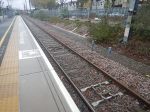
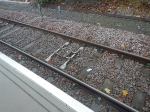
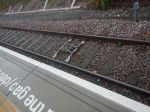
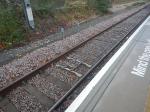
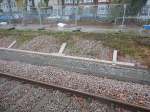
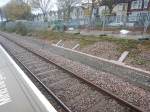
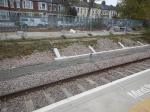
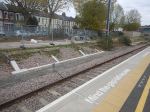

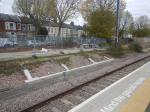
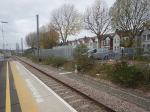
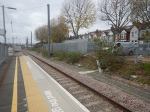
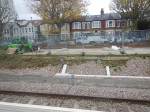
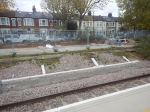
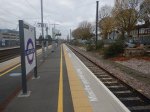
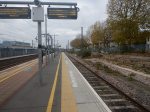
At last, it seems something is happening.
Note the concrete pads on the other side of the track for the bay platform. There appear to be eight pads, which could be to support the containers that will hold the Vivarail Fast Charge System.
Isle of Man Steam Packet Fears Wind Farm Plans May Disrupt UK Routes
The title of this post, is the same as that of this article on the BBC.
These are the first four paragraphs.
Plans to build two new offshore wind farms in the Irish Sea could disrupt Isle of Man ferry services, a Manx operator has warned.
Energy firms have proposed projects named Morgan and Morecambe in areas between the island and Lancashire.
The Isle of Man Steam Packet Company said the developments could cause navigation issues for its sailings to Liverpool and Heysham in bad weather.
But the project’s backers said it was possible to find “ways to co-exist”.
Given, that the approaches to the Ports of Felixstowe, Immingham, Leith, Liverpool, London Gateway and Tilbury, are littered with hundreds of wind turbines, I would suspect that finding a solution will not be difficult.
Perhaps, The Isle of Man Steam Packet Company is angling for a subsidy.
The Isle of Man Steam Packet Company has a current fleet of three ships.
- The company serves Belfast, Dublin, Heysham and Liverpool.
- All routes will likely be through wind farms in a few years.
- The ships were all built in 1998.
- A new ship is being built in South Korea for delivery in 2023.
- All ships are diesel-powered.
Does The Isle of Man Steam Packet Company have a decarbonisation policy?
With the three wind farms having the following sizes.
- Mona – 1500 MW
- Morgan – 1500 MW
- Morecambe – 480 MW
Perhaps, some of the nearly 3.5 GW could be used to power electric or hydrogen ships to the Isle of Man.
The Isle of Man is also powered currently by the Isle of Man to England interconnector and an 85 MW combined cycle gas turbine power station at Pulrose, in the capital, Douglas.
With all of the wind power surrounding the island, perhaps there is some scope for repurposing the island’s economy.
It’s not the island for steelmaking or heavy industry, but what about a few data centres?
Lost In The Purple
In Whitechapel Station Is The Preferred Interchange, I said this.
It certainly appeared to me from some staff, I spoke to, that some passengers were getting rather lost.
It was also confirmed by a member of Elizabeth Line staff at Moorgate station.
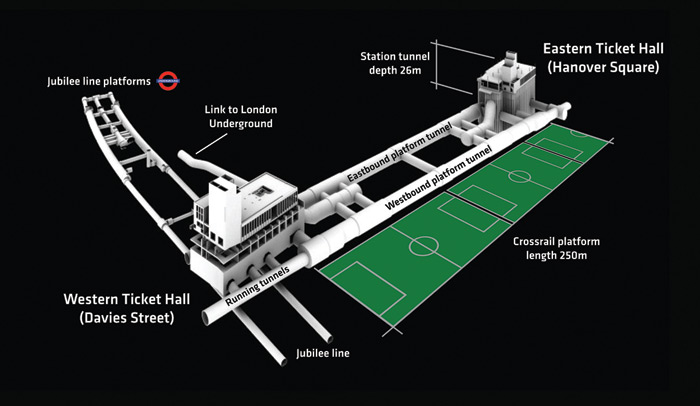
In A Look At Bond Street Station, I showed this image and said the following.
Bond Street station is double-ended.
This visualisation shows the knitting that connects it to the current Bond Street station.
Note.
- The station has two entrances; Davies Street and Hanover Square.
- The length of the Crossrail platforms.
- It looks like the Western interchange between Crossrail and Jubilee Line is easy.
- It could be quite a walk between Crossrail and the Central Line at Davies Street.
- If you’re a strong walker, some will use the Hanover Square entrance to access the Central and Victoria Lines.
On this quick look, I have a feeling that at Bond Street station, it will pay to know your entrances and make sure you’re at the right place on the train.
I could have added, that it will pay to know your entrances on any of the large stations.
At the Moorgate end of Liverpool Street station, yesterday passengers were turning up, who really wanted the Liverpool Street end.
The subterranean information needs to be better.
As an example, there are a few modestly-priced hotels, that include a Premier Inn, clustered around the Elizabeth Line station at Woolwich.
- Woolwich station is a simple single-ended station with the entrance at the Western end of the platforms.
- So passengers for Woolwich should always get in the Western end of the Elizabeth Line trains.
- That would be the front going West.
- That would be the back going East.
If staying at a hotel near an Elizabeth Line station make sure you know your entrance and train position.
So Many Cases On A Train!
This afternoon about three, I went to West Ealing station to see what it was like to transfer between the Elizabeth Line Central Tunnel and the Western Branch at Paddington.
Coming back, I took an Elizabeth Line service that had started from Heathrow Airport and it was one of the busiest Lizzies, I’d ever ridden!
To get on the train at West Ealing station, I got in to probably coach 4 of 9, as that was in the dry and the back end of the train I needed for Moorgate station was certainly in the wet.
I then had to walk half the length of the train to get to the back of the train.
It was not easy, as the train was full of scores of passengers with large wheelie cases.
This got me thinking.
Are Passengers Transferring To The Lizzie Line?
And especially those with large cases. that are the sort you could use for bringing in a pair of folded-up contortionists.
- These cases don’t fit well on the Piccadilly Line, which has only a few step-free stations.
- From what I’ve seen cases are easily wheeled to Elizabeth Line platforms at Heathrow.
- Many of these cases won’t fit in the average family car.
- All parking is expensive at Heathrow, whether it is short, medium or long.
- Valet parking at Heathrow has been devalued by all the scam artists.
- Taxis are the province of those that own oil wells, hedge funds or belong to the highest wunch of bankers.
- Pick-up and drop-off is now very expensive.
- There were a good proportion of couples, who were both dragging or pushing a massive case.
- The Elizabeth Line is cheaper than the Heathrow Express.
- The Elizabeth Line like the Piccadilly Line allows the use of a bank card as a ticket.
- Only the Elizabeth and Piccadilly Lines take you direct to dozens of stations with only same-platform interchanges.
- The Elizabeth Line has step-free interchanges with the Bakerloo, Circle, District, Hammersmith and City, Jubilee, and Metropolitan Lines, the Docklands Light Railway and the London Overground.
- Whitechapel has been turned into a major transport hub for the Easternmost part of London.
There seems to be quite a few reasons why a traveller going to or from Heathrow might at least try the Elizabeth Line.
And travellers seemed to be doing it in droves today!
Were Upmarket Passengers Using The Lizzie Line?
Take the couple next to me on the train from West Ealing.
- Around sixty.
- Very well-dressed.
- Possibly Mediterranean or South American.
- Matching medium-size wheelie-cases.
- She was wearing expensive glasses.
A couple of years ago, they would have probably used the Heathrow Express.
They certainly weren’t the only passengers, who looked like archetypal Heathrow Express passengers.
Will The Lizzie Line Take Passengers From The Piccadilly Line?
As the cost will be the same, I suspect the answer will be yes.
Although, there will be groups of travellers, who will probably remain loyal to the Piccadilly Line.
- If you were going to or from the step-free Cockfosters or Oakwood, with a heavy case, all the way on the Piccadilly Line could be a simple sensible option. I used to live near Oakwood station and remember several long trips on the Piccadilly Line, but not too Heathrow.
- The step-free Kings Cross St. Pancras, Green Park, Knightsbridge and Earls Court may well have reasons to keep their regular passengers.
- Those only travelling a few stops to or from Heathrow will probably stay with the Piccadilly Line for convenience.
- Transport for London have been adding step-free access to the Heathrow Branch and this will surely promote use.
The Piccadilly Line is also getting new trains in a few years.
In Extending The Elizabeth Line – Piccadilly Line To Ealing Broadway, I talked about a proposal to turnback some Piccadilly Line trains at Ealing Broadway station.
I think it is a good idea, as it could make it simpler for Piccadilly Line passengers to access Heathrow and reduce congestion on the Piccadilly Line.
Will The Lizzie Line Take Passengers From The Heathrow Express?
This is an extract from Extending The Elizabeth Line – Piccadilly Line To Ealing Broadway
It will be difficult to predict what will happen to Heathrow Express, but I suspect several groups of passengers will desert it.
- Passengers wanting to go anywhere East of Paddington without changing trains.
- Passengers wanting any Elizabeth Line station.
- Passengers, who don’t like the prices of Heathrow Express.
- Passengers using Oyster or contactless cards.
- Passengers who want to ride on London’s spectacular new Elizabeth Line.
After Old Oak Common station is opened for High Speed Two, the numbers could further decrease.
Will Heathrow Express survive?
Will The Lizzie Line Attract Passengers Who Usually Drive?
Large swathes of the country already have single-change step-free access to the Elizabeth Line.
- All services out of Liverpool Street and/or Stratford.
- All services out of Moorgate.
- All Thameslink services through Farringdon.
- All services out of Paddington.
- All services through Abbey Wood.
- When Crossrail to Ebbsfleet (C2E) opens, this will add all services through Gravesend and Ebbsfleet.
- When High Speed Two opens, this will add all services through Old Oak Common.
- When the Western Rail Approach To Heathrow is completed, this will add all services through Reading.
If you can get a train direct to the Elizabeth Line network and then a train direct to your terminal, would you seriously want all the hassle of parking after a two hour drive?
I can see parking at Heathrow suffering a severe lack of demand.
Conclusion
Lizzie will start a revolution in travel to and from Heathrow.
 The Anonymous Widower