UK Cruise Ships Scrapped In India’s ‘Ship Graveyard’
The title of this post, is the same as that of this article on the BBC.
This is the introductory paragraph.
Two UK cruise ships have been scrapped on an Indian beach despite assurances they would continue to be operated.
The ships are the Marco Polo and the Magellan, whose owner went bust due to the pandemic.
After a couple of transactions, they will be heading to the ship-breaker at Alang in North-West India.
This Google Map shows the yard. Or beach!
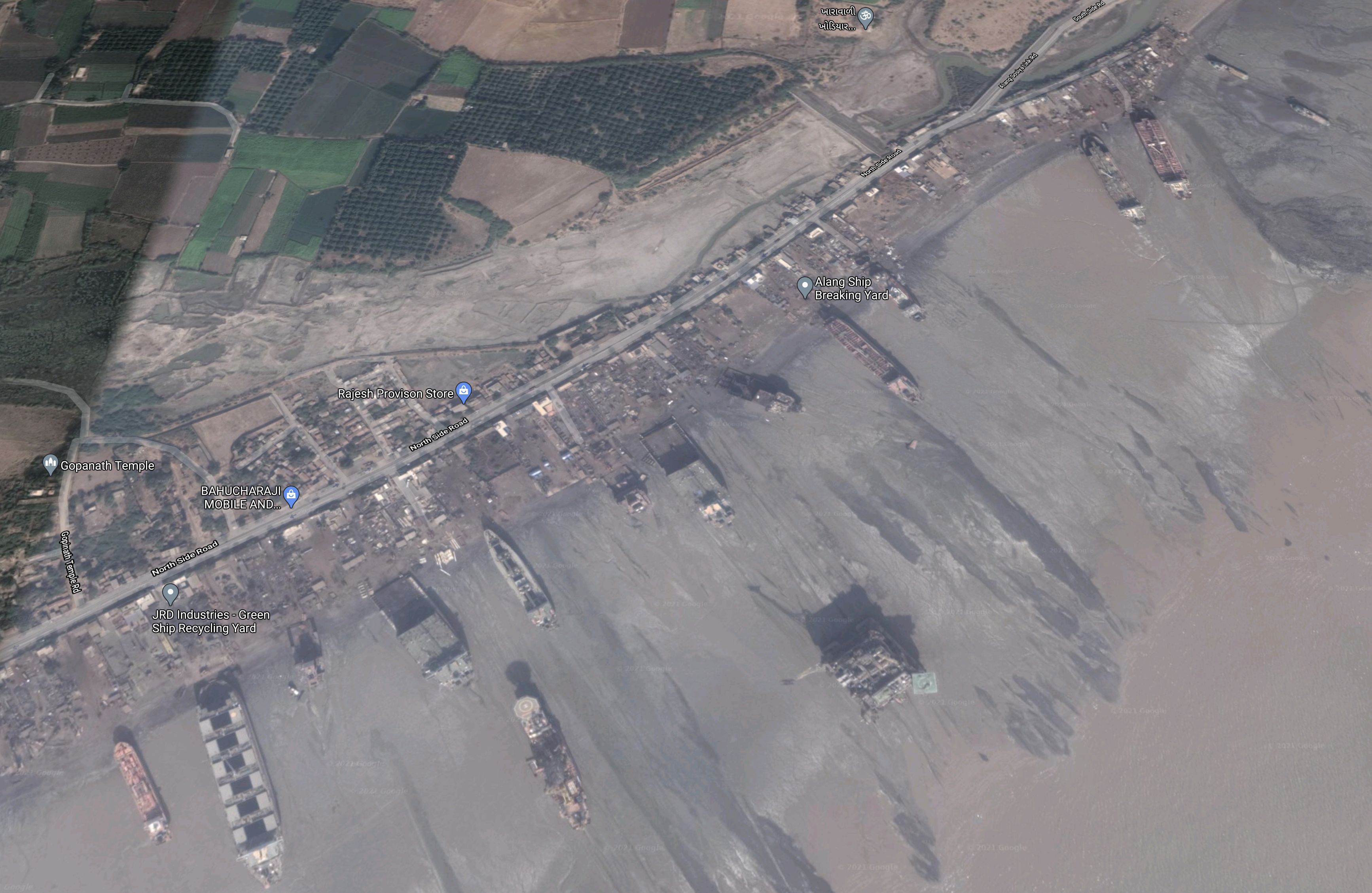
What a mess!
It looks to me, that someone has been doing a bit of sleight of ship to get round UK regulations, which class ships at the end of their lives as hazardous waste and make it illegal to send them to developing countries.
Fossil-Free Steel A Giant Step In Scania’s Decarbonisation
This title of this post, is the same as that of this article on Automotive World.
This is the introductory sub-title.
“Now we are gearing up in our journey towards completely emission-free products!” This is how Scania’s Head of Purchasing Anders Williamsson sees the company’s decision to invest in and enter into a partnership with the company H2 Green Steel (H2GS).
Other points from the article include.
- Each Scania truck contains five tonnes of steel.
- Scania will have a close partnership with H2GS.
- Scania will be able to get 90 % of their steel from H2GS.
H2GS will change steelmaking, when they start production in 2024.
Design For Bank Tube Station Entrance For Approval
The title of this post, is the same as that of this article on Ian Visits.
This is the introductory paragraph.
Design details for Bank tube station’s new Cannon Street entrance have been submitted to the City of London for planning approval.
Note.
- It certainly looks to be an entrance with a very high capacity.
- It looks like there will be a fully-accessible toilet inside the barriers, which many will welcome.
I would hope that approval will be quickly nodded through!
A Thought On Low Vaccination Rates In London
Could London’s bad performance be down to difficult parking provision at vaccination centres?
There was no parking, where I went to the Francis Crick institute for my vaccination.
But I went by bus and train using my Freedom Pass. So it cost me nothing!
According to my contacts at Transport for London, there are still a lot of elderly and eligible Londoners, who don’t have Freedom Passes.
I’d love to see a graphic showing Freedom Passes against vaccination in the over 65’s in London!
There are probably other related questions to answer.
- How many no-shows at vaccination centres are down to parking problems?
- How many of the non-vaccinated couldn’t find a centre close by, that they could drive to?
- How many of the non-vaccinated object to spending money to get to the vaccination centre?
And many more! I hope a university is doing the research!
Digging The Central Entrance To Old Street Station – 27th February 2021
This map from Transport for London shows the future layout of Old Street Roundabout.
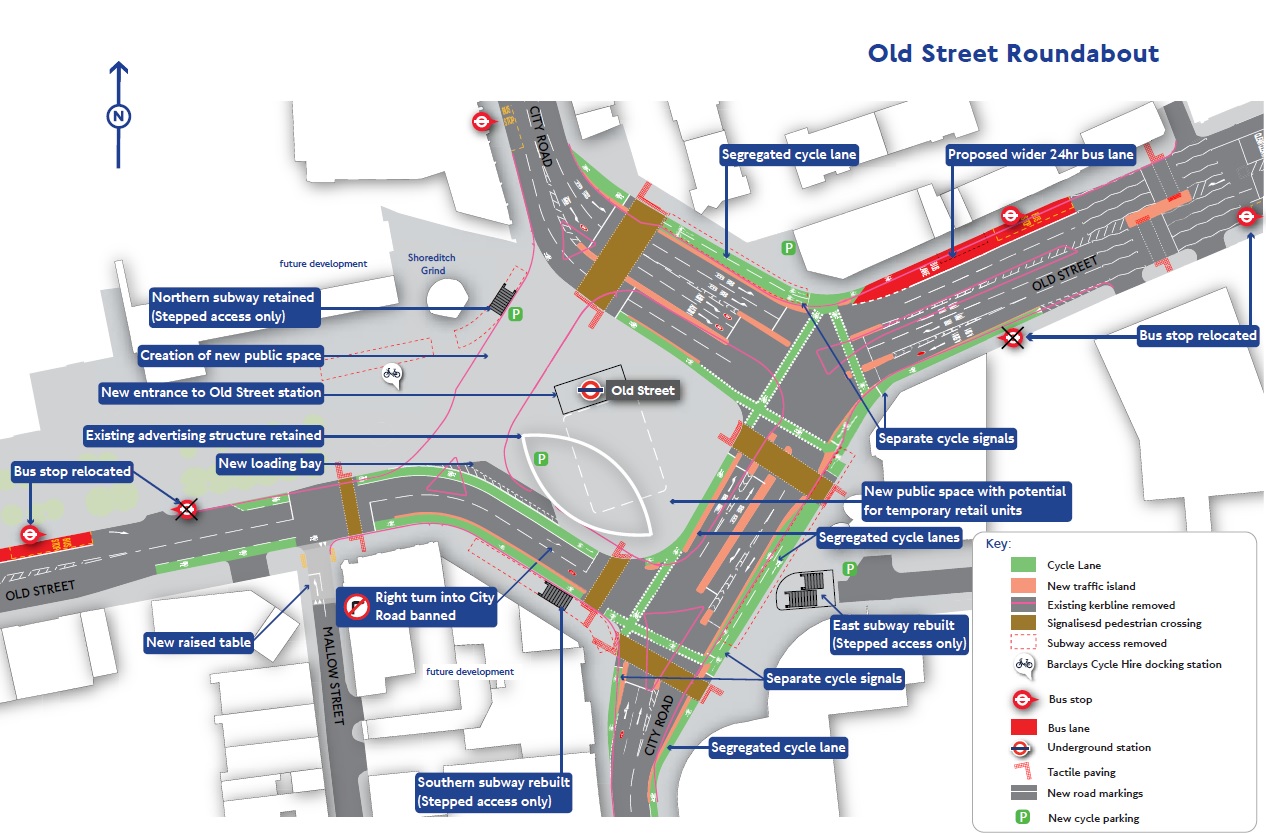
Note the new entrance to the station in the middle of the roundabout.
The contractors are now digging a big hole for the central entrance, with a digger in an unusual turquoise colour.



Note.
- The central and the two other entrances will be steps.
- There will also be a lift, close to the Shoreditch Grind, in the North-West area.
- There will also be a service lift for the shops in the station.
- Particular attention has been given to the use of natural light.
- The central entrance features a green roof.
Some won’t like the design, but I think, its simplicity like some of London’s 1930s Underground stations will endear it to the majority of passengers.
Cowper Street Entrance To Old Street Station – 21st February 2021
These pictures show the start of the works to create the new Cowper Street entrance to Old Street station.
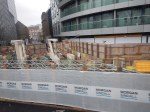


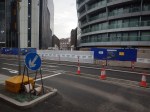
Note the large frame, which had been delivered the previous day.
This map from Transport for London shows the future layout.
The Cowper Street entrance will be in the South-East corner of the roundabout. The map says it will have stepped-access only.
This TfL image is a visualisation of the entrance.
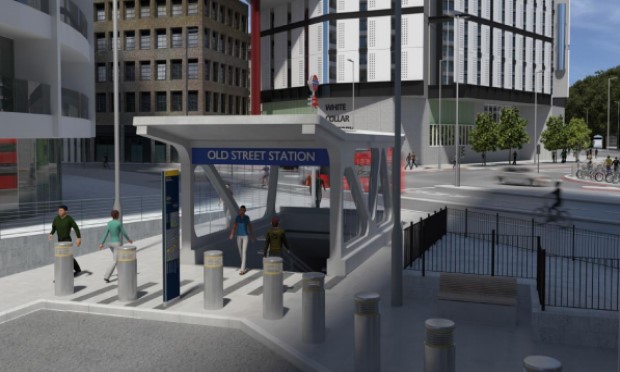
I wonder if it should be step-free with a lift, as walking across to the lift in the centre, could be some way in bad weather.
DHL Teams With Volvo Trucks To Speed Up Transition To Fossil-Free Trucking
The title of this post is the same as that of this article on CleanTechnica.
This is the introductory paragraph.
Electric buses, electric garbage trucks, and even electric construction equipment are becoming more and more commonplace in urban landscapes, but there’s still some debate over whether or not battery electric vehicles will take over open-road, long distance trucking any time soon. To help make the case that electric trucking is the way forward, DHL Freight and Volvo Trucks have partnered to speed up the introduction of heavy duty electric trucks to be used for regional transport throughout Sweden.
Read the article and see what you think.
The author takes the view that electric trucks may be able to handle heavy duty road transport and that would sideline expensive fuel cell trucks powered by hydrogen.
This is a paragraph.
If it’s successful, the move to battery electric trucking could be one of the final nails in the coffin of expensive hydrogen fuel cell projects like Nikola Trucks and Volvo’s own recently acquired Daimler truck division.
I am not so sure, that he is right!
Recently, I wrote Holyhead Hydrogen Hub Planned For Wales and Felixstowe And Harwich Ports Submit Bid For ‘Freeport’ Status, where hydrogen hubs are proposed at the posts of Holyhead and Felixstowe.
- This is a distance of 335 miles.
- As trucks average 55 mph on motorways and dual carriageways, this journey would take six hours.
- Six hours is the maximum time a truck driver can work without a break.
- Tesla have said that their battery Semi Truck will have a range of 300 or 500 miles.
I feel that this rough calculation shows that both electric and hydrogen trucks could handle the Felixstowe and Holyhead route.
- With the battery truck, the weight and size of the battery would probably reduce the payload.
- Factors like cost of ownership, payload and drivers hours would probably play a big part in the choice.
- Trucks would need to be refuelled at the start of the journey, if they’d just come off a ferry.
- On Tesla’s figures, recharging a battery truck would take thirty minutes.
Once we start looking at practical journeys like say Cologne and Dublin, if you want to do it with one truck, it has to be hydrogen.
But a container between Felixstowe and Holyhead could probably be handled by an electric truck.
If you look at between Dover and Holyhead, that is 370 miles and at 55 mph, it would take almost seven hours. So the driver would need a break.
Conclusion
There will need to be extensive modelling to decide, what type of truck is best for a particular route, operator and cargo.
Daimler’s Philosophy
In Daimler Trucks Presents Technology Strategy For Electrification – World Premiere Of Mercedes-Benz Fuel-Cell Concept Truck, I examined Daimler’s strategy for hydrogen and electric trucks.
This is a summary of their philosophy.
- Mercedes-Benz GenH2 Truck, a fuel-cell truck with a range of up to 1,000 kilometres and more for flexible and demanding long-haul transport – customer trials in 2023, start of series production in second half of this decade.
- Mercedes-Benz eActros LongHaul, a battery-electric truck with a range of about 500 kilometres for energy-efficient transport on plannable long-haul routes – projected to be ready for series production in 2024.
- Mercedes-Benz eActros, a battery-electric truck with a range of well over 200 kilometres for heavy urban distribution to go into series production in 2021.
Note.
- 500 kilometres is 310 miles,
- The Mercedes-Benz eActros LongHaul will be able to handle Dover or Felixstowe and Holyhead with a thirty minute driver break/battery charge somewhere in the Midlands.
- The Mercedes-Benz GenH2 Truck will be able to handle Dover or Felixstowe and Holyhead without refuelling.
- The Mercedes-Benz GenH2 Truck will be able to handle a 620 mile out-and-back journey from Dover or Felixstowe without refuelling. This would allow journeys to Birmingham, Derby, Leeds, Liverpool, Manchester, Nottingham and Sheffield
The flexibility built into Daimler’s philosophy is probably a sensible approach and ideal for truck journeys from Dover and Felixstowe.
Daimler would appear to have done a lot of modelling.
Luton DART Fly Through
This video does what it says in the title.
It certainly looks like the DART will greatly improve the experience of getting to Luton Airport.
Cardiff Bridge Avoids £40m Demolition Thanks To Electric Resistant Paint
When I first saw this headline on this press release on the Network Rail web site, I felt it sounded too good to be true.
This is the introductory paragraph.
In a world first, electric resistant paint combined with voltage-controlled clearance (VCC) has helped make a Victorian railway bridge usable by new electric trains, avoiding weeks of passenger disruption and train delays in the process.
I think this is the bridge.
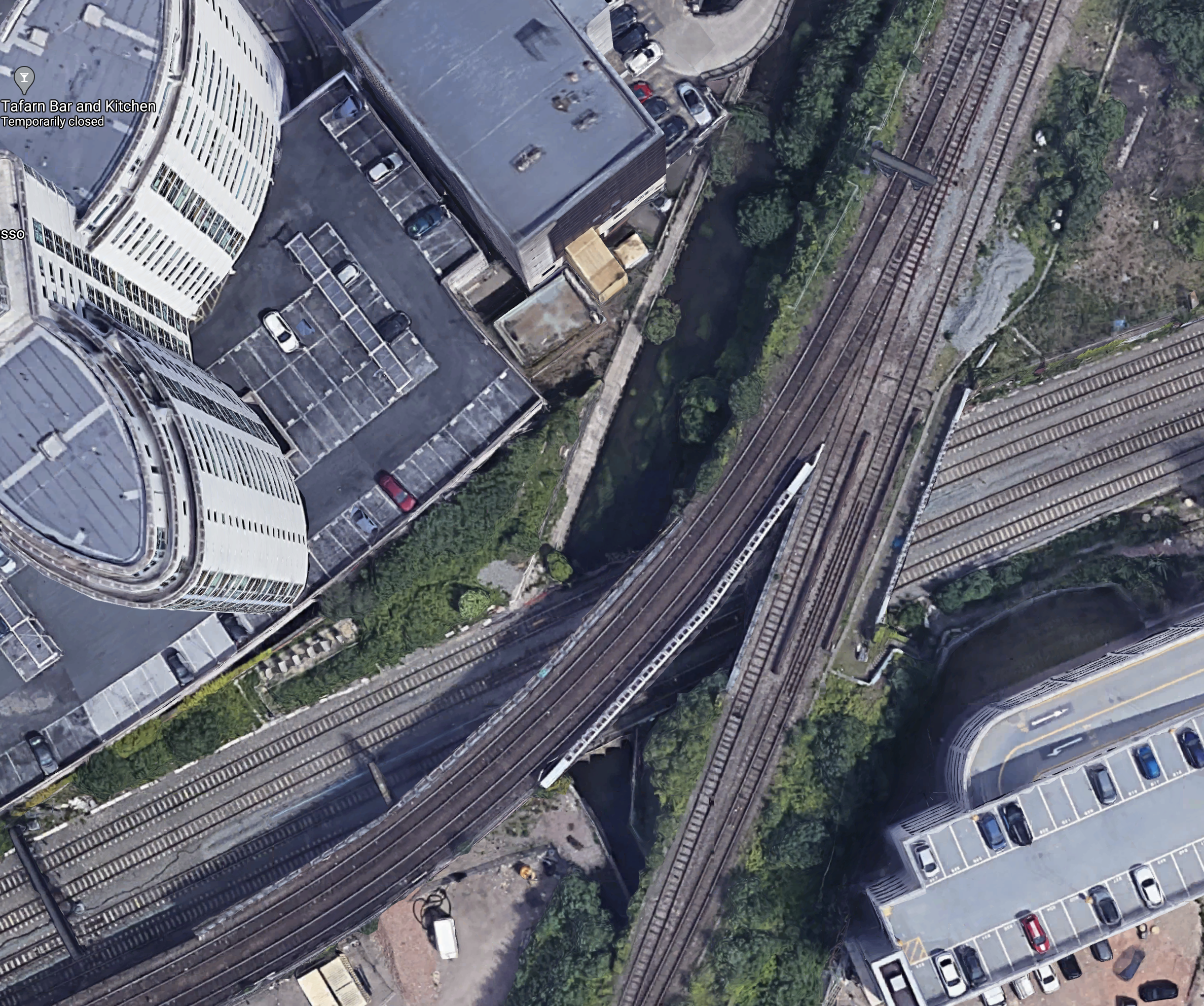
Note.
- The South Wales Main Line runs East-West, with Cardiff Central station to the West.
- The track between Cardiff Queen Street and Cardiff Bay stations runs North-South, with Cardiff Queen Street station to the North.
- The two rail lines cross over a canal.
- The site is surrounded by new high-rise buildings.
- The clearance been the bridge and the main line underneath appeared to be too tight for electrification to be fitted.
But by using the combination of technologies, as stated in the introductory paragraph, Network Rail were able to squeeze the wires through, which didn’t need the bridge to be demolished and rebuilt on a tricky site.
I can see that railways and other places, where high-voltage cables are close to metal structures, will be able to find lots of uses for Southampton University’s “Magic Paint”
The Pedestrian Tunnels In Bank Station
Growing up in London in the 1950s, I was always intrigued by the escalator connection between Bank and Monument stations, shown on the tube map.
The connection opened in the 1930s, but I can’t remember using it until recently.
It is not shown on the latest map.
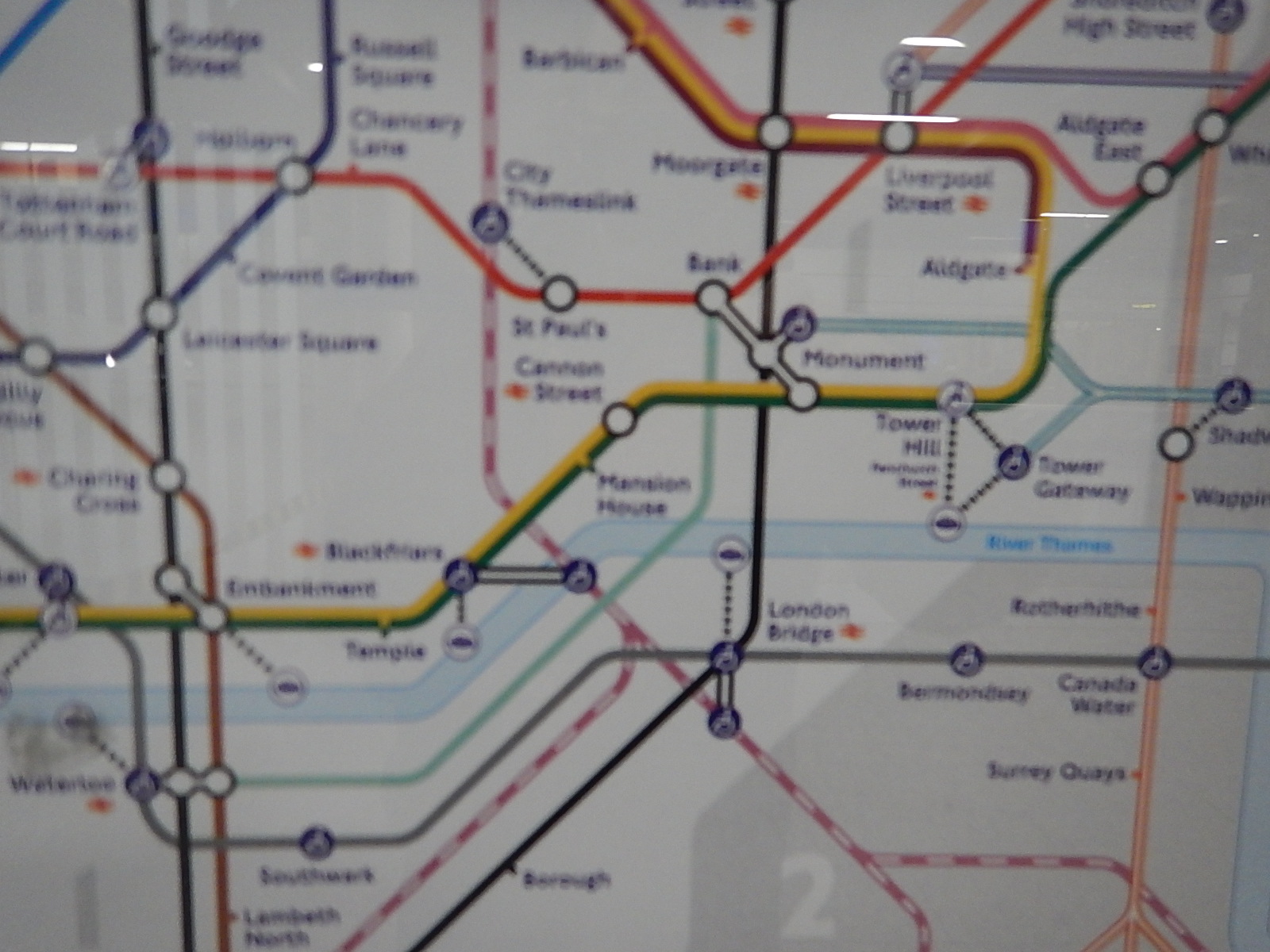
The combined Bank and Monument stations now have lots of tunnels and some will be affected by the works to extend the station.
Arriving On The DLR
These pictures show arriving on the DLR and taking the route up the escalator to the Central, Northern and Waterloo and City Lines.
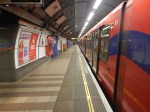
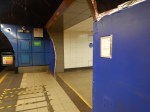


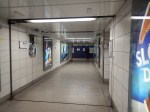
Note.
- Once at the top of the escalator, the Central, Northern and Waterloo and City Lines are accessed by more tunnels.
- The tunnel, that used to run between the two platforms appears to be closed off at the moment.
- Could the Northern end be being turned into an information point?
Access To The Central Line
This visualisation shows the current and future access to the Central Line.
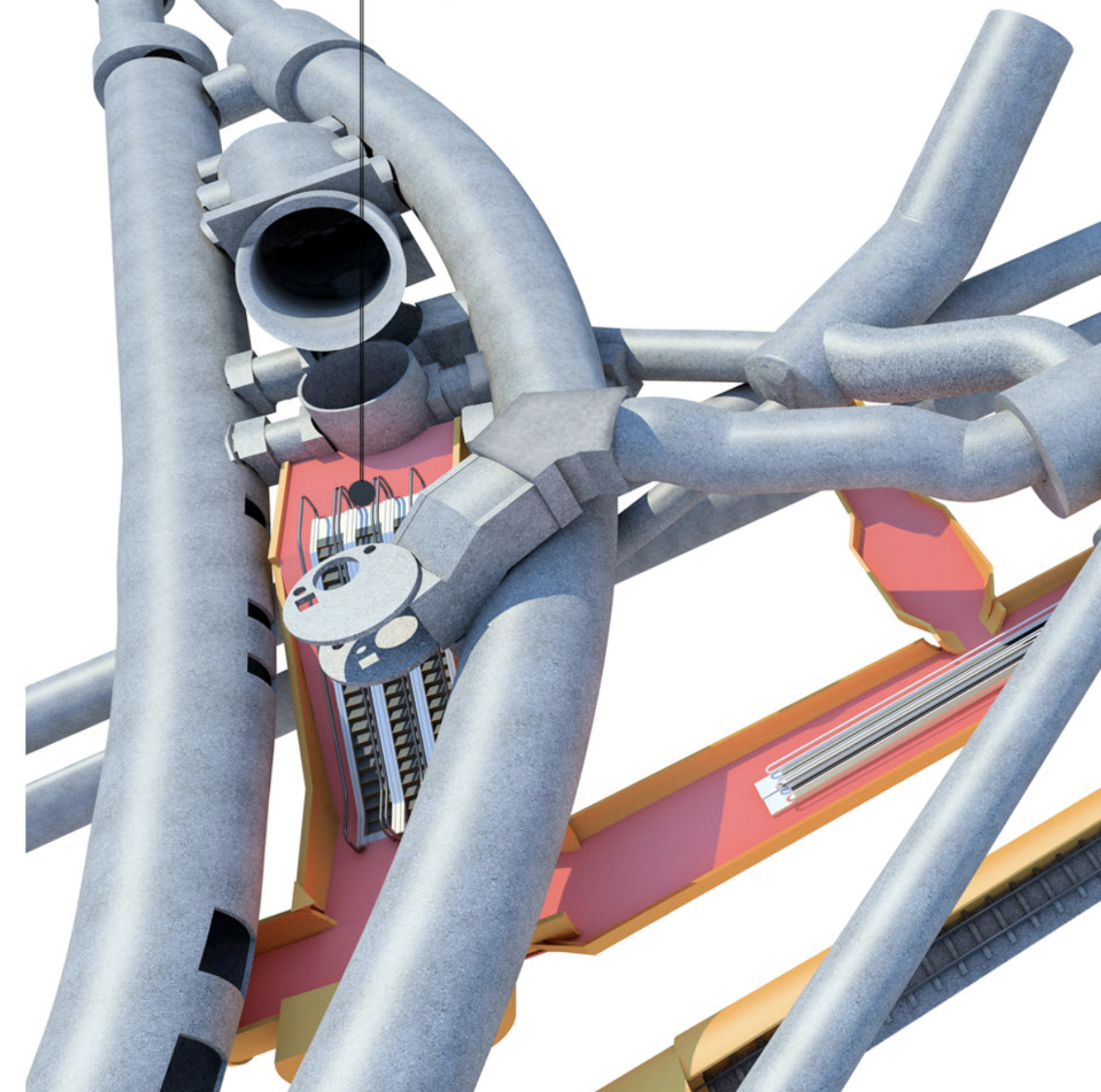
Note.
- The two fat curved grey tunnels on the left are the Central Line.
- The straighter one on the left is the Eastbound tunnel, with East at the top.
- The curved one is the Westbound tunnel.
- The tunnel facing us, between the Central Line tunnels is the triple escalator barrel from the entrance under Bank junction.
- Just visible underneath it is the spiral staircase that connects to the Northern Line.
- A new triple escalator will connect the Central Line platforms down to the main North-South travelator.
- Above the new escalators is the current connection between the Central Line platforms and the DLR.
These pictures show the connection between the Central and Northern Lines via the spiral staircase.
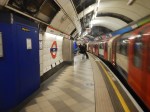


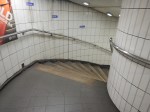

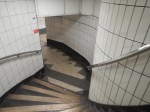
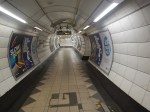

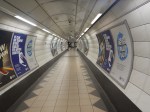
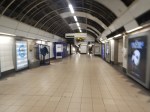


Note that once down the spiral staircase, the passage is level.
Northern Access To The Northern Line Platforms
Currently, there are two staircases down from the lobby, where both the previous routes end to the Northern Line platforms.
This visualisation shows the Northern ends of the current Northern Line platforms.
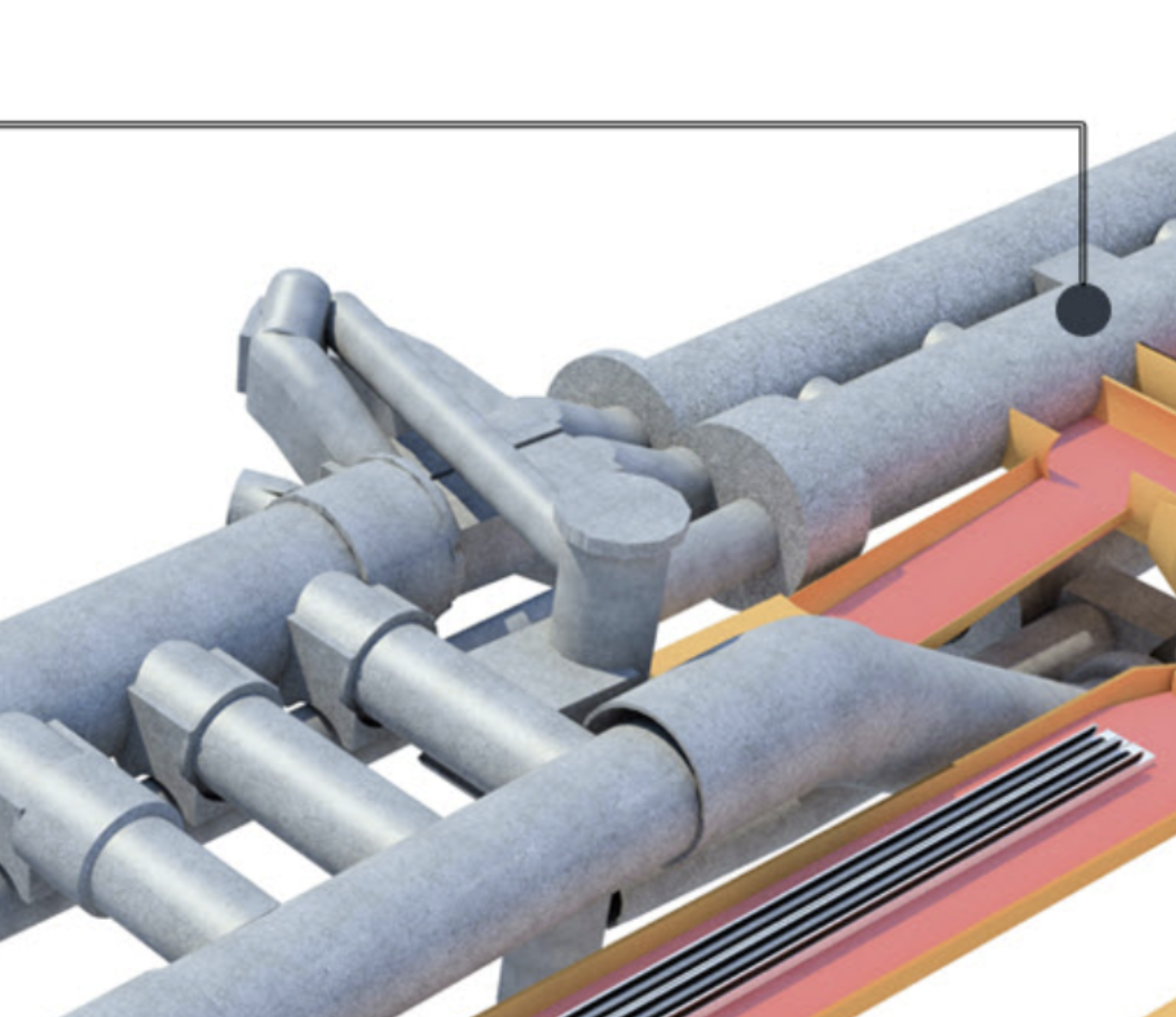
Note.
- North is to the left.
- The two tracks and the narrow island platform of the current Northern Line on the far side of the visualisation.
- The two staircases leading up from Northern Line to a lobby, where passengers can walk North to the Central Line.
- The double escalator barrel going down to the DLR.
- The three cross passages linking the DLR escalators to the lobby between the Central and Northern Lines.
- The most Southerly of these cross passages has a lift to the DLR.
These pictures show the two staircases leading up from the Northern Line platforms.


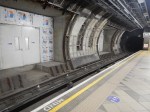
Other pictures show, top of the stairs, the lobby and the current state of the Southbound platform.
After completion of the upgrade, the following works will have been done.
- The Southbound track will be filled in.
- The Northbound platform will be extended over the former Southbound track and platform, to make a very wide platform.
- The doors in the tunnel walls will become cross passages to the new Southbound platform about thirty metres to the West, the triple bank of escalators to the new Cannon Street entrance, escalators to the DLR and the travelator to the Central Line.
What will happen to the two short staircases?
At present they lead up to lobby with passages to the DLR and the Central and Waterloo & City Lines and the lifts.
- It all depends on how much, they will be used with so many new routes in the station.
- They could be refurbished, with perhaps one for up and one for down.
- They could be shut off.
There certainly is space for wide staircases, leading down to the very wide single platform.
I think they should be kept to please the duckers-and-divers.
From The Northern Line Platforms To Monument Station
This is the original 1930s escalator connection between the Northern Line at Bank station and the District and Circle Lines at Monument station.
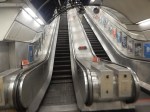
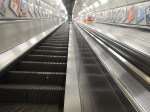


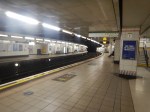
Note.
- Judging by the two sets of blue hoardings, there will be some extra passages connection to this route.
- The escalator is surprisingly long.
I do wonder, if this route might tend to be sidelined, as many passengers will find the new Cannon Street entrance quicker.
From Monument Station To The DLR
These pictures show going between Monument station And The DLR.


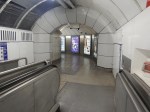
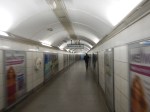
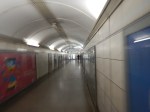
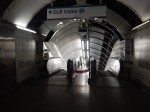




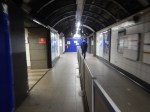
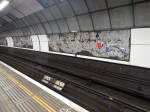
Note.
- Except at the DLR end, there is no blue hoardings hiding the construction work.
- The tunnel between the two platforms is blocked off.
- At the DLR rnd, both platforms can be accessed.
It strikes me that after the completion of the expansion of Bank station, this tunnel will be substantially the same.
 The Anonymous Widower