Scrapping Of Airport Link ‘Lack Of Ambition’ At The Heart Of Government
The title of this post is the same as that of this article on Rail Technology Magazine.
This is one of those sagas that rumbles on and on, with all those involved in the decision having different views on how to solve the problem.
I suspect a very experienced transport engineer and planner from Aberdeen, Cardiff or Liverpool, could tell the Glaswegians what they really need on the back of a used envelope.
But there are so many politicians grinding axes in the decision, that nothing sensible will ever happen.
One of my Glaswegian friends told me some years ago, that they should close both Edinburgh and Glasgow Airports and build a new rail-connected airport between the two cities.
Look at these distances
- London to Gatwick – 27 miles
- London to Stansted – 38 miles
- Edinburgh to Glasgow – 46 miles
Perhaps my friend has a point, as a shared airport would be closer to Edinburgh and Glasgow, than Gatwick and Stansted are to London.
But as someone, who has only ever used Glasgow Airport once, I think that Glasgow’s biggest rail problem is the two separate stations in the centre with no simple interchange.
I walk between the two,stations, but not everybody can.
Royal Mint Gardens
Royal Mint Gardens is a housing development to the East of Fenchurch Street and Tower Gateway stations.
These are a few pictures of the development.






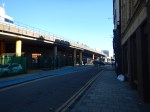
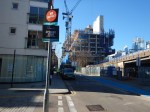
But this doesn’t tell the full story.
This Google Map shows the position of the development.
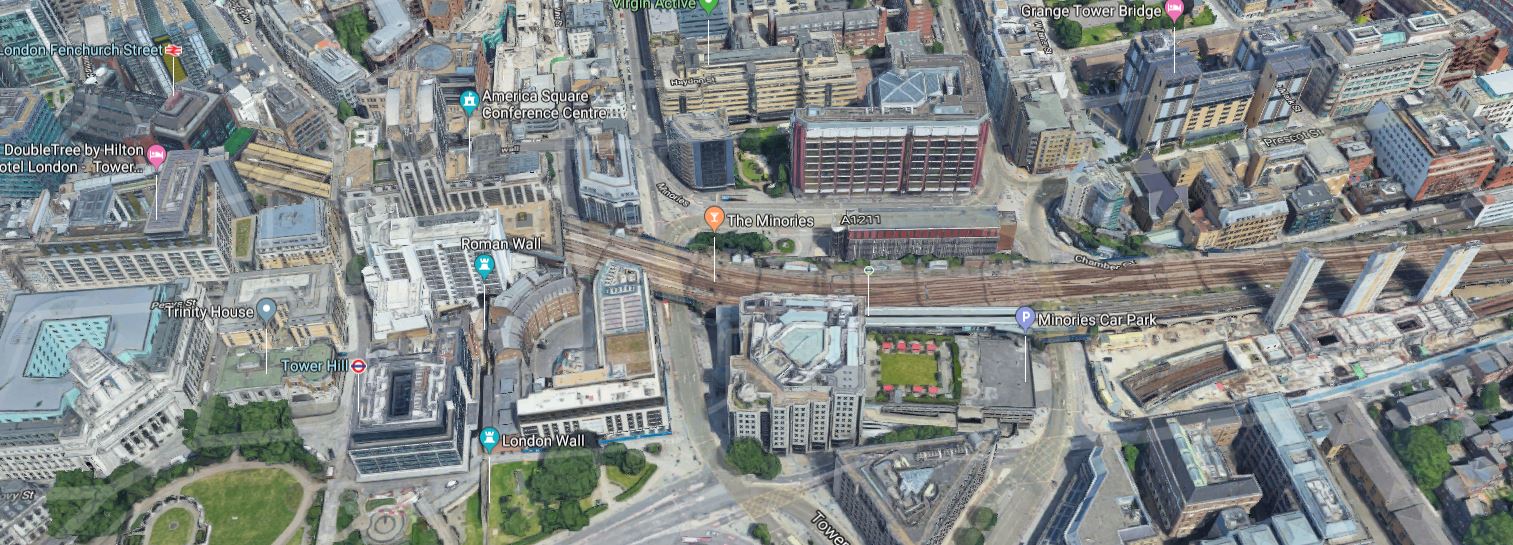
Note.
- Fenchurch Street station is towards the top-left corner of the map.
- The c2c tracks running to the East from Fencurch Street station.
- Tower Gateway DLR station is just to the right of the centre, just above the green space.
- The tracks of the Docklands Light Railway running to the East from Tower Gateway DLR station.
The three concrete towers at the right of the map, lying to the South of the railway tracks, are the three structural towers of Royal Mint Gardens.
This Google Map shows a close up of Royal Mint Gardens.
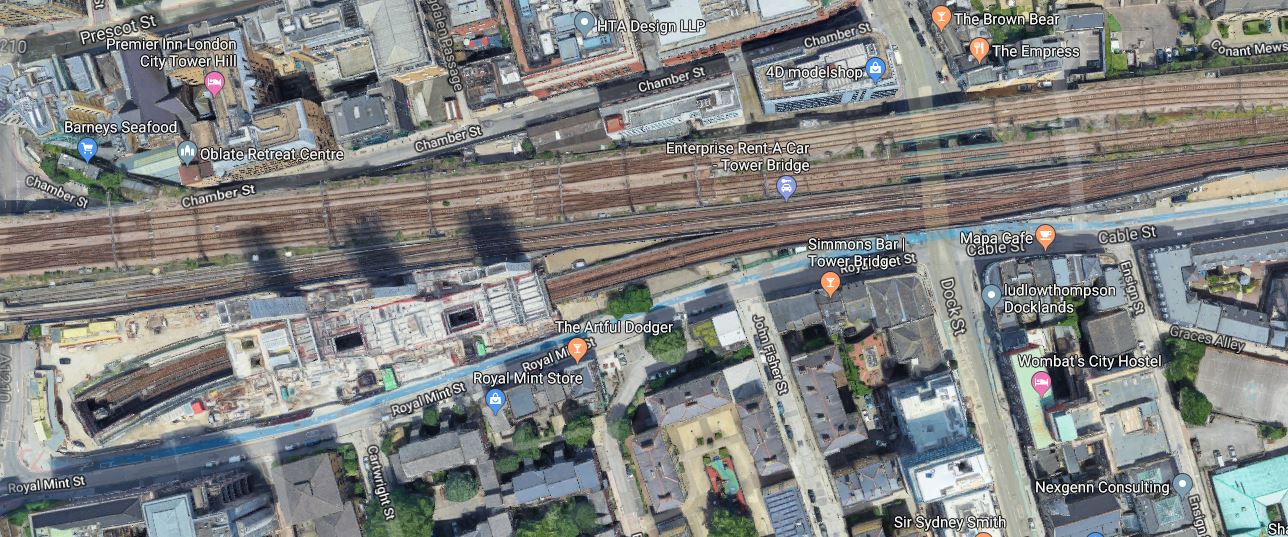
Note how the Docklands Light Railway splits into two to the East of the development.
- The Northern pair of tracks skirt the development to the North to go to Tower Gatewat DLR station.
- The Southern pair of tracks go underneath the development to go to Bank DLR station.
The new development has put the Bank branch in a concrete tunnel.
So in an area of the world, where land is a very expensive commodity, this area is being used twice at the same time.
Royal Mint Gardens On The BBC
BBC London television has been covering various aspects of the building of Royal Mint Gadens in local news for most of the day.
The developer, the architect, Network Rail and the reporter, all seemed very positive about what is being created.
The architect felt up to 250,000 houses could be created on similar sites across London.
How many houses could be built over rail lines in the rest of the UK?
Conclusion
Building over rail lines like this, will increasingly be seen as a way of adding new housing in densely populated cities.
DfT Keen To Encourage Rail Travel For Football Fans
The title of this post is the same as that of an article in Issue 873 of Rail Magazine.
I was moved to send this letter to the magazine.
Was this title on page 17 of Issue 873 serious or an ironic joke?
I am a seventy-one-year-old Ipswich fan and Season Ticket holder, who lives in London, within walking distance of Liverpool Street station on a fine day.
Over the last six or seven years, I have been unable to see Home matches as often, as I would like, as on perhaps half of weekend match days, there have been no trains running on the Great Eastern Main Line, due to the constant maintenance. Or is it a complete rebuilding for 140 mph trains?
To be fair, I have occasionally used the replacement buses, but the problem is that they make the journey well over an hour longer. So on a match day, there is no time left for anything else!
I had to watch the two Ipswich-Norwich matches on television, as on both these Sundays to get to the match by mid-day was impossible and probably needed an overnight stay!
I accumulated my very adequate pension pot, by writing software to schedule resources on complicated projects. Surely, Network Rail, Greater Anglia, the Premier League and the EFL can agree a plan that is better than the current shambles.
Greater Anglia surely have the means to improve the situation arriving in their depots.
Pairs of four-car Class 755 trains could run reduced services via Cambridge.
- If the line is blockaded between Ipswich and London, then a direct service could be run between Norwich and London via Ipswich and Cambridge.
- If the line is blockaded between Ipswich and Norwich, then a direct service could be run between Norwich and London via Cambridge.
Although, this has nothing to do with football, pairs of Class 755 trains would also be useful for running a service between Peterborough and London, when the Southern section of the East Coast Main Line is closed.
I shall add a few extra notes to this on-line version of the letter.
Class 755 Trains
Points about Class 755 trains.
- They are 100 mph trains on both electric and diesel, and probably have similar performance to the current Class 90 locomotive/Mark 3 coaches that run between Liverpool Street and Norwich.,
- Capacity of a pair of Class 755 trains is 458 seats, as against the 514 seats of the current stock.
- The interior will be suitable for services between London and Norwich.
- The trains and their crews will probably be certified for all of Greater Anglia’s Network.
- A single train is eighty metres long and a pair would be 160 metres.
- The trains should fit all important main-line stations on the Greater Anglia Network.
I also suspect that these trains could run into Kings Cross station, either using the East Coast Main Line or the Hertford Loop Line.
They are blockade-busters par excellence.
A Potential Leicester To Coventry Rail Link
This article on Rail Technology Magazine is entitled Potential Leicester To Coventry Rail lLnk Mulled Over In Updated Leicestershire Transport Vision.
This is the first two paragraphs.
The potential of a Leicester to Coventry rail link has been revived again as one of the key highlights of a new transport masterplan outlined by Leicestershire County Council.
In the council’s revamped Prospectus for Growth handed out to Leicestershire County Council members this week, the document noted that there are currently no direct rail services between Leicester and Coventry, meaning a journey of just 25 miles takes an average of one hour and eight minutes.
The route would use these two lines.
- Birmingham-Peterborough Line between Leicester and Nuneaton stations.
- Coventry to Nuneaton Line between Nuneaton and Coventry stations.
This sounds easy. So what’s wrong with using two trains and changing at Nuneaton station?
- Driving along the M69 between the two cities will take around 43 minutes.
- The fastest rail services take 48 minutes, and run hourly.
- Most other rail services take over an hour and a quarter, with a long wait at Nuneaton station.
- Leicester and Coventry services serve opposite sides of Nuneaton station.
I suspect regular travellers have got the rail journey sorted, but occasional travellers will always take the car.
This Google Map shows Nuneaton station.
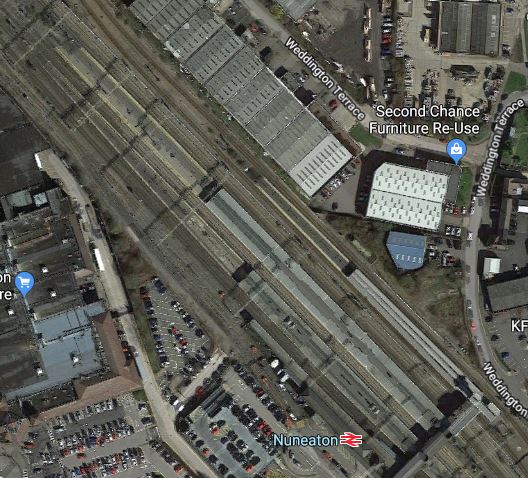
Note.
- The West Coast Main Line going NW-SE through the station.
- Coventry services terminate in Platform 2, which is on the West side of the station.
- Birmingham-Leicester services stop on the other side of the station.
The station has lifts, but it wouldn’t be a good one for a fast change of trains.
This Google Map shows the West Coast Main Line to the South of Nuneaton station.
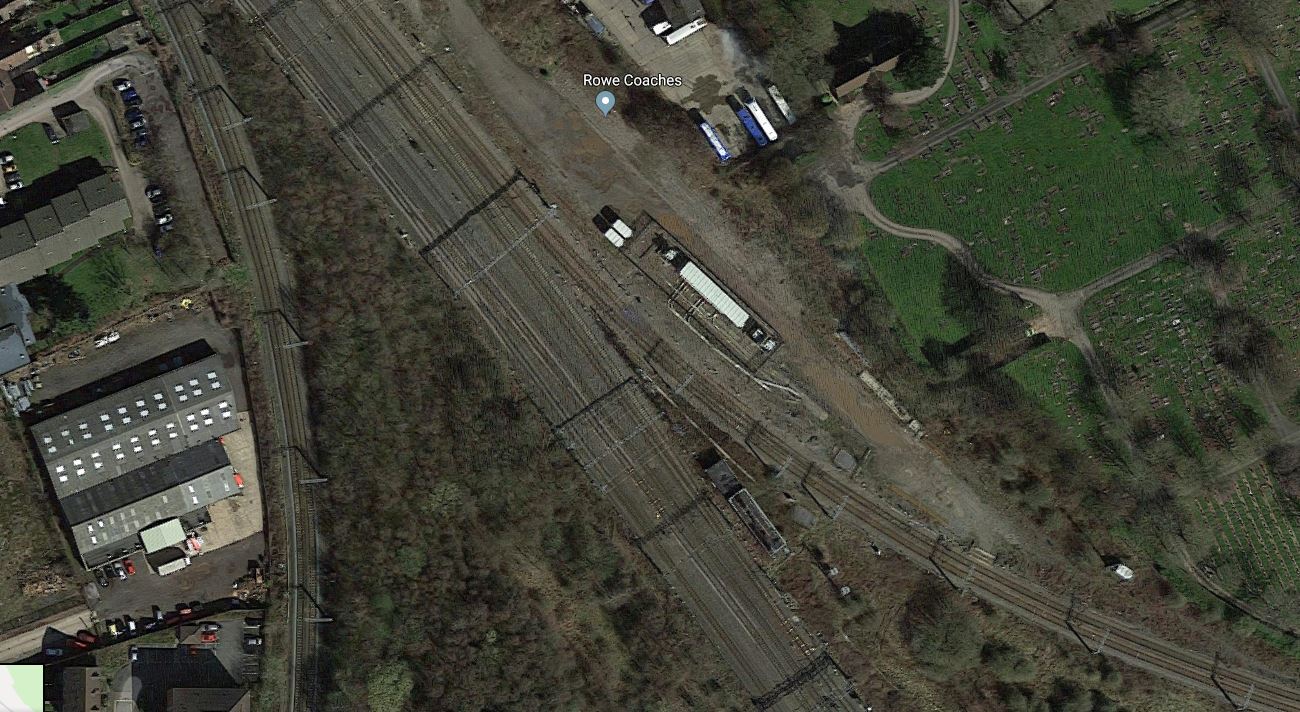
Note how the West Coast Main Line splits into three.
- The Coventry to Nuneaton Line goes South.
- The electrified West Coast Main Line goes South-East.
- The Nuneaton to Leicester breaks away to the East.
It would appear that a train going from Leicester to Coventry would need to cross the West Coast Main Line.
This would be very difficult without a flyover or a tunnel.
It would be even more difficult if the train had to call at Nuneaton station.
But it might be possible for trains between Leicester and Coventry to do the following.
- Call at Platform 2 in Nuneaton station.
- All trains would reverse at Nuneaton station.
- A single-track flyover or dive-under would link the Eastern track of the Coventry to Nuneaton Line to the Nuneaton to Leicester Line.
It would be a tricky piece of engineering.
The Possible Route
If the train did the same station stops as the current services, it could stop at the following intermediate stations.
- South Wigston
- Narborough
- Hinckley
- Nuneaton
- Bermuda Park
- Bedworth
- Coventry Arena
The total time would appear to be around fifty minutes, with 28 minutes for Leicester to Nuneaton and 22 minutes from Nuneaton to Coventry.
I think if the route were to be run using a modern 100 mph bi-mode or diesel train, that saved time at each stop, that a round trip could be done within two hours.
If this were possible then two trains would be needed for an hourly service.
The article talks of extending the services to Nottingham and The Thames Valley.
It would be likely, that a route length would be chosen, that was convenient to timetable.
Conclusion
The plan to run a Leicester to Coventry service looks feasible.
Northumberland Park Station Is Almost Finished
The new Northumberland Park station is almost finished, as these pictures show.
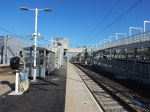

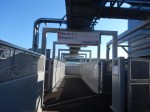

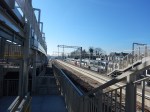
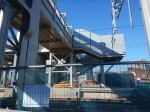
One thing that appears to be missing is a ticket machine on the River Lee or Eastern side of the station.
Wigan North Western To Alderley Edge And Stalybridge
The following two services were started from Wigan North Western station in May 2018.
- Alderley Edge via Manchester Piccadilly.
- Stalybridge via Manchester Victoria
Both services are hourly and cross-Manchester services. I rode both of them on Friday afternoon.
These two routes are not fully-electrified and it was intended that they would use new Class 769 bi-mode trains, which can use diesel on sections without electrification.
But the Class 769 trains are still under test, so there was a selection of good and not-so-good rolling stock.
- One four-car train was two refurbished Class 156 trains working together.
- Another was a pair of refurbished Class 150 trains.
- And a third was a Class 150 train pulling a Pacer.
The diesel trains trundled into Manchester at speeds between sixty and eighty mph.
At least the four-car trains were the right size for the route and although full, the trains weren’t by any means over-full!
The arrival of the Class 769 trains would increase the quality and operating speed of the rolling stock.
I also went into Manchester on Saturday in a Class 319 train.
This electric train was doing up to ninety mph on the fully-electrified route via Newton-le-Willows.
As the Class 769 trains are based on Class 319 trains on electrified sections of the routes, they will be able to speed along and shorten journey times.
Wigan North Western And Alderley Edge
On this route approximately 9.5 miles of the 34.5 miles route is not electrified and journeys take 78 minutes.
As between Bolton and Alderley Edge is now fully electrified, I wonder what will be time between Wigan North Western and Alderley Edge.
If the service is under the hour, this could mean a reduction in the number of trains needed to work the route.
Wigan North Western And Stalybridge
On this route approximately 17 miles of the 27.8 miles route is not electrified and journeys take 59 minutes.
Because this service spends more time on diesel, the speed-up might not be as easy to achieve.
Conclusion
I predict that the Class 769 trains will be welcomed by passengers, operators and staff, as they will speed up services.
The Wires Are Completed At Bolton
I took these pictures as I changed trains at Bolton station.
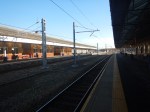
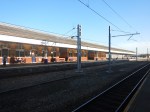


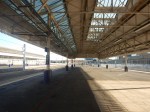


According to this article on Rail News, which is entitled Final Test Train Runs On Electrified Preston Line, the Manchester-Preston line has passed all the tests to allow Class 319 trains to run at 100 mph.
They also hope, that 100 mph running will start in May.
 The Anonymous Widower