Tunnelling Complete On Northern Line Extension
The title of this post is the same as that of this article on Global Rail News.
This is said in the Wikipedia entry for the Northern Line Extension To Battersea.
The main tunnelling started in April 2017.
So as it’s now November 2017, the tunnellers have performed like a Jack Russell after a rabbit.
I do think that this excellent performance might give Transport for London ideas for some new passenger or train tunnels under London.
Riding On A Battery-Electric Double-Deck Bus
This morning I rode on a battery-electric double-deck bus.
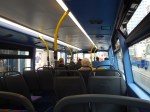
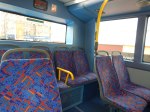


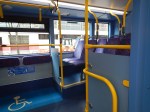



Some of these buses are russing on route 98 between Holborn and Willesden Garage, which includes a run down Oxford Street.
There’s more on the buses in this page on the Metroline web site.
I went upstairs and the experience was little different to that of a normal hybrid bus.
My Thoughts
My thoughts in various areas.
Design
It is a well-designed bus, that is easy to use for this seventy-year-old.
Passenger Experience
Travelling along Oxford Street, the passenger experience was equal to that of a New Routemaster, without the occasional low noise of the engine.
Performance Of The Bus
As we proceeded along Oxford Street, the performance of the bus, was very much in line with current hybrid buses.
The bus wasn’t full on the upper deck, but I suspect that the total weight of the passengers is very much lower than the weight of the battery, so this might mean that a full bus performs well compared with an empty bus.
Limited Space On The Lower Deck
There is one obvious problem and that is that the size of the battery reduces the number of seats downstairs.
As I said earlier, I doubt the weight of the passengers is a problem, but the available space, where they sit and stand could be.
Economics Of The Bus
The bus will obviously be expensive to purchase and to run, as batteries are expensive and need to be replaced every few years.
Coupled with the fact that capacity is smaller than current hybrid buses, which probably means more buses are needed to perform the required service, the economics of the buses may not be suitable for many routes.
I also wonder, if a battery-electric double-deck bus has better economics than a single-deck bus, as the extra weight of the top deck and the extra passengers is small compared to the weight of the battery.
But the economics will get better with improved battery technology.
The Marketing Advantages
BYD and Metroline could be big winners here, as corporate videos and marketing material showing buses in Central London, can’t be a bad thing!
The Competition From Diesel Hybrid Buses
I believe that one competitor to the battery-electric bus will be the next generation of diesel hybrid buses.
Take the current modern hybrid buses like a New Routemaster or any other hybrid bus built in the last couple of years. These have a battery that can power the bus for perhaps a couple of miles.
As the battery is smaller, it can be squeezed into an unlikely space. On a New Routemaster, the diesel engine is under the back stairs and the battery is under the front stairs.
A technique called geo-fencing can be retro-fitted, which forbids the use of the buses diesel engine in sensitive areas, based on GPS technology.
So a route like London’s route 98 could work through the ULEZ on battery power and charge the battery between Edware Road station and Willesden Garage.
The Competition From Hydrogen Hybrid Buses
This will surely be similar to that from diesel hybrid buses.
- Battery size will probably be as for a diesel hybrid bus.
- As hydrogen doesn’t give out noxious emissions, this will be an advantage and you won’t need the geo-fencing.
- But you will need to store the hydrogen.
As hydrogen technology improves, I feel that the hydrogen hybrid bus could become a formidable competitor.
The Competition From Converting Old Diesel Buses To Diesel Hybrid Buses
I talked about this in Arriva London Engineering Assists In Trial To Turn Older Diesel Engine Powered Buses Green.
Never underestimate good engineers with a good idea, that has a good financial payback.
Conclusion
There is going to be a lot of competition between the various technologies and the passengers, bus operators, London and London’s air will be big winners.
As all of this technology can be applied anywhere, other parts of the UK will benefit.
Government Delays Silvertown Tunnel By Six Months
This article on City AM is entitled Government Delays Silvertown Tunnel Decision By Another Six Months Over Air Quality Concerns.
The decision on the Silverton Tunnel will now be made in May 2018.
But surely this is too early.
- The Elizabeth Line will open between Abbey Wood and Paddington stations in December 2018.
- The Elizabeth Line will open between Shenfield and Paddington stations in May 2019.
- Thameslink will open between Kent and Central London via London Bridge in May 2018.
- The ULEZ becomes operational in April 2019.
I would have thought that the decision should be made after the effects of these changes have settled down.
This map shows the route of the tunnel.
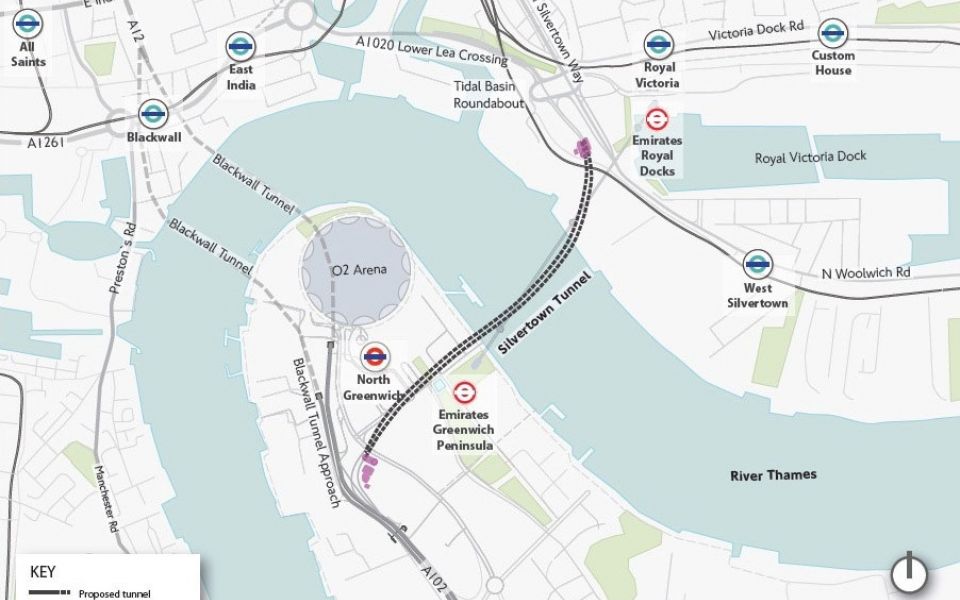
Will any other public transport developments reduce the urgency for the tunnel?
London City Airport Crossrail Station
Under New Stations, the Wikipedia entry for Crossrail says this about a station at Silvertown close to the London City Airport.
London City Airport has proposed the re-opening of Silvertown railway station, in order to create an interchange between the rail line and the airport. The self-funded £50m station plan is supported ‘in principle’ by the London Borough of Newham. Provisions for re-opening of the station were made in 2012 by Crossrail. However, it is alleged by the airport that Transport for London is hostile to the idea of a station on the site, a claim disputed by TfL
This must surely cut down the traffic needing to cross the Thames in this area.
Gallions Reach Crossing And Thamesmead Extension Of The Docklands Light Railway
Wikipedia has a section, which says this about the extension.
The proposed Gallions Reach Crossing has been suggested by TfL as allowing a branch to leave the existing DLR network at Gallions Reach, and cross the river on the proposed tunnel/bridge and into Thamesmead. The new branch could then pass through Thamesmead and towards Abbey Wood, Woolwich, or northwards towards Barking. On 4 October 2016 the London Assembly approved the extension to Thamesmead.
Will this extension be a game-changer?
Extending The Gospel Oak To Barking Line From Barking Riverside To Thamesmead
This is definitely another rail extension that will be looked at.
The New Southeastern Franchise
The successor for the current Southeastern franchise will be announced in August 2018 and they will take over the franchise in December 2018.
If this award follows the pattern of others in recent time, there will be a lot of new services and trains promised.
Updating The Woolwich Ferry
Wikipedia has a Future section for the Woolwich Ferry, which says that two new diesel-electric hybrid vessels are on order.
Conclusion
We should wait until all related issues and projects are decided before making the decision on the Silvertown Tunnel.
Auckland Rows Back On Battery Train Plan
The title of this post is the same as this article on the International ailway Journal.
This is said.
Following approval by Auckland Council, the proposal went to the New Zealand Transport Agency (NZTA) for final sign-off. However, in the run-up to New Zealand’s general election on September 23, a political consensus emerged in favour of bringing forward electrification of the Papakura – Pukekohe line, prompting the NZTA to reject the case for battery trains.
Can we assume the reason for the change of order is political?
Certainly, CAF, who are building the trains seem to have the required battery technology. This is also said.
CAF says the contract will include an option to equip the trains with battery packs at a later date if required.
I just wonder if battery trains are just too risky for politicians, who tend to be rather conservative and badly-informed about anything technological.
World’s First Hydrogen-Powered Tram Runs In China
The title of this post is the same as this article on Global Rail News.
This is the first two paragraphs.
Rolling stock manufacturer CRRC has announced that the world’s first hydrogen-powered tram has been put into passenger operation in China.
The three-carriage hybrid electric tram enter service in the city of Tangshan, Hebei, on October 26.
It seems to have the following characteristics.
- Three cars
- 66 seats
- 70 kph.
- 40 km range.
It all sounds very tram-like.
It does seem there’s a lot of train and tram manufacturers thinking about hydrogen power.
Oxford Street Could Be Pedestrianised By Next Christmas
The title of this post is the same as the sub-title of this article in the Independent.
The aim is to pedestrianise Oxford Street from Oxford Street to Orchard Street by December 2018, which is the date when the Elizabeth Line will open.
It is an ambitious plan and despite substantial backing from the Mayor, Westminster City Council, the West End Company and groups like the British Heart Foundation, I don’t think it will be plain sailing.
Walking Along Oxford Street
In Walking Along Oxford Street, I show various pictures I took this morning whilst walking between Marble Arch and Tottenham Court Road stations.
Oxford Street looked to have improved, since I last did this. But then it’s a long time since I’ve walked the streets without crowds.
My views are as follows.
Measuring Success Or Failure
The success or failure of the pedestrianisation of Oxford Street is very easy to gauge.
The rate of change of turnover is a direct measure.
The Buses
I regularly go shopping in Oxford Street and often used a bus to travel there and back.
I used to be able to get a 73 bus from either 200 metres from my house or by changing at the Angel. But since the 73 has been cut back to Oxford Circus, I’ve tended to use the Underground, often by taking a bus to Bank for the Central Line.
Under Sadiq Khan’s plan all buses will be removed from Oxford Street and only the 139 and the 390 will remain, being rerouted along Wigmore Street.
A lot of people who go to Oxford Street regularly by bus, will lose their direct bus route. How will they react?
Will they use the Underground or the Elizabeth Line or will they go shopping elsewhere?
Since the 73 has been cut back, I think I’ve also gone to Oxford Street a lot less.
Why? I’ve no idea.
But it could be, that regularly, I’d buy something in John Lewis,Selfridges or perhaps in Bond Street and get straight on a 73 bus to the Angel, where I just got off the bus and waited until a bus home arrived at the same stop. As the 73 buses are New Routemasters, they’re a real shoppers’ bus and a lot easier than the Underground.
The Underground And Crossrail
Oxford Street will have the following stations and entrances as you proceed from East to West.
- Holborn – Central and Piccadilly
- Tottenham Court Road (Current Entrance) – Central, Elizabeth and Northern
- Tottenham Court Road (Dean Street Entrance) – Central and Elizabeth
- Oxford Circus – Bakerloo, Central and Victoria
- Bond Street – Central, Elizabeth and Jubilee
- Marble Arch – Central
Between Oxford Circus and Orchard Street, which will be the first section to be pedestrianised, you’ll never be more than two hundred metres from a fully step-free Elizabeth Line station.
Will this be enough to do away with the buses on Oxford Street?
Holborn station is being expanded with a new entrance, so will Oxford Circus and Marble Arch be upgraded?
Cycling
This will be banned. Although the plan envisages alternative cycle routes to the North and South.
Taxis
These will be banned from Oxford Street. Taxi ranks will be provided.
Will this be acceptable to the taxi drivers?
Uber And Mini-Cabs
These will be banned from Oxford Street.
How will these effect the surrounding streets?
Deliveries
How will these be arranged? You can’t get behind all the shops!
The Stalls
There are lots of stalls selling various goods along Oxford Street.
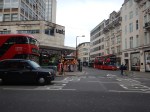



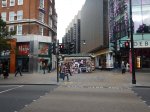


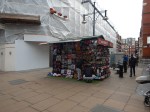
Will the stallholders give up their pitches quietly, if necessary?
Security
I’m no security expert, but after the latest attacks in the UK and Europe, surely keeping out vehicles must remove the weapon of choice from a large group of terrorists.
Local Residents
There are quite a few residents in the area perhaps two hundred metres on either side of Oxford Street.
They could be the biggest losers with traffic cramming the side streets.
Timing
Crossrail opens in December 2018. Does this mean the 1st, 31st or some day in between?
How do you time the pedestrianisation of Oxford Street to fit in with Crossrail?
Especially, as December 2018 will probably contain Christmas!
Conclusion
There is going to be a lot of discussion about this scheme.
As to my view, I like pedestrianised streets and Oxford Street should have gone this way years ago.
Throwing The Baby Out With The Bathwater
I like the New Routemaster and I use them regularly as five of the routes running close to my house use the buses.
So when I saw that Wright SRM buses, which are based on the New Routemaster, were being trialled on Route 183, I had to take a ride.
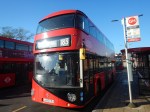
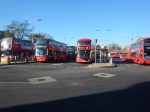
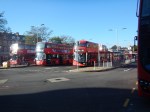


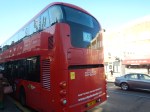
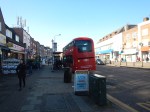
I went between Golders Green and Kenton stations.
In my view the bus has three major design faults compared to the New Routemaster.
The Floor Is No Longer Flat
The New Routemaster has a completely flat floor, whereas this bus doesn’t.
I suspect that this is because the bus is based on a standard Volvo B5LH chassis to save money, whereas the New Routemaster used a custom design.
Front Entry Only
One of the great features of the New Routemaster is that you can get in at any door, as there are card readers on all doors.
Drivers take advantage of this and often seem to stop the bus, so passengers can board quickly.
This must mean that they keep to the timetable better!
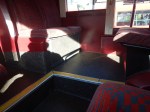
The Bus Is Rather Gloomy Inside
I sat towards the back, as I often do on New Routemasters, but the bus is so gloomy, as there is no windows facing to the rear.
Conclusion
I very much feel that someone needs to design a better bus chassis, as the standard Volvo chassis means that a flat floor and a light and airy interior, which are so important in my view, seem to be impossible.
Wrightbus can do a lot better.
Four Trains Per Hour Between Dalston Junction And Battersea Park Stations
Normally, there is only one train per day in both directions between Dalston Junction and Battersea Park stations.
Wikipedia says this about the service.
Until December 2012, Southern operated a twice-hourly service from London Victoria to London Bridge via Denmark Hill. This ceased when London Overground’s Clapham Junction to Dalston Junction service commenced at that time. However, since December 2012, a skeleton London Overground service has run to/from Battersea Park (instead of Clapham Junction) at the extreme ends of the day to retain a “parliamentary service” between Battersea Park and Clapham High Street.
But today, London Overground were running four trains per hour between Dalston Junction and Battersea Park stations, as there was a track fault, which meant trains couldn’t get between Wandsworth Road and Clapham Junction stations.
I took these pictures on my journey.


It certainly looked, like London Overground weren’t having much trouble, in running four trains per hour between Dalston Junction and Battersea Park stations.
Crossrail Gets A Convenient Hotel
This article on The Urban Developer is entitled London’s Newest Skyscraper Gets Green Light.
This is the first two paragraphs.
London’s Paddington will soon be home to a new 20-storey hotel tower, dubbed The Gateway Building, after planning permission was granted by Westminster council planners.
The Sheldon Square site will house the 113-metre-high hotel designed by architects Carmody Groarke for developer British Land. The hotel will provide access to the area’s new Crossrail station, with the third basement level expected to provide access to the Elizabeth Line — connecting Reading with London and Heathrow.
As they say, location is everything!
- Crossrail will whisk you to and from Heathrow.
- There’s not many hotels with direct access to the station underneath.
- For the businessman who has everything, Bond Street is only one stop away for the trophy wife to spend your hard-earned money.
- The City and Canary Wharf are just a few stops further.
I doubt the hotel will be a Premier Inn.
How many other skyscraper hotels will sprout up along Crossrail?
Each one will be another nail in the coffin of Heathrow Express.
The Reliability Of Online Reviews
Wake Up To Money this morning on BBC Radio 5 was talking about the reliability of on-line reviews.
So I sent in the following text.
As a coeliac, I find if I type “gluten free restaurant” with the city I’m in, I find somewhere good. Perhaps coeliacs don’t want to drop their peers in it!
It wasn’t read out directly, but someone else had said the same thing and the two messages were combined.
The method has certainly found me some very good gluten-free meals.
 The Anonymous Widower