Flotation Energy, Vårgrønn Take First Permitting Step For Another Oil & Gas-Powering Floating Wind Farm
The title of this post, is the same as that of this article on offshoreWIND.biz.
This is the sub-heading.
Flotation Energy and Vårgrønn, who recently filed a Marine Licence application for their 500 MW Green Volt floating wind farm in Scotland, have now submitted a Scoping Report for the 1.4 GW Cenos floating offshore wind farm to Marine Scotland.
And this is the first paragraph.
The developers have submitted leasing applications for both Cenos and Green Volt as part of the Crown Estate Scotland’s Innovation and Targeted Oil and Gas (INTOG) leasing round, whose winners are expected to be announced in the second quarter of this year.
Both wind farms have web sites, where you can find more information.
It’s beginning to look like applications for the INTOG leasing round, are going to use quality floating technology and generate very large numbers of megawatts.
In Cerulean Winds Is A Different Type Of Wind Energy Company, I wrote about their plans for a 6 GW proposal for INTOG, spread around four sites in the North Sea.
It looks like we have several companies flexing their technologies to harness the dragons of the Celtic Sea and now it appears, the new giants of the wind are preparing to make a good fist of decarbonising oil and gas in the North Sea.
Utility Completes Testing Of Revolutionary Zero-Electricity Hydrogen Reactor
The title of this post, is the same as that of this article on Hydrogen Central.
These two paragraphs introduce the article.
Utility completes testing of revolutionary zero-electricity hydrogen reactor.
Utility announced at its 3rd annual technology day event, the successful completion of their pilot plant testing program for the H2Gen™ reactor product line. Utility is the only decarbonization technology company pioneering the eXEROTM technology platform optimized for hard to abate industry sectors.
Am I right in thinking, that Utility have developed a way of splitting hydrogen out of hydrocarbons by cleverly exploiting physics and chemistry?
This is the first paragraph on their Learn More page.
The Electroless Coupled Exchange Reduction Oxidation technology platform (eXERO™) capitalizes on both the advantages of electrochemical processes (which yield high product purity without the need for expensive purification steps) and chemical processes (which have comparatively low capital and operating costs, especially avoiding the losses of electricity generation and transmission). The eXERO™ technology platform is achieved by removing the external electrical circuit from an electrolyzer and instead driving the electrolysis reaction with the overpotential (voltage) that exists between different gas compositions. Similar to a conventional solid oxide electrolyzer, oxygen ions are transferred from the cathode to the anode through an oxygen ion conducting electrolyte. However, unlike a conventional electrochemical reactor, electrons are transferred from the anode to the cathode through an electronically conducting phase within the electrolyte, also known as a mixed conducting electrolyte.
In a section on the page, with a heading of Principles, this is said.
The eXERO™ technology platform is based on two streams which are separated by an impermeable electrolyte, and counter-exchange of oxygen ions and electrons. Thus, one of the streams undergoes reduction while the other stream simultaneously undergoes oxidation. Unlike traditional fuel cells or electrolyzers, no current is extracted or delivered to the reactor to drive the process. Rather, an overpotential can be induced by introducing gases of different composition at the anode and cathode the cell. Examples of gases introduced at the anode to induce an overpotential, relative to steam (water) are shown below:
This is interesting. Very interesting!
Belgians To Start Building World’s First Artificial Energy Island Next Year (VIDEO)
The title of this post, is the same as that, of this article on offshoreWIND.biz.
This is the sub-heading.
Belgian offshore construction companies Jan De Nul and DEME, through their consortium TM EDISON, have won the tender for the construction of the Princess Elisabeth Island in their home country and the first artificial energy island in the world.
And this first paragraph outlines the project.
The artificial island, which will be built some 45 kilometres off the Belgian coast and will occupy an area of approximately five hectares above the waterline, will serve as the link between the offshore wind farms in the country’s second, 3.5 GW Princess Elisabeth offshore wind zone and its onshore high-voltage grid.
Initial plans don’t seem to be putting any wind turbines or solar panels on the island.
The most impressive part of the article is the video, which shows how the island will be constructed.
To some people of my age, the construction of the island will seem familiar, as the island will be built in a similar way to the Mulberry harbours of World War II.
A few years ago, I went inside some of the giant Pheonix caissons in The Netherlands, where they were initially used to plug the dykes after the North Sea Flood of 1953. They are now a museum of the floods called the Watersnoodmuseum.
Engineering is repeating itself.
9 Energy, House And Rail Projects Planned For Norfolk
The title of this post, is the same as that of this article on the Eastern Daily Press.
The article is a survey of major projects across Norfolk.
Projects in the article with my thoughts will now be detailed.
Railway Village
This is described as follows in the article.
Plans to build a new 5,000-home town north of Dereham could take a significant step forward in 2023.
The proposals have been dubbed a ‘railway village’ and would lie close to the Mid Norfolk Railway at North Elmham.
The 1,278-acre site has been put forward by its owners as a potential area for development included in Breckland Council’s forthcoming local plan – a document detailing how the district should grow over the next two decades.
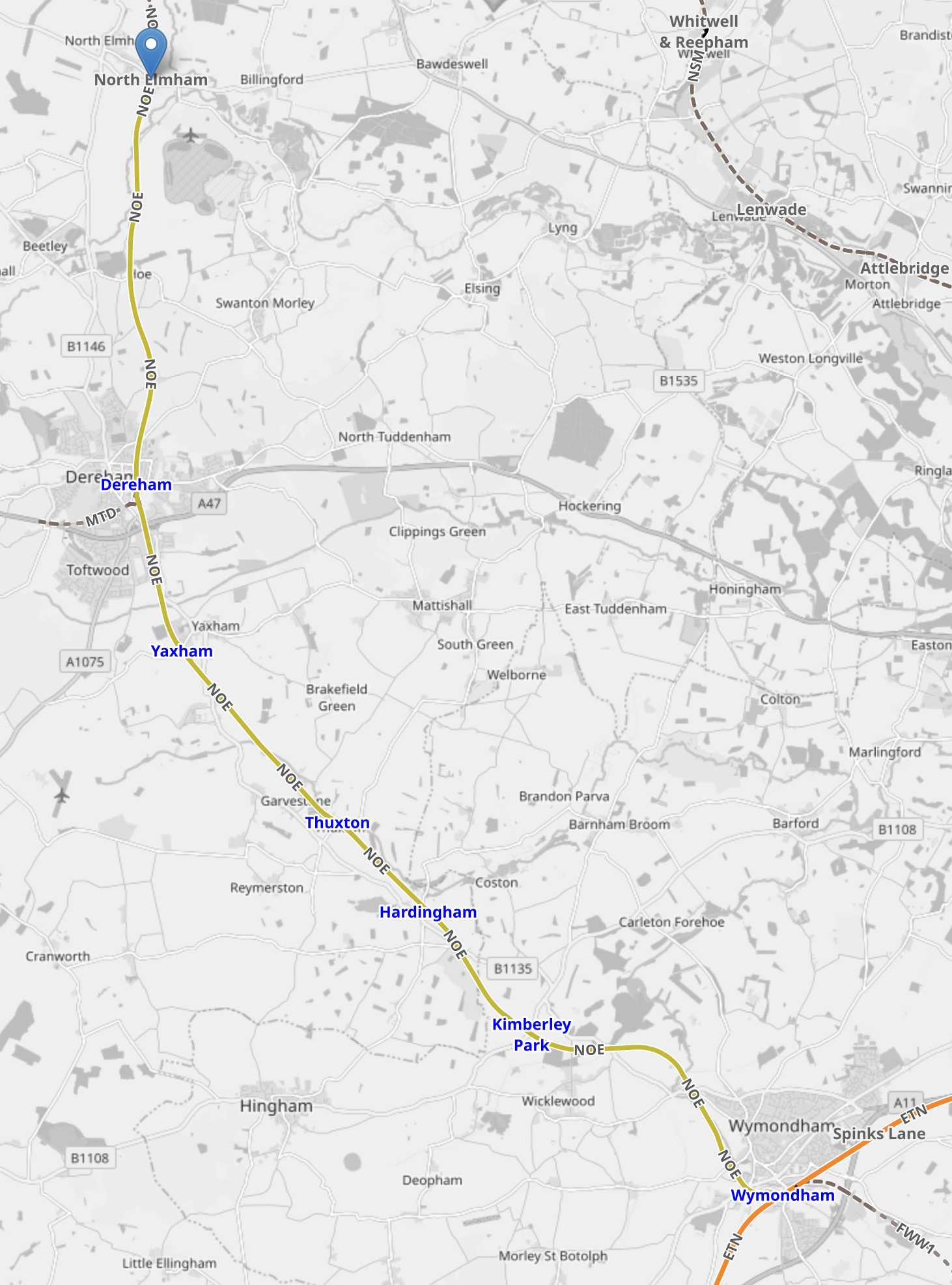
This map from OpenRailwayMap shows North Elmham and the Mid-Norfolk Railway.
Note.
- The yellow line is the Mid-Norfolk Railway.
- The site of the former North Elmham station is shown by the blue arrow at the top of the map.
- The orange line across the South-East corner of the map is the Breckland Line between Cambridge and Norwich.
- Wymondham station is on the Breckland Line, but trains between the Mid-Norfolk Railway and Norwich would be able to call at Wymondham station.
Wymondham station could be converted into a proper connection between the Breckland Line and the Mid-Norfolk Railway, with services being run between Norwich and North Elmham via Dereham.
In the Wikipedia entry for the Mid-Norfolk Railway, there is a section, which is entitled Community Railway, where this is the first paragraph.
The Mid-Norfolk Railway was established as a multi-functional line, with an intention to operate a community service in addition to tourist and freight services. The railway has also stated their belief that a commuter service between Dereham and Norwich remains a viable proposition, with the MNR either running the service themselves or working with an existing train operator. One obstacle on the MNR to running such services is the requirement to operate five manual gated level crossings between Dereham and Wymondham, although level crossing automation is a possibility in the future.
Later the section indicates that the Mid-Norfolk Railway could be extended to Fakenham.
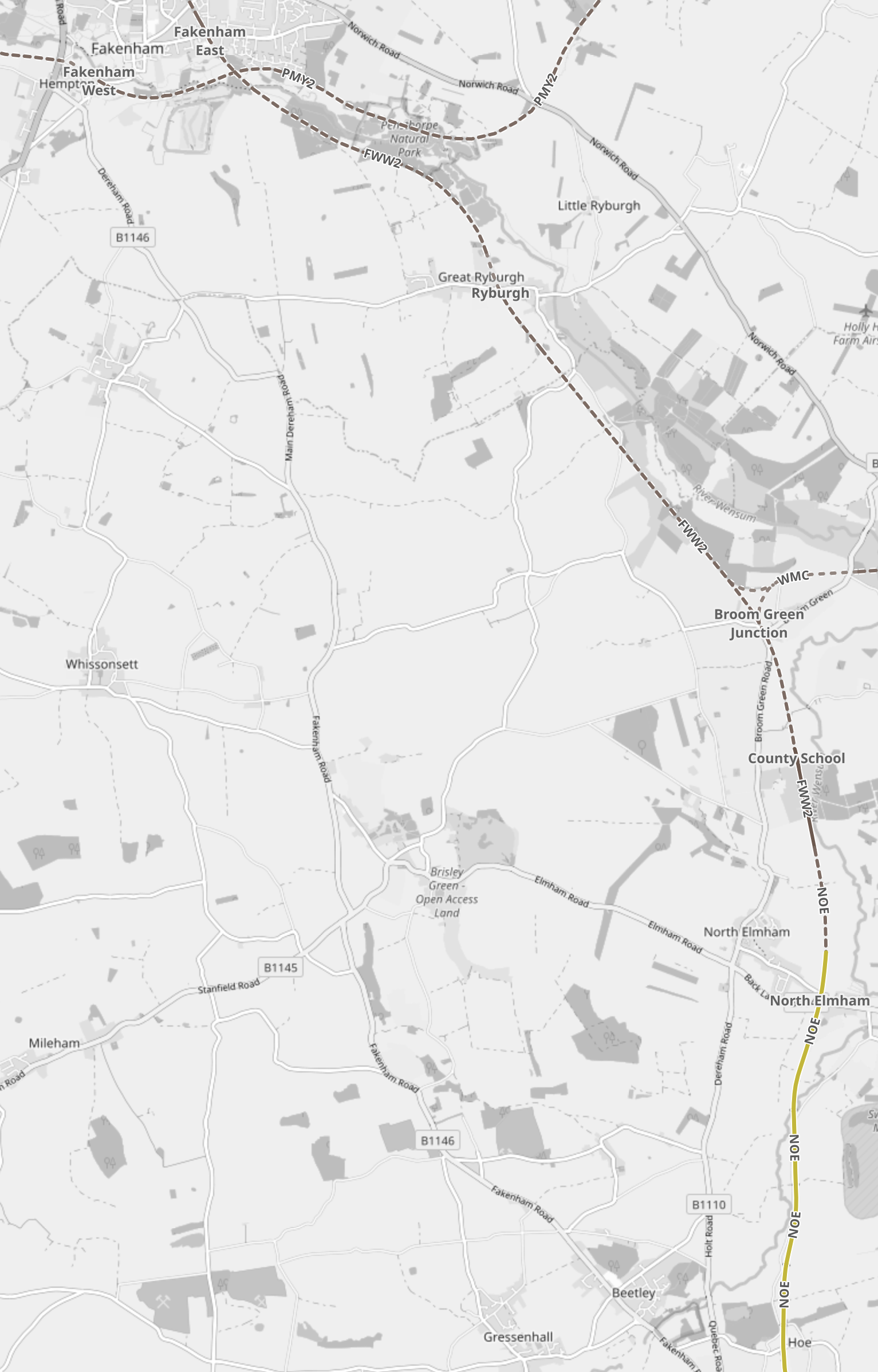
This map from OpenRailwayMap shows the original route between North Elmham and Fakenham.
Note.
- The yellow line is the Mid-Norfolk Railway.
- North Elmham station is at the top of the yellow.
- Fakenham is at the top of the map.
Adding Fakenham to the passenger service from Norwich would surely increase its viability.
There have been ambitions in the past to create a Norfolk Orbital Railway, that would connect the National Rail stations at Sheringham and Wymondham, using the tracks of the North Norfolk Railway and Mid-Norfolk Railway, and some new and relaid track.
This map from OpenRailwayMap shows North Norfolk from Fakenham and North Elmham in the West to Sheringham in the East.

Note.
- Fakenham is on the Western edge of the map about halfway up.
- North Elmham is in the South-West corner of the map, on the yellow line, what indicates the Mid-Norfolk Railway.
- The railway shown in the North-West corner is the Wells and Walsingham Light Railway. which is a 260 mm. gauge railway.
- Sheringham station, which has an hourly service to Norwich via Cromer, is in the North-East corner of the map.
- The Eastern terminus of the North Norfolk Railway is a short walk from Sheringham station.
- The blue arrow to the West of Sheringham station, indicates the Western terminus of the North Norfolk Railway at Holt station.
The Norfolk Orbital Railway would need to connect Fakenham and Holt, which doesn’t appear to be easy.
But if the connection could be made, Greater Anglia could run a combined service around the county, which would allow those living in the houses at North Elmham to get easily to the coast or the City of Norwich.
Wash Barrage
This is described as follows in the article.
A bid to build a tidal barrage stretching from Norfolk to Lincolnshire was unveiled at the end of last year.
While the scheme has seen objections from conservation groups, proponents say it would help protect the Fens from flooding, generate tidal power and would allow a new deep-sea container port to be built.
A planning application has yet to be submitted for the scheme, which Centre Port, the group behind the proposal, said could be operational by the end of the decade if given the go-ahead.
The Wash Barrier has a web site, but I doubt the RSPB will like it.
New Reservoir
The article says that the proposed site is between Chatteris and March in Cambridgeshire.
Long Stratton Bypass
This is described as follows in the article.
The Long Stratton Bypass has been mooted for decades and finally looked like it was going to get underway after funding was approved in 2021.
The scheme will mean motorists can avoid passing through the centre of the town.
It was needed, when C regularly commuted to Norwich in the 1980s.
Norwich Western Link
This is described as follows in the article.
The flagship infrastructure project has been thrown into doubt after County Hall announced an indefinite delay earlier this month.
The 3.9-mile road is designed to link the A47 with the NDR to the west of the city and has been hailed as a council priority for several years.
Climate protestors are mounting a High Court challenge.
Windfarms
These are described as follows in the article.
There are a series of major windfarms planned for the Norfolk coast.
These include Swedish energy giant Vattenfall’s Boreas and Vanguard projects, which could be some of the largest in the world.
The company was granted development consent for its Norfolk Vanguard windfarm in 2022, pledging to get underway early this year.
The two schemes could power more than 3.9m homes in the UK.
Hornsea Three, another major scheme which could power another 3.2m homes, is set to start being built in March.
Note.
- The author missed out the Sheringham Shoal and Dudgeon Extension windfarms.
- Total wind power that will be developed is around 6 GW, which would supply around a quarter of the UK.
The only problem is that Norfolk is protesting against the cables to connect the wind farms to the National Grid.
I suspect they will have to be put under the sea. I wrote about this in Is There A Need For A Norfolk-Suffolk Interconnector?
New Rail Junctions
The problems around Ely station are described as follows in the article.
A key rail junction, which could help to boost growth across the region, could steam ahead this year.
Ely Junction is important because it links five lines connecting Norwich, Ipswich, Cambridge, Peterborough and King’s Lynn.
It is currently operating at full capacity, which limits the opportunity for growth of routes for passenger and cross-country freight services.
It would also enable more frequent passenger services, including between King’s Lynn and London.
An outline business case was submitted to the Department for Transport last year to seek money for the next stage of the design process – but the government has yet to make a decision.
There are also problems at Haughley Junction.
Hospitals Rebuild
The article also puts the case for developing both King’s Lynn and Great Yarmouth hospitals.
Conclusion
Norfolk is going to be busy.
Surveys Completed For Celtic Sea Floating Offshore Wind Projects
The title of this post, is the same as that of this article on offshoreWIND.biz.
This is the sub-heading.
N-Sea Group has finished a series of benthic and geophysical surveys for Llŷr 1 and Llŷr 2 floating offshore wind projects in the Celtic Sea.
I described the two projects in detail in Two More Floating Wind Projects In The Celtic Sea.
- At least the surveys are complete and it still appears that a commissioning date of 2026/27 is still feasible for these twin 100 MW projects.
- In the original documents, it was stated that there would be six next generation turbines in each wind farm, with a capacity of between 12 and 20 MW.
- There appears to be no decision on the floats or turbine size to be used.
I wouldn’t be surprised to see larger turbines used and the capacity of the farms increased.
Five New Railway Stations Considered For West Midlands
The title of this post, is the same as that of this article on Rail Advent.
This is the first paragraph.
Transport authorities in the West Midlands are considering the case for building five new stations at Balsall Heath, Coventry East (Binley), Foleshill, Castle Bromwich and Tettenhall.
The location of the stations is as follows.
- Balsall Heath station is on the Camp Hill Line and was formerly known as Brighton Road station, which was shut in 1941 as a wartime economy measure.
- Castle Bromwich station, will be between Birmingham and Water Orton.
- Coventry East station will be on the main line between Coventry and Rugby.
- Foleshill station will be on the Coventry-Nuneaton Line, between Coventry and Coventry Arena stations.
- Tettenhall station will be to the west of Wolverhampton on the Wolverhampton Shrewsbury Line.
Note.
- Balsall Heath station would require construction of the Bordesley Chords and extra capacity at Moor Street Station.
- Coventry East station will benefit from the opening of High Speed Two, will will allow more local services.
- Castle Bromwich station would also benefit from the extra capacity from High Speed Two and the Midland Rail Hub.
Railways in Central Birmingham appear to be having a big sort out.
The article also says this about other stations, being planned in the West Midlands.
These planned new stations will add to expansion of the region’s rail network that is already underway, with new stations being built on the Camp Hill line in south Birmingham at Moseley Village, Kings Heath and Pineapple Road, and on the Walsall to Wolverhampton line serving Darlaston and Willenhall. A new station is also planned at Aldridge, with funding allocated subject to business case. The City of Wolverhampton, South Staffordshire District and Staffordshire County councils have also looked at the case for a new station at Brinsford, which will be considered alongside the case for nearby Tettenhall Station.
In the last part of the article, Andy Street talks about the funding secured.
It certainly looks like station builders in the West Midlands will have lots of work to do.
Dutch Take Aim At Lower Green Hydrogen Costs By Combining Offshore Wind And Floating Solar
The title of this post, is the same as that of this article on offshoreWIND.biz.
This is the sub-heading.
A consortium of Dutch companies has launched a government-backed project to explore the synergies between offshore wind, offshore solar and hydrogen production at sea for improved sustainability of North Sea renewable energy projects.
T thought about calling this post, The Dutch Go For The Full Monty, but there is no mention of wave or tidal power.
These two paragraphs outline the project.
The four-year project, dubbed Solar Enhanced North Sea Energy Hub (SENSE-HUB), is expected to accelerate the rollout of offshore solar into offshore renewable energy systems.
Let by TNO, short for Netherlands Organization for Applied Scientific Research, the project will address the integration of various energy system modules for the Dutch North Sea by understanding and removing the implementation barriers for future SENSE-HUBs from a technical, economical, ecological, legal and societal perspective.
I wouldn’t be surprised to see more integrated systems like this in the waters around our coasts.
I also believe that the ultimate offshore energy production system will also use wave and tidal power to generate electricity and have inbuilt energy storage.
Moorgate To Charlton Via Cannon Street
I needed to go to Charlton station this morning to take a couple of photographs for a possible blog post.
- I had had my usual breakfast in LEON on Moorgate, so I started from Moorgate station.
- I took the Northern Line one stop to Bank station.
- It was then straight up the double escalators.
- I followed this by a brisk walk along Cannon Street.
The total time between entering Moorgate station and sitting on my train at Cannon Street station was about ten minutes.
One of London’s more difficult stations to access now has a North-South Underground line, to go with its East-West line.
NHS Prevention Programme Reduces Type 2 Diabetes By A Fifth
The title of this post, is the same as that of this article on The Times.
This is the sub-heading.
Participants are given free Fitbits or smart watches to help them lose weight
These two paragraphs outline the program.
An NHS scheme that sends obese patients to slimming classes and gives them free Fitbits has cut diabetes rates by one fifth.
The NHS Diabetes Prevention Programme, also known as Healthier You, offers health advice alongside free cookery and exercise sessions online or in person. Participants are given NHS-funded Fitbits or smart watches to monitor their activity to help them lose weight.
Note.
- Manchester University have analysed the project.
- Those on the scheme lost five pounds on average.
- The Healthier You programme is available in all parts of England.
It sounds like the programme has been a success.
I’d like to hear of peoples’ stories about this programme.
Vattenfall Invests In 76-Megawatt Agrivoltaic Project
The title of this post, is the same as that of this media report from Vattenfall.
This is the sub-heading.
Agrivoltaics is the combination of sustainable agriculture and solar power generation on the same agricultural land. Vattenfall has now made a final investment decision for a 76-megawatt solar park Tützpatz in Mecklenburg-Western Pomerania. The project is being set up without state support.
These two paragraphs outline the project.
Photovoltaics is now one of the cheapest technologies among renewable energies, and solar power has a high level of acceptance among the population. However, critics of open space photovoltaics fear that expansion could take place at the expense of agricultural land used for food production. The relatively young technology of agrivoltaics, which can reconcile agricultural use and photovoltaics, can help to resolve this competitive situation.
For the first time, Vattenfall will implement this innovative concept of land use on a commercial scale with partners. The aim of the project in Tützpatz is to combine module types on different mounting systems with suitable agricultural uses over an area of 95 ha, and thus gain further practical experience for future commercial projects of this kind. According to current plans, construction at Tützpatz is scheduled to start in early summer 2023.
Note.
- Tützpatz is a few miles North of Lincoln.
- This project is subsidy-free.
- At Tützpatz, 76 MW is to be installed in 95 hectares, which is an energy density of 0.8 MW per hectare.
- Agrivoltaics have an extensive Wikipedia entry.
I would expect we could use agrivoltaics in quite a few places in Southern England.
 The Anonymous Widower