The Southern End Of The Silvertown Tunnel
This map from OpenRailwayMap shows the Southern end of the Silvertown Tunnel.
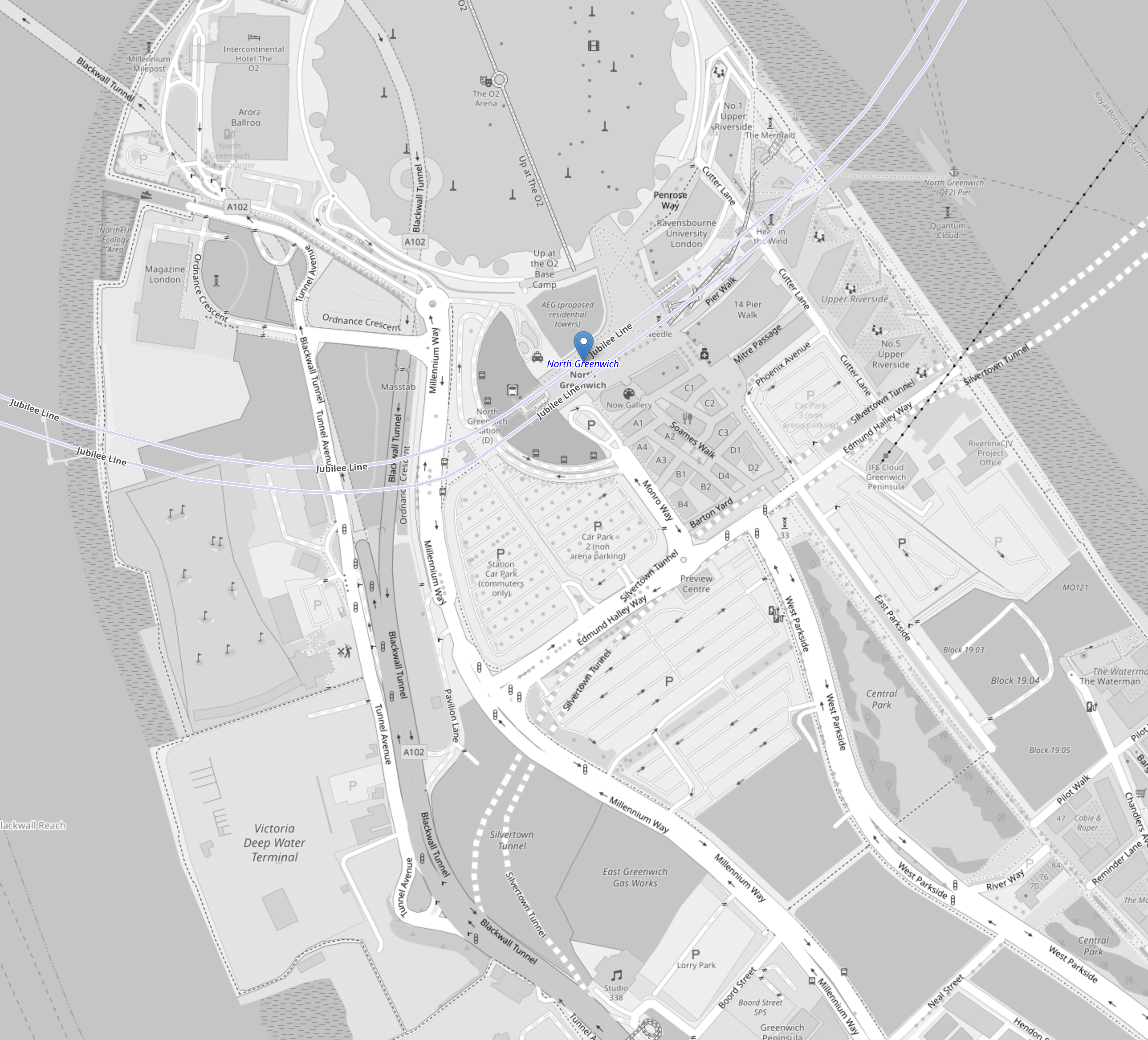
Note.
- The O2 Arena at the top of the map in the middle.
- The blue arrow below it, which indicates North Greenwich station.
- The two dotted white lines show the route of the Silvertown Tunnel.
- The two silver-grey lines that loop across the top part of the map are the Jubilee Line.
- The black dotted line between the Jubilee Line and the Silvertown Tunnel is the cable car.
This second OpenRailwayMap shows the Silvertown Tunnel’s junction with the approach to the Blackwall Tunnel.
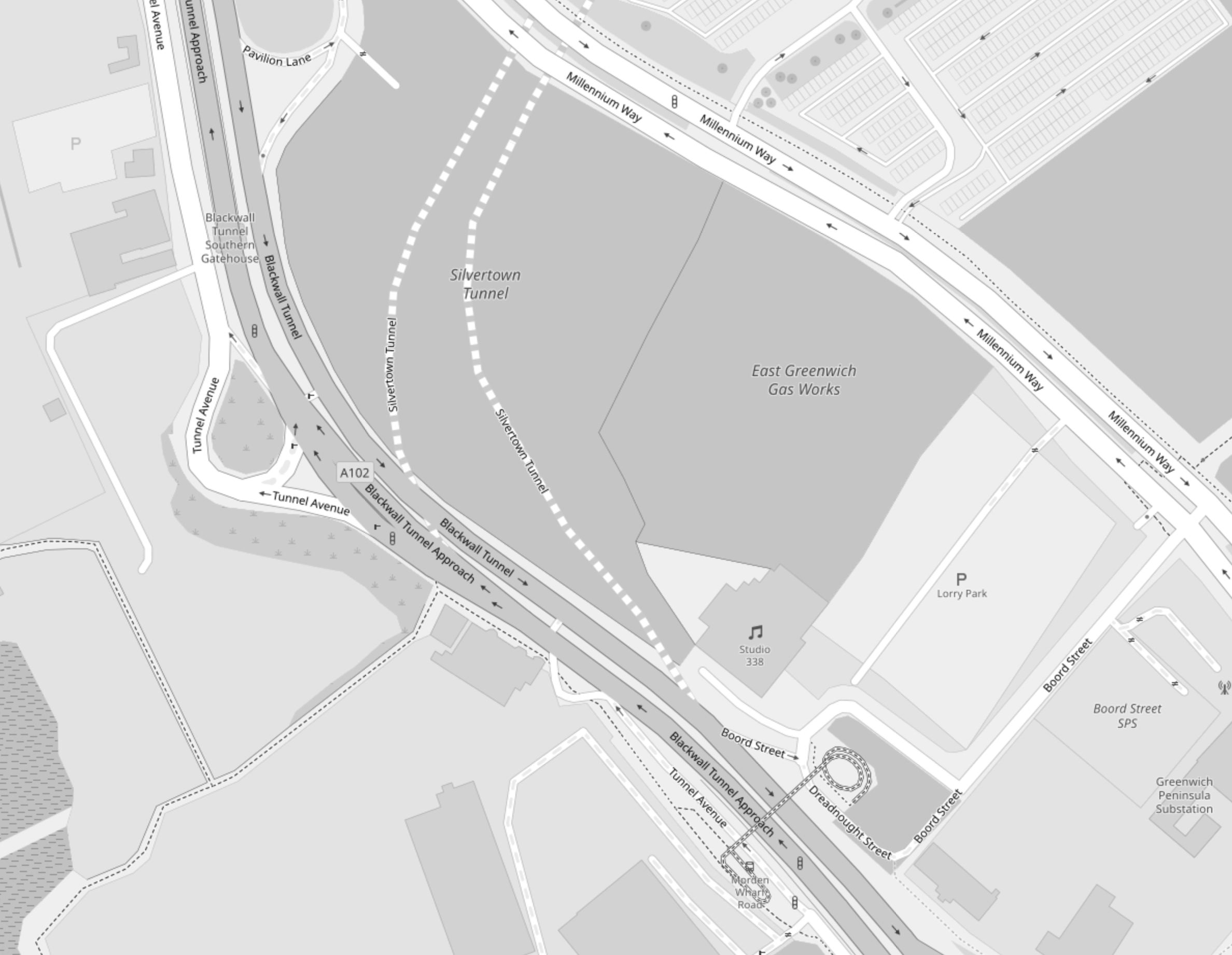
Note.
- The two dotted white lines show the route of the Silvertown Tunnel.
- Studio 338, which is a music and arts venue, is indicated by the double quaver.
- The site to the North of Studio 338 is labelled the East Greenwich Gas Works.
- The roads to the Northbound tunnel bores of both tunnels, split to the West of Studio 338.
- The roads from the Northbound tunnel bores of both tunnels, join to the West of Studio 338.
This Google Map shows the same area as the previous map.
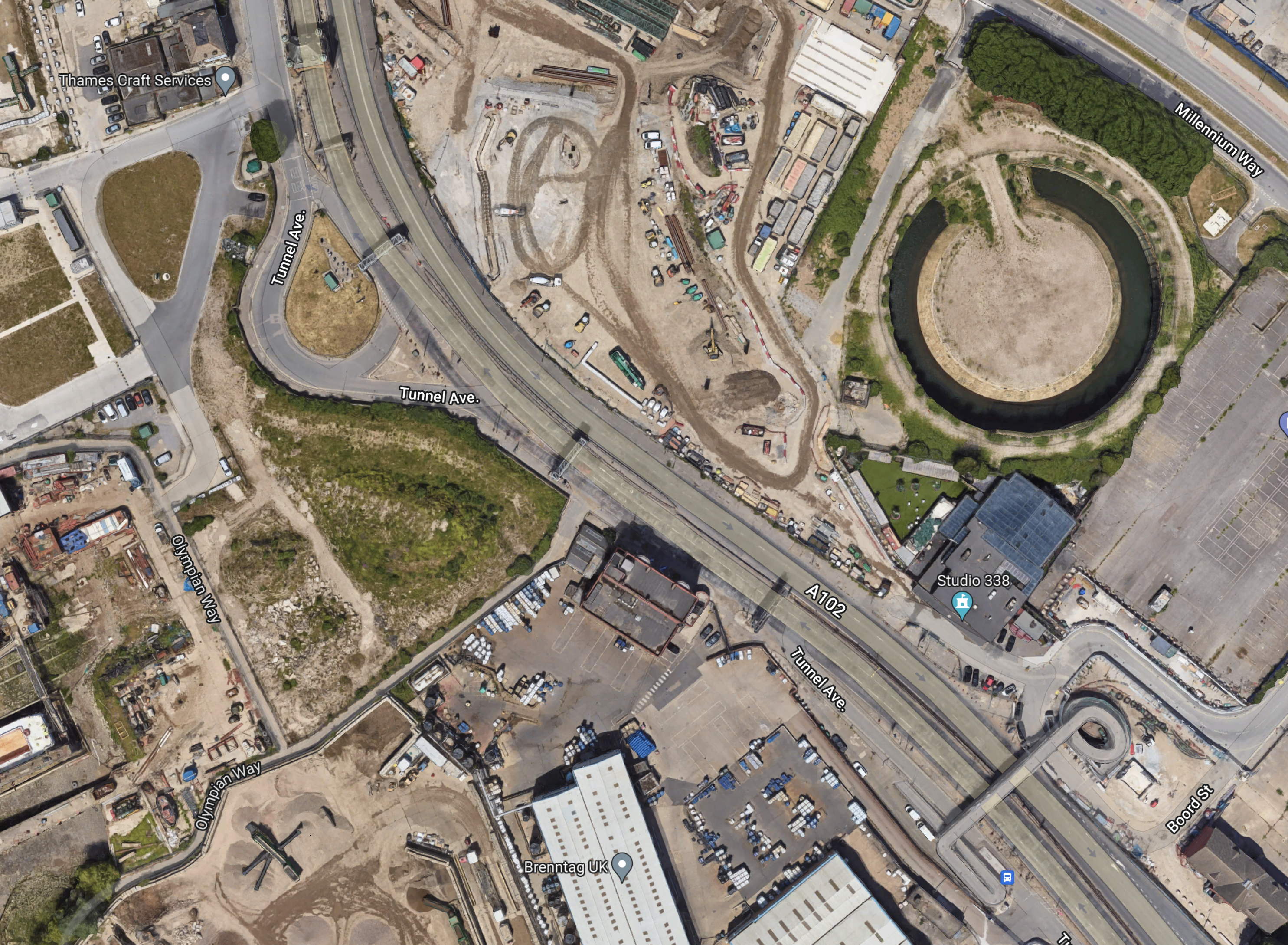
Note.
- Studio 338 is clearly marked.
- To its North is a circular structure on the site labelled as the East Greenwich Gas Works on the previous map.
- Could this be the remains of a gas holder?
Could it be that the works to the West of the circular structure are the start of tunneling?
Conclusion
It looks to me, that the designers of the Silvertown Tunnel have been able to squeeze in a junction between the approaches to the two tunnels, that should be fairly free-flowing.
Through The Blackwall Tunnel In A 108 Bus
Around lunchtime today, I took a 108 bus from North Greenwich station on the Jubilee Line to Bow Church station on the DLR. It’s rather a roundabout way to get home from Bow Church station, so I walked to Bow Road station to get a train to Moorgate for a bus home.
I took these pictures of the journey.



















Note.
- The first picture shows the Radisson Red hotel on Tunnel Avenue.
- The Northbound bus travelled through the old tunnel, which was built in 1897.
- It looks in good condition for its age in my pictures.
- Even at lunchtime on Christmas Eve, there are queues of traffic waiting to go through the tunnel from both directions.
- The dog in the last picture is better and less-threatening street art, than you get in some parts of the UK
Taking good pictures from inside a dirty single-deck bus is not the easiest task.
This paragraph from the Wikipedia entry for the Blackwall Tunnel, gives a snapshot of the tunnel’s development.
The tunnel was originally opened as a single bore in 1897 by the Prince of Wales, as a major transport project to improve commerce and trade in London’s East End, and supported a mix of foot, cycle, horse-drawn and vehicular traffic. By the 1930s, capacity was becoming inadequate, and consequently a second bore opened in 1967, handling southbound traffic while the earlier 19th century tunnel handles northbound.
Note.
- Both tunnels are not open to pedestrians, cyclists or non-motorised traffic.
- There is a four metre height limit on the Northbound tunnel, which also has sharp bends.
- The Southbound tunnel is straight and has a height limit of 4.72 metres.
- London’s iconic Routemaster and New Routemaster buses are 4.38 and 4.39 metres high respectively.
- The tunnel will be tolled, when the Silvertown Tunnel opens in a few years time.
- It looks like both Blackwall and Silvertown tunnels will have the same charge as the Dartford Crossing, which is currently two pounds if you pre-pay for a car.
The pictures and words give clues to why the Mayor has decided to build the Silvertown Tunnel.
It is very rare to get through the tunnel without being delayed in a queue of traffic.
Double deck buses can’t go through the Northbound Tunnel.
As a non-driver, who doesn’t need to use the Blackwall Tunnel, I don’t listen to traffic reports, but perhaps once a week whilst waiting for the news on Radio 5, I hear of problems at the tunnel. Sometimes, these are caused by over-height or over-long vehicles, which have got stuck in the Northbound tunnel.
Incidentally, my earliest memory of the tunnel is probably from about 1953, when my family was stuck in the tunnel for several hours in my father’s Y-type MG.

, My father’s car had the registration BNH 368.
I doubt I’ve driven through the tunnel this century, as I have rarely driven to South and South-East London since the 1970s, as I’ve generally taken the train across London. I can remember one trip in about 2008 though, when I took the Woolwich Ferry for the Southbound crossing.
As I was living near the top of the M11 in Suffolk, I may have gone home via the Blackwall Tunnel.
Ruby Wax, Melanie Brown and Emily Atack Climb Pikes Peak
I have just watched these three ladies climb Pikes Peak in Colorado.
Around the age of 18, I used to regularly read the American car magazine; Road & Track and was fascinated to read about the annual hill climb, that took place on the 14,000 foot Pikes Peak.
I am surprised that the hill climb up Pikes Peak was not mentioned in the program.
I have only driven at anywhere near that height once, although, I flew my Cessna 340 at 24,000 ft several times.
When C and I had a memorable holiday in Ecuador, we took a small Chevrolet Metro, up to about 12,000 feet in the Andes.
Cars cough badly at that altitude!
Good Vibrations Turbo Charge Green Hydrogen Production
The title of this post, is the same as this news item from RMIT University in Australia.
This is the sub-heading.
Engineers in Melbourne have used sound waves to boost production of green hydrogen by 14 times, through electrolysis to split water.
And these are the first two paragraphs.
They say their invention offers a promising way to tap into a plentiful supply of cheap hydrogen fuel for transportation and other sectors, which could radically reduce carbon emissions and help fight climate change.
By using high-frequency vibrations to “divide and conquer” individual water molecules during electrolysis, the team managed to split the water molecules to release 14 times more hydrogen compared with standard electrolysis techniques
I could understand a two or three times increase, but fourteen times is sensational.
Again, Australia seems to have found the gold through innovative green technology.
Other Benefits
Read the last sections of the news item.
- The process allows the use of cheaper silver electrodes instead of platinum and iridium.
- The engineers also feel that their technique could help in this and other process where bubbles are a problem.
Sound waves have been used for decades for various processes and I am surprised that this appears to be the first time, they’ve applied to electrolysis.
Conclusion
I worked in a hydrogen factory around 1970 and have watched developments over the years.
I am now convinced that an individual or a company will come up with an affordable way to make green hydrogen.
Promising technologies in addition to this one include.
- High Temperature Electrolysis. See Nuclear-Enabled Hydrogen – How It Helps To Reach Net Zero.
- HiiROC See Centrica Partners With Hull-Based HiiRoc For Hydrogen Fuel Switch Trial At Humber Power Plant.
- Electrolysis of sea water. See Torvex Energy.
I can see a combination of a couple of methods.
SSE Thermal Charts Path To Green Hydrogen Future With First-Of-A-Kind Project
The title of this post, is the same as that of this press release from SSE Thermal.
This is the sub-heading.
SSE Thermal is developing a first-of-a-kind project in the Humber which would unite hydrogen production, storage and power generation in one location by the middle of this decade.
These paragraphs explain the project.
The Aldbrough Hydrogen Pathfinder project will support the evidence base for wider deployment of flexible hydrogen power in the UK’s net zero journey and is a major enabler of SSE Thermal’s wider Humber ambitions.
Located at SSE Thermal and Equinor’s existing Aldbrough Gas Storage site on the East Yorkshire coast, the project is designed to demonstrate the interactions between hydrogen electrolysis, hydrogen cavern storage and 100% hydrogen dispatchable power.
The concept would see green power sourced from grid through Renewable PPAs, in compliance with the Low Carbon Hydrogen Standard. Hydrogen would then be produced via a 35MW electrolyser before being stored in a converted salt cavern and then used in a 100% hydrogen-fired turbine, exporting flexible green power back to grid at times of system need. In future, hydrogen storage will also benefit offtakers in other sectors, for example in industry, heat or transport.
Note.
- The Aldbrough Gas Storage site currently can store the equivalent of 320 GWh of electricity, It is currently being expanded to be one of the largest hydrogen stores in the world according to this page on the SSE web site.
- SSE Thermal are proposing to build a hydrogen-powered power station at Keadby to the South of the Humber. The press release says this power station could have a peak demand of 1,800MW of hydrogen.
- Aldbrough at its current size could keep the Keadby hydrogen-powered power station going for a week. But Aldbrough will be a lot bigger than the current 320 GWh.
- The Hornsea and Dogger Bank wind farms off the coast of East Yorkshire will have a capacity of at least 13.5 GW.
- A 35 MW electrolyser will produce 15.2 tonnes of hydrogen per day.
SSE and Equinor hope to be storing hydrogen by 2025.
Conclusion
It is an enormous project and it will surely grow with more electrolysers and hydrogen-powered power stations.
Where Have All The Party Poppers Gone?
Every Christmas, about ten of us get together for Christmas lunch.
I usually provide a bag of small useful things for everyone.
Each bag usually contains a few party poppers like these.

But this year there weren’t any to be found.
Eventually, my son bought some from mumdadandbaby.co.uk.
Vattenfall Boosts Capacity For Norfolk Offshore Wind Zone
The title of this post, is the same as that of this article on offshoreWIND.biz.
This is the sub-heading.
Vattenfall is increasing the capacity for the Norfolk Offshore Wind Zone off the UK from 3.6 GW to over 4.2 GW, meaning that an additional 700,000 homes will be powered by the zone, the energy company said.
This is a sixteen percent increase in capacity.
In this article in the Eastern Daily Press, this is said.
Rob Anderson, project director of Vattenfall’s Norfolk Zones, said that the increase is due to the project using “innovative” technology and being “able to maximise its design”.
Moving from 12 MW to 14 MW turbines would give the planned increase.
This article on offshoreWIND.biz, is entitled Siemens Gamesa Ships Out First Set Of 115-Metre Wind Turbine Blades.
This is said about the two Norfolk Zone wind farms.
The SG 14-236 DD model will be commercially available in 2024 and has so far been selected as a preferred option for the Norfolk Vanguard and Boreas wind farms offshore the UK, as well as for the MFW Bałtyk II and MFW Bałtyk III wind farms in the Polish Baltic Sea.
It looks to me that Siemens Gamesa have got a success in the making.
It should be noted that the offshore floating wind farm named Ossian could increase from 2.6 GW to 3.6 GW, which I wrote about in Ossian Floating Wind Farm Could Have Capacity Of 3.6 GW.
A similar effect of size increases happened in North Sea Oil and Gas in the 1970s, as the cranes got larger and the techniques got better.
Is history repeating itself?
Ramboll To Develop Offshore Wind-To-Hydrogen Concept
The title of this post, is the same as that of this article on offshoreWIND.biz.
This is the sub-heading.
Ramboll has been selected to investigate the feasibility of producing hydrogen offshore at a multi-gigawatt scale with NortH2 in the Dutch part of the North Sea.
Note.
- NortH2 has a web site.
- There is a very rich About NortH2 page.
- NortH2 is a consortium made up of Equinor, Eneco, Gasunie, Groningen Seaports, RWE and Shell Netherlands.
- The consortium aims to use 4 GW to produce hydrogen by 2030 and 10 GW by 2040.
The world needs more ambitious projects like this.
World’s First Net Zero Transatlantic Flight To Fly From London in 2023, Powered By The Rolls-Royce Trent 1000
The title of this post, is the same as that of this press release from Rolls-Royce.
These are the three main bullet points.
- World first as Virgin Atlantic wins UK government funding to operate historic London – New York flight
- Rolls-Royce, Boeing, Imperial College London, University of Sheffield, Rocky Mountain Institute (RMI) and ICF also form part of an iconic British-led consortium
- Heralds future of low carbon aviation, with the wider sustainable aviation fuel (SAF) industry potentially creating thousands of UK jobs while supporting delivery of net zero aviation emissions by 2050
Note.
- The flight will take place next year.
- The aircraft will be one of Virgin Atlantic’s flagship Boeing 787s, which are powered by a pair of Rolls-Royce Trent 1000 engines.
- When fully replacing kerosene, SAF can slash lifecycle carbon emissions by more than 70% compared to conventional fossil jet fuel.
- This flight is expected to be fuelled by SAF made primarily from waste oils and fats, such as used cooking oil.
- SAF could create a UK industry with an annual turnover of £2.4bn by 2040, and which supports up to 5,200 UK jobs by 2035.
The flight could be made net zero, if it used 100 % SAF and offset any carbon dioxide produced.
What Is Sustainable Aviation Fuel?
It is also known as Aviation biofuel, which has a comprehensive Wikipedia entry, which has this first paragraph.
An aviation biofuel or bio-jet fuel or bio-aviation fuel (BAF) is a biofuel used to power aircraft and is said to be a sustainable aviation fuel (SAF). The International Air Transport Association (IATA) considers it a key element to reducing the carbon footprint within the environmental impact of aviation. Aviation biofuel could help decarbonize medium- and long-haul air travel generating most emissions, and could extend the life of older aircraft types by lowering their carbon footprint.
Sustainable Aviation Fuel (SAF) can be made in a variety of ways, which are described in the Wikipedia entry.
Could A Plane Run On Kerosene One Flight And SAF The Next?
I suspect that the practicalities of airline operation and schedules and the production and distribution of aviation fuel, will mean that if an airliner can run on both kerosene and SAF would be a great advantage.
This is a paragraph from the press release.
It comes hot off the heels of the world’s first sustainable fuel military transporter flight using 100% SAF, completed by the RAF last month using the iconic Voyager aircraft.
Note.
- The Voyager is an RAF military transport/tanker aircraft based on the Airbus 330 and fitted with Rolls-Royce Trent 772B-B-60 engines.
- Rolls-Royce Trent engines power both the Dreamliner and the Voyager.
- I’m sure that for operational reasons, the RAF would mandate a dual fuel capability.
This press release on the RAF web site, which is entitled Royal Air Force Completes World-First Sustainable Fuel Military Transporter Flight, gives more details of the RAF flight.

