Green Light For New £80m Merseyrail Station
The title of this post, is the same as that of this article on the Liverpool Echo.
These are the first two paragraphs.
The station was hailed as a key part of the town’s “bright future” tonight as councillors met to consider the proposal at a meeting of Knowsley Council ’s planning committee.
Based at Headbolt lane in the Tower Hill/ Northwood area of Kirkby, the station, which will take around 18 months to build, will become the first in the country to have trains operating by battery power instead of electrified lines on part of the track.
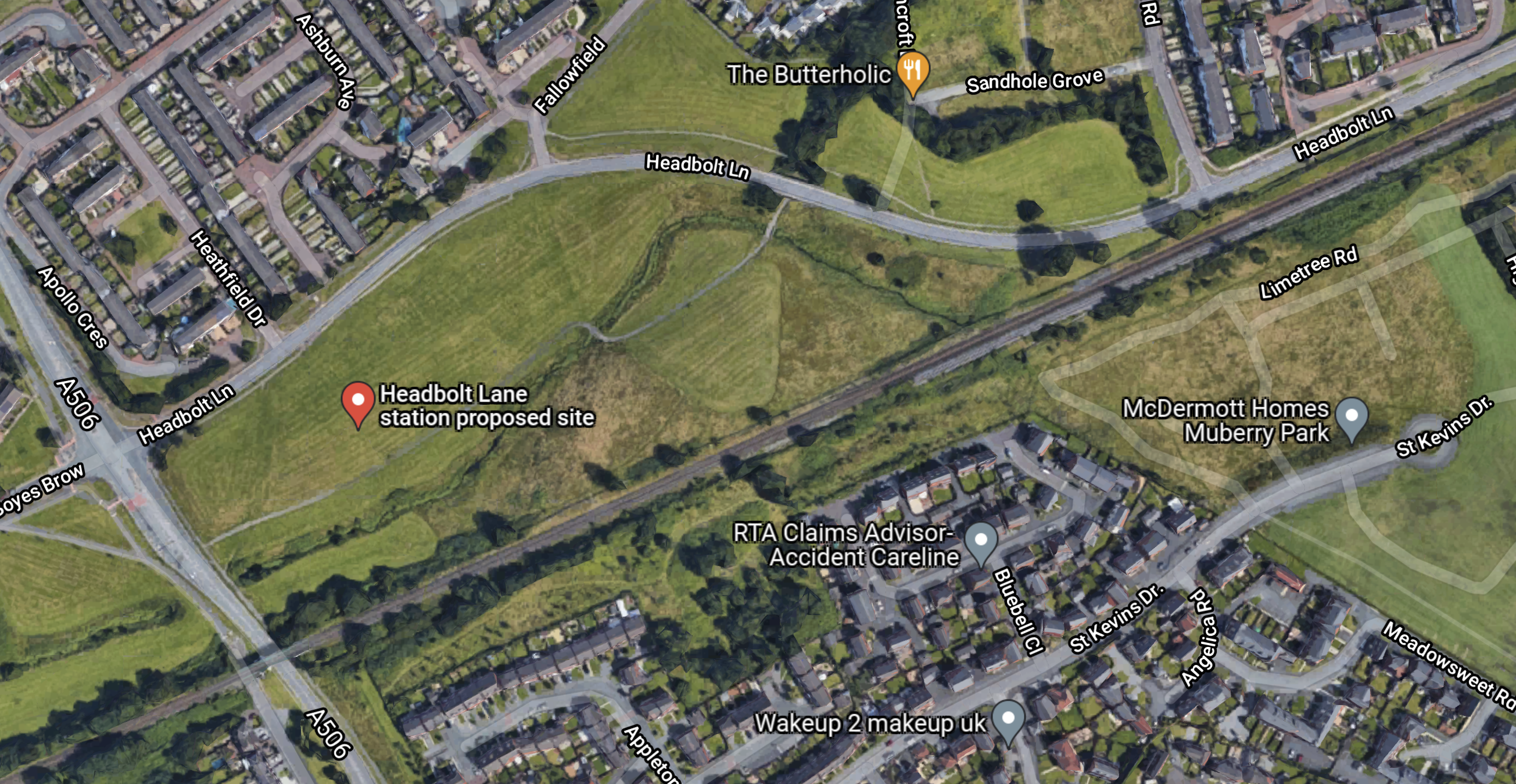
This Google Map shows the location of the station.
And this planning document from Knowsley Council shows the station road layout.
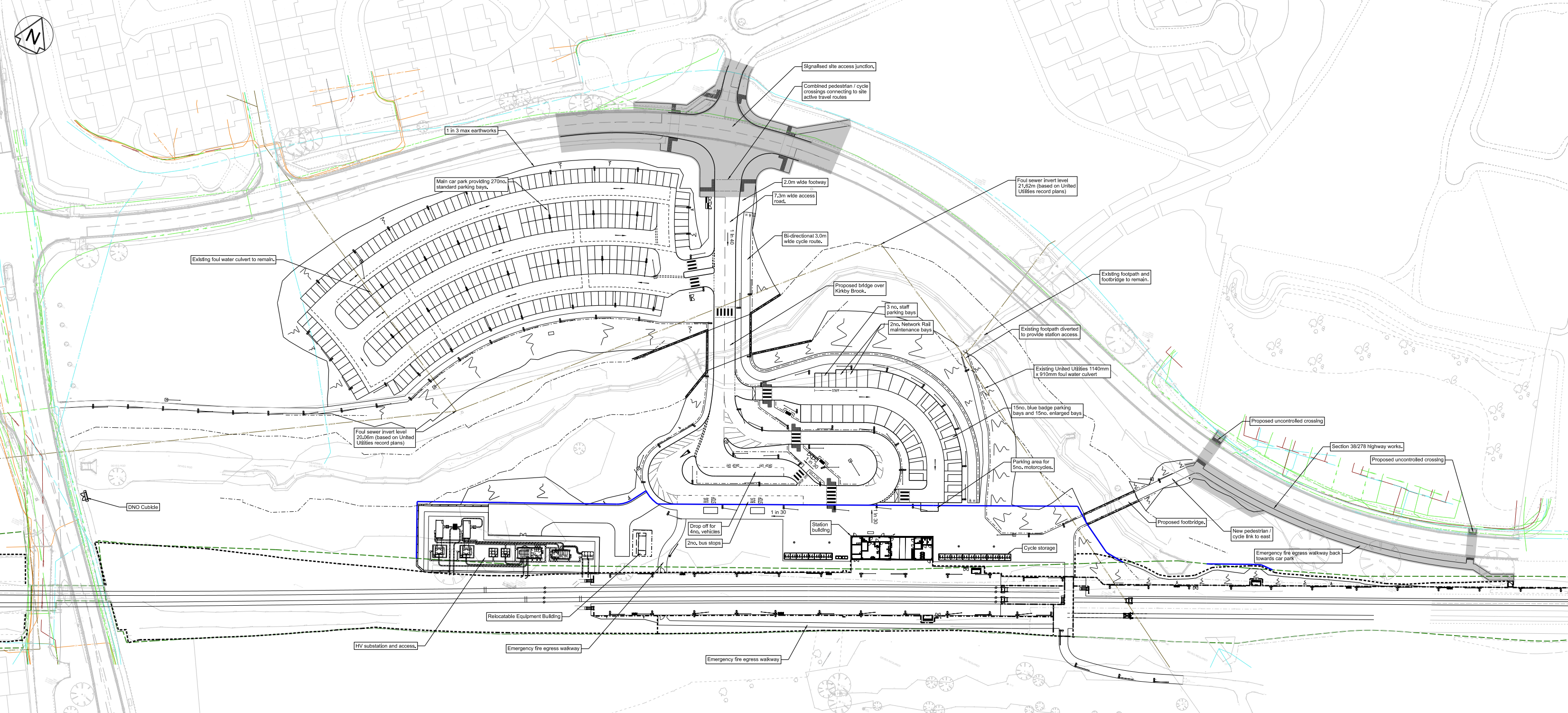
Note.
- Kirkby station and Liverpool is to the West.
- Wigan is to the East.
- There is adequate car parking.
I have also enlarged the area around the station buildings to show the platform layout.
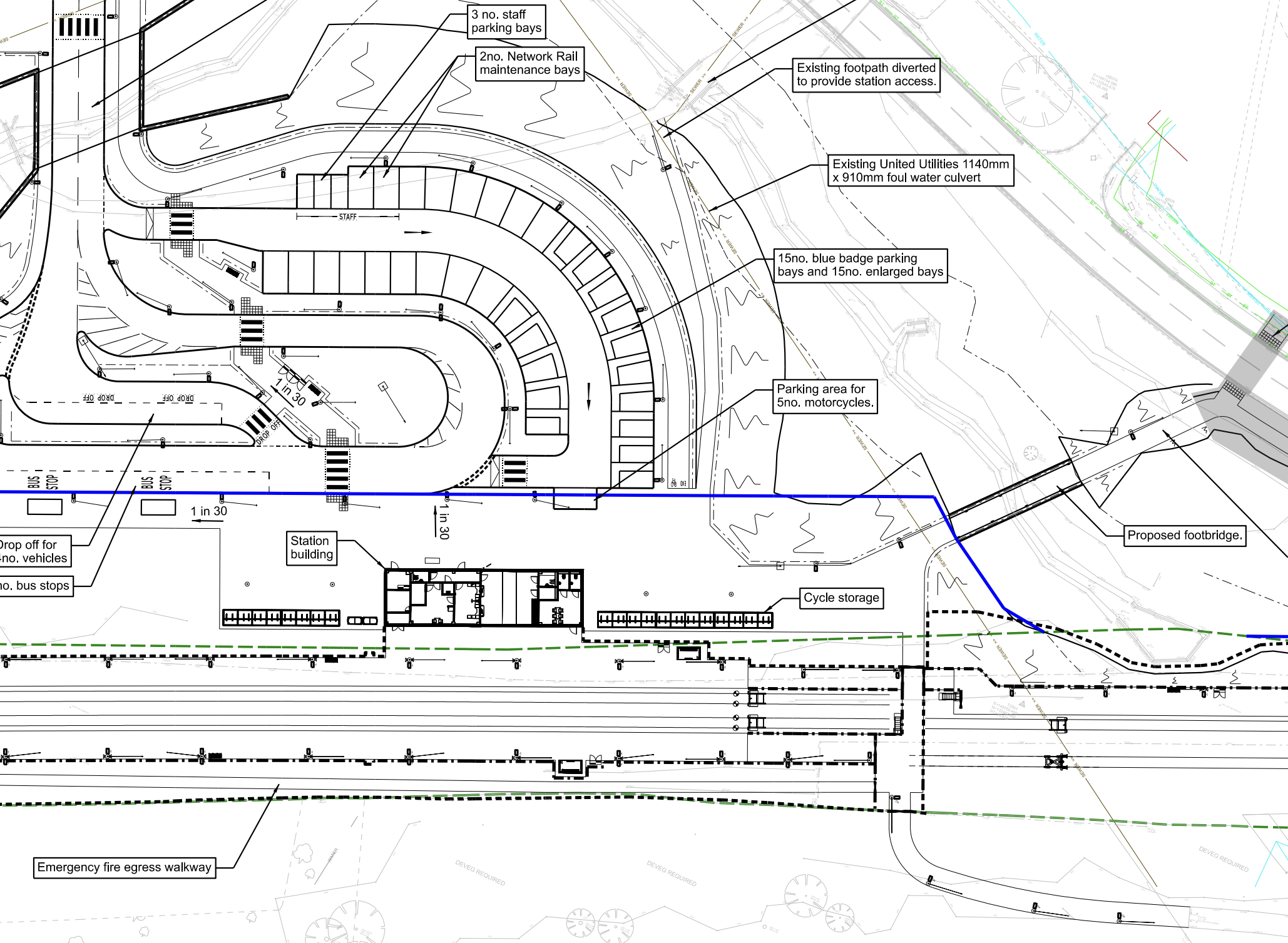
Note.
- There are two platforms and tracks towards Liverpool.
- There is a single platform towards Wigan.
- There appears to be adequate cycle storage and blue badge parking.
In Headbolt Lane Station Fly-Through, I described the new Headbolt Lane station.
This screen capture is from the video in that post.
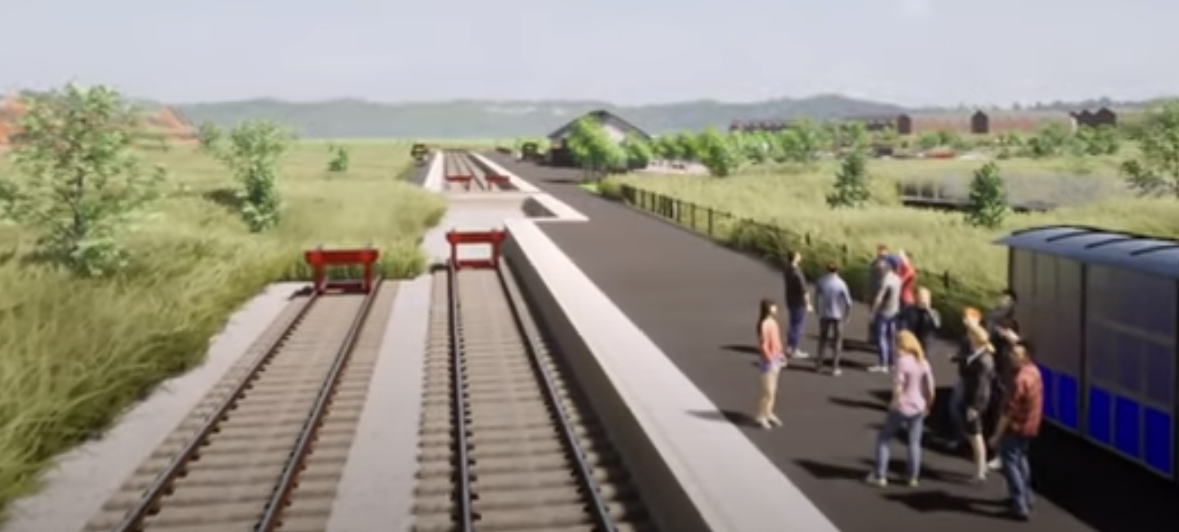
Note.
- Two platforms going away from the camera and one platform and what looks to be a siding going towards the camera.
- There appears to be no direct connection between the two different sets of tracks.
From the maps the camera is looking towards Liverpool,so it would mean that Liverpool services had two platforms. But they currently make do with one at Kirkby.
There appears to be no clues about how the station will be modified to serve Skelmersdale.
When It Comes To Buses, Will Hydrogen Or Electric Win?
The title of this post, is the same as that of this evcellent article on WIRED.
The WIRED article is a serious comparison between the merits of battery and hydrogen-powered buses.
The writer of the article talked to two people, who should know.
- James Dixon, who is a Research Fellow in the Transport Studies Unit and Environmental Change Institute at Oxford University
- Neil Collins, who is Managing Director of Wrightbus.
I think the philosophy of Wrightbus with four basic zero-carbon buses could be right.
- Streetdeck Hydroliner FCEV – A hydrogen-powered double-deck bus.
- Streetdeck Electroliner BEV – A battery-powered double-deck bus.
- GB Kite Hydroliner FCEV – A hydrogen-powered single-deck bus.
- GB Kite Electroliner BEV – A battery-powered single-deck bus.
This surely is a basis for satisfying customers, who like to buy what they feel is best for their networks and passengers.
This paragraph from the Wired article, illustrates how terrain and climate might favour one bus or the other.
Still, hydrogen may be a better option in a city with lots of hills, like Hong Kong, where it’s also very warm and humid, says Collins. “That’s going to be a problem for electric buses, because the cooling and the hills are just going to drain the batteries,” he says. “But if the city is relatively flat, and the journey times are relatively short, and it’s not either significantly warm or significantly cold, battery electric can do a very good job.”
In addition, you wouldn’t choose hydrogen buses, if supply of hydrogen was difficult.
Could this be why Jo Bamford, who is the owner of Wightbus, has established a company to help bus operators with the transition to hydrogen. I wrote about it in New Company Established To Help Transition Bus Fleets To Hydrogen.
I have also heard stories of garages in city centres, where it is not possible to get enough power to charge a garage full of battery buses. Some of these garages are in residential areas, which perhaps may not welcome tankers of hydrogen going through to supply the buses with hydrogen.
Perhaps, the solution for garages like this is to relocate the garage to a site, which fulfils one of these conditions.
- Good connections to the motorway and trunk road network, so that hydrogen can be brought in by truck.
- A high-capacity electricity supply to either charge battery electric buses or generate hydrogen using an electrolyser.
Buses would operate according to this daily cycle.
- Buses would either be charged or refuelled with hydrogen overnight.
- They would position to a convenient place to start their daily diagrams.
- At the end of the day, they would return to the garage.
Note.
- Battery-electric buses may need to be topped-up during the day.
- Hydrogen buses with their longer range should be able to service routes further away.
- Routes would be arranged, so that hydrogen buses would not need to be topped up.
The big advantage of a remote bus garage is that the city centre site could be redeveloped to pay for the new buses and garage.
Volkswagen Transformation Boosts Spending On Electric Vehicles
The title of this post, is the same as that of this article in The Times.
This is the first paragraph.
Volkswagen plans to increase its spending for battery-powered electric vehicles by about 50 per cent to €52 billion by 2026 as part of the carmaker’s far-reaching transformation.
That is a lot of euros.
This is a statement from their Chief Executive; Herbert Diess
We are becoming a battery manufacturer, a charging infrastructure manager, software is playing a more dominant role . . . We are developing new business activities with an unbelievable dimension for us.
Vehicle manufacturers must either change or die.
TfL To Ban Private e-Scooters and e-Unicycles From Its Premises
The title of this post, is the same as this article on City AM.
I am no fan of these devices, especially, when they are ridden on pavements at speed, as they are very often in London.
I have also seen several instances of Darwinian behaviour, which would increase the quality of the gene pool.
The sooner the riders of these devices are made to obey the law the better.
Fortescue Making Plans To Test ‘Green’ Locomotives At Rail Operations In 2022
The title of this post, is the same as that of this article on International Mining.
This is the first two paragraphs.
The decarbonisation of Fortescue Metals Group’s (Fortescue) locomotive fleet is ramping up with the arrival of two additional locomotives at Fortescue Future Industries’ (FFI) research and development facility in Perth, Western Australia.
The two four-stroke locomotives will undergo further testing on the new fuel system, joining the first two-stroke locomotive which underwent testing earlier this year.
FFI aim to test the locomotives in 2022.
Reading the International Mining article reveals an interesting philosophy for decarbonisation.
FFI have set up a Green Team and it appears that they have a free rein to stick their noses into any decarbonisation issue in Fortescue Metals Group’s business.
I know it is a technique that works from personal experience.
When I worked for ICI Plastics Division in the early 1970s, I was in their Computer Techniques Section. The section had been setup by the Divisional Board to see if these new-fangled computers had a use in the running and development of the business outside of the company’s billing and accountancy.
We had a right to stick our noses anywhere.
It certainly gave me a wonderful apprenticeship into how to apply computers to diverse and difficult problems.
Rail Minister Officially Opens Werrington Tunnel
The title of this post, is the same as that of this article on Rail Technology Magazine.
This is the first two paragraphs.
Werrington Tunnel, an underground freight tunnel running beneath the East Coast Main Line near Peterborough, has been formally opened by Rail Minister Chris Heaton-Harris.
A key step in the £1.2bn East Coast upgrade, the opening of the tunnel allows for freight services to be ran underneath the main rail artery, significantly improving passenger service reliability on the East Coast Main Line.
I also think, that the tunnel will be used creatively by passenger and freight operators.
Electrification
There is a possibility that the Great Northern and Great Eastern Joint Line (GNGE) between Werrington and Doncaster via Lincoln could be electrified.
- It would allow the many freight trains using the route to be hauled by electric locomotives.
- It would create a by-pass for the East Coast Main Line during engineering works, that could be used as a diversion route by electric trains.
- Werrington and Lincoln are just over fifty miles and might be handled by battery-electric trains, if the GNGE were to be partially electrified.
According to one report, the Werrington Tunnel has been readied for electrification, should that be decided.
An Improved Peterborough And Lincoln Service
In the past, I have travelled between London and Lincoln with a change at Peterborough. In one case, I just missed my connection, as it was a long crowded walk between the two platforms.
The Werrington Tunnel will enable trains to and from Lincoln to use platforms on the West side of Peterborough station.
Train times and platform allocations could be arranged to make connections at Peterborough easier.
A London And Lincoln Service Via Spalding And Sleaford
There are two possible routes between London King’s Cross and Lincoln
- The current LNER service leaves the East Coast Main Line at Newark.
- An alternative route would leave the East Coast Main Line at Peterborough and be routed via the Werrington Tunnel, Spalding and Sleaford.
These notes apply to the alternative route.
- The Lincoln service wouldn’t call at Grantham and Newark.
- Some services could also call at other stations.
- The current hourly Peterborough and Lincoln service via Spalding is run by a Class 153 train , which stops four times and takes fourteen minutes longer than LNER’s service via Newark.
- An easy connection to and from Skegness could be arranged at Spalding,
LNER also plans to extend some Lincoln services to Grimsby Town and Cleethorpes. Timings will dictate which will be the better route.
The Werrington Tunnel would add a large degree of flexibility in routing services between London King’s Cross and Lincoln and Lincolnshire.
Splitting And Joining At Peterborough
If the Werrington Tunnel makes Lincoln timings via Spalding and Sleaford viable, I wonder if it would be possible for trains to split and join at Peterborough.
- One train would go to Lincoln via the Werrington Tunnel, Spalding and Sleaford.
- The other might go North to Bradford, Hull, Middlesbrough, Scarborough or York.
The Werrington Tunnel again adds flexibility.
A Round-The-Wash Service Between Doncaster And Ipswich/Norwich
In Is There A Case For A Round-The-Wash Service Between Doncaster And Ipswich/Norwich?, I suggested this service, which would be an hourly Doncaster and Cambridge service via Scunthorpe, Grimsby Town Cleethorpes, Lincoln, Sleaford, Spalding, Werrington Tunnel and Peterborough that would alternatively extend to Ipswich or Norwich.
The Werrington Tunnel again opens up possibilities.
Conclusion
I’m sure that the Werrington Tunnel and the technology that built it will be imitated elsewhere.
HS2 Ltd Awards Landmark Rolling Stock Contracts To Hitachi-Alstom Joint Venture
The title of this post, is the same as that of this press release from High Speed Two.
The press release gives two major bullet points.
- Major boost for UK train-building as HS2’s state-of-the-art fleet of 225mph (360km/h) high speed trains will be built by Alstom and Hitachi Rail at their factories in County Durham, Derby and Crewe
- Landmark contract set to support 2,500 jobs across the UK and boost the economy by over £157m each year
The press release then gives a link to this video clip.
The video doesn’t appear to show much.
These are my thoughts.
The Train Specification
This document on the Government web site is the Train Technical Specification for High Speed Two Classic-Compatible Trains.
The Bare Bones Of The Contract
These three paragraphs in the press release outline the contract.
HS2 Ltd today confirmed that a Hitachi/Alstom JV has been awarded the contracts to build Britain’s next generation of high speed trains at their factories in Derby and County Durham in a major deal set to support 2,500 jobs across the UK.
The landmark contracts – worth around £2bn – will see the JV design, build and maintain a fleet of 54 state-of-the-art high speed trains that will operate on HS2 – the new high-speed railway being built between London, the West Midlands and Crewe.
Capable of speeds of up to 225mph (360km/h), the fully electric trains will also run on the existing network to places such as Glasgow, Liverpool, Manchester and the North West. Building on the latest technology from the Japanese Shinkansen ‘bullet train’ and European high-speed network, they will be some of the fastest, quietest and most energy efficient high-speed trains operating anywhere in the world.
The third paragraph is probably the most significant, with the last few words standing out.
They will be some of the fastest, quietest and most energy efficient high-speed trains operating anywhere in the world.
That is a high bar and let’s hope the joint venture achieves it.
The Fastest Trains?
In Wikipedia’s section on High Speed Rail, this is said.
China has the fastest conventional high-speed rail in regular operation, with the Beijing–Shanghai high-speed railway reaching up to 350 km/h (217 mph).
It may not be the fastest, when it opens, but the Hitachi/Alstom JV train will certainly put the wind up the Chinese.
The Quietest Trains?
In Class 345 Trains Really Are Quiet!, which I wrote in May 2017, I said this.
This morning I was sitting waiting on Platform 8 at Stratford station.
Platform 8 is separated from Platform 9 by just two tracks, so you notice a train, when it goes through Platform 9 at speed.
Usually, the trains that go through Platform 9 at speed towards Liverpool Street station are Class 321 trains or rakes of Mark 3 coaches oulled by a Class 90 locomotives.
Today, a new Class 345 train went through and the level of noise was extremely low compared to other trains.
Bombardier have applied world class aviation aerodynamics to these trains. Particularly in the areas of body shape, door design, car-to-car interfaces, bogies and pantographs.
Remember too, that low noise means less wasted energy and greater energy efficiency.
I have since confirmed the quietness of Aventras many times.
I know the Aventra is only a suburban trundler, but have the JV applied all the knowledge that makes an Aventra such a quiet train to their new high speed train.
One of the best ways to cut noise on a vehicle or train, is to make sure all the components are as quiet as possible.
On a train, a surprising amount of high-frequency noise comes from the pantograph.
This article from Rail Technology Magazine is entitled HS2 Ltd Awards Hitachi-Alstom JV Landmark Rolling Stock Contracts. This is said about the pantograph.
The new trains will utilise a pioneering low noise pantograph, the arm which collects power from the overhead wires developed by Hitachi Rail. The technology was first developed in Japan and will make the new HS2 trains quieter than comparable high speed trains.
There’s nothing wrong with that logic.
The Most Energy Efficient Trains?
There are several clues to the energy efficiency of these trains.
The Rail Technology Magazine article also says this.
Regenerative braking to boost energy efficiency.
Nothing is said about whether the energy is returned to the track in any of the articles on the train.
But in the specification for the train, in Section 7.3 Braking, this is said.
The Unit shall be capable of achieving this deceleration for any payload up to Normal
Payload (HDL) without regenerating to the 25kV power supply.
So what does the train do with the energy?
It must be stored on the train and reused to accelerate the train or provide hotel power, which means the train must have integrated battery storage.
This would contribute to the train’s energy efficiency.
Other factors, that would contribute are a lighter weight and good aerodynamics.
Relationship To The Zefiro 300
The Zefiro 300 is a high speed train, that was built by a consortium of Bombardier and Hitachi Rail in Italy.
This is said in the Wikipedia entry for the Zefiro 300.
An evolution of the Italian version of the Zefiro 300 was also offered by Bombardier (joined with Hitachi Rail) for High Speed 2 commercial tender.
Note.
- The Zefiro 300 uses FLEXX Eco bogies.
- The Zefiro 300 is a 300 kph train.
- The Zefiro 300 is called a Frecciarossa 1000 in Italy.
There is also a Zefiro 380 in China, which is a 380 kph train.
I’ve ridden one of these trains and describe it in Riding The Frecciarossa.
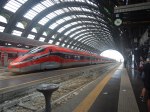
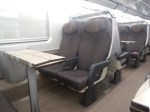


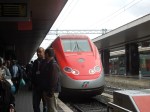
I think the High Speed Two trains will have level boarding.
Bogies
The bogies are one of the most important parts of the train. Like the Zefiro 300, will the train have FLEXX Eco bogies?
This article on Global Railway Review is entitled FLEXX Eco: The Leading Lightweight Passenger Bogie Design and it gives details on the bogie and its history.
Some of the concepts were developed at British Rail Research and some were applied to the bogies of the legendary British Rail Mark 3 and Mark 4 coaches, which ride better than some of today’s trains.
The Rail Technology Magazine article says this about the bogies.
Further supporting the UK rail supply chain, all of the bogies for the new trains will be assembled and maintained at Alstom’s facility in Crewe – which is the first time since 2004 that both jobs have been done in the UK.
It sounds sensible to have one factory to assemble and maintain the bogies.
Will this factory also supply the bogies for Aventras, which are also FLEXX Eco?
Assembly
The press release says this about assembly.
- The first stages including vehicle body assembly and initial fit-out will be done at Hitachi Rail’s facility at Newton Aycliffe, County Durham.
- The second stage of fit out and testing will be done at Alstom’s Litchurch Lane factory in Derby.
Conclusion
I find it interesting, how improvements in one area help another.
The JV has worked hard to perfect this design.
Solidity Or Speculation, It’s Your Choice
The title of this post, is the same as that of this article on Investors Chronicle.
This is the introductory paragraph.
Solid-state batteries are made using a technology that promises massive improvements in lithium-ion battery efficiency and capacity, so a breakthrough could see ranges in electric vehicles (EVs) extended well beyond the few hundred miles that the most advanced models can currently achieve.
It then lists four companies, that are possible investments; Gelion Technologies, Ilika, Superdielectrics and Solid State.
I am sure the technology will break through, but finding the winner will be difficult.
Siemens Gamesa Partners On Offshore Wind-to-Hydrogen
The title of this post, is the same as that of this article on renews.biz.
This is the first three paragraphs.
Siemens Gamesa has signed a memorandum of understanding with Strohm to collaborate on the development of offshore wind-to-hydrogen infrastructure.
The partnership will focus on the advancement of hydrogen transfer solutions that will look to improve the decentralized green hydrogen concept, whereby green hydrogen is generated in each turbine generator and transported to shore by a subsea pipe.
In this concept power cables are replaced by a pipe infrastructure used for storing and transferring hydrogen.
Thermoplastic composite pipe (TCP) will be used.
Andrew Forrest, AGL Partner To Explore Hydrogen Option For Hunter Valley Coal Plants
The title of this post, is the same as that of this article on abc.
This is the first paragraph.
Mining billionaire Andrew Forrest said hydrogen would eventually “dwarf” the coal industry as he announced plans to develop a green hydrogen hub in the New South Wales Hunter Valley.
I wish Forrest well with this venture, because if he makes a success of it, it could form a model for lots of other places in the world.
He’s certainly a man on a mission.
 The Anonymous Widower