My Hand Appears To Be Healing
I just took this picture of my poor left hand.

Compare this picture with this second picture, which I took soon after the accident.

The scabs have gone and the plaster is smaller.
The Diamond Light Source And COVID-19
Deep in the Oxfordshire countryside on the Harwell Science and Innovation Campus, there is this large building.

It is around twenty-eight metres across and is houses the Diamond Light Source.
When you are in a war, military commanders call up their largest and most powerful weapons, when they are up against it.
Think about Barnes Wallis‘s weapons of the Second World War; the bouncing bomb and the ten-tonne Grand Slam bomb.
The Diamond Light Source is described on its web site like this.
Diamond Light Source is the UK’s national synchrotron science facility, located at the Harwell Science and Innovation Campus in Oxfordshire.
Another section on their web site details the cost.
Diamond’s construction was funded by its two shareholders, the UK Government through the Science and Technology Facilities Council (STFC), which has contributed 86% of the investment, and the Wellcome Trust charity, which has a 14% stake in the facility.
Diamond’s construction is taking place in phases. Phase I cost £263 million and included the synchrotron machine itself, the surrounding buildings and the first seven experimental stations or beamlines. This phase was completed on time, on budget and to specifications in January 2007. Phase II funding of £120 million for a further 15 beamlines and a detector development programme was confirmed in October 2004 and completed in 2012. Diamond can potentially host up to 40 beamlines so there will be continual construction within the main building.
In the first year of operations (2007/8) Diamond’s operational costs were £23 million, in 2012/13, with 22 beamlines the operational costs were £40 million. As we enhance the facility by adding new beamlines the operational costs will increase. However, the more beamlines we have, the more cost effective we become, as the cost of running the machine is shared by a growing number of experimental stations.
It looks like capital costs were nearly £400 million, with yearly running costs of £40 million.
Earlier in the week, The Times detailed the work that Diamond was doing with British scientists and Chinese samples from Wuhan to find out the structure of the the COVID-19. The article said this.
A beam of light in an Oxfordshire laboratory that is ten billion times brighter than the Sun has been illuminating an object ten billion times smaller than a pinhead (Tom Whipple writes). In the shadows it produces may lie clues to defeating coronavirus.
The Diamond Light Source at the Harwell campus near Didcot is one of the most sophisticated microscopes in the world. Gwyndaf Evans, the principal beamline scientist, said that over the past three weeks there had been one goal — looking for ways to thwart coronavirus.
And I thought, Gwndaf Evans was a successful Welsh rally-car driver.
The Diamond Light Source web sire has a page for the Public on its research into coronavirus.
Read this page and certainly the last section, which is entitled What Is The Scientific World Concentrating On With The Current Outbreak of COVID-19?, where this is said.
The COVID-19 outbreak is at a critical stage, the WHO suggests that China, through tough and effective containment has bought other countries more time. This is the third bat-derived coronavirus to cause outbreaks of human disease in less than 20 years, and the most serious.
The response to COVID-19 has been remarkable: first reports of an unknown pneumonia were on 31st December 2019 and by 11th January, six virus sequences were made available. Structural biologists moved extraordinarily quickly, getting synthetic genes made immediately, rushing to pick them up the day they were finished, and in less than a month, on 5th Feb the first structure, of the main protease was released by the PDB, from Zihe Rao and Haitao Yang’s team at ShanghaiTech. By then these coordinates had already been distributed by the team to 300 groups. In addition by this point, the protein had been used for in vitro assays and a collection of licenced drugs with potential antiviral activity had been identified and made available publicly.
Indeed by now, 35 clinical trials have been started, with the first just closed, so the first results should start to emerge quickly. However, these are re-purposed compounds, the route to tailor-made molecules will be longer but scientists across the world are working to find these.
I am heartened by what I have read today and feel that we are making progress towards at least winning a battle against COVID-19.
COVID-19 Only Research Other User Operations Suspended
This is the headline on one of the latest news pages on the Diamond Light Source web site, where this is said.
Given the rapid spread of COVID-19 Diamond Light Source wishes to minimise travel and the number of people on site, and we have in the first instance taken the decision to suspend user operations from our facilities until 28th April. A further extension of that period might become necessary, and we will keep users informed during the coming weeks.
However, it is still possible to run sessions remotely but only with samples connected with work associated with combating COVID-19 either through an already approved BAG or through the rapid access application.
Is Diamond concentrating all its immense muscle on COVID-19?
Conclusion
It looks like to get results you need teams of brilliant collaborating scientists and lots of money.
And all backed up by sophisticated tools, like the Diamond Light Source!
Is the world planning a bigger one?
Surely, as each of these viruses seems to get more deadly and more difficult to combat we will need it.
Et Toi, Papa? Boris Johnson’s Dad Seeks To Become A French Citizen
Surely, this is the headline of the week in The Sunday Times.
Apparently, Stanley’s mother was born in Versallies!
And you don’t get any more French than that!
An Unprecedented Display Of Rail Solidarity
These pictures show an advert for National Rail in The Sunday Times.


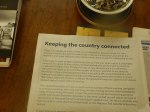

Let’s hope that this co-operation between staff, unions and train operating companies brings us through the COVID-19 crisis.
Some People Are Profiting From COVID-19!
There are a few people out there, who are using various scams to profit from COVID-19, but there are also some, who are making money legitimately from the virus.
This week, Diana Moran, ( aka the Green Goddess) made a comeback on BBC Breakfast and this morning, she’s featured in The Sunday Times, in an article, which is entitled Green Goddess Diana Moran Rises Again To Help The Over-70s Turn Home Into A Health Spa.
This is the introduction to the article.
When Diana Moran was first asked to slip into a vivid green leotard, she was seen as little more than a television novelty act catching the start of 1980s fitness and aerobics craze, but she turned into a cult hit known as the Green Goddess.
Now aged 80, Moran is returning to a regular slot on the BBC — but this time the stakes are much higher.
Stephen Fry was also found to be giving sound advice on the Andrew Marr Show.
Good luck to Diana, Stephen and others of their ilk!
My Essential Foods
These are my essential foods on which I base a lot of my diet.




















Note.
- I find most flavours acceptable.
- I prefer honeydew melon, mango, pineapple and strawberry, but hate watermelon.
- The honey and ginger flavour yoghurt is best and makes good pasta sauce.
- Blueberry muffin and cocoa orange are my two favourite flavours.
- Most Marks and Spencer bread is good, but this is my staple.
- I add to the granola – C would be surprised that apricots are on the list.
- With two eggs, a tin makes a good quick meal.
Most of these foods seem to have come from Marks and Spencer
Carry On Blogging
At seventy-two and after recovering from a serious stroke ten years ago, I could be considered to be in a relatively high-risk category from COVID-19.
I also live alone and am a coeliac.
But.
- I have reasonable supplies of ready-meals, tea, milk, beer and packaged foods to last for a week.
- I test my INR and on Friday it was 2.5.
- I weigh about 61 Kg.
- I exercise regularly and can easily walk a couple of miles briskly.
- I have plenty of INR testing strips, with probably enough to last until August.
- I have about two months of drugs, but there is supposed to be a system lunched this week to get drugs to people like me.
- I have an on-line subscription to The Times, so I can read their news in detail and get access to all their puzzles.
- I can walk round the corner to a shop, where I can get milk and other daily supplies.
- I can easily walk to my GP’s surgery and the local Marks and Spencer Simply Food.
- I have a son, who can put shopping on the door-step, ring the bell and run!
- I have enough cash to pay for goods that neighbours or others might deliver.
I also have the great advantage, that my front door almost opens onto the street, so I can receive deliveries without meeting the courier, by just leaning out the window and telling them to put them on the step.
I very much feel, that I can set myself up to just carry on blogging.
Others can help here by doing the following.
- Suggest topics, where they would like my comments.
- Sending me stories, that I might like to read on topics like battery-power, branch line reopening, design, energy storage, hydrogen-power, innovation, extreme science, humour and life in general.
- Sending me positive stories about COVID-19.
It’s probably best, if you don’t send me stories from the BBC and The Times as I read them extensively.
I shall always reply, if I can. Hopefully, I will try and treat subjects in a light-hearted manner to ease the burden of these serious times.
We must all carry on!
Step-Free Access At Kentish Town Station
On a web page recently, I saw a suggestion about how to add step-free access to Kentish Town station.
The suggestion was that it was too difficult to add it to the Underground station, but why not add it to the Thameslink station?
This Google Map shows the station.
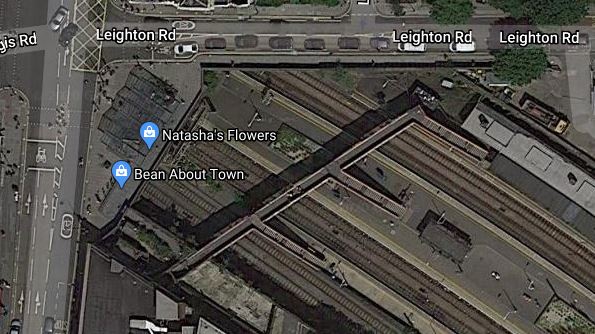
Note the pedestrian bridge across the tracks with steps going down to the platforms.
Adding a lift to each platform would give full step-free access to Thameslink and would give an alternative step-free route to these step-free stations in Central and South London.
- Kings Cross St. Pancras
- Farringdon
- Blackfriars for the South Bank
- London Bridge
- Elephant & Castle
- Denmark Hill
- Herne Hill
- Mitcham Eastfield
- Wimbledon
- Sutton
The step-free access would be much easier to install, than on the Northern Line platforms.
Connecting The North West Of England’s Three Powerhouses
It could reasonably be argued that the three most important economic centres of the North West of England are.
- The City of Liverpool and Merseyside
- Manchester Airport
- The City of Manchester and Greater Manchester
I’ll take a quick look at each, with particular reference to public transport links.
The City of Liverpool and Merseyside
Liverpool is introduced by this paragraph in Wikipedia.
Liverpool is a city and metropolitan borough in Merseyside, England. As of 2018, the population is approximately 494,814. Liverpool is the ninth-largest English district by population, and the largest in Merseyside and the Liverpool City Region. It lies within the United Kingdom’s sixth-most populous urban area. Liverpool’s metropolitan area is the fifth-largest in the United Kingdom, with a population of 2.24 million.
Knowing Liverpool with affection as I do, I find the City difficult to describe in an unbiased manner, but in my experience few people go for a visit to Liverpool and don’t come back enchanted in some way. It is a many-faceted city!
One of Liverpool’s strengths is the local rail system; Merseyrail, which connects the suburbs to the centre, just like the Underground does in London. As with London, Merseyrail is backed up by a comprehensive bus network. And like London, Liverpool is introducing hydrogen-powered double-deck buses.
Merseyrail is also in a strong expansionist phase.
- New trains are being delivered to replace some of the oldest trains on the national network in the UK.
- New stations are being added to the core Merseyrail network.
- Stations are being improved with refurbishment and step-free access.
- Merseyrail have ambitions to expand their network to Liverpool Airport, Preston, Skelmersdale, Warrington and Wrexham.
The City of Liverpool and Merseyside in general are getting ready to expand their economy.
Manchester Airport
This Google Map shows Manchester Airport.

Note.
- The two runways.
- The railway station in the middle of the Airport.
- The M56 motorway passing across the North-West of the Airport.
Manchester Airport is the third-busiest airport in the UK in terms of passenger numbers.
- It is a two-runway airport like Heathrow, which helps a lot in operational efficiency.
- In 2018, it handled 61% of the number of passengers as Gatwick, but 71% of the aircraft movements.
- The airport has three terminals.
- The airport has rail connections to Crewe, Manchester, Northern England, the Central Belt of Scotland and Wales.
- The airport is connected to the trams of the Manchester Metrolink.
I’ve never flown from the airport as a passenger, so I can’t comment.
Wikipedia has a section on the Future of Manchester Airport, which says.
- Terminal 2 will be expanded with fifteen more covered stands,
- The airport will expand to handle more freight.
Airport City Manchester is an £800million expansion to create an airport city on the lines of those at Barcelona and Frankfurt, alongside the airport.
Manchester Airport is certainly building for a future expansion.
Reading about rail links to the airport, you get the impression that some places like Bradford, Derby and Nottingham would like direct links to Manchester Airport.
The City of Manchester and Greater Manchester
Manchester is introduced like this in Wikipedia.
Manchester is a city and metropolitan borough in Greater Manchester, England, with a population of 547,627 as of 2018 (making it the fifth most populous English district). It lies within the United Kingdom’s second-most populous urban area, with a population of 2.5 million and second most populous metropolitan area, with a population of 3.3 million. It is fringed by the Cheshire Plain to the south, the Pennines to the north and east, and an arc of towns with which it forms a continuous conurbation.
I don’t know Manchester as well as I know Liverpool and most of my visits to the City are usually with limited objectives and a possible overnight stay.
Like Liverpool, Manchester has an extensive public transport network based on the trams of the Metrolink and some local railway lines, backed up by lots of buses.
Transport for Greater Manchester is developing the transport network, with a new Metrolink line to the Trafford Centre opening soon.
Note that if Manchester’s rail system has a problem, it is congestion in the Castlefield Corridor through Manchester Piccadilly, Manchester Oxford Road and Deangate stations and on to Manchester Victoria and Salford Crescent stations. A permanent long-term solution is needed.
The City of Manchester and Greater Manchester are getting putting in the necessary transport links to expand their economy.
Connecting The Three Powerhouses
In Changes Signalled For HS2 Route In North, I wrote the following, which I am now repeating in an updated form.
This clip of a map from this Transport for the North report , which is entitled At A Glance – Northern Powerhouse Rail, shows a schematic of the current and possible rail links in the triangle between Crewe, Liverpool and Manchester.

High Speed Two, which is shown in dark green, would appear to come North and split into two routes.
- One continues North to join the existing West Coast Main Line just South of Wigan.
- Another goes through Crewe station.
North of Crewe, the two routes join and then split into three at the Junction labelled 6.
- To Warrington and Liverpool
- To Wigan, Preston and Scotland
- To Manchester Airport and Manchester.
A second Junction labelled 5, allows Northern Powerhouse Rail trains to run Liverpool-Warrington-Manchester Airport-Manchester.
This is a new layout and has the following advantages.
- I estimate that trains could save 7-8 minutes on services running between Crewe and Wigan because of the longer running at High Speed Two operating speeds at 225 mph.
- ,If they don’t stop at Crewe and Runcorn, further minutes could be saved.
- Trains between London and Preston and London and Glasgow could skip the stop at Warrington to save further minutes.
- There could be an advantageous reorganisation of stopping patterns.
- London and Liverpool services and Liverpool and Manchester services could stop at Warrington, which would give Warrington very good connections.
- The Liverpool-Manchester and Liverpool-Crewe Lines could be built to High Speed Two standards, which could allow 225 mph running.
I also think the track layout can be run alongside or underneath the various motorways in the area for a lot of the route between Liverpool, Crewe, Warrington and Manchester Airport.
It would appear to be a very good solution to a complex problem and overall, I suspect it gives better connectivity, at a more affordable cost, whilst creating a railway that can be built with less disruption and will ultimately produce less noise.
The Transport for the North report, also says the following.
- There could be a new Warrington South Parkway station.
- Six tph between Liverpool and Manchester via Warrington are planned.
- Journey times will be 26 minutes.
The Twenty-first Century will finally get a modern and fast Liverpool and Manchester Railway.
- Trains would stop at Manchester Airport, a new Warrington South Parkway and possibly Liverpool South Parkway.
- Trains would run every ten minutes.
- Trains would take 26 minutes between Liverpool and Manchester.
These are a few other thoughts on the route.
The Liverpool Terminus
The Transport for the North report proposes a new High Speed station in Liverpool.
- It would possibly be alongside Liverpool Lime Street station.
- It would handle both High Speed Two and Northern Powerhouse Rail services.
- The station would need at least four platforms.
- The station could be connected to Liverpool Lime Street station’s Wirral Line platform.
I believe that a well-designed station could be squeezed in, on the edge of Liverpool City Centre.
Should Trains Stop At Liverpool South Parkway?
I think this could be important, especially, if the station gets a link to Liverpool Airport.
Between Manchester Airport And Manchester City Centre
Most current trains between Manchester Piccadilly and Manchester Airport stations take between 15-18 minutes.
I don’t believe that these times are compatible with a 26 minute time between Liverpool and Manchester.
So I am fairly certain that to achieve the planned time in the Transport for the North report, that an almost direct tunnel between Manchester Airport and Manchester City Centre is necessary.
The Manchester City Centre Station
Could the tunnel pass through underground platforms at Manchester Piccadilly station, which run across the station and then surface to connect with the chosen route to Leeds?
In an earlier plan, referenced under Manchester City Centre (Phase 2b) in the Wikipedia entry for High Speed Two,, this is said.
The route will continue from the airport into Manchester city centre via a 7.5-mile (12.1 km) twin bore branch tunnel under the dense urban districts of south Manchester before surfacing at Ardwick.
Under the earlier plan, trains would have gone into a rebuilt Manchester Piccadilly station.
I also wonder, if the solution would be to bore a tunnel under Manchester City Centre with stations under Manchester Piccadilly station, Piccadilly Gardens and Manchester Victoria.
- It might be just one set of platforms with travellators, escalators and lifts all over Manchester City Centre.
- It should be noted that two High Speed Two trains, running as a pair would be four hundred metres long.
One of the advantages of a train connection between Manchester Piccadilly and Manchester Victoria station, would be that the Castlefield Corridor would be by-passed.
- TransPennine Express services between Manchester Airport and the North-East would be replaced by Northern Powerhouse Rail services between Liverpool and the North-East via Manchester Airport.
- The Castlefield Corridor would probably be reserved for local services.
- Passengers needing Manchester Oxford Road or Deansgate stations would use the current Manchester Airport station.
There are probably other advantages.
Building The High Speed Liverpool And Manchester Line
I believe that this line can be built without too much disruption to existing services, because Crossrail’s construction didn’t disrupt London.
Conclusion
My overall conclusion is that it is feasible to build a Liverpool and Manchester High Speed Line, as an early part of Northern Powerhouse Rail, that will also be used by High Speed Two, when that is extended to Liverpool and Manchester.
Put Thameslink On The Tube Map Says London Assembly
The title of this post is the same as that of this article on Ian Visits.
This is the introductory paragraph.
A report on improving accessibility on London’s Transport services has called for the fully accessible Thameslink line to be on the Tube map as a matter of some urgency.
I’m all for this happening.
I use Thameslink quite a bit, as if I’m in some places South of the River and am coming home, taking Thameslink to West Hampstead Thameslink and then using the Overground to Canonbury, from where I walk home, is a convenient route.
- It is step-free.
- There is a Marks and Spencer at West Hampstead, where I can do a bit of food shopping.
- Walking from Canonbury station to my house is gently downhill.
These are some other thoughts about Thameslink,
The Underground Train With A Toilet
Sometimes, I also find it doubly-convenient, as I need to spent a penny or more. Often, the toilets on Thameslink trains are free in the tunnels under London!
How many other Underground trains have toilets?
Obviously, Eurostar does, but does anybody know of any other trains that run deep under the surface, that have toilets?
Do Thameslink Want The Extra Passengers That Being On The Map Would Bring?
This may seem a dumb question, but sometimes, I do wonder, if the answer is that they don’t!
Thameslink Would Surely Make A Good Travel Partner For Eurostar
Increasing, many visitors from the Continent to London and the South East are travelling across the Channel using the excellent Eurostar.
As the Thameslink and Eurostar platforms at St. Pancras International, there could be mutual advantages to both companies to be partners.
Suppose you were travelling on these routes.
- Paris and Gatwick
- Brussels and Greenwich
- Amsterdam and Brighton
- Rotterdam and Luton Airport
And for one reason or other you didn’t want to fly; climate change, you like trains, awkward baggage or just plain fear of flying.
Surely, using Eurostar and Thameslink would be the obvious travel companies.
Note that Thameslink have posters, saying that they are the ideal way to get to Luton Airport.
Do they have posters, saying they are the ideal way to get to Eurostar at St. Pancras?
If I was running Thameslink, I’d do the following.
- Make sure, that all Thameslink stations accepted contactless ticketing using bank or credit cards.
- Put information and advertising on Eurostar trains and stations, telling passengers how to get to and from any Thameslink station without buying a physical ticket.
- Devise a simple add on ticket, that would be printed on your Eurostar boarding pass or held in Eurostar’s app.
- Market Thameslink to the French as the UK’s answer to the RER.
- Put travel information in at least Chinese, English, French, German, Italian, Japanese and Spanish, at St. Pancras station.
I would think, that a properly thought-out plan, could be a nice little earner for Thameslink.
 The Anonymous Widower