A Solution To Hospital Car Parking Charges
If I need to go to my preferred hospital of University College Hospital, I walk round the corner from my house and get a number 30 bus, which stops outside the hospital.
If I want to go to the Royal London Hospital, I take the Overground four stops to Whitechapel.
I live in Dalston, which is reasonably close to Central London and I chose to live here, as I don’t drive.
Some other cities have good hospital access on public transport.
- Addenbroke’s Hospital in Cambridge has a fast guided busy to the City Centre and the North of the City. It also has it’s own bus station and may even get a railway station.
- The Queen’s Medical Centre in Nottingham has a tram stop with direct step-free access to the hospital. The tram system also has seven large Park-and-Ride sites.
- James Cook Hospital in Middlesbrough has its own railway station.
But how many hospitals and that includes many new ones have terrible public transport links?
Consider two elderly sisters; Elsie and Doris, perhaps living on opposite sides of the country.
Suppose one sister has a bad fall and ends up in the local hospital.
- The train system in the UK is improving and I’ve regularly met fellow train passengers well into their eighties travelling for four or five hours by train, to visit friends and relatives or have a holiday.
- Crossing London can be a problem for some, but my London-savvy eighty-five year old friend does it regularly.
It’s just the last link to the hospital, that can be a problem.
Norwich And Norfolk Hospital
The Norfolk and Norwich Hospital is a large teaching hospital, that was built in 2001 on the Western outskirts of the City.
It replaced a City Centre hospital.
There is a bus from the station, but finding details of the schedule is difficult, as the bus company’s web site, is more about selling you deals, that telling you how often the buses run.
I suppose the only way to find out is to go to Norwich station and do some bus spotting.
This Google Map shows the location of the hospital close to the University of East Anglia and the world-famous John Innes Institute.
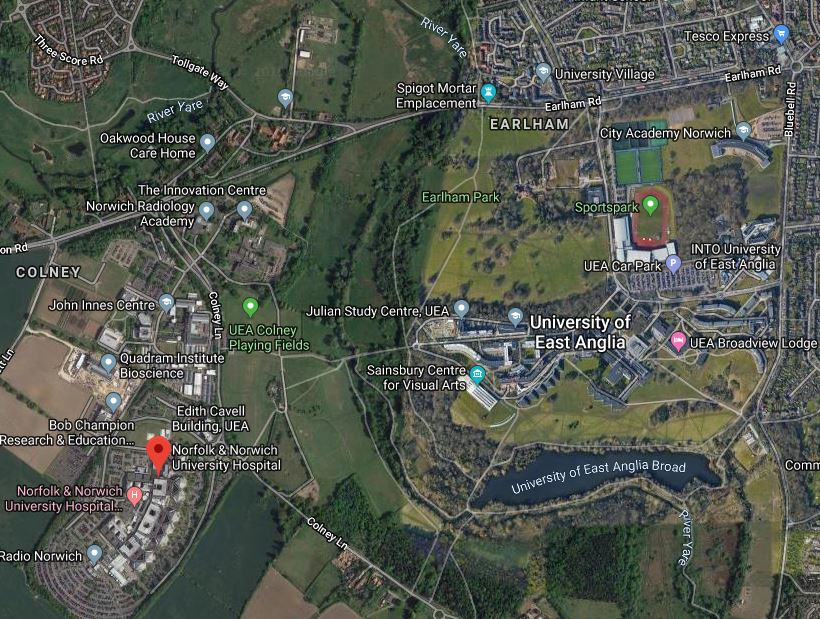
I’ve only ever been to the area by car and I do wonder what students without transport think about getting to the University of East Anglia.
It certainly, isn’t the sort of place, I’d have wanted to go to University. During our time at Liverpool, C and myself were always popping down Brownlow Hill to the City Centre.
In somewhere like Germany or Switzerland, there would be a tram from the train station.
A London Example Of Improvement
If I wanted to go to Barnet Hospital, I would take the Underground to High Barnet station and then get a bus. But the Underground and bus interchange at High Barnet is not easy, especially on a wet day.
But it does appear that there is a better route, which involves catching a 384 bus from Cockfosters station.
- The bus provides a feeder service direct to the hospital.
- Cockfosters station will be step-free in a few years.
- The bus stops at both Barnet Hospital and the A & E unit.
It’s certainly a lot better than when I lived in the area as a child.
Why Can’t All Hospitals Have Decent Public Transport?
Hospitals are important to so many people and although not every hospital can have a transport network as good as Addenbrooke’s, the Queen’s Medial Centre or University College Hospital, getting to some hospitals is a major logistics nightmare.
- Hospitals serving a large rural area, must be at the heart of the bus network.
- There should be a frequent bus or tram service to the city or town centre and the main railway station.
- There should be much better information.
- Hospitals could follow Nottingham’s and Cambridge’s .examples, where the hospital is on the city’s Park-and-Ride network.
How many hospitals in the UK meet this standard?
Conclusion
I believe that if decent public transport is provided to a hospital, that many patients, staff and visitors will use it, as they seem to do in Cambridge, London and Nottingham.
- In some places there is no easy way to get to the hospital and driving is the only way.
- Car parking is expensive to provide.
- Some hospitals have no space for car parking to be increased or added.
- How many are late for their appointments because the parking is full or they can’t find a space?
- Making car parking free will only make the problem worse, as everybody will drive.
Perhaps we should rate hospitals on the quality of the public transport, just as they are rated on care.
The New Mr. Creosote
The front page headline on today’s copy of The Times is Corbyn ‘Neutal’ On Brexit.
Is this a good idea?
- Strong Remainers or strong leavers will surely be unlikely to back Corbyn or the Labour Party in the General Election on December 12th.
- It also contrasts sharply with his strong definite views on the direction of the economy.
It is a weak decision and is fence-sitting of the highest order.
I Live In An Election Poster-Free Area
I gaven’t seen a poster for the election yet.
Although, I did see one St. George’s Cross, but England were playing that night.
Boris And A National Insurance Cut
This article on the BBC is entitled Boris Johnson Pledges Cut To National Insurance.
This is the introductory paragraph.
Boris Johnson aims to change National Insurance rules so workers will not have to pay it until they earn £12,500.
I can just about remember my first real pay packet.
- I was 16 and it was only a vacation job from school.
- It was notes and coins in a brown envelope.
- I was working in a factory designing and building electronics to automate heavy machinery.
- In the pay packet was a payslip, which included a small deduction for National Insurance.
- I was a bit miffed at the deduction, as I wasn’t earning much.
What I like about Boris’s plan, is that so many of those employed in lower-paid jobs will now not see a deduction for Income Tax or National Insurance.
What reaction will that bring in those employed in those lower-paid jobs?
- I doubt anybody would object.
- It could be a powerful motivator, as they would keep more of the fruits of their labours.
It would also be a very difficult policy to reverse. Imagine a future government breaking the link between Income Tax and National Insurance!
Thoughts On The Liberal Democrats Manifesto
This article on the BBC is entitled Liberal Democrats Manifesto: 12 Key Policies Explained.
I feel that there is some scientifically incorrect thinking on both the part of the Liberal Democrats and the BBC.
Here are my thoughts.
Note that the numbers are those in the BBC article.
4. Generate 80% Of Electricity From Renewables By 2030
The BBC article says this about this proposal.
We are already on a path of rapid decarbonisation – with 40% of our electricity produced by wind, solar and biomass in the third quarter of this year.
And recent government projections suggest that contribution is set to rise to just under 50% over the next decade.
So the Liberal Democrats’ plan for 80% would mean the extremely rapid construction of many more solar farms and wind turbines on land and out at sea.
I think that the BBC are underestimating the City of London and especially, the big pension providers and insurance companies like Aviva, Aberdeen Standard, L & G and lots of others.
These companies need safe long-term investments and offshore wind, soplar farms and energy storage, fit the bill extremely well. In World’s Largest Wind Farm Attracts Huge Backing From Insurance Giant, I discuss how Aviva are backing renewable energy.
If the Government doesn’t annoy the City, it may well be possible to persuade companies to invest in renewable energy projects.
5. Tax Frequent Flyers
This will have various effects.
- A family, who fly regularly to their weekend house in Bordeaux would take the train. This is beneficial.
- More people will use their cars on short trips to the Continent. This is not beneficial.
- Long haul passengers might find it cheaper to fly to say Australia, by taking a train to Paris or Schipol airports. This is not beneficial and already happens in Europe, where people drive to Schipol.
I am all for discouraging people not to fly, but I do feel that it fight be better to plant trees to offset the carbon.
7. Legalise Cannabis
Cannabis is a difficult problem.
- I believe that we don’t know enough about the long term effects of taking cannabis.
- I also think we don’t know enough about itsw theraupeutic uses.
- I wouldn’t take it now, but if I was dying a painful death, I might try anything.
I also feel that my son was coeliac like me and his heavy use of cannabis and gluten ruined his immune system, which meant his body didn’t fight the early stages of the pancreatic cancer, that killed him.
8. Freeze Train Fares
This is one of those policies, that looks good on paper and goes down well with voters.
But look what happened on the North London Line, when new trains and more frequent services were introduced nearly ten years ago.
Passenger numbers increased dramatically and since then, the number of trains has been increased to match.
On many routes, a fare freeze would create a similar rise in passengers, so make sure the numbers are correct and the necessary new trains are ordered, refurbished or sourced.
Conclusion
Politicians never think out their policies fully!
The Power Of Battery Storage
This article on Fastmarkets is entitled Neoen To Expand Li-ion Battery Capacity at Hornsdale Plant.
This is the introductory paragraph.
Australia’s Hornsdale Power Reserve, the world’s biggest lithium-ion battery plant, is set to expand capacity by 50% to 150 megawatts, according to Neoen SA, the French power producer that owns and operates the site.
If you read the article and the Wikipedia entry for Hornsdale Power Reserve (HPR), you’ll see why it is being expanded.
This paragraph is from Wikipedia.
After six months of operation, the Hornsdale Power Reserve was responsible for 55% of frequency control and ancillary services in South Australia.[11] By the end of 2018, it was estimated that the Power Reserved had saved A$40 million in costs, most in eliminating the need for a 35 MW Frequency Control Ancillary Service.
Somewhat surprisingly, the power is mainly generated by the associated Hornsdale Wind Farm.
These are some statistics and facts of the installation at Hornsale.
- There are 99 wind turbines with a total generation capacity of 315 megawatts.
- HPR is promoted as the largest lithium-ion battery in the world.
- HPR can store 129 MWh of electricity.
- HPR can discharge 100 MW into the grid.
- The main use of HPR is to provide stability to the grid.
HPR also has a nice little earner, in storing energy, when the spot price is low and selling it when it is higher.
It certainly explains why investors are putting their money in energy storage.
Wikipedia lists four energy storage projects using batteries in the UK, mainly of an experimental nature in Lilroot, Kirkwall, Leighton Buzzard and six related sites in Northern |England. One site of the six has a capacity of 5 MWh, making it one of the largest in Europe.
But then we have the massive Dinorwig power station or Electric Mountain, which can supply ,1,728-MW and has a total storage capacity of 9.1 GWh
Consider.
- Electric Mountain has seventy times the capacity of Hornsdale Power Reserve.
- Electric Mountain cost £425 million in 1984, which would be a cost of £13.5 billion today.
- Another Electric Mountain would cost about £1.6 billion per GWh of energy storage.
- Hornsdale Power Reserve cost $ 50 million or about £26 million.
- Hornsdale Power Reserve would cost about £0.2 billion per GWh of energy storage.
So it would appear that large batteries are better value for money than large pumped storage systems like Electric Mountain.
But it’s not as simple as that!
- There aren’t many places, as suitable as North Wales for large pumped storage systems.
- Omce built, it appears pumped storage system can have a long life. Electric Mountain is thirty-five years old and with updating, I wouldsn’t be surprised to see Electric Mountain in operation at the end of this century.
- Battery sites can be relatively small, so can be placed perhaps in corners of industrial premises or housing developments.
- Battery sites can be built close to where power is needed, but pumped storage can only be built where geography allows.
- Pumped strage systems can need long and expensive connections to the grid.
- I think that the UK will not build another Electric Mountain, but will build several gigawatt-sized energy storage facilities.
- Is there enough lithium and other elements for all these batteries?
- Electric Mountain is well-placed in Snowdonia for some wind farms, but many are in the North Sea on the other side of the country.
In my view what is needed is a series of half-gigawatt storage facilities, spread all over the country.
Highview Power looks to be promising and I wrote about it in British Start-Up Beats World To Holy Grail Of Cheap Energy Storage For Wind And Solar.
But there will be lots of other good ideas!
An Angry Sea At Dawlish
As I came back from Plymouth this morning, I came along the coast at Dawlish.


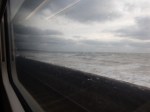










The sea was angry.
You could understand how the sea wall gets damaged by the sea.
China’s Biggest Worry Is Pork Not Protests
The title of this post, is the same as that of this article in The Times.
In the year of the Pig, apparently swine flu is rampant in China and half the pig population has gone in the last fifteen months.
It’s a thoughtful article by |Edward Lucas.
Over the years crises like this have brought governments down and with the price of pork rising fast China may see some serious unrest.
This situation is one to watch!
New Trains Make Debut On Suffolk Route From Ipswich To Felixstowe
The title of this post, is the same as that of this article on the East Anglian Daily Times.
This introductory paagraph says it all.
The first new Greater Anglia train operating on Suffolk routes out of Ipswich has gone into service on the Felixstowe branch.
Frim the picture I’m sure it is a four-car Class 755 train.
Will Future Hitachi AT-300 Trains Have MTU Hybrid PowerPacks?
I have mentioned this possibility in a couple of posts and I feel there are several reasons, why this might be more than a possibility!
What Do We Know About The Second Iteration Of An AT-300?
The first order for East Midlands Railway is for thirty-three five-car trains.
- Four engines instead of three.
- 125 mph on diesel power.
- A modified nose profile.
I find the nose profile significant, as I don’t believe that the current trains are aerodynamically much more efficient than British Rail’s legendary InterCity 125 trains.
On the other hand, Bombardier’s Aventras look as if the company’s aerospace division has been involved in the design. They certainly are very quiet, when they pass close by.
The second order for West Coast Rail is thin on detail, but they do mention that services from Euston could reach as far as Godowen.
I would also feel that 125 mph on diesel could be very helpful on the North Wales Coast Line to Holyhead.
Will 140 mph Running Be Commonplace?
Very much so!
For 140 mph running by the current trains, the following is needed.
- Tracks able to accommodate that speed.
- ERTMS signalling
- In-cab signalling
Wikipedia speaks of unspecified minor modifications to the trains.
To answer my question, I believe there will be running over 125 mph, if not 140 mph on substantial stretches of the following lines.
- East Coast Main Line
- Great Western Main Line
- Midland Main Line
- West Coast Main Line
I also believe other routes could see large increases in operating speed on certain sections.
- Basingstoke and Exeter
- Breckland Line
- Bristol and Exeter
- East and West Coastways
- Golden Valley Line
- Great Eastern Main Line
- Hitchin and Kings Lynn via Cambridge
- North Wales Coast Line
- Reading and Exeter via Newbury
If trains are capable of 125 mph and faster running without electrification, I can see Network Rail, doing what they have shown they can do well on the Midland Main Line, which is increasing line speed.
Note that on my list, I have included the second route to Norwich via the East Coast Main Line, Cambridge and Thetford and Kings Lynn services.
I can envisage hourly 125 mph services to and from Norwich and Kings Lynn joining and splitting at Cambridge and then running at high speed between Kings Cross and Cambridge.
It would be a massive boost for West Norfolk and Norwich, but it would not require extra high speed paths on the East Coast Main Line.
There must be other routes that by proven conventional track engineering can be turned from 80-100 mph lines into 125-140 mph high speed lines. No problem electrification to promote, design and erect. It just needs appropriate trains.
I can see the following routes without electrification being run at 125-140 by the new AT-300 trains.
- Euston and Holyhead
- Kings Cross and Cleethorpes via Lincoln
- Kings Cross and Hull
- Kings Cross and Kings Lynn/Norwich
- Liverpool and Edinburgh via Leeds
- Paddington and Exeter via Basingstoke and Yeovil
- Paddington and Gloucester/Cheltenham
- Waterloo and Exeter via Basingstoke and Yeovil
There are probably other routes.
Without doubt, the new AT-300 trains must be able to run at 140 mph on lines without electrification, once Network Rail have raised the operating speed.
Thoughts On AT-300 TrainsWith MTU PowerPacks
These are my thoughts on various topics.
Weight
The data sheet for the MTU PowerPack gives the mass at around five tonnes for a diesel engine of 700 kW.
Depending on the way you read the figures this appears to be less than that of a similar power diesel..
Fuel Economy
This is obviously better and MTU are quoting a forty percent saving.
Regenerative Braking
This comes as standard.
One PowerPack Per Car
I always like this concept, especially as many trains these days seem to have a lot of powered axles.
It also reduces the energy losses in the cables between cars.
The East Midlands Railway trains seem to have five cars and four engines, so is that four motor cars and one trailer.
Would trains be lengthened by adding extra trailer and/or motor cars as appropriate in the middle of the train?
Simpler Control System
MTU will have responsibility for the software of the PowerPack and all Hitachi’s control system for the train, will need to do with the PowerPacks is tell them how much power is required.
Hopefully, this will help in the debugging of the train, for which Bombardier had so much trouble with the Aventra.
Batteries
It appears that the design of the PowerPacks is very flexible with respect to size and number of battery packs.
Would it be an advantage for a train builder or an operator to tailor the battery capacity to the speed and length of a route.
Compatible AT-200 Local Trains
The AT-200 is Hitachi’s smaller and slower train of which the Class 385 train is an example.
If a version were to be produced with say three or four cars and one or more MTU PowerPacks, Hitachi would have a very nice bi-mode with a lot in common with the new AT-300, which would ease servicing for train operators, who were running both trains
Hitachi’s Relationship With MTU
MTU engines are used in the current Hitachi trains, so unless I am told otherwise,I am led to believe they have a good working relationship.
Conclusion
I wouldn’t be surprised to see the next generation of AT-300 use MTU PowerPacks.
 The Anonymous Widower