Westminster Proposes A Voluntary Mansion Tax
This may seem a bit strange for the Tories’ flagship Council, but it does seem well researched, according to a report in today’s Sunday Times.
Any house worth over £10 million would be put in a new band above Council Tax Band H and the owners would pay double the Band H rate of tax, which is currently £1,376 a year.
Westminster has 2,000 properties in this band, that are worth over £10 million and the scheme would raise £2.75 million, if everybody paid the extra, which would be voluntary.
It’s an interesting concept, that has been well-thought out.
But like most radical plans, I doubt it will see the light of day!
BBC Click On Batteries
This weekend’s Click on the BBC is a cracker and it’s all about batteries.
Electric Mountain
It starts with pictures of the UK’s largest battery at Dinorwig Power Station or Electric Mountain, as it is colloquially known.
The pumped storage power station was completed in 1984 and with a peak generating capacity of 1.6 GW, it was built to satisfy short term demand, such as when people make a cup of tea in advert breaks in television programs. Under Purpose of the Wikipedia entry for Dinorwig Power Station, there is a very good summary of what the station does.
To build Dinorwig was a wonderful piece of foresight by the CEGB, over forty years ago.
Would environmentalists allow Dinorwig Power Station to be built these days?
That is a difficult question to answer!
On the one hand it is a massive development in an outstanding area of natural beauty and on the other Dinorwig and intermittent power sources like solar and wind power, is a marriage made in heaven by quality engineering.
As solar and wind power increase we will need more electric mountains and other ways of storing considerable amounts of electricity.
Close to Electric Mountain, another much smaller pumped storage power station of 100 MW capacity is being proposed in disued slate quarries at Glyn Rhonwy. This article on UK Hillwalking, is entitled Opinion: Glyn Rhonwy Hydro is Causing a Stir.
The article was written in 2015 and it looks like Planning Permission for the new pumped storage power station at Glyn Rhonwy has now been given.
The UK’s particular problem with pumped storage power stations, is mainly one of geography, in that we lack mountains.
However Electric Mountain is in the top ten pumped storage power stations on this list in Wikipedia.
I doubt in today’s economy, Electric Mountain would be built, despite the fact that it is probably needed more than ever with all those intermittent forms of electricity generation.
The Future Of Pumped Storage Technology
But if you read Wikipedia on pumped-storage technology, there are some interesting and downright wacky technologies proposed.
I particular like the idea of underwater storage, which if paired with offshore wind farms could be the power of the future. That idea is a German project called StEnSea.
Better Batteries
Click also talks about work at the Warwick Manufacturing Group about increasing the capacity of existing lithium-ion batteries for transport use by improved design of the battery package. Seventy to eighty percent increases in capacity were mentioned, by a guy who looked serious.
I would reckon that within five years, that electric vehicle range will have doubled, just by increments in chemistry, design and manufacture.
Batteries will also be a lot more affordable.
Intelligent Charging
Warwick Manufacturing Group are also working on research to create an intelligent charging algorithm, as a bad charging regime can reduce battery life and performance.
I rate this as significant, as anything that can improve performance and reduce cost is certainly needed in battery-powered transport.
The program reclons it would improve battery performance by ten percent in cars.
Surely, this would be most applicable to buses or trains, running on a regular route, as predicting energy use would be much easier, especially if the number of passengers were known.
In Technology Doesn’t Have To Be Complex, I discussed how Bombardier were using the suspension to give a good estimate of the weight of passengers on a Class 378 train. I suspect that bus and train manufacturers can use similar techniques to give an estimate.
So a bus or train on a particular route could build a loading profile, which would be able to calculate, when was the optimum time for the battery to be charged.
As an example, the 21 bus, that can be used from Bank station to my house, is serviced by hybrid new Routemasters. It has a very variable passenger load and sometimes after Old Street, it can be surprisingly empty.
Intelligent charging must surely offer advantages on a bus route like this, in terms of battery life and the use of the onboard diesel engine.
But is on trains, where intelligent charging can be of most use.
I believe that modern trains like Aventras and Hitachi’s Class 800 trains are designed to use batteries to handle regenerative braking.
If you take a Class 345 train running on Crossrail, the battery philosophy might be something like this.
- Enough energy is stored in the battery at all times, so that the train can be moved to a safe place for passenger evacuation in case of a complete power failure.
- Enough spare capacity is left in the battery, so that at the next stop, the regnerative braking energy can be stored on the train.
- Battery power would be used where appropriate to reduce energy consumption.
- The control algorithm would take inputs from route profile and passenger loading.
It may sound complicated, but philosophies like this have been used on aircraft for around forty years.
Reusing Vehicle Batteries In Homes
Click also had detailed coverage about how vehicles batteries could be remanufactured and used in homes. Especially, when solar panels are fitted.
Other Batteries
On the on-line version, the program goes on to look at alternative new ideas for batteries.
Inside Electric Mountain
The on-line version, also gives a tour of Electric Mountain.
Conclusion
The future’s electric, with batteries.
A New Gateway To China: Europe Prepares For The Launch Of Baku–Tbilisi–Kars Railway
The title of this post is the same as that of this article on Global Rail News. This is the first two paragraphs.
A new rail corridor linking Azerbaijan and Turkey via Georgia is set to launch in September, establishing a new freight and passenger link between Europe and China.
Every year, millions of tonnes of cargo is expected to be transported on the 825km line.
Baku, which is the Eastern terminus of the Baku–Tbilisi–Kars Railway, is the capital of Azerbaijan and is a port on the Caspian Sea. It is connected to Turkmenbashi on the other side of the sea, which is the Western terminus of the Trans-Caspian Railway, which leads to Kazakhstan, Afghanistan and China.
At the other end of the line Kars in Turkey is connected to the European rail network.
Freight forecasts for the route in the Global Rail News article are bullish.
According to estimates, by the third year the annual turnover of cargo on BTK will be three to five million tonnes, rising to six to eight million by its fifth year and more than 10 million tonnes in its 10th. By 2034 this figure is anticipated to reach 17 million tonnes of annual freight.
Wikipedia also says this.
The Baku-Tbilisi-Kars project is intended to complete a transport corridor linking Azerbaijan to Turkey (and therefore Central Asia and China to Europe) by rail. (In late 2015, a goods train took only 15 days to travel from South Korea to Istanbul via China, Kazakhstan, Azerbaijan, and Georgia—considerably less time than a journey by sea.)
The sea journey takes between four and six weeks.
This article on the BBC is entitled All aboard the China-to-London freight train. This is an except from the article describing why Tesco use trains to get goods from China to the UK.
The UK’s biggest supermarket, Tesco, doesn’t have any goods on this particular train but does use rail to carry toys, electrical goods, homeware and clothing from China to European rail hubs such as Bratislava in Slovakia and Krasnaje in Belarus.
Alistair Lindsay, Tesco’s head of global logistics, says the supermarket prefers shipping its goods because this is the most environmentally friendly way, as well as offering the best value for money, but that “where we need to move products quicker we have that option to do it by rail”.
This decision would normally be driven by customer demand for particular products, he says.
So it’s all about value-for-money and customer demand.
Conclusion
I am drawn to the conclusion, that the Baku–Tbilisi–Kars Railway will meet the forecasts.
It has the great advantage over some of the other routes, that it avoids Putin’s Russia, which must be a good thing.
Levenmouth’s Rail Link Moves A Step Closer In Scotland
The title of this post is the same as this article in Global Rail News.
I wrote about the Levenmouth Rail Link before in Is The Levenmouth Rail Link Going To Be Scotland’s Next New Railway?.
According to the Global Rail News article the Scottish Parliament has debated the proposal to reopen the railway and it all went well, with support from seven MSPs from various parties.
The Scottish Transport Minister; Humza Yousaf, recommended that Transport Scotland look at the project.
So perhaps nearly sixty years after it closed, the Levenmouth Rail Link could be reopened.
The project certainly has a lot going for it.
- Levenmouth is the largest urban area in Scotland not directly served by rail.
- The line passes the largest grain distillery in Europe.
- The line is mostly single track and only five miles long.
- The track is still intact, so relaying won’t be the most difficult job.
- Only two stations need to be built.
- Could the stations be single platform?
My only negative thought about the reinstatement of this line is that like the Borders Railway, it might suffer from London Overground Syndrome, where the new line has such a high level of patronage, that more trains have to be procured.
How To 3D-Print Using Concrete!
All the 3D-printing I’ve seen has involved plastic, but Crossrail’s builders are using the technique to create complex shapes in concrete.
It’s all explained in this post on IanVisits, which is entitled How Crossrail Is Using 3D-Printing To Build Its Stations.
They don’t actually 3D-print the concrete, but a wax mould, that is then used to cast the actual piece required.
According to the post, the FreeFAB process has been used to create 1,400 unique moulds, which have then been used to create 36,000 different shaped concrete panels.
Ian’s post is a fascinating read and the mind boggles as to what will eventually produced using this technique.
Should A Mega-Station Be Created At Kings Cross-St. Pancras-Euston?
The three important stations of Kings Cross, St. Pancras and Euston sit like three isolated islands on Euston Road.
Kings Cross Station
Kings Cross station was extended and refurbished in 2012 and is the most modern of the three, with a well-designed square in front of the station.
Kings Cross serves as a terminus for East Coast Main Line and some Cambridge services.
Underground
Kings Cross has connections to the following Underground lines at Kings Cross St. Pancras tube station.
- Circle, Hammersmith and City and Metropolitan.
- Northern
- Piccadilly
- Victoria
On the whole, the connections to the Underground are generally good, but crowded.
Buses
If you want to go East connectivity is good, but when taking a bus to the West or South, finding the stop can be difficult.
Taxis
The taxi rank at Kings Cross generally works well, as it was reconfigured when the station was updated.
Summing Up Kings Cross Station
Kings Cross has a lot of space both inside and outside and using the station can be an easy process compared to many.
St. Pancras Station
St. Pancras station was rebuilt and extended for Eurostar and Southeastern Highspeed services in 2007.
I always describe St, Pancras as a Fur-Coat-And-No-Knickers station.
It may look spectacular, but it wasn’t designed for passengers or staff, due to the dreadful connectivity between the various services at the station.
- Continental
- Midland Main Line
- Southeastern Highspeed
- Thameslink
With all these services set to expand, I have a feeling that St. Pancras faces a capacity problem.
Underground
To further complicate matters, it’s a often a long walk to the Underground line you need, as these were designed to serve Kings Cross.
- Circle, Hammersmith and City and Metropolitan.
- Northern
- Piccadilly
- Victoria
There is a ticket hall at the front of the station, but it’s often very crowded with large numbers of Eurostar passengers queuing for tickets.
Buses
It’s a walk to Kings Cross in most cases unless you can find a way across the busy Euston Road.
Taxis
I always walk to Kings Cross, as like most passenger facilities at St. Pnncras, the taxi rank wasn’t well-designed.
Summing Up St. Pancras
St. Pancras doesn’t have the space inside or outside that Kings Cross has and often feels cramped with every seat taken.
With the increase in all services expected in the next few years, passengers should think hard about how they can avoid the station,
Euston Station
Euston station is going to be rebuilt in the next few years for HS2.
Currently, it serves as a terminus for West Coast Main Line and a few suburban services.
Underground
The Underground at Euston is a mess with Euston tube station handling the following lines.
- Both branches of the Northern
- Victoria
Round the corner is the cramped Euston Square station which handles the Circle, Hammersmith and City and Metropolitan Lines.
Neither station is fully step-free and the Underground connection will need expansion for HS2.
Buses
Euston has a good bus station if you’re going East, but going West means crossing the busy Euston Road.
Taxis
Euston has an underground taxi rank, that seems to work well.
Summing Up Euston Station
Space is at a premium in Euston station and the Underground connections need urgent improvement.
Crossrail 2
Crossrail 2 is being put forward as the project that will sort out the problems of the three stations on the Euston Road.
A mega station is to be built called Euston St. Pancras, which will serve all three stations.
But Euston and St. Pancras need extra capacity in connecting services now, not in the early 2030s!
Existing Lines
This map from carto.metro.free.fr shows the current Underground Lines at the three stations.

Can these lines be improved to help solve the capacity problems?
Victoria Line
If you want an example of the quality of the engineers working on the London Underground, you only have to look at the Victoria Line.
Fifty years old next year, the line was built on the cheap, but with superb automatic systems and some clever station layouts and now every year, more trains seem to be squeezed down its pair of tunnels. Currently, the frequency of trains is thirty-six trains per hour (tph) along its whole length.
As the Victoria Line calls at all three stations, any improvements to Dear Old Vicky, like step-free access at Euston, will help.
Northern Line
The Northern Line has three major projects underway.
- The extension to Battersea
- The upgrading of Camden Town station.
- The upgrading of Bank station
When these are complete around 2024, it will be possible to split the line into two separate lines each handling 36 tph.
But more trains will be needed.
Piccadilly Line
The major upgrade for the Piccadilly Line will be new trains, which should arrive from 2022, which will bring a double-digit increase in capacity.
It should also be noted that the frequency in the core is only twenty-one tph, so upwards of thorty tph must be an objectve.
Unlike the Northern And Victoria Lines, the Piccadilly Line doesn’t call at Euston station.
Circle, Hammersmith and City and Metropolitan Lines
The Circle, Hammersmith and City and Metropolitan Lines are being upgraded. This is said on Wikipedia.
Together with the introduction of S Stock trains, the track, electrical supply and signalling systems are being upgraded in a programme planned to increase peak-hour capacity on the Circle and Hammersmith & City lines by 65 per cent by the end of 2018. A single control room for the sub-surface railway is to be established in Hammersmith and an automatic train control (ATC) system will replace signalling equipment installed from the 1940s. The cross-London Crossrail line, planned to open in 2018, is expected to reduce crowding between Paddington and Whitechapel.
This should result in a large increase in capacity between Baker Street and Liverpool Street.
Crossrail
Although Crossrail doesn’t fully open until December 2019, and doesn’t even call at Kings Cross, St.Pancras and Euston stations, the new line will have an effect on passengers travelling to the three stations.
- In my quote from Wikipedia, it says that Crossrail is expected to reduce crowding between Paddington and Whitechapel.
- Crossrail is expected to have a link with HS2 at Old Oak Common station.
- Crossrail may be extended up the West Coast Main Line.
The latter two points would allow passengers to bypass Euston.
Thameslink
Thameslink when it is running fully at the design frequency of 24 tph will certainly have effects on passenger traffic.
But it is difficult to say what they will be.
Difficult Interchanges
If you look at the interchanges between the various lines, in my opinion, the following are the more difficult interchanges.
- Euston Square tube station to Euston station.
- Euston station to St. Pancras station.
- Victoria Line to Thameslink at St. Pancras station.
- Circle, Hammersmith and City and Metropolitan Lines ro Thameslink at St. Pancras station.
- Euston Square tube station to Northern Line at Euston station.
In addition Euston Square and Euston stations are not step-free.
Transport for London probably know the improvements that would offer the most benefit.
Euston Square Station And Euston Station
The poor connectivity between Euston Square tube station and Euston station, is a major problem.
Sort this bad connectivity, when Euston station is rebuilt for HS2 and world’s oldest underground railway, dating from 1863, will be providing a high-frequency service to the UK’s premier high-speed railway.
Euston Road
Euston Road, which can be very busy, is a major problem for passengers needing to cross to perhaps use buses going to the West.
The experience of using the stations could be improved for a proportion of travellers, if crossing the road was easier.
Should A Mega-Station Be Created At Kings Cross-St. Pancras-Euston?
I’ll return to the original question I asked.
- If Crossrail 2 is built, there will obviously be a mega station at Euston St. Pancras.
- But I believe that all the other improvements that will happen before HS2 opens may well be enough to cope with the extra capacity needed for a few years.
Obviously though, any improvements must not compromise the building of Crossrail 2’s mega-station.
Conclusion
I believe it is possible to improve connectivity to the three major stations of King Cross, St. Pancras and Euston, by doing the following.
- Improving the frequency and capacity on the various Underground lines serving the three stations.
- Splitting the Northern Line into two separate lines.
- Improving the links between the existing Nation Rail and Underground Lines.
- Integrating Euston Square station into Euston station, when Euston is rebuilt for HS2.
- Improving the crossing of Euston Road on foot.
In some ways the last-but-one point is the most important, as it cures the worst interchange.
Could A Lea Valley Metro Be Created?
Crossrail 2 envisages these developments and level of service North along the Lea Valley.
- A four-track West Anglia Main Line between Tottenham Hale and Broxbourne stations.
- Step-free stations
- A service running between Tottenham Hale and Broxbourne stations.
- 10-15 trains per hour (tph)
Crossrail 2 also envisages that at Tottenham Hale station, the line will enter a tunnel for Central and South West London.
But there is an unused alternative terminal, that could handle perhaps 16 tph with modern signalling.
Look at this map from carto.metro.free.fr of the lines at Stratford.
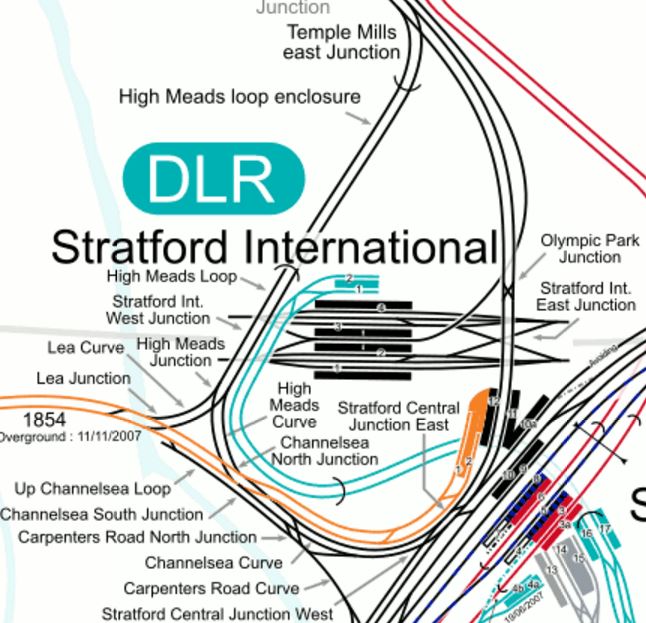
Note the double-track loop that encircles Stratford International station and goes through Platforms 11 and 12 at Stratford station.
Consider.
- Loops like this can easily handle 12 tph, as they do in Liverpool with the Wirral Line.
- Stratford is well-connected to the Central, Great Eastern Main, Jubilee and North London Lines, Crossrail and the Docklands Light Railway.
- The Loop could be connected to Stratford International station for Southeastern Highspeed services.
- There’s probably enough capacity to allow a couple of Stansted services to terminate in the loop.
- There is a massive development going on at Meridian Water, where a new station is being built.
- Liverpool Street station lacks capacity.
I can’t believe that a viable 12 tph service is not possible.
The major works would be as follows.
- Four-tracking the West Anglia Main Line into two fast and two slow lines.
- Making all stations step-free.
- Removing the level crossings.
- Creating a flyover at Coppermill Junction to connect the fast lines to Liverpool Street and prepare for Crossrail 2.
If Crossrail 2 is built in the future, the Metro service would be diverted into the central tunnel at Tottenham Hale station.
Integration With The London Overground
The Chingford, Cheshunt and Enfield Town services of the London Overground will not only offer alternative routes during the four-tracking of the West Anglia Main Line, but they could be better connected to a Lea Valley Metro.
- Tne Class 710 trains could enable four tph on each branch.
- The Class 710 trains will enable faster services on each branch.
- A reinstated Hall Farm Curve would connect Chingford and Walthamstow to Stratford.
- Creation of a step-free Cheshunt station would ease transfer between the London Overground and the Lea Valley Metro.
The new trains will be key and may open up more possibilities.
Note too, that moving services to Stratford from Liverpool Street will release capacity at Liverpool Street, that will be well-used by Greater Anglia and London Overground.
Dear Old Vicky
She’s always there when you need her and engineers keep coming up with ways to keep the Victoria Line giving more.
Currently, the frequency of trains between Walthamstow Central and Brixton is 36 tph.
I can’t believe that the engineers working on the line, don’t want to squeeze another four tph out of her, to achieve the fabulous forty.
This might be possible with the trains, tracks and signalling, but the problem is the capacity of some of the 1960s-built stations.
- Many stations have an empty space, where a third escalator could be.
- Lifts are few and far between.
- Some stations don’t have ceilings in the platform tunnels.
These stations could be improved.
Walthamstow Central Station
Walthamstow Central station gets desperate in the Peak, but it could be given a third escalator, a second entrance at the other end of the platforms and a much better step-free connection to the Chingford Branch of the Overground.
Blackhorse Road Station
Blackhorse Road station could be finished and given a third escalator to cope with the extra passengers that will transfer to and from an electrified Gospel Oak to Barking Line.
Tottenham Hale Station
Tottenham Hale station is being rebuilt to increase capacity. Will it get the missing third escalator and ceilings?
Seven Sisters Station
Seven Sisters station will be a Crossrail 2 station and will need updating to cope with an expected eight tph on the Overground. Expect a major project here.
Finsbury Park Station
Finsbury Park station is one of London’s stations designed by Topsy. Improvements are underway to cope with the extra passengers from Thameslink and an upgraded Northern City Line.
Highbury and Islington Station
Highbury and Islington station suffered worst at the hands of the Nazis and 1960s cost cutting, when the Victoria Line was built. This made it one of London’s worst stations.
However help is at hand.
- Plans are being prepared for a second entrance to the station on the other side of the Holloway Road.
- The frequency on the Northern City Line is being upgraded to twelve tph with new larger capacity Class 717 trains.
- There is space for a third escalator to be added to connect the Overgriound with the deep-level Victoria and Northern City Lines.
It should be born in mind, that Highbury and Islington station is busier than either Manchester Piccadilly or Edinburgh Waverley stations.
But with an upgrade, because it has cross-platform interchange between the Victoria and Northern City Lines, it could be an upgrade that increases the passenger capacity of the Victoria Line.
Euston Station
Euston station will be upgrqaded for HS2.
Oxford Circus Station
Oxford Circus station is desperately in need of more capacity, especially as there will be an upgrade to the Bakerloo Line in the future.
The opportunity at Oxford Circus is that some of the buildings around the junction are tired and some probably need to be replaced.
So will we see a development like Bloomberg Place, that will create a new entrance to Bank station, at Oxford Circus?
Could it also have an subterranean connection to Crossrail’s Hanover Square entrance for Bond Street station?
Victoria Station
Victoria station is in the process of being upgraded.
It certainly appears to be a case of so far so good!
South Of The River
Vauxhall and Brixton stations have rather undeveloped interchanges with the National Rail lines and these could surely be improved.
Under Possible Future Projects in the Wikipedia entry for the Victoria Line, this is said.
For many years there have been proposals to extend the line one stop southwards from Brixton to Herne Hill. Herne Hill station would be on a large reversing loop with one platform. This would remove a critical capacity restriction by eliminating the need for trains to reverse at Brixton. The Mayor of London’s 2020 Vision, published in 2013, proposed extending the Victoria line “out beyond Brixton” by 2030.
This would surely be the last upgrade to squeeze even more out of Dear Old Vicky.
Conclusion
A Lea Valley Metro can be created and eventually, it can be the Northern leg of Crossrail 2, when and if that line is built.
Before Crossrail 2 is completed, it will have great help in the following ways.
- In North East London from the London Overground.
- Across London from the Victoria Line.
Don’t underestimate how Crossrail and an updated Northern City Line will also contribute.
£1bn Northern Line Extension Under Threat As TfL Fails To Reach A Deal With Battersea Developers
The title of this post is the same as that of this article in City AM.
It talks how because of design changes to the developments over Battersea Power Station station, the cost of the extension has risen by £240 million.
Transport for London (TfL) and the developers are now arguing who pays the extra costs.
TfL have said, that if need be, the terminus of the extension will be mothballed until agreement is reached.
In Did Heathrow Back Down?, I reported on how Heathrow Airport lost a fight with TfL over Crossrail’s access to the Airport.
TfL is certainly no push-over in these type of negotiations.
I suppose, it all depends on how much, the developers want the station to open!
I have to ask, how many of the development’s owners and residents will want to use the Northern Line?
Hackney Wick Station – 27th September 2017
These pictures were taken on the North Side of the station.


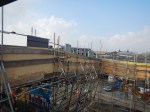
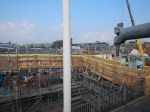


The scaffolding and wood construction is the temprary ramp for passengers.
Meridian Water Station – 27th September 2017
I took these pictures from the top deck of a 341 bus, as it passed the site of Meridian Water station.


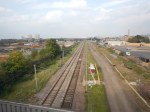

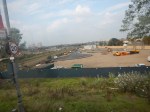

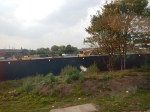
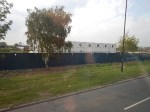
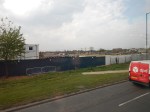
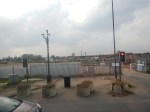
It doesn’t look like it will be a small station.
 The Anonymous Widower