Slow Trains Outside The South-East
This article on the Times and Star website is entitled Mind the snores! Snail’s-pace trains four times slower outside South East.
This is said.
Trains connecting Britain’s major towns and cities are up to four times slower outside the South East, according to new research.
Press Association analysis of the quickest possible trains on 19 routes found that services from London travel at average speeds of 65-93mph, compared with just 20-60mph elsewhere.
The slowest route featured in the study was Liverpool Central to Chester, which takes 41 minutes to make the 14-mile journey (as the crow flies) at 20mph.
The example that they give between Liverpool Central and Chester stations, is one that I can use to illustrate the problem.
- Currently, services on this route are run by nearly forty-year-old Class 508 trains, that are only capable of 75 mph.
- The speed limit on the Wirral Line is just 70 mph, so the well-maintained elderly trains can’t even stretch their legs properly.
- The route has thirteen stops.
The timing is dreadful, if you consider that Merseyrail has exclusive use of the line.
The new Stadler Flirt trains are promised to save nine minutes between Southport and Hunts Cross stations, because they are better designed for passenger entrance and exit with faster speed and better braking and acceleration.
Applying this saving to the Liverpool Central to Chester route would reduce the time from 41 minutes to 35 minutes.
If these Swiss trains can get a roll on, I do wonder if they could do the round trip in under an hour, which would mean Merseyrail could run a four trains per hour (tph) service with just four trains. The slower Class 508 trains need six trains.
This logic can apply to a lot of rail lines in the UK.
Conclusion
The reasons for slow trains can be summed up as follows.
- Trains are timetabled for the slowest trains that work the route.
- A lot of routes, including quite a few in the South-East are timetabled for elderly scrapyard specials.
- Line speeds can often be improved by five or ten mph.
- Modern trains like Merseyrail’s new Flirts are designed to minimise the time it takes to stop at a station. This is referred to as the dwell time.
- Platforms and trains don’t always match up well.
- Level crossings can be a nuisance on some lines like the York to Scarborough Line, which has 89 of the little darlings in forty-two miles.
Trains can be speeded up by doing the following.
- Improving platforms, track and signalling to the highest possible standard and safe line speed.
- Choose trains that can make use of the good infrastructure.
- Consign scrapyard specials like Pacers and Class 508 trains to a well-deserved but long-overdue retirement.
- Make sure that train entry and exit for wheelchair users, persons of reduced mobility, buggy pushers and wheeled-case draggers is level.
- Have well-trained staff and excellent information on the platform.
This is the London Overground’s philosophy and it looks like Merseyrail are applying it.
Courtesy On London Buses
Today, a 30 bus was at the stop that takes me on my way in the morning. Especially, if like today, I was tryibg to get to the Angel I say trying, as Thanes Water are having a big construction party as they try to sort out the water mains on Upper Street. Normally, I have three routes that I can take. But due to the works, only the 30 is a sensible option, as the others go via Silicon Roundabout.
Courtesy 1 – The driver was about to leave as I approached, but he saw me coming and waited.
Courtesy 2 – The bus was pretty full with the only one empty seat for persons of restricted mobility. So I had one of those non-arguments with a pregnant lady about who would not have the seat. On seeing a vacant seat towards the back of the bus, I walked past and she eventually sat down. You see these after you situations a lot. The funniest, I saw was when an elderly Orthodox Jew and a black lady about twenty, delayed a bus whilst they decided who got on first. So charming!
Courtesy 3 – The seat I went for had a lady’s bag on it, but she quickly removed it, when she saw I was coming for the seat.
Courtesy 4 – At Highbury Grove a guy pushing a lady in a wheelchair needed to get on! As the ramp descended a guy who’d parked his baby in a buggy in the space made a quick exit, to allow the wheelchair to be parked.
Courtesy 5 – At the next stop, a lady with a buggy and two other children, needed to get on, but after other passengers told her the wheelchair space was occupied, she moved on.
London buses are generally friendly places and people often talk to each other.
I’ve actually never seen an argument over the wheelchair space in London.
I do wonder if this courtesy is helped, by London’s bus design, which always has a separate entrance and exit. The exit doubles as the wheelchair entrance.
Waterloo Upgrade August 2017 – A Progress Report From London Reconnections
This article on London Reconnections is entitled Back to the Future: (Re)lengthening and Shortening at Waterloo.
It describes in detail why and how the platforms at Waterloo station are being lengthened and shortened and information on other important topics can be gleaned.
Why Did The Train Hit The Barrier Train?
It doesn’t actually say why, but it does discuss the need for the barrier train to protect the workforce. As the train hit the barrier train, it seemed to have worked.
If you want to know more, I suggest you search for barrier in the comments added to the article by others. If nothing, you’ll realise there’s a lot to go wrong.
Why Weren’t The International Platforms Used Earlier?
The platforms were designed to handle six trains per hour (tph) with a long dwell time in the platform and after modification they will handle 18 tph for the Windsor Lines. So a lot of serious work was needed!
There was also complicated ownership of the five platforms.
Looking at it from a planning point of view, the provision of a terminal for Eurostar in London could have been handled better.
Why Are The International Platforms Only Being Used For A Few Weeks And Then Reopening in 2018?
The platforms are needed for this August’s blockade, but there is still a lot of work to do.
Effectively, the remodelling of the International Platforms have been almost split into two independent projects.
I like the way they’ve done this.
How Will Suburban Capacity Change?
In addition to the five platforms in the old International station, platforms 1-6 will also be remodelled for suburban use.
Currently, the slow lines through Wimbledon can handle 18-19 tph into four platforms.
After completion . these same slow lines will handle 22 tph, but they will have the use of two extra platforms.
In An Analysis Of Waterloo Suburban Services Proposed To Move To Crossrail 2, I showed that if you were running 4 tph on the four branches to Chessington South, Epsom, Hampton Court and Shepperton, which will transfer to Crossrail 2, then you need.
- New 100 mph trains.
- A capacity of 20 tph between Waterloo and Wimbledon.
Both these conditions will be met.
How Will The Passenger Experience At Waterloo Change?
Read the article and there are some snippets in there, that give me hope, that passengers will like it. See what you think!
Conclusion
It is a highly intricate and difficult project, that will be performed in a short time.
An Alternative View On HS3
This article on CityMetric is entitled Is Crossrail For The North The Biggest Priority For The North?
The article presents a lot of information and finishes with this paragraph.
None of which is to say that HS3 (I’m sticking with that name) is a bad idea: the existing trans-pennine links are shocking, and it’s pretty gross that transport secretary Chris Grayling scrapped plans to invest in rail in the north in literally the same week he called for another £30bn railway line for London. But if money is scarce, there may be better things we can do with it.
In Lord Adonis On Crossrail Of The North, I came to this conclusion.
Improvements are much-needed in the North, which could include.
- A short/medium term plan to deliver the best possible service with the new trains ordered by Northern and TransPennine Express.
- A long term plan to deliver a genuine 140 mph service across the North of England.
- A plan to improve the Calder Valley and Hope Valley Lines across the Pennines.
- A plan to improve some of the poor connections across the North.
- A strategy to make the best use of the two connections with HS2 at Manchester and Leeds .
A detailed plan is needed that lays down what should be done in the next ten to twenty years.
The plan is also needed as soon as possible.
Perhaps, a high speed route or routes across the North of England could be paired with improved local rail, tram and bus services in all urban areas.
Internet Age Just Starting, Says Tech Guru
The title of this post is the same as the title of a short article in the Business section of the Sunday Times.
It is a summary of an interview with Marc Andreesen onside the Business section.
Some points raised.
- The next wave of technological disruption will affect law, medicine and construction.
- The basic cost of starting an Internet company has fallen dramatically
- There’s something really special happening at the intersection of medincine and computer science.
I certainly agree with the title of the article.
The New Ipswich Station Forecourt
These pictures show the new forecourt at Ipswich station.
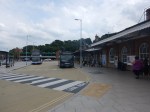

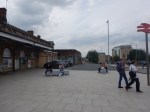
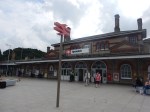
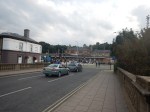
It is certainly a lot better than it was, especially, if you want to get to Portman Road, as you have a clear route to the pedestrian crossing.
I should think the taxi drivers aren’t pleased, as they are no longer directly in front of the station.
Greater Anglia’s New Manningtree Depot – 26th August 2017
Work has started on clearing the site for Greater Anglia’s new Manningtree Depot.



There’s still a fair part of the old industrial buildings left, so it is unclear how much of the whole site the deport will occupy.
This visualisation is from Greater Anglia’s web site.

And this Google Map shows the site.

Note the access road and the conveniently placed Norwich to London express train on both images.
There are other visual clues that suggest to me that although taking a substantial part of the derelict, there will be space around the depot for substantial development.
The train is about 220 metres long, with the building in the new depot being described as 300 metres long.
Electrification ‘Very Unlikely’ To Come Back Into EWR Scheme
The title of this post is the same as this article on Rail Technology Magazine.
This is a quote from Andy Free, who is head of engineering of the alliance that is building the East West Rail Link.
The steer from the DfT is that wherever the Alliance is building a new structure it needs to be clear and suitable for electrification, “and we must do nothing that hinders future electrification, but it is not on the short- or medium-term horizon.
Given the developments in bi-mode trains in recent years, I suspect this is a sensible policy.
Electrification is probably cheaper to fit to a train in a nice warm factory in Derby or Newton Aycliffe, than at a remote location in the pouring rain and the howling wind.
In the case of the East West Rail Link, where sections of the route are well defined, as they are existing rail alignments, building the route would involve.
- Raising any over-bridges to be clear of future electrification.
- Building any bridges or flyovers, where the new railway crosses over roads and other railways.
- Preparing the track bed.
- Laying the track.
- Building or rebuilding the stations.
Note I have ignored signalling, as ideally that will be in-cab by radio.
Building the line without electrification must give advantages.
- Network Rail seem to find it impossible to do electrification projects to time and budget.
- Stations without electrification are safer places and easier to design and build.
- There is less visual intrusion for Nimbys to complain about.
- The cost of connecting the electrification to the National Grid is zero.
- There is less copper cable to steal.
In Is A Bi-Mode Aventra A Silly Idea?, I outlined what I believe the ultimate bi-mode train will be like.
A bi-mode Aventra would be a sophisticated train with the following characteristics.
- Electric drive
- Regenerative braking.
- 25 KVAC overhead and 750 VDC third rail capability.
- Automatic pantograph deployment.
- Onboard energy storage.
- Automatic power source selection.
- Diesel or hydrogen power-pack
The first four are probably already in service in the Class 345 train.
A train going from between Reading and Bedford on the East West Rail Link, would charge its energy storage at the terminals and then use this power along the route. If the train detected that the stored energy was running low, the diesel or hydrogen power-pack would cut in and charge the energy storage.
Conclusion
It is my view, that if you are building a new rail line that is not high speed or high frequency, that there is no need to electrify the line, as intelligent bi-mode trains will be able to work the route economically and without the noise, pollution and vibration problems of their diesel engines working all the time.
HSTs For 2020
The title of this post is the same as that of an article in the September 2017 Edition of Modern Railways.
It describes how Wabtec in Doncaster will be updating the InterCity 125 train, so that meet the latest Persons with Reduced Mobility (PRM) regulations, which come into force in 2020.
The fitting of power doors and retention toilets will see the following trains in service for a number of years after 2020.
- CrossCountry – 5 x 2+8 sets.
- GWR 11 x 2+4 sets.
- Scotrail – 17 x 2+5 sets
- Scotrail – 9 x 2 +4 sets
This totals up to eighty-four Class 43 power cars and two hundred and five Mark 3 coaches.
Work On The Power Cars
With the exception of some interlocks, there appears to be little work being done on the power cars, which is probably because of the good care, that the trains have had over the years.
Although, they’ll obviously be serviced and painted.
Work On The Coaches
This is summed up as follows.
- Sliding power doors for passengers will be fitted.
- A test rig will simulate fifteen years of use.
- Controlled emission toilets are being fitted.
- If a coach has two toilets , only one can be retained due to space limitations, caused by the pockets for the sliding doors.
- Most of the coaches are receiving new universal access toilets.
- From a picture caption in the article, it appears that less work on the interiors will be done on the CrossCountry coaches.
Production details are also given.
- The first GWR and CrossCountry sets will be released in early November.
- Two production lines will be setup.
- The CrossCountry sets are targeted for completion by May 2018.
- The Scotrail sets are targeted for completion by May 2019.
- The final ten GWR sets will be rebuilt last.
Initially coaches will be modified to a 40-day turnround, which should be halved for the Scotrail sets.
Conclusions
Wabtec seem to be doing a comprehensive and quality job in updating the Msrk 3 coaches.
Consider.
- Wabtec are setting up two production lines for the modifications.
- At twenty days to modify a train, that means in a year, they can refurbish 36 coaches or probably four trains.
- Greater Anglia have fifteen rakes of recently-refurbished Mark 3 coaches, one of which has been sold to be used with 60163 Tornado.
- East Midlands Trains have twelve InterCity 125 sets.
- Virgin Trains East Coast have sixteen InterCity 125 sets,
I wonder if any of these extra sets will be converted at Wabtec?
Where would they be used?
Chiltern Railways
Chiltern will probably need some more coaches for their services to Birmingham, Oxford and in the future; Milton Keynes.
If partial electrification should happen on their routes, Chiltern could replace the current Class 68 locomotives for a bi-mode like a Class 88 locomotive.
The New East Midlands Franchise
The new East Midlands franchise could go for a fleet of InterCity 125s for Derby, Leicester, Nottingham and Sheffield services given than electrification won’t happen.in the near future.
It should be noted that HS2 will reach the new East Midlands Hub station around 2032/2033, so this will become a date, when London to East Midlands services will change forever.
CrossCountry
CrossCountry has a capacity problem and might find more InterCity 125s a very well-proven solution, that is liked by passengers.
Long Distance Services
Some long-distance routes like Norwich to Liverpool and Cardff to Manchester might be ideal for shortened InterCity 125s.
New Services
It is well-known that passengers very much like travelling on InterCity 125s and after my trip from Edinburgh to Inverness in the cab, I am convinced that drivers and probably other staff too, have a lot of affection for these superb trains from a very different era.
It is these thoughts and feelings, that led Scotrail to go down the route of introducing shortened InterCity 125s on their major inter-city routes North of Edinburgh and Glasgow.
So could we see Scotrail’s example used in other places in the UK?
Chris Stokes in the September 2017 Edition of Modern Railways, finishes his column, after talking about scenic railways in the rest of the world, with this paragraph.
There are limited examples in Britain, such as the ‘Jacobite’ steam service between Fort William and Mallaig and the expensive and exclusive ‘Royal Scotsman’ service. But elsewhere on the Kyle line, the Cambrian Coast or Settle-Carlisle, all you get is a Class 158, with, if you’re lucky seats aligned with the windows. We could do so much better.
A shortened InterCity 125, perhaps with a regional buffet car would certainly be a lot better.
Scotrail could perhaps start the process by running a Glasgow to Leeds service via the Glasgow South Western Line and the the Settle to Carlisle Line.
Where Are The Class 707 Trains?
This article on Global Rail News is entitled Class 707s Enter Service On Windsor Routes.
This is the first paragraph.
The first two Class 707 EMUs have entered passenger service on the Windsor routes – a few days before the franchise is handed over to First/MTR.
I have been to Waterloo several times this week and the Class 707 trains are conspicuous by their absence.
So where are the trains?
Perhaps, South Western Railway have dragged them off to be repainted or vinyled and have appropriate signs and information fitted?
When, these trains enter service, they will allow another batch of trains to be reliveried.
 The Anonymous Widower