INTERVIEW – Combining Geothermal Power With Minerals Key To Viability, says GEL CEO
The title of this post, is the same as that of this article on Renewables Now.
These three paragraphs introduce, this very much a must-read article.
Producing critical minerals such as lithium alongside geothermal electricity generation could make deep geothermal projects economically viable, according to Ryan Law, founder and chief executive of UK deep geothermal firm Geothermal Engineering Ltd (GEL).
Electricity generation on its own is quite challenging economically, but combining that baseload power with commodity pricing from the minerals seems to get these projects relatively easily funded, he told Renewables Now.
Law also pointed out that geothermal electricity generation began in Italy more than 100 years ago, but the geothermal wells there were initially used to extract boric acid. “It’s just interesting that the story started with geothermal power as a sort of mineral extraction process,” he noted
It certainly looks like we’ve gone round in a large virtuous circle.
These are some points from the article.
There Have Always Been Minerals In Geothermal Fluids
But because they were cheap and no-one bothered about them coming from China, nobody thought about mining them.
Oil And Gas Expertise Helps The Geothermal Sector
This is a sentence.
Law emphasised that the geothermal sector needs a lot of equipment and skills from the oil and gas industry, which currently in the UK are concentrated in Aberdeen. He said the UK will need a strong oil and gas industry until geothermal becomes large enough to absorb those jobs.
Law said we mustn’t disband that sector too quickly.
The US Appears To Be Backing The Sector
These are two paragraphs.
Law said he could see the sector scaling significantly within a decade, driven largely by developments in the US. He pointed to a number of big financial raises in the US recently.
“And also that the US government is very behind the mineral production,” Law remarked.
Conclusion
Geothermal energy paired with the mining of rare earth minerals could be a surprising winner in a decarbonising world.
Great Portland Street – 22nd July 2026
Out of curiosity, I went back to Great Portland Street, this morning.
I took these pictures.





























Note.
- I used to visit the area a lot in the 1970s, to see Time Sharing Ltd., who were a computer company, that I did a lot of work with.
- Time Sharing Ltd has a Wikipedia entry.
- I don’t think there were buses down Great Portland Street in the 1970s.
- The area is dominated by the buildings of the Portland Hospital.
- The Mason’s Arms has changed its name to The Lucky Saint.
- The Mason’s Arms, was where we all drunk.
The area has much changed.
UK’s Largest Onshore Wind Farm To Be Rebuilt With Fewer, Larger Turbines
The title of this post is the same as that of this article on the BBC.
This is the sub-heading.
One of Europe’s biggest onshore wind farms is to be flattened and rebuilt with fewer, taller turbines, its owner has announced.
These three paragraphs add more detail to the story.
Whitelee Windfarm has been producing electricity for about 20 years on a stretch of moorland near Eaglesham, south of Glasgow, but is reaching the end of its life.
Scottish Power Renewables says the existing 215 turbines will be replaced in three phases with around 124, each of which will be about 110m (361ft) taller.
The £1.5 billion “repowering” project will take 10 years to complete and will double the electricity output from 539 megawatts to 1 gigawatt, which is enough to power about 650,000 homes.
I asked Google AI,”Will there be any objectors to the repowering of Whitelee Wind Farm” and received this reply.
While there are no formal objectors on record yet, opposition to the repowering of Whitelee Wind Farm is highly anticipated. The developer, ScottishPower Renewables, officially filed their proposal with the Scottish Government in July 2026, but the formal planning application is not expected to be submitted until December 2027.
Anticipated objectors and their concerns typically include:
Campaign Groups & Environmentalists: Organisations like Scotland Against Spin generally challenge large-scale onshore wind projects over landscape dominance, ecological impacts, and the sheer scale of the new turbines.
Visual and Height Concerns: The repowering plan proposes replacing the existing 215 turbines with roughly 124 much larger machines. Each new turbine will stand roughly 110m taller than the current ones, which is expected to draw objections from those concerned about the visual alteration of the moorland.
Aviation and Radar Issues: Taller turbines and longer blades frequently raise fresh concerns and potential clearance objections from civil aviation and military radar stakeholders.
The BBC article finishes with this paragraph.
The work at Whitelee is expected to generate about £330m for the Scottish economy.
How many Scottish jobs will a third of a billion pounds sustain?
Blackfriars Station – 22nd July 2026
I feel that with a few modifications, Thameslink could solve some of London’s airport connectivity and general transport capacity problems.
So this morning, I went to Blackfriars station and took these pictures.
































Note.
- Blackfriars station has two through platforms and two South-facing bay platforms.
- Blackfriars station is fully step-free.
- The two through platforms handle just 12 trains per hour (tph).
- Both Thameslink and the Elizabeth Line are designed to handle up to 24 tph.
The Wikipedia entry for Thameslink, says this about the frequency of operation.
The new services began operating in 2018, though the full projected timetable of 24 trains per hour has never been achieved.
So how could this spare capacity be used?
Could A Gatwick And Luton Airport Express Service Be Developed?
Consider.
- Thameslink already has a 2 tph Bedford and Brighton service, that already stops at the two airports, but it also stops at twenty other stations.
- Thameslink already has a 2 tph Bedford and Three Bridges service, that already stops at the two airports, but it also stops at nineteen other stations.
- Both airports have a 6 tph service, that stops in Central London at London St Pancras International(for Eurostar), Farringdon (for the Elizabeth Line), City Thameslink, London Blackfriars and London Bridge.
- East Midlands Railway operates a 2 tph St.Pancras International and Corby service, which stops at Luton Airport Parkway, Luton, Bedford, Wellingborough, Kettering, which takes only 32 minutes. This service uses a dedicated platform at St.Pancras International, where platform space is limited.
I wonder if it would be better if the East Midlands Railway service became an Express service through the Thameslink core and perhaps replaced one of Bedford’s Thameslink services. Bedford would still have the same number of services, but two would be a lot faster.
Battery-electric trains might even extend the service to Leicester, which might allow extra stations at Oakham and Melton Mowbray to be added.
Loganair Agrees To Buy Five Beta Technologies’ Alia CTOL (CX300) Electric Aircraft For Use Across Scotland
The title of this post, is the same as that of this article on the John O’Groat Journal.
These two paragraphs add some detail.
A “truly historic moment” in regional air travel could soon see electric aircraft transporting passengers between between Highlands and Islands airports.
Loganair announced a deal to buy five all-electric aircraft, with options for five more, on Monday.
The first aircraft is expected to be in service in 2029.
As an engineer and a former private pilot, I felt this would happen at some time, but not as early as this.
Read the Wikipedia entry for the plane to find out more about this fascinating aircraft.
Four Of The Largest Grid Batteries From Fidra
Fidra have made a big splash as they enter the UK’s Long Duration Energy Storage market, with three grid batteries.
Bicker Fen 1 and 2
Capacity – 1.20 GW/2.40 GWh
Web site
Commission Date – BF1-2028, BF2-2029
Thorpe Marsh
Capacity – 1.45 GW/2.90 GWh
Commission Date – Q1-2027
West Burton C
Capacity – 500 MW/1 GWh
Commission Date – Q4-2027
Note.
- All are two-hour batteries.
- Each battery has some drone footage of the site.
Welsh Manufacturing Boost As Sizewell C Awards Contract To Boccard UK
The title of this post, is the same as that of this news item from Sizewell C.
These two bullet-points act as sub-headings.
- Boccard UK will deliver Pools, Tanks, and Sumps (PTS) scope elements for Sizewell C
- Tanks will be manufactured at fully-digitised Deeside facility in North Wales, which supports over 200 jobs
These two paragraphs add some more details.
Sizewell C has awarded a major contract to Boccard UK to deliver its critical Pools, Tanks, and Sumps (PTS) scope elements – with manufacturing to take place in its Deeside facility in North Wales.
Over the four-year programme, Boccard UK will be responsible for the fabrication and pre-assembly of high-integrity stainless steel tanks. These components will be embedded within key reinforced concrete structures across Sizewell C’s Nuclear Island and will play an essential role in the power station’s long-term operation.
Note.
- Boccard UK is a subsidiary of long-established family-owned Boccard.
- Bruno Boccard and Patrick Boccard serve as the Chief Executive Officers (CEOs).
- Where will the stainless steel come from?
- Will finished products be delivered to Sizewell C by rail?
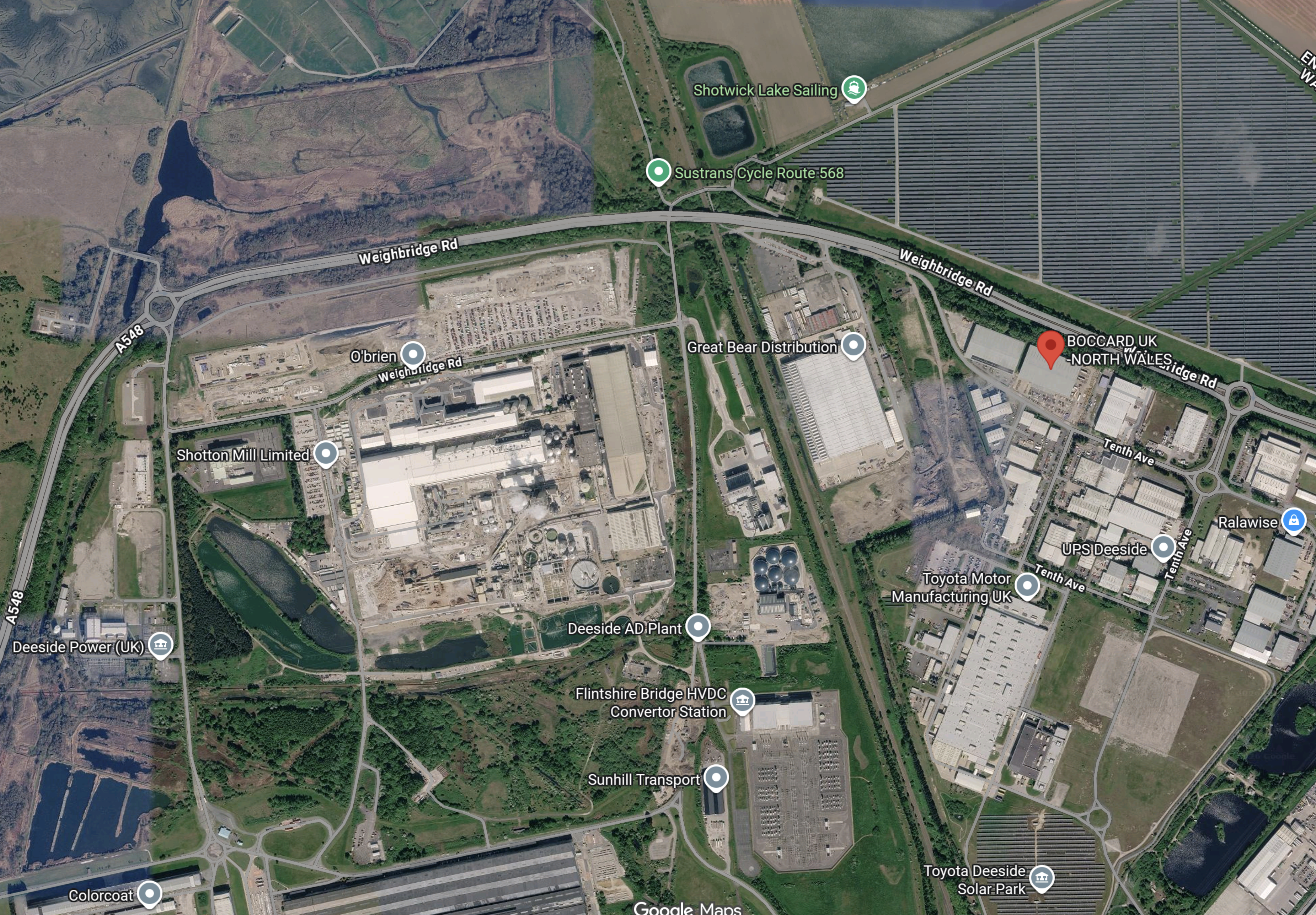
This Google Map shows Deesside Industrial Park.
Note.
- The Boccard UK site is indicated by the red arrow.
- The Borderlands Line between Liverpool and Wrexham runs more or less North-South across the middle of the map.
- There is certainly a lot of solar power in the area.
- Deesside Parkway station will be built where Weighbridge Road crosses the railway.
- The station will be ideally placed for Sustrans Cycle Route 568, which goes from the Wirral to Chester via Hawarden Bridge.
I have added Deesside Parkway station to my list of stations to visit, when hopefully it opens at the end of 2027.
Does Deeside Industrial Park Have a Rail Freight Connection?
I asked Google AI, the question in the title of this section and received this answer.
Deeside Industrial Park does not have a general-use rail freight terminal. While parts of the adjacent Borderlands Line are used by industrial rail traffic—such as the Dee Marsh Reception Sidings and the Tata Steel site at Shotton—general businesses primarily rely on road freight. For broader rail freight connections, companies typically use facilities at the Port of Liverpool or the Euro Freight Line terminal in Crewe.
Despite that answer, if one of the tenants of the Deeside Industrial Park wanted a rail connection, I’m sure it could be arranged.
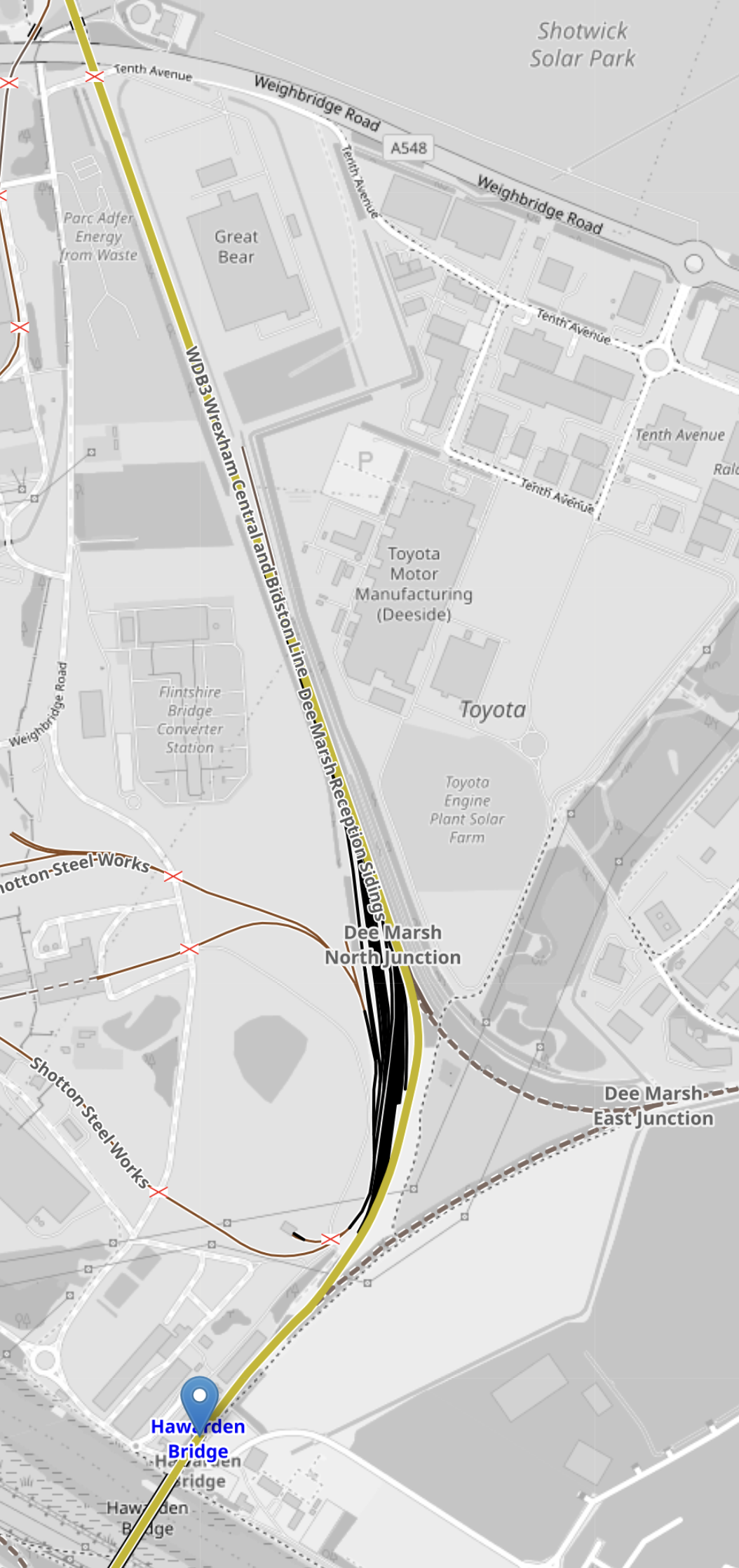
This Google Map shows the Dee Marsh Sidings and the adjacent businesses.
Note.
- The Borderlands Line between Liverpool and Wrexham runs more or less North-South across the middle of the map.
- Hawarden Bridge and Hawarden Bridge Station are in the South-West corner of the map.
- The Dee Marsh sidings are tucked inside the bend of the Borderlands Line.
- Rail lines seem to fan out to all corners of the Shotton steel works.
- The Boccard UK site is in the North-East corner of the map. Their site is the middle one of the five lined up on Weighbridge Road.
- Toyota’s engine plant fills in much of the space to the North-East of Dee Marsh Sidings.
I believe that if one of the tenants of the Deeside Industrial Park wanted a rail connection, I’m sure it could be designed and built.
Toyota Shock Admission: Electric HiLux And 4WDs Won’t Suit Mainstream Buyers Until Battery Tech Leaps Forward
The title of this post, is the same as that of this article on EVCentral.
These are the three introductory paragraphs.
Toyota says electric utes and 4WDs are still years away from suiting mainstream, consumer-facing applications like touring and towing.
The admission came from Toyota Australia’s engineering team, speaking at the recent HiLux BEV and LandCruiser 300 Performance Hybrid briefing.
Toyota Australia’s product planning chief Ray Munday said battery energy density remains the single biggest obstacle standing between today’s electric utes and something capable of doing what a diesel HiLux or LandCruiser can do.
EVCentral also has an article entitled Toyota boss exults in Australian launch of new HiLux EV in 2026, hydrogen HiLux coming in 2028.
I hope, I’m still here in 2028, so I can have a ride in a hydrogen HiLux.
Hammersmith Bridge’s Future ‘Could Be Driverless’
The title of this post, is the same as that of this article on the BBC.
This is the sub-heading
A community group in west London has proposed using autonomous pods to move people over the Hammersmith Bridge, which has been closed to vehicular traffic since 2017.
These three paragraphs add more detail.
Barnes and Hammersmith Electric Light Transit (BHELT) was established “to help explore, develop and promote the idea of lightweight autonomous electric pods operating across Hammersmith Bridge”.
The not-for-profit organisation said the pods could be part of “an inclusive and sustainable transport future” for the area.
Transport for London said it had no plans to introduce the pods on the river crossing, or for driverless buses more generally on its network.
I notice that the picture of one of the pods, has a sticker on it, that says Milton Keynes.
It appears that the trials THERE ended in March.
So, I can’t go and have a ride.
But BHELT has a web site.
Will Andy Burnham Take The Highview Road To Lower Energy Bills?
Has Andy Burnham Ever Said He’d Like Energy Bills To Come Down?
I asked Google AI, the question in the title of this section of this post, and received this reply.
Yes, Andy Burnham has explicitly stated he wants to bring energy bills down, making it a central priority upon becoming UK Prime Minister in July 2026. He has pledged to give voters “breathing room” on the cost of living and is considering radical market overhauls to reduce household costs.
But has he looked at radical engineering solutions, that would also help to push energy bills down.
This morning, I wrote Molten Salt And Human Sweat: The Weird Batteries That Could Store Renewable Energy, which is based on a must-read article in today’s Guardian.
The Guardian article shows Andy Burnham with Highview Power’s engineers and managers at the ground breaking ceremony of Highview Power’s 50MW/300 MWh liquid-air grid battery at Carrington in Andy Burham’s feifdom of Greater Manchester, where he was mayor for nine years.
In Andy Burnham and Highview Power, I asked Google AI about their relationship and Andy Burnham came over as an enthusiastic supporter of Highview Power.
In UK Wind Risks ‘Exponentially Rising’ Curtailment Without Energy Storage, I discuss using Highview’s batteries to avoid shutting wind turbines down, when we have too much electricity.
I believe that if Andy Burnham, were to experdite up to 20 of Highview’s largest 300 MW/3.2 GWh batteries around the UK, this would have the right effect on energy bills.
I would hope that Andy Burnham is watching the progress of the Carrington battery closely.

