Gatwick Second Runway Plan Approved By Transport Secretary
The title of this post is the same as that of this article on the BBC.
This is the sub-heading.
Transport Secretary Heidi Alexander has approved plans for a second runway at London Gatwick Airport, as the government looks for economic growth opportunities.
These four introductory paragraphs add some detail.
The £2.2bn privately-financed project involves in effect moving the current Northern Runway 12 metres to bring it into regular use, as well as other developments, including extending the size of terminals.
The airport says its plans will bring jobs and boost the local economy. But there has long been opposition from campaigners and groups worried about the impact on the surrounding area.
Gatwick currently handles about 280,000 flights a year. It says the plan would enable that number to rise to around 389,000 by the late 2030s.
A government source has described the plans as a “no-brainer for growth,” adding that “it is possible that planes could be taking off from a new full runway at Gatwick before the next general election.”
Over the last fifty years, I’ve been involved in many large projects, as I used to write project management software and at one period in the 1980s, half of all the world’s major projects, were being managed by the Artemis software, that I wrote in a Suffolk attic.
I am starting this post by asking Google AI, when Gatwick’s Northern Runway was built. This was the answer I received.
Gatwick’s Northern Runway was built in 1979 by widening an existing taxiway to serve as an emergency runway. While the main runway is known as 08R/26L, the standby or emergency runway is designated as 08L/26R and is located just to the north of the main runway.
Note.
- 08 means that the runway is aligned at 080 degrees, which is almost due East.
- 26 means that the runway is aligned at 260 degrees, which is almost due West.
- Normally, when landing and taking off at Gatwick, your aircraft will use the Southern runway, which points to the West or Runway 26L.
This Google Map shows the layout of the airport.

Note.
- The longer Southern 08R/26L runway.
- The shorter Northern 08L/26R runway.
- The station in the North-East corner of the map is Horley.
- The station to the East of the runways is Gatwick Airport station.
- Both stations are on the Brighton Main Line, which runs North-South past the Airport.
- As when it was built, the Airport envisaged that the Northern runway would be turned into a runway that would meet all standards, I doubt there will be any problems rebuilding the Northern Runway, the required twelve metres to the North.
It was a cunning plan, when it was executed in the late 1970s and worthy of Baldrick at his best.
I do wonder, if it had been developed using Artemis!
US Interior Secretary: ‘No Future For Offshore Wind Under This Administration’
The title of this post, is the same as that of this article on offshoreWIND.biz.
This is the sub-heading.
US Interior Secretary Doug Burgum said at a press conference on 10 September that offshore wind has no future in the US under the Trump administration and that the government was reviewing five offshore wind projects that are now under construction.
There is also this quote from Burgum.
Offshore wind was too expensive and not reliable enough.
Many of those projects weren’t really about electricity, they were about tax subsidies
I think the fact that the subsidies have been either cut back or limited means that it is likely that there will not be future offshore wind built in America.
He also added that there were concerns that wind turbines interfered with whales and radar systems.
I asked Google AI a few questions.
Is Offshore Wind Extremely Expensive?
Google AI replied.
No, offshore wind is not considered extremely expensive when compared to other energy sources, particularly gas-fired power stations, and its costs are projected to fall further. While initially more expensive to construct than onshore wind due to the marine environment, the higher and more consistent wind speeds offshore generate more power, leading to a competitive or lower overall levelised cost of energy (LCOE) in many regions. Recent economic challenges like inflation and supply chain disruptions have increased costs temporarily, but the sector’s financial position is recovering, and cost reductions are expected to continue.
That looks pretty fair to me.
Is Offshore Wind Reliable?
Google AI replied.
Yes, offshore wind is a reliable energy source because it generates power more consistently than onshore wind due to higher, more dependable wind speeds at sea, and can be integrated with other renewables and energy storage to provide continuous power. Offshore wind turbines operate almost all the time, and the power can be backed up by grid-level storage to ensure a steady electricity supply, even when the wind isn’t blowing.
That looks pretty fair to me.
Are Subsididies And Tax Breaks Important For Offshore Wind?
Google AI replied.
Yes, subsidies and tax breaks are important for the offshore wind industry, which faces high upfront costs and inflationary pressures, to make it more cost-competitive with fossil fuels and secure financing for projects. These incentives help reduce costs for developers, de-risk investments, and ensure the technology can meet climate targets by fostering investment and ensuring long-term viability.
That looks pretty fair to me, but if you were in the oil and gas industry you might think differently.
On the other hand some countries like Norway and the UK, are encouraging the linking of offshore wind farms to offshore oil and gas production to decarbonise offshore operations.
Does Offshore Wind Kill Whales?
This article on the BBC is entitled Fact-Checking Donald Trump’s Claim That Wind Turbines Kill Whales.
It goes into detail about Trump’s claims about wind turbines and marine life.
These are four paragraphs.
“We know what the main threats are to humpback whales: it’s very much the impact from things like fishing and ship strikes,” says Rob Deaville from the Zoological Society of London’s Cetacean Strandings Investigation Programme.
“To talk about wind farms being a problem takes away discussion around the very real threats that are a problem for those species.”
Many other areas with high numbers of wind farms have not seen an increase in whale mortality.
For example, the UK is home to the world’s four largest wind farms, but no humpback whale strandings there have been conclusively linked to the impact of those farms.
That looks pretty fair to me.
But because of our massive portfolio of offshore wind farms and top universities, who research the marine environment, the UK is in a unique position to expose fake science, that was made up on the back of a used envelope.
Does Offshore Interfere With Radar?
Google AI replied.
Yes, offshore wind farms can interfere with radar by reflecting radar signals, causing “radar clutter” or false echoes that can obscure real targets, like aircraft or ships, or create phantom images on a radar display. This interference, also known as a “blade flash,” can negatively impact air defense, air traffic control, and maritime navigation, leading to reduced accuracy and potential safety risks.
That looks pretty fair to me.
Have Wind Turbines Caused Any Air Accidents?
Google AI replied.
Yes, wind farms have caused air accidents, though they are rare. These incidents primarily involve light aircraft colliding with wind turbines or experiencing loss of control due to turbulence from turbine wakes. Examples include a pilot crashing near a wind farm due to turbulence and another fatal crash involving an aircraft hitting a turbine blade.
That looks pretty fair to me.
I learned to fly light aircraft in the 1970s and I remember being told about wake turbulence from airliners, which has been strong enough in some cases to flip an aircraft like a Cessna 150 upside down or into a spin.
What Are The CAA’s Rules For Flying Near Wind Turbines?
Google AI replied.
The primary CAA rule for flying near wind turbines is related to their visibility and safety, focusing on lighting requirements and potential hazards like turbulence. Structures 150 meters or higher require medium-intensity red lights. Pilots must avoid dazzling lights with their own, and wind turbine developers must assess and mitigate risks such as turbulence, radar interference, and impact on Instrument Flight Procedures (IFPs).
That looks like what I would have expected.
Conclusion
I have tried not to be selective with my evidence, but if you are there are reasons that could be used to ban wind turbines.
I am also happy to add any other questions.
Shell Pulls Plug On Rotterdam Biofuels Plant
The title of this post, is the same as that of this article on The Times.
This is the sub-heading.
Retreat from green energy continues as facility that was earmarked to produce sustainable aviation fuel and renewable diesel will not now be built
These first three paragraphs add some details.
Shell has scrapped construction of one of Europe’s biggest biofuels plants as it continues its retreat from green energy
The move by the FTSE 100 oil and gas group represents a further setback for efforts to cut aviation emissions.
Shell said it would not restart construction of the biofuels facility at its Rotterdam energy and chemicals plant, which was due to produce sustainable aviation fuel (SAF) and renewable diesel.
When I wrote Centrica Secures Investment Stake In Gasrec Helping Boost UK Bio-LNG Ambitions, I took a look at the use of liquified natural gas (LNG) in transport.
This paragraph from the Centrica press release about the stake, gives the thoughts of Chris O’Shea, who is Group Chief Executive, Centrica.
Chris O’Shea, Group Chief Executive, Centrica plc, said: “Demand for bio-LNG for transport is growing fast as more HGV operators make the switch – drawn by a clean, ready-to-use fuel which slashes CO2 emissions by up to 85 per cent in comparison to diesel*. This investment in Gasrec enhances our collaboration with the leading company in the sector, and puts us in a strong position to energise a vital sector of the industry on its journey to net zero.”
Chris O’Shea of Centrica appears to feel that bio-LNG is a good alternative to diesel, so have Shell come to a similar decision, about satisfying the demand for diesel?
I asked Google AI if LNG has advantages over diesel as a truck fuel and received this answer.
Yes, LNG offers advantages over diesel, including significantly lower emissions of nitrogen oxides (NOx), sulfur oxides (SOx), and particulate matter (PM), which improves local air quality. It can also be more economically efficient, with fuel costs potentially lower than diesel depending on market conditions. However, the overall greenhouse gas (GHG) benefits are mixed; while LNG has a lower carbon content, it can result in higher lifecycle GHG emissions due to energy losses in its production and transport, as well as methane slip.
Note.
- If it drops emissions by up to 85 percent for bio-LNG, surely, it would do the same for LNG.
- I also think with tight regulations, the use of LNG could improve air quality in cities like London.
- LNG would probably be a more affordable fuel than hydrogen.
It should also be noted, that several major diesel engine makers, now make families of engines, which can handle, diesel, hydrogen and natural gas.
LNG would also be a convenient stepping stone between current fuels and hydrogen, that might give a few extra years for the transition.
Could LNG Be Used In Aircraft?
Consider.
- LNG would certainly give some reduction in carbon emissions.
- Handling LNG in aircraft could have similar problems to hydrogen, so companies like Airbus might have already solved them.
- In addition, LNG doesn’t have the fearsome reputation, that hydrogen seems to have gained because of the Hindenburg.
- It would be easier to provide LNG fuel at airports all round the world.
- Airbus have said availability of hydrogen at airports, could be a problem.
Out of curiosity, I asked Google AI if LNG could be used to power an airliner and received this answer.
Yes, liquefied natural gas (LNG) can theoretically be used to power airliners, offering a potential reduction in CO2 emissions compared to conventional jet fuel, but significant challenges exist. These challenges include the need for entirely new, larger, and heavier cryogenic fuel tanks, modifications to aircraft engines and fuel systems, and the development of a new global infrastructure for LNG supply. While experimental tests have been conducted, such as on the Soviet Union’s Tupolev Tu-155 in 1989, LNG is not currently in normal service due to these practical and infrastructural hurdles.
I would prefer it was a purpose-designed Airbus, than a Soviet-era Tupolev.
Could London And Central Scotland Air Passengers Be Persuaded To Use The Trains?
How Many Passengers Fly Between London And Edinburgh?
Wikipedia gives these figures for 2024 for passengers from Edinburgh to London
- London City – 334,873
- London Gatwick – 476,152
- London Heathrow – 1,148,634
- London Luton – 338, 729
- London Stansted – 693,953
This gives a total of 2,992,341.
As Wikipedia doesn’t give complete figures for from London to Edinburgh, for the purpose of this analysis, I’ll assume they are the same.
How Many Passengers Fly Between London And Glasgow?
Wikipedia gives these figures for 2024 for passengers from Glasgow to London
- London City – 208,405
- London Gatwick – 456,002
- London Heathrow – 954,027
- London Luton – 255,095
- London Stansted – 225,110
This gives a total of 2,098,639.
As Wikipedia doesn’t give complete figures for from London to Glasgow, for the purpose of this analysis, I’ll assume they are the same.
How Many Passengers Fly Between London And Scotland’s Central Belt?
Adding the two figures gives 5,090,980. in both directions.
Which is an average of 97,903 per week or 13,948 per day.
How Many Train Seats Run Between London And Scotland’s Central Belt?
These figures are for Friday the 1st of August.
- Aventi West Coast – London Euston and Glasgow Central – 5 x 9-car Class 390 train – 2,345 seats
- Aventi West Coast – London Euston and Glasgow Central – 16 x 11-car Class 390 train – 6,677 seats
- LNER – London King’s Cross and Edinburgh – 26 x 9-car Class 801 train – 15,886 seats
- Lumo – London King’s Cross and Edinburgh – 5 x 5-car Class 803 train – 2,010 seats
Note.
- All services are all-electric.
- All services are fairly new or have recently been refurbished,
This gives a total of 26,918 train seats.
Adding Lumo’s Service To Glasgow
In Lumo Will Extend Its King’s Cross And Edinburgh Service To Glasgow, I suggested that the Glasgow service would be run as follows from December 2025.
- Two existing Lumo services will leave London as pairs of five-car trains.
- The pairs will split at Edinburgh.
- The leading train will go on to Glasgow Queen Street calling at Edinburgh Haymarket and Falkirk High stations.
- The trailing train will return to London King’s Cross.
- At the end of the day, the two trains in Glasgow will do a fast run back to London King’s Cross as a pair of 5-car trains.
This will add 804 seats per day between London and Glasgow Queen Street in both directions.
The daily total would now total 27,722 train seats, which compares with a daily average of 13,948 passengers per day, who travel by air.
Adding Lumo’s Service To Stirling
In Lumo To Expand Scotland’s Rail Network With New London-Stirling Rail Route From Spring 2026, I talk about Lumo’s new service to Stirling.
- There will be five trains per day (tpd) in each direction.
- Lumo’s new route will link London Euston directly to Stirling, also calling at Milton Keynes, Nuneaton, Crewe, Preston, Carlisle, Lockerbie, Motherwell, Whifflet (serving Coatbridge), Greenfaulds (serving Cumbernauld) and Larbert.
- The service will use 6-car Class 222 trains, which in the linked post, I estimate will have a similar one-class capacity to the Class 803 trains between London King’s Cross and Edinburgh.
- If the capacity of the two train types is similar, this should give operational advantages and allow some more Class 803 trains to run the Euston and Stirling route.
This second Scottish route will add 2010 train seats per day between London Euston and Stirling in both directions.
The daily total would now total 29,732 train seats, which compares with a daily average of 13,948 passengers per day, who travel by air.
Could More Capacity Be Added Between London And Scotland’s Central Belt?
I believe some of the Lumo services between London King’s Cross and Edinburgh could be doubled up to a pair of trains.
There would have to be no platform length issues at London King’s Cross, Stevenage, Newcastle and Morpeth stations.
If three trains could be doubled up, that would add 1,206 train seats per day between London and Edinburgh in both directions.
The daily total would now total 30,938 train seats, which compares with a daily average of 13,948 passengers per day, who travel by air.
I also suspect, that some of the Stirling services could be doubled up.
Connectivity Of England’s Northern Airports To London And Central Scotland
Birmingham Airport
Consider.
- There are easyJet flights to Edinburgh and Glasgow
- There are 1.5 trains per hour (tph) between Birmingham New Street and Edinburgh.
- There are 6 tpd between Birmingham New Street and Glasgow.
You would make your choice and pay the money.
East Midlands Airport
There are no flights or trains to Edinburgh and Glasgow.
Leeds Airport
Consider.
- There are no flights to Edinburgh or Glasgow.
- There is one tph between Leeds and Edinburgh
- There is one tpd between Leeds and Glasgow
Could Leeds and Glasgow get better connectivity?
Liverpool Airport
Consider.
- There are no flights to Edinburgh or Glasgow.
- There is one tph between Liverpool Lime Street and Edinburgh
- There is three tpd between Liverpool Lime Street and Glasgow
The Liverpool area is well connected to Crewe, Warrington Bank Quay, Wigan North Western and Preston stations on the West Coast Main Line for alternative services to Glasgow.
Manchester Airport
Consider.
- There are no flights to Edinburgh or Glasgow.
- There is one tph between Manchester Airport and Scotland via Manchester Piccadilly and Manchester Oxford Road, which alternates between Edinburgh and Glasgow.
The Manchester area is well connected to Crewe, Warrington Bank Quay, Wigan North Western and Preston stations on the West Coast Main Line for alternative services to Glasgow.
Omio gives this summary of flights between Heathrow and Manchester airports.
Flights from Manchester Airport to London Heathrow Airport depart on average 8 times per day, taking around 1h 6m. Cheap flight tickets for this journey start at £63 but you can travel from only £16 by coach.
Wrightbus and others will be producing mouse-quiet hydrogen-powered coaches in a couple of years. I suspect these will give short flights a good kicking.
Newcastle Airport
Consider.
- There are no flights to Edinburgh or Glasgow.
- There is three tph between Newcastle and Edinburgh with an additional 5 tpd from Lumo.
- There is two tpd between Newcastle and Glasgow.
- There is one tpd between Newcastle and Stirling.
- From December 2025, Lumo will add two tpd from Newcastle to Glasgow and one tpd from Glasgow to Newcastle.
- In Lumo Will Extend Its King’s Cross And Edinburgh Service To Glasgow, I stated that I believe that Lumo’s Glasgow to Newcastle service will be a late evening ten-car train, so travellers can have a long day in Glasgow, Edinburgh and Newcastle and still return to London.
Lumo would appear to fill in the gap between Newcastle and Glasgow.
Google AI gives this summary of flights between Heathrow and Newcastle airports.
There are usually 5-6 direct flights per day between Newcastle and Heathrow airports. These flights are operated by British Airways. The average flight time is around 1 hour and 10 minutes.
Note.
- In 2024, 497, 469 passengers flew between between Heathrow and Newcastle airports, which is an average of 681 passengers in each direction every day.
- This was an increase of 13.6 % on 2023.
- From December Lumo will be running extra London King’s Cross and Newcastle services, with each train having 402 seats.
- The improvements in rail services in and around Newcastle in recent months, will surely bring more passengers to use trains from Newcastle station.
- Will Lumo also target adverts at airline passengers?
London and Newcastle could be another route for mouse-quiet hydrogen-powered coaches.
Conclusion
These numbers summarise my calculations.
- Currently an average of 13,948 passengers per day fly between London and Central Scotland.
- Currently, there are 26,918 train seats available per day between London and Central Scotland.
- In December 2025, Lumo will add another 804 low-cost train seats between London King’s Cross and Glasgow Queen Street.
- In Spring 2026, Lumo will add 2010 low-cost train seats between London Euston and Stirling.
- From Spring 2026, there will be 29,732 train seats available per day between London and Central Scotland.
- This represents a 10 % increase of seats on the trains between London and Central Scotland.
How many passengers, who normally fly, will switch to using the train?
- Lumo may only offer one class, but you get a trolley and can order food from M & S and others to be delivered to your seat.
- Both LNER and Lumo accept dogs. I don’t know about Avanti.
- All services will be all-electric, when Lumo gets its new electric trains for Stirling, in a few years.
- It looks to me like Lumo could be offering a late train back to London from Edinburgh and Glasgow.
- Digital signalling on the East Coast Main Line should speed up services.
If Lumo to Glasgow and Stirling works out, it could also cut the total carbon footprint of travel between London and Central Scotland.
Hotel Tycoon Reveals Heathrow Expansion Proposal
The title of this post is the same as that of this article on the BBC.
This is the sub-heading.
Hotel tycoon Surinder Arora has announced he is submitting a Heathrow expansion plan which rivals a proposal from the airport’s owners.
These three paragraphs add more details.
The billionaire’s Arora Group said the “primary benefit” of the plan it submitted to the government was a shorter new runway which would avoid the costly and disruptive need to divert the M25 motorway.
Building a 2,800-metre (9,200 ft) third runway instead of the full-length 3,500-metre (11,500 ft) runway planned by the airport would result in “reduced risk” and avoid “spiralling cost”, the company said.
The airport declined to comment on the Arora Group’s proposal.
Note.
- In Heathrow Willing To Build Shorter Runway After Airline Outcry Over Cost, I proved to my satisfaction, that a shorter third runway would work.
- Any scheme that involves diverting the M25, is not fit to get to be on the short list, as construction will be too disruptive.
- I also remember the problems of the M 25, during the construction of Terminal 5.
The last paragraph is the most important, as it illustrates Heathrow’s attitude to outside ideas.
- Was HS4Air, that I talked about in Ambitious £10bn Plans For Gatwick Heathrow HS4Air Rail Service Rejected properly considered?
- Was Heathrow Southern Railway, that I talked about in Why I Like The Heathrow Southern Railway Proposal, properly considered?
Perhaps, Heathrow’s management suffers from Not-Invented-Here Syndrome?
Conclusion
I suspect that Surinder Arora’s project will be a non-starter.
Heathrow Willing To Build Shorter Runway After Airline Outcry Over Cost
The title of this post, is the same as that of this article in The Telegraph.
This is the sub-heading.
BA and Virgin have objected to expansion plan that could see departure fees swell to as much as £100
These are the first two paragraphs.
Heathrow has said it is willing to build a shorter, cheaper third runway following an outcry from airlines over cost.
Europe’s busiest airport will indicate its readiness to negotiate with carriers over runway options when it submits a formal pitch to ministers next week, said Thomas Woldbye, the airport’s chief executive.
This is a map of the new proposal from the DfT.
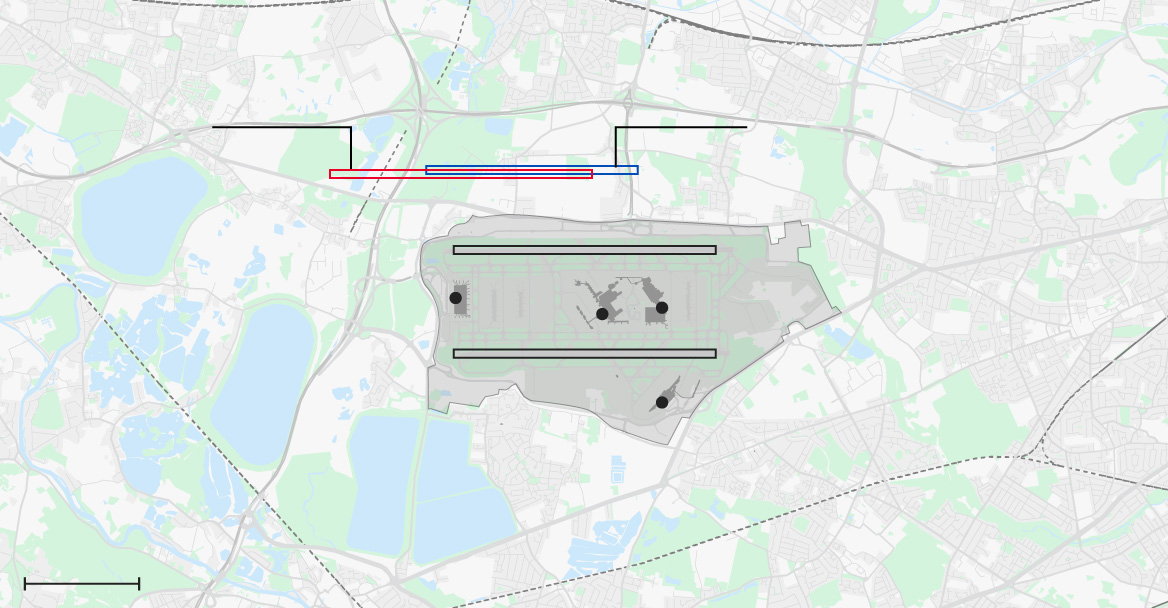
Note.
- The current Northern and Southern runways, with terminals 5, 3 and 2 between them from West to East.
- Terminal 4 is South of the Southern runway.
- The runway shown in red to the North of the Northern runway is the current proposal for a full-length new runway.
- The runway shown in blue to the North of the Northern runway is the new proposal for a shorter-length new runway.
- The M25 can be picked out going North-South to the West of the current runways and the new shorter runway.
- But the M25 is crossed by the full-length new runway.
It would appear that the proposal for the new shorter runway will avoid putting the M25 in a tunnel.
So hopefully, it would reduce the cost and disruption incurred, by building the new shorter runway.
Was The Price Of Fuel A Factor In The Ahmedabad Plane Crash?
I am asking this question, as I know that a prudent airline, is careful where it buys the fuel for its aircraft.
I asked Google, if jet fuel is more expensive at Gatwick or in India and got this reply.
Jet fuel (Jet A-1/AVTUR) is more expensive at Gatwick Airport compared to India. At Gatwick, the price is 906.8 GBP/1000L. While in India, the price varies by location, for example, ₹97,975.72/kl in Delhi. This indicates that Jet A-1/AVTUR costs more at Gatwick than in India.
I suspect, if they can that Air India would prefer to fill up their planes in India.
Consider.
- The flight that crashed was AI 171.
- The aircraft was a Boeing 787-8.
- The Air India flight that crashed was flying direct to Gatwick Airport, which is a great circle distance of 4254.3 miles.
- Afterwards, it would fly from Gatwick Airport to Goa, which is a great circle distance of 4703.7 miles.
- Wikipedia gives the range of a Boeing 787-8 as 8410 miles.
As a former private pilot, who did many long flights, if I were Air India, I might use a strategy like this.
- Fill the plane with as much fuel, as it can carry at Ahmedabad.
- Fly to Gatwick on an efficient great circle route.
- Top up the plane, with enough fuel to fly safely to Goa, at Gatwick.
The cost of fuel would be minimised, but it would mean a heavy take-off at Ahmedabad.
The temperature at Ahmedabad yesterday was around the low thirties and as the altitude is only 53 metres, I don’t think it would have been a hot-and-high take-off.
Heart Aerospace Relocates Corporate Headquarters To Los Angeles, California
The title of this post, is the same as that of this news item from Heart Aerospace.
This is the sub-heading.
Hybrid-electric airplane manufacturer Heart Aerospace has announced the relocation of its corporate headquarters from Gothenburg, Sweden to Los Angeles, California. This strategic move aims to bolster the company’s product development in the United States, supporting the upcoming experimental flights of its Heart X1 prototype and the future Heart X2 prototype.
These two introductory paragraphs add ,ore detail.
Scheduled for its maiden flight in 2025, the X1 marks a major milestone in Heart’s innovation journey, setting the stage for X2.
“Our move to Los Angeles marks a new chapter in Heart Aerospace’s journey—one that prioritizes iterative development and deeper vertical integration,” said Anders Forslund, co-founder and CEO of Heart Aerospace. “For the X2, we’re developing key technologies like batteries, actuation systems, software, and hybrid-electric hardware in-house. This approach allows us to refine and enhance our systems continuously, just as we’ve done with the X1 prototype, which has seen extensive testing and major design updates since its initial rollout in 2024.”
In some ways, I find this move to California slightly sad, as I suspect most of those associated with the airliner, would have liked to see the development stay in Sweden.
This paragraph gives more details on the reasons for the move.
“We are deeply grateful to our team in Sweden for being part of this chapter of Heart’s journey, and for all the support we have received in Sweden,” said Anders Forslund. “However, as our customers, partners, and investors are increasingly based in the U.S, we see greater opportunity in focusing our resources here. By consolidating our operations in Los Angeles, we can accelerate development, strengthen collaboration, and better position Heart Aerospace for the future.”
They are not mentioned, but I do hope, Trump’s tariffs have nothing to do with it.
Gatwick To Accept ‘Stricter Limits’ On Plane Noise
The title of this post, is the same as that of this article on the BBC.
This is the sub heading.
Gatwick Airport has said it will accept stricter limits on aircraft noise and has put forward what it called improved plans in response to the government’s approval for a second runway.
These two introductory paragraphs give a bit of detail about the deal that seems possible.
Last month Transport Secretary Heidi Alexander said that she was “minded” to give consent for the airport to bring its second runway into use.
Gatwick has now responded to the Secretary of State’s letter with what it called an “improved noise scheme for local residents.”
This certainly appears to be a fruitful start to negotiations.
The airport also seems to have put forward a package of proposals.
- The airport said it accepts a requirement to have 54% of passengers using public transport before it brings the Northern Runway into operation. – but it needs support.
- Gatwick said it needs help from others, including the Department for Transport, to meet the target.
- The full Gatwick Express train service should be reinstated.
- If the 54% public transport target is not achieved then an alternative cars-on-the-road limit should be met instead.
- If neither the public transport mode share or the cars-on-the-road limit are met, then the second runway would be delayed until £350m of road improvements have been completed.
- The airport also responded on sustainable design and reducing emissions.
I also think, we should note, that Heidi Alexander was seen at Newton Aycliffe, at the launch of Grand Central’s new trains, which I wrote about in Arriva Group Invests In New Battery Hybrid Train Fleet In Boost To UK Rail Industry.
It does seem, that after one trip to Hitachi’s factory in the North-East and she has softened her attitude on open access operators.
Perhaps, the sushi was excellent?
Since that trip to the North-East, Arriva Group have put in another application for an open access service, which I wrote about in Arriva Group Submits Open Access Rail Application To Connect Newcastle And Brighton, Via London Gatwick.
This proposal could mean the following.
- Lots of neglected places between Newcastle and Brighton get an improved and better connected rail service.
- Gatwick gets extra trains, which will increase the proportion of passengers going to Gatwick by train.
- Arriva Group’s owner ; I_Squared meet one of their corporate objectives of improving transport links.
- This could help the airport meet the conditions for a new runway.
- Hitachi get an order for a few more trains.
- An optimist, might even think, that this deal could result in some exports of Hitachi trains.
Being a politician, Heidi will claim the credit, if it all works out well.
The UK’s Worst Airport For Flight Delays Revealed
The title of this post, is the same as that, as this article in The Times.
This is the sub-heading.
The shortage of air traffic controllers is a European problem but some in the industry have blamed early retirement during the pandemic
These are the first two paragraphs.
Gatwick was the country’s worst airport for delays last year as it struggled with air traffic issues and capacity.
Departures were an average of more than 23 minutes late, according to analysis of Civil Aviation Authority (CAA) data. It is the second year in a row it has topped the late league table.
It does look that the first paragraph is saying they need more air traffic controllers and that second runway.
Ironically, one of the adverts in my copy of the article was for Avanti West Coast.
 The Anonymous Widower