Rolls-Royce mtu Series 4000 engines To Power New Catalina Express Ferry In California
The title of this post, is the same as that of this press release from Rolls-Royce.
These two bullet points act as sub-headings.
High-capacity ferry to feature four EPA Tier 4-certified engines, delivering over 7463 kW (10,000 bhp)
Cutting-edge propulsion system will integrate SCR and DPF once certified by the EPA, USCG, and CARB to meet commercial harbour craft regulations
These three paragraphs from the press release, describe the ferry and its operation.
Rolls-Royce has been selected by Catalina Express of San Pedro, CA (USA) to supply the marine propulsion system for its new high-capacity ferry. The 500-passenger vessel, which will be the largest in the Catalina Express fleet upon completion, will be powered by four mtu 12V4000 M65L engines, delivering a combined output of over 7463 kW (10,000 bhp).
The new ferry is part of the Port of Los Angeles’ $31 million LA MER project, which is funded by the California Air Resources Board (CARB). Via the project, Catalina Express received a $15 million grant, matching it with $15 million of its own investment. The goal of the LA MER project is to test ways to reduce emissions as the Port works toward becoming a zero-emission port.
The new 42-meter ferry, which will be able to reach speeds up to 37 knots, will replace three older Catalina Express vessels maintaining capacity and increasing environmental performance. The vessel will serve as a next-generation leader of the fleet, showcasing the company’s commitment to sustainable operations.
The Wikipedia entry for Catalina Express has this first paragraph.
Catalina Express is an American passenger ferry service that operates scheduled trips between Santa Catalina Island and mainland California. The company began service in 1981 with a single sixty-passenger vessel. As of 2016, the Catalina Express fleet includes eight high-speed vessels that can make the roughly 30-mile (48 km) crossing in about an hour.
There appears to be strong commitment of the California Air Resources Board and Catalina Express to air quality and zero emissions.
In Liberty Lines Commissions First High-Speed Ferry With mtu Hybrid System From Rolls-Royce, I wrote about another high-speed ferry, that will be powered by a Rolls-Royce mtu hybrid system.
The European ferry will be able take 281 passengers at 34.5 mph, and also use battery-power in port.
I can see larger, faster and more advanced ferries being developed, with lower-emission power systems, that will take over some of the shorter sea routes.
US Floating Wind Platform Developer Issues RFI To Fabricators Worldwide
The title of this post, is the same as that of this article on offshoreWIND.biz.
This is the sub-heading.
Aikido Technologies, which recently secured a spot at a Norwegian offshore demo site, has released an RFI for its 15 MW ‘AO60’ floating wind platform to offshore wind fabricators.
These are the first four paragraphs which add more details.
The California-based floating wind foundation developer said on social media that it had issued the RFI to more than ten “top-tier offshore wind fabricators from around the world”.
The RFI has been released in three separate packages, each tailored to a specific type of facility: one for standard offshore steel shops, one for tubular/jacket yards, and one for monopile/tower facilities.
“This is how we can build 1, 50 or 100 of these units with existing fabrication capabilities, with components that can be easily transported around the world for final assembly at a local port. No need for custom yards, custom vessels or custom ports”, Aikido Technologies said.
In May 2025, the company was allocated a slot for its AO60 platform at the Marine Energy Test Centre (METCentre) in Norway, where Aikido will deploy what it says is a first-of-its-kind 15 MW demonstration project.
As someone, who wrote project management computer systems for thirty years, I like Aikido’s plans and feel they would be well suited to the UK, where we have quite a few local ports, that would appear suitable for final assembly of the A060 platforms.
In Yarmouth Harbour To Be ‘Completed’ In £60m Project, I describe the expansion of the Port of Great Yarmouth.
These two paragraphs describe the work to be done.
Peel Ports said it would invest between £50m and £60m in Great Yarmouth’s Outer Harbour by developing the southern terminal, creating a roll-on roll-off (RORO) lift ramp and a large storage area.
Port director Richard Goffin said the construction work, which is set to begin in 2026, would “complete” the port as laid out in a business case in the early 2000s.
This image from Peel Ports Group shows how the Port of Great Yarmouth will look after the the proposed development.
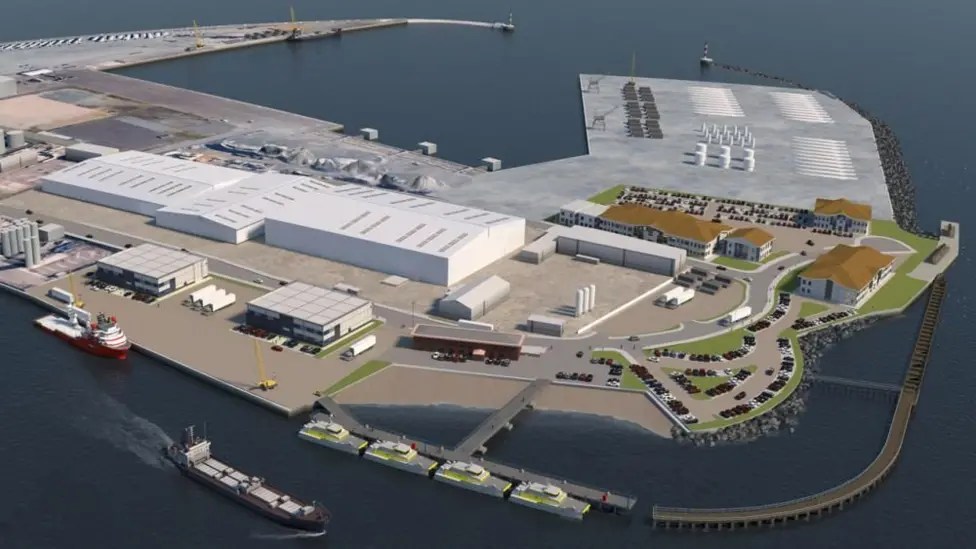
As the Port of Great Yarmouth has a depth of ten metres it could be an ideal base for the assembly and maintenance of floating wind turbines.
Heart Aerospace Relocates Corporate Headquarters To Los Angeles, California
The title of this post, is the same as that of this news item from Heart Aerospace.
This is the sub-heading.
Hybrid-electric airplane manufacturer Heart Aerospace has announced the relocation of its corporate headquarters from Gothenburg, Sweden to Los Angeles, California. This strategic move aims to bolster the company’s product development in the United States, supporting the upcoming experimental flights of its Heart X1 prototype and the future Heart X2 prototype.
These two introductory paragraphs add ,ore detail.
Scheduled for its maiden flight in 2025, the X1 marks a major milestone in Heart’s innovation journey, setting the stage for X2.
“Our move to Los Angeles marks a new chapter in Heart Aerospace’s journey—one that prioritizes iterative development and deeper vertical integration,” said Anders Forslund, co-founder and CEO of Heart Aerospace. “For the X2, we’re developing key technologies like batteries, actuation systems, software, and hybrid-electric hardware in-house. This approach allows us to refine and enhance our systems continuously, just as we’ve done with the X1 prototype, which has seen extensive testing and major design updates since its initial rollout in 2024.”
In some ways, I find this move to California slightly sad, as I suspect most of those associated with the airliner, would have liked to see the development stay in Sweden.
This paragraph gives more details on the reasons for the move.
“We are deeply grateful to our team in Sweden for being part of this chapter of Heart’s journey, and for all the support we have received in Sweden,” said Anders Forslund. “However, as our customers, partners, and investors are increasingly based in the U.S, we see greater opportunity in focusing our resources here. By consolidating our operations in Los Angeles, we can accelerate development, strengthen collaboration, and better position Heart Aerospace for the future.”
They are not mentioned, but I do hope, Trump’s tariffs have nothing to do with it.
Hyundai Unveils Upgraded Xcient Hydrogen Fuel Cell Truck
The title of this post, is the same as that of this article on Automotive Powertrain International.
This is the sub-heading.
Hyundai Motor Company has unveiled the upgraded Xcient fuel cell class-8 heavy-duty truck, which features advanced hydrogen technologies and advanced driver assistance systems (ADAS) tailored for the North American market.
The article is worth a full read, as it shows how the largest American trucks, can be replaced with zero-carbon hydrogen fuel cell trucks.
This is the Hyundai Xcient truck web site.
US DOE Offers US$1.76 billion Loan To Hydrostor For A-CAES California Project
The title of this post, is the same as that of this article on Energy Storage News.
These three paragraphs give more detail.
The US Department of Energy’s (DOE) Loan Programs Office (LPO) has made a conditional commitment for a loan to long-duration energy storage (LDES) developer and operator Hydrostor of up to US$1.76 billion.
If finalised, the loan would be used to help fund the Willow Rock Energy Storage Centre, a 500MW/4,000MWh, 8-hour advanced compressed air energy storage system (A-CAES) in Eastern Kern County, California, led by Hydrostor subsidiary GEM A-CAES.
Compressed air energy storage (CAES) charges by pressurising air and funnelling it into a storage medium, often a salt cavern, and discharges it by releasing the compressed air through a heating system, which expands air before it is sent through a turbine generator.
Note.
- Both the Canadian Hydrostor and the British Highview Power use air in their batteries, with the Canadians using compressed air, often in salt caverns and the British using liquid air in tanks.
- Highview Power’s first large scale battery will be 200MW/2.5GWh, which is about half the size of Hydrostor’s, which will be 500MW/4.0GWh.
- Having mathematically-modeled large tanks full of chemicals in the 1970s for ICI, I wouldn’t be surprised, if the Highview Power battery is more easily scalable.
This could be an interesting technological shootout.
Complicating matters could be Trump’s policies to big batteries.
This article on Utility Dive, which is entitled Potential Trump Policies Pose Risks For US Storage Sector, With Musk Impact Uncertain.
Analysts Say Gives A Reasoned.
Higher battery material tariffs and phased-down IRA tax credits threaten a 15% drop in U.S. storage deployment through 2035 in a “worst-case” scenario,
BNEF analysts said.
Mortenson Announces Completion Of Edwards & Sanborn Solar + Storage Project
The title of this post, is the same as that of this press release from Mortenson.
These two paragraphs describe the project,
Terra-Gen and Mortenson have announced the full substantial completion of the Edwards & Sanborn Solar + Energy Storage project, the largest solar plus energy storage project in the United States. Mortenson was the full Engineering, Procurement, and Construction (EPC) contractor on both the solar and energy storage scopes for this vanguard project in the energy industry.
This project stretches over 4,600 acres and includes more than 1.9 million First Solar modules. In total, the project generates 875 MWdc of solar energy and has 3,287 megawatt-hours of energy storage with a total interconnection capacity of 1,300 megawatts. The project supplies power to the city of San Jose, Southern California Edison, Pacific Gas & Electric Co. and the Clean Power Alliance, and Starbucks, among others. A portion of the project is situated on the Edwards Air Force Base and was the largest public-private collaboration in U.S. Department of Defense history. The project uses LG Chem, Samsung, and BYD batteries.
Note.
- 4,600 acres is just over seven square miles.
- There’s more about this massive project on this web page.
- Judging by the fact, they use three different makes of batteries, did Mortenson have a problem sourcing the number needed from a single manufacturer or are the contractors seeing, which perform best in the hot desert?
California and other places can build these projects, if there is masses of sun and flat desert.
Shotwick Solar Park is the largest solar farm in the UK. It has a capacity of 72.2 MW.
Tesla Megapack Battery Caught Fire At PG & E Substation In California
The title of this post, is the same as that of this article on CNBC, which was published in September 2022.
The article starts with these three key points.
- A Tesla Megapack caught fire at a PG&E energy storage facility in Monterey, California on Tuesday.
- The fire caused road closures and shelter-in-place orders for residents nearby.
- Richard Stedman, an air pollution control officer for the Monterey Bay Air Resources District (MBARD) said in general lithium ion battery fires can emit toxic constituents like hydrochloric and hydrofluoric acid.
The article goes on to say, that there were no power outages and no on-site personnel were injured.
In the late 1960s, I worked for ICI at Runcorn.
One of the instruments, I helped to develop was a detector for water in bromochlorodifluoromethane or BCF, as it is commonly known.
- You may have seen BCF on a fire-extinguisher, as that is the chemical’s main use.
- In those days, ICI made BCF on a plant that also manufactured the anaesthetic; Fluothane.
- The plant was in Rocksavage works by the Mersey.
It should be noted, that Rocksavage works had one of the best safety records in the whole of the company.
When the instrument was ready, I was told to go to the plant and see Charlie Akers, who was the foreman electrician on the plant. He would arrange fitting the instrument to the plant.
- Charlie was a short stout man and the first thing he did was to get a proper mug out of a box of perhaps two dozen new ones and write my name on it.
- He then made us both mugs of fresh tea with fresh milk from a bottle.
- He said something like. “Now you’ve got no excuse to come and see me before you go on the plant or have any questions!”
- He also said that everybody, who worked in Rocksavage was very proud of its safety record and proceeded to give me a tour of the plant pointing out its hazards.
One lesson, I learned that day and still do was to walk up stairs in a hazardous environment using the stanchions of the rails. You never know what has fallen on the handrails. On the BCF plant this could have been hydrochloric and hydrofluoric acid.
- At one point to illustrate the danger of the latter, he took a pair of tweezers and put a spec of hydrofluoric acid (HF) dust on the tip of my finger, which was painful.
- He also said that HBr was a lot more dangerous.
I didn’t disgrace myself on that plant and the lessons, I learned that day have stayed with me all my life. I even think, that they have had positive effects on my stroke recovery, as I was given tips about how to get out of a chemical plant, after a fire or serious spillage.
Thank you Charlie!
One of the key points in the CNBC article, is that lithium-ion battery fires can emit hydrochloric and hydrofluoric acid.
It makes me wonder, if our high levels of usage of these batteries for where there is an alternative is a good idea.
First Offtake Deal Signed For 500MW/4,000MWh Advanced Compressed Air Energy Storage Project In California
The title of this post, is the same as that of this article on Energy Storage News.
These three paragraphs explain the deal.
Advanced compressed air energy storage (A-CAES) company Hydrostor has signed a power purchase agreement (PPA) for one of its flagship large-scale projects in California.
Central Coast Community Energy, one of California’s several dozen Community Choice Aggregator (CCA) non-profit energy suppliers, has signed a 200MW/1,600MWh energy storage PPA with a 25-year term with Toronto-headquartered Hydrostor for its Willow Rock Energy Storage Center.
That’s just under half of the output and capacity of the planned 8-hour, long-duration energy storage (LDES) facility, which is designed to be 500MW/4,000MWh. This is its first offtake deal, but the company is in discussion for others to take the rest of the plant’s available resource.
The article says that Hydrostor aim to have the plant online by 2028.
This segment describes their current projects.
It is currently working on large-scale projects with around 9GWh storage capacity in total across two sites in California as well as another in Australia.
Together with Willow Rock in Kern County, Hydrostor is developing the 400MW/3,200MWh Pechos Energy Storage Center in San Luis Obispo County, California, and the 200MW/1,500MWh Silver City Energy Storage Center in Broken Hill, New South Wales, Australia.
On its UK Projects page, Highview talks about a 200MW/2.5GWh facility in Yorkshire, which puts the two companies in similar markets, with Hydrostor appearing to have slightly larger systems under development.
Conclusion
It will be interesting to see how this technology progresses and which company does best in what is a very large energy storage market.
Powerhouses Clash Offshore California In Bid To Build Wind Farms
The title of this post, is the same as that of this article on offshoreWIND.biz.
Expansion Plan To Take World’s Biggest Battery Storage Project To 3GWh Capacity
The title of this post, is the same as that of this article on Energy Storage News.
These are the first two paragraphs.
Plans to nearly double the output and capacity of the world’s biggest battery energy storage system (BESS) project to date have been announced by its owner, Vistra Energy.
The Texas-headquartered integrated utility and power generation company said it wants to add another 350MW/1,400MWh BESS to the Moss Landing Energy Storage Facility in California’s Monterey Bay.
The project is based at the Moss Landing Power Plant, which was once the largest power plant in the state of California, with a generation capacity of 2560 MW.
There appear to be three phases.
- Phase 1 is 300MW/1,200MWh and went online at the end of 2020
- Phase 2 is 100MW/400MWh and went online in August 2021.
- Phase 3 will be 350MW/1,400MWh.
This gives a maximum power output of 750 MW and prospective total capacity of 3 GWh. At full power, the battery could supply 750 MW for four hours.
For comparison, the two Scottish batteries I talked about in Amp Wins Consent For 800MW Scots Battery Complex, have a combined output of 800 MW and a total capacity of 1600 MWh, which would give a full power run of two hours.
Could the difference be that Scotland has 9.3 GW of installed windpower, whereas the much larger California has only 6 GW?
Both Scotland and California also have some pumped storage power stations.
- Drax Group who own the 7.1 GWh Cruachan power station, plan to increase its generating capacity from 440MW to 1040MW.
- California has two larger stations at Castaic and Helms.
- After writing about the Western HVDC Link in Amp Wins Consent For 800MW Scots Battery Complex, I wonder if when the wind is blowing in Scotland and it isn’t in Wales, that electricity can be exported from Scotland to Wales for storage.
This all shows the complex integrated nature of electricity networks.
 The Anonymous Widower