Equinor Sets Sights On Gigawatt-Scale Floating Offshore Wind Projects In Celtic Sea
The title of this post, is the same as that of this article on offshoreWIND.biz.
This is the opening paragraph of the article.
Equinor has disclosed its interest in developing gigawatt-scale floating offshore wind in the Celtic Sea, with the upcoming Celtic Sea floating wind seabed leasing round in view.
These are some other points from the article.
- The Crown Estate is planning a seabed leasing round in the Celtic Sea in 2023.
- As the developer and soon-to-be operator of two of the world’s first floating offshore wind farms, Equinor said it views new floating opportunities in the Celtic Sea with great interest.
- Project development areas are being prepared by The Crown Estate for the development of gigawatt-scale floating offshore wind projects.
Equinor could move into the Celtic Sea in a big way.
On the Projects page of the Blue Gem website, this is said about floating wind in the Celtic Sea.
Floating wind is set to become a key technology in the fight against climate change with over 80% of the worlds wind resource in water deeper than 60 metres. Independent studies have suggested there could be as much as 50GW of electricity capacity available in the Celtic Sea waters of the UK and Ireland. This renewable energy resource could play a key role in the UK meeting the 2050 Net-Zero target required to mitigate climate change. Floating wind will provide new low carbon supply chain opportunities, support coastal communities and create long-term benefits for the region.
How much of this possible 50 GW of offshore wind in the Celtic Sea will be leased by the Crown Estate in 2023?
Floating Wind Farms At Sea To Create 29,000 Jobs – Crown Estate
The title of this post, is the same as that of this article on the BBC.
These three paragraphs introduce the article.
Plans to generate electricity through floating wind farms off the south Wales coast could create thousands of new jobs, according to the Crown Estate.
The property business owned by the monarch but run independently said the new industry could create about 29,000 jobs, including 10,000 in Wales.
It is leasing the space to generate enough power for four million homes.
Will Wales be the world’s next offshore wind powerhouse?
Wind power experts have said there is a potential for 50 GW of offshore wind power in the Celtic Sea and the BBC article talks of an investment of £43.6 billion by 2050.
The process has started, but will the engineers be able to tame the dragons?
The Salamander Project
The Salamander project may be a strange name for a proposed Scottish offshore wind farm, but that is what it is.
It is being developed by Ørsted and the Simply Blue Group.
There is a web site, which has this bold mission statement.
Helping To Unlock Scotland’s Floating Offshore Wind.
These paragraphs outline the project.
The Salamander project will utilise innovative and cutting-edge floating offshore wind technologies to produce zero-carbon electricity. The development aims to be a stepping stone to help Scotland and the UK to progress towards a net-zero future.
With a proposed 100 MW pre-commercial size project, the Salamander project which is located off Peterhead in the East coast of Scotland, is in an advanced planning stage. Salamander has a strong focus on supply chain development and will provide an opportunity for the local supply chain to gear up for commercial scale opportunities in Scotland, as well as de-risking floating wind technologies for the future commercial projects in Scotland and beyond. This will allow Scotland to maximise the financial benefit of its strong offshore wind resource and generate long term jobs for its local communities.
The project will contribute to the Scottish government’s target of 11 GW of installed offshore wind by 2030, as well as the UK government’s target of 5 GW of operational floating offshore wind by the same date.
There is also a video, which is very much a must-watch.
Floating offshore wind is a relatively new technology and will become the major generator of the world’s electricity within the next decade.
Note this phrase in the first paragraph.
The development aims to be a stepping stone to help Scotland and the UK to progress towards a net-zero future.
This philosophy is shared with other projects.
In DP Energy And Offshore Wind Farms In Ireland, I said this.
They are also developing the Gwynt Glas offshore wind farm in the UK sector of the Celtic Sea.
- In January 2022, EDF Renewables and DP Energy announced a Joint Venture partnership to combine their knowledge and
expertise, in order to participate in the leasing round to secure seabed rights to develop up to 1GW of FLOW in the Celtic Sea. - The wind farm is located between Pembroke and Cornwall.
The addition of Gwynt Glas will increase the total of floating offshore wind in the UK section of the Celtic Sea.
- Blue Gem Wind – Erebus – 100 MW Demonstration project – 27 miles offshore
- Blue Gem Wind – Valorus – 300 MW Early-Commercial project – 31 miles offshore
- Falck Renewables and BlueFloat Energy – Petroc – 300 MW project – 37 miles offshore
- Falck Renewables and BlueFloat Energy – Llywelyn – 300 MW project – 40 miles offshore
- Llŷr Wind – 100 MW Project – 25 miles offshore
- Llŷr Wind – 100 MW Project – 25 miles offshore
- Gwynt Glas – 1000 MW Project – 50 miles offshore
This makes a total of 2.2 GW, with investors from several countries.
It does seem that the Celtic Sea is becoming the next area of offshore wind around the British Isles to be developed.
These Celtic Sea wind farms include Erebus, which like Salamander is a 100 MW demonstration project.
Salamander And Erebus Compared
Consider.
- Both are 100 MW floating wind demonstration projects.
- Salamander and Erebus are 27 and 21 miles offshore respectively.
- Salamander and Erebus are close to the deepwater ports of Peterhead and Milford Haven.
- Both are described as stepping-stone projects.
- Both projects talk about developing supply chains.
- The developers of Salamander and Erebus include Ørsted and EDF Renewables respectively, who are both big beasts of the offshore wind industry.
Both wind farms are in areas, where the UK, Scottish and Welsh governments want to develop massive offshore wind farms, that will eventually total over 50 GW. I believe that Salamander and Erebus will indicate any problems, that will be likely to occur in the building of these massive offshore floating wind farms.
It is a very sensible plan and could lead to an energy rich future for the UK.
How Long Will It Take To Assemble A Floating Wind Turbine?
Each floating wind turbine requires these major components.
- A wind turbine, which in the Kincardine Wind Farm have a capacity of 9.5 MW, is obviously needed. Some proposed floating offshore wind farm are talking of turbines between 14 and 16 MW. These turbines will be very similar to onshore turbines.
- A float, usually made out of steel or possibly concrete. Various designs have been built or proposed. The Wikipedia entry for floating wind turbine gives several examples.
- The anchoring system to keep the float with its turbine in the desired position.
- The electrical system to connect the wind turbine to the offshore substation, which could also be floating.
Note that the designs for the float, anchoring and electrical systems will rely heavily on technology proven in the offshore oil and gas industry.
Principle Power are the designer of the WindFloat, which is one of the first floats to be used in floating offshore wind.
Their home page has a continuous full-screen video, that shows a WindFloat being assembled and towed out.
The video shows.
- The completed float being floated alongside a dock, which obviously has an appropriate water depth.
- The dock has a large crane.
- The turbine tower and then the blades being lifted into position and securely fixed.
- Finally, a tug tows the completed turbine/float assembly to its position in the wind farm.
This would appear to be an assembly operation, that could flow just like the production in any world-class vehicle factory.
- There would need to be just-in-time delivery of all components.
- The weather would need to be cooperative.
- Lighting might be needed to work in poorer light levels.
- This method of assembly would be turbine and float agnostic.
- Multiple shift working could be employed.
My project management involvement tells me, that it would not be unreasonable to assemble, at least one complete turbine and its float and accessories in a working day.
I can do a small calculation.
The average size of turbine is 15 MW.
One turbine is assembled per day.
There are 300 working days possible in a year with multiple shift working, ignoring Bank Holidays and bad weather.
Just one site could produce 4.5 GW of floating wind turbines per year.
How Many Production Sites Could There Be?
These are surely the best possibilities.
- Barrow
- Belfast
- Clyde
- Devon/Cornwall
- Forth Estuary
- Great Yarmouth
- Haven Ports
- Holyhead
- Humber
- Liverpool
- Milford Haven
- Peterhead
- Southampton Water
- South Wales
- Teesside
- Thames Estuary
I have named sixteen areas, that could be suitable for the assembly of floating wind turbines.
So let’s assume that eight will be developed. That could mean as much as 36 GW of capacity per year.
The Energy Density Of Floating Wind Farms
In ScotWind Offshore Wind Leasing Delivers Major Boost To Scotland’s Net Zero Aspirations, I summarised the latest round of Scotwind offshore wind leases.
- Six new fixed foundation wind farms will give a capacity of 9.7 GW in 3042 km² or about 3.2 MW per km².
- Ten new floating wind farms will give a capacity of 14.6 GW in 4193 km² or about 3.5 MW per km².
Returning to the earlier calculation, which says we could have the ability to create 36 GW of wind turbines per year, with 15 MW turbines, this means with a generating density of 3.5 MW per km², the 36 GW would take up around a hundred kilometre square of sea.
Conclusion
We will become Europe’s powerhouse.
Accelerating The Delivery Of Offshore Wind Farms
It is one of Kwasi Kwarteng’s ambitions to accelerate the delivery of offshore wind farms.
In The Growth Plan 2022, these groups of wind farms are mentioned.
- Remaining Round 3 Projects
- Round 4 Projects
- Extension Projects
- Scotwind Projects
- INTOG Projects
- Floating Wind Commercialisation Projects
- Celtic Sea Projects
My thinking in this post, will probably apply to all of these groups.
These are my thoughts.
Accelerating Delivery Of A Wind Farm
This will have these positive effects.
- Electricity will be delivered earlier.
- Customers will have a more secure supply of electricity.
- The wind farm owner will start to be paid for their electricity.
- The Crown Estate will start to be paid for their leases. Although, these might start at signing.
- National Grid will be paid for the transmission of the electricity.
- An energy storage company could be paid for storing surplus electricity.
- Construction teams and engineers can move on to the next project.
- Expensive construction hardware like ship-mounted cranes will no longer be needed.
- I also suspect that the government will raise some taxes from the various companies involved.
It looks like it’ll be winners all round.
How Will Delivery Be Accelerated?
These are some thoughts.
Overall Project Time
In How Long Does It Take To Build An Offshore Wind Farm?, I came to these conclusions.
- It will take six years or less from planning consent to commissioning.
- It will take two years or less from the start of construction to commissioning.
I suspect that as we have been building offshore wind farms for some years, that it will be very difficult to reduce these times significantly.
But as some wind farms take quite a few years to progress from the initial proposal to planning consent, I suspect that improvements to the planning process may speed up the overall construction time of a wind farm.
Project And Resource Management
Good project and resource management will always help.
Better Design And Construction Methods
I always remember in the early days of North Sea Oil, being told by a very experienced project manager that construction of production platforms was accelerated by the availability of larger and more powerful cranes.
Are we approaching the design of the ultimate wind farm? I doubt it, as in the last few months, I’ve seen two very radical new designs.
In Hexicon Wins UK’s First Ever CfD Auction For Floating Offshore Wind, I show this image of one of their TwinHub turbine installations being towed into place.
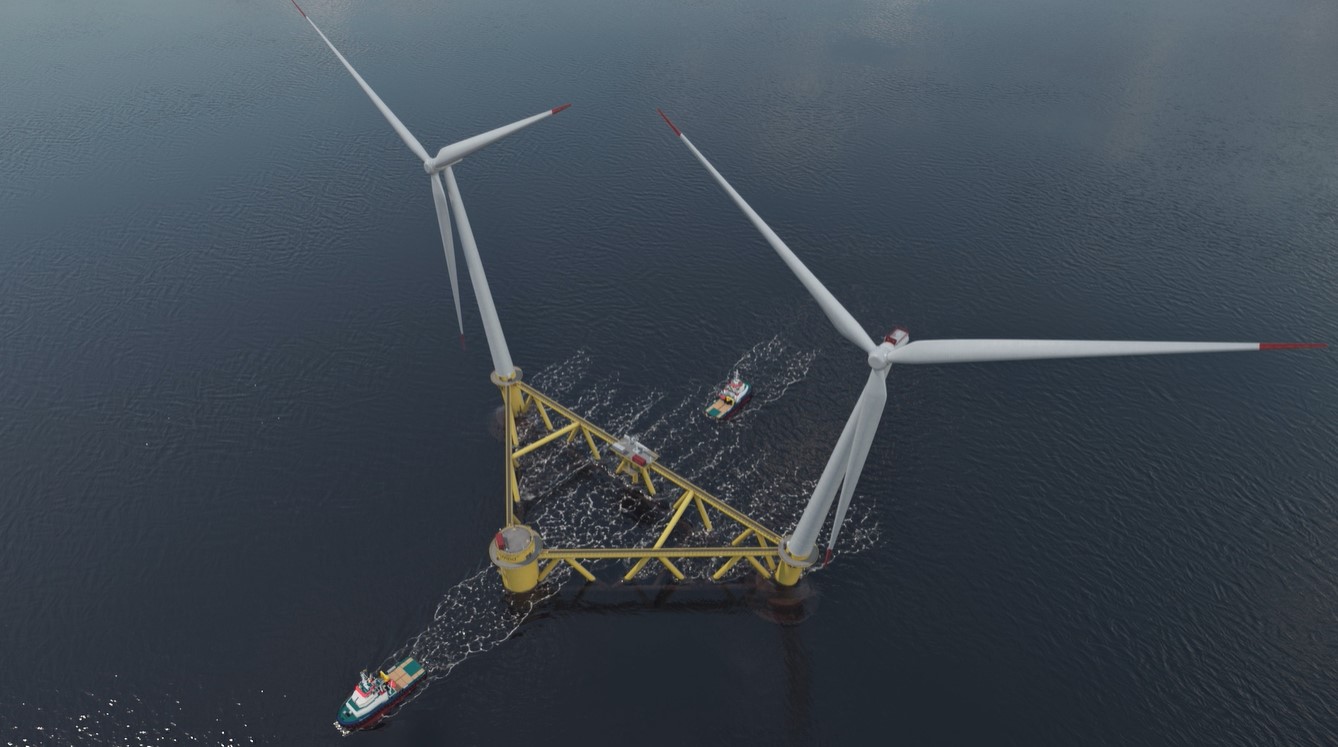
The TwinHub home page has a title of The First Floating Offshore Wind Project in The Celtic Sea.
This is the description on the page.
The TwinHub offshore wind demonstration project intends to prove how Hexicon’s innovative design with two turbines on one floating foundation can further reduce the Levelized Cost of Energy (also referred to as LCoE) before large scale commercialisation. The TwinHub project is a stepping stone to help kick-start floating wind in the Celtic Sea, an area identified as a hotspot for floating wind by the UK Government. It will pave the path for larger and larger projects to help support The Crown Estates’ ambitious target of 4GW of floating wind in the Celtic Sea.
Scroll the page down and there is a fascinating short video of a pair of wind turbines in operation.
- It appears that when there is no wind, it automatically goes into a safe parked mode.
- As the wind rises, one turbine starts up.
- The second turbine starts up and the float turns so they face the wind.
It appears to be a classic example of disruptive innovation.
I have a feeling that this type of installation might have generation, assembly and cost advantages over a single turbine mounted on a single float.
RCAM Technologies are also creating interesting designs for mounting turbines and energy storage using 3D-printed concrete.
What Ts The UK Government Doing To Accelerate Projects?
This article on offshoreWIND.biz, was published in late September 2022 and is entitled BREAKING: UK Puts Massive Amount Of New Offshore Wind Capacity On Fast Track and this is the first paragraph.
The UK will speed up planning and development consent processes for projects from the recently completed, currently ongoing, and upcoming (floating) offshore wind leasing rounds to bring new energy capacity online faster and facilitate economic growth and job creation.
The article is based on what Kwasi Kwateng said on the 23rd of September about speeding up projects in the 2022 Growth Plan.
A Quick Summary Of Our Wind Energy
The article has this paragraph, which summarises our wind energy.
For the UK, which currently has around 14 GW of offshore wind capacity in operation and 8 GW under construction, the projects from the listed auction rounds could bring well beyond the targeted capacity for 2030, which was recently raised to 50 GW.
I can see the target being raised again to at least 60 GW.
Thoughts On The Mini-Budget
This article on the BBC is entitled At A Glance: What’s In The Mini-Budget?.
If nothing else KK has whipped up a storm, with the most tax-cutting budget in decades.
But!
According to my calculations in Will We Run Out Of Power This Winter?, the planned offshore wind that will be installed between 2022 and 2027 will be at least 19 GW. About 3 GW of this offshore wind is already producing electricity.
To this must be added 3.26 GW for Hinckley Point C, 2 GW for solar and 0.9 GW for onshore wind in Scotland, which will be developed by 2027.
So we have 25.2 GW for starters.
Following on from this is the 27.1 GW from ScotWind, about 4 GW from the Celtic Sea, 3 GW from Morecambe Bay and 10 GW from Aker’s Northern Horizons. All of these are firm projects and some are already being planned in detail.
These wind and solar farms are the collateral for KK’s borrowing.
The corporate tax changes will hopefully attract world class energy and manufacturing companies to set up UK-domiciled subsidiaries to develop more offshore wind farms and manufacture the turbines and the electrical gubbins close to where they will be installed.
As more wind farms are built, many GW of electricity and tonnes of hydrogen will be exported to Europe.
Note that 1 GW for a day costs around £ 960,000 and for a year costs £350.4 million.
A big benefit of all this electricity, will be that we won’t need to frack.
Technologies like green hydrogen, that will be created by electrolysis will reduce our need for gas.
We might develop a gas field like Jackdaw, to give us gas for a backup with a few gas-fired power stations, for when the wind doesn’t blow, but gas will only have a minor roll.
The force of the maths is with KK!
Hexicon Wins UK’s First Ever CfD Auction For Floating Offshore Wind
The title of this post, is the same as that of this press release from Hexicon.
This is the first paragraph.
Today (7th of July) the UK Government confirmed that Hexicon AB’s TwinHub project in the Celtic Sea was successful in the latest Contracts for Difference (CfD) Allocation Round (AR4). It has been awarded a CfD for its 32MW floating wind project at a strike price of £87.30/MWh (2012 real prices) taking the project a significant step closer to completion.
This image shows one of their TwinHub turbine installations being towed into place.
The TwinHub home page has a title of The First Floating Offshore Wind Project in The Celtic Sea.
This is the description on the page.
The TwinHub offshore wind demonstration project intends to prove how Hexicon’s innovative design with two turbines on one floating foundation can further reduce the Levelized Cost of Energy (also referred to as LCoE) before large scale commercialisation. The TwinHub project is a stepping stone to help kick-start floating wind in the Celtic Sea, an area identified as a hotspot for floating wind by the UK Government. It will pave the path for larger and larger projects to help support The Crown Estates’ ambitious target of 4GW of floating wind in the Celtic Sea.
Scroll the page down and there is a short video of a pair of wind turbines in operation.
- It appears that when there is no wind, it automatically goes into a safe parked mode.
- As the wind rises, one turbine starts up.
- The second turbine starts up and the float turns so they face the wind.
It appears to be a classic example of disruptive innovation.
I did the calculations for floating and reusable oil and gas platforms in the 1970s, that were designed by two Cambridge University professors, which would have been launched horizontally and upturned when in position. This experience leads me to believe that the Swedish designers of this type of platform have been able to verify that this is a workable design.
This document from the Department of Business, Industry and Industrial Strategy indicates that the demonstration is for 32 MW.
Does that indicate, that this installation is twin 16 MW wind turbines?
16 MW seems to be the size of the largest wind turbines in the world.
There is a lot to like about this Swedish design.
- As the video shows, it appears to balance itself with the wind.
- I suspect from the calculations I did in Cambridge, that the twin design with its higher weight is more stable than a floating single turbine design.
- The float and its two turbines can be assembled alongside a dock with a large stable onshore dockside crane.
- Servicing would also be done in a dock.
- Working onshore is much safer and easier, than working offshore.
- The twin design allows more power to be generated in a given area of sea.
This is a brilliant concept and it will give Putin, the Sheikhs and the other oil dictators, the most terrible of nightmares.
The initial site chosen for this design in the UK, will be in the sea at Hayle in Cornwall.
This map shows the location.
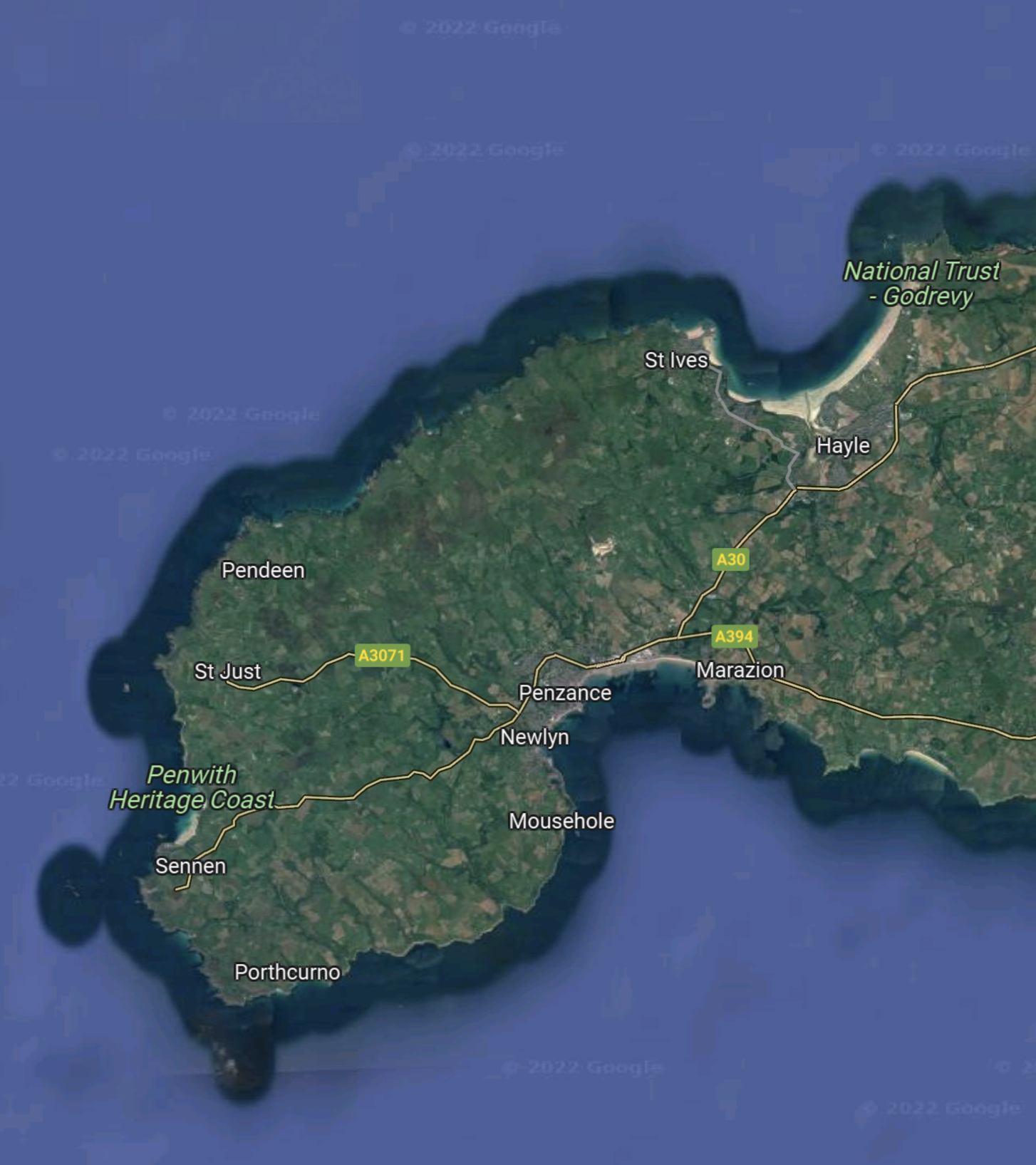
Hayle is in the North-East corner of the map, by the sandy beach.
A 32 MW turbine could probably provide enough electricity for 15,000 houses.
The Crown Estate Announces Areas Of Search To Support Growth Of Floating Wind In The Celtic Sea
The title of this post, is the same as that of this press release from the Crown Estate.
This is the first paragraph.
In a major step forward in supporting the UK’s net zero ambitions, The Crown Estate has today identified five broad ‘Areas of Search’ for the development of floating offshore wind in the Celtic Sea – a region rich in natural resources, including world-class wind resource that can be developed with floating turbines. This marks a significant milestone and provides the foundation on which to build greater capacity in the future, helping the UK to achieve its renewable energy targets and drive economic development.
Points in the press release include.
- Five areas with good wind power potential have been chosen.
- A competitive tender, is to be launched in mid-2023.
- It is intended that these areas will deliver 4GW of floating offshore wind power by 2035.
This map shows the areas.
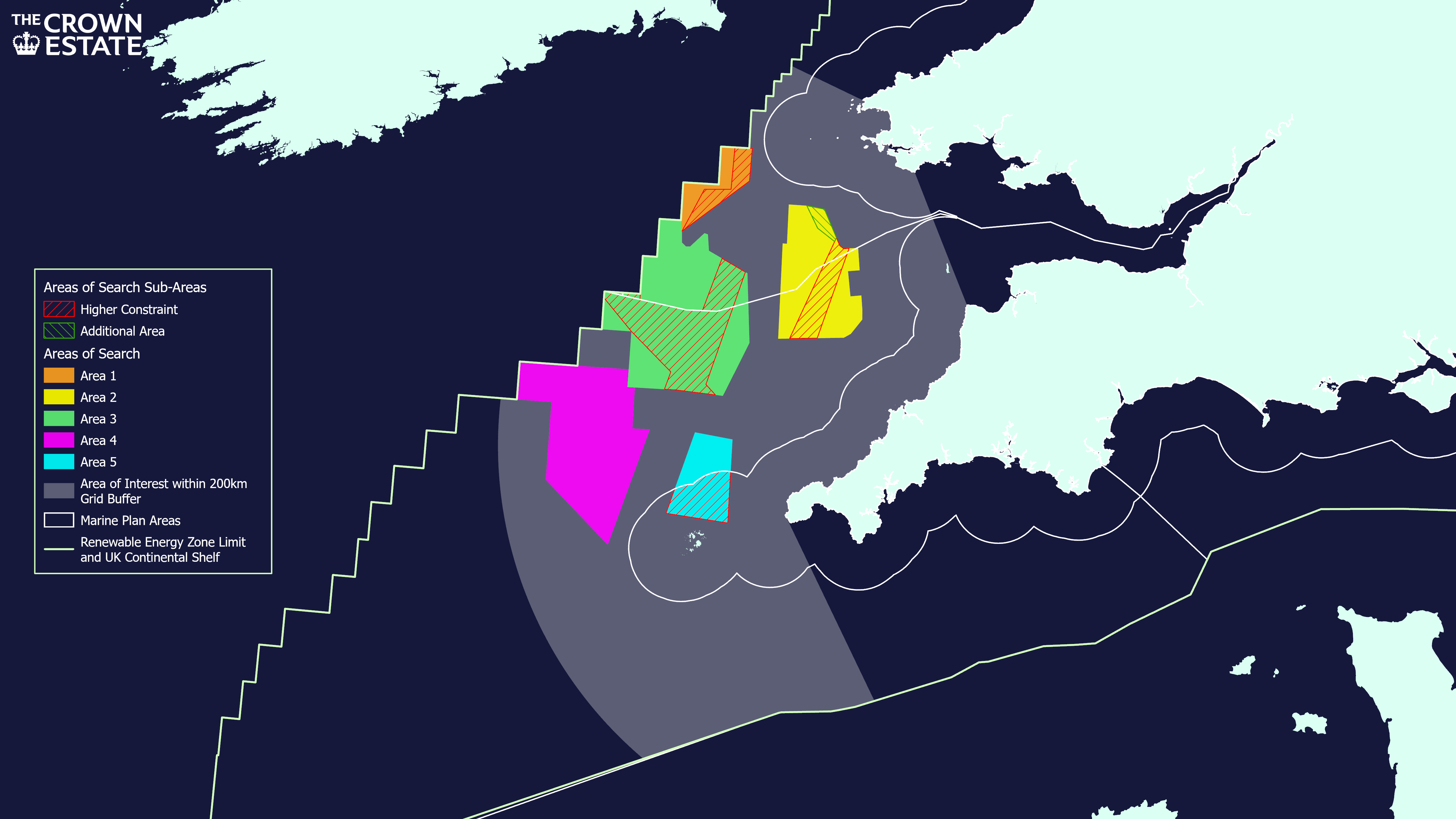
I have a few thoughts.
What About The Other Wind Farms Already Announced In the Celtic Sea?
In DP Energy And Offshore Wind Farms In Ireland, I said this.
They are also developing the Gwynt Glas offshore wind farm in the UK sector of the Celtic Sea.
- In January 2022, EDF Renewables and DP Energy announced a Joint Venture partnership to combine their knowledge and
expertise, in order to participate in the leasing round to secure seabed rights to develop up to 1GW of FLOW in the Celtic Sea. - The wind farm is located between Pembroke and Cornwall.
The addition of Gwynt Glas will increase the total of floating offshore wind in the UK section of the Celtic Sea.
- Blue Gem Wind – Erebus – 100 MW Demonstration project – 27 miles offshore
- Blue Gem Wind – Valorus – 300 MW Early-Commercial project – 31 miles offshore
- Falck Renewables and BlueFloat Energy – Petroc – 300 MW project – 37 miles offshore
- Falck Renewables and BlueFloat Energy – Llywelyn – 300 MW project – 40 miles offshore
- Llŷr Wind – 100 MW Project – 25 miles offshore
- Llŷr Wind – 100 MW Project – 25 miles offshore
- Gwynt Glas – 1000 MW Project – 50 miles offshore
This makes a total of 2.2 GW, with investors from several countries.
It does seem that the Celtic Sea is becoming the next area of offshore wind around the British Isles to be developed.
So what about these seven wind farms?
Erebus and Valorus
Is Blue Gem’s philosophy to develop and prove the technology and put in big bid for around a GW?
Gwynt Glas
The Gwynt Glas web site says this.
The Crown Estate announced in March 2021 that it intends to run a competitive leasing round to award seabed rights to developers for floating offshore wind (FLOW) projects in the Celtic Sea, targeting an overall regional capacity of 4GW.
In January 2022, EDF Renewables and DP Energy announced a Joint Venture partnership to combine their knowledge and expertise, in order to participate in the leasing round to secure seabed rights to develop up to 1GW of FLOW in the Celtic Sea.
The partnership project is called Gwynt Glas, Welsh for Blue Wind, in recognition of its Celtic roots.
Our proposed floating offshore wind project could provide power for approximately 920,000 homes.
It looks like they’re throwing their hat into the ring for 1 GW.
Llŷr Wind
The Llŷr Wind web site says this.
Combined, the two 100MW projects will generate enough renewable electricity to power around 250,000 homes. If successful, we will be able to offer highly cost-effective, floating offshore wind farms to the rest of the world by 2030.
By unlocking new, higher energy capacities from deeper waters, further offshore, the Llŷr projects have huge implications for UK energy consumers. Not only will they help the UK meet its target for net zero emissions, but they will create new opportunities for regional manufacturing and supply chains in Wales and Southwest England as global demand for floating, offshore, wind rises.
It looks to me that this project hasn’t been fully defined yet. Perhaps, this will happen after a successful bid.
Llywelyn
The Llywelyn web site says this.
Llywelyn wind farm is located in Welsh waters in the Celtic Sea, 40 miles off the coast of Pembrokeshire.
Llywelyn’s location has been selected following an extensive feasibility study and rigorous site assessment process. Our assessment has included reviews of protected areas, environmental impacts, cable routing, existing infrastructure, marine traffic, and fishing activity.We have signed an agreement with National Grid, securing a 300MW grid connection in Pembrokeshire. The system operator is exploring upgrades to the existing site to facilitate the connection. These developments will enable the Llywelyn offshore wind project to quickly enter the planning system.
Have they already said go?
Petroc
The Petroc web site says this.
Petroc’s location has been selected following an extensive feasibility study and rigorous site assessment process. Our assessment has included reviews of protected areas, environmental impacts, cable routing, existing infrastructure, marine traffic, and fishing activity.
We have signed an agreement with National Grid, securing a 300MW grid connection in North Devon. The system operator is exploring upgrades to the existing site to facilitate the connection. These developments will enable the Petroc offshore wind project to quickly enter the planning system.
Have they already said go?
These companies are certainly setting themselves up for bidding or have already got a smaller deal.
How Much Wind Power Can Be Developed In The Celtic Sea?
This article on the Engineer is entitled Unlocking The Renewables Potential Of The Celtic Sea.
The article starts with these two paragraphs.
Over the last decade, the UK has become a global leader in renewable marine energy, tapping into the vast resources its coastal geography offers. Offshore wind, in particular, has flourished, with gigawatt-scale projects being deployed off the east coast of England and Scotland, at Hornsea, Dogger Bank and Moray.
However, looking at a map of existing and proposed wind farms, what’s perhaps most striking is the complete absence of projects in the southwest of Britain, off the rugged shores of Wales, Devon and Cornwall, shaped by the fierce North Atlantic. The Celtic Sea – which extends south off Wales and Ireland down past Cornwall and Brittany to the edge of the continental shelf – is estimated to have around 50GW of wind generating capacity alone. What’s more, it also delivers some of the highest tidal ranges in the world, alongside some of the best waters in Europe for generating wave energy. In a country blessed with renewable resources, the Celtic Sea may well be its biggest prize.
I’ll go along with what this article says and accept that 50 GW of wind capacity could be installed in the Celtic Sea.
As I write this article at around nine o’clock, the UK is generating almost exactly 30 GW of electricity, which gives an idea of how large electricity production in the Celtic Sea could be.
Conclusion
It will be interesting to see how this first round of leasing in the Celtic Sea develops.
DP Energy And Offshore Wind Farms In Ireland
DP Energy are a company that are developing these offshore wind farms in Ireland.
Located off the West Coast of Ireland, the Clarus Offshore Wind Farm project will utilise Floating Offshore Wind (FOW) technology and upon completion, will have the potential capacity of up to 1 GW.
Located off the South Coast of Ireland, the Inis Ealga Marine Energy Park project will utilise Floating Offshore Wind (FOW) technology and upon completion, will have the potential capacity of up to 1 GW.
Latitude 52 Offshore Wind Farm
DP Energy has given the name Latitude 52 to the area it is exploring for a potential future offshore wind farm off the coast of Counties Wicklow and Wexford.
It appears to be another 1 GW project.
Located off the East Coast of Ireland, the Shelmalere Offshore Windfarm project will utilise fixed bottom wind turbines and upon completion, will have the potential capacity of up to 1 GW.
Note.
- These wind farms are being developed in a partnership with Spanish Energy company; Iberdrola.
- Each is a one GW offshore wind farm.
They are also developing the Gwynt Glas offshore wind farm in the UK sector of the Celtic Sea.
- In January 2022, EDF Renewables and DP Energy announced a Joint Venture partnership to combine their knowledge and
expertise, in order to participate in the leasing round to secure seabed rights to develop up to 1GW of FLOW in the Celtic Sea. - The wind farm is located between Pembroke and Cornwall.
The addition of Gwynt Glas will increase the total of floating offshore wind in the UK section of the Celtic Sea.
- Blue Gem Wind – Erebus – 100 MW Demonstration project – 27 miles offshore
- Blue Gem Wind – Valorus – 300 MW Early-Commercial project – 31 miles offshore
- Falck Renewables and BlueFloat Energy – Petroc – 300 MW project – 37 miles offshore
- Falck Renewables and BlueFloat Energy – Llywelyn – 300 MW project – 40 miles offshore
- Llŷr Wind – 100 MW Project – 25 miles offshore
- Llŷr Wind – 100 MW Project – 25 miles offshore
- Gwynt Glas – 1000 MW Project – 50 miles offshore
This makes a total of 2.2 GW, with investors from several countries.
It does seem that the Celtic Sea is becoming the next area of offshore wind around the British Isles to be developed.
Interconnectors
Interconnectors are to be built to connect Ireland, UK and France.
The Celtic Interconnector is being built between County Cork in Ireland and the North West Coast of France.
Greenlink is being built between County Wexford in Ireland and Pembroke in Wales.
Conclusion
Are the British, Irish and French governments, planning to build a large wind power resource in the Celtic Sea?
Two More Floating Wind Projects In The Celtic Sea
In Two Celtic Sea Floating Wind Projects Could Be Delivered By 2028, I said this.
There now appears to be four floating wind farms under development in the Celtic Sea between the South-West corner of Wales and the Devon and Cornwall Peninsular.
- Blue Gem Wind – Erebus – 100 MW Demonstration project – 27 miles offshore
- Blue Gem Wind – Valorus – 300 MW Early-Commercial project – 31 miles offshore
- Falck Renewables and BlueFloat Energy – Petroc – 300 MW project – 37 miles offshore
- Falck Renewables and BlueFloat Energy Llywelyn – 300 MW project – 40 miles offshore
But they do create a starter for a GW.
Last night, I found two other projects being developed in the Celtic Sea, under the collective name of the Llŷr Project.
The sponsoring company, which appears to be called Llŷr Wind has a web site, with a title of Harnessing Welsh Energy, which has this outline description underneath.
Situated off the Pembrokeshire coast, in southwest Wales, is a flagship project that could transform the world’s ability to generate renewable electricity from wind. The Llŷr projects are exploring the potential of two innovative floating offshore wind technologies.
The next statement is key.
Combined, the two 100MW projects will generate enough renewable electricity to power around 250,000 homes. If successful, we will be able to offer highly cost-effective, floating offshore wind farms to the rest of the world by 2030.
The Llŷr Project would appear to be a research project to find the best way to generate electricity using floating wind turbines in deep water.
- It appears that the two wind farms will use different floats for the turbines.
- The Llŷr projects are located in the approaches to the Bristol Channel in the Celtic Sea approximately 40 kilometres offshore at depths averaging 60-70 metres.
- These offshore sites enjoy high average windspeeds which are, typically, in excess of 10 metres per second. That is over twenty miles per hour.
- Each 100MW project will comprise 6 to 8 next-generation turbines which are too large to be deployed on land.
- 6 x 20 MW turbines will be 120 MW.
- 8 x 12 MW turbines will be 96 MW.
- Each project will have an offshore substation.
- There will be up to two connections for each substation.
- Will the Llŷr Projects test manufacturers’ new turbine designs?
- It is hoped that installation of the turbines will start in 2025/26, with power being delivered in 2026/7.
- The project is being developed by Floventis Energy, which is a joint venture of SBM Offshore and Cierco.
It does look to me that SBM Offshore, who are a Dutch company, are using their extensive oil and gas experience to develop floating offshore wind.
This appears to be a very well-thought out research project in a location, where there is everything needed.
- Lots of wind, which can be boosted by dragons if needed.
- Deep water.
- Ports for assembly of turbines onto floats.
- Steelworks and fabrication.
- Good electrical connections to the National Grid.
- Excellent universities.
- Good transport connections.
- An experienced engineering workforce.
There is also the ultimate potential of 50 GW of floating offshore wind in the Celtic Sea.
Conclusion
The Llŷr Project could have a very positive input into the worldwide development of floating offshore wind.
I have read the web sites of Floventis, SBM Offshore and Cierco and these companies appear to be aiming to dominate the floating offshore wind industry.
Their strategy is stated on the Floventis web site.
Our strategy is simple. We plan to maximize the local benefits of our projects and minimize their impact. Our technologies are far more benign than conventional offshore wind and more suited for deployment in remote and sensitive environments.
Already driving demonstration projects in California and the UK, Floventis is building a portfolio of projects to take floating offshore wind, through a stepwise process – increasing project size, to full scale commercial development proposals by 2030.
We believe that the floating offshore wind industry is a model for a “just transition” to clean energy, at scale, which will reward communities, in the broadest sense, with skilled jobs and enhanced social equity.
I can certainly live with that! And I’m certain the world can too!
Two Celtic Sea Floating Wind Projects Could Be Delivered By 2028
The title of this post, is the same as that of this article on offshoreWIND.biz.
This is the first paragraph.
Falck Renewables and BlueFloat Energy have said that they are looking at early delivery of their two floating wind projects in the Celtic Sea, called Llywelyn and Petroc, which have grid connections secured and almost a year’s worth of bird surveys already completed.
These would add two extra 300 MW wind farms to the Celtic Sea.
In Enter The Dragon, I indicated the potential of renewable energy around Wales based on this article on the Engineer is entitled Unlocking The Renewables Potential Of The Celtic Sea. This sentence from the article talks about the possibilities of offshore wind in the Celtic Sea.
The Celtic Sea – which extends south off Wales and Ireland down past Cornwall and Brittany to the edge of the continental shelf – is estimated to have around 50GW of wind generating capacity alone.
The article also talks about Blue Gem Wind and their Erebus and Valorous wind farm projects in the Celtic Sea, that I wrote about in Blue Gem Wind.
There now appears to be four floating wind farms under development in the Celtic Sea between the South-West corner of Wales and the Devon and Cornwall Peninsular.
- Blue Gem Wind – Erebus – 100 MW Demonstration project – 27 miles offshore
- Blue Gem Wind – Valorus – 300 MW Early-Commercial project – 31 miles offshore
- Falck Renewables and BlueFloat Energy – Petroc – 300 MW project – 37 miles offshore
- Falck Renewables and BlueFloat Energy Llywelyn – 300 MW project – 40 miles offshore
But they do create a starter for a GW.
Both consortia seem to have similar objectives.
- To use a stepping-stone approach, gradually building in size.
- To involve the local community in creating a supply chain.
- Create long-term benefits for the region.
If these and other consortia fill the Celtic Sea with 50 GW of floating wind turbines, then we’ll all benefit.

