Irlam Station To Go Step-Free
This document on the Government web site is entitled Access for All: 73 Stations Set To Benefit From Additional Funding.
Irlam station is on the list.
These pictures show the station and the current subway.
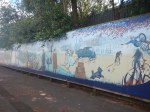
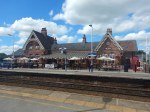

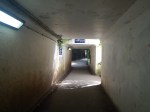

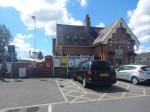
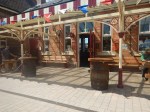
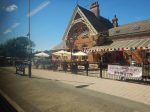
The station was a total surprise, with a large pub-cafe and a lot of visitors and/or travellers sitting in the sun.
I had an excellent coffee and a very welcoming gluten-free blueberry muffin!
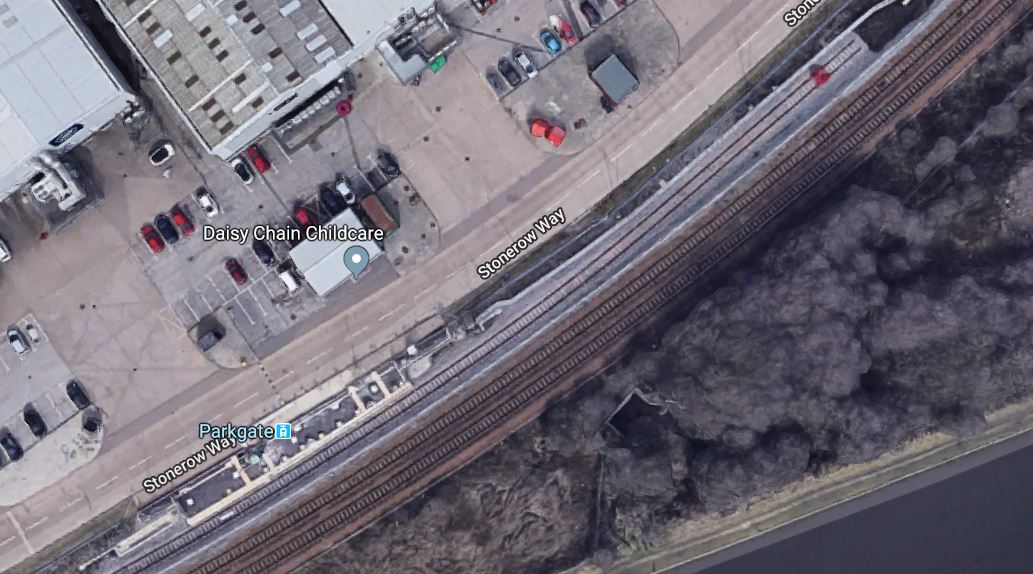
This Google Map shows the station.
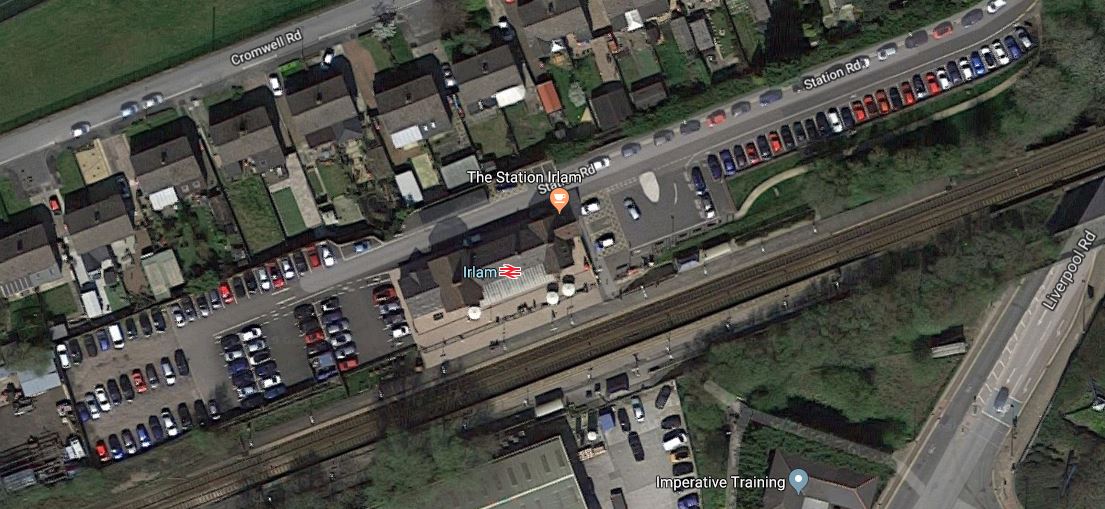
It is one of those stations where commuters have to cross the railway either on the way to work or coming home.
So a step-free method of crossing the railway is absolutely necessary.
The Current And Future Rail Service
As the station lies conveniently between Liverpool and Warrington to the West and Manchester and Manchester Airport to the East, it must be a station with tremendous potential for increasing the number of passengers.
At the moment the service is two trains per hour (tph) between Liverpool Lime Street and Manchester Oxford Road stations.
- Oxford Road is probably not the best terminus, as it is not on the Metrolink network.
- When I returned to Manchester, many passengers alighted at Deansgate for the Metrolink.
- On the other hand, Liverpool Lime Street is a much better-connected station and it is backed up by Liverpool South Parkway station, which has a connection to Merseyrail’s Northern Line.
- The current service doesn’t serve Manchester Piccadilly or Airport stations.
A guy in the cafe also told me that two tph are not enough and the trains are often too short.
Merseyrail work to the same principle as the London Overground and other cities of four tph at all times and the frequency certainly draws in passengers.
Whilst I was drinking my coffee, other trains past the station.
- One tph – Liverpool Lime Street and Manchester Airport
- One tph – Liverpool Lime Street and Norwich
Modern trains like Northern’s new Class 195 trains, should be able to execute stops at stations faster than the elderly diesel trains currently working the route.
So perhaps, after Irlam station becomes step-free, the Manchester Airport service should call as well.
As Liverpool Lime Street station has been remodelled, I can see a time in the not too distant future, when that station can support four tph, that all stop at Irlam station.
The Manchester end of the route could be a problem, as services terminating at Oxford Road have to cross the busy lines of the Castlefield Corridor.
So perhaps all services through Irlam, should go through Deansgate, Manchester Oxford Road and Manchester Piccadilly stations to terminate either at the Airport or perhaps Stockport or Hazel Grove stations.
But would this overload the Castlefield Corridor?
Battery/Electric Trains
If you look at the route between Liverpool Lime Street and Manchester Oxford Road stations, the following can be seen.
- Only about thirty miles between Deansgate and Liverpool South Parkway stations is not electrified.
- The section without electrification doesn’t appear to be particularly challenging, as it is along the River Mersey.
It is my view, that the route between Liverpool and Manchester via Irlam, would be an ideal route for a battery/electric train.
A train between Liverpool Lime Street and Manchester Airport stations would do the following.
- Run from Liverpool Lime Street station to Liverpool South Parkway station using the installed 25 KVAC overhead electrification.
- Drop the pantograph during the stop at Liverpool South Parkway station.
- Run from Liverpool South Parkway station to Deansgate station using battery power.
- Raise the pantograph during the stop at Deansgate station.
- Run from Deansgate station to Manchester Airport station, using the installed 25 KVAC overhead electrification.
The exact distance between Deansgate and Liverpool South Parkway stations is 28.2 miles or 45.3 kilometres.
In 2015, I was told by the engineer riding shotgun on the battery/electric Class 379 train, that that experimental train was capable of doing fifty kilometres on battery power.
There are at least four possible trains, that could handle this route efficiently.
- Porterbrook’s proposed batteryFLEX train based on a Class 350 train.
- A battery/electric train based on the seemingly unwanted Class 379 train.
- A battery/electric version of Stadler’s Class 755 train.
- I believe that Bombardier’s Aventra has been designed so that a battery/electric version can be created.
There are probably others and I haven’t talked about hydrogen-powered trains.
Battery power between Liverpool and Manchester via Irlam, appears to be very feasible.
Tram-Trains
As my train ran between Manchster and Irlam it ran alongside the Metrolink between Cornbrook and Pomona tram stops.
Manchester is very serious about tram-trains, which I wrote about in Could A Class 399 Tram-Train With Batteries Go Between Manchester Victoria And Rochdale/Bury Bolton Street/Rawtenstall Stations?.
Tram-trains are often best employed to go right across a city, so could the Bury tram-trains go to Irlam after joining the route in the Cornbrook area?
- Only about thirty miles between Deansgate and Liverpool South Parkway stations is not electrified.
- The route between Liverpool and Manchester via Irlam doesn’t look to be a very challenging line to electrify.
- The total distance bettween Liverpool Lime Street and Manchester Victoria station is only about forty miles, which is a short distance for a tram-train compared to some in Karlsruhe.
- Merseyrail’s Northern Line terminates at Hunts Cross station, which is going to be made step-free.
- There is an existing step-free interchange between the Liverpool and Manchester route via Irlam and Merseyrail’s Northern Line at Liverpool South Parkway station.
- Class 399 tram-trains will have a battery capability in South Wales.
- Class 399 tram-trains have an operating speed of 62 mph, which might be possible to increase.
- Stadler make Class 399 tram-trains and are building the new Class 777 trains for Merseyrail.
I think that Stadler’s engineers will find a totally feasible and affordable way to link Manchester’s Metrolink with Liverpool Lime Street station and Merseyrail’s Northern and Wirral Lines.
I can envisage the following train service running between Liverpool and Manchester via Irlam.
- An hourly service between Liverpool Lime Street and Nottingham, as has been proposed for the new East Midlands Franchise.
- A four tph service between Liverpool Lime Street and Manchester Airport via Manchester Piccadilly.
- A tram-train every ten minutes, linking Liverpool Central and Manchester’s St Peter’s Square.
- Tram-trains would extend to the North and East of Manchester as required.
- All services would stop much more comprehensively, than the current services.
- Several new stations would be built.
- In the future, the tram-trains could have an interchange with High Speed Two at Warrington.
Obviously, this is just my speculation, based on what I’ve seen of tram-train networks in Germany.
The possibilities for the use of tram trains are wide-ranging.
Installing Step-Free Access At Irlam Station
There would appear to be two ways of installing step-free access at Irlam station.
- Add lifts to the existing subway.
- Add a separate bridge with lifts.
These are my thoughts on each method.
Adding Lifts To The Existing Subway
Consider.
- The engineering would not be difficult.
- Installaton would probably take a number of weeks.
- There is good contractor access on both sides of the railway.
There are similar successful step-free installations around the UK
The problem is all about, how you deal with passengers, whilst the subway is closed for the installation of the lifts.
Adding A Separate Bridge With Lifts
Consider.
- There is a lot of space at both the Eastern and Western ends of the platform to install a new bridge.
- Adding a separate bridge has the big advantage, that during the installation of the bridge, passengers can use the existing subway.
- Once the bridge is installed, the subway can be refurbished to an appropriate standard.
Passengers will probably prefer the construction of a new bridge.
In Winner Announced In The Network Rail Footbridge Design Ideas Competition, I wrote how the competition was won by this bridge.
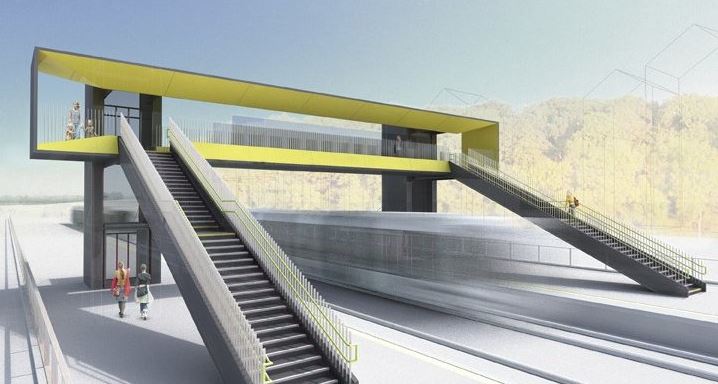
So could a factory-built bridge like this be installed at Irlam station?
There is certainly space at both ends of the platform to install such a bridge and the daily business of the station and its passengers would be able to continue unhindered, during the installation.
I’m also sure, that the cafe would be happy to provide the daily needs of the workforce.
Conclusion
From a station and project management point-of-view, adding a new factory-built bridge to Irlam station is the easiest and quickest way to make the station step-free.
It also appears, that Network Rail have made a wise choice in deciding to put Irlam station on their list of stations to be made step-free, as the station could be a major part in creating a new high-capacity route between Liverpool and Manchester.
This could also be one of the first stations to use an example of the new bridge.
- Installation would be quick and easy.
- There is no site access problems.
- There station can remain fully open during the installation.
- All stakeholders would probably be in favour.
But above all, it would be a superb demonstration site to bring those from stations, where Network Rail are proposing to erect similar bridges.
Comparing Trams And Tram-Trains In Manchester And Sheffield
In Could A Class 399 Tram-Train With Batteries Go Between Manchester Victoria And Rochdale/Bury Bolton Street/Rawtenstall Stations?, I discussed how Class 399 tram-trains might be used on a route in the Manchester area.
This was my conclusion.
Could we see tram-trains running from Bury Bolton Street, Hebden Bridge, Rawtenstall and Rochdale into Manchester Victoria and then taking to the existing tram network?
If you’ve ever been to Karlsruhe, as I have to see the Class 399 tram-trains German cousins, you wouldn’t rule out anything.
That would include tram-train services to Blackburn, Buxton, Chester, Glossop, Hebden Bridge, Sheffield, Southport and Wigan.
So how do Manchester’s M5000 trams, Sheffield’s Supertrams compare to the Class 399 tram-train?
Body Construction
- M5000 – Aluminium
- Supertram – Steel
- Class 399 – Lightweight Stainless Steel
Does the Class 399 use lightweight stainless steel to give enhanced crash protection and better corrosion resistance?
Sections, Doors and Length
- M5000 – 2, 4 and 38.4 metres
- Supertram – 3, 4 and 34.8 metres
- Class 399 – 3, 4 and 37.2 metres
Capacity
- M5000 – 60 or 66 seats, 149 standing, 209/215 maximum
- Supertram – 86 seats, 155 standing, 241 maximum
- Class 399 – 88 seats and 150 standing, 238 maximum
The M5000 is a bit less because it is a shorter vehicle with less standing space.
Entrance Height
- M5000 – 0.98 metres
- Supertram – 0.42 metres
- Class 399 – .425 metres
The Supertram and the Class 399 have obviously been built to be able to use the same tram platforms in Sheffield.
Wikipedia says this about standard UK platform height.
The standard height for platforms is 915 mm with a margin of +0,-25 mm
But it would appear that the M5000 is not far from the UK standard height, but the Class 399 is 0.465 metres too low.
Consider.
- The entrance height of a Greater Anglia Class 755 train, which is a bi-mode FLIRT is 0.96 metres.
- On the South Wales Metro, variants of Class 399 tram/trains and Class 755 trains will share platforms.
So Stadler must have a nifty solution to overcome the platform height difference for these two trains, which is similar to that in Manchester between a Class 399 tram-train and an M5000.
If it’s on the tram-train, then Stadler have a solution, that will allow Class 399 tram-trains to run on the Manchester Metrolink.
The datasheet for the Class 399 tram-train says this about the suspension of the tram-train.
Smooth and silent operation with secondary air suspension and resilient wheels.
Secondary air suspension is not new on trains, as it certainly featured on British Rail Mark 3 coaches from the 1970s, which have a legendary smooth ride. It can still be seen between the bogie and the coach on many Bombardier trains, which trace their ancestry to British Rail designs.
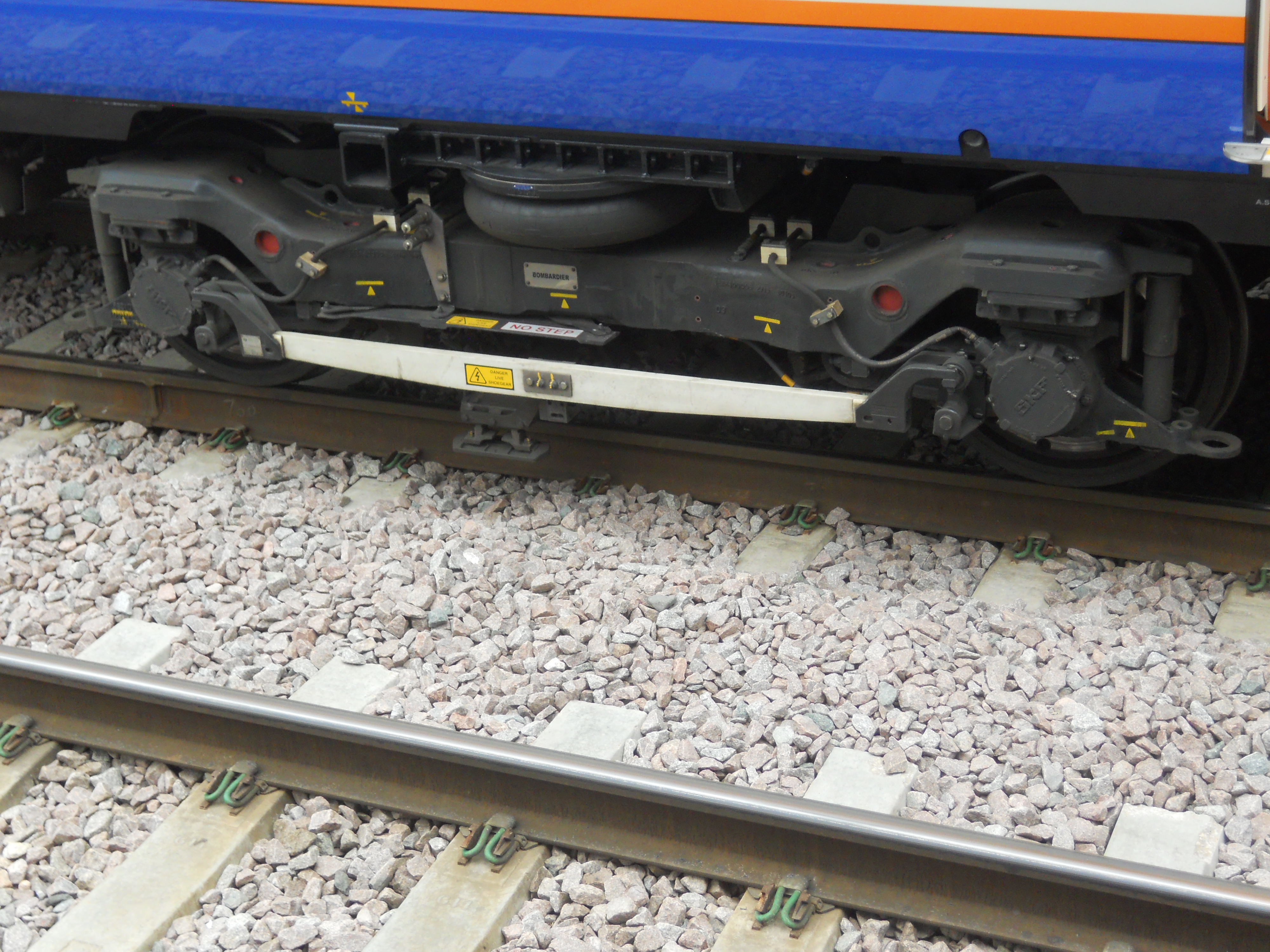
The picture shows the bogie on a Class 378 train.
Note the air-suspension above the frame of the bogie.
Some cars use secondary air suspension with computers to control the amount of air in each rubber bag to improve the ride and road-holding.
Transport for London measure the pressure in the suspension and use this to calculate train loading. I described this application in Is This The Hippest Train Status Displays?
Could the air bags be pumped up to raise the train and and reduced in pressure to drop it a few centimetres?
There are certainly suspension engineers, in the automotive and motor-sport industries, who have relevant experience and could suggest a solution.
All this speculation is a bit like Lew Grasde’s quote on the film Raise the Titanic on which he lost a lot of money.
Raise The Titanic? It would have been cheaper to lower the Atlantic!
Here it’s a bit of the reverse as if the tram-trains can be adjusted to the platform height, then hundreds of platforms don’t need to be rebuilt.
Suppose the platforms were built to fit an existing tram or train.
- On the Manchester Metrolink the platforms would fit the M5000 trams.
- On the Sheffield Supertram, the platforms would fit the Supertrams.
- On the South Wales Metro, the platforms would fit the Welsh variant of the Class 755 train.
The Class 399 tram-trains running in Sheffield have their suspension adjusted on mnufacture and in the depot, so that there is level access between tram-train and platform.
Could the same tram-trains be adjusted so that they fit the Manchester Metrolink platforms, which are higher?
If they can, then Manchester has got a source of off-the-shelf tram-trains.
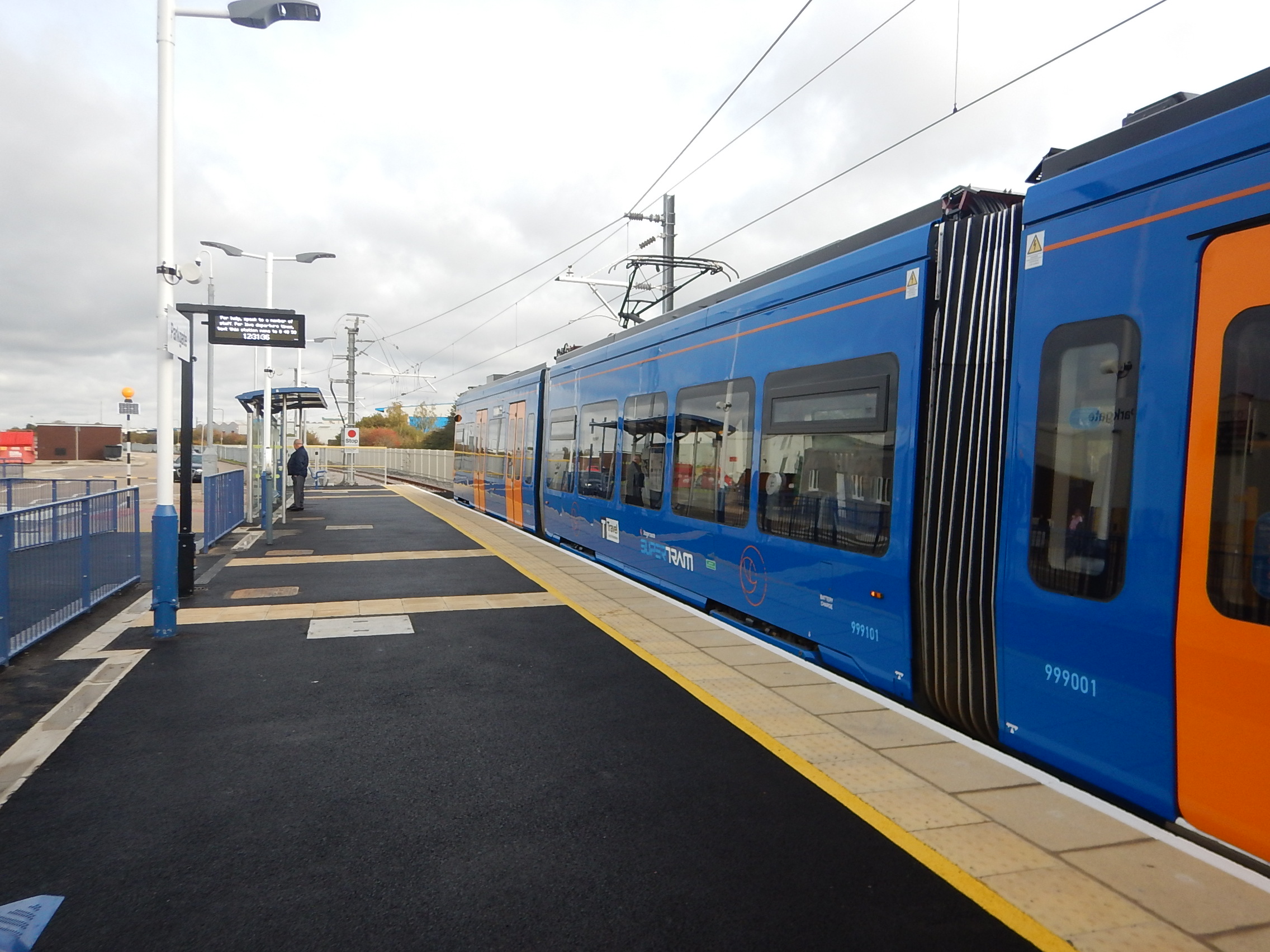
The picture shows a Class 399 tram-train at Rotherham Parkgate. Note the level access at the orange door in the foreground.
Manchester would need a different colour as Chelsea Blue wouldn’t be appropriate.
The intriguing idea, is can the same Class 399 tram-trains run in both Manchester and Sheffield, with the tram-train’s computer adjusting the ride height to suit the different height of platforms?
At present the answer is probably no, as if they could then there wouldn’t be dual-height platforms at Rotherham Central station.

Note the slopes down on both sides of the tracks from the high-level train platforms in the background, to the low-level tram platforms in the foreground.
It all depends on whether the suspension design is possible.
If it is, which I doubt, it would get round the bit problem of platforms on tram-train systems.
Weight
- M5000 – 30.7 tonnes
- Supertram – 46.5 tonnes
- Class 399 – .66.1 tonnes
The Class 399 tram-train is a heavy beast so raising it by much might be difficult, as you changed from Sheffield to Manchester heights.
Operating Speed
- M5000 – 80 kph
- Supertram – 80 kph
- Class 399 – .100 kph
Power And Power/Weight Ratio
- M5000 – 480 kW – 15.6 kW/tonne
- Supertram – 1108kW – 23.8 kW/tonne
- Class 399 – 870 kW – 13.2 kW/tonne
Noye.
- By comparison the power/weight ratio of a Class 321 train is just 7.9 kW/tonne
- I have talked to Sheffield tram-drivers and their view is that the Class 399 tram-trains handle Sheffield’s hills better with a full load of passengers.
- The Class 399 has six traction motors, whereas the others have four.
So perhaps, the way that the Class 399 tram-train puts its power to the rail with more driven axles, is important.
Conclusion
I am convinced that just as Sheffield’s Supertram can work happily with Class 399 tram-trains, Stadler have ways and means of making Manchester Metrolink’s M5000 trams work with the tram-trains.
If the Class 399 tram-train is compatible with both tram networks, this will be a great advantage in designing new tram-train routes.
It would also mean that one day, a tram-train service could run from Cathedral in Sheffield to Piccadilly Gardens in Manchester via the Hope Valley Line.
I suspect that a lot of local services from the two cities will be run by tram-train services, that cross the cities.
Stadler Rail’s Specification For UK Trains
These are links to the pdf specifications of Stadler Rail’s products in the UK.
- DRS – Class 68
- DRS – Class 88
- Greater Anglia – Class 755
- Merseyrail – Class 777
- Sheffield – Class 399 tram-train
I shall add more as I find them!
Could There Be A Tram-Train Between Ipswich And Felixstowe?
I should declare an interest here of my teenage self, who spent some very boring summers in, what was then, the small coastal resort and dormitory town of Felixstowe.
There was only so many places you could cycle and as my school friends were all in London, I used to avoid going to Felixstowe if possible.
I can remember going from London to Felixstowe several times on the train.
I would cycle from our London house in Cockfosters to Liverpool Street station and put my bike in the guard’s van for the trip to Ipswich.
From Ipswich, I would ride the dozen or so miles along the A45 (now the A14) to Felixstowe.
I suspect, that I could have used, the two-car diesel shuttle from Ipswich to Felixstowe, but I never did.
Perhaps, it was because it was not the most frequent of services.
The frequency was certainly a lot less than the current hourly service.
A Tram-Train To Felixstowe
This report on the East West Rail web site is entitled Eastern Section Prospectus and gives full details of their proposals for the Eastern section of the East-West Rail Link.
This is said in the report.
Introduction of a tram-train service on the Felixstowe branch, with doubling between Derby Road and Felixstowe and street running through
Ipswich.
It is also said, that there will be a frequency of four trains per hour (tph) between Ipswich and Felixstowe.
So how feasible is this proposal?
The Proposed Frequency
People travel between Ipswich and Felixstowe for several reasons.
- It is an important dormitory town for Ipswich and increasingly for London,
- The Port of Felixstowe is an important employer.
- There is a large amount of leisure traffic between the two towns.
Currently, much of the travelling between Ipswich and Felixstowe is by car on an increasingly crowded A14.
Four tph seems an eminently sensible frequency.
Why Propose A Tram-Train?
If a train, like a Class 170 train or one of the new Class 755 trains were used for the route, it would mean the following.
- Four tph in the single platform at Felixstowe.
- Four tph in a dedicated platform at Ipwich.
- Four trains would be needed for the service.
- An extra six tph using the route between Westerfield and Ipswich stations.
The stations should be able to cope, but I doubt that the extra trains could be fitted into a busy route with the following services.
- Ipswich and Norwich
- Ipswich and Bury St. Edmunds, Cambridge and Peterborough
- Ipswich and Lowestoft
If you add in the up to forty freight trains per day, that will use the route, something will have to give.
The Route Od The Tram-Train
It would appear that the plan is to replace the train, with a tram-train running on the streets of Ipswich.
This could be a possible route for street running.
- Ipswich Station
- Portman Road
- Ipswich Town Centre
- Ipswich Hospital
It would then join the Ipswich-Felixstowe rail line in the area of Derby Road station or the retail parks on the East of Ipswich.
This Google Map shows Derby Road station and Ipswich Hospital.
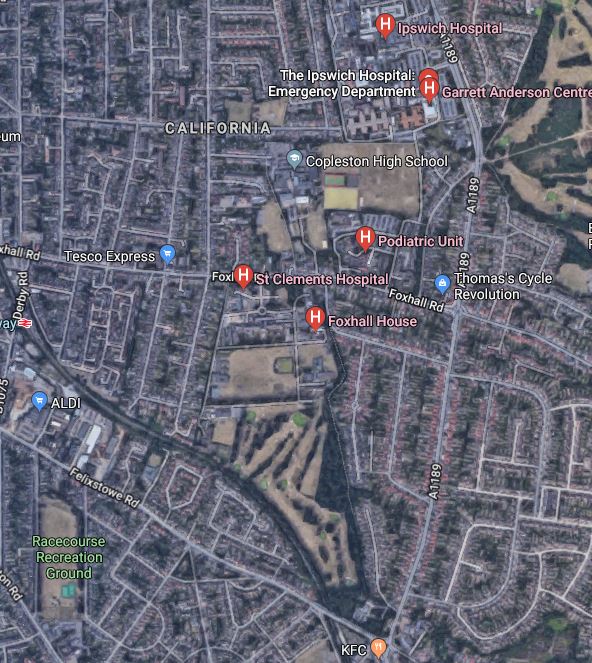
Note.
- Ipswich Hospital is in the top-right of the map.
- Derby Road station is at the left side of the map in the middle.
- The Ipswich-Felkixstowe Line can be seen going South-Easterly across the map to the well-known St. Augustine’s roundabout.
A tram-train would have the following benefits.
- It would link the town centres of Ipswich and Felixstowe.
- It would create a step-free link across Ipswich Town Centre to the all-important hospital.
- Extra stations can be added where they are needed in Ipswich without decreasing capacity on the rail line.
- It would surely encourage more people to use the trains from Ipswich station.
I suspect too, that Class 399 tram-trains could be used as they are in Sheffield and will be on the South Wales Metro.
Between Ipswich And Derby Road Stations
This extract is from the Wikipedia entry for the Felixstowe Branch Line.
The train now enters a section of double track through Derby Road station (6.10 miles (9.82 km) from Ipswich station by train, but only 1.5 miles on the map) where trains can pass.
It is very significant, that going through the houses between the two stations is a route that is shorter by eight-and-a-half miles.
Could it be that the time that would be saved by the shorter route is balanced by the slower progress of on-street running, which means that the current twenty-six minute journey time can be maintained?
Doubling Between Derby Road And Felixstowe
I’ll repeat what is said in the report.
Introduction of a tram-train service on the Felixstowe branch, with doubling between Derby Road and Felixstowe.
Doubling of about a mile of the Felixstowe Branch to the West of Trimley is ongoing and doubling further to the West looks to be fairly easy from my helicopter.
But there is one major problem.
This Google Map shows, where the rail line goes over the Ipswich by-pass.
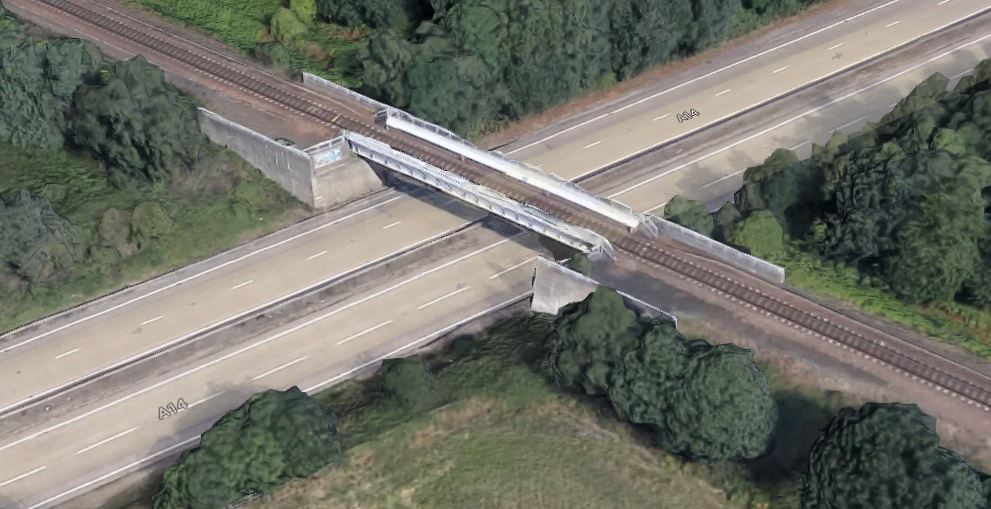
Note that provision has been made for a second track.
So hopefully, it won’t be much more expensive to add a second bridge and track, than to add points either side of the existing bridge.
There would be some extra bridge works between the A14 and Derby Road station, but doubling all the way from Derby Road station to Felixstowe doesn’t look to be the world’s most difficult railway engineering.
Extra Tram-Train Stops Between Ipswich And Felixstowe
There used to be an extra stop at Orwell station. It was little-used and closed in 1959.
Looking at the station, it is now a large private residence and I suspect there is no point in reopening, as there isn’t much housing in the area.
But there could be a case for a station at Futura Park, which is shown in this Google Map.
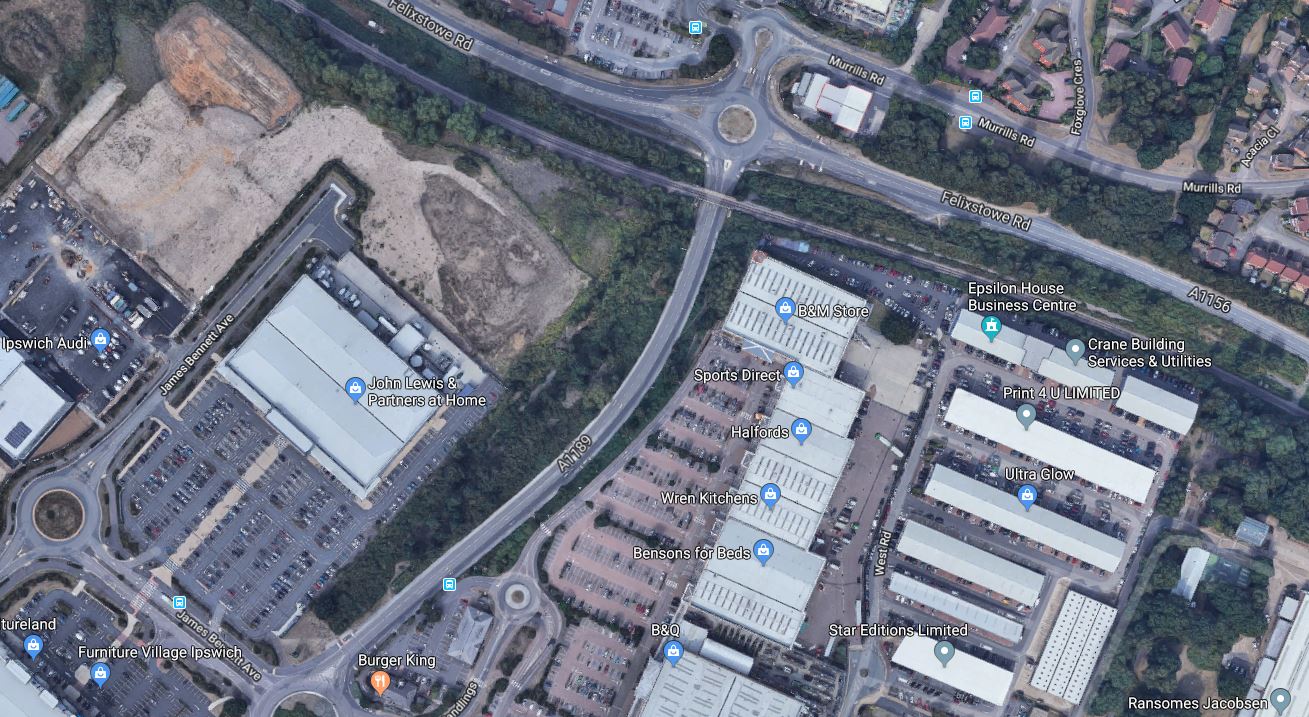
Lots of the usual out-of-town stops are there including a Waitrose and a John Lewis.
The railway runs to the South of the A1156 Felixstowe Road and there is surely the possibility of a station in this area.
There is also the possibility, that the tram-train could join and leave the Felixstowe Branch Line at this point, after and before street running to Ipswich station.
Would The Tram-Trains Go Walkabout In Felixstowe?
Felixstowe used to have two other stations; Felixstowe Pier and Felixstowe Beach. Both are now closed.
- I can remember Felxstowe Beach station, as occasionally in the 1950s, we stayed nearby at the Cavendish Hotel.
- Felixstowe Pier station was towards Landguard Fort and even served steam vessels going to Germany.
Both stations were served by trains reversing at the main station, which is impossible now as the chord has been removed.
This Google Map shows the current rail lines in Felixstowe.
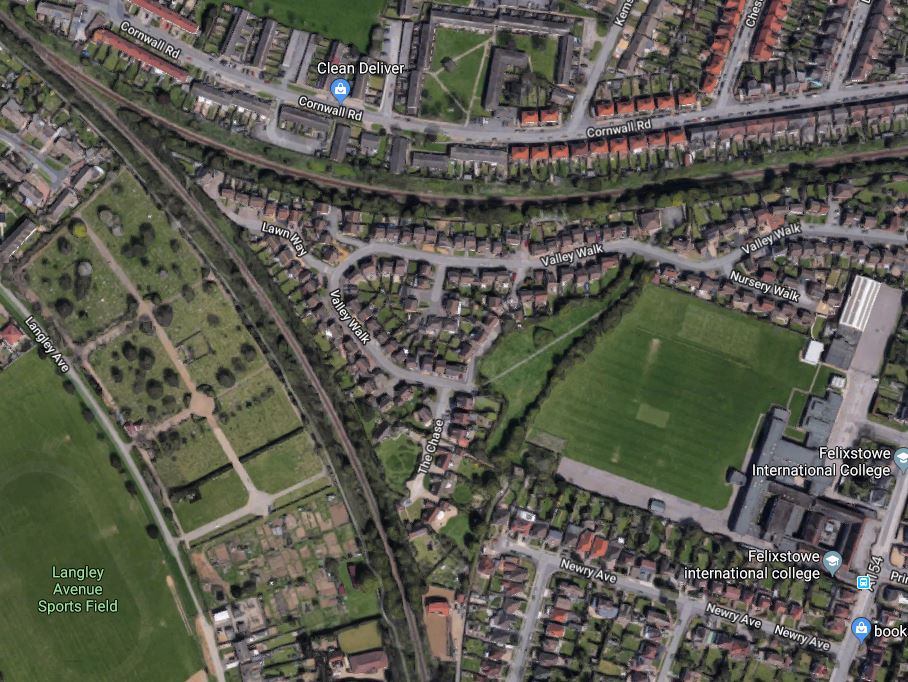
The line to/from Ipswich splits into two in the top-left corner of the map.
- The branch going East goes to Felixstowe station.
- The branch going South used to serve the two other Felixstowe stations and now serves the Port of Felixstowe.
The missing chord is visible to the West of the playing fields of Felixstowe International College.
I would rate reinstatement of the chord as highly unlikely.
- The only reason, the chord would be reinstated, would be if the Port of Felixstowe wanted to have a four tph passenger service.
- The Port wouldn’t want to have all those extra movements on what is a busy and exclusive freight line.
On the other hand, I wouldn’t rule out extension into Felixstowe Town Centre.
This Google Map shows the Town Centre.
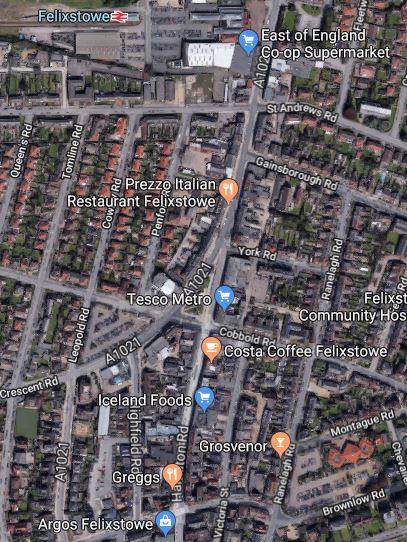
Note.
- The one-platform station is at the top of the map, behind a small Co-op supermarket and the Listed station buildings, which are now a small shopping centre.
- The High Street, which is part -pedestrianised leads down from the station to the top of the cliffs, where Bent Hill leads down to the sea-front.
- Halfway along is a triangular garden, where a local road splits off toward the Southern part of the sea-front and the Port.
- The pattern of retail shopping is changing and Marks and Spencer in the town will be closing soon.
My plan would be as follows.
- Rebuild the Co-op supermarket to allow a single-track tram line to squeeze through to the High Street.
- Trams would then continue down the High Street to the triangular garden.
- A second platform face could be added at Felixstowe station to allow trams to pass and give flexibility.
Done properly, it could improve Felixstowe’s appeal as a leisure destination.
I also think, that as the extension is only short, the current Ipswich to Felixstowe timing could be maintained.
Future Services At Ipswich Station
Listing all the services proposed at Ipswich station gives the following.
- 3 tph – London Liverpool Street and Norwich – Greater Anglia
- 1 tph – Colchester and Peterborough – Greater Anglia – Replaces current Ipswich and Peterborough service.
- 1 tph – Manningtree and Oxford via Cambridge – East West Rail – Replaces current Ipswich and Cambridge service
- 1 tph – Ipswich and Lowestoft – Greater Anglia – Some services extend to London
- 4 tph – ipswich and Felixstowe – Greater Anglia – Proposed tram-train service.
If the Felixstowe tram-train service were to terminate outside the station, as trams tend to do, there would only be a need for one bay platform at Ipswich, that would handle hourly Lowestoft services, that didn’t go to/from London.
Ipswich station would become more of a through station with the following through trains.
- Five tph going between Manningtree and Stowmarket
- Two tph between Manningtree and the proposed A14 Parkway station via Bury St. Edmunds.
This would all save the expense of rebuilding large parts of Ipswich station.
Although, there would be a certain amount of remodelling of the station forecourt to accommodate the tram-trains.
Conclusion
It is a classic application of tram-train technology and I’m sure that a good route can be devised between the two towns.
Automated Shuttle Trains With A Train Captain
There are various short routes on the UK rail network, where shuttle trains work a frequency of perhaps two or three trains per hour (tph), that is generally felt by passengers and train operators to be inadequate.
Examples include the following.
Could the frequency on these lines be increased using automation?
The Automated Docklands Light Railway
The Docklands Light Railway is not a simple railway, but it is fully automated.
- Trains are driverless
- A Train Captain is responsible for patrolling the train, checking tickets, making announcements and controlling the doors.
- The Train Captain can take control of the train if required.
It is a system that seems to have worked well for many years.
An Automated Shuttle With A Train Captain
Could a similar principle be applied to a shuttle train?
As an example, I’ll use the Bromley North Line.
Consider.
- The line is two miles long and trains take five minutes each way.
- The current frequency is three tph.
- There are problems at Grove Park station with connections in the Peak.
- The route is double-track.
- The current service is operated by a single train, manned only by a driver.
It would appear if the Bromley North Line could be run at four tph, this would be a welcome improvement.
One of the problems of driver-operated shuttle services like this, is that at each end of the route, the driver must change ends, which takes a couple of valuable minutes.
To operate a frequency of four tph, the round-trip must be performed in fifteen minutes.
- Each leg takes five minutes.
- There are four stops in a round trip; one at Grove Park, one at Bromley North and two at Sundridge Park.
I believe that a single automated train, with a Train Captain on board to look after safety, open and close the doors and start the train after each stop, should be able to handle the much-needed four tph on the Bromley North Line.
How Would The Automation Work?
Many years ago, a Central Line driver explained to me how the original automation of the Victoria Line worked.
- A train would arrive in the station and stop in the correct place automatically with high precision.
- The doors would be opened.
- After passengers had unloaded and loaded, the doors would be closed.
When the doors were closed and everything was safe, the driver would push a button to ask the automation to take the train to the next station.
Automation has moved on since the 1960s, and I believe that some form of on-train automation would be able to handle a simple shuttle.
- Only one track would probably be need to used to remove the complication of points.
- Only one train would be used for the shuttle, as this increases safety.
- Sensors would determine the exact position of the train.
- CCTV cameras, including ones looking forwards and backwards, would be relayed to the Train Captain and their Control Station in the middle of the train.
- The Train Captain would have an Emergency Stop Button.
If something goes wrong or the train is being taken to and from the depot, the Train Captain would go to the forward cab, switch off the automation and drive the train in the normal manner.
I am sure, that it would not only be a very safe system, but if it made full use of the capabilities of modern trains, it would speed up services sufficiently, so that frequencies could be increased.
What Trains Would Be Suitable?
I think that the choice of trains would be wide, but I think they must have the following characteristics.
- An ability to perform a station stop and restart quickly.
- Fast acceleration and deceleration.
- Level access between platform and train.
- Walk-through interior, to help the Train Captain perform their duties.
- Lots of wide double doors and large lobbies.
All these characteristics would enable the train to save time on the route.
Power would be anything that could be used on the route. For the Bromley North Line, that would be either third-rail electrification or battery power.
Battery power, though on this route, would have a problem.
If the train is running an intense shuttle service, with stops taking a minute or even less, the train never stops long enough to charge the batteries. As the route is electrified with 750 VDC using third-rail, this would need to be used on the Bromley North Line.
Although, I have used the word train in this section, I suspect trams, tram-trains or light rail vehicles could be used.
All vehicles would retain their driving cabs for the following reasons.
- If there is a problem, the Train Captain can drive the train, as happens on the Docklands Light Railway.
- If the train needs to be positioned to and from a depot, the train could be driven manually.
I also feel that for these reasons, the Train Captain would be a fully qualified driver.
Examples of vehicles that could be used, if appropriate automation were to be fitted include.
Class 399 Tram-Train
Class399 tram-trains are working successfully in Sheffield and they have been ordered for the South Wales Metro, where they will run under both overhead and battery power.
As an Electrical Engineer, I believe that it would not be the most difficult piece of engineering to fit these tram-trains with the ability to run under third-rail power.
The tram-trains would have similar capacities, cross-section and performance to the current Class 466 trains.
The only modifications that would be needed to the route, would be to adjust the platforms used by the tram-train to give level access between tram-train and platform.
A Three-Car Aventra Or Similar
Three-car Class 730 Aventra trains, have been ordered by West Midlands Railway and Aventras have also been ordered to run using third-rail power.
As with the Class 399 tram-train, these trains could probably work the route successfully, subject to suitable platform modification.
How Fast Could Stops Be Performed?
I have timed stops on the London Overground and the London Tramlink rarely do you find a time from brakes on to brakes off in excess of a minute, without a red signal being involved.
I have measured some London Overground stops are at thirty seconds some London Tramlink stops at twenty seconds.
If a shuttle had the track to itself and the train was a modern design, I could see maximum timings on the Bromley North Line as follows.
- Bromley North – One minute
- Sundridge Park – Thirty seconds
- Grove Park – One minute
Surely, with station stop times like these and perhaps faster running than the current 30 mph, the goal of four tph could be comfortably achieved.
What Happens With Delays?
Suppose, an incident occurs, and the train is delayed.
After the incident is successfully sorted, the train could just carry on or wait until it was on schedule for the next train.
Within a few minutes, the train would be running to time.
Some Other Selected Routes
Over the next few days, I will be adding calculations for other routes.
Slough And Windsor & Eton Central
Extra routes will be added here.
Conclusion
On the Bromley North Line, selective automation should be able to enable a four tph service using one train or tramtrain.
Would Batteries Help Voltage Change-over In A Dual Voltage Train Or Tram-Train?
Battery Power And Tram-Trains
Consider.
- The Class 399 tram-trains in Sheffield can work on both 25 KVAC and 750 VDC overhead electrification.
- Their German cousins in Karlsruhe can work on both 15 KVAC and 750 VDC overhead electrification.
In Karlsruhe, there is a ceramic rod between the two overhead cables with different voltages and the pantograph rides across. I suspect that clever power electronics on the tram-train measures the voltage and converts it automatically to that needed to power the tram-train.
I haven’t been able to see how Sheffield connects the two different voltages, but I wouldn’t be surprised if a similar system with a ceramic rod is used.
Look at this picture, I took of a Class 399 tram-train in Sheffield.
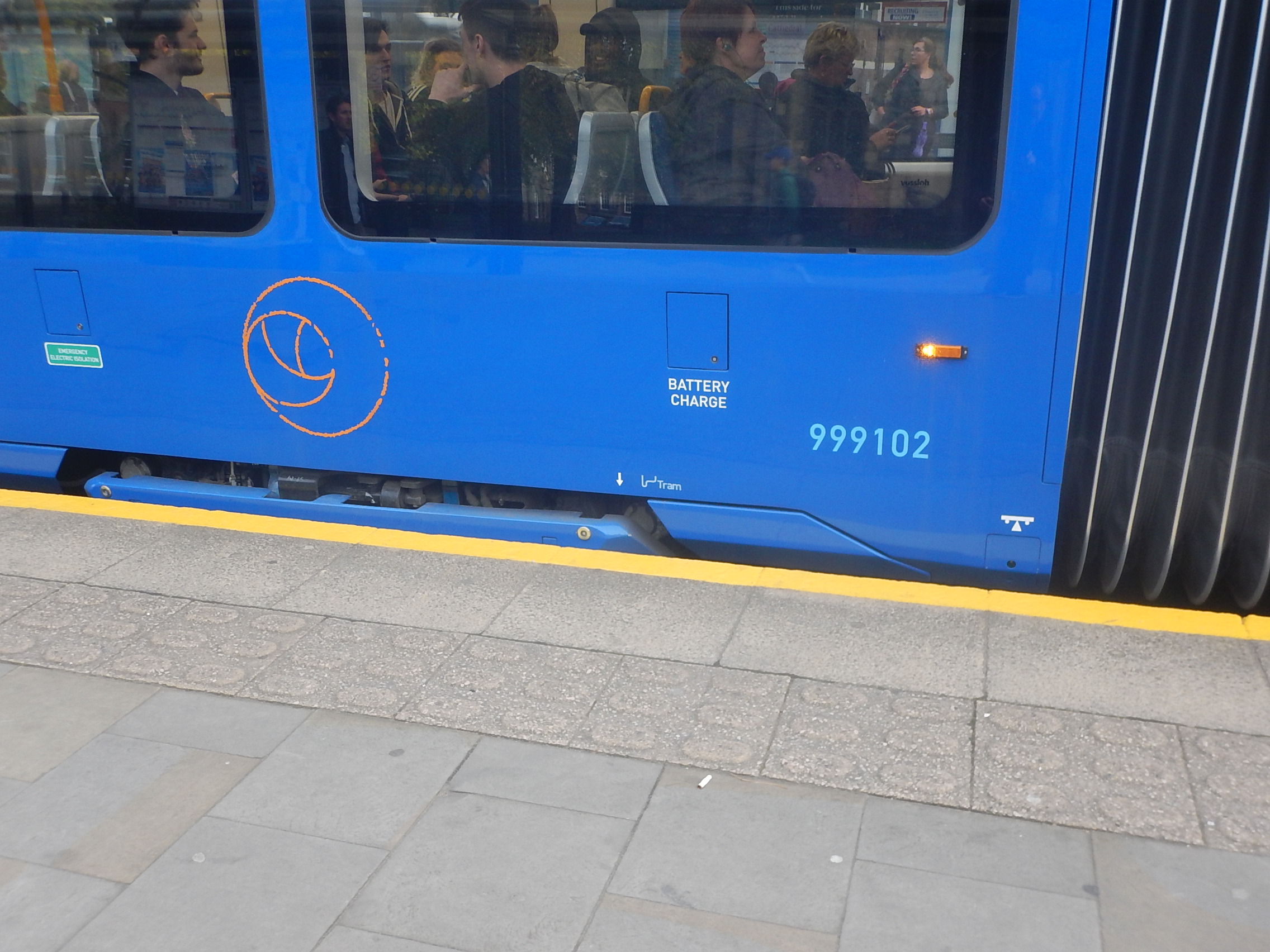
Note the BATTERY CHARGE socket to the left of the car number.
Why would an electrically-powered vehicle need a battery?
I suppose it could be to start up the tram-train in the morning and raise the pantograph.
But could it also be for emergency power, to move the tram-train short distances, such as in depots or to assist the vehicle through the dead sections, where the power supply changes from one voltage to another?
The Class 399 tram-trains ordered for the South Wales Metro will also have to cope with discontinuous electrification. So is the technology needed for this already installed in the tram-trains in Sheffield?
Battery Power And Dual Voltage Trains
Suppose you have a train like a Class 378 or Class 700 train, that can run on both 25 KVAC overhead and 750 VDC third-rail electrification.
Third-rail trains with contact shoes deal with discontinuous electrification all the time.
If a dual-voltage train had a battery that could take it say two hundred metres, then I believe that voltage changeover could be simplified and speeded up.
I have watched Class 717 trains change voltage at Drayton Park station and what changes would a limited battery capability make.
The third-rail electrification would stop several metres short of the station and would be removed in the station itself.
Going towards Moorgate, this would be the procedure.
- The train would stop in the station as it does now.
- The driver would drop the pantograph, whilst passengers unloaded and loaded.
- The driver would close the doors.
- The train would accelerate away on battery power.
- After a few metres the train would contact the third-rail and the train’s computer would change from battery to third-rail power.
Going away from Moorgate, this would be the procedure.
- The train would automatically disconnect from third-rail power, where that stopped to the South of the station.
- The train would automatically switch to battery power.
- The train would stop in the station as it does now.
- The driver would raise the pantograph, whilst passengers unloaded and loaded.
- The driver would close the doors.
- The train would accelerate away on overhead power.
The stops should be no longer, than a normal station stop without power changeover.
Conclusion
Batteries may well reduce the time taken to change voltage
Could A Class 399 Tram-Train With Batteries Go Between Manchester Victoria And Rochdale/Bury Bolton Street/Rawtenstall Stations?
In Rossendale Reopening Prospect, I looked at a proposal to run a new service between Manchester Victoria and Bury Bolton Street stations.
Could this route be run by a Class 399 tram-train with a battery capability?
These tram-trains would be very similar to the Stadler Citylink Metro Vehicles, that have been specified for the South Wales Metro.
- Wikipedia gives the weight of the vehicle as 66 tonnes.
- Manchester Victoria has an altitude of 44 metres
- Bury has an altitude of 100 metres.
- Rochdale has an altitude of 137 metres.
- Rawtenstall has an altitude of 174 metres.
- I will assume 200 passengers at 90 Kg. each, which gives a weight of 12 tonnes.
Using Omni’s Potential Energy Calculator gives the following.
- Manchester Victoria to Bury Bolton Street has an increase in potential energy of 12 kWh.
- Manchester Victoria to Rochdale has an increase in potential energy of 20 kWh.
- Manchester Victoria to Rawtenstall has an increase in potential energy of 28 kWh.
When you consider that a Class 230 train has 400 kWh of batteries in a two-car train, I don’t think that there will be any problem fitting batteries big enough to take a Class 399 tram-train from Manchester Victoria to Bury Bolton Street, Rochdale or Rawstenstall stations under battery power with a full load of passengers.
- The batteries would be charged in Manchester Victoria station.
- Returning to Manchester Victoria station would use a small amount of battery power, with some assistance from Newton’s friend; gravity.
- The batteries would get a certain amount of charge from the regenerative braking of the tram-trains.
This Google Map shows the Eastern approaches into Manchester Victoria station.
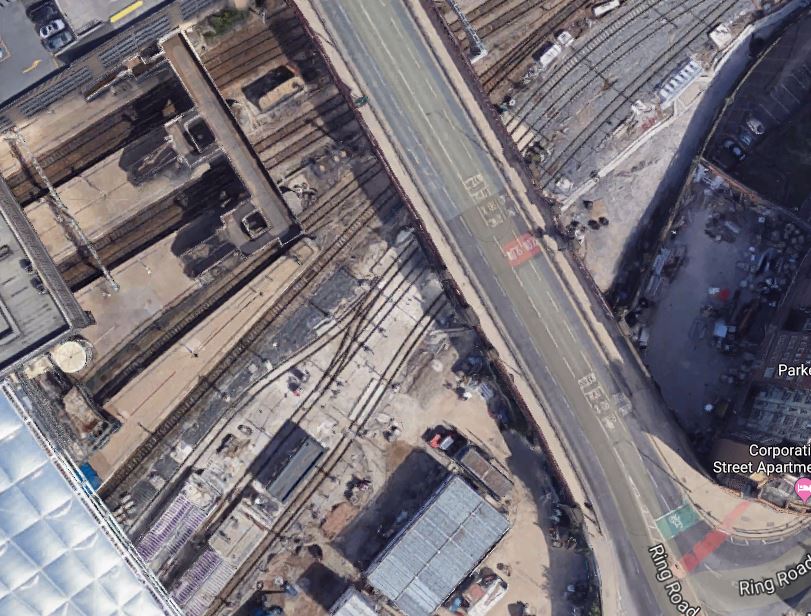
Note.
- The four through platforms numbered 3 to 6.
- The two bay platforms numbered 1 and 2.
- The four platform faces and three tracks of the Metrolink.
Having seen several tram-train systems all over Europe, I believe it would be possible to connect tram-trains running on batteries on the Calder Valley Line to the Manchester Metrolink at Manchester Victoria station.
- Going from Manchester to Bury Bolton Street, Rochdale or Rawtenstall, the tram-train would stop in the Manchester Victoria tram-stop, drop the pantograph and then continue on its way under battery power.
- Returning from the North, the tram-train would stop in the Manchester Victoria tram-stop, raise the pantograph and then continue on its way using power from the overhead wires.
- Batteries would be charged whilst running through Manchester.
There couldn’t be too many tram-train systems that would be easier to build than this?
It is interesting to note that Hebden Bridge station is just twenty-three miles from Manchester Victoria station and has an altitude of 190 metres.
So would it be possible for a Class 399 tram-train to reach Hebden Bridge station on battery power? I very much think it would be!
Class 399 Tram-Trains And Class 156 Trains
Class 156 trains are one of the better workhorses of the railways in the North and despite their age, they scrub up well.
If their performance is compared to that of a Class 399 tram-train, they are not that different.
- Noise and vibration of the electric tram-train is obviously much lower.
- The modern interior of the tram-train is geared to the needs of passengers.
- Passenger capacity of the two vehicles is also about the same.
- In Karlsruhe, tram-trains travel for up to 100 miles from the centre of the city.
Both Karlsruhe and Sheffield use three-car tram-trains, but Valencia uses much longer ones, so on heavily-used routes larger tram-trains could be used.
I doubt there would be many complaints, if a Class 156 service were to be replaced with one run by Class 399 tram-trains.
Electrification Of The Calder Valley Line
Electrifying the Calder Valley Line with 25 KVAC overhead wires as far as Rochdale station, would certainly make running to Hebden Bridge station possible.
- That electrification would also mean that electric trains could be turned-back at Rochdale station, just as diesel trains are now!
- I have flown my helicopter along the route and it looks like of the seven or eight bridges on the route, mostly appear to be modern structures for new roads or motorways.
- As 25 KVAC overhead electrification is currently being erected between Manchester Victoria and Stalybridge, a spur to Rochdale would be very much a simple addition.
It could be a very useful short length of electrification.
Tram-Trains In Manchester
This article on Rail Technology Magazine was puiblished yesterday and is entitled Plans For Tram-Trains In Manchester Unveiled As Grayling And Burnham Mull Expansion Of Metrolink.
Conclusion
Could we see tram-trains running from Bury Bolton Street, Hebden Bridge, Rawtenstall and Rochdale into Manchester Victoria and then taking to the existing tram network?
If you’ve ever been to Karlsruhe, as I have to see the Class 399 tram-trains German cousins, you wouldn’t rule out anything.
That would include tram-train services to Blackburn, Buxton, Chester, Glossop, Hebden Bridge, Sheffield, Southport and Wigan.
Procrastination Over Airport Rail Links
This article in the Glasgow Evening Times is entitled Glasgow Airport Rail Link: Fresh Fears Over Plans As MSP Slams Delay.
The title says it all.
Of the airports in the UK, the following have or will have good rail or tram links.
- Birmingham
- Cardiff
- Edinburgh
- Gatwick
- Heathrow
- London City
- Luton – Building a people-mover between the airport and station.
- Manchester
- Newcastle
- Southampton
- Southend
- Stansted
In addition, the following airports have been talking about rail links.
- Belfast City
- Bristol
- East Midlands
- Glasgow
- Leeds/Bradford
- Liverpool
In fact they’ve been talking about rail links for decades.
As I started with a report about Glasgow, if you want to see how they have taken two decades to get nowhere, read the Wikipedia entry for the Glasgow Airport Rail Link.
The latest £144million plan involves tram-trains running from Glasgow Central station.
Currently, of the airports, that have talked for years, I believe the following could use tram-train technology to provide the airport rail link.
- Bristol
- East Midlands
- Glasgow
- Leeds/Bradford
- Liverpool
Now that tram-trains are working well in Sheffield and have been ordered for the South Wales Metro, surely this technology can be considered almost mainstream for the UK.
In the specific case of Glasgow the following would be needed.
- Modification of platforms at Glasgow Central and Paisley Gilmour Street stations, so they would give level-access to the tram-trains.
- Creation of a single-track spur to the airport without electrification, that ends in a single platform, close to or in the airport terminal.
- A fleet of Class 399 tram-trains with a battery capability, as have been ordered for the South Wales Metro.
- Improved signalling to handle the extra trains.
Note.
- Space should be left, so that in the future, the airport spur could be doubled.
- A flat junction would probably work initially, but provision for a flying junction for the spur should be made.
- Currently, four trains per hour (tph) run past the Airport.
- Could the tram-trains be built to give level access to standard height platforms, so that no substantial modification of existing platforms would be needed?
It also strikes me, that this could be a privately funded scheme.
- Glasgow Airport is ultimately owned by Ferrovial and Macquarie Group, who will be the main beneficiary of the scheme.
- Both Ferrovial and Macquarie Group are companies that invest in infrastructure.
- The Class 399 tram-trains can obviously be leased.
So what’s the problem?
- Network Rail are against the scheme, as it’s not one of theirs.
- The Scottish government won’t sanction a privately-funded scheme.
- Various interests want a different scheme.
- The jury is still out on tram-trains.
- It’s a scheme for Glasgow and the decision is taken in Edinburgh.
- Glasgow would get a better airport link than Edinburgh.
Enlighten me!
Other Airport Links
Once Glasgow is completed, other airport links could be built using the same techniques.
I have a feeling, that another airport will get a tram-train link before Glasgow!
A Tailpiece On The Sheffield To Rotherham Parkgate Tram-Train
I took this picture at the Rotherham Parkgate tram stop.
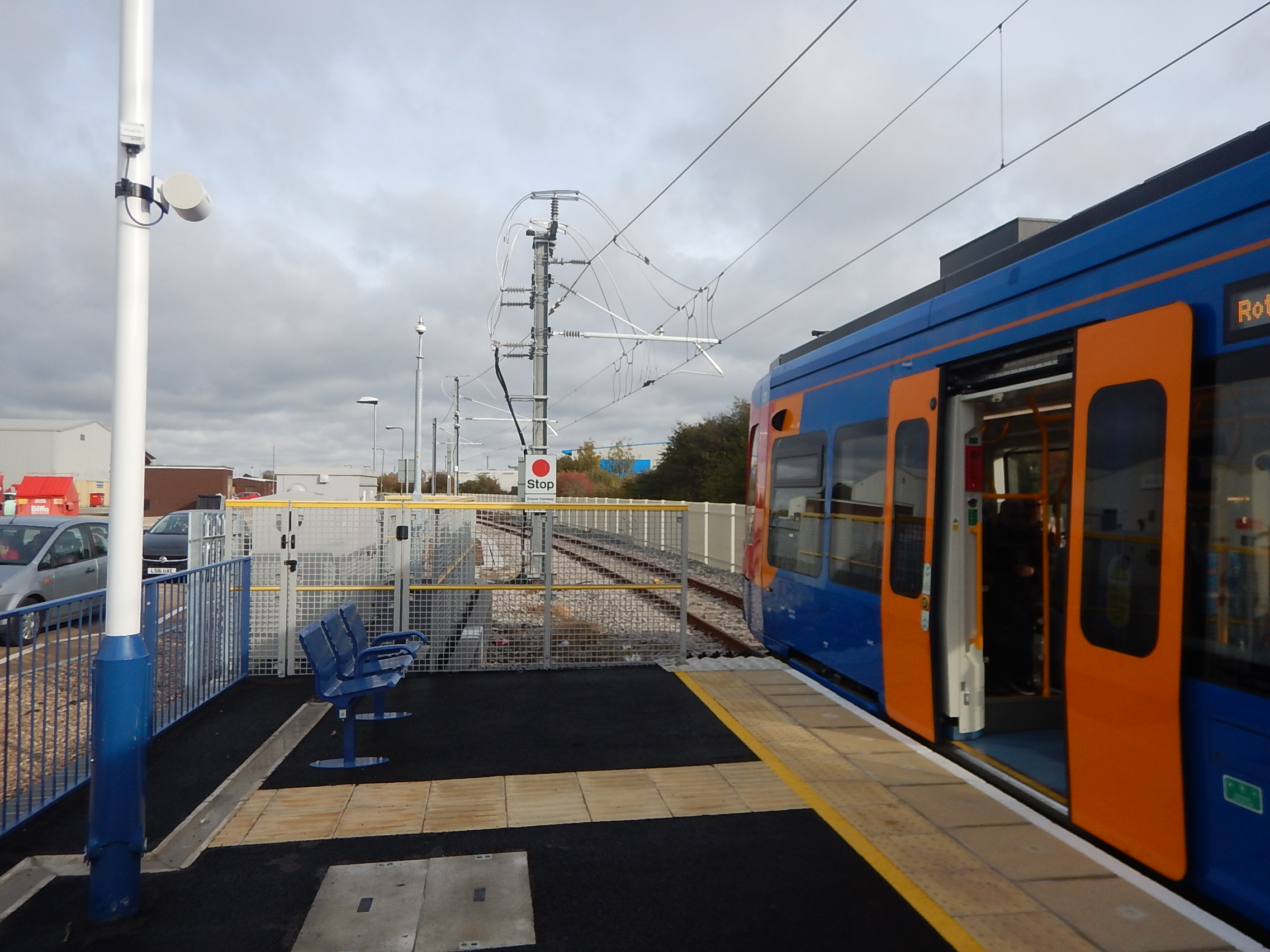
Note.
- The level step-free access between the Class 399 tram-train and the platform.
- The platform laid-out to help passengers and meet all regulations.
- The 25 KVAC overhead electrification.
- The track continuing into a siding, which could be turned into a loop to extend the service to Doncaster.
- The well-placed safety fences.
It certainly appears that Network Rail have produced a professional design that works well and makes things easy for passengers.
What Would Tram-Trains With A Battery Capability Do For The Sheffield Supertram?
I asked this question in a slightly different form in Is The Sheffield Rotherham Tram-Train Showing Signs Of London Overground Syndrome?, where I said this.
Sheffield could do a lot worse, than replace the Siemens-Duewag trams with Class 399 tram-trains. Especially, as the South Wales Metro, will be buying thirty-six similar vehicles with batteries.
What would tram-trains with a battery capability do for Sheffield, Rotherham and the neighbouring towns?
We don’t know much about Stadler’s proposed tram-trains for the South Wales Metro.
- They look to be very similar externally to the Class 399 tram-trains.
- They will be able to work using 25 KVAC electrification on the South Wales Main Line.
- They will be able to work the two-mile long Butetown Branch Line on battery power.
- Whether they will have a 750 VDC capability has not been said.
A tram-train with batteries would certainly offer other possibilities.
On my trip to Rotherham, I met a guy of about my age, who was a resident of Sheffield. He was proud of the city’s trams and was trying out the tram-train for the first time.
He also suggested two possible extensions.
- Royal Hallamshire Hospital
- A tram-train to Doncaster.
There have also been plans at times to run tram-trains to Dore & Totley and Penistone stations.
So how would tram-trains with batteries help for these routes?
Royal Hallamshire Hospital
On this page of the Sheffield Teaching Hospitals web site, this is said about getting to the hospital by tram.
Supertram does not serve the Northern General Hospital. It can be used to reach the Royal Hallamshire, Jessop Wing, Charles Clifford and Weston Park Hospitals, although please be aware that there is still a 10-15 minute uphill walk from the nearest stop (University). We would recommend that anyone who experiences difficulty walking long distances choose some alternative means of travelling to hospital.
How many doctors, nurses and other hospital staff, would be put off by that paragraph and go and work elsewhere, where the public transport is better,
This Google Map shows the area.
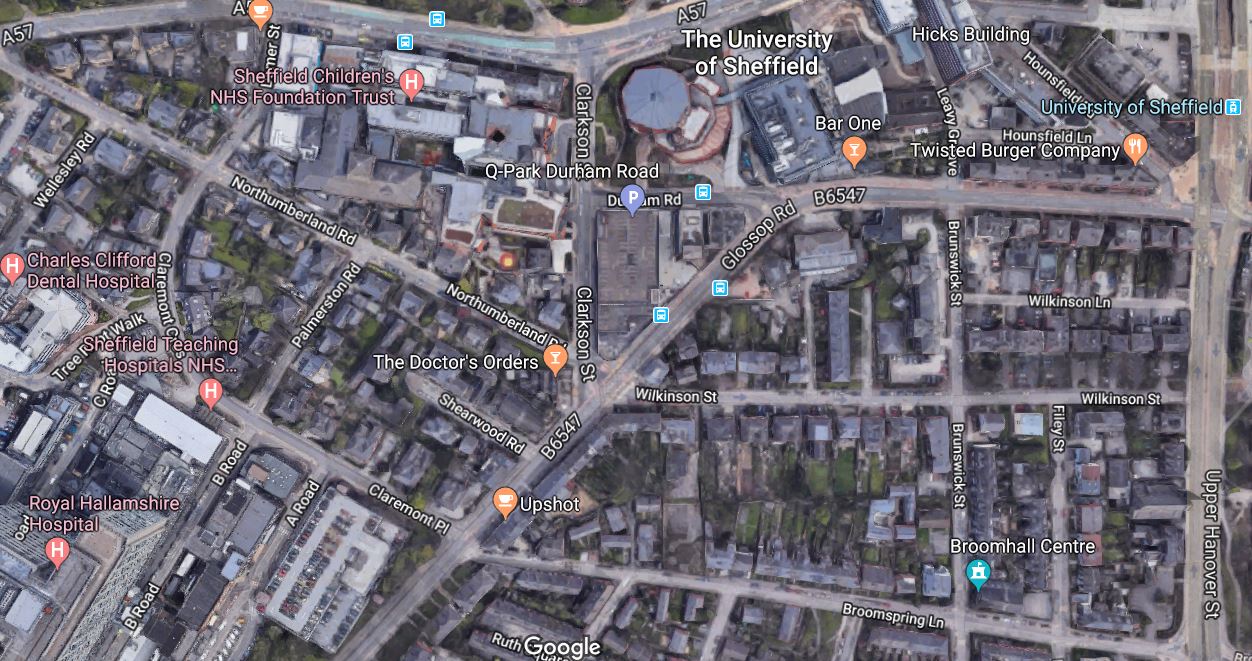
Note.
- The University tram stop is in the North-East corner of the map and is marked by a blue dot, marked with University of Sheffield.
- The Royal Hallamshire Hospital is in the South-West corner of the map.
This Google Map shows the University of Sheffield tram stop and how the tram route turns East to go to and from the city centre.
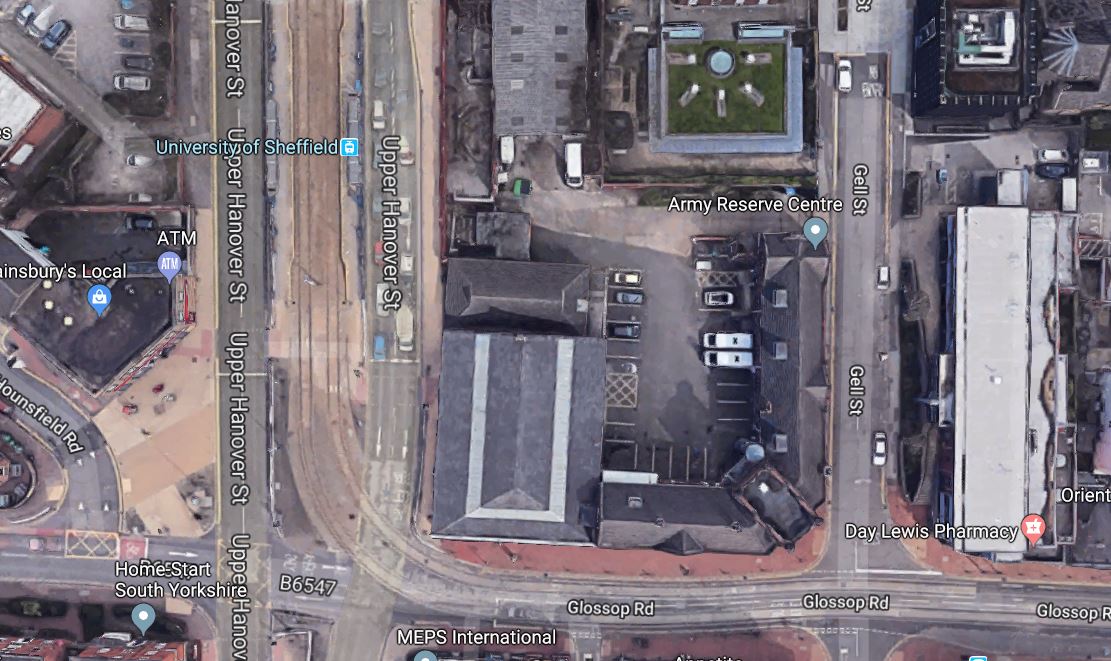
If the terrain allows it, a short extension might be possible to be built to the West along Glossop Road.
- As in Birmingham City Centre, the tram-trains could run on batteries, without any overhead wires.
- Charging could be provided at the terminal station which could be a few minutes walk to the hospital.
- The hospital and the university could be a good terminus for tram-trains from Rotherham and the East.
This is a typical extension, that is made easier and more affordable by the use of trams with a battery capability.
Connecting The Supertram To Heavy Rail
The Sheffield Supertram was designed before tram-trains existed, but even so there would seem to be several places, where the two systems could be connected.
The design of the Class 399 train-trams also makes the connections easier to design and build.
- The tram-trains can take tight turns.
- There are various innovative solutions, that allow the pantograph to ride from one electrification system to the other.
- If the tram-trains have batteries, this helps the electrification system changeover.
As more tram-train systems are installed, the library of solutions will get larger. As Electrification specialist ; Furrer and Frey have their UK subsidiary based in Nottingham, Sheffield could play a big part in the evolution of tram-train systems.
Tram-Train To Doncaster
There is a two trains per hour (tph) Northern service that goes between Sheffield and Doncaster, stopping at Meadowhall, Rotherham Central, Swinton, Mexborough and Conisbrough.
- One train continues to Hull and the other to Adwick.
- The service takes forty minutes from Doncaster to Sheffield.
- The service goes past the Rotherham Parkgate tram-train stop.
- The service takes about twenty minutes to go from Rotherham Parkgate to Doncaster, which is a distance of around 11.5 miles.
There is surely scope to extend the tram-train service to Doncaster to improve links between Sheffield, Rotherham and Doncaster.
This Google Map shows the Rotherham Parkgate tram-train stop.
Note how the tram-train stop is effectively a siding alongside the double-track Dearne Valley Line, that links Rotherham Central with Leeds and York. It also has a link to Doncaster via the short Swinton-Doncaster Line.
Space would appear to have been left to convert the line through the tram-train stop to a loop. With an additional cross-over at the Eastern end of the stop, it would be possible to extend the tram-train service beyond its current terminal.
I have a map, which shows that the routes to Doncaster and along the Dearne Valley Line to where it crosses the Leeds-Doncaster Line could be electrified in the early 2020s.
If this electrification is carried out, then the tram-train service could easily be extended to Doncaster.
On the other hand, as Rochester Parkgate to Doncaster is around 11.5 miles and the route will have 25 KVAC overhead electrification at both ends, would it be possible for a tram-train with batteries to bridge the gap in the electrification?
Comparing a three-section Class 399 tram-train with a two-car battery/electric Class 230 train shows that the two vehicles have similar lengths, weight and passenger capacities.
As Vivarail have managed to fit 400 kWh of batteries under a Class 230 train, I wouldn’t be surprised to see at least 200 kWh of batteries squeezed under a Class 399 tram-train.
So would 200 kWh of battery power be sufficient to take a Class 399 tram-train between Rotherham Parkgate and Doncaster?
It should be noted that the total power of a Class 399 tram-train is 870 kW, so it wouldn’t be possible if the tram-train was on full power all the time.
But.
- The route is along the River Don and appears to be not very challenging.
- Regenerative braking can be used at the three stops and any other stops due to red signals.
- The initial acceleration at both ends could be accomplished under a short length of electrification.
- The tram-trains will probably have been designed to use the lowest level of energy possible.
- The tram-train could run in a low energy mode, when under battery power.
Stadler also know that handling a route like this on battery power would be an important sales feature all round the world.
Tram-Train To Dore & Totley
Running a tram-train service to Dore & Totley station in the South West of Sheffield seems to keep being mentioned.
When it was planned that HS2 was going to Meadowhall, this document was published. This was said about connecting Dore & Totley station to HS2.
Improved rail access to Meadowhall from south-west Sheffield could also be considered – for
example, a frequent service between Dore & Totley and Meadowhall could be included.Proposed future transport schemes include the tram-train project; if successful, this could be extended to allow further interchange possibilities at the HS2 station.
But HS2 is now going to the main Sheffield station.
This will probably mean.
- The route between Sheffield and Chesterfield will be upgraded and electrified, with I suspect extra tracks.
- The electrified lines will pass through Dore & Totley station.
- HS2 will need frequent connecting services from all over South Yorkshire into Sheffield station.
Dore & Totley and the stations on the Hope Valley service have a truly inadequate erratic hourly service to both Sheffield and Manchester.
There are two compatible solutions.
- A four tph regional solution of a train between perhaps Hull and Manchester stopping at Doncaster, Rotherham Central, Sheffield and a few stations on the Hope Valley Line.
- A higher frequency Sheffield solution of a train between perhaps Doncaster and the stations near to Sheffield on the Hope Valley Line.
The first service would be an advanced bi-mode train, whilst a tram-train with batteries could be ideal for the second
.Consider using a tram-train with batteries on the second service.
- It could use batteries on the Hope Valley Line to avoid electrification.
- It would serve Sheffield and Meadowhall stations.
- It could use heavy rail or tram routes in between the two major stations.
- It could provide a high frequency service between the two major stations.
There are a lot of possibilities and the transport planners will know the best things to do, with respect to traffic.
Tram-Train To Penistone
In Riding The Penistone Line, I described a trip on the Penistone Line.
This was my conclusion.
Tram-trains like the Class 399 tram-train could easily climb the hill to Penistone to provide a perhaps two trains per hour service to Sheffield.
But the line would need to be electrified or hybrid diesel tram-trains, as in Chemnitz will need to be used.
So perhaps Northern‘s plan for the Northern Connect service, which would use more powerful Class 195 diesel multiple units, might be better suited to the Penistone Line.
I think the heavy rail solution will be used.
Conclusion
I think that tram-trains with batteries will find a few worthwhile uses in the wider Sheffield area.
 The Anonymous Widower