I’m Getting A New Hydrogen-Ready Boiler
The pump in my current nine-year-old boiler has died and it needs to be replaced.
The plumber gave me two solutions.
- Put a new pump in the old boiler.
- Replace the boiler with the current version of the old boiler.
Note.
- The plumber said the new boiler would be hydrogen-ready.
- I seem to remember the same pump failed before.
- The pump had failed because of a water-leak into its electrics.
- Was the previous failure of the pump caused by the same water-leak?
- Fitting a heat pump in my house would probably cost more than I could afford.
- The new boiler would come with a ten-year guarantee.
As an engineer, I can see the following scenarios for heating my house and providing hot water.
1. Keeping Calm And Carrying On
This means that the current arrangements for energy continue.
- There would be no compulsory heat pumps.
- There would be no change to any of my hardware, after installing the new boiler.
- I would continue to get gas for heating and hot water delivered through the mains.
The new boiler solution should give me ten years of reasonably trouble free-running, so long as the gas was natural gas, hydrogen blend or hydrogen.
2. Keeping Calm And Carrying On But My Energy Supplier Switches My Gas To 20 % Hydrogen-Blend
This means that the current arrangements for energy continue.
- There would be no compulsory heat pumps.
- There would be no change to any of my hardware, after installing the new boiler.
- I would continue to get gas for heating and hot water delivered through the mains.
- The gas pipe into my house would have to be checked for compatibility with hydrogen-blend. But then I encountered no problems when switched from coal-gas to North Sea Gas around 1970.
The new boiler solution should give me ten years of reasonably trouble free-running, so long as the gas was natural gas, hydrogen-blend or hydrogen.
3. Keeping Calm And Carrying On But My Energy Supplier Switches My Gas To 100 % Hydrogen
This means that the current arrangements for energy continue.
- There would be no compulsory heat pumps.
- There would be no change to any of my hardware, after installing the new boiler.
- I would continue to get gas for heating and hot water delivered through the mains.
- The gas pipe into my house would have to be checked for compatibility with hydrogen.
The new boiler solution should give me ten years of reasonably trouble free-running, so long as the gas was natural gas, hydrogen blend or hydrogen.
4. Switching To Some Form Of Heat Pump
- This would mean that I would go all electric.
- My house is a concrete lump and a guy I trust, said it would be difficult to fit a heat pump.
- I am suspicious of scientific and technical solutions proposed by politicians.
I’m not saying, I’d never use a heat pump, but I will take a lot of convincing.
5. Switching To Some New Form Of Electric Heating
I have seen two companies, which use the excess heat from a data centre to heat water for central heating and/or hot water for domestic needs.
- heata is a spin out from Centrica, that provides hot water and saves you money on your utility bill.
- thermify is a startup from Wales, that replaces the gas boiler, with an electric one.
There are probably other similar systems under development.
From my knowledge of computing and electrical engineering, I believe devices like this could be new form of cost-efficient electric heating.
Because my house has three-bedrooms, I would need a thermify, for both heating and hot water, but a heata working in tandem with my gas boiler could probably keep me in hot water.
I would feel that large blocks of flats or offices could have a data centre in the basement to provide heat for the building.
I would also suspect, that there are other devices out there, that work on different principles.
My Decision
I’m fitting a new boiler, as that should give me ten years’guarantee-backed and trouble free running and future-proof me for all possible government decisions, except saying that everybody must fit a heat pump.
When, this new boiler pops its clogs, i would hope, that some clever engineers have come up with a plug-compatible electric replacement for the new boiler I am about to have fitted.
Singapore’s First Hydrogen-Powered Data Center Launched By DayOne Using SOFC Technology
The title of this post, is the same as that of this article on Fuel Cell Works.
These two bullet points act as sub-headings.
- DayOne has broken ground on its first AI-ready hyperscale data center in Singapore, a 20MW facility set to be operational in 2026. The project integrates 100% renewable energy, SOFC-based hydrogen power generation, and cutting-edge hybrid cooling technologies.
- Strategic partnerships with Sembcorp and NUS will drive green energy adoption and R&D in sustainable tropical data center innovation, aligning with Singapore’s AI and digital infrastructure goals.
This data centre and the companies and the technologies behind it, are certainly ones to watch.
The R & D and innovation behind it could allow data centres to be built in more tropical places than is currently possible.
National Grid Starts Work On New Substation In Buckinghamshire To Power Data Centres
The title of this post, is the same as that of this press release from National Grid.
These three bullet points act as sub-headings.
-
New substation site at Uxbridge Moor in Buckinghamshire will power new data centres –delivering economic growth and enabling UK digitalization
-
Site to feature two SF6-free gas-insulated switchgear (GIS) substations to minimise environmental footprint
-
Work comes as National Grid is planning £35 billion investment in its transmission network between 2026 to 2031
This is the first paragraph.
National Grid is starting work on its new Uxbridge Moor substation in Buckinghamshire which will connect over a dozen new data centres to its network.
This Google Map shows the current Iver substation.
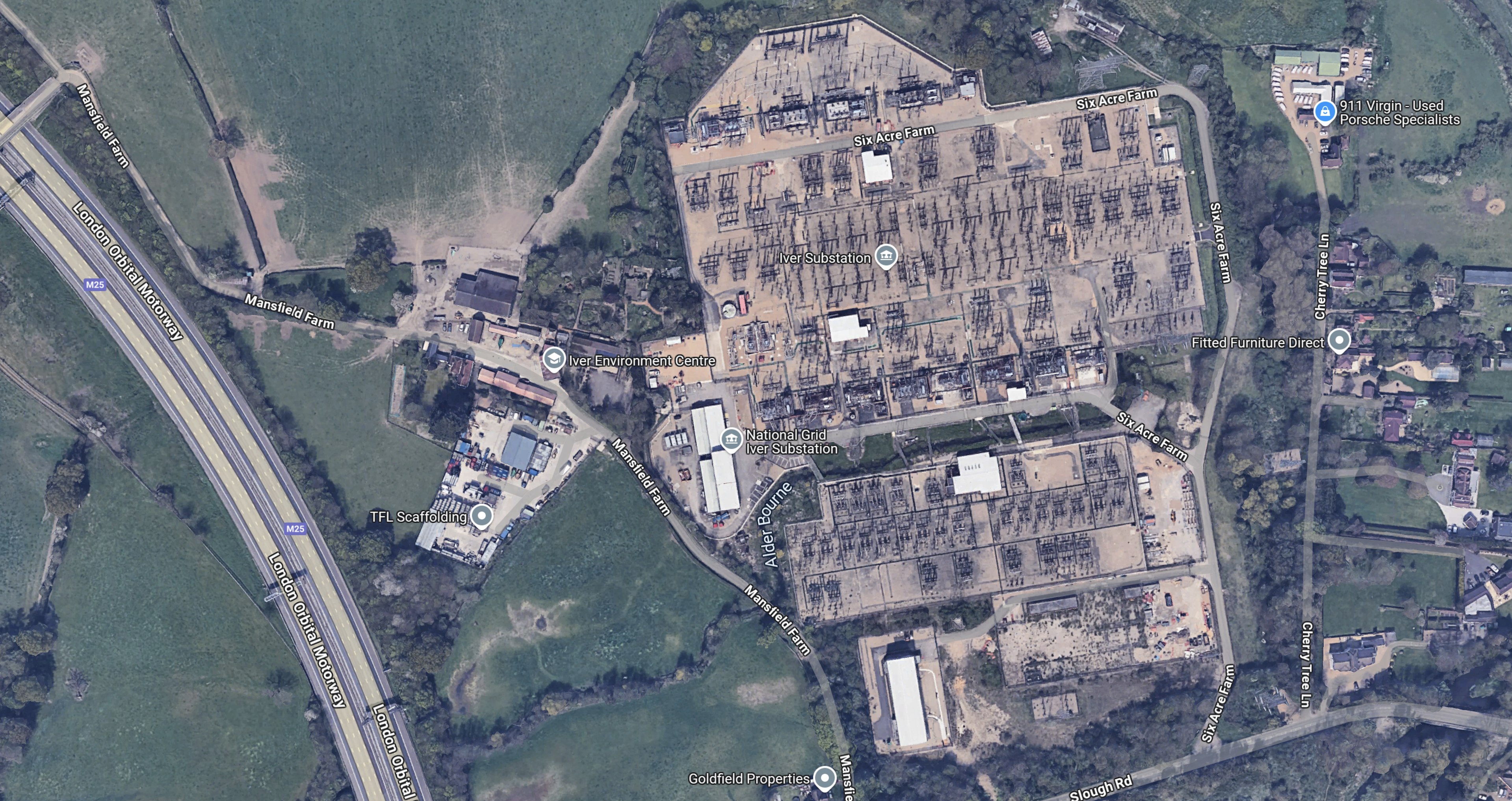
The road on the left is Western section of the M25, which gives an idea of the size of the substation.
These two paragraphs give more details of the new Uxbridge Moor substation.
The requests from data centres to connect at Uxbridge Moor will require around 1.8GW of new capacity, equivalent to adding a mid-sized city to the grid on the outskirts of London. When built, it will be the largest new substation on National Grid’s network by gigawatt capacity.
The new substation site borders National Grid’s existing Iver 400kV substation in Buckinghamshire, which has reached capacity and cannot be expanded to meet the demand from data centres and other customers for connections in the area.
Nothing about the new substation appears small!
The cost of the Uxbridge Moor substation does not appear to have been disclosed by National Grid, but they do say this about their projected total spend in the next few years.
National Grid is planning £35 billion of investment between 2026 to 2031 to connect both large sources of demand such as data centres and gigafactories, and new sources of electricity generation such as wind and solar.
But then it’s not their fault, that the UK is a superb place for renewable energy and we generally speak English.
Could A Highview Power CRYOBattery Provide Backup Power For A Large Data Centre?
I asked Google AI how much power does a data centre need and got this answer.
The power requirements for an average data center vary greatly depending on its size and purpose, ranging from 1-5 MW for small facilities to 20-100 MW or more for large hyperscale centers. Small data centers, typically with 500-2,000 servers, might need 1-5 MW of power, while large or hyperscale data centers, housing tens of thousands of servers, can consume 20-100 MW or even more.
As Highview Power are currently building four 200 MW/2.5 GWh CRYOBatteries for the UK, I am fairly sure the answer is in the affirmative.
AI Forecast To Fuel Doubling In Data Centre Electricity Demand By 2030
The title of this post, is the same as that as this article in The Times.
This is the sub-heading.
International Energy Agency predicts that artificial intelligence could help reduce total greenhouse gas emissions
These are the first two paragraphs.
Data centres will use more than twice as much electricity by 2030 than they do today as artificial intelligence drives demand, the International Energy Agency predicts.
The agency forecast that all data centres globally will use about 945 terawatt-hours of electricity each year by 2030, roughly three times as much as the UK’s total annual demand of 317 terawatt-hours in 2023.
I am very much an optimist, that here in the UK, we will be able to satisfy demand for the generation and distribution of electricity.
- Our seas can accommodate enough wind turbines to provide the baseload of electricity we will need.
- Roofs and fields will be covered in solar panels.
- SSE seem to be getting their act together with pumped storage hydro in Scotland.
- I am confident, that new energy storage technologies like Highview Power with the packing of companies like Centrica, Goldman Sachs, Rio Tinto and others will come good, in providing power, when the wind doesn’t blow and the sun doesn’t shine.
- Hopefully, Hinckley Point C and Sizewell C will be online and soon to be joined by the first of the new small modular nuclear reactors.
- Hopefully, Mersey Tidal Power will be operating.
- There will be innovative ideas like heata from Centrica’s research. The economical water heater even made BBC’s One Show last week.
The only problem will be the Nimbies.
Sunset Studios Pivots From Plan To Develop Major Soundstage Complex Outside US
The title of this post, is the same as that of this article on the Hollywood Reporter.
This is the sub-heading.
Operator Hudson Pacific and investment giant Blackstone had envisioned a 91-acre site in North London to have 21 soundstages totaling 470,000 square feet.
These two paragraphs give more details.
Plans have been formally put on hold for a 91-acre film and TV soundstage complex outside of London that had been billed as a major foray for the Sunset Studios brand outside the United States.
Sunset Studios, owned by operator Hudson Pacific along with significant investor Blackstone, had announced the project in 2021 during what may have been the height of the streaming content spending boom on film and TV projects.
This Google Map shows the site today.
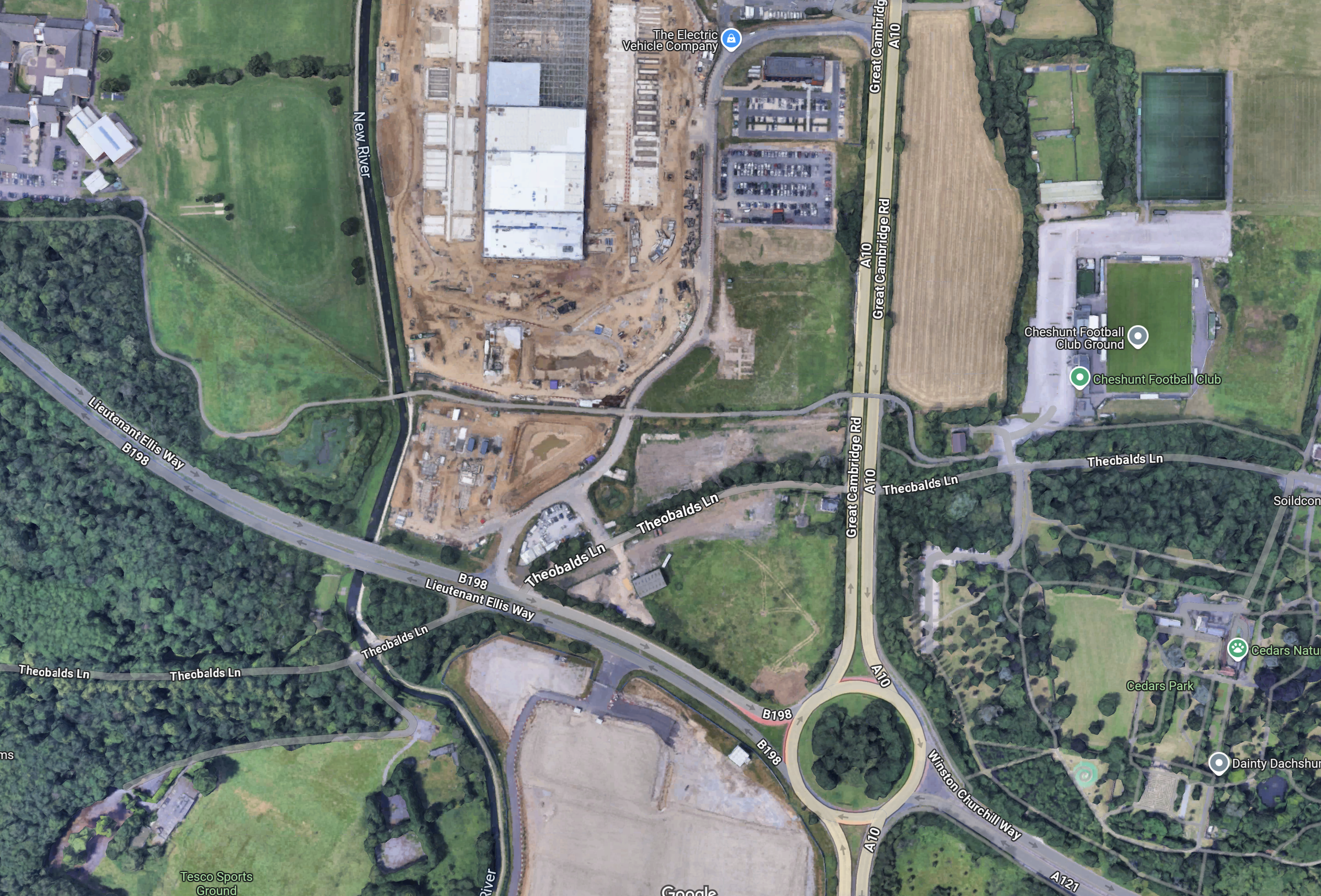
Note.
- The North-South road is the A10.
- The roundabout , is where Winston Churchill Way meets the A10.
- The dual-carriageway going West from the roundabout is Lieutenant Ellis Way.
- Construction of a data centre for Google seems to have started to the North-West of the roundabout.
- Lieutenant Ellis Way would have separated the data centre from the studios.
In Google Starts Building £790m Site In Hertfordshire, I say more about building the data centre.
This Google Map shows the area South of the roundabout, where Winston Churchill Way meets the A10.
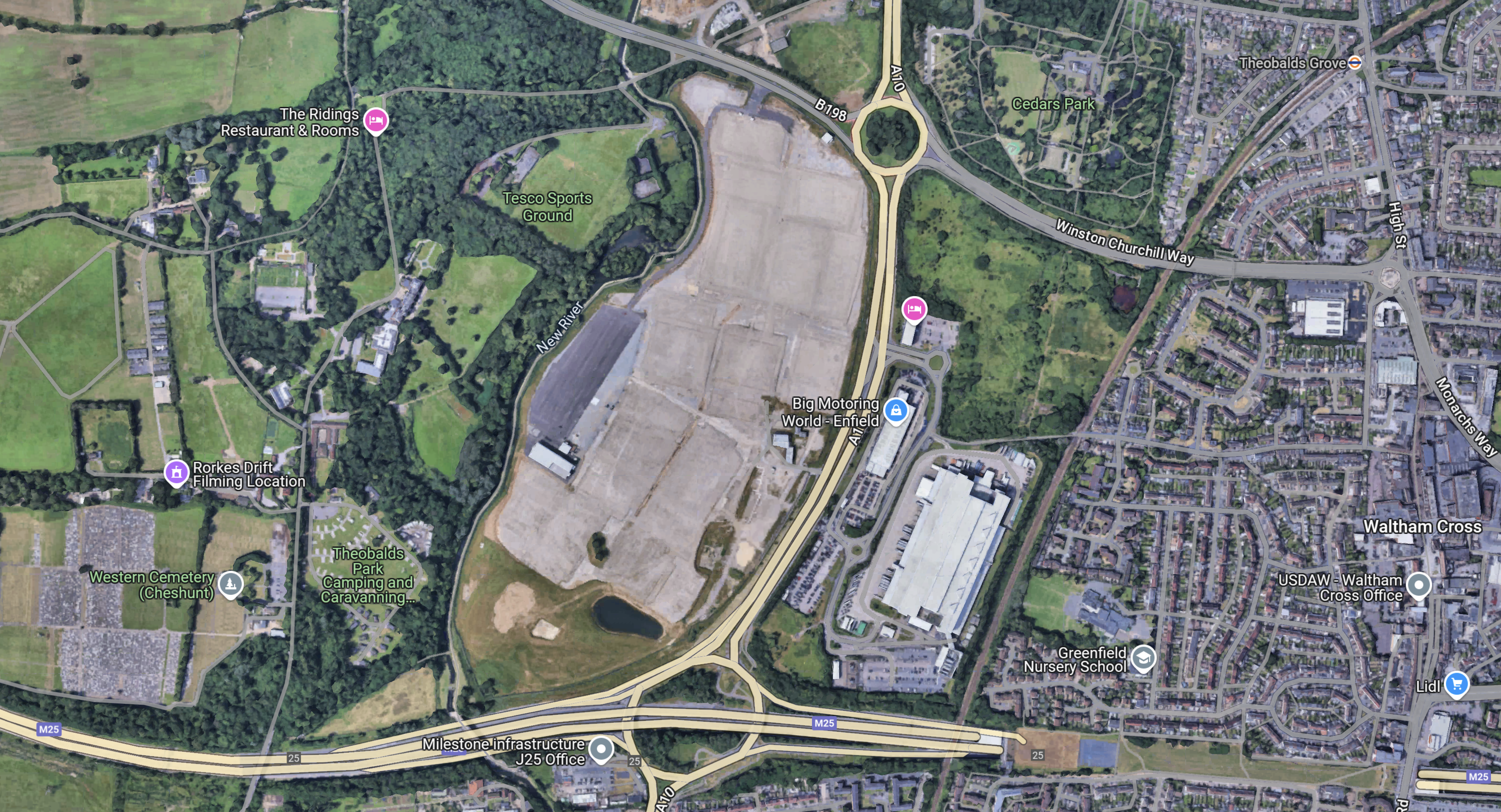
Note.
- The North-South road is the A10.
- The green patch of land to the South-East of the roundabout where Winston Churchill Way meets the A10 appears to be ripe for development.
- Looking at the green patch with a higher resolution, the land is little more than high class scrub beloved of newts.
- The London Overground line to Cheshunt runs down the East side of the site.
- To the North, the London Overground crosses Winston Churchill Way to get to Theobalds Grove station.
- To the South, the London Overground crosses the M25 to get to Turkey Street station.
- The M25 runs across the bottom of the map, through junction 25.
- The site to the West of the A10 between the two roundabouts, was the site reserved for Sunset Studios.
- The site appears to have been concreted.
What is going to happen to the Sunset Studios site now?
Blackstone Secures Approval For $13bn Hyperscale Data Centre In UK
The title of this post, is the same as that of this article in Private Equity Insights.
This is the sub-heading.
Blackstone has received approval from Northumberland County Council to move forward with its $13bn hyperscale data centre project in North East England.
These three paragraphs add detail.
The investment marks a major push by the private equity giant into the fast-expanding digital infrastructure sector, as demand for data storage and cloud computing surges.
The project, covering 540,000 square metres, represents one of the largest data centre developments in Europe. It is expected to bring significant economic benefits to the region, creating 1,200 long-term construction jobs, hundreds of permanent operational roles, and up to 2,700 indirect positions.As part of its commitment to the local economy, Blackstone has pledged £110m to support job creation and economic growth along the Northumberland Line, a newly launched railway corridor. Find out more and meet Blackstone at the Italy Private Equity Conference in Milan.
The Northumberland Line cost £300 million to build. Adding £110 million for job creation and economic growth looks to be a good return for the North-East.
Conclusion
As we have the power, perhaps we should add a few more hyperscale data centres around our coasts.
British Gas Partners With heata On Trial To Reuse Waste Heat From Data Processing
The title of this post, is the same as that of this news item from Centrica.
This is the sub-heading.
British Gas has partnered with sustainable cloud computing provider, heata, on an innovative trial to explore how harnessing waste heat generated by computer servers can save households money on their bills.
These two paragraphs describe heata’s system.
heata’s innovative model distributes cloud computing workloads to servers in homes. In a data centre, the heat generated during processing is a waste product, and energy-intensive cooling systems are required to stop the servers from overheating.
To overcome this, heata has created a ‘virtual data centre’ – a network of servers distributed in people’s homes. Each server is attached to the home’s hot water cylinder, and as they process data, the heat they generate is transferred into the water. This reduces the energy needed to heat water in the home, and as this is typically provided by gas boilers, it reduces the amount of gas used, lowering the carbon impact as a result. heata pays for the electricity the heata unit uses, which means the household pays less to heat their hot water.
Note.
- I would expect that future systems would also heat the house.
- I would be an ideal system for my house, as I have an unusual skin, that is better with a daily bath.
- I also wash my eyes most days with clean warm water, as they are often full of sleep.
- heata has a web site.
- heata has an about page, which describes the company and the technology.
- heata is supported by British Gas, Innovate UK and Sustainable Futures.
- Thermify is a similar system.
These three paragraphs describe the trial.
As part of a three-month trial, 10 heata units will be installed in the homes of British Gas employees, and the energy provider’s computing workloads will be processed on these units. As a result British Gas will be providing free hot water for its own employees as a byproduct of their own cloud compute.
The trial will provide feedback around performance and customer experience, as well as demonstrating the associated CO2 and energy cost savings to further co-develop customer propositions in 2025.
According to heata, the devices can provide up to 4kWh of hot water per day, with the technology expected to save households up to £340 per year when offsetting electrically heated hot water, and up to £120 when offsetting gas heated hot water.
I shall certainly think about fitting one.
£10bn Investment In AI Data Centre Confirmed
The title of this post, is the same as that of this article on the BBC.
This was the sub-heading.
A £10bn investment in a new artificial intelligence data centre will create about 4,000 jobs, the government has said.
These two paragraphs add more details.
The site in Cambois, near Blyth, Northumberland, will become one of Europe’s biggest AI data centres.
The land was bought by private equity giant Blackstone earlier this year, after the collapse of Britishvolt which had planned to build an electric car battery factory on the site.
In My First Trip On The Northumberland Line – 18th December 2024, I said this after my first trip to the line.
The Blyth Valley Is Well Supplied With Electricity
Several high-capacity connections to wind farms and Norway are planned to come ashore at Blyth and it appears from the pictures that the area is well connected to the grid.
This must have nudged Britishvolt to put their battery plant at Blyth.
But no matter for those jobs, as with a rail service to Greater Geordieland and lots of electricity, there must be other energy-hungry businesses like datacentres or small modular reactor factories, who would want the site.
The Long Platforms
I am fairly sure that some of the platforms have been sized to take a five-car Hitachi Class 80x train, which are only 130 metres long and can carry around 400 passengers.
This must enable the ability to use the Northumberland Line as a diversion for the East Coast Main Line.
Some services could perhaps stop at Blyth for the large factories and/or Northumberland Park for the Metro.
It looks to me, that the Northumberland line was designed for large factories or businesses with lots of workers, that needed lots of electricity.
My First Trip On The Northumberland Line – 18th December 2024
Yesterday, I took Lumo to Newcastle and took my first ride to Ashington on the Northumberland Line.
These are some of the pictures I took.







































































































Note.
- Much of the route is double-track.
- Bridges over the tracks indicate, that some stations will have two platforms.
- I suspect some stations could take a five-car train.
- One guy said that there is a lot of landscaping to do.
- The standard is very similar to the Borders Railway.
I have some other thoughts.
The Blyth Valley Is Well Supplied With Electricity
Several high-capacity connections to wind farms and Norway are planned to come ashore at Blyth and it appears from the pictures that the area is well connected to the grid.
This must have nudged Britishvolt to put their battery plant at Blyth.
But no matter for those jobs, as with a rail service to Greater Geordieland and lots of electricity, there must be other energy-hungry businesses like datacentres or small modular reactor factories, who would want the site.
The Long Platforms
I am fairly sure that some of the platforms have been sized to take a five-car Hitachi Class 80x train, which are only 130 metres long and can carry around 400 passengers.
This must enable the ability to use the Northumberland Line as a diversion for the East Coast Main Line.
Some services could perhaps stop at Blyth for the large factories and/or Northumberland Park for the Metro.
It looks to me, that the Northumberland line was designed for large factories or businesses with lots of workers, that needed lots of electricity.
Development North Of Ashington
This OpenRailwayMap shows the area North of Ashington.
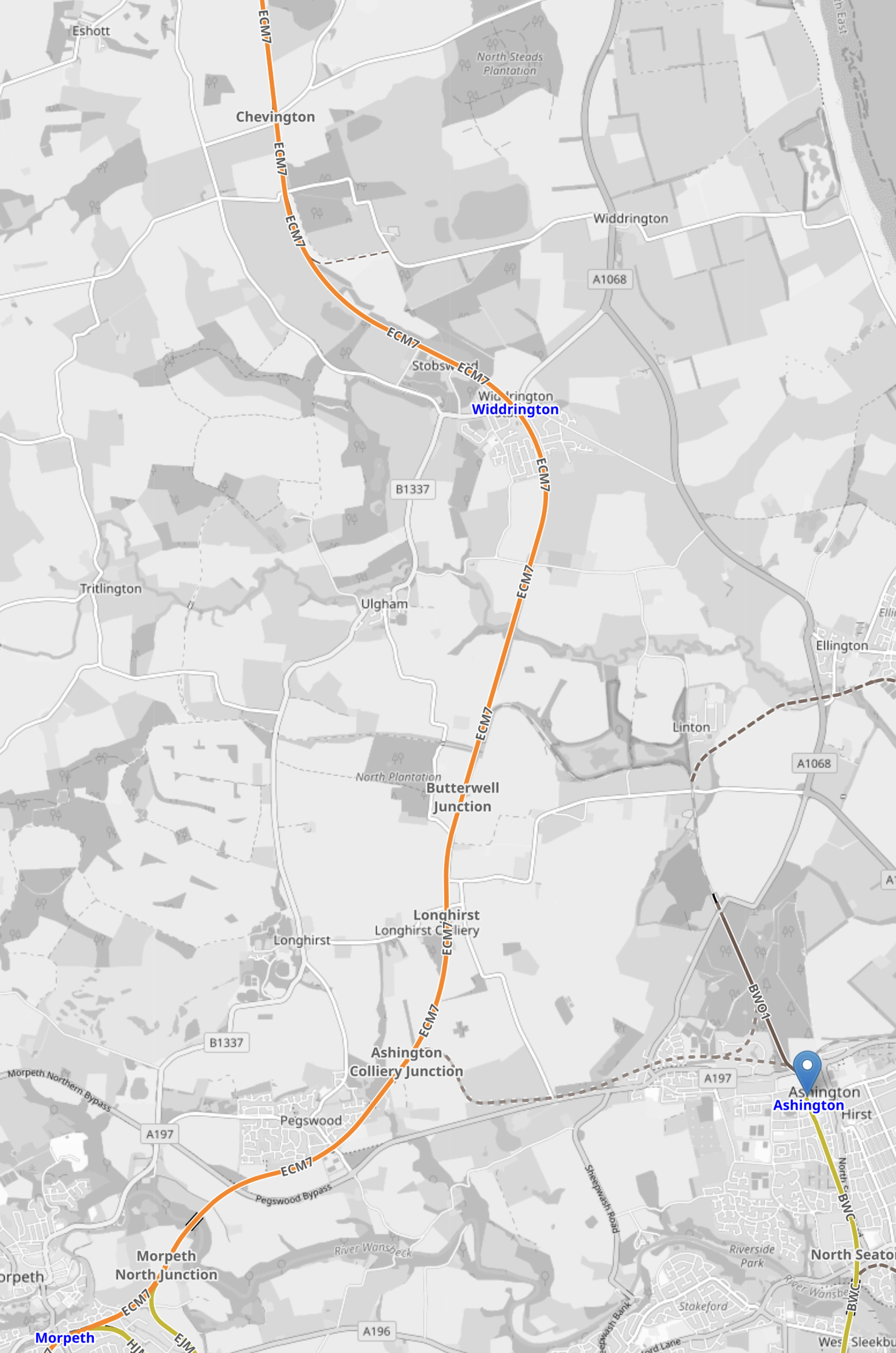
Note.
- The orange line going up and down the map is the East Coast Main Line.
- Morpeth station is in the South-West corner of the map.
- Ashington station is in the South-East corner of the map.
I think there might be scope to develop this area to make the heavy components needed for wind farms and small modular reactors,
 The Anonymous Widower