British And French Engineers Can Work Together
In the Sunday Times today, they are talking about a £4billion project to import electricity into the UK from Iceland, It is called Icelink and it would appear to have the backing of both the UK and Iceland governments. There’s more about it in this article in Utility Week.
So it got me thinking about undersea electricity connections around the world. There is a list of them here. And there is forty-four of them
Perhaps the best known is the connection between Kent and France, which is called the HVDC Cross Channel. It is actually the second one and it has been running for nearly thirty years. A section in Wikipedia describes its significance.
Since the commissioning of the 2,000 MW DC link in the 1980s, the bulk of power flow through the link has been from France to Britain. However, France imports energy as needed during the summer to meet demand, or when there is low availability of nuclear or hydroelectric power.
As of 2005 imports of electricity from France have historically accounted for about 5% of electricity available in the UK. Imports through the interconnector have generally been around the highest possible level, given the capacity of the link. In 2006, 97.5% of the energy transfers have been made from France to UK, supplying the equivalent of 3 million English homes. The link availability is around 98%, which is among the best rates in the world. The continued size and duration of this flow is open to some doubt, given the growth in demand in continental Europe for clean electricity, and increasing electricity demand within France.
So it would appear it’s been successful and proves that we can work with the French on an engineering project.
It strikes me that we need to connect all of our power systems together in Western Europe. The UK is being connected to Ireland, Iceland and Norway and the Netherlands, Belgium and Germany are getting in on the act.
What you won’t find from reading about the cables, but you will in some newspaper articles, is that Norway will have the ability to store electricity in a pumped storage system in the future.
So when the wind is blowing and we have too much electricity, the Norwegians will pump water from a low to a high lake and when we want it back, the water will be released through a turbine. It’s like putting your KWh in a bank!
The High Speed Train Got Through
I’ve just found this clip of video on the BBC’s web site.
It just shows the sort of conditions that these trains of the 1970s can withstand. It also shows why they will never electrify this line between Exeter and Plymouth.
This other video shows the work going on to repair the line. Note the wall of shipping containers filled with ballast to give protection to the workings and properties by the railway line. But even these have been breached, as is reported here on ITV.
It’s all extreme engineering at its most way out. Hopefully the engineers will win, but it should lead to better techniques for the next set of problems.
My IKEA Furniture Now Has Some Brass Knobs!
My house has a theme of dark black-brown steel beams fitted together with brass fittings.
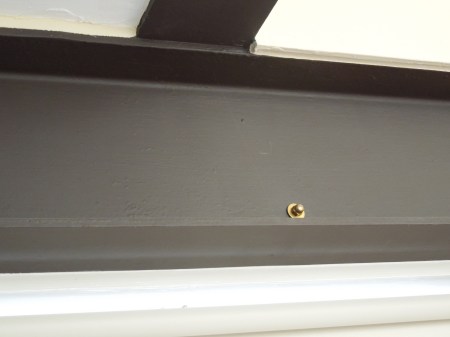
Dark Steel And Brass Bolts
When I bought the house, it still had Jerry’s gold-painted steel bolts, which I have replaced with real brass ones. Even if some might be just be real bolts glued into Jerry’s crude holes.
So when I bought some of IKEA’s Expedit boxes, which are just the right colour for the beams, I was disappointed that they only come with natural aluminium knobs.
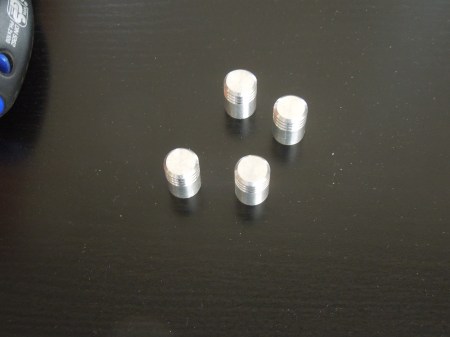
IKEA’s Aluminium Knobs
So it was off to Birmingham by train to visit Honeyglen Anodising in Sparkbrook to see what they could do. I’ve now got the trial batch and here’s one in place.

Expedit With Brass Knobs
I’ve now got to get all the others together and send them off to Birmingham. I am getting them in a pretty standard brass colour, but there are more details here of the colours available.
The Engineer Who Fixed His Own Heart
This story from the BBC’s web site is almost beyond belief, but it is totally true. Here’s the intro.
As an engineer, Tal Golesworthy is no stranger to taking things apart, figuring out what the trouble is and putting them back together with the problem solved.
But for more than 30 years, he lived with a life-threatening issue that was less easy to fix.
That is, until he took an idea from the garden, combined it with some basic procedures borrowed from the aeronautical industry and came up with a “beautifully simple” solution to treat his own heart condition.
He then managed to convince surgeons to put it into him.
That was nine years ago, and he’s still here!
Perhaps we need to train doctors more in simple engineering techniques.
Keyhole Surgery For Gas Mains
I like this story from the Standard, as it shows how good design and clever technology can make the solving of everyday problems, quicker and easier. Here’s the first paragraph.
A £1m robot will today complete work repairing gas mains in London without having to dig a single hole in the street in a UK first that it is claimed will save thousands of hours of disruption to motorists.
It may have cost a lot, but how much did it save?
Getting Ready For The Flat Pack Station
Custom House station on Crossrail has been described as the flat-pack station, like in this article in the Standard. Here’s the first paragraph.
A £35 million “flatpack” station for Crossrail is being built hundreds of miles from London in a first for the rail industry.
The new station for Custom House is taking shape in a factory near Sheffield, pictured left, before being transported to London for assembly in 2015.
The question has to be asked, if they will be bringing the station to London by train.


The pictures show the state of the site, with lots of work going on.
If we can buy flat pack furniture from IKEA and their ilk, why can’t Crossrail use similar suppliers?
Phyllis And Ada To Be Buried Alive
This headline from a magazine, seems like something consistent with Halloween.
But it’s not!
The headline actually is from the Crossrail update on the back page of this month’s Modern Railways. It tells how, the two tunnelling machines; Ada and Phyllis, will be left in the ground rather than recovered. The two machines are named after Ada Lovelace and Phyllis Pearsall respectively.
This does seem to be a pity, especially, as they cost ten million pounds each, but getting some of them out will be a very difficult, dangerous and expensive job. I also suspect that there isn’t much of a second-hand market for specialist tunnelling machines, which generally seem to be built for a particular set of conditions and sizes. Crossrail are actually using two different types of machine for their project. There’s more about the tunnelling here.
Speeding Past The Hitchin Flyover
The Hitchin Flyover, is compared to HS2, a fairly miniscule piece of railway infrastructure.


According to this article, it will cost £47 million and save 30,000 minutes a year in train schedules.
I have this feeling, that engineers know of similar schemes, that would benefit UK railways all over the country. But most of them aren’t very sexy for politicians.
Will We Get HSW Before HS2?
In this post about the BBC’s knocking of HS2, I jokingly referred to the Great Western Main Line as HSW, for High Speed West or High Speed Wales.
But is it that far from the truth?
A high speed railway is defined as one where speeds of 200 kph or 125 mph are possible. The fastest lines run at 320 kph or 200 mph.
So what speed can we expect to see on the Great Western Main Line, after it is fully modernised in 2017?
Currently the fastest trains in the UK are the Class 373 ( 300 kph) used by Eurostar, the Class 390 ( 225 kph) used by Virgin and the InterCity 225 (225 kph) used by East Coast. The latter two trains are restricted to 200 kph, due to signalling restrictions on their lines and because they have to mix it with slower trains.
It is also interesting to note that the Class 395, which bring the high speed Kent commuter services into St. Pancras run at 225 kph.
The new trains for the electrified Great Western Main Line are based on the Class 395 and are called Class 800 and Class 801. These have a design speed of 225 kph, but will be limited to 200 kph on traditional lines.
But Brunel built the Great Western for speed and a lot of the route it is pretty straight and much has four tracks. It is also going to be resignalled to the highest European standards with in-cab signalling. The latter is necessary to go above 200 kph. So it shouldn’t be one of the most difficult tasks to make much of the line capable of 225 kph or even more.
The only real problem on the line is the Severn Tunnel. But as Crossrail has shown, we have some of the best tunnel engineers in the world. So just as the Swiss dealt with their railway bottleneck of the Simplon Tunnel, all we need to do to improve the Severn Tunnel is give the best engineers their head and let them solve the problems, whilst the politicians sit around and watch and wait. After all it’s only a baby compared to the massive twin bores of the Simplon.
As an aside here, I do wonder if one of the most affordable solutions might be to use a modern tunnel boring machine to create a new tunnel alongside the current one.
Conclusion
So I believe that even if it still goes slower on opening, trains to Bristol and Wales will be doing 225 kph before the end of this decade.
If that isn’t a high speed railway like HS1, I don’t know what is?
But whatever we call it, it’ll be here several years before HS2!
I think we need to call for three cheers for Brunel, who got the route right in the first place.
Do They Use These Doors In Pyramids?
I saw this door opening method in several places in Italy.
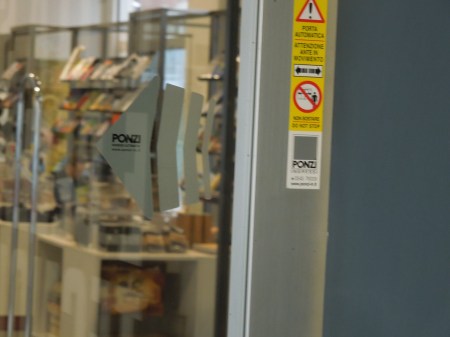
Do They Use These Doors In Pyramids?
They seemed to work well, so they could be described as a good Ponzi system.
This web site explains all about the company.
And this one explains about Ponzi schemes.
 The Anonymous Widower