Rio Tinto Orders Wabtec FLXdrive Battery Locomotives To Reduce Emissions
The title of this post, is the same as that of this press release from Wabtec.
This is the introductory paragraph.
Wabtec Corporation (NYSE: WAB) and Rio Tinto announced today an order for four FLXdrive battery-electric locomotives to support sustainable operations of the mining company’s rail network in the Pilbara region of Western Australia. The 100-percent, battery-powered locomotive will help Rio Tinto’s effort to achieve a 50-percent reduction in Scope 1 and 2 carbon emissions by 2030.
Some other points from the press release.
- The locomotives have 7 MWh batteries.
- The first locomotive will be delivered in 2023.
- The FLXdrive is anticipated to reduce the company’s fuel costs and emissions in percentage by double digits per train.
This paragraph describes how the FLXdrive locomotives will be used.
The mining company plans on using the locomotives in multiple applications including as a shunter in the railyard and ultimately in mainline service. In mainline operations, Rio Tinto currently uses three diesel-electric locomotives in a consist to pull trains with 240 cars hauling about 28,000 tons of iron ore. The FLXdrives will transition from the diesel locomotives in mainline service to form a hybrid consist, and recharge during the trip through regenerative braking and at charging stations. Wabtec’s next generation energy-management software system will determine the optimal times to discharge and recharge the batteries along to route ensuring the most fuel-efficient operation of the entire locomotive consist during the trip.
I can see this approach leading to even bigger fuel and emission savings.
Especially, if Wabtec developed a compatible locomotive, that was powered by hydrogen.
This was rumoured in FLXdrive ‘Electrifies’ Pittsburgh, where a partnership between Carnegie-Mellon University (CMU), Genesee & Wyoming and Wabtec to create the Freight Rail Innovation Institute was described.
Conclusion
There certainly seems to be a consensus between some of the world’s largest mining and rail companies about the future of heavy freight trains to support the mining industry.
Canadian National Buys Battery Locomotive
The title of this post, is the same as that of this article on Railway Gazette.
This is the first paragraph.
Canadian National’s Bessemer & Lake Erie Railroad has purchased a Wabtec FLXdrive battery-electric freight locomotive, with financial support from the Pennsylvania Department of Environmental Protection’s Marine & Rail Freight Movers grant programme.
The locomotive is intended to work in multiple with diesel locomotives and this cuts fuel consumption, pollution and noise.
I described the locomotive in FLXdrive ‘Electrifies’ Pittsburgh and the more I learn about this locomotive the more I like it.
The locomotive numbered 3000, which appears in all Wabtec pictures is an example an ES44AC from the GE Evolution Series and was converted from a standard locomotive, that was in the test fleet.
Interestingly, Canadian National own several hundred of these locomotives, so they won’t be short of one to convert.
The diesel version would appear to be a 3.3 MW diesel locomotive.
In addition, this page on the Wabtec web site gives some details of the battery-electric locomotive.
- The locomotive is powered by lithium-ion batteries.
- There are around 20,000 battery cells
- The batteries have their own air-conditioning
- There is a sophisticated battery-management system.
- The total battery size is 2.4 MWh
- Power output is 4400 HP or 3.24 MW
- Locomotive will run for 30-40 minutes at full power.
- The locomotive has regenerative braking.
- Operating speed is 75 mph
Note that running at 75 mph for 40 minutes would cover fifty miles.
It does look as if, the diesel-electric and the battery-electric conversion have similar power outputs. Could this be, as the traction system on both locomotives are identical? It’s just that one uses a diesel generator and the other uses batteries.
Although there must be differences in the traction systems, as the battery-electric locomotive has regenerative braking.
The battery-electric locomotive is designed to work in conjunction with one or two diesel locomotives, where a sophisticated computer system decides which engines power the train.
- Wabtec are claiming a thirty percent reduction in fuel and emissions compared to an all-diesel setup.
- Electric power will also be used in depots and sensitive areas.
I do think though, that this is a pragmatic solution to cut the carbon footprint of heavy-freight in North America.
But it could be a half-way solution, as Wabtec have hinted that they are working on hydrogen-powered locomotives.
I also feel it might be possible to convert some of the UK’s Class 66 locomotives into battery-electric locomotives for lighter freight duties or working in a pair with a Class 66 locomotive to reduce fuel consumption and emissions.
I discuss this in Could Class 66 Locomotives Be Converted Into Battery-Electric Locomotives?
Have CN Bought The Prototype?
There is also this article on the Green Car Congress, which is entitled CN Purchases Wabtec’s Battery-Electric Locomotive.
The article seems fairly certain they have.
So perhaps, they want to get on with the job and see what the locomotive can do?
‘Dramatically More Powerful’: World’s First Battery-Electric Freight Train Unveiled
The title of this post, is the same as that of this article in The Guardian.
It is a good article about Wabtec’s new FLXdrive battery train and is very positive about it coming from a typical Guardian direction.
The article is a must-read.
I am beginning to feel that what Wabtec has done is to create a practical and affordable solution, that will cut carbon emissions in a difficult area, that produces the figures and also is understandable by diverse groups, like journalists, politicians and environmentalists. And they are backing it with academic research from a good university.
I also believe that the technology can be applied to existing locomotives as I outlined in Could Class 66 Locomotives Be Converted Into Battery-Electric Locomotives?.
Could this be another example of positive environmental change brought about by when the big beasts play their cards in the jungle?
Going green is a way of company survival! And Wabtec are going in that direction.
Could Class 66 Locomotives Be Converted Into Battery-Electric Locomotives?
This picture shows a Freightliner Class 66 locomotive passing through Stratford with a multimodal freight train.
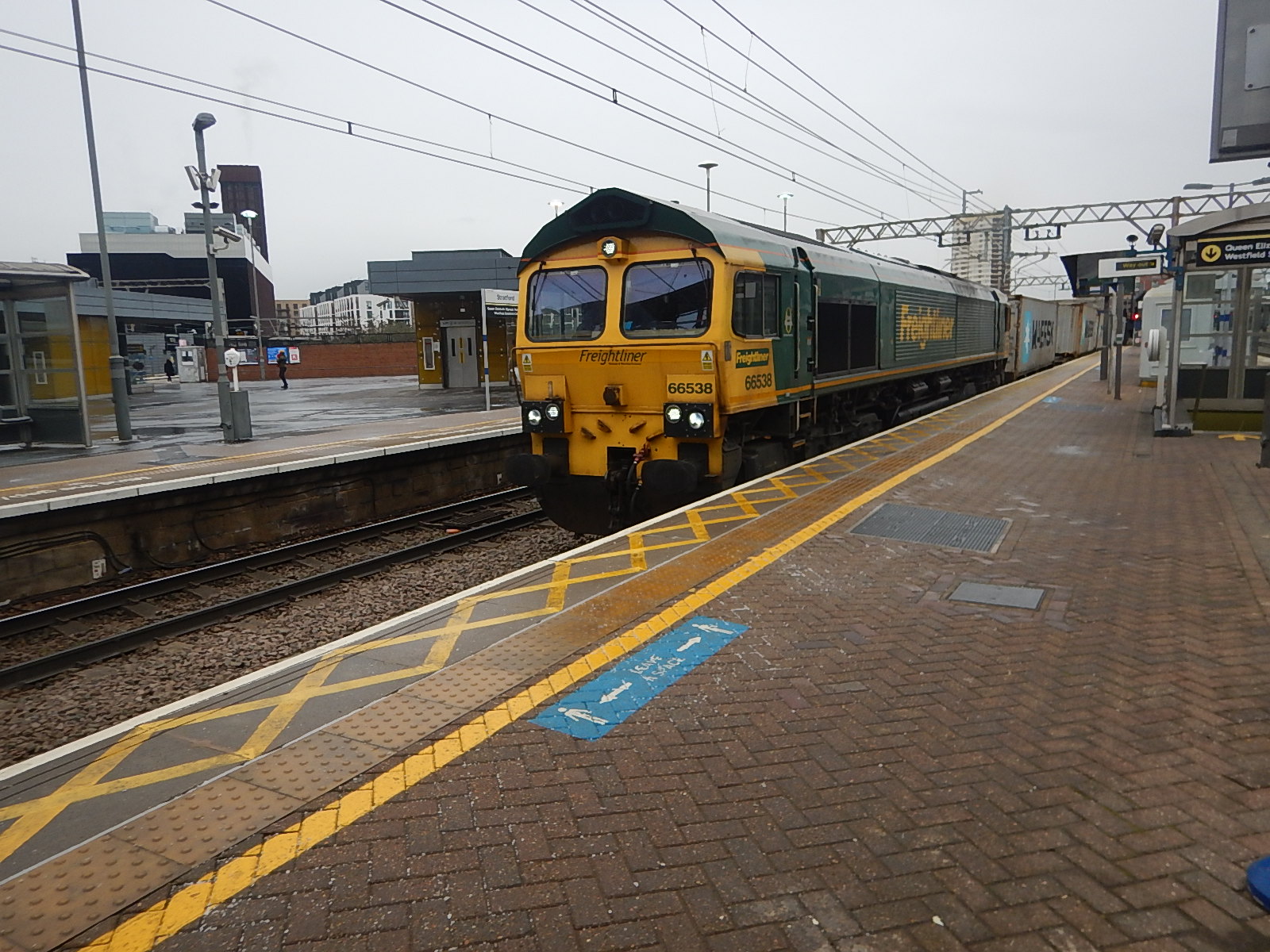
These are a few thoughts on converting some of the four hundred and eighty Class 66 locomotives into battery-electric locomotives.
An Estimate Of Performance Of A Battery Electric Class 66 Locomotive
In Iron Ore Miner Orders Heavy-Haul Battery Locomotive, I said this about a UK-sized locomotive based on Wabtec’s FLXdrive battery-electric technology.
I could envisage Wabtec designing a UK-sized battery-electric locomotive with these characteristics.
- 2.5 MW power output, which is similar to a Class 66 locomotive.
- A battery size of perhaps 1.8 MWh based on Wabtec’s FLXdrive technology.
- A pantograph to charge the batteries and also power the locomotive where electrification exists.
- 75 mph operating speed.
- Ability to work in tandem with a Class 66 locomotive.
All technology is under Wabtec’s control.
This locomotive could have a range of at least fifty miles on battery power, doing the sort of duties that Class 66 locomotives do!
So it would be able to take a multimodal container train out of the Port of Felixstowe to the electrification at Ipswich.
The Class 66 Locomotive Is Diesel-Electric
The Class 66 locomotive is a diesel-electric locomotive, where the diesel engine drives an alternator, which generates electricity, which then powers the six traction motors, which are arranged, so that there is one on each of the six axles.
This should make conversion easier, as the heavy lump of the engine and the alternator would be replaced with a large number of lithium-ion batteries.
Wabtec Has A Modular Battery System
This article on Railway Age gives a lot of detail and several pictures of the modular FLXdrive battery system.
- Each module is a 4.9 kWh battery, that weighs 72.6 Kg.
- Batteries are arranged into strings, which feed the traction motors.
- There is a sophisticated control system, which ensures that a module failure doesn’t disable the locomotive.
- The battery system is air-cooled.
I would expect that Wabtec could arrange a number of modules in the stripped out body of a Class 66 locomotive.
The FLXdrive Battery System Handles Regenerative Barking
The Railway Age article says this.
Battery charging while the FLXdrive is operating occurs through regenerative dynamic braking.
This will certainly improve efficiency.
Could A Pantograph Be Fitted To A Class 66 Locomotive?
This picture of a Class 66 locomotive was taken at Peterborough.

Note the 25 KVAC overhead electrification and the gap between the wires and the roof of the locomotive.
I don’t think it would the toughest job to design a pantograph for a Class 66 locomotive.
What Would Be The Use Of A Battery Electric Class 66 Locomotive With A Fifty Mile Range?
I believe that a surprising number of duties currently handled by Class 66 locomotives could be performed by a battery-electric Class 66 locomotive.
- The locomotives would effectively be electric locomotives with a last fifty mile capability.
- The number of possible duties will increase as electrification increases.
- They would be ideal to support track maintenance activities.
- They would be a zero-carbon locomotive with a low noise footprint.
As I said earlier, they should be able to haul a heavy intermodal train out of the Port of Felixstowe.
Would A Battery-Electric And A Diesel-Electric Class 66 Locomotive Working As A Pair Be Able to Handle The Heaviest Trains?
As the Americans and Canadians have shown with more than one locomotive, where one is a battery-electric locomotive can reduce the carbon-emissions, the same rules must apply in the UK.
Conclusion
I am not a lover of the smelly, noisy and polluting diesel Class 66 locomotives, but it does look it could be possible to convert some into battery-electric locomotives.
I wouldn’t be surprised to see Wabtec convert some Class 66 locomotives into battery-electric locomotives.
I also believe, that conversion of Class 66 locomotives to battery-electric operation could be the most affordable way to help decarbonise rail freight.
FLXdrive ‘Electrifies’ Pittsburgh
The title of this post, is the same as that of this article on Railway Age.
The article describes Wabtec’s FLXdrive locomotive, as “the world’s first 100% battery, heavy-haul locomotive”
It is well worth a read, as it describes some of the design philosophy.
In addition, this page on the Wabtec web site gives some details of the locomotive.
It is powered by lithium-ion batteries.
- There are around 20,000 battery cells
- The batteries have their own air-conditioning
- There is a sophisticated battery-management system.
- The total battery size is 2.4 MWh
- Power output is 4400 HP or 3.24 MW
- Locomotive will run for 30-40 minutes at full power.
- The locomotive has regenerative braking.
- Operating speed is 75 mph
Note that running at 75 mph for 40 minutes would cover fifty miles.
The Railway age article has this paragraph, which describes a partnership between Carnegie-Mellon University (CMU), Genesee & Wyoming and Wabtec to create the Freight Rail Innovation Institute.
CMU, Genesee & Wyoming and Wabtec also hope to create the Freight Rail Innovation Institute, described as “the first-of-its-kind effort to create zero-emission locomotives, develop technology that increases freight rail utilization and improve safety by 50%, and create 250,000 jobs by 2030.” G&W’s Buffalo & Pittsburgh Railroad will pilot technologies developed by the Freight Rail Innovation Institute, including a zero-emissions battery and hydrogen-powered train that is planned for revenue operation on 200 miles of track between Pittsburgh and Buffalo, N.Y. within the next three years.
Note.
- The paragraph is very much a mission statement.
- Genesee & Wyoming are the parent of Freightliner in the UK, who are developing a dual-fuel locomotive, that I wrote about in Freightliner Secures Government Funding For Dual-Fuel Project.
It strikes me CMU, Genesee & Wyoming and Wabtec are on the right track.
 The Anonymous Widower