Watford Junction Station’s Barrier Seats
I quite like these seats at Watford Junction station.
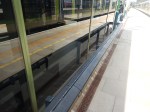
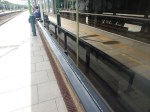
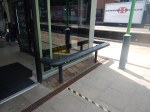

They would appear to give a nice perch to sit, whilst waiting for the train and also act as a crush barrier for the glass shelter behind.
They also give me something to hold, when a train goes through.
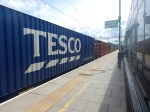
The train shown in the picture was a Tesco train between Tilbury and Daventry.
It went through the station at probably over 60 mph.
It had the usual smelly and polluting Class 66 on the front.
It took four hours 45 minutes for the journey, which included the Gospel Oak and Barking Line through London.
I did note earlier that the train seemed to be using modern wagons.
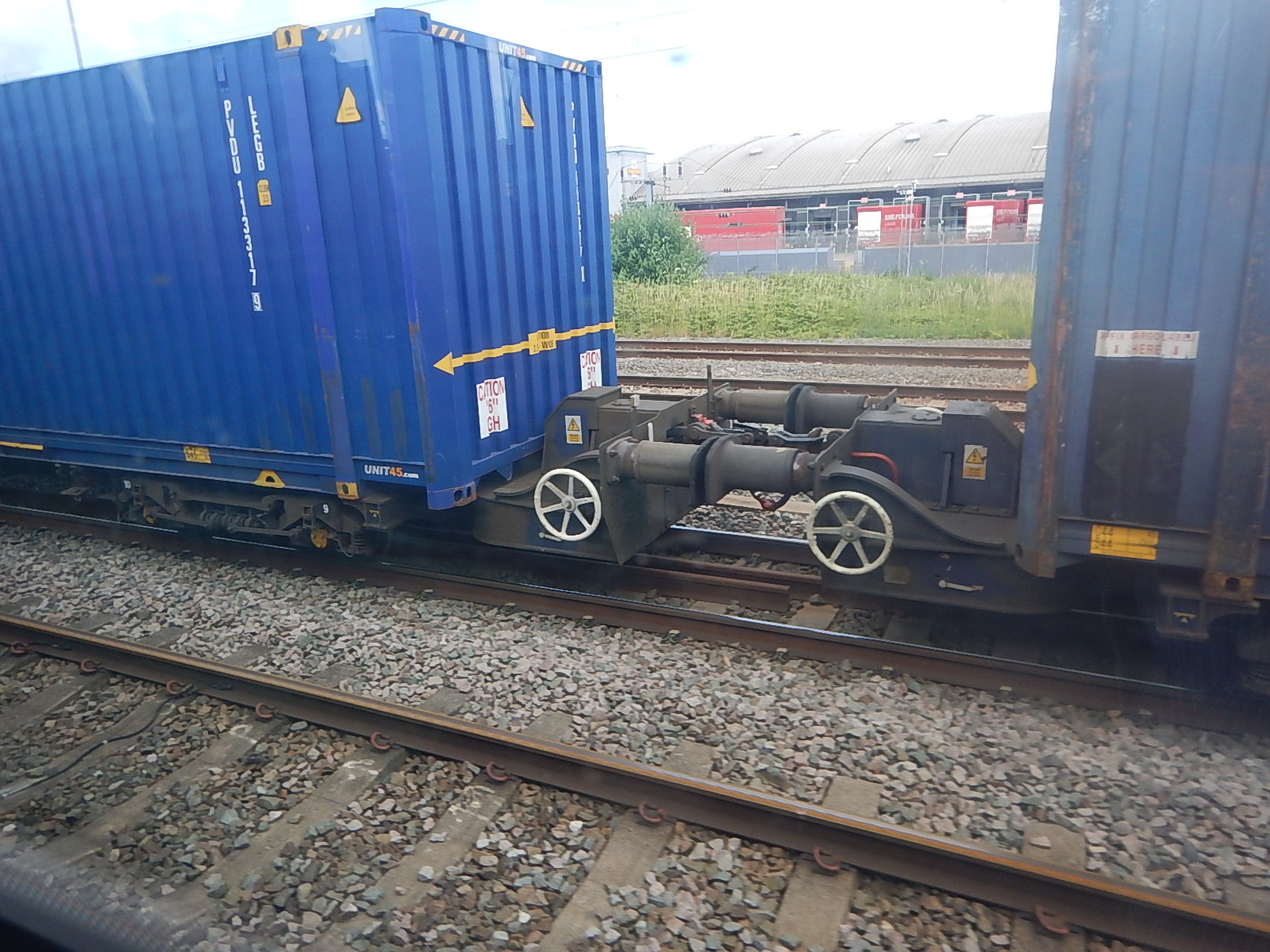
Are these wagons faster than those you generally see on UK railways?
Surely too, this is the type of train, that could be hauled by an electric locomotive with a Last-Mile capability, like a Class 88 Locomotive.
I would have thought, that Tesco could benefit, by using electric haulage, especially if the locomotive was appropriately liveried.
Is This The Shape Of Freight To Come?
This article on Rail Advent is entitled Eversholt Rail Unveils First Swift Express Freight Train In Doncaster.
It is a full report on the first of a new breed of freight trains based on redundant 100 mph electric multiple units.
Three Rail Problems
The rail industry, its financiers and customers have a lot of problems, they’d like to solve, but these three seem to be coming together to create a whole new industry.
Rolling Stock Leasing Companies Have A Surplus Of Redundant Rolling Stock
Most of the released rolling stock has been made redundant because of the arrival of new trains.
- Some trains and locomotives, like Greater Anglia’s Class 379 trains and Class 90 locomotives will probably be passed on to other operators.
- Some trains like Greater Anglia’s Class 315 trains and Govia Thameslink Railway‘s Class 313 trains and Merseyrail‘s Class 507 trains and Class 508 trains will probably only be fit for scrapping.
- Climate change ambitions will probably finish off anything which is elderly and diesel-powered.
What will be left will be a an assortment, which will contain a lot of trains with these characteristics.
- Four cars
- Can run in formations of 4, 8 and 12 cars
- Electrically-powered.
- Some trains are even dual voltage.
- 100 mph operating speed.
- Good reliability.
- Easy maintenance and modification if needed.
Many were even built over thirty years ago by British Rail Engineering Ltd.
As someone, who used to part-own a company that leased trucks to operators, I know that to maximise cash-flow and ultimately profits, you don’t want them sitting in a yard or a siding.
Conversion to zero carbon is one option.
- Porterbrook have said they will convert the Class 350 trains, that they own to battery-electric operation.
- Porterbrook have also converted some Class 319 trains to electro-diesel Class 769 trains.
- Porterbrook have also converted a Class 319 train to hydrogen operation.
- Eversholt Rail Group and Alstom are converting Class 321 trains to hydrogen operation.
I also believe that the redundant Class 379 trains will also be converted to battery-electric operation.
But there will still be a substantial number of quality trains, that need a second life.
The Growth Of Parcel Freight
Parcel freight traffic driven by on-line shopping, has boomed in the pandemic.
This type of traffic often originates from outside of the UK and enters the country at places like London Gateway or East Midlands Airport.
Much of it is currently distributed to large cities by truck, which in this day and age is not a green option, or even an option at all.
Rail Operations Group have leased ten Class 769 trains and 9 Class 319 trains with the intention of running parcel services under the Orion brand. I wrote about this proposal in A Freight Shuttle For Liverpool Street Station Planned.
Road Congestion
Road congestion is getting worse and there is bir much point in having product stuck on the motorway, when it can be running along at a 100 mph on an electrified rail line.
The Need For Just-In-Time Deliveries
Many factories these days work on the Just-In-Time principle, with product delivered just as its needed.
As an example Toyota build their cars at Burnaston near Derby, but the engines are built in North Wales. I suspect that they go across the country by truck.
Looking at maps, the engine plant could be rail connected and I feel one could be arranged at Burnaston.
Do they keep a good stock of engines at Burnaston?
I can see several situations like this needing a regular company train.
Fast Food
Because of Brexit we will need to be growing more of our own food.
Traditionally, the Class 43 power cars of InterCity 125 trains carried flowers and fish up from Cornwall.
So will we see rail provide an alternative.
Conclusion
Put these problems together and you can see a fair number of four-car electric multiple units being converted to short 100 mph electric freight trains.
Eversholt Rail Group‘s Swift Express Freight Train is very much a demonstrator for their ideas and it has some expected and unexpected features.
Based On A Class 321 train
The train is based on a four-car Class 321 train.

I rode one recently and I timed it at over 90 mph on the way to Southend.
Trolley Cages
Pictures in the Rail Advent article show a stripped-bare interior with a steel floor, with another picture showing three supermarket trolley cages arranged across the train.
One estimate in the article says that each coach can handle over fifty of these cages and up to nine-and-a-half tonnes of cargo.
Four Seats And A Toilet
Eversholt feel that some of the trains could be used in a Travelling Post Office mode and there may be a need for sorting en route, so two first-class seats, two second-class seats and a toilet are provided.
This train would enable an Anglo-Scottish parcel service.
- It might stop several times en route.
- At each stop parcels would be rolled out and in, perhaps with the help of a Harrington Hump.
- The on-train staff would sort the incoming parcels and put them in the required trolley for offloading.
I don’t think though, they’ll be delivering postal orders.
A Last Mile Capability
The article also disclosed that Eversholt were thinking of fitting a Last-Mile capability to the Swift Express Freight Train.
Batteries were mentioned and they would obviously work.
But one development recently is Porterbrook’s HydroFlex train, which has converted a Class 319 train to hydrogen power.
- The conversion was done by Birmingham University.
- It appears that all the hydrogen gubbins is underneath the floor, so cargo capacity would not be reduced.
I suspect underfloor hydrogen power could be very viable in an express freight train.
Fleet Size
The article talks of a fleet size of twenty and also says that the first train has been leased to an unnamed parcel distributor in the UK.
East Coast Main Line South Bi-Directional Capability
London has a rail capacity problem, for both freight and passenger trains.
This report from Network Rail is entitled The London Rail Freight Strategy (LRFS).
One of the secondary recommendations of the report is to use the bi-directional capability of the East Coast Main Line to create another freight route through London.
The report explains it like this.
The southern end of the East Coast Main Line, from Kings Cross to Stoke Tunnel (about five miles south of Grantham), is due to be the first part of a national main line to be fully converted to European Train Control System (ETCS) digital signalling.ETCS, because it does not rely on fixed lineside equipment facing one way or another, is bi-directional by nature.
This presents an opportunity for freight to make use of a new routeing at the southern end of the East Coast Main Line, which current signalling and track layout do not permit.
This strategy therefore proposes installing new track layout features that would facilitate this routeing for freight trains, enabling them to take advantage of the bi-directional capability brought about through ETCS deployment.
The main expected change would be the creation of a facing crossover at Bowes Park, to enable southbound freight trains to run onto the Down Enfield Viaduct in the up direction, before continuing onwards to the terminal at Ferme Park or accessing the Gospel Oak-Barking Line at Harringay.
This example shows an advantage of digital in-cab signalling.
This map from cartometro, shows the lines between Bowes Park and Alexandra Palace stations.
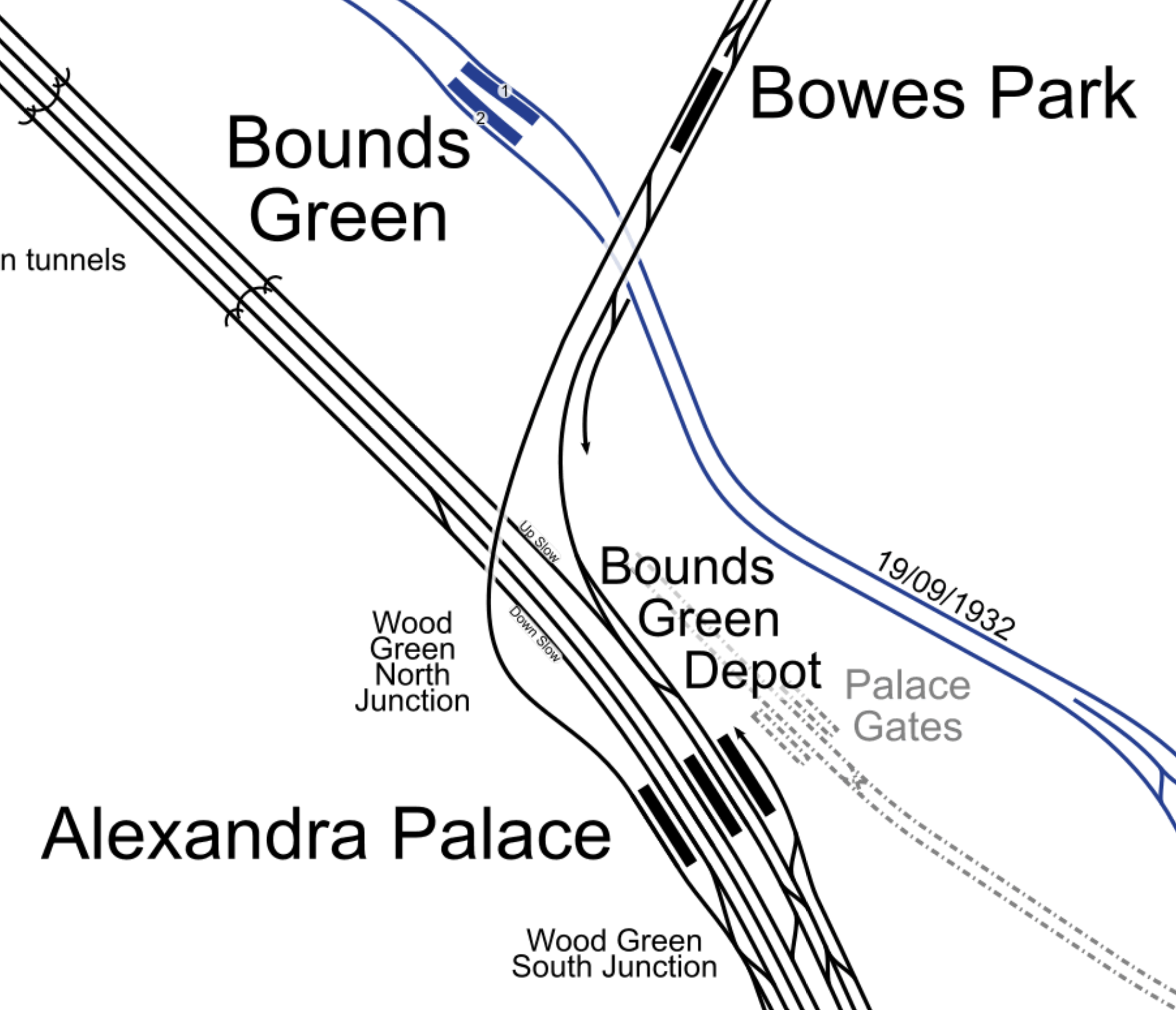
Freight trains coming from the North regularly take the Hertford Loop Line and arrive in North London at Bowes Park
Currently, they sneak down the Eastern side of the East Coast Main Line and then take a route across London, which probably uses the North London Line.
What is proposed is that with an extra crossover just South of Bowes Park station, freight trains will crossover and take Enfield Viaduct the wrong way to the Western side Alexandra Palace station.
The Enfield Viaduct is the track taken from Alexandra Palace station to Bowes Park station, by trains going to Enfield. It takes a bit of a loop to the West.
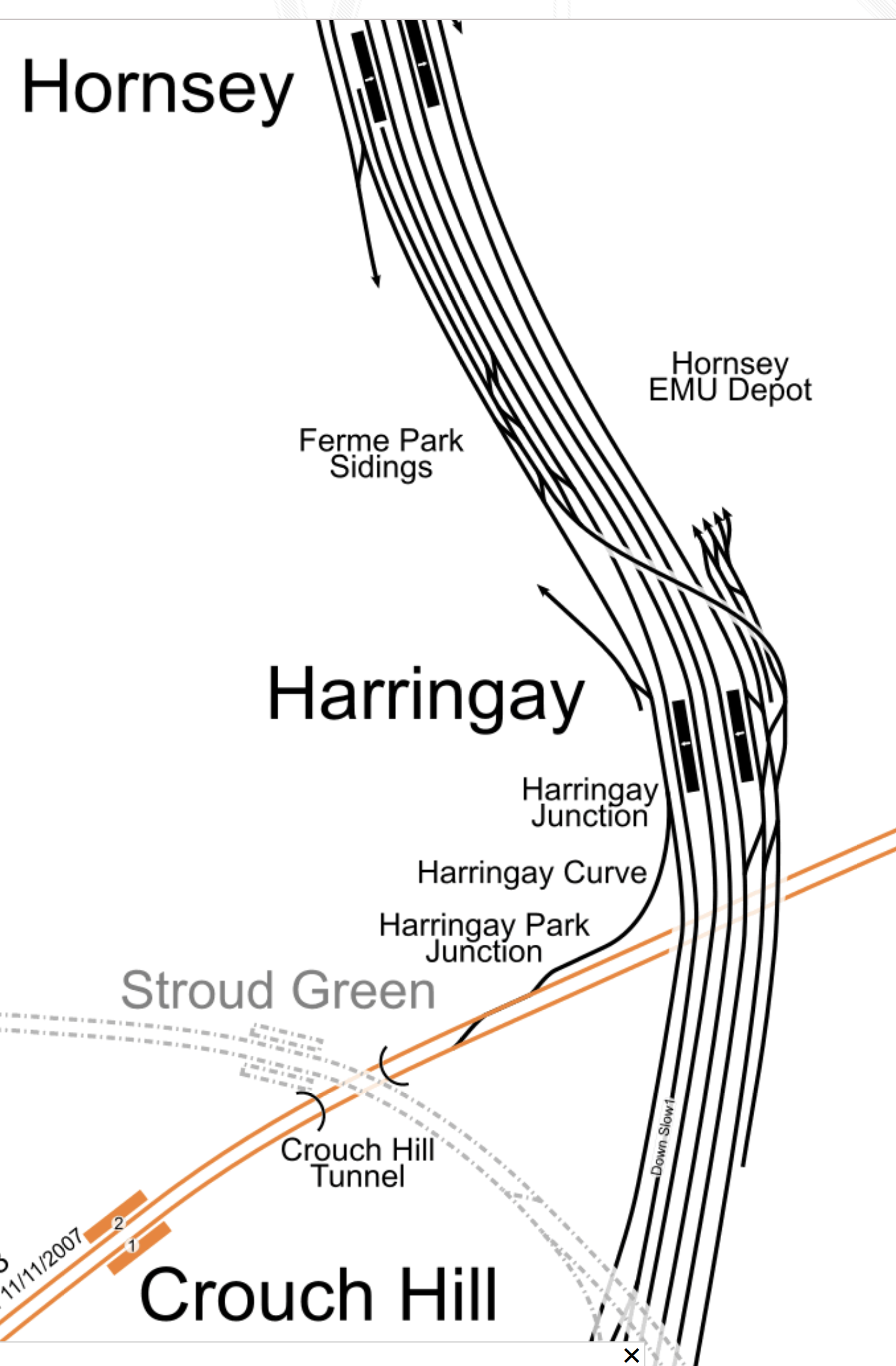
This second map from cartometro, shows the lines South of Alexandra Palace stations.
Note.
- Hornsey is the next station to the South of Alexandra Palace.
- The Eastern side of the East Coast Main Line is crowded with maintenance depots for trains.
- The orange line is the Gospel Oak to Barking Line.
By the use of digital signalling a new freight route through North London can been created.
Conclusion
How many other places can this technique be used?
Related Posts
These are related posts about the London Rail Freight Strategy (LRFS).
Decarbonisation Of London’s Freight Routes
Gauge Improvements Across London
Headway Reductions On The Gospel Oak To Barking, North London and West London Lines
Heavy Axle Weight Restrictions
Kensal Green Junction Improvement
Longhedge Junction Speed Increases
Moving The West London Line AC/DC Switchover To Kensington Olympia
Moving The West London Line AC/DC Switchover To Shepherd’s Bush
Stratford Regulating Point Extension
Gauge Improvements Across London
London has a rail capacity problem, for both freight and passenger trains.
This report from Network Rail is entitled The London Rail Freight Strategy (LRFS).
One of the secondary recommendations of the report is to improve the gauge across London.
The report explains it like this.
The portfolio of options developed from this strategy needs to include a cross-London programme of gauge clearance, to address existing gaps and open up new market opportunities for rail freight in the long-term future.
Priorities in this area include:
- Formal publication of W10 clearance on the North London Line from Kensal Green Junction to Acton Wells Junction. This section is currently only published as W9 but has been used for diversions of W10 traffic in the recent past.
- Further work to understand what would be required to achieve W12 clearance on the North London Line and Gospel Oak-Barking Line.
This stands to enable rail freight to take advantage of emerging opportunities in the short-sea market from the Essex Thameside ports
and is a priority for stakeholders.Continued development work towards gauge enhancement of the Channel Tunnel classic routes, which run through south and west London to Wembley.
The ultimate aim is to progress a programme of clearance works to achieve full W12, but opportunities to deliver incremental improvements by clearing for wagon and box combinations above what is possible today, but short of W12, are also being actively considered.
It appears to me, that a series of well-designed and well-defined projects is needed to update all those places, where loading gauge is insufficient.
In the Felixstowe And Nuneaton Freight Capacity Scheme, Phase 1 included increasing the loading gauge between Peterborough and Nuneaton to a loading gauge of W10.
This scheme involved the replacement of fourteen bridge and eleven tracking lowering/slewing schemes.
Conclusion
Gauge enhancement on a difficult railway has been performed successfully in several places in the UK and the bullet must be bitten to enhance the loading gauge appropriately, through London.
Related Posts
These are related posts about the London Rail Freight Strategy (LRFS).
Decarbonisation Of London’s Freight Routes
East Coast Main Line South Bi-Directional Capability
Headway Reductions On The Gospel Oak To Barking, North London and West London Lines
Heavy Axle Weight Restrictions
Kensal Green Junction Improvement
Longhedge Junction Speed Increases
Moving The West London Line AC/DC Switchover To Kensington Olympia
Moving The West London Line AC/DC Switchover To Shepherd’s Bush
Stratford Regulating Point Extension
Nunhead Junction Improvement
London has a rail capacity problem, for both freight and passenger trains.
This report from Network Rail is entitled The London Rail Freight Strategy (LRFS).
One of the secondary recommendations of the report is to improve Nunhead junction.
The report explains it like this.
Rail freight stakeholders have consistently highlighted Nunhead as a priority location for improving the flow of freight around the London orbital routes. The junction to the immediate east of the station is a flat crossing where two lines of route and multiple passenger and freight services groups converge into the South London Line, creating a pinch point for capacity.
Freight train drivers, when consulted for input into this strategy, flagged the route eastbound from Peckham Rye through Nunhead and towards Lewisham as a challenging section on which to keep heavier trains moving. This is primarily a consequence of the relatively slow permissible speed of 25mph over Nunhead Junction when routed towards Lewisham,
which follows a steadily rising gradient from Peckham Rye.The option proposed by this strategy is for changes to the track alignment in order to increase the speed of the turnout towards Lewisham, as far as can be achieved without affecting the speed of the main route towards Catford. This option would primarily benefit the performance of eastbound freight flowing from the South London Line towards the North Kent lines, one of the key rail freight corridors in the South East, enabling freight trains to run at faster and more consistent speeds towards Lewisham.
This would most likely increase right time presentation at the critical flat junction at Lewisham, as well as assisting the flow of passenger and freight trains to the Catford Loop by ensuring preceding Lewisham-bound traffic can clear Nunhead Junction as quickly as possible.
Addressing the existing constraints to freight traffic through Nunhead, which by their nature most affect the heavier bulk traffic that characterises the North Kent corridor, would also support industry aspirations to maximise the payloads that trains can haul.
This map from cartometro.com shows the route between Nunhead and Lewisham stations.

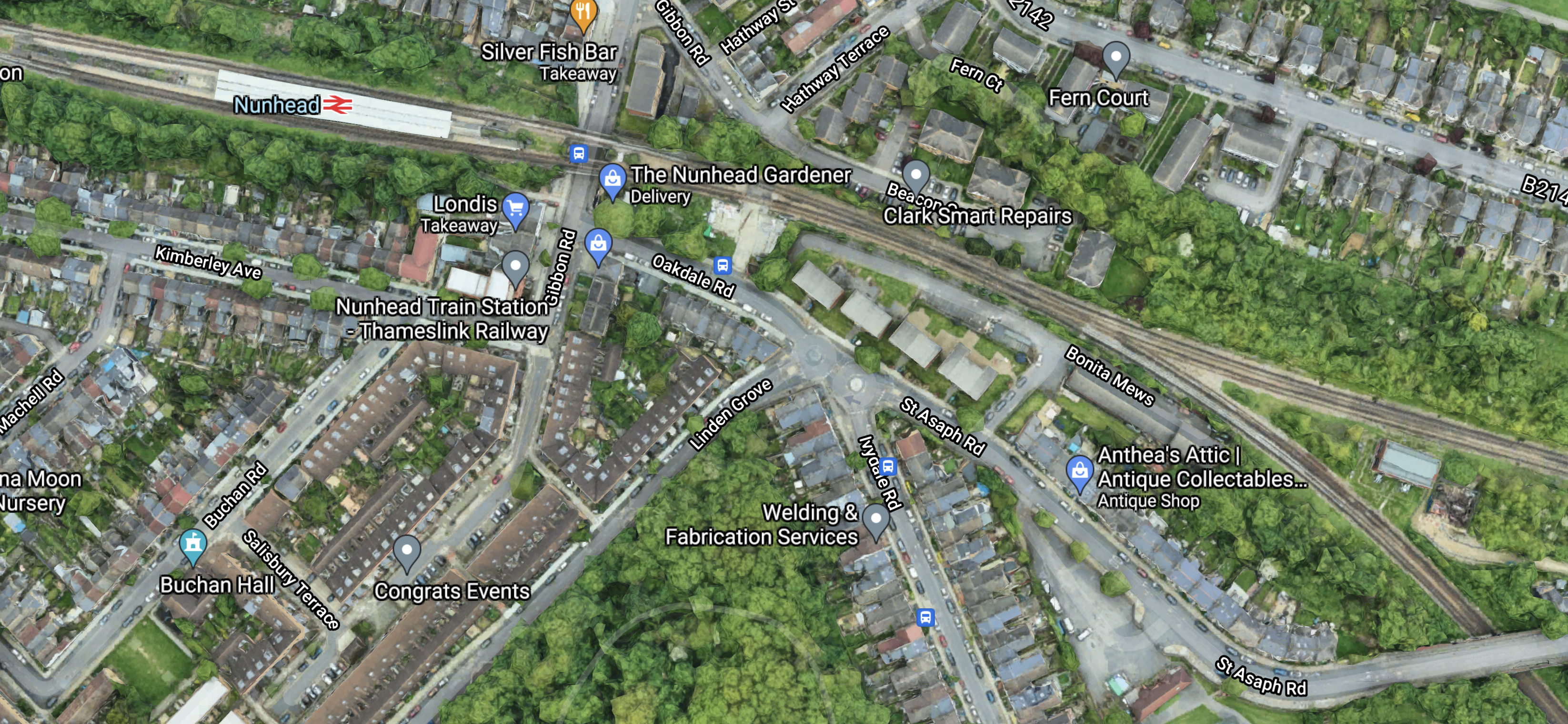
And this Google Map shows Nunhead station and the junction.
Note.
- Nunhead junction is towards the right of the map.
- The lines going to the East go to Lewisham.
- The lines going to the South East go to Crofton Park and Catford.
- I have counted the freight trains through Nunhead junction on real time trains and there can be as main as six trains per hour (tph), through the junction at times, using both Lewisham and Crofton Park routes.
But there would also appear to be plenty of space around the junction to realign the tracks.
As many trains need to go East from Lewisham and there are two flat junctions on the route; Nunhead and Lewisham, anything that improves keeping to schedule is to be welcomed.
The Use Of Electric Haulage
All routes through Nunhead junction have 750 VDC third-rail electrification, but I suspect all freight trains through the junction are diesel hauled.
Real time trains also shows that many of the trains through Nunhead junction also use the West London Line through Shepherd’s Bush.
In Decarbonisation Of London’s Freight Routes, I proposed a dual-voltage battery-electric locomotive to handle freight trains.
Perhaps more capable battery-electric freight locomotives with their better acceleration, are part of the solution at Nunhead junction.
Conclusion
This appears to be a well-thought out solution to one of the problems for freight trains in London.
I also believe that dual-voltage battery-electric locomotives could be part of the solution at Nunhead junction and would also help in many other places on the UK rail network.
Related Posts
These are related posts about the London Rail Freight Strategy (LRFS).
Decarbonisation Of London’s Freight Routes
East Coast Main Line South Bi-Directional Capability
Gauge Improvements Across London
Headway Reductions On The Gospel Oak To Barking, North London and West London Lines
Heavy Axle Weight Restrictions
Kensal Green Junction Improvement
Longhedge Junction Speed Increases
Moving The West London Line AC/DC Switchover To Kensington Olympia
Moving The West London Line AC/DC Switchover To Shepherd’s Bush
Stratford Regulating Point Extension
Stratford Regulating Point Extension
London has a rail capacity problem, for both freight and passenger trains.
This report from Network Rail is entitled The London Rail Freight Strategy (LRFS).
One of the secondary recommendations of the report is what Network Rail call the Stratford Regulating Point Extension.
The report explains it like this.
Capacity analysis for this study emphasised in its conclusions that the key to making the timetable work is the ability to hold trains in strategic locations in order to match capacity between the orbital lines and the radial routes in and out of London.
It therefore noted that holding capacity at Stratford for the longest freight trains (up to 775m) is essential, recommending that consideration is given to lengthening the Up Channelsea Loop at Lea Junction in particular.
The purpose of this scheme would be to provide a regulating point offering 775m standage for freight trains passing through Stratford towards the NLL, fully segregated from other traffic.
This would be achieved by extending the existing Up Channelsea Loop to the North-West, so that it can accommodate a 775m train clear of Stratford Central Junction.
This option offers combined capacity and train lengthening benefits, as the ability to regulate the longest trains at key interface points on the network increases the chances of finding them a compliant path through successive timetable structures as they pass from route to route.
Note.
- 775 metres is the longest train allowed on UK railways.
- Longer trains are an efficient way of moving freight and often mean less trains in total.
- It is extremely handy to have a place to park a train, to aid in keeping to the timetable.
This map from cartometro.com shows the Eastern end of the North London Line and the Up Channelsea Loop.
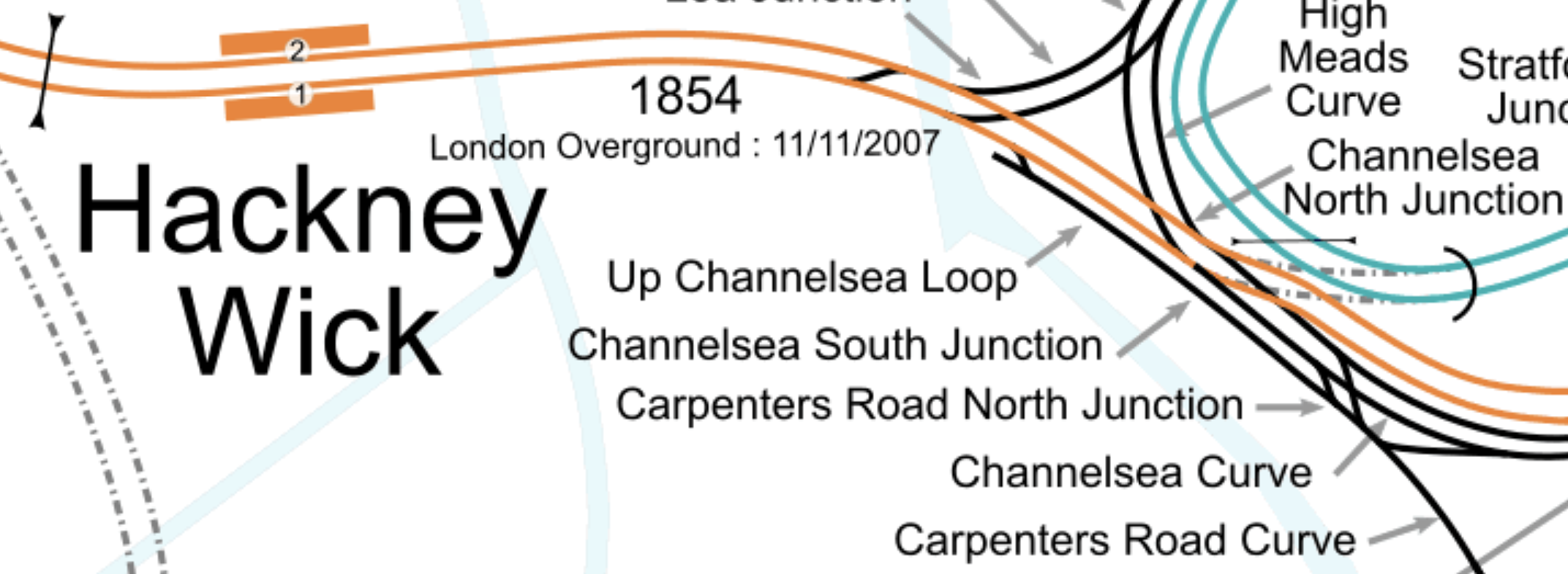
Note.
- The orange tracks are the North London Line and are used by the London Overground and freight trains.
- The Up Channelsea Loop to the South-West of the North London Line.
- The Up Channelsea Loop has connections to both directions of the Great Eastern Main Line at its South-Eastern end.
- Carpenters Road North junction would appear to connect Liverpool Street station to the High Meads curve, so that empty stock can be moved to and from the sidings at Orient Way.
- I would expect that any train waiting in the Up Channelsea Loop can’t overhang Carpenters Road North junction, as this would block the empty stock movements between Liverpool Street and Orient Way sidings.
This Google Map shows the South-Eastern end of the Up Channelsea Loop.
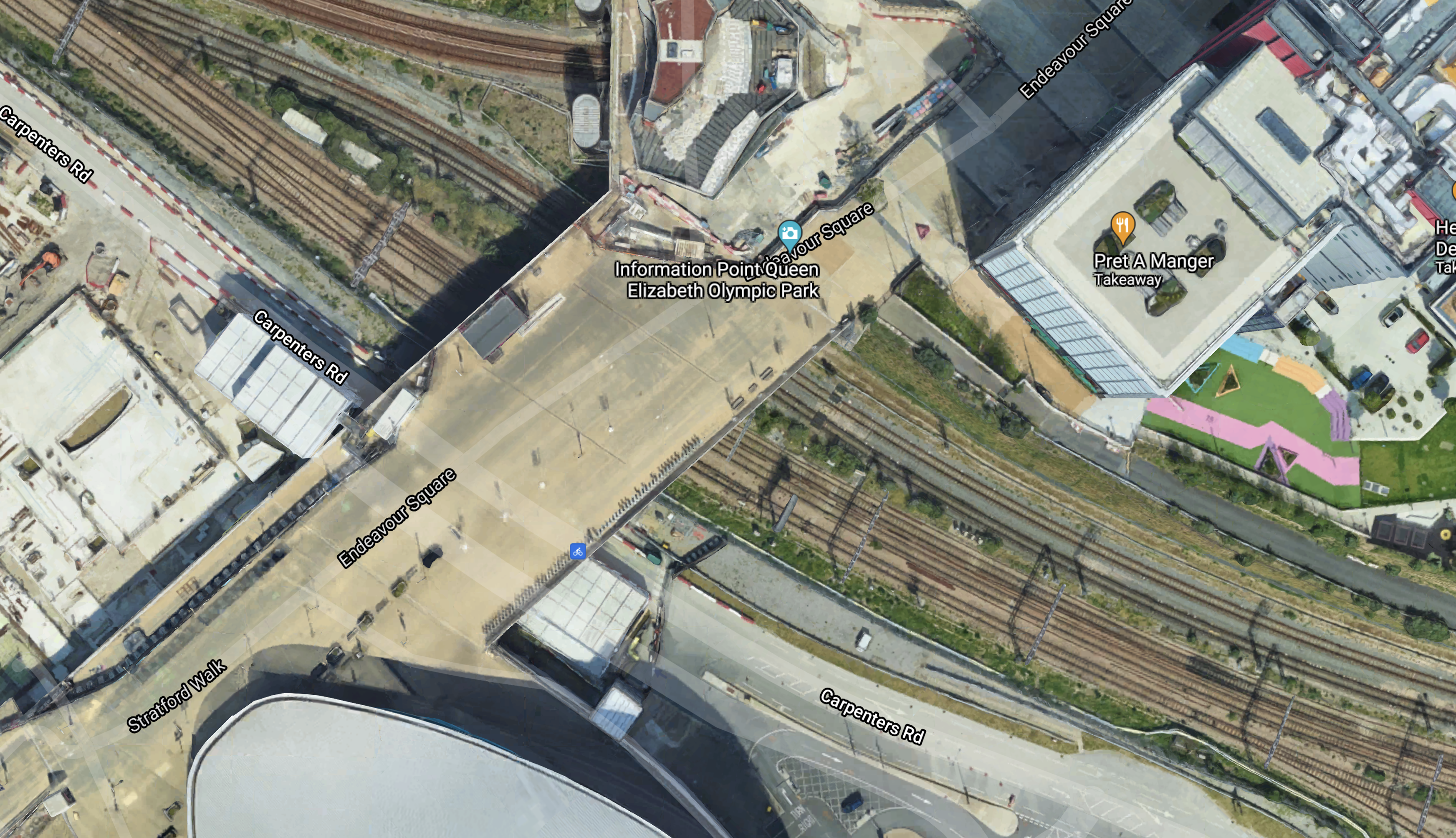
Note.
- The bridge over the tracks is the main access to the Olympic Park.
- I have arranged that the Up Channelsea Loop runs between the North-West and South-East corners of the map.
- The two tracks to access the Up Channelsea Loop join in the South-East corner of the map.
- The crossover to the North of the bridge is part of Carpenters Road North junction.
I would estimate that freight trains waiting in the Up Channelsea Loop can’t be closer than about thirty metres from the bridge.
This second Google Map shows what I suspect is the usable section of the Up Channelsea Loop.
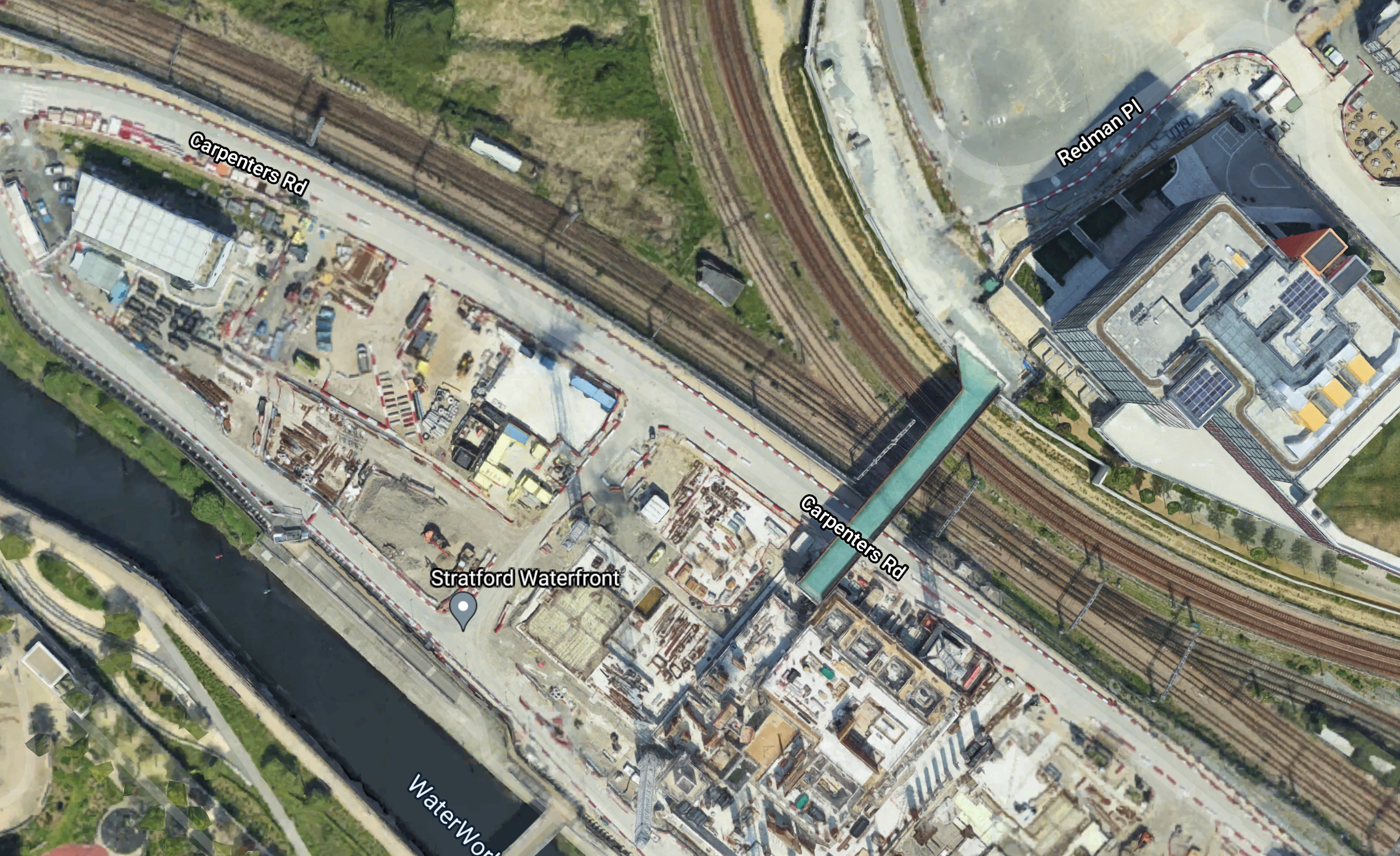
Note.
- I have arranged the North-Western corner of the map over the buffer stops at the end of the Up Channelsea Loop.
- The South-Eastern corner is at the lower limit of the Up Channelsea Loop.
- I estimate that the usable length of the current Up Channelsea Loop is six hundred metres at most.
This third Google Map shows the Northern end of the Up Channelsea Loop.
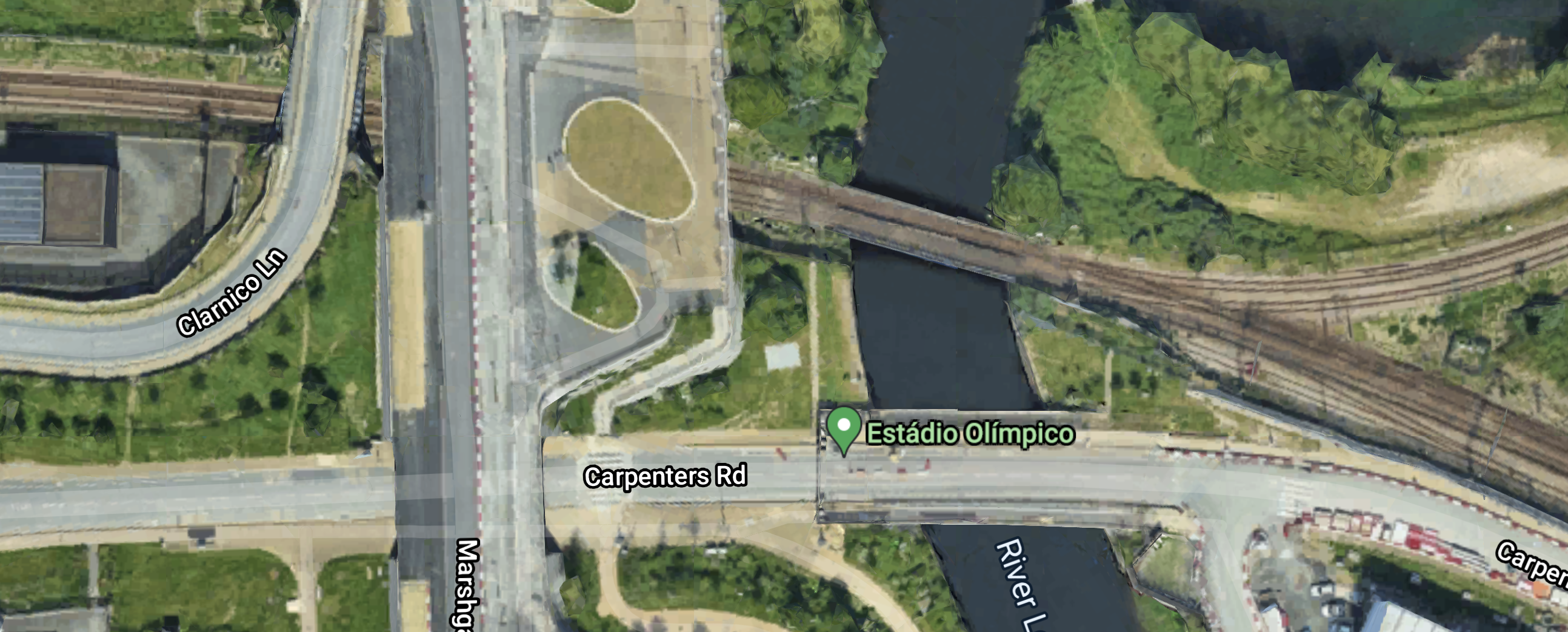
Note.
- The crossover so trains can leave the Up Channelsea Loop in the South-East corner of the map.
- There is a red buffer stop on the end of the loop.
I feel they will certainly have to bridge the River Lea, if the Up Channelsea Loop is going to be lengthened to the North-West.
Perhaps this fourth Google Map, that shows a 3D view of the area from the West.
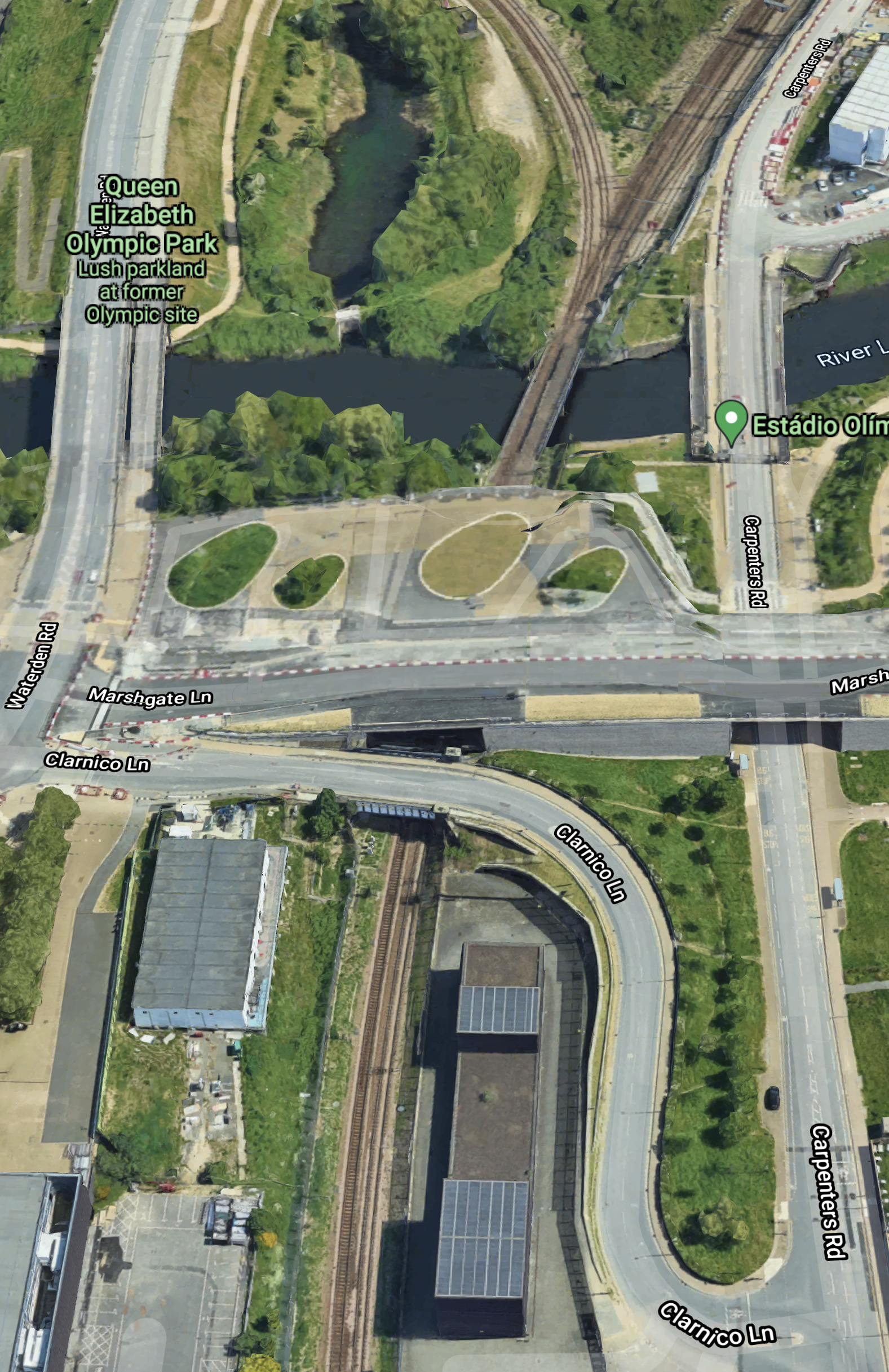
Note.
- Is there a tunnel under Marshgate Lane that can take three tracks.
- There could be space to extend the Up Channelsea Loop over the River Lea and alongside the long building, which is the Energy Centre for the site.
- There might even be a bit more space to create a fast exit from the Up Channelsea Loop.
If the Up Channelsea Loop is going to extend this far, then it looks like it has been planned for some time.
I took these pictures as I approached Stratford station.
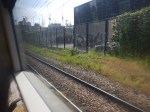


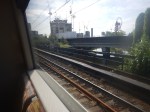
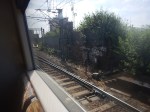

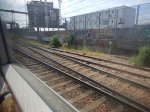
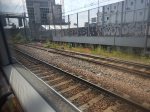


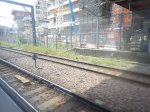
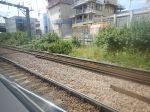

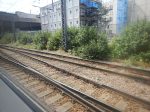
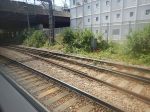

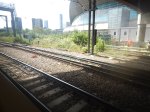
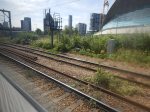

Note.
- The Up Channelsea Loop is the track furthest away to the right.
- The red buffer stop can be picked out.
- I started taking pictures alongside the Energy Centre.
- I think that the short tunnel between the Energy Centre and the River Leacan handle three tracks.
It looks to me, that provision was made for lengthening the Up Channelsea Loop, when these tracks were laid.
Conclusion
I think it is going to be a tight fit to extend the Up Channelsea Loop by sufficient length to handle the longest freight trains.
But it should be possible.
Related Posts
These are related posts about the London Rail Freight Strategy (LRFS).
Decarbonisation Of London’s Freight Routes
East Coast Main Line South Bi-Directional Capability
Gauge Improvements Across London
Headway Reductions On The Gospel Oak To Barking, North London and West London Lines
Heavy Axle Weight Restrictions
Kensal Green Junction Improvement
Longhedge Junction Speed Increases
Moving The West London Line AC/DC Switchover To Kensington Olympia
Moving The West London Line AC/DC Switchover To Shepherd’s Bush
Doubling Harlesden Junction
London has a rail capacity problem, for both freight and passenger trains.
This report from Network Rail is entitled The London Rail Freight Strategy (LRFS).
One of the secondary recommendations of the report is to double Harlesden Junction. It says this about the doubling.
At present, several Goods lines from the direction of Wembley Yard converge into a single lead through Harlesden Junction, the connection to the City lines, from which the North London Line is accessed. This represents a bottleneck where trains are unable to pass in each direction simultaneously. Conceptual design work for the LRFS has identified that the bridge span immediately above the junction, which the two West Coast Main Line Slow lines also pass under, formerly accommodated four tracks in total.
Because the City lines extend for a relatively short distance between Harlesden Junction and Kensal Green Junction, a speed increase at Harlesden Junction is necessary in order to align with the uplifted speeds proposed for Kensal Green Junction (see Core Interventions). Upgrading Harlesden Junction is therefore required in order to realise the benefits of the core intervention at Kensal Green Junction. Doubling the junction would further ease the flow of freight trains through this critical connection between the West Coast Main Line and the orbital routes.
This map from cartometro.com shows Harlesden Junction.
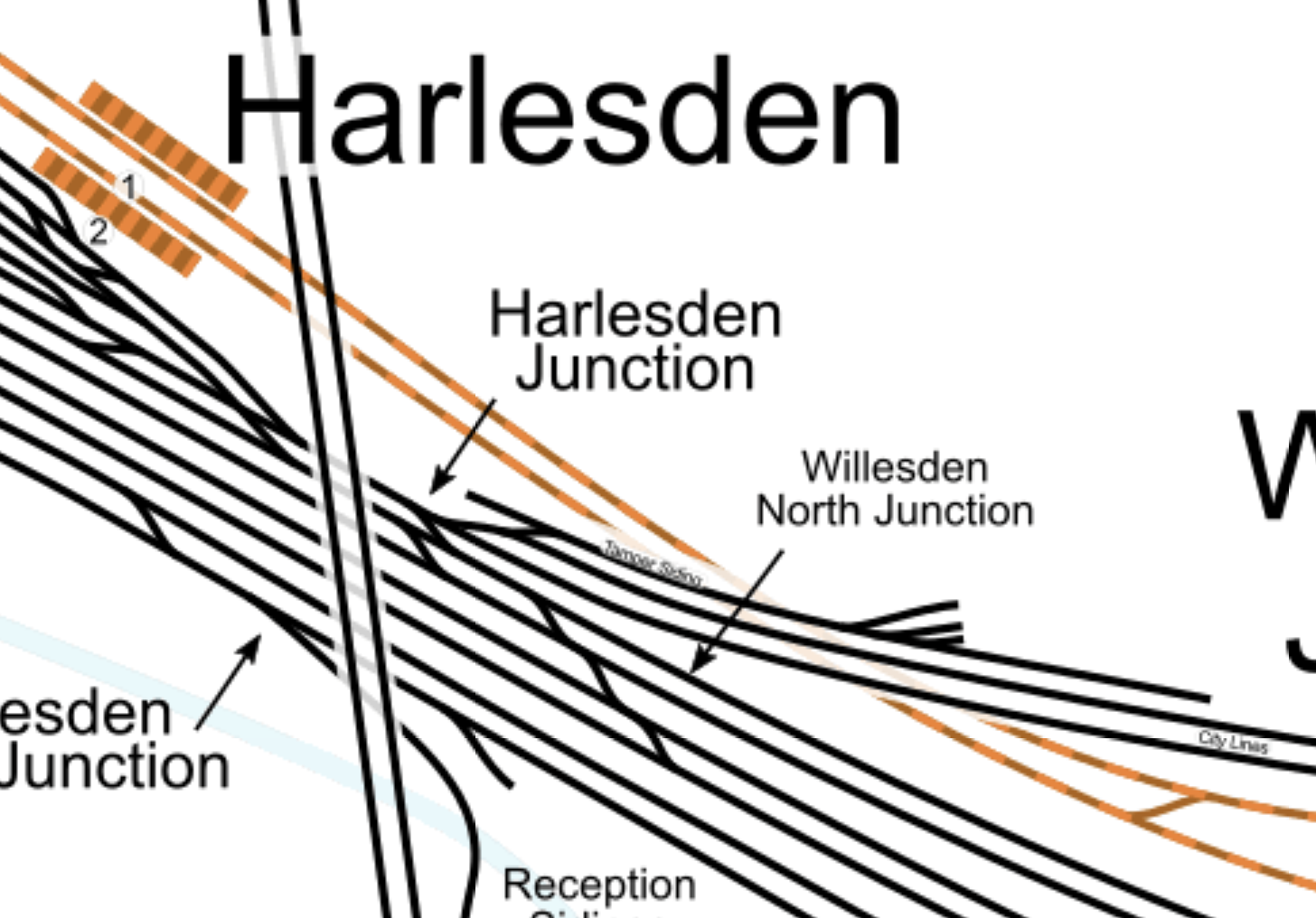
This Google map shows the area.
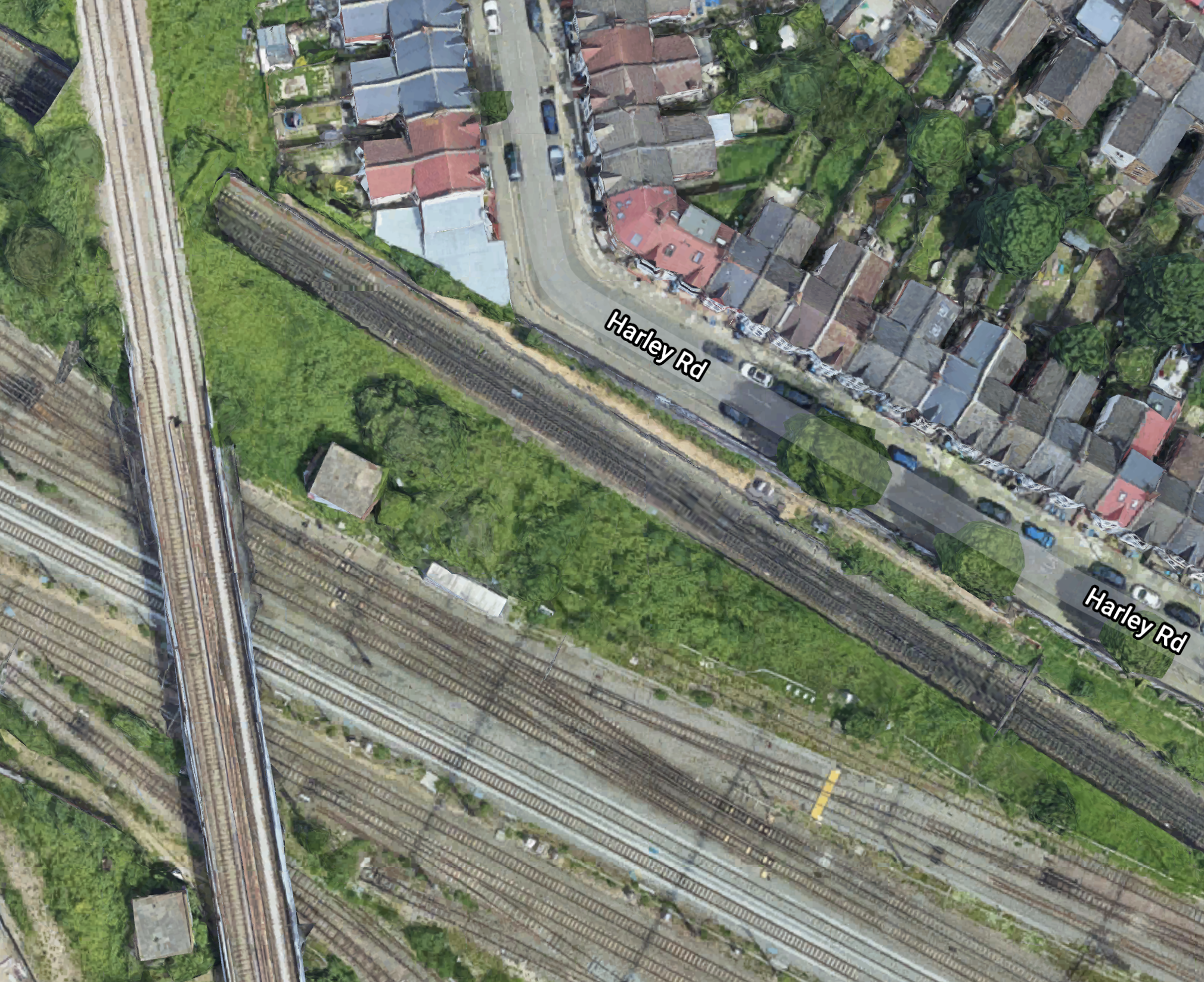
Note.
- The six tracks across the bottom of both maps are the West Coast Main Line.
- The double track rail line going North-South over the West Coast Main Line is the Dudding Hill Line.
- The Northernmost tracks, that go East-West under the Dudding Hill Lines are the combined Watford DC and Bakerloo Lines, which explains their colour in the first map.
- South of these tracks are the City Lines and Harlesden Junction, which connects it to the West Coast Main Line.
This 3D image shows the Harlesden Junction with the Dudding Hill Line over the top, looking from the South-East.
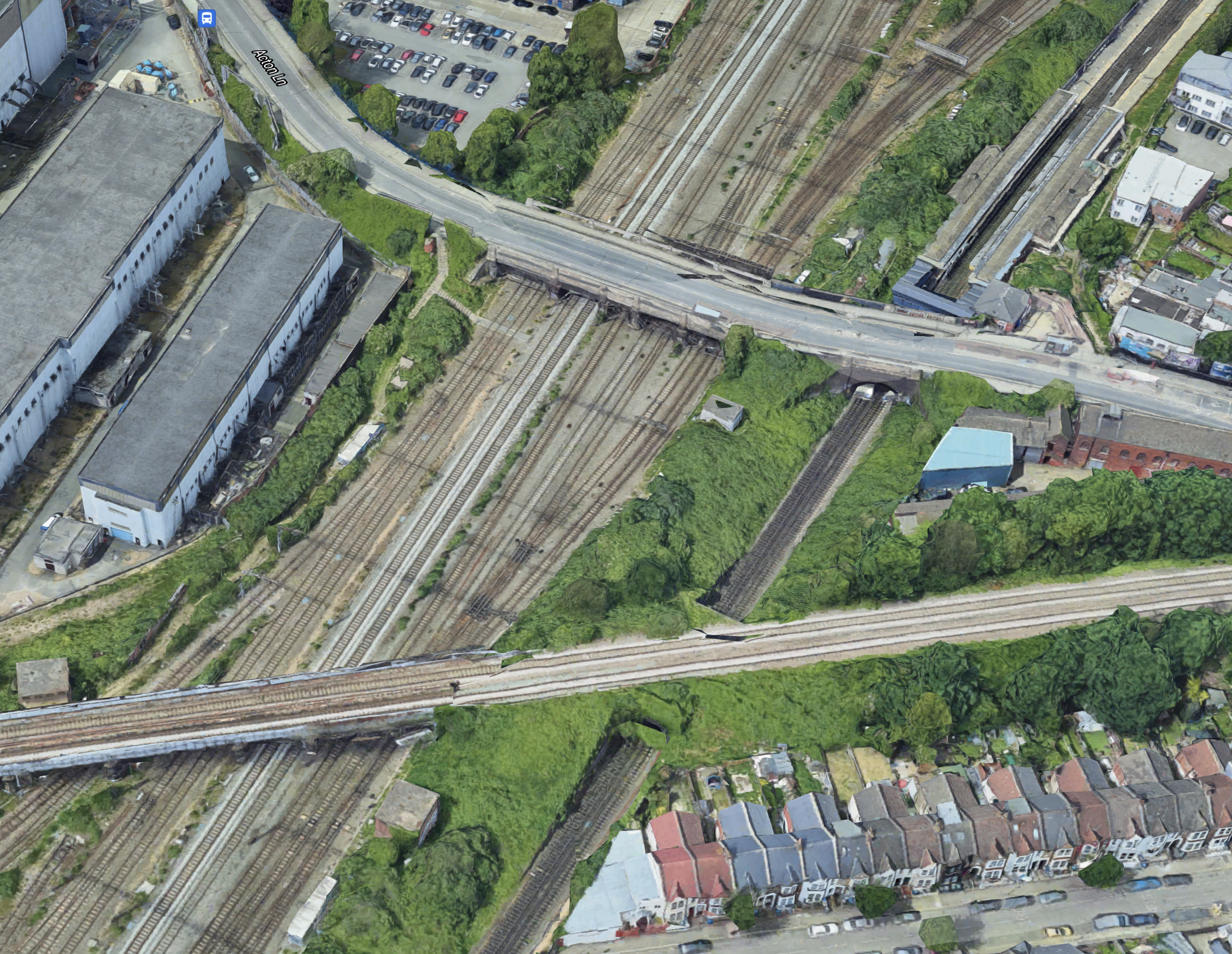
Note that Harlesden station can be seen in the North-East of the map.
There is certainly space in the area to improve the junction.
Conclusion
It strikes me that if you improve Kensal Green Junction, then doubling of Harlesden Junction is needed, to make the most of the investment at Kensal Green.
Related Posts
These are related posts about the London Rail Freight Strategy (LRFS).
Decarbonisation Of London’s Freight Routes
East Coast Main Line South Bi-Directional Capability
Gauge Improvements Across London
Headway Reductions On The Gospel Oak To Barking, North London and West London Lines
Heavy Axle Weight Restrictions
Kensal Green Junction Improvement
Longhedge Junction Speed Increases
Moving The West London Line AC/DC Switchover To Kensington Olympia
Moving The West London Line AC/DC Switchover To Shepherd’s Bush
Stratford Regulating Point Extension
Moving The West London Line AC/DC Switchover To Kensington Olympia
London has a rail capacity problem, for both freight and passenger trains.
This report from Network Rail is entitled The London Rail Freight Strategy (LRFS).
One of the secondary recommendations of the report is to move the switchover between AC and DC power on the West London Line to Kensington Olympia station. It says this about the switchover.
Although moving the changeover to Shepherd’s Bush would eliminate the need for passenger trains to slow down or stop at North Pole Junction, electrically hauled freight trains will still need to switch power supply modes whilst moving, wherever the AC/DC interface is located.
Due to the substantial incline facing trains running northward on the WLL, which increases in severity towards the Willesden end of the route, it would be preferable for the changeover to be made as far south as possible. This would enable freight trains to slow down to switch traction before reaching the worst of the gradient, giving them a much better chance of regaining line speed once drawing power from the OLE.
Although Kensington Olympia is less than a mile to the south of Shepherd’s Bush, the intervening route section is almost entirely level, with the incline commencing just before Shepherd’s Bush station and continuing to rise sharply along the rest of the WLL. The capacity and performance benefits of relocating the changeover are therefore likely to be greater if the overhead wires are extended to Kensington Olympia, removing the risk to traffic flow that would remain if freight trains were forced to switch whilst running uphill.
This would prepare the West London Line for the transition to electric freight that will be necessary as part of the decarbonisation of the railway over the next thirty years.
Resolving the current traction changeover issues for freight as well as passenger trains would support this transition by encouraging freight operators to invest in electric locomotives to run on the orbital routes, in the confidence that this constraint has been addressed.
I covered this recommendation in Moving The West London Line AC/DC Switchover To Shepherd’s Bush, as so many arguments are the same about the two stations.
This was my conclusion in the related post.
I believe, as probably do Network Rail, that Kensington Olympia station should be the station, where the switchover occurs.
I did add a caveat, that it is probably all down to money.
Related Posts
These are related posts about the London Rail Freight Strategy (LRFS).
Decarbonisation Of London’s Freight Routes
East Coast Main Line South Bi-Directional Capability
Gauge Improvements Across London
Headway Reductions On The Gospel Oak To Barking, North London and West London Lines
Heavy Axle Weight Restrictions
Kensal Green Junction Improvement
Longhedge Junction Speed Increases
Moving The West London Line AC/DC Switchover To Shepherd’s Bush
Stratford Regulating Point Extension
 The Anonymous Widower