Hardly Any Passengers – But Greater Anglia’s Trains Are More Reliable
The title of this post is the same as that of this article on the Great Yarmouth Mercury.
This is the introductory paragraph.
It may be operating fewer trains and carrying a fraction of the passengers it was – but Greater Anglia’s trains are now much more reliable for essential workers, figures show.
Greater Anglia’s most punctual route was Manningtree to Harwich at almost 99 %.
Greater Anglia Completes Directly-Managed Norwich Victoria Sidings Project
The title of this post is the same as that of this article on Railway Gazette.
This is the introductory paragraph.
Greater Anglia has opened four sidings able to stable 12-car trains just outside Norwich station, with its first train using the facility on March 3.
Other information can be found in this and other articles.
- It was Greater Anglia’s biggest infrastructure investment to date.
- The sidings are on the South side of the Trowse Swing Bridge, that crosses the River Wensum.
- The project took nine months to complete.
- The sidings look to be fully electrified.
I would assume that each siding can take one of the following.
- A twelve-car Class 745 train, which are 236.6 metres long.
- A ten-car Class 720 train, which are 240 metres long.
- Two five-car Class 720 trains, which are 122 metres long.
- More than one Class 755 trains, which are 65 metres long (3-car) and 81 metres long (4-car)
They will certainly be able to pack in the trains.
Testing Of Greater Anglia’s New Electric Trains Continues Amid Coronavirus Outbreak
The title of this post is the same as that of this article on itv.com.
These are the first paragraphs of the report.
Greater Anglia is continuing to test it’s new electric trains amid the coronavirus outbreak.
The company says they are following all government guidelines to ensure that the workforce is kept as safe as possible.
One of the new electric trains completed its maiden voyage to Liverpool Street recently – a journey the company says was a success.
Hopefully, the testing program won’t be delayed too long.
LNER To Keep Class 91s Until 2023
The title of this post is the same as that of this article on Rail Magazine.
This is the two introductory paragraphs.
Class 91s hauling Mk 4s will remain with London North Eastern Railway until 2023.
Ten rakes of coaches and ten ‘91s’ will be used, with two additional spare ‘91s’ and a handful of spare Mk 4s also retained.
It looks like LNER are keeping enough Class 91 locomotives and Mark 4 coaches to guarantee having ten trains in service.
Why 2023?
The answer to this question is probably contained in an article in Issue 901 of Rail Magazine, which is entitled ORR Approves New Hitachi Inter-Car Connector Design, which has these two statements.
- All inter-car connectors will have been updated by Summer 2022.
- Hitachi has deals for a further 61 trains for three operators and all will be in traffic by the end of 2022.
It looks like Hitachi could have production capability from 2023.
The original Rail Magazine article also says this.
The extension is until the end of 2023 while LNER sources brand new trains, which would take a minimum of around two years to build and deliver. The operator has previously told RAIL it needs around six new trains.
It appears the difference between retaining ten InterCity 225 trains and adding six new trains to the fleet, is to cover for the retrofit of the inter-car connectors.
The Performance Of A Class 91 Locomotive And Five Mark 4 Coaches
I have seen in mentioned that Virgin East Coast were intending to run shortened rakes of Mark 4 coaches.
In the Wikipedia entry for the Class 91 locomotive, there is a section called Speed Record, where this is said.
A Class 91, 91010 (now 91110), holds the British locomotive speed record at 161.7 mph (260.2 km/h), set on 17 September 1989,[ just south of Little Bytham on a test run down Stoke Bank with the DVT leading. Although Class 370s, Class 373s and Class 374s have run faster, all are EMUs which means that the Electra is officially the fastest locomotive in Britain. Another loco (91031, now 91131), hauling five Mk4s and a DVT on a test run, ran between London King’s Cross and Edinburgh Waverley in 3 hours, 29 minutes and 30 seconds on 26 September 1991. This is still the current record. The set covered the route in an average speed of 112.5 mph (181.1 km/h) and reached the full 140 mph (225 km/h) several times during the run.
When you consider, this was nearly forty years ago, there can’t be much wrong with British Rail’s train engineering.
What Average Speed Do You Need To Achieve London And Edinburgh In Four Hours?
The rail distance between London and Edinburgh is 393 miles, so four hours needs an average speed of 98 mph.
Consider.
- I have travelled in InterCity 125 and InterCity 225 trains, where I have measured the speed at around 125 mph for perhaps thirty or forty miles.
- In Norwich-In-Ninety Is A Lot More Than Passengers Think!, I travelled to Norwich and back, at around 100 mph most of the way.
- Continuous 125 mph running is just as much about the track as the train.
- I have watched a driver in an InterCity 125 at work and these guys and girls know the route and their charges, like the backs of their hands.
I think it is possible to arrange train pathing, so that trains could run between London and Edinburgh in excess of 100 mph.
I believe, that this would enable London and Edinburgh in under four hours.
Will LNER Run Faster Services With Short Sets?
Virgin East Coast’s original plan, was to run short sets between London and Edinburgh.
Would these short sets have been faster, than full size sets?
- The power-to-weight ratio is higher, so acceleration would be better.
- A five-car train would probably need half the power of a ten-car train to cruise at a given speed.
- It might be possible to save weight to increase performance.
- There would be no intermediate stops.
- They know that the Kings Cross and Edinburgh record is three-and-a-half hours, which was set by a five-car train.
- In-cab digital signalling and other improvements could be fitted.
It should also be noted, that a short set would probably do significantly less damage to the track than a full-size set at 140 mph.
Possible Short InterCity 225 Routes
LNER have only six fully-electrified routes, where they could run short InterCity 225 sets.
- Kings Cross and Leeds
- Kings Cross and Doncaster
- Kings Cross and York
- Kings Cross and Newcastle
- Kings Cross and Edinburgh
- Kings Cross and Stirling
Note.
- All routes are fully-electrified, which is a pre-requisite, as InterCity 225 sets have no self-power capability.
- Kings Cross and Leeds will probably be run by pairs of Class 800 trains, as LNER looks like it will split trains at Leeds and serve two destinations.
- Do Doncaster, York and Newcastle generate enough traffic for a fast service?
- The Edinburgh route will have direct competition from East Coast Trains, who will be running five-car Class 803 trains.
- The Stirling route at over five hours is probably too long.
It looks to me, that the preferred route for InterCity 225 sets,; short or full-size will be Kings Cross and Edinburgh.
How Many Trains Would Be Needed To Run An Edinburgh Service?
A flagship service between London and Edinburgh might have the following timetable.
- One tph perhaps leaving at a fixed time in every hour.
- A timing of under four hours.
- Minimal numbers of intermediate stops.
- The service would not be extended past Edinburgh, as the trains need electrified lines.
Suppose, the trains could do a round trip in eight hours, this would mean that eight trains would be needed to provide a service.
Ten trains would allow one train in maintenance and one ready to be brought into service at a moment’s notice.
Does this explain, why ten InterCity 225 sets are being retained.
Would In-Cab Signalling Be Needed?
I suspect that under current rules, in-cab digital signalling might be needed! But as I observed in Partners On Board For In-Cab Signalling Project On East Coast Main Line, this is on its way!
But, as the average speed needed to do London and Edinburgh in four hours is only 98 mph, I wonder what time could be achieved by one of the top drivers, using the following.
- All their route knowledge and driving skill.
- A five-car train.
- Maximum acceleration.
- A well-thought out pathing structure.
- A clear track
- No hold-ups
- A non-stop run.
If the train were to run at 125 mph all the way without stopping, the journey time would be around three hours and ten minutes.
Wikipedia says this about in-cab digital signalling on the East Coast Main Line.
The line between London King’s Cross and Bawtry, on the approach to Doncaster, will be signalled with Level 2 ERTMS. The target date for operational ERTMS services is December 2018 with completion in 2020.
- I estimate that that this will mean that 145 miles of the route will have full in-cab digital signalling.
- Currently, the fastest London and Doncaster times are around 90 minutes, with many taking 97-98 minutes for the 155 miles.
This means the fast train takes 84 minutes between King’s Cross and Bawtry, at an average speed of 103 mph.
Suppose this fast train could go at 125 mph for all but twenty of the distance between King’s Cross and Bawtry, how much time would this save?
- 125 miles at 125 mph would take 60 minutes.
- 125 miles at 103 mph would take 72 minutes.
This means that just by running at 125 mph continuously for all but twenty miles could save up to twelve minutes.
If 140 mph running could be maintained on this section, another six minutes would be saved.
As they say, every little helps!
Lessons From Norwich-in-Ninety
In Norwich-In-Ninety Is A Lot More Than Passengers Think!, I travelled to Norwich and back, at around 100 mph most of the way.
Liverpool Street and Norwich is 114 miles and a ninety minute journey is an average of just 76 mph, which is 24 mph below the maximum cruise of a Class 90 locomotive and a rake of eight Mark 3 coaches. Compare this with an average speed of 98 mph needed for London and Edinburgh in four hours and the 125 mph maximum certified cruise of an InterCity 225 train, without in-cab digital signalling.
It should also be noted that Greater Anglia, run an additional stopping train after the Norwich-in-Ninety expresses, that call at several important stations and not just Ipswich.
Will LNER use a similar strategy? It was working well and successfully for Greater Anglia, until services were decimated by COVID-19!
Will LNER Increase Frequency Between London And Edinburgh To Three Trains Per Hour?
It would seem that the current two tph service running nine- or ten-car trains, runs with a high level of occupancy, so to replace some of these trains with faster and shorter trains might cause capacity problems.
But to add, a third faster train in the hour might be possible. Especially, if the Norwich-in-Ninety strategy were to be used. The timetable in both directions could be something like.
- XX:00 – Four hour express
- XX:06 – Four-hour plus train to current timing
- XX:30 – Four-hour plus train to current timing
LNER’s Marketing Department would like it.
Could Hitachi Trains Achieve London and Edinburgh In Four Hours?
The all-electric Class 801 trains most certainly have a performance to match an InterCity 225 in terms of acceleration and maximum operating speed without in-cab digital signalling. After all, the Japanese train was designed as a direct replacement for British Rail’s last high performance train!
So I believe that with a well-designed timetable, electric Hitachi trains will be able to run between London and Edinburgh in under four hours, with a small number of stops.
Note that LNER will have a fleet of thirty nine-car and twelve five-car all-electric Class 801 trains.
But East Coast Trains will have a fleet of five five-car all-electric Class 803 trains, which could get near to a four-hour timing, despite their four stops at Stevenage, Durham, Newcastle and Morpeth.
- I have timed a Class 800 train leaving Kings Cross and they get up to 125 mph fairly fast, by about Potters Bar, which is reached in eleven minutes.
- Stops at Stevenage, Durham and Morpeth will probably each add two minutes to the timing, with Newcastle adding five minutes.
- 125 mph all the way from Kings Cross to Edinburgh would be a timing of three hours and ten minutes.
Add up the stationary times at the stops (2+2+2+5) and that gives a journey time of three hours and twenty-one minutes, which leaves thirty-nine minutes for the five decelerations and accelerations between stationary and 125 mph.
This page on the Eversholt Rail web site, has a data sheet for a Class 802 train, which is a Class 800 train with larger engines.
The data sheet shows that a five-car train can accelerate to 125 mph and then decelerate to a stop in six minutes in electric mode. So five accelerations/deceleration cycles to 125 mph would take thirty minutes. This gives a journey time between London and Edinburgh of three hours and fifty-one minutes.
Note that Class 801 trains, which don’t lug diesel engines about will have better acceleration, due to the lower weight, so should have better acceleration and deceleration.
Does this time seem reasonable? First Group with their extensive experience of running Class 800 trains on the Great Western Main Line will know the capabilities of the trains, down to the last mph.
I doubt, they’d have bought the trains for East Coast Trains, if they couldn’t do London and Edinburgh in four hours.
I believe that both InterCity 225 and Class 801/803 trains can do London and Edinburgh in four hours and any train company that doesn’t offer this timing, will come second!
A Possible Hitachi-Based Timetable For LNER
I would be very surprised if a service pattern like this wouldn’t be possible.
- XX:00 – Four hour express – Class 801 train
- XX:06 – Four-hour plus train to current timing – Class 801 train or InterCity 225
- XX:30 – Four-hour plus train to current timing – Class 801 train or InterCity 225
Note.
- As there is only one extra train per hour, ten extra trains would be the addition to the fleet, needed to run this service pattern.
- Class 801 trains could be five-car or nine-car sets as passenger numbers require.
- InterCity 225 trains could be as long as are needed.
InterCity 225 trains would only be doing the job, they’ve done for many years.
Targeting The Airline Market
In Trains Ordered For 2021 Launch Of ‘High-Quality, Low Fare’ London – Edinburgh Service, which described the launch of First East Coast Trains, I said this about their target market.
First East Coast Trains is targeting the two-thirds of passengers, who fly between London and Edinburgh. The company are also targeting business passengers, as the first train arrives in Edinburgh at 10:00. Trains will take around four hours.
Note that currently, LNER’s first train arrives at 11:12. In the future, I would envisage that LNER intend to go for four hour journeys.
It would seem to me, that both train companies will be attempting to take passengers from the airlines.
Conclusion
It looks to me that ten InterCity 225 trains could add a third train in each hour between London and Edinburgh for LNER, that would do the journey in under four hours.
The third train could either be an InterCity 225 or a Class 801 train.
First Of Greater Anglia’s Aventra EMUs On Test
The title of this post, is the same as that of this article on Railway Gazette.
This was the introductory paragraph.
Greater Anglia has begun testing the first of the 111 Aventra 25 kV 50 Hz electric multiple-units being supplied by Bombardier Transportation for its London commuter routes.
Hopefully, we’ll be seeing some of these trains in service this year.
Cambridge South Station To Be Developed
To me, this was one of the highlights of the 2020 Budget today.
As I lived near Cambridge for over a dozen years and regularly played real tennis at the University, I know the scientific heartbeat of the City better than most.
I have discussed the problems of running a business in the City, with many, who are associated with some of the City’s most successful businesses. I have also funded several ventures in the area.
The same basic problems keep arising.
- Lack of premises, offices and workshops, of all sizes and qualities.
- Lack of staff to work in the ventures.
- Lack of suitable housing, where staff moving to the City can live.
- Staff are being forced to live further out and the roads, railways and other pubic transport systems don’t have the capacity.
- Inadequate connections to Stansted Airport.
In the last few years, the transport has improved.
- A sophisticated and award-winning Park-and-Ride running to five large car parks ringing the City has been developed.
- The Park-and-Ride also caters for cyclists.
- Cambridge North station has been opened close to the Cambridge Science Park and the A14 Cambridge Northern By-Pass, with a 450-space car-park and space for a thousand bikes.
- The Cambridge Guided Busway has been developed across the City from Huntingdon station to Trumpington via Cambridge Science Park, Cambridge North station, Cambridge City Centre, Cambridge bus station, Cambridge station and Addenbrooke’s Hospital.
- Addwnbrooke’s Hospital is a Major Trauma Centre.
- The forecourts of Cambridge and Cambridge North stations have been developed to create good interchanges and meeting points.
- Great Northern now has two fast and two stopping trains per hour (tph) between London Kings Cross and Cambridge and/or Cambridge North stations, with trains continuing alternatively half-hourly to Ely or Kings Lynn.
- Thameslink has two tph between Brighton and Cambridge.
- Thameslink also has two tph between Cambridge and London Kings Cross, which will be extended to Maidstone East station, within a couple of years.
- Greater Anglia run an hourly service between Norwich and Stansted Airport via Ely, Cambridge North and Cambridge stations.
- Greater Anglia run two tph between London Liverpool Street and Cambridge North stations.
- Greater Anglia run an hourly service between Ipswich and Cambridge via Bury St. Edmunds and Newmarket stations.
- All Greater Anglia trains are being replaced with new and much larger Class 755 or Class 720 trains.
- CrossCountry run an hourly service between Birmingham New Street and Stansted Airport via Peterborough, March, Ely, Cambridge North and Cambridge stations.
- The A14 and A428 roads are being improved between Cambridge and the A1.
- The East West Railway between Reading and Cambridge via Oxford, Milton Keynes and Bedford is being developed and should open before the end of the decade.
But Cambridge still needs better links to the surrounding countryside and further.
- Connections to Peterborough could be doubled to hourly.
- Cnnections to Haverhill and Wisbech are poor.
- East West Railway have ideas about improving connections to both East and West of Cambridge.
- Better connections are needed at Addenbrooke’s to connect the rail system to the hospital and the Cambridge Biomedical Campus.
Cambridge South station would be the icing on the cake.
- It could be the Southern terminus of a Wisbech service.
- It could be on a service of at least four tph between Ely and Cambridge South stations via Waterbeach, Cambridge North and Cambridge stations.
- It would bring Addenbrooke’s and the Cambridge Biomedical Campus within easy commuting of London.
- It would be well-connected to Bedford, London, Milton Keynes, Oxford, Reading, Stansted Airport and Stevenage.
- There have also been rumours, that the station could be connected to the Cambridge Autonomous Metro, which would be developed from the Cambridgeshire Guided Busway and the Park-and-Ride.
Cambridge South station would be the hub, that ties all the various routes together,
The station could be a fairly simple station to build, by just building platforms and buildings alongside the existing electrified line.
This Google Map shows the hospital. and the West Anglia Main Line running North-South to the West of the hospital.
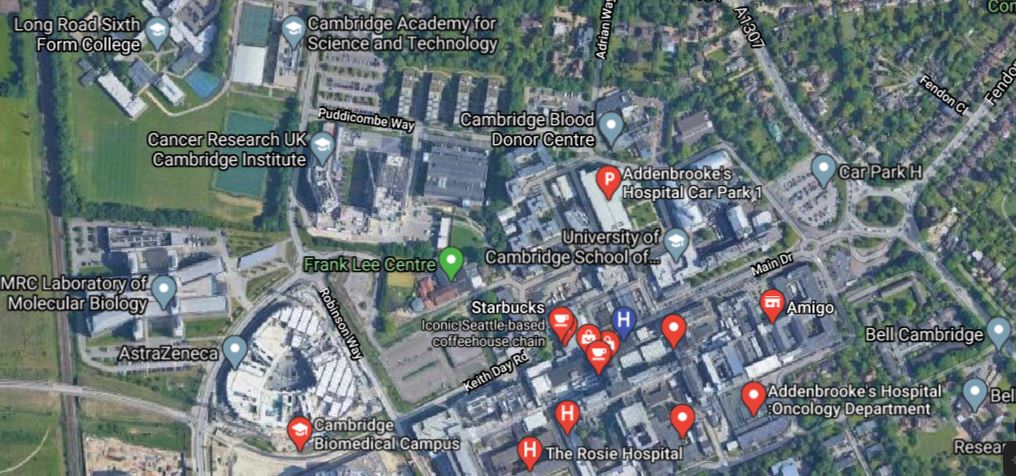
Note the West Anglia Main Line running North-South to the West of the hospital.
Station Design
This page on the Network Rail web site gives a basic design.
- Four platforms with step-free access via a footbridge and lifts;
- Platforms with seating and shelter for waiting passengers;
- A ticket office and ticket machines, along with automatic ticket gates;
- Taxi and passenger drop off facilities:
- Facilities such as a retail/catering unit, a waiting room and toilets;
- Blue badge parking; and
- Cycle parking.
The page then gives various location options.
Services
These are my take on the initial services, based on the current ones and those proposed by the East West Railway.
- 1 tph – CrossCountry – Birmingham New Street and Stansted Airport, via Coleshill Parkway, Nuneaton, Leicester, Melton Mowbray, Oakham, Stamford, Peterborough, March, Ely, Cambridge North, Cambridge, Cambridge South and Audley End.
- 1 tph – Greater Anglia – Norwich and Stansted Airport, via Wymondham, Attleborough, Thetford, Brandon, Lakenheath, Ely, Cambridge North, Cambridge, Cambridge South, Whittlesford Parkway and Audley End.
- 1 tph – Greater Anglia – Ipswich and Cambridge South via Needham Market, Stowmarket, Bury St. Edmunds, A14 Parkway, Newmarket and Cambridge.
- 2 tph – Greater Anglia – Cambridge North and London Liverpool Street via Cambridge, Cambridge South, Audley End, Bishops Stortford, Harlow, Broxbourne and Cheshunt.
- 1 tph – Greater Anglia – Wisbech and Cambridge South via March, Ely, Cambridge North and Cambridge.
- 2 tph – Thameslink – Cambridge and Brighton via Stevenage, London St. Pancras, East Croydon and Gatwick Airport.
- 2 tph – Thameslink – Cambridge and Maidstone East via Stevenage, London St. Pancras and Blackfriars
- 2 tph – Great Northern – Ely/Kings Lynn and London Kings Cross via Stevenage.
- 1 tph – East West Railway – Norwich and Reading or Oxford, via Ely, Cambridge North, Cambridge, Cambridge South, Bedford and Milton Keynes.
- 1 tph – East West Railway – Manningtree and Reading or Oxford, via Ipswich, Needham Market, Stowmarket, Bury St. Edmunds, A14 Parkway, Newmarket, Cambridge, Cambridge South, Bedford and Milton Keynes
Note.
- I have left out a few less important stations.
- I have extended the current Ipswich and Cambridge service to Cambridge South.
- I have added East West Rail’s proposed A14 Parkway station.
- I have added a Wisbech and Cambridge South service.
This simple service gives the following frequencies.
- 6 tph – Ely and Cambridge North
- 8 tph – Cambridge North and Cambridge
- 10 tph – Cambridge and Cambridge South
- 2 tph – Cambridge/Cambridge South and Stansted Airport
- 1 tph – Cambridge North/Cambridge/Cambridge South and Kings Lynn
- 8 tph – Cambridge/Cambridge South and London
- 2 tph – Cambridge/Cambridge South and Ipswich.
- 2 tph – Cambridge North/Cambridge/Cambridge South and Norwich.
- 1 tph – Cambridge North/Cambridge/Cambridge South and Peterborough.
- 6 tph – Cambridge/Cambridge South and Stevenage.
I feel strongly about the following.
- If six tph is thought to be ideal between Cambridge/Cambridge South and Stevenage, then surely more services are needed between Cambridge and Ipswich, Kings Lynn, Norwich. Peterborough and Stansted Airport. Perhaps as many as four tph are needed to give a Turn-Up-And-Go service.
- The frequency through Ely, Cambridge North, Cambridge and Cambridge should be as high as possible. With digital signalling ten tph must be possible.
At least Greater Anglia have plenty of Class 755 trains.
Conclusion
Rishi Sunak is right to build Cambridge South station.
You might even be able to argue, that the work done on the Cambridge Biomedical Campus could be key in fighting diseases like the coronavirus.
Cambridge To Ipswich In A Class 755 Train
Because of the usual buses on the Great Eastern Main Line, to get to the football at Ipswich, I went via Cambridge and had a drink with a friend in the City.
The journey is timetabled to take seventy five minutes with seven or eight intermediate stops.
These were my observations.
- We arrived in Ipswich a couple of minutes late.
- At times the train was travelling at 75 mph.
- The operating speed is given in Wikipedia as 40-75 mph.
- Some stops were executed from brakes on to brakes off in around thirty seconds.
- I wasn’t sure, but the pantograph may go up and down at Stowmarket, depending if the train is going East or West.
- Cambridge to Stowmarket averaged 43 mph, whereas Stowmarket to Ipswich averaged 48 mph, which would seem to indicate use of the electrification.
I suspect that there isn’t much room to speed up the service, especially as the current 75 minutes gives a convenient turnround with a round trip of three hours.
Which means three trains are needed for the hourly service.
Surprise
What surprised me was the timing of the station stops.
As I said, some were around thirty seconds, with the longest at Stowmarket, where I assume the train picked up the electrification.
It certainly shows how modern trains can do station stops fast.
Ready To Charge
The title of this post is the same as that of this article in Issue 898 of Rail Magazine.
This is the sub-title of the article.
Vivarail could be about to revolutionise rail traction with its latest innovation
The article details their plans to bring zero-carbon trains to the UK.
These are a few important more general points.
- The diesel gensets in the trains can be eco-fenced to avoid unning on diesel in built-up areas.
- The Transport for Wales trains could be the last Vivarail diesel trains.
- A 100 kWh battery pack is the same size as a diesel generator. I would assume they are almost interchangeable.
- Various routes are proposed.
- In future battery trains will be Vivarail’s focus.
- At the end of 2020, a battery demonstration train will be dispatched to the United States.
- Two-car trains will have a forty-mile range with three-cars managing sixty.
- Trains could be delivered in nine to twelve months.
The company also sees Brexit as an opportunity and New Zealand as a possible market.
Modifying Other Trains
The article also states that Vivarail are looking at off-lease electric multiple units for conversion to battery operation.
Vivarail do not say, which trains are involved.
Vivarail’s Unique Selling Point
This is the last two paragraphs of the article.
“Our unique selling point is our Fast Charge system. It’s a really compelling offer.” Alice Gillman of Vivarail says.
Vivarail has come a long way in the past five years and with this innobvative system it is poised to bring about a revolution in rail traction in the 2020s.
Conclusion
Could the train, that Vivarail refused to name be the Class 379 trains?
- There are thirty trainsets of four-cars.
- They are 100 mph trains.
- They are under ten years old.
- They meet all the Persons of Reduced Mobility regulations.
- They currently work Stansted Airport and Cambridge services for Greater Anglia.
- They are owned by Macquarie European Rail.
I rode in one yesterday and they are comfortable with everything passengers could want.

The train shown was used for the BEMU Trial conducted by Bombardier, Network Rail and Greater Anglia.
The only things missing, for these trains to run a large number of suitable routes under battery power are.
- A suitable fast charging system.
- Third rail equipment that would allow the train to run on lines with third-rail electrification.
- Third rail equipment would also connect to Vivarail’s Fast Charge system
As I have looked in detail at Vivarail’s engineering and talked to their engineers, I feel that with the right advice and assistance, they should be able to play a large part in the conversion of the Class 379 fleet to battery operation.
These trains would be ideal for the Uckfield Branch and the Marshlink Line.
If not the Class 379 trains, perhaps some Class 377 trains, that are already leased to Southern, could be converted.
I could see a nice little earner developing for Vivarail, where train operating companies and their respective leasing companies employ them to create battery sub-fleets to improve and extend their networks.
First Time On A Saturday
Yesterday, after a dreadful match at Ipswich, I came back to London in a new Class 745 train.
I have a feeling, this was the first time that the trains have been running with passengers on a Saturday.
They really are seriously good trains!
I shall be interested to see how the number of passengers increase between London and Norwich via Chelmsford, Colchester and Ipswich.
An Open Letter To Jamie Burles Of Greater Anglia
I will open by saying that this letter is not a complaint about your company, as you, like all your passengers and staff are just suffering collateral damage from the overwhelming incompetence of the real culprit.
I have been supporting Ipswich Town, off and on, since my parents retired to Felixstowe around 1960, when the next door neighbour used to take me to Portman Road.
In 2007, after living together in Suffolk for nearly forty years, my wife died of a squamous cell carcinoma of the heart, followed in 2010, by our son, who died at just thirty-seven of pancreatic cancer. I am coeliac and because of all this grief, I neglected my health, which caused me to have a serious stroke. Luckily, the only lasting problem, I suffered was a partial loss of vision, which meant I was unable to drive.
So I sold up in Suffolk and moved back to London, where I had been born in 1947.
For a couple of years, things went well coming out to Ipswich for matches by train. Typically, on a match day I would have a gluten-free lunch in London and catch the reliable 12:30 Norwich express and just arrive in my seat a few minutes before kick-off.
I should note, that there is only one reliable place for a coeliac like myself, who needs gluten-free food to eat in Ipswich and that is Pizza Express. But you can only eat so much pizza! I can get gluten-free sandwiches in Marks and Spencer, but as with the pizza, it means walking to the centre of town and at seventy-two now, that is not such an easy proposition, as it once was.
Over the last six years, the journey has got worse. The much longer journey time on replacement buses, means I can’t eat properly or do any of the other things , I need to do in life on an average Saturday.
Consider.
- Football may be important to me, but it is not that important.
- I should say, that sometimes, I go via Cambridge, when replacement buses are in operation for a change, as I can have a meal in the city with friends or buy sandwiches in the Marks & Spencer in the station.
- In all these years of disruption, it always seems that if Ipswich are at home on the Saturday, there would be a busification of the service, whereas on other Saturdays a full service operated.
When I first started coming out from London to see matches, there were quite a few supporters on the trains from London, including one guy in a wheel-chair. Over the years many seem to have fallen by the wayside, because of the constant disruption.
I had hoped that this season, Network Rail’s deplorable project management of the Great Eastern Main line, which often results in surprise closures, would have been consigned to history.
But if ever, there have been more closures this season and the latest batch of nine closures starting on Saturday, are the last straw as far as I am concerned.
Saturday’s closure was particularly inconvenient, as Kings Cross was closed and the West Anglia Main Line was running a reduced service, so in the end, I had a late breakfast at St. Pancras and took Southeastern Highspeed to Ebbsfleet where a friend and fellow Ipswich season ticket holder, who lives nearby, gave me a lift to the match. The home-to-home round trip , was actually almost as long, as that on the previous Saturday’s trip to Tranmere.
Looking at the next few Saturday Ipswich home games, I see the following.
- Peterborough – 1st February – Normal service (?)
- Burton Albion – 15th February – Buses
- Oxford United – 22nd February – Buses
- Coventry – 7th March – Buses
- Portsmouth- 21th March – Buses
- Rochdale – 18th April – Buses
I probably speak with more authority, than most, as the company I started in Ipswich; Metier Management Systems, is recognised as one of the companies, that changed project management completely, in the last three decades of the twentieth century. At times, half the major projects in the world were being planned and managed by software I wrote in a Suffolk attic.
I rate, Network Rail’s performance over the last few years in the wider UK, as one of the worst project management disasters I have known, alongside Berlin’s Brandenburg Airport, the legendary hospital built the wrong way round, and the Boeing 737 MAX.
 The Anonymous Widower